▲ 생물학적 노화 시계를 늦추는 지중해·MIND 저속노화 식단 / 만인의 탑 DB·컬럼비아대
“몸 천천히 늙는 법은 과연 존재할까?” 기대수명 100세 시대를 맞아 단순히 오래 사는 것을 넘어 질병 없이 젊음을 유지하는 '생물학적 노화(Biological Aging)' 지연에 대한 의학적 관심이 그 어느 때보다 뜨겁습니다. 최근 미국 컬럼비아대학교 메일맨 보건대학원과 로버트 버틀러 노화센터 연구팀은 세계적 의학 학술지 '신경학 연보(Annals of Neurology)'를 통해, 저속노화 식단(MIND 식단)을 철저히 실천할 경우 신체 전반의 DNA 메틸화 노화 속도계인 '더니든페이스(DunedinPACE)'가 현저히 감속되어 전신 생체 나이와 뇌 노화를 극적으로 지연시킨다는 사실을 대규모 임상 코호트로 전격 규명했습니다.
만인의 탑 저속노화 의학 핵심 팩트 브리핑
컬럼비아대 연구팀의 규명: DNA 메틸화 기반 후성유전학적 노화 속도계(DunedinPACE) 실측 결과, MIND 식단 준수군에서 생물학적 노화 속도가 뚜렷하게 감속
뇌 인지 보존 효과의 27%는 '전신 노화 지연': 특정 뇌 영양 공급을 넘어 심혈관·대사계 전신의 세포 노화를 늦춤으로써 생물학적 뇌 나이를 2.5년에서 최대 7.5년 젊게 유지
저속노화 10대 식단 황금률: 푸른 잎채소·베리류·통곡물·견과류·올리브오일의 '5대 필수 섭취'와 단순당·정제곡물·초가공식품·붉은 육류·과다 나트륨의 '5대 철저 절제'
1. 주민등록 나이가 아닌 '생물학적 나이'를 늦추는 식단의 힘
우리가 매일 마주하는 식탁은 단순한 칼로리 공급처가 아니라, 체내 유전자 발현과 세포 노화 속도를 조절하는 가장 강력한 약리학적 제어 장치입니다. 같은 연령대의 성인이라도 어떤 식습관을 유지하느냐에 따라 혈관 탄력도, 면역 세포 기능, 뇌 신경망 유지력에서 극명한 차이를 보입니다. 현대 의학은 이를 단순한 노안이나 체질의 문제가 아닌 '생물학적 노화(Biological Aging)'의 격차로 정의합니다.
미국 컬럼비아대학교 연구진은 수십 년간 축적된 프래밍햄 심장 연구(Framingham Heart Study)의 1,644명 코호트 데이터를 정밀 분석했습니다. 연구진은 혈액 속 DNA 메틸화 패턴을 측정하여 신체 장기들이 얼마나 빠른 속도로 늙어가고 있는지를 보여주는 최첨단 후성유전학적 속도계인 '더니든페이스(DunedinPACE)'를 적용했습니다. 그 결과, 지중해식 식단과 고혈압 예방 대시(DASH) 식단을 결합한 MIND 식단을 충실히 따른 사람들은 노화 속도계가 유의미하게 느려져 전신의 생체 시계가 늦춰지는 놀라운 결과를 보였습니다.
2. 식탁을 채워야 할 5대 항노화 골든 푸드
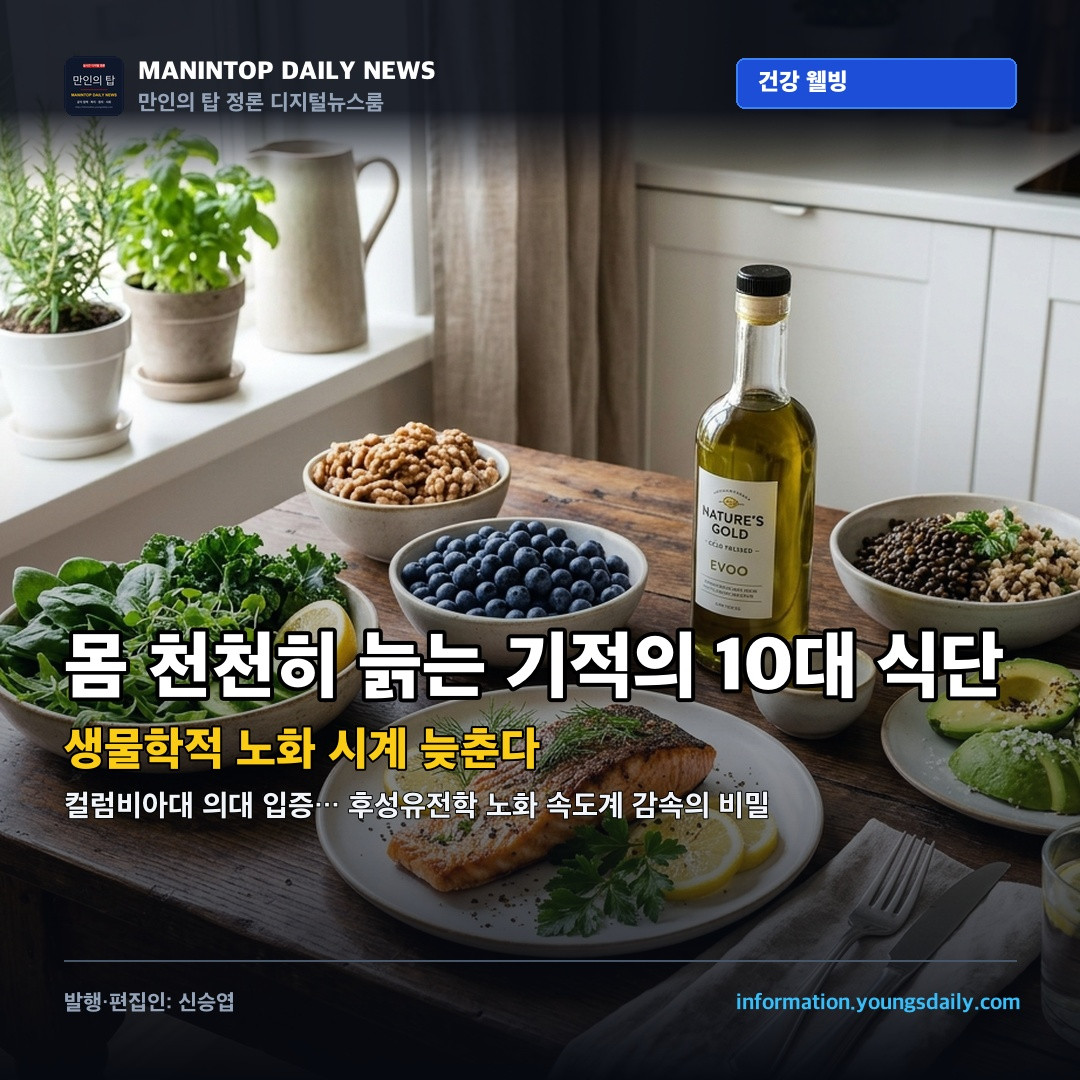
저속노화를 달성하기 위해 가장 먼저 적극적으로 섭취해야 할 핵심 식재료는 세포 손상을 막고 자가포식(Autophagy)을 촉진하는 식품군입니다. 첫째는 시금치, 케일, 깻잎 등 '푸른 잎채소'입니다. 풍부한 엽산과 루테인은 뇌 모세혈관의 산화 스트레스를 억제하여 인지 저하를 방어합니다. 둘째는 '베리류(블루베리, 딸기)'로, 강력한 플라보노이드 항산화 물질이 뇌 신경세포 간 시냅스 신호전달을 보호합니다.
셋째는 현미, 귀리, 렌틸콩, 병아리콩 등 '통곡물 및 콩류'입니다. 혈당을 천천히 올리는 복합 탄수화물과 식이섬유는 장내 유익균의 단쇄지방산(SCFA) 생성을 자극해 전신 미세염증을 차단합니다. 넷째는 호두, 아몬드와 '엑스트라 버진 올리브오일'입니다. 불포화지방산과 올레오칸탈 성분은 혈관 내피세포의 유연성을 유지하고 나쁜 콜레스테롤(LDL)의 산화를 막아냅니다. 마지막으로 오메가-3 지방산이 풍부한 '등푸른 생선(고등어, 연어)'은 심혈관계와 신경계 노화를 동시에 방어합니다.
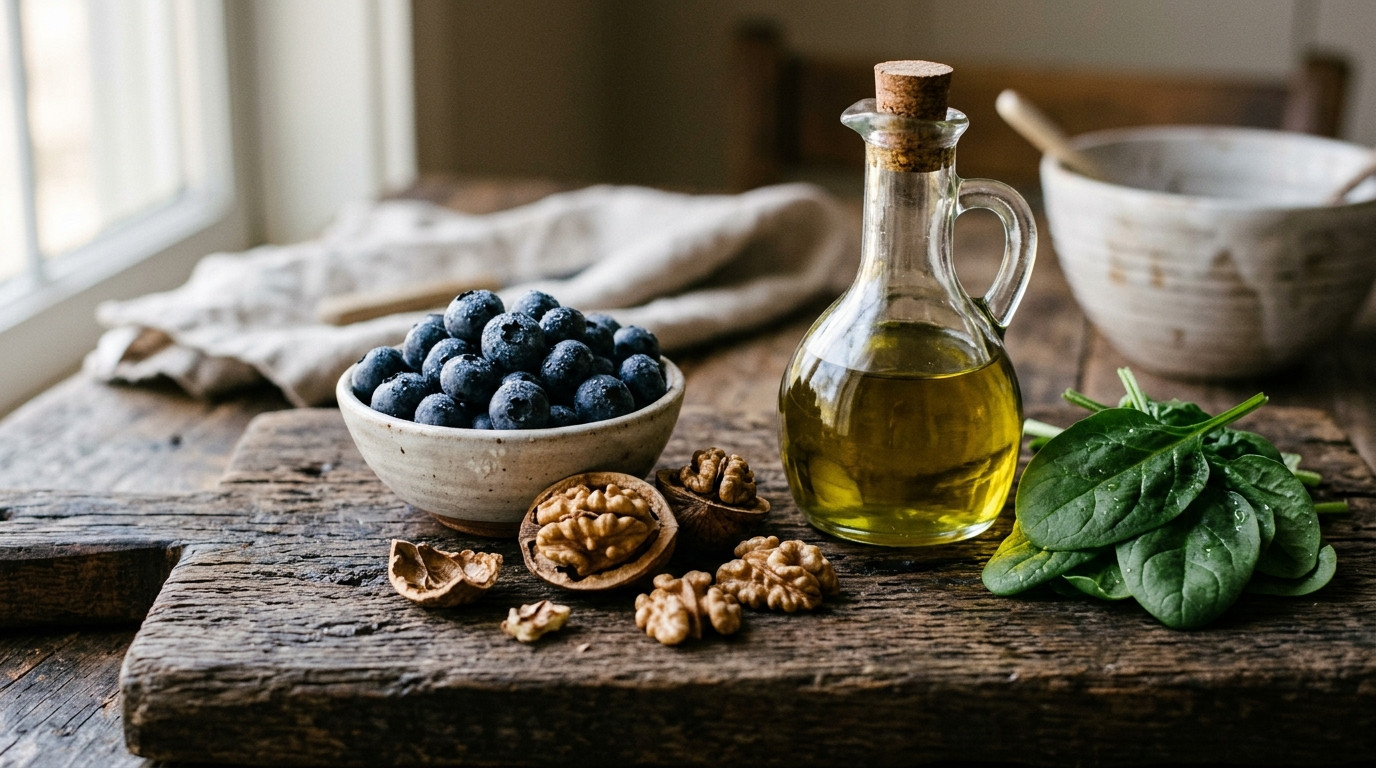
▲ 세포 노화를 늦추는 항산화 베리류와 견과류, 올리브오일 등 저속노화 핵심 슈퍼푸드 / 만인의 탑 DB·컬럼비아대
3. 세포를 태우는 '가속노화 5대 유발원'의 과감한 퇴출
좋은 음식을 먹는 것 이상으로 중요한 것은 세포에 녹이 슬게 만드는 치명적인 가속노화 유발 물질을 식단에서 걷어내는 일입니다. 가장 위험한 적은 탄산음료와 액상과당, 설탕으로 대표되는 '단순당'과 흰쌀밥, 흰 빵, 정제 밀가루 면류 등 '정제 탄수화물'입니다. 이러한 탄수화물은 혈당 스파이크를 일으켜 단백질과 결합, 체내 조직을 딱딱하게 굳히는 '최종당화산물(AGEs, 당독소)'을 대량 생성하여 혈관과 피부 탄력을 파괴합니다.
이어 감자튀김, 인스턴트 스낵 등 '초가공식품 및 트랜스지방'은 체내 면역 체계를 교란해 만성 저강도 염증(Inflammaging)을 유발합니다. 또한 소고기, 돼지고기 등 포화지방이 높은 '붉은 육류와 햄, 소시지 등 가공육'은 장내 유해균에 의해 심혈관 독성 물질인 TMAO를 생성하므로 섭취 빈도를 주 1회 미만으로 최소화해야 합니다. 마지막으로 '과도한 나트륨'은 혈관 내벽을 자극하여 고혈압과 뇌혈관 질환을 앞당기는 핵심 기전입니다.
4. 일상 속 지속 가능한 한국형 저속노화 식단 실천법
노화 속도를 늦추는 식단은 단기간의 다이어트가 아닌 평생의 라이프스타일이어야 합니다. 한국인의 식생활에 맞춰 현실적으로 실천하는 가장 손쉬운 첫걸음은 주식인 밥을 바꾸는 것입니다. 흰쌀의 비율을 줄이고 귀리, 보리, 렌틸콩, 서리태 등을 40~50% 이상 혼합한 '잡곡밥'으로 전환하면 급격한 식후 인슐린 분비를 원천 차단할 수 있습니다.
또한 식사 순서를 '채소 샐러드나 나물 반찬 → 생선·두부 단백질 → 잡곡밥' 순으로 섭취하는 '식이섬유 퍼스트(Fiber-First)' 원칙을 준수하면 혈당 완충 효과가 극대화됩니다. 조리 시에는 버터나 정제 식용유 대신 엑스트라 버진 올리브오일이나 들기름을 적극 활용하고, 소금 간을 줄이는 대신 마늘, 양파, 식초, 레몬즙 등 천연 향신료를 활용하는 것이 혈관과 세포를 젊게 유지하는 지혜로운 비결입니다.
구분
식품군 및 대표 식재료
생물학적 작용 기전
권장 실천 가이드
적극 권장 (5대)
푸른 잎채소, 베리류, 통곡물·콩류, 견과류·올리브유, 생선
DunedinPACE 감속, 항산화 시냅스 보호, SCFA 생성
매일 2회 이상 채소, 주 2회 이상 생선·베리류
철저 절제 (5대)
단순당·음료, 흰쌀·흰밀가루, 초가공식품, 붉은육류·가공육, 고염분
최종당화산물(AGEs) 폭증, 만성 미세염증, TMAO 유발
가공육 전면 배제, 붉은 육류 주 1회 이하로 제한
만인의 탑 보건의학 특별취재팀발행인 겸 편집인: 신승엽 (Seung Youb Ssin)
MANINTOP MEDICAL & WELLNESS · GLOBAL EDITION
How to Decelerate Biological Aging: Ten Evidence-Based Dietary Protocols Proven to Slow Epigenetic Clocks
Reported by Seung Youb Ssin, Ph.D. | Publisher & Editor-in-Chief
Addressing the universal question of how to slow down biological aging, groundbreaking multi-cohort epidemiological research conducted by Columbia University Mailman School of Public Health and the Robert N. Butler Columbia Aging Center, published in the Annals of Neurology, provides empirical proof that sustained adherence to the MIND diet decisively decelerates multi-system biological aging. By utilizing the cutting-edge DunedinPACE epigenetic clock, researchers established that specific dietary patterns directly retard the biological speedometer of human cells, mediating substantial protection against dementia and cardiovascular decay.
Columbia University Epigenetic Validation: High adherence to the MIND diet demonstrates a statistically significant deceleration in the DunedinPACE epigenetic speedometer of biological aging.
Systemic Deceleration Mediates Cognitive Defense: Multi-system biological aging deceleration accounts for 27% of the total protective association between diet and reduced dementia risk, preserving brain age by up to 7.5 years.
Ten Core Anti-Aging Dietary Rules: Active daily inclusion of leafy greens, berries, whole grains, nuts, and extra virgin olive oil, paired with rigorous restriction of refined carbs, ultra-processed foods, red meats, and excess sodium.
1. Decoupling Biological Age from Chronological Time
The daily human diet acts not merely as caloric sustenance, but as a primary epigenetic signaling mechanism dictating genomic expression, mitochondrial integrity, and the multi-system rate of biological aging. While chronological age advances uniformly with the calendar, biological senescence exhibits profound variability driven by nutritional biochemistry, inflammatory signaling, and metabolic homeostasis.
Investigating this phenomenon across 1,644 participants in the Framingham Heart Study, researchers at Columbia University Mailman School of Public Health analyzed blood DNA methylation patterns using the DunedinPACE epigenetic clock. Developed by scientists at Duke University and the University of Otago, DunedinPACE functions as a biological speedometer measuring the instantaneous rate of cellular deterioration. Crucially, subjects with high long-term adherence to the Mediterranean-DASH Intervention for Neurodegenerative Delay (MIND) diet demonstrated a verified deceleration in biological pace, significantly mitigating dementia risk and cardiovascular decay.
2. The Five Pillar Superfoods Decelerating Cellular Senescence
Achieving systemic longevity requires proactive nutritional integration of compounds that stimulate cellular autophagy and neutralize oxidative damage. Foremost among these are dark leafy green vegetables (spinach, kale, Swiss chard), which deliver essential folate, phylloquinone, and lutein to maintain microvascular integrity and cognitive acuity. Second, berries (blueberries, strawberries) supply dense anthocyanin flavonoids that cross the blood-brain barrier to reinforce synaptic plasticity.
Third, whole grains and legumes (quinoa, oats, lentils, chickpeas) furnish low-glycemic complex carbohydrates and prebiotic fiber, fostering short-chain fatty acid (SCFA) production in the gut microbiome to attenuate systemic neuroinflammation. Fourth, raw walnuts, almonds, and extra virgin olive oil provide oleic acid and polyphenols like oleocanthal, protecting endothelial elasticity and inhibiting atherogenic LDL oxidation. Finally, fatty cold-water fish rich in omega-3 eicosapentaenoic acid (EPA) and docosahexaenoic acid (DHA) fortify neuronal membranes and cardiac electrophysiology.
3. Eliminating the Five Accelerators of Metabolic Decay
Equally paramount is the systematic elimination of pro-inflammatory dietary agents that provoke cellular senescence. Primary among these are simple sugars and high-fructose syrups, alongside refined carbohydrates such as white bread, polished rice, and industrial pasta. These rapidly digested starches trigger postprandial glycemic excursions, promoting non-enzymatic glycation that generates Advanced Glycation End-products (AGEs), stiffening vascular architecture and exhausting pancreatic beta cells.
Additionally, ultra-processed foods and industrial trans fats disrupt mucosal gut barriers and perpetuate chronic low-grade sterile inflammation (inflammaging). Furthermore, heavy consumption of red and processed meats (beef, pork, sausages) elevates saturated fat loads and generates pro-atherosclerotic trimethylamine N-oxide (TMAO) through gut microbial metabolization. Lastly, excess dietary sodium accelerates endothelial stiffening, elevating cerebral hypoperfusion risks.
4. Clinical Longevity Architecture: A Sustainable Nutritional Paradigm
Slowing biological aging demands enduring behavioral consistency rather than transient dietary restriction. A primary clinical guideline is the adoption of the Fiber-First sequencing principle: consuming raw leafy salads or steamed vegetables and lean proteins prior to complex carbohydrates. This physiological sequence forms a viscous polysaccharide mesh in the duodenum, blunting glucose absorption kinetics by up to 30%.
Furthermore, replacing butter and hydrogenated seed oils with cold-pressed extra virgin olive oil, while substituting processed condiments with polyphenol-rich spices like garlic, turmeric, and lemon juice, provides continuous biochemical defense. Translating the Columbia University and Framingham epidemiological evidence into daily habit offers individuals an authentic, scientifically authenticated mechanism to decelerate biological senescence and sustain vibrant cognitive longevity.
Dietary Classification
Target Food Groups
Biological Mechanism
Clinical Recommendation
Promoted (Top 5)
Dark leafy greens, berries, whole grains, nuts, olive oil, fish


0 댓글