MANINTOP GLOBAL NEWSROOM · SPECIAL EDITORIAL REPORT
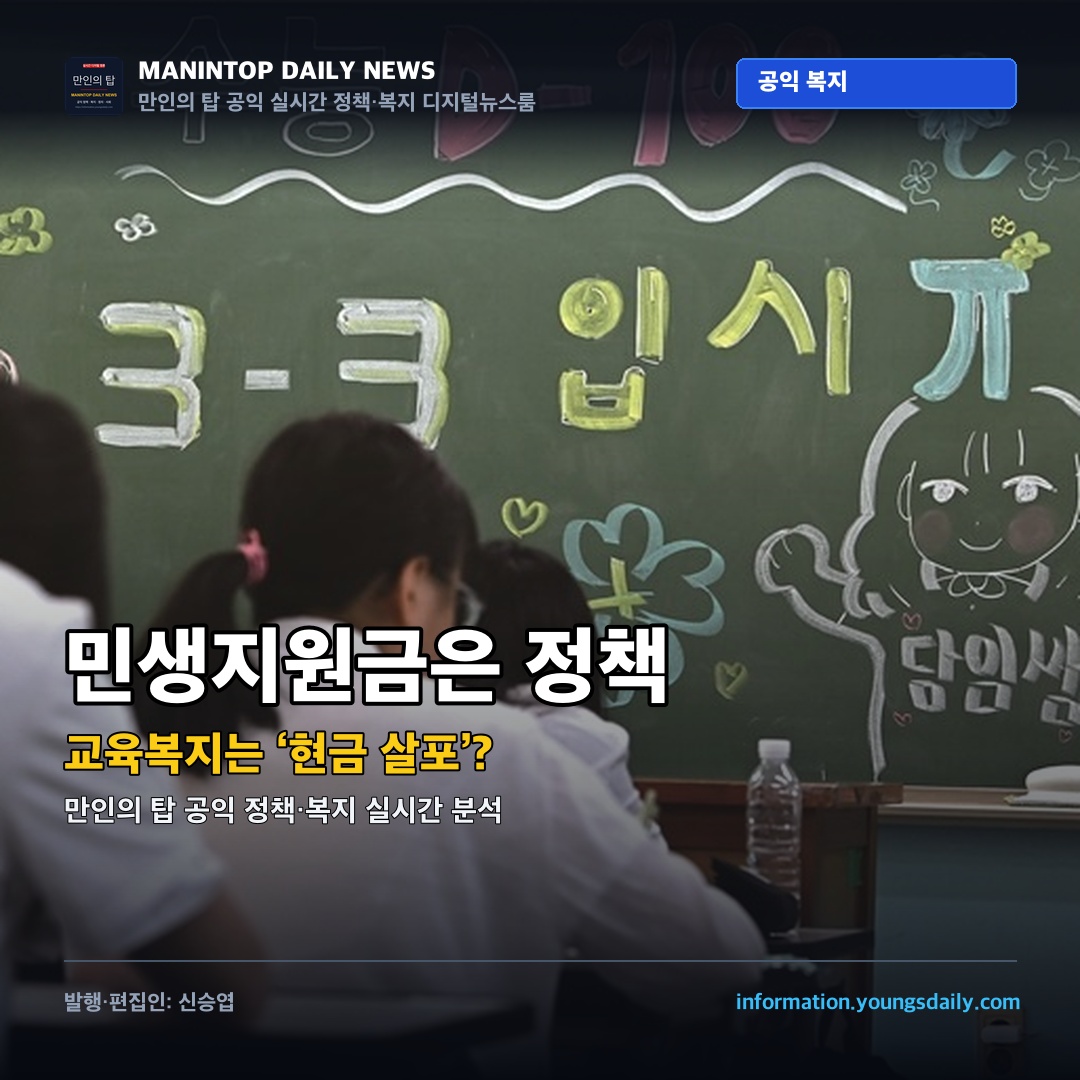
The announcement regarding the livelihood support fund as a policy and the educational welfare as 'cash distribution' outlines the government's support criteria and application procedures.
Reported by Alex Shin, Ph.D. | Publisher & Editor-in-Chief, MANINTOP DAILY NEWS
📌 Key Takeaways (Executive Summary)
- Key Points of Policy Support: Focusing on the livelihood support fund as a policy and educational welfare as 'cash distribution', this initiative aims to alleviate the financial burden on low-income households and strengthen the welfare safety net.
- Eligibility and Scale of Support: Enhancing the perception of support through the relaxation of income recognition standards and the expansion of actual support amounts.
- Application and Submission Schedule: A comprehensive application process will commence through online and offline welfare portals and local government resident centers.
With the official launch of the livelihood support fund as a policy and educational welfare as 'cash distribution', expectations are high that this initiative will significantly contribute to the stability of housing and living conditions for low-income and vulnerable groups. This measure emphasizes addressing the needs on the ground, eliminating support blind spots, and realizing tangible welfare.
1. Background of Policy Introduction and Key Support Contents
The recently announced 'livelihood support fund as a policy and educational welfare as 'cash distribution'?' initiative is a tailored support system urgently established to reinforce the safety net for low-income households amid a prolonged economic situation characterized by high inflation and rising housing and living costs. According to analyses from major accredited institutions such as Baby Times, KBS News, and Daejeon Ilbo, previous support systems have been criticized for their rigid income assessment methods and stringent documentation requirements, which have prevented those in dire need from accessing assistance.
The detailed measures prepared this time reflect these voices from the field, aiming to lower entry barriers and enhance effectiveness. The policy intends to alleviate the social entry costs for the youth and share the burden of care and medical expenses for elderly households, thereby providing a solid foundation for vulnerable families to maintain stability even when faced with unexpected economic crises.
2. Comprehensive Comparison Table of Support Requirements and Benefits
The fundamental change in this policy lies in broadening the scope of eligible recipients and actualizing the benefit system compared to existing frameworks. In the past, households that narrowly missed out on support due to dependency criteria or strict asset conversion rates can now be reasonably included within the newly adjusted income recognition formula.
Additionally, the adjustment of the unit price of supported amounts and the effectiveness of voucher benefits in line with recent inflation rates is a notable aspect. A summary of the practical differences between the previous standards and the newly implemented system is as follows.
| Category |
Pre-improvement standards |
Revised and expanded standards |
Expected effects |
| Support targets |
Limited support for certain groups |
Significant relaxation of the median income criteria |
Resolution of blind spots |
| Support scale |
Basic level fixed support |
Customized vouchers to reduce actual burden |
Real reduction of household burden |
| Application process |
Complexity of visit applications and documents |
One-click online simplification |
Enhanced convenience of application |
| Post-management |
Termination after one-time execution |
Activation of continuous monitoring system |
Stable welfare benefits |
3. Practical Application Methods and Important Considerations
Regardless of how beneficial a policy may be, if the individual does not apply within the designated timeframe, they will not receive even a single penny of support. The public welfare system in South Korea operates on a 'request principle', requiring beneficiaries to submit the necessary documents to initiate benefits. Citizens curious about their eligibility can visit the official Ministry of Health and Welfare portal 'Welfare Road (bokjiro.go.kr)' or 'Government 24 (gov.kr)', where they can use the simulation service after simple authentication to instantly check their income recognition amount and expected support within one minute.
For the elderly who are not familiar with the digital environment or households busy with their livelihoods, visiting the welfare desk at the administrative welfare center in their jurisdiction with identification can provide them with personalized one-on-one consulting from dedicated officials. Since projects with limited budgets may close on a first-come, first-served basis, it is advisable to note the announced application schedule in advance and prepare the necessary documents proactively.
4. Follow-up implementation schedules by local governments and contact networks of relevant departments.
A truly advanced welfare state is achieved by ensuring that not a single neighbor is obstructed from receiving welfare due to complex paperwork or administrative convenience. An equally important task is to promote a field-centered approach that allows all citizens to easily and intuitively understand and utilize the benefits of good systems.
Relevant ministries and local governments must strengthen on-site application services that go beyond desk administration by directly visiting areas with concentrated vulnerable populations. While strict measures should be taken against fraudulent claims during the post-implementation process, careful channels for appeals must be maintained to prevent the occurrence of unintentional exclusions. We hope that this policy, funded by the valuable taxes of citizens, will firmly establish itself as a strong support for households in need.


0 댓글