MANINTOP GLOBAL NEWSROOM · SPECIAL EDITORIAL REPORT
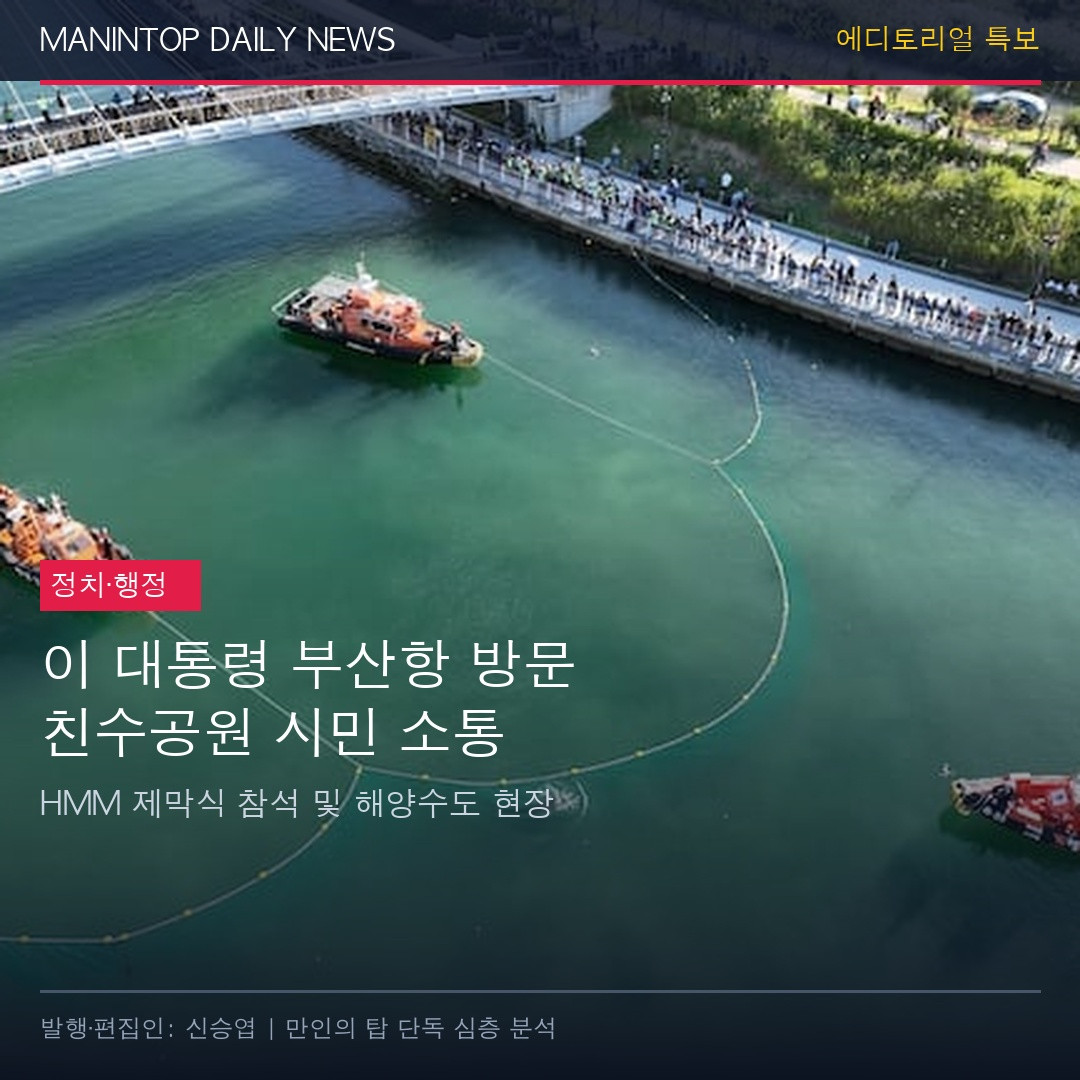
President Lee visits the 'Bukan-i' waterfront park to engage with citizens and attends the HMM unveiling ceremony amid escalating political tensions between the ruling and opposition parties.
Reported by Alex Shin, Ph.D. | Publisher & Editor-in-Chief, MANINTOP DAILY NEWS
📌 Key Takeaways (Executive Summary)
- Key Issues Emerge: President Lee's visit to the 'Bukan-i' waterfront park for citizen engagement and attendance at the HMM unveiling ceremony has become a focal point in the regular National Assembly's major committee discussions.
- Political Standoff: A cooling political atmosphere is forming due to differences in positions between the leadership of the ruling and opposition parties.
- Future Legislative Directions: Follow-up verification is anticipated through the review of related bills and inquiries during the National Assembly's audit.
Tensions are rising in the National Assembly and political circles as a standoff between the ruling and opposition parties over the issue of President Lee's visit to the 'Bukan-i' waterfront park and attendance at the HMM unveiling ceremony rapidly takes shape. This matter is being evaluated as a significant turning point that will influence the review of major legislative tasks in the upcoming National Assembly committee sessions, transcending mere political disputes.
1. Background of the Issue and Political Context
The direct catalyst for the public discourse surrounding President Lee's visit to the 'Bukan-i' waterfront park and attendance at the HMM unveiling ceremony was the official announcements from the government and related agencies, as well as the exchanges that took place during key National Assembly meetings. According to reports from multiple reputable media outlets, including Yonhap News, Korea Economic Daily, and Global Economic News, this situation has emerged as a significant issue surrounding the legitimacy of administrative principles and the exercise of authority, going beyond mere differences in opinion.
In particular, the controversial statement 'I went to see Bukan-i and saw President Lee' has brought to light the underlying institutional issues that have been simmering beneath the surface. While there have been various conflicts during past legislative reviews or personnel vetting processes, this time, the regular National Assembly schedule and the strategic judgments of the ruling and opposition party leadership have converged, leading to an unprecedentedly sharp confrontation. From the perspective of high school students or the general public, this is not merely a dispute over positions or a verbal clash, but a critical event that assesses the independence of the institutions enforcing the law and the extent of the National Assembly's oversight authority.
2. Comparison of Positions and Issues
The political confrontation surrounding this issue is encapsulated in the phrase 'I went to see Bukan-i and saw President Lee,' and both sides are maintaining a tense stalemate. The ruling party emphasizes that this is a legitimate exercise of command authority as stipulated in the Constitution and current laws, and an unavoidable measure to uphold the principles of public service. They argue that unwavering law enforcement is essential for the stable completion of national tasks and the establishment of public order.
In response, the opposition party strongly argues against this, labeling it as an abuse of power and an administrative overreach, and is preparing to push for rigorous inquiries and a national investigation at the National Assembly level. They criticize the ruling party for bypassing democratic deliberative processes and taking reckless actions that could set a bad precedent for similar cases in the future. A systematic comparison of the key points and legal issues raised by both sides reveals the following.
| Classification |
Ruling Party Position |
Opposition Party Position |
Agreement and Outlook |
| Basic Position |
Principles of National Policy Tasks and Compliance with the Rule of Law |
Criticism and Oversight of Government Policy Failures |
Continued Standoff in Standing Committees |
| Legal Issues |
Emphasis on Compliance with Current Legal Procedures |
Claims of Abuse of Power and Unconstitutionality |
Initiation of Legal Review |
| Political Repercussions |
Call for Separate Handling of Livelihood Issues |
Intense Struggle and Promotion of Hearings |
Coordination of Meetings Between Ruling and Opposition Party Leaders |
| Follow-up Measures |
Passage of Institutional Improvement Proposals in the Regular National Assembly |
Formation of Special Committees and Thorough Verification |
Exploration of Compromise Negotiations |
3. Prospects for Passage in Committees and the Plenary Session: Key Points to Watch
What institutional procedures will the issue of 'President Lee visiting the 'Bucani' waterfront park for citizen engagement and attending the HMM unveiling ceremony' undergo in the National Assembly? The matter will be presented at the official meetings of the relevant standing committees (such as the Judiciary Committee, the Interior and Safety Committee, and the Management Committee), where pointed inquiries will be directed at the ministers and officials of the responsible departments. If new documents or evidence are introduced during the question-and-answer process, which will be permanently recorded in the National Assembly's minutes, the political tension is expected to escalate significantly.
It is noteworthy that the political disputes in Yeouido have a direct and indirect impact on the lives of ordinary citizens and high school students. If the National Assembly becomes engrossed in political strife, delaying the review of livelihood-related bills and budget proposals, it will result in a cascading delay of youth support measures, improvements in educational environments, and public infrastructure investments aimed at stabilizing living costs. This is why political news directly affects 'my family's taxes and future environment.'
4. Future Schedules for Negotiations Between the Ruling and Opposition Parties and Key Points to Watch in the Political Landscape
In a democratic society, conflict and checks are natural processes; however, the resolution of conflicts must always culminate in rational compromise and the enhancement of public interests. Historical precedents show that extreme attrition ultimately incurs heavy costs in terms of administrative expenses and public fatigue.
Political circles must focus on restoring public trust through transparent information disclosure and strict adherence to institutional procedures, transcending party interests. When mature and responsible politics is realized—upholding principles based on common sense and reason while accepting legitimate criticisms from opponents—this situation could serve as a stepping stone for our democracy to advance rather than a quagmire of conflict.


0 댓글