"세법은 살지 않으면 무거운 세금을 물리겠다고 집주인을 몰아붙이는데, 정작 세입자 보증금을 빼줄 금융 창구는 1억 원 상한에 꽁꽁 묶였습니다. 대출 규제가 낳은 극심한 돈맥경화 속에서 강남 초고가 아파트에는 24억 사금융이 버젓이 등장하고, 서울 외곽의 영끌 차주들은 44% 폭증한 법원 강제경매의 벼랑 끝으로 내몰리고 있습니다."
신승엽 경제·부동산 전문기자|2026. 11. 10. 23:55 송고
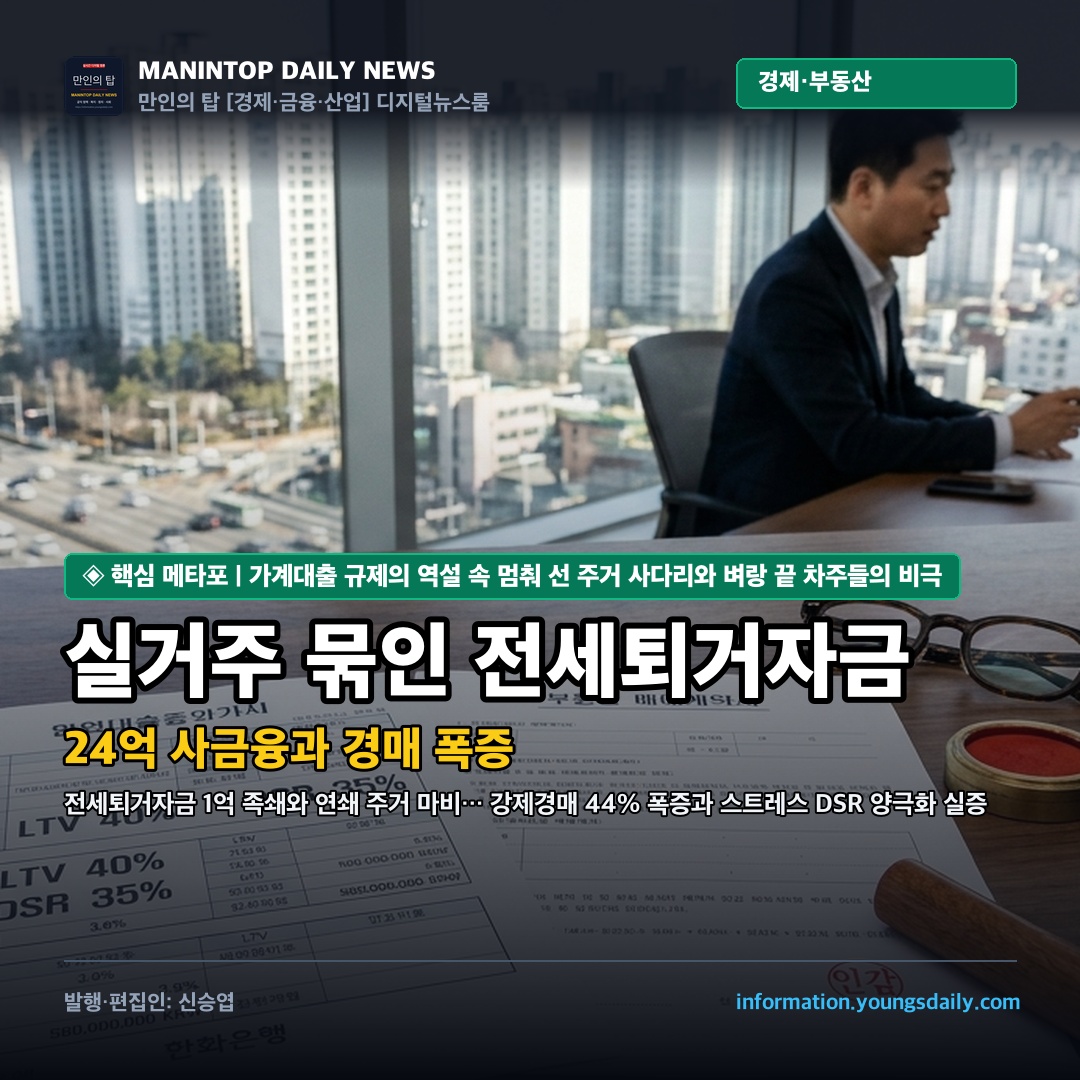
▲ 공식 보도사진 — 서울 시내 한 금융기관 상담 창구에서 차주가 주택담보대출 심사 서류를 앞에 두고 한도 산정 내역을 확인하고 있다. 정부의 가계대출 총량 규제와 3단계 스트레스 DSR이 본격화되면서 실거주를 위한 전세퇴거자금대출 한도가 크게 축소되어 혼선이 빚어지고 있다.
핵심 취재 팩트 요약
세제는 실거주하지 않는 1주택자에게 중과세를 압박하지만, 금융당국은 세입자 반환용 전세퇴거자금을 '생활안정자금'으로 묶어 1억 원 상한선과 스트레스 DSR 7.5% 가산금리를 적용해 연쇄 주거 마비를 촉발하고 있습니다.
25억 원 초과 주택의 대출이 2억 원으로 차단되자 개포주공 6·7단지에서는 관리처분인가 절세 시한(2026년 10월 8일)을 맞추기 위해 매도인이 매수인에게 18억~24억 원을 직접 빌려주는 기형적 사금융이 71.4%에 달했습니다.
학술 실증분석 결과 스트레스 DSR은 현금 부자가 몰린 강남과 마용성 집값만 띄우고(+0.0140, +0.0079), 대출 의존도가 높은 외곽 서민 지역(-0.0062)만 얼어붙게 만들어 서울 법원 강제경매가 44% 폭증하는 부작용을 낳았습니다.
정부의 전방위적인 가계대출 규제 강화 속에서 실거주를 위해 입주하려던 1주택자들이 전세퇴거자금 한도 1억 원에 묶여 발을 구르고 있으며, 초고가 재건축 시장의 24억 사금융과 법원 강제경매 44% 폭증이라는 극단적인 시장의 명암이 드러나고 있습니다.
부동산 시장 현장에서는 정부 부처 간의 손발이 맞지 않는 정책 엇박자로 인해 애꿎은 실수요자들만 유탄을 맞고 있다는 비명이 터져 나옵니다. 한쪽에서는 세법을 고쳐 실제로 들어가 살지 않으면 양도세 비과세 혜택을 깎고 종합부동산세를 무겁게 매기겠다고 압박하는데, 다른 한쪽에서는 은행 창구 문을 굳게 닫아 세입자에게 돌려줄 전세보증금 대출을 가로막고 있기 때문입니다. 집주인은 들어가 살 길이 막혀 세금 폭탄을 맞을 판이고, 세입자는 보증금을 돌려받지 못해 이사를 나가지 못하는 진퇴양난의 악순환이 곳곳에서 벌어지고 있습니다.
이러한 강력한 대출 족쇄는 부동산 시장을 엉뚱한 방향으로 왜곡시키고 있습니다. 돈줄이 막힌 강남 초고가 재건축 시장에서는 집을 파는 매도인이 매수인에게 20억 원이 넘는 잔금을 직접 빌려주고 근저당을 설정하는 전례 없는 기형적 사금융이 판을 치고 있습니다. 반면 지난 부동산 급등기에 영혼까지 끌어모아 집을 샀던 서민 차주들은 추가 대출과 대환의 길이 완전히 막히면서 소액 채무조차 갚지 못해 집이 법원 강제경매로 넘어가는 비극을 맞이하고 있습니다. 대출 규제의 칼날이 과연 누구를 겨누고 있는지 현장의 생생한 실태를 짚어보겠습니다.
1. 실거주 압박과 전세퇴거자금 1억 한도의 충돌… 멈춰 선 주거 사다리
현재 부동산 시장에서 가장 심각한 병목 현상이 일어나는 지점은 바로 1주택자의 실거주 입주 과정입니다. 기획재정부와 세제 당국은 주택 투기를 막는다는 명분으로 1주택자의 실거주 요건을 갈수록 엄격하게 강화하고 있습니다. 실제로 거주하지 않는 1주택자에 대해서는 종합부동산세 기본공제 한도를 종전 12억 원에서 9억 원으로 낮추는 방안이 추진되고 있으며, 집을 팔 때 양도세를 최대 80%까지 깎아주던 장기보유특별공제 역시 실거주 기간을 채우지 못하면 공제율이 대폭 깎이도록 설계되어 있습니다.
하지만 정작 집주인이 실거주를 위해 자기 집으로 들어가려고 해도 은행 문턱을 넘을 수가 없습니다. 기존에 살고 있던 세입자에게 전세보증금을 내주려면 '전세퇴거자금대출'을 받아야 하는데, 금융당국이 이 대출을 주택 구입 목적이 아닌 '생활안정자금'으로 분류해 놓았기 때문입니다. 이에 따라 연간 빌릴 수 있는 한도가 단 1억 원으로 묶여 버렸습니다. 서울 아파트 평균 전세가격이 6억 원을 웃도는 현실에서 1억 원 한도로는 세입자의 보증금을 반환하는 것이 물리적으로 불가능합니다.
엎친 데 덮친 격으로 이 1억 원 대출마저도 7.5%에 달하는 가상의 스트레스 금리를 얹은 DSR 심사를 통과해야 하며, 은행들이 연간 대출 증가율을 1.5% 수준으로 틀어쥐면서 신규 접수 자체를 꺼리고 있습니다. 집주인은 세입자 돈을 못 빼줘 실거주를 못 하고, 세입자는 새 전셋집 계약금을 날릴 위기에 놓이는 연쇄 주거 이동 마비 사태가 수도권 전역으로 번져가고 있습니다.
2. LTV·DSR·스트레스 DSR 3중 족쇄… 연봉 5천만 원 대출 1억 4천만 원 증발
현재 주택담보대출 시장을 옥죄고 있는 규제 장치는 크게 LTV(주택담보인정비율), DSR(총부채원리금상환비율), 그리고 스트레스 DSR이라는 3단계 필터로 작동합니다. 집값 대비 대출 비율을 따지는 LTV의 경우, 규제지역 무주택자는 50%, 비규제지역은 70%가 적용되지만 주택 가격 구간별로 촘촘한 상한선이 가로막고 있습니다. 15억 원 이하 주택은 최대 6억 원, 15억~25억 원 구간은 최대 4억 원, 25억 원 초과 주택은 최대 2억 원까지만 대출이 나오며 다주택자는 규제지역 내 대출이 전면 금지됩니다.
하지만 LTV 한도가 나온다고 해서 그 돈을 다 빌릴 수 있는 것은 아닙니다. 2차 관문인 DSR이 소득 대비 원리금 상환액을 은행권 기준 40%로 엄격히 제한하기 때문입니다. 여기에 2026년 하반기부터 전면 시행된 3단계 스트레스 DSR은 차주의 목을 한층 더 강하게 죄고 있습니다. 미래 금리 인상 위험을 방어한다는 명목으로 수도권 주택담보대출에 대해 실제 시중금리(연 4.5% 안팎)에 무려 3.0%p의 가산금리를 강제로 덧붙여 7.5% 금리를 기준으로 대출 한도를 산정하기 때문입니다.
이 계산법이 적용되면 연봉 5,000만 원인 평범한 직장인이 30년 만기 원리금균등분할상환으로 대출을 신청할 때 엄청난 한도 증발이 발생합니다. 기존 기본 DSR 체계에서는 약 3억 3,000만 원까지 대출이 가능했지만, 스트레스 DSR 3단계가 완전히 적용되면 한도가 1억 9,000만 원 선으로 주저앉습니다. 앉은 자리에서 대출금 1억 4,000만 원(약 42%)이 공중으로 사라지는 셈입니다. 성과급이나 상여금 소득 산정 기준까지 최근 2~3개년 평균으로 강화되면서 평범한 월급쟁이가 대출을 받아 내 집을 마련하는 주거 사다리는 사실상 철거되었습니다.
주택 가격 구간 구분
적용 LTV 법정 상한
구간별 대출 허용 상한액
규제지역 및 다주택 취급 제한
15억 원 이하 주택
비규제 70% / 규제지역 50%
최대 6억 원 한도
실수요 무주택자 위주 배정, LTV 범위 내 적용
15억 원 초과 ~ 25억 원 이하
비규제 70% / 규제지역 50%
최대 4억 원 한도
고가 주택 구간 진입 시 대출 한도 2억 원 축소
25억 원 초과 초고가 주택
비규제 70% / 규제지역 50%
최대 2억 원 한도
담보 가치와 무관하게 2억 원 상한 강제 제한
다주택자 신규 주담대
0% 전면 금지
0원 (취급 불가)
규제지역 내 유주택자 신규 구입 자금 전면 차단
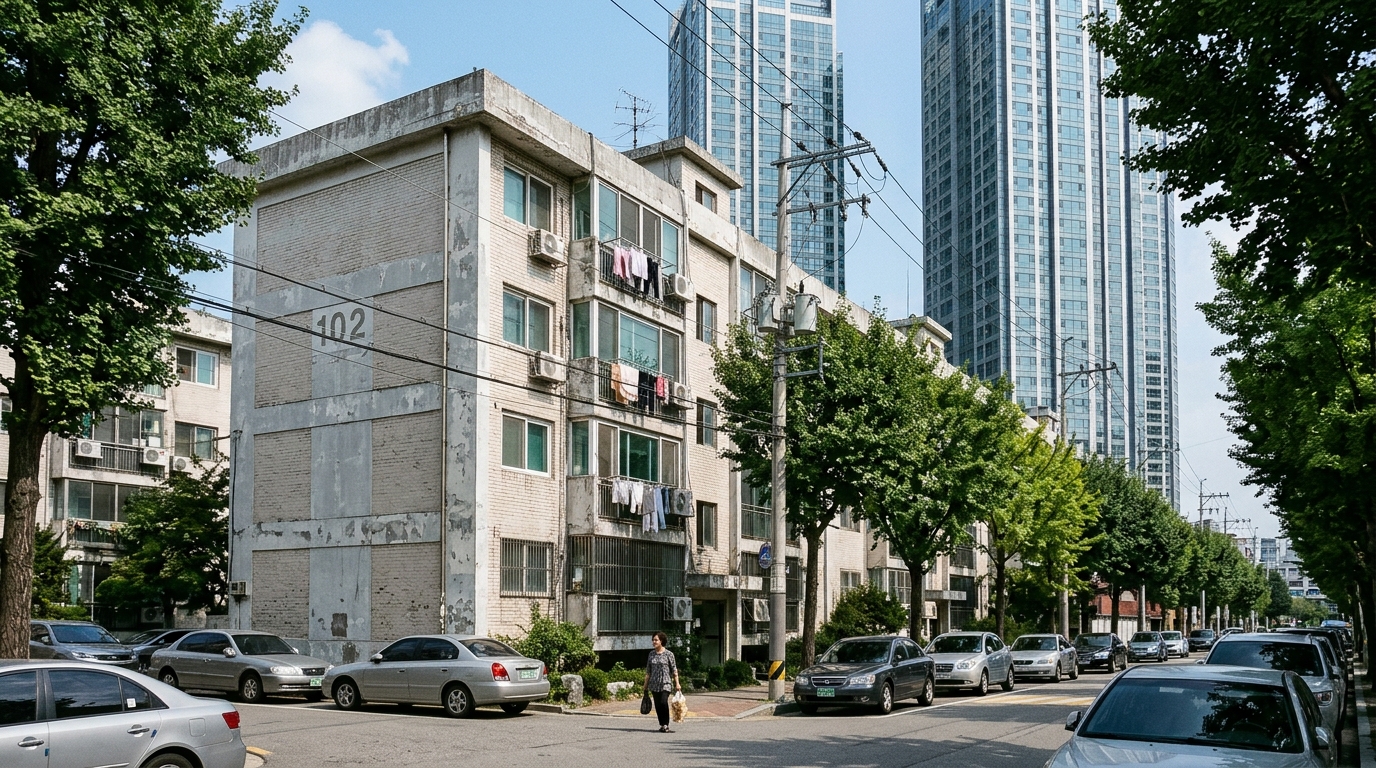
▲ 현장 취재사진 — 서울 강남구 개포동 일대 재건축 대상 저층 노후 단지 전경 뒤로 초고층 신축 주상복합 타워가 펼쳐져 있다. 25억 원 초과 대출 규제와 관리처분인가 조합원 지위 양도 제한 시한이 겹치면서 매도인이 매수인에게 잔금을 직접 빌려주는 사금융 거래가 성행하고 있다.
3. 개포주공 등기부의 비밀… 24억 사금융과 관리처분인가 절세의 내막
정부의 획일적인 대출 규제가 초고가 주택 시장에서 빚어낸 가장 기이한 풍경은 바로 강남 재건축 단지의 등기부등본에서 확인됩니다. 서울 강남구의 대표적 재건축 대어로 꼽히는 개포주공 6·7단지가 그 진원지입니다. 이 단지의 최근 부동산 실거래 등기 내역 14건을 심층 전수 조사한 결과, 무려 10건(71.4%)에서 매도인이 매수인에게 18억 원에서 24억 원에 달하는 잔금을 사적으로 빌려주고 20억~28억 원 상당의 거액 근저당권을 설정한 사실이 드러났습니다.
거래 가격이 27억~32억 원에 달하는 아파트를 사면서 매수인은 고작 5억~8억 원의 현금만 쥐고 계약을 체결했습니다. 나머지 매매 대금의 70~80%는 은행 대출이 아닌 집주인의 호주머니에서 나온 사금융으로 메운 것입니다. 은행 문이 닫히자 사인 간의 거액 사금융 계약인 '매도인 잔금대출(Seller Financing)'이 공공연한 거래 관행으로 자리 잡은 것입니다.
집을 파는 매도인이 이처럼 막대한 채권 회수 위험을 감수하면서까지 거액을 빌려주는 속사정에는 '세금 시한폭탄'이 자리 잡고 있습니다. 개포주공 6·7단지는 2026년 10월 8일 관리처분계획인가 고시를 앞두고 있었습니다. '도시 및 주거환경정비법'에 따르면 투기과열지구 재건축은 관리처분계획인가 고시가 떨어지는 순간 조합원 지위 양도가 전면 금지됩니다. 고시 전에 소유권이전등기를 완료하지 못하면 1세대 1주택 비과세 혜택과 수억 원에 달하는 장기보유특별공제(최대 80%)를 완전히 날리게 됩니다. 하루 차이로 수억 원의 양도세 폭탄을 맞느니 차라리 매수인에게 돈을 빌려주고라도 등기를 넘기는 기형적 선택을 한 것입니다.
4. 갭투자 원천 봉쇄와 2027 세금 데드라인… 매매가 억눌려도 전세대란 역설
금융당국은 갭투자(전세 낀 매매)를 원천 차단하기 위해 소유권 이전 조건부 전세대출을 전면 금지하는 등 퇴로를 철저히 봉쇄했습니다. 여기에 2027년 1월부터는 수도권 비거주 1주택자에 대한 전세자금대출의 신규 취급은 물론 기존 대출의 만기 연장까지 일체 불허하는 초강력 방침이 예고되어 있습니다. 과거 임대사업자로 등록했던 주택들의 10년 의무임대기간 만료와 1년 내 의무 매각 유예 시한 역시 2027년에 대거 집중되어 있습니다.
이러한 규제 폭탄은 단기적으로 매매 수요를 억눌러 집값 상승세를 둔화시키는 착시 효과를 낳고 있습니다. 하지만 시장 내부를 들여다보면 심각한 전세 대란의 역설이 싹트고 있습니다. 갭투자가 차단되고 집주인들이 실거주 요건을 채우기 위해 입주하거나 비거주 페널티를 피해 매물을 거둬들이면서, 서민들이 거주할 수 있는 순수 전월세 임대차 매물이 시장에서 급속도로 자취를 감추고 있기 때문입니다.
매물이 귀해지자 집주인들은 높아진 보유세와 대출 이자 부담을 전세보증금 인상이나 월세로 세입자에게 전가하고 있습니다. 2027년 세제와 대출 데드라인이 가까워질수록 전세 시장의 매물 품귀와 전셋값 폭등이 가속화되고, 이렇게 치솟은 전셋값이 다시 매매가 하단을 떠받치는 부메랑으로 돌아올 것이라는 전문가들의 경고가 잇따르고 있습니다.
차주 연소득 수준
기본 LTV 대출 가능액
기본 DSR (스트레스 미적용)
스트레스 DSR 3단계 적용액
대출 한도 순감소액
연봉 5,000만 원 차주
6억 0,000만 원 (10억 아파트)
약 3억 3,000만 원
약 1억 9,000만 원
△1억 4,000만 원 (△42.4%)
연봉 8,000만 원 차주
6억 0,000만 원 (12억 아파트)
약 5억 2,800만 원
약 3억 0,500만 원
△2억 2,300만 원 (△42.2%)
연봉 1억 원 차주
4억 0,000만 원 (18억 아파트)
약 6억 6,000만 원
약 3억 8,100만 원
△2억 7,900만 원 (△42.3%)
연봉 1억 5천만 원 차주
2억 0,000만 원 (26억 아파트)
약 9억 9,000만 원
2억 0,000만 원 (LTV 캡)
LTV 2억 상한 강제 제한
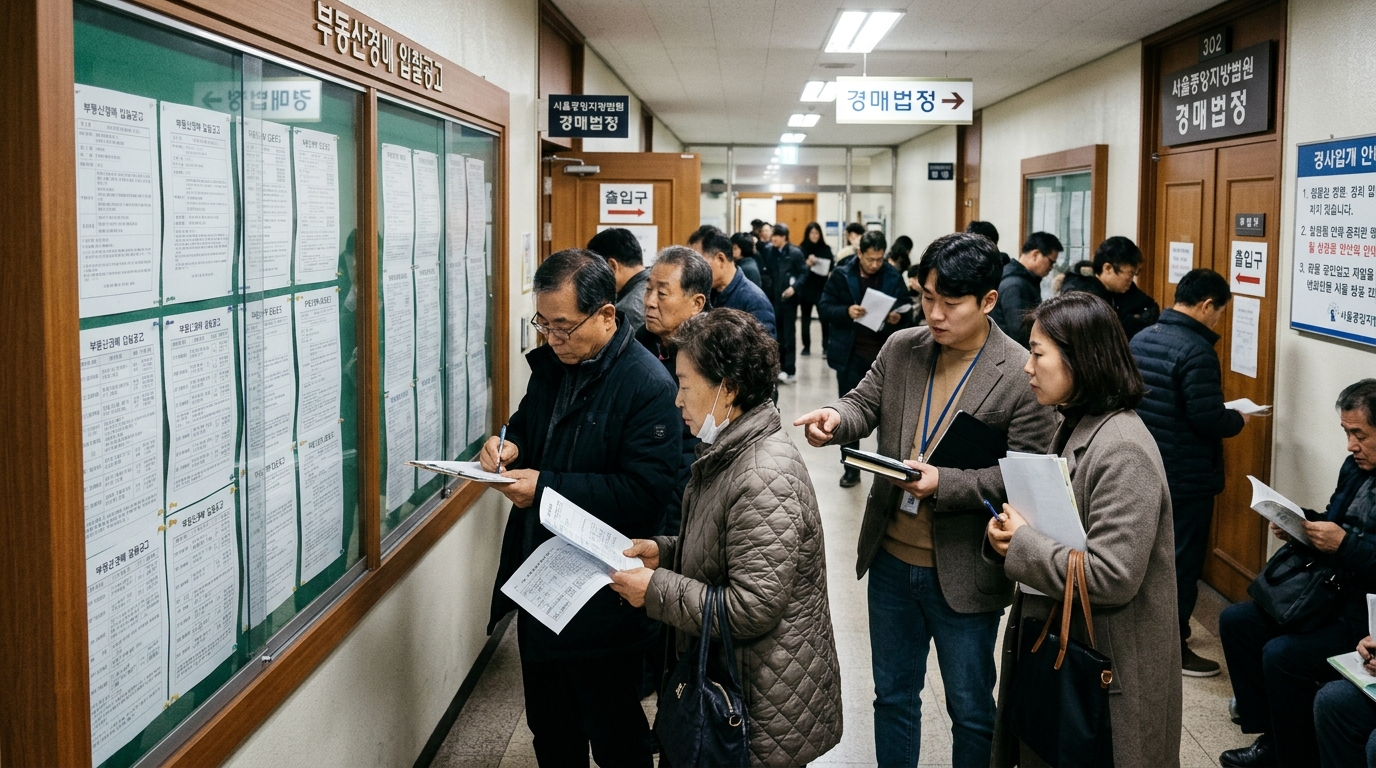
▲ 현장 취재사진 — 서울 시내 한 법원 경매법정 복도에서 응찰자와 시민들이 게시판에 붙은 부동산 강제경매 공고문을 꼼꼼히 살펴보고 있다. 대출 한도가 축소되고 고금리가 장기화되면서 채무를 감당하지 못한 서민 차주들의 아파트와 다세대 주택 경매 건수가 44% 폭증했다.
5. 벼랑 끝에 몰린 영끌족… 서울 강제경매 3,854건 44% 폭증의 비극
대출 옥죄기가 빚어낸 가장 참혹한 그늘은 법원 경매 시장에서 통계로 확인됩니다. 2026년 1월부터 7월까지 서울 법원에 접수된 부동산 소유권이전등기 촉탁 건수 중 '강제경매'로 인한 건수는 총 3,854건에 달했습니다. 이는 전년 같은 기간의 2,677건과 비교해 무려 44.0%나 폭증한 수치이며, 대법원이 2010년 관련 통계를 작성하기 시작한 이래 역대 최다 기록입니다.
주목할 점은 이 강제경매 물건의 절대다수인 94.3%가 아파트와 빌라 등 서민들이 거주하는 '집합건물'에 집중되어 있다는 사실입니다. 저금리 시절 은행 대출과 카드론, 신용대출까지 총동원해 집을 샀던 2030 영끌 차주들이 한계점에 도달한 것입니다. 고금리가 수년째 이어지며 이자 부담이 눈덩이처럼 불어난 데다, 3단계 스트레스 DSR 도입으로 추가 대환대출이나 생활안정자금 조달마저 원천 차단되었기 때문입니다.
일반적으로 은행이 담보권을 실행하는 '임의경매'와 달리, 강제경매는 채무자가 카드값이나 제2금융권 신용대출 등 수백만~수천만 원 수준의 소액 빚조차 갚지 못해 채권자가 소송 판결문을 받아 집을 강제로 처분하는 절차입니다. 한 달에 수십만 원의 이자나 카드 대금을 돌려막지 못해 전 재산인 보금자리를 통째로 날리는 한계 차주들이 급증하고 있다는 뜻입니다. 무차별적인 대출 규제가 취약 차주들의 숨통을 끊어놓는 사회적 비극으로 이어지고 있습니다.
6. 스트레스 DSR의 역설… 강남·마용성 띄우고 서민 노도강만 잡은 실증분석
대출 규제가 부동산 시장을 안정시키기는커녕 오히려 자산 격차를 극단적으로 벌려놓았다는 사실은 공인된 학술 연구를 통해서도 명백히 입증되었습니다. 국토교통부 산하 한국부동산원이 발행하는 권위 있는 학술지인 《부동산분석》(2025년 11월호)에 게재된 건국대학교와 창신대학교 공동 연구팀의 실증 논문이 대표적입니다. 연구팀은 서울시 25개 자치구의 실거래가 빅데이터를 바탕으로 고정효과 패널 회귀분석을 실시했습니다.
분석 결과는 충격적이었습니다. 스트레스 DSR 규제가 시행된 이후 서울 전체 집값의 안정 효과는 통계적으로 미미했던 반면, 권역별 양극화는 극에 달했습니다. 대출 규제가 강화될수록 강남 3구(강남·서초·송파)의 아파트 가격 변동 계수는 오히려 +0.0140(1% 유의수준)을 기록하며 강한 상승세를 나타냈고, 마용성(마포·용산·성동) 역시 +0.0079로 올랐습니다. 반면 대출 의존도가 높은 서민 실수요자 중심의 노도강(노원·도봉·강북)은 계수가 -0.0062로 뚝 떨어지며 완연한 하락세로 곤두박질쳤습니다.
이러한 현상이 나타난 원인은 명확합니다. 수십억 원의 현금을 보유한 자산가들에게는 은행 대출 한도가 줄어드는 것이 아무런 걸림돌이 되지 않았습니다. 오히려 상급지 똘똘한 한 채로 수요가 쏠리며 강남권은 신고가를 잇달아 갈아치웠습니다. 반면 소득과 자산이 부족해 주택담보대출을 지렛대 삼아 내 집을 마련하려던 중산층과 서민들은 3단계 스트레스 DSR의 철퇴를 맞아 시장 밖으로 튕겨져 나갔습니다. 결국 가계부채를 잡겠다며 도입한 획일적인 대출 규제가 부자들의 현금 잔치만 부추기고 서민들의 주거 사다리만 걷어찬 셈입니다.
서울 분석 권역
스트레스 DSR 가격 영향 계수
통계적 유의성 검증
규제 시행 후 실제 시장 흐름
강남 3구 (강남·서초·송파)
+0.0140 (상승 영향)
p < 0.01 (99% 신뢰도)
현금 부자 중심 똘똘한 한 채 집중, 역대 최고가 경신
마용성 (마포·용산·성동)
+0.0079 (상승 영향)
p < 0.05 (95% 신뢰도)
도심 접근성 및 상급지 갈아타기 수요로 견고한 지지선 형성
노도강 (노원·도봉·강북)
-0.0062 (하락 영향)
p < 0.05 (95% 신뢰도)
대출 한도 급감으로 서민 실수요 이탈, 급매물 누적 하락세
서울 전체 평균
+0.0012 (유의성 미미)
통계적 유의성 결여
전체 지수는 보합세이나 권역 간 자산 격차는 사상 최대로 확대
In-Depth InvestigationEconomy & Real Estate
[In-Depth Analysis] Housing Dilemmas and Market Divergence: Stalled Leasehold Exits, Private Shadow Loans, and a 44% Surge in Foreclosures
"While strict tax codes force homeowners to move in or face crushing capital gains levies, financial authorities have capped tenant exit loans at a meager 100 million won. Amidst severe credit rationing, multi-billion won private loans have emerged in Gangnam reconstruction projects, while struggling borrowers across outer Seoul are pushed toward a 44% spike in court-ordered foreclosures."
Seung Youb Ssin, Senior Economy & Real Estate Journalist|Published Nov 10, 2026 23:55 KST
▲ Official News Photo — A financial consultant in Seoul evaluates loan eligibility documents alongside a client under rigorous lending guidelines. As macroprudential authorities enforce lending caps and Stage 3 Stress DSR, severe bottlenecks are emerging for homeowners seeking leasehold deposit return loans to fulfill mandatory residency requirements.
Executive Fact Briefing
Tax policy mandates physical owner-occupancy under penalty of heavy surcharges, yet banking rules classify tenant refund loans as living expenses capped at 100 million won with a 7.5% stressed interest rate.
Faced with a 200 million won mortgage ceiling on luxury homes, 71.4% of recent sales in Gaepo Jugong 6 and 7 saw sellers privately financing between 1.8 billion and 2.4 billion won to beat statutory tax deadlines.
Academic panel regressions in the Journal of Real Estate Analysis prove that Stress DSR boosted prime Gangnam prices while depressing outer suburban neighborhoods, triggering a 44% surge in compulsory court auctions.
Across South Korea's financial landscape, sweeping macroprudential loan curbs are trapping single-home owners behind an arbitrary 100 million won limit on leasehold deposit return loans, sparking both 2.4 billion won private shadow lending in affluent reconstruction zones and a record 44 percent surge in court foreclosures among working-class households.
Industry observers and market participants report mounting frustration over contradictory government mandates that penalize ordinary homeowners. On one side, tax authorities have tightened physical residency requirements, slashing long-term holding tax deductions and expanding comprehensive real estate levies for non-occupying owners. Yet on the banking side, macroprudential regulators have shut loan windows, preventing owners from accessing institutional credit to refund outgoing tenants. Landlords cannot move in and face massive tax penalties, while tenants cannot recover their deposits to relocate, freezing mobility across the entire metropolitan housing chain.
This credit contraction has severely distorted market mechanisms. In premier reconstruction enclaves like Gangnam, sellers are taking matters into their own hands by directly lending billions of won to buyers and registering private mortgages to close deals before redevelopment permits trigger statutory tax penalties. Meanwhile, highly leveraged young professionals who bought homes during the low-rate boom are finding all avenues of refinancing blocked, leading to personal insolvency and compulsory auctions. Here is an exhaustive analysis of the deepening divide caused by one-size-fits-all credit tightening.
1. Policy Collision: Stalled Move-Ins and the 100 Million Won Leasehold Exit Cap
The most acute operational deadlock in the Seoul housing market occurs during the owner-occupancy transition. Fiscal authorities have progressively tightened residency requirements to curb speculative buy-to-let investments. Homeowners who fail to physically reside in their properties face a reduction in the comprehensive real estate tax threshold from 1.2 billion to 900 million won, alongside severe reductions in capital gains tax exemptions that normally offer up to an 80 percent deduction for long-term owner-occupiers.
However, when owners attempt to occupy their properties, institutional financing is virtually unobtainable. Returning the tenant's security deposit requires a specialized leasehold exit loan. Regulators, treating these funds as non-purchase living stability capital rather than essential transaction financing, have slapped a rigid annual ceiling of 100 million won on such facilities. In Seoul, where average leasehold deposits easily exceed 600 million won, an allowance of 100 million won fails to bridge the financial gap.
Compounding the problem, applicants must clear stringent Debt Service Ratio (DSR) underwriting calculated against an elevated hypothetical stress rate of 7.5 percent. With commercial banks enforcing a 1.5 percent cap on total annual loan growth, lenders are actively rejecting new applications. Landlords are blocked from moving in, exposing them to tax penalties, while tenants face missed closing dates and forfeited contract deposits on subsequent leases.
2. The Triple Lending Trap: How LTV, DSR, and Stress DSR Shrink Middle-Class Borrowing
The contemporary mortgage screening architecture operates through a three-tier regulatory filter comprising the Loan-to-Value (LTV) ratio, the Debt Service Ratio (DSR), and the newly expanded Stress DSR. Statutory LTV benchmarks stand at 50 percent in speculative zones and 70 percent in non-regulated areas, but hard cash caps override theoretical percentages. Properties appraised under 1.5 billion won are capped at 600 million won, those between 1.5 billion and 2.5 billion won are limited to 400 million won, and luxury homes exceeding 2.5 billion won face an absolute ceiling of 200 million won.
Even if collateral value supports an LTV allocation, the statutory DSR cap restricts aggregate annual principal and interest payments to 40 percent of documented income. The introduction of Stage 3 Stress DSR severely magnifies this constraint. To hedge against interest rate fluctuations, regulators mandate a 3.0 percentage point stress premium on Seoul metropolitan mortgages, forcing banks to evaluate borrowing capacity at an artificial 7.5 percent rate even when actual market rates hover around 4.5 percent.
Under this rigorous formulation, a median salary earner making 50 million won annually on a 30-year amortizing schedule experiences an unprecedented reduction in borrowing capacity. Under baseline criteria, this borrower could secure approximately 330 million won. With the full implementation of Stage 3 Stress DSR, the maximum allowable principal drops to roughly 190 million won, wiping out 140 million won or 42.4 percent of their borrowing power. Coupled with tighter verification rules that smooth volatile performance bonuses across multi-year averages, conventional wage earners find their path to homeownership completely severed.
Property Valuation Tier
Statutory LTV Ceiling
Maximum Borrowing Allowance
Regulatory and Multi-Home Restrictions
Below 1.5 Billion Won
70% Non-Regulated / 50% Regulated
Up to 600 Million Won
Reserved for end-user buyers within standard LTV parameters
1.5 Billion to 2.5 Billion Won
70% Non-Regulated / 50% Regulated
Up to 400 Million Won
Hard ceiling reduces borrowing power by 200 million won
Above 2.5 Billion Won (Ultra-Luxury)
70% Non-Regulated / 50% Regulated
Up to 200 Million Won
Mandatory 200 million won cap regardless of property valuation
Multi-Homeowner New Mortgages
0% Complete Prohibition
Zero (Unavailable)
Complete ban on new home purchase credit in regulated zones
▲ Investigative Coverage Photo — Aging low-rise apartment blocks in Gaepo-dong, Gangnam-gu, juxtaposed against state-of-the-art residential skyscrapers. Severe loan caps on homes valued over 2.5 billion won and impending management disposal deadlines have driven a surge in multi-billion won seller-financed transactions.
3. Secrets of the Gangnam Land Registry: 2.4 Billion Won Shadow Loans and Tax Avoidance
The most striking distortion generated by uniform credit restrictions appears directly on the official land title registries of Gangnam's premier reconstruction complexes. In Gaepo Jugong Complex 6 and 7, an exhaustive review of 14 recent transactions revealed that 10 purchases, representing 71.4 percent of volume, featured massive seller-financed loans ranging from 1.8 billion to 2.4 billion won, secured by private collateral registrations worth up to 2.8 billion won.
Buyers acquired prime units trading between 2.7 billion and 3.2 billion won with only 500 million to 800 million won in liquid capital. The remaining 70 to 80 percent of the purchase price was funded not by institutional mortgage lenders, but directly from the outgoing seller's private funds. With banking avenues shuttered, private seller financing has effectively replaced conventional mortgage intermediation.
Sellers accepted this substantial credit risk due to an impending regulatory and tax deadline. Gaepo Jugong Complex 6 and 7 was rapidly approaching its official Management and Disposal Plan Approval notice on October 8, 2026. Under urban redevelopment statutes, the legal transfer of reconstruction union membership rights is strictly prohibited once this approval is gazetted. Failing to register the deed prior to the notice would strip the seller of capital gains exemptions and up to 80 percent in long-term holding deductions, triggering hundreds of millions of won in tax liabilities. To prevent this outcome, sellers extended private loans to ensure immediate deed transfers.
4. Gap Investment Ban and the 2027 Tax Clock: Why Stagnant Sales Trigger Rental Crises
Financial regulators have effectively neutralized leveraged buy-to-let arrangements by prohibiting tenant loans tied to simultaneous title transfers. Looking ahead to January 2027, authorities have announced an outright ban on originating or extending leasehold loans for non-resident owners of single homes in the greater capital region. Furthermore, statutory grace periods requiring registered rental operators to dispose of properties within 12 months of mandatory deregulation are heavily concentrated in 2027.
While these coordinated measures have temporarily dampened speculative demand and induced transaction stagnation in the sales market, they have unleashed unintended turbulence in the leasing sector. As buy-to-let activity vanishes and owners either reoccupy properties or withdraw listings to escape non-residency tax surcharges, the aggregate inventory of available rental homes is plummeting.
Confronting elevated holding taxes and financing costs, landlords are shifting financial burdens onto tenants through steeper deposits and monthly rent conversions. Real estate economists caution that as the 2027 tax and regulatory deadlines approach, acute supply shortages in the rental sector will drive lease costs higher, eventually spilling over to establish an elevated pricing floor across the sales market.
Borrower Annual Income Level
Statutory LTV Potential
Baseline DSR (Without Stress)
Stage 3 Stress DSR Allowance
Net Borrowing Capacity Reduction
50 Million Won Salary
600 Million Won (1.0B Home)
Approx. 330 Million Won
Approx. 190 Million Won
-140 Million Won (-42.4%)
80 Million Won Salary
600 Million Won (1.2B Home)
Approx. 528 Million Won
Approx. 305 Million Won
-223 Million Won (-42.2%)
100 Million Won Salary
400 Million Won (1.8B Home)
Approx. 660 Million Won
Approx. 381 Million Won
-279 Million Won (-42.3%)
150 Million Won Salary
200 Million Won (2.6B Home)
Approx. 990 Million Won
200 Million Won (Capped)
Hard LTV Cap Enforced at 200M
▲ Documentary Field Photo — Prospective bidders and property owners inspect compulsory real estate auction listings posted in the hallway of a district court in Seoul. Amid contracted credit limits and protracted high interest rates, foreclosures involving residential apartments and multi-family homes surged 44 percent over the past year.
5. Borrowers on the Brink: Inside Seoul's 44% Compulsory Foreclosure Spike
The human toll of aggressive credit contraction is captured in court auction registries. Between January and July 2026, Seoul courts registered 3,854 compulsory foreclosure filings for property title transfers. This figure marks a dramatic 44.0 percent increase compared to the 2,677 cases recorded during the same period in 2025, setting an all-time record since official recordkeeping began in 2010.
A staggering 94.3 percent of these forced sales involved collective residential dwellings, primarily apartments and multi-family villas inhabited by working-class families. Highly leveraged borrowers who entered the market during the historic monetary easing cycle of 2020 and 2021 have exhausted their financial reserves. Sustained borrowing costs combined with strict Stress DSR regulations have permanently blocked refinancing options and temporary liquidity lines.
Unlike voluntary auctions initiated by institutional mortgage holders under established liens, compulsory auctions stem from judicial enforcement judgments over unsecured consumer liabilities, credit card balances, or secondary tier borrowings often totaling less than a few thousand dollars. Borrowers unable to service modest monthly obligations are seeing their primary residences liquidated through court decrees, illustrating the severe human impact of uncalibrated macroprudential rationing.
6. The Stress DSR Paradox: Empirical Proof of Widening Housing Wealth Inequality
Academic research confirms that credit curbs have accelerated wealth polarization rather than stabilizing price trajectories. An empirical investigation published in the Journal of Real Estate Analysis by research teams from Konkuk University and Changshin University provides quantitative verification. The authors utilized fixed-effects panel regression models tracking transaction data across Seoul's 25 administrative districts.
The findings demonstrated that while broad market price stabilization remained statistically negligible under Stress DSR, spatial divergence deepened dramatically. In the affluent Gangnam Three districts (Gangnam, Seocho, Songpa), the price response coefficient registered at +0.0140 (statistically significant at the 1 percent level), signaling ongoing price appreciation. The central urban core of Mapo, Yongsan, and Seongdong recorded a positive coefficient of +0.0079. Conversely, the peripheral, credit-sensitive working-class enclaves of Nowon, Dobong, and Gangbuk plunged into negative territory with a coefficient of -0.0062.
The structural drivers behind this divergence are unambiguous. For affluent buyers possessing substantial liquid wealth, institutional loan restrictions pose zero impediment, driving high-end capital concentration into marquee assets and setting consecutive price records. Conversely, aspiring middle-class and working-class families relying on prudent leverage to climb the housing ladder find themselves shut out by stringent Stress DSR thresholds. In practice, blanket macroprudential curbs have subsidized wealthy cash investors while removing the rungs of homeownership for ordinary citizens.
Seoul Metropolitan Sub-Market
Stress DSR Price Impact Coefficient
Statistical Significance Metric
Observed Post-Regulation Market Trend
Gangnam 3 Districts (Gangnam, Seocho, Songpa)
+0.0140 (Upward Momentum)
p < 0.01 (99% Confidence)
Cash-rich buyers consolidate capital, driving record valuations
Mayongseong (Mapo, Yongsan, Seongdong)
+0.0079 (Upward Momentum)
p < 0.05 (95% Confidence)
Urban accessibility and upgrading demand create firm price floor
1월이 시작되면 감기는 이미 우리 곁에 와 있습니다. 2월, 3월, 4월까지 이어지는 추위와 건조함은 코와 목을 가장 먼저 공격합니다. 아침에 일어나자마자 막혀 있는 코. 계속 흐르는 콧물. 괜히 칼칼해지는 목. 이 증상은 “시작”일 뿐입니다. 한 번 무너지면 일주일, 길면 한 달까지 끌고 갑니다. 약을 먹으면 잠깐 괜찮아집니다. 하지만 며칠 뒤 또 반복됩니다. 왜일까요? 감기는 ‘치료’의 문제가 아니라 ‘관리’의 문제이기 때문입니다. 대부분은 감기가 오고 나서 약을 찾습니다. 하지만 진짜 중요한 건 감기가 오기 전에 코와 목을 지키는 것입니다. 건조한 실내 공기, 차가운 바깥 공기, 눈에 보이지 않는 세균. 코와 목은 매일 공격받고 있습니다. 지긋지긋하죠! 그런데도 우리는 아무 준비 없이 버티고 있습니다. 이번 겨울도 그렇게 보낼 건가요? 사실 방법은 어렵지 않습니다. 코를 깨끗하게 관리하고, 목을 따뜻하게 보호하고, 점막을 촉촉하게 유지하고, 기관지를 미리 관리하고, 외부 공기를 차단하는 것. 이 다섯 가지만 꾸준히 해도 감기약 없이 겨울을 보내는 것이 충분히 가능합니다. 🔥 이제부터 그 방법을 하나씩 살펴보겠습니다. 🔥 1. 코와 목을 먼저 관리해야 하는 과학적 이유 감기의 대부분은 코 점막에서 시작됩니다. 국제 학술지 Nature Reviews Microbiology 와 Journal of Allergy and Clinical Immunology 에 실린 호흡기 감염 관련 연구들에서는, 감기 바이러스가 비강 상피세포에 먼저 부착해 증식한다는 점을 설명하고 ...
리모델링사업이 진행 중인 아파트를 매매할 때 “계약금 10%를 언제까지 내야 하느냐”는 질문이 특히 많이 나옵니다. 이주공고(이주 안내)가 7~11월쯤이라고 들으면, 그 시점에 맞춰 계약금도 움직일 것 같아서 더 헷갈리기 쉽습니다. 하지만 실제 납부기한은 ‘이주공고가 언제냐’만으로 자동 결정되지 않는 경우가 많습니다. 1) 계약금 10% 납부기한: 결국 ‘문서에 적힌 일정’이 기준 계약금 10%를 언제까지 납부해야 하는지는, 내가 서명하는 매매계약서(특약 포함) 와 사업주체/조합이 제시한 공고·안내문 에 적힌 납부 일정이 기준이 됩니다. 실제 공고문에서는 분양대금 납부의 큰 틀(계약금→중도금→잔금)을 먼저 안내하고, 상세 일정은 별도 표나 유의사항으로 제시하는 방식이 흔합니다. 또, 계약서 문구에 따라 지급 시점이 조건부로 설정될 수도 있습니다. 예를 들어 한 사례 소개 자료에서는 용역계약서에 잔금(10%) 지급시기가 “사업승인 후”로 기재되어 있었다는 점이 언급됩니다. 이런 식으로 ‘사업 단계’와 지급을 연동하는 문구가 들어가면, 질문의 답은 계약서 문구를 확인해야만 확정됩니다. 관련 내용은 링크 에서 문구 사례를 확인할 수 있습니다. 2) 입주자모집공고에서 확인되는 ‘납부 순서’와 잔금 마감 시점 공고문에 적힌 문구를 보면, 납부 순서와 잔금 마감에 대한 기준이 비교적 명확하게 제시되는 경우가 있습니다. 예를 들어 한 입주자모집공고에는 “분양금액(주택가격)은 계약금, 중도금, 잔금의 순서로 납부”하며 “잔금은 입주(열쇠 수령일) 전에 완납”해야 한다고 안내되어 있습니다. (문구 확인: 링크 ) 이 문구가 의미하는 바는 최소 2가지입니다. 분양/공급 형태의 문서에서는 ‘계약금→중도금→잔금’ 흐름이 공식적으로 안내될 수 있습니다. 잔금은 “입주(열쇠 수령)” 이전에 완납해야 한다는 마감 기준이 문서에 적혀 있을 수 있습니다. 다만, 위 공고문 문구는 잔금 마감에 대한 기준을 보여주지만, 계약금 10%의...
윤석열 전 대통령 탄핵 인용 소식을 접하면, 가장 궁금한 지점은 ‘헌재가 정확히 무엇을 위헌·위법으로 봤는가’입니다. 또한 탄핵과 별개로 진행되는 형사재판(내란 우두머리 혐의 등)이 어디까지 왔는지도 함께 정리할 필요가 있습니다. 아래 내용은 제공된 기사/게시물 스니펫과 링크에서 확인되는 범위만 모아, 일반인이 흐름을 이해하기 쉽게 정리한 것입니다. 1) 탄핵 인용 관련: 스니펫에서 확인되는 ‘판단의 골격’ 제공된 근거 중 조국혁신당 사이트에는 헌법재판소가 윤석열 탄핵 심판에서 “피청구인의 위헌·위법행위는 국민 신임 …”이라는 취지로 판단했다는 문장이 인용돼 있습니다( 링크 ). 이 인용문만 놓고 보면, ‘위헌·위법행위’가 있었는지와 그로 인해 ‘국민의 신임’이 어떻게 평가됐는지가 핵심 축으로 소개됩니다. 다만 질문에서 요청하신 세부 항목, 즉 비상계엄 선포 자체를 문제 삼은 구체적 이유, 계엄 이후 조치(포고령, 국회 통제 등)의 어떤 지점이 헌법 위반인지, 국회의 권한행사 방해 및 정치활동 제약을 어떤 논리로 판단했는지 등은, 이번에 제공된 근거의 제목/스니펫만으로는 조항·사실관계·판단 구조가 그대로 제시돼 있지 않습니다. 따라서 이 글에서는 ‘헌재가 무엇을 문제 삼았다’는 세부 리스트를 단정적으로 재구성하기보다, 현재 확인 가능한 문구 수준의 요약(위헌·위법행위 → 국민 신임의 문제로 평가)까지만 적습니다. 만약 헌재 결정문 전문(주문 및 이유)이 추가로 확인되면, 그때는 문장 단위로 ‘어떤 행위’와 ‘어떤 헌법 원리/조항’이 연결되는지(예: 권력분립, 국회의 권한, 정치적 기본권 등) 구조화해 정리하는 것이 가장 정확합니다. 2) 형사 절차(내란 혐의) 관련: 체포영장과 1심 선고 언급 탄핵 심판과 별도로, 12·3 비상계엄 사태로 내란 혐의를 받는 윤석열 대통령에 대해 2024년 12월 31일 체포 영장이 발부됐다는 BBC 보도가 있습니다( 링크 ). 해당 보도는 ‘현직 대통령’에 대한 체포영장 발부라는 점을 함께 언급합니다. 또...