| 대한민국판 서울 16.5℃ 맑음
🔍 기사 검색 🔑 로그인 · 구독 신문사 소개 기사 제보
/
LIFE & INFO 삶의 지혜
MANINTOP DAILY NEWS 우리들의 삶을 윤택하게 하는 정보를 담은 뉴스
DAILY NEWS 유익한 정보
만 인 의 탑
우리들의 삶을 윤택하게 하는 정보를 담은 뉴스
MANINTOP DAILY NEWS
인터넷신문 | https://information.youngsdaily.com

[기획] "1도 낮추면 7% 절감" 난방비 폭탄 피하는 법… 3세대 카본매트와 초절전 난방 경제학
[기획] "1도 낮추면 7% 절감" 난방비 폭탄 피하는 법… 3세대 카본매트와 초절전 난방 경제학

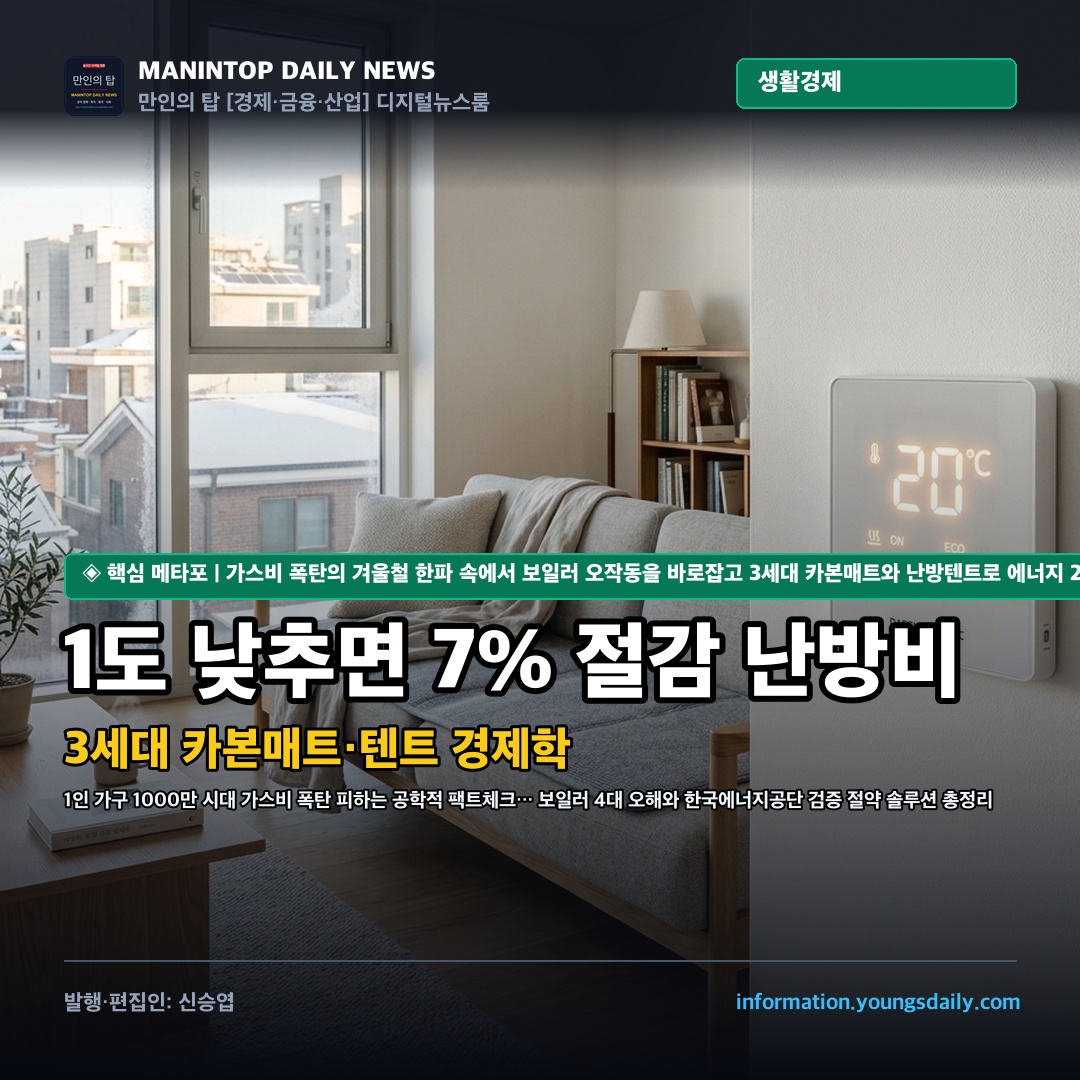
겨울철 아파트 거실 보일러 적정 실내온도 20도 조절과 3세대 카본매트 난방 보도사진
▲ 겨울철 난방비 폭탄을 방지하기 위해 실내 설정온도를 적정 수준인 20℃로 맞추고 고효율 3세대 탄소(카본)매트로 국소 보온을 실천하고 있는 가정집 전경. / 공식 보도자료 사진
3줄 핵심 요약 (Key Takeaways)
  • 외출할 때 보일러를 끄면 재가동 시 가스 소비가 폭증하므로 외출 모드를 유지하고, 온수 온도를 55℃에서 40℃로 낮추는 것이 핵심입니다.
  • 한국에너지공단 실측 결과 실내 온도를 1℃ 낮추면 7%의 에너지가 절감되며, 밸브 조절과 배관 청소만으로 월 4만 7,540원을 아낄 수 있습니다.
  • 소비전력 150W급 3세대 카본매트와 실내 난방텐트를 결합하면 체감온도가 3℃ 이상 올라 약 21%의 난방비를 추가로 방어합니다.

겨울철 한파가 몰아칠 때마다 가계 경제를 위협하는 가장 무서운 불청객은 바로 난방비 고지서입니다. 실내 희망 온도를 단 1도만 낮춰도 전체 에너지의 7%가 절감된다는 공학적 진실과 함께, 보일러를 잘못 다뤄 발생하는 가스비 폭탄을 피하는 법, 그리고 하루 8시간을 틀어도 한 달 전기요금이 커피 한 잔 값에 불과한 3세대 카본매트와 난방텐트의 알뜰한 초절전 난방 경제학을 알기 쉽게 총정리해 드립니다.

1인 가구 1,000만 시대 덮친 난방비 쇼크… LNG 128% 폭등과 공공요금 급등의 실체

추운 겨울이 시작되면 통장 잔고를 가장 먼저 갉아먹는 것이 도시가스 요금입니다. 특히 우리나라 전체 가구의 34.5%를 차지하며 어느덧 1,000만 세대를 돌파한 1인 가구에게 난방비는 생존의 문제입니다. 넓은 집에서 여러 식구가 분담하는 다인 가구와 달리, 원룸이나 소형 오피스텔에 거주하는 1인 가구는 주거 유지 비용을 홀로 감당해야 하기 때문에 에너지 요금 인상의 직격탄을 그대로 맞게 됩니다.

실제 취재 현장에서 확인된 사례들은 가히 충격적입니다. 서울 신창동의 한 원룸에 사는 직장인은 전년과 똑같은 수준으로 보일러를 틀었음에도 무려 22만 8,870원에 달하는 고지서를 받아 들었습니다. 양천구 목동의 다세대 주택 거주자는 한 달 난방비로 13만 3,400원을 청구받아, 일반 관리비와 전기·수도요금을 모두 합친 금액보다 난방비가 더 커지는 역전 현상을 겪었습니다. 경기 고양시에서는 사용량이 31% 늘어났을 뿐인데 요금은 7만 5,852원에서 13만 8,091원으로 82% 폭증하기도 했습니다.

난방비가 이처럼 천정부지로 솟구친 근본적인 이유는 국제 에너지 시장의 원자재 가격 폭등 때문입니다. 러시아와 우크라이나 간 전쟁 등으로 인해 발전용 액화천연가스(LNG) 수입 가격은 단위당 2021년 15.04달러에서 2022년 34.24달러로 무려 128% 폭등했습니다. 이에 따라 대한민국 연간 가스 수입액은 567억 달러(약 70조 원)로 역대 최고 기록을 갈아치웠고, 한국가스공사의 미수금이 8조 8,000억 원대까지 불어나면서 정부는 주택용 도시가스 요금을 1년 새 38.4%, 지역난방 열 요금을 37.8% 잇달아 인상할 수밖에 없었습니다.

지역 및 조사 사례 가스 사용량 변동률 청구 금액 변동 내역 가계 부담 분석 및 핵심 시사점
서울 신창동 1인 가구 전년 동월 대비 유사 유지 월 22만 8,870원 청구 단열 취약 다세대 주택으로 사용량 대비 기본 열 손실 과다
서울 목동 원룸 거주자 체감 난방 시간 10% 증가 13만 3,400원 청구 일반 관리비 및 수도·전기요금 합산액을 초과하는 난방비 역전
경기 고양시 다세대 전년 대비 31% 증가 7만 5,852원 → 13만 8,091원 단가 인상과 사용량 증가가 중첩되며 요금 82% 폭증 부담 발생
전국 평균 1인 가구 동절기 평균 1.5배 증가 평균 1.8배~2.0배 청구 누진적 단가 체계와 한파 지속일수 증가로 체감 충격 극대화

보일러를 둘러싼 4대 상식의 함정… 공학적으로 검증된 가스비 낭비 메커니즘

많은 분들이 난방비를 한 푼이라도 아끼기 위해 일상에서 여러 가지 노력을 기울입니다. 하지만 우리가 흔히 '상식'으로 알고 있던 행동들 중 상당수는 공학적으로 오히려 보일러의 가스 소모를 크게 부추기는 치명적인 실수가 되곤 합니다. 한국에너지공단과 보일러 공학 전문가들이 지적하는 4대 오해를 짚어보겠습니다.

첫째, "외출할 때는 보일러 전원을 완전히 꺼두는 것이 이득이다"라는 생각입니다. 보일러 전원을 완전히 끄고 집을 비우면 방바닥 배관 속에 들어있는 난방수가 얼음장처럼 차갑게 식어버립니다. 외출 후 돌아와 다시 전원을 켜면, 차갑게 식은 방바닥과 배관을 다시 데우기 위해 보일러는 내부 부품을 풀가동하며 장시간 최대 화력으로 불꽃을 태웁니다. 이때 소모되는 가스량은 보일러를 일정 온도로 계속 유지했을 때보다 훨씬 큽니다. 따라서 8시간 이내로 가볍게 외출할 때는 전원을 끄지 말고 반드시 '외출 모드'로 돌려놓아야 난방수가 식지 않아 연료를 아낄 수 있습니다.

둘째, "가스비는 방바닥을 데우는 실내 난방에서 가장 많이 나온다"는 오해입니다. 실제 가정의 도시가스 고지서에서 가장 많은 지분을 차지하는 주범은 방바닥 난방이 아니라 바로 '온수 사용'입니다. 차가운 수돗물을 사람이 샤워할 수 있는 40도 이상의 뜨거운 물로 순식간에 끌어올리는 과정에서 보일러는 순간 최대 열량을 폭발적으로 소비합니다. 온수 설정 온도를 기본 55℃에서 40℃ 안팎으로 15도만 낮춰도 가스 소비량을 극적으로 줄일 수 있습니다.

셋째, "수도꼭지 레버 위치는 보일러 가동과 상관없다"는 편견입니다. 설거지나 양치를 마친 뒤 수도꼭지 손잡이를 '온수' 방향에 그대로 놓아두는 습관이 가스비를 갉아먹습니다. 다음에 물을 잠깐 틀어 손을 씻거나 컵을 헹굴 때조차 보일러 내부의 미세 유량 감지 센서가 작동해 즉시 점화 장치가 돌아가기 때문입니다. 미처 따뜻한 물이 나오기도 전에 물을 잠그더라도 보일러는 이미 헛불을 켠 셈이 되므로, 물을 쓴 뒤에는 손잡이를 반드시 '냉수' 쪽으로 돌려놓는 것이 안전합니다.

넷째, "추울 때 강하게 틀고 더우면 껐다가 다시 트는 것이 낫다"는 간헐 난방 방식입니다. 급격한 온도 변화는 보일러의 열효율을 최악으로 떨어뜨립니다. 보일러는 설정 온도를 18도에서 20도 사이로 고정해 두고, 온도 감응 센서에 의해 안정적으로 연속 운전될 때 가장 적은 가스로 가장 높은 난방 효율을 냅니다.
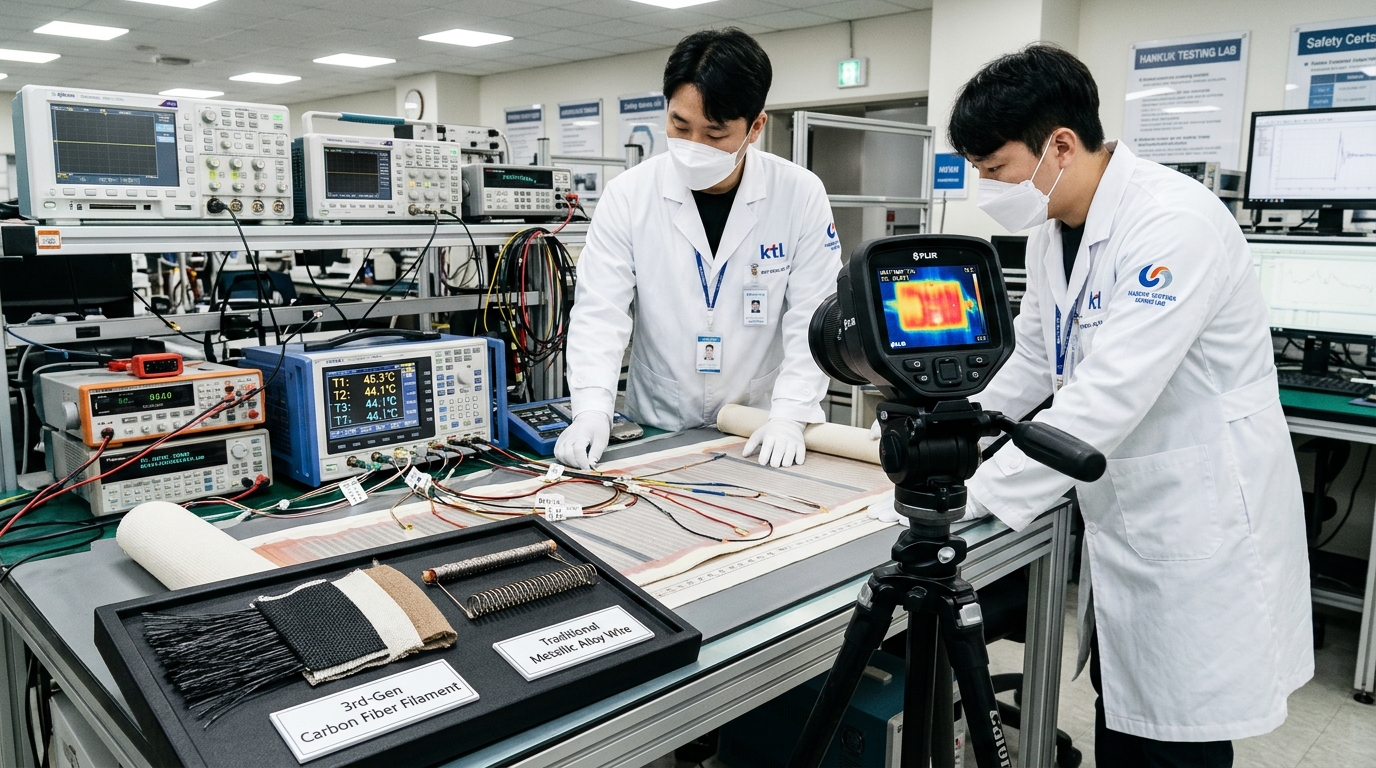
한국산업기술시험원 공인 시험 벤치에서 진행된 3세대 카본매트 열선 및 발열 균일도 시험 보도사진
▲ 공인 시험 인증 연구실에서 연구원들이 열화상 카메라와 디지털 온도 센서를 통해 3세대 탄소섬유 매트와 기존 금속 열선 매트의 표면 발열 균일도 및 전력 효율을 정밀 측정하고 있는 모습. / 공식 보도자료 사진

한국에너지공단 실측 데이터의 증명… 1도 낮출 때 7% 아끼는 행동 수칙별 정량 효과

실내 온도를 조절하고 배관을 점검하는 간단한 생활 습관이 과연 통장에 얼마나 직접적인 이익을 가져다줄까요? 한국에너지공단이 표준 가구(연간 난방 사용량 13.0Gcal, 월평균 환산 가스 사용량 141.7Nm³ 기준)를 대상으로 정밀 분석한 실측 데이터는 놀라운 절약 수치를 보여줍니다.

기본적으로 겨울철 실내 적정 난방 온도는 18℃에서 20℃ 사이입니다. 실내 온도가 20℃를 넘어가기 시작하면, 겨우 1℃를 올릴 때마다 난방비는 15% 이상 가파르게 치솟습니다. 반대로 실내 설정 온도를 딱 1℃만 낮춰도 전체 난방 에너지 소비량의 7%가 절감됩니다. 한국동서발전 연구에 따르면 이 1℃의 절약만으로도 가구당 이산화탄소 배출량이 10%나 줄어드는 친환경 효과까지 발생합니다.

특히 생활 속에서 즉시 실천할 수 있는 3대 배관 및 밸브 관리 수칙의 효과는 정량적으로 검증되어 있습니다. 첫째, 평소 자주 쓰지 않는 드레스룸이나 손님방의 분배기 난방 밸브를 잠그는 조치만으로도 한 달에 가스 38.3Nm³를 아껴 2만 5,923원을 절약할 수 있습니다. 둘째, 보일러 연소실 내부의 그을음을 청소하고 배관 속 공기를 빼내어 난방수가 원활하게 순환하도록 만들면 월 14.2Nm³의 가스를 줄여 1만 3,007원이 절약됩니다. 셋째, 온수 온도를 55℃에서 40℃로 낮추면 월 9.4Nm³를 감축하여 8,610원을 아낍니다. 이 세 가지만 실천해도 매달 약 4만 7,540원의 가스비가 굳는 셈입니다.

절약 실천 행동 요령 월간 가스 절감량 (Nm³) 월간 절감 금액 (원) 월간 CO₂ 감축량 (kgCO₂) 주요 메커니즘 및 실천 팁
안 쓰는 방 분배기 밸브 잠그기 38.3 Nm³ 25,923원 63 kgCO₂ 미사용 방 분배기 차단 후 주 밸브 일부 조절 및 방문 닫기
보일러 청소 및 배관 에어 빼기 14.2 Nm³ 13,007원 31 kgCO₂ 연소 그을음 제거 및 배관 내 에어 배출로 열 순환 효율 극대화
온수 설정 온도 하향 (55℃ → 40℃) 9.4 Nm³ 8,610원 2 kgCO₂ 일 200kg 온수 사용 기준 불필요한 과열 방지 및 열 손실 차단
3대 핵심 절약 수칙 통합 적용 61.9 Nm³ 47,540원 96 kgCO₂ 실내 적정 습도(40~60%) 유지 및 내복 착용 시 체감온도 3℃ 추가 상승

3세대 카본매트 vs 일반 전기장판 전격 비교… 한국소비자원 10종 품질 시험의 진실

도시가스 요금이 폭등하자 넓은 바닥 전체를 보일러로 데우는 대신, 잠자리나 휴식 공간만 집중적으로 따뜻하게 해주는 온열 매트가 필수 가전으로 떠올랐습니다. 온열 매트는 기술 발전에 따라 크게 1세대 전기장판, 2세대 온수매트, 3세대 카본(탄소)매트로 진화해 왔습니다.

1세대 일반 전기장판은 구리나 니크롬 합금 열선에 전기를 흘려 열을 냅니다. 가격은 3만~5만 원대로 저렴하지만 접었을 때 내부 열선이 끊어지거나 피복이 손상되어 화재나 합선 위험이 높고, 전자기파 발생 우려가 있습니다. 2세대 온수매트는 소형 보일러에서 물을 데워 매트 속 튜브로 순환시키는 방식으로 전자파 걱정은 덜었으나, 주기적으로 물을 보충해야 하고 누수 위험이 있으며 모터 소음과 높은 소비전력이 단점으로 꼽혔습니다. 반면 3세대 카본매트는 금속 열선 대신 탄소섬유나 그래핀 열선을 적용하여 원적외선 복사열을 방출합니다. 선이 끊어질 걱정이 없어 접어서 보관하거나 세탁기 울코스로 빨아 쓸 수 있으며 전력 소모도 매우 적습니다.

한국소비자원이 시중에서 가장 인기가 높은 1인용 탄소매트 10개 제품을 정밀 시험 평가한 결과는 주목할 만합니다. 가격은 최저 3만 1,900원에서 최고 35만 8,000원까지 최대 11.2배나 벌어졌습니다. 특히 매트 표면의 부위별 온도 편차(열 균일도)에서 큰 성능 차이가 나타났습니다. 귀뚜라미(KDM-921) 제품은 부위별 온도 편차가 0.4℃에 불과해 매트 전체에 온기가 가장 고르게 퍼졌으며, 실속형 중에서는 듀플렉스(전기요SS)가 3.0℃의 준수한 균일도를 기록했습니다. 반면 일부 제품은 부위별 편차가 10.5℃까지 벌어져 발 쪽은 뜨겁고 등 쪽은 미지근한 불균형을 보였습니다. 20℃에서 35℃까지 도달하는 발열 속도는 한일의료기가 12분으로 가장 빨랐고, 경동나비엔과 장수돌침대도 20분대 초반의 우수한 성능을 나타냈습니다.

난방기구 구분 대표 소비전력 하루 4시간 가동 시 (월) 하루 8시간 가동 시 (월) 하루 10시간 가동 시 (월) 겨울 4개월 누적 전기요금
전기장판 1인용 100W 1,540원 3,090원 (12.0 kWh) 3,860원 1만 2,360원 (8시간 기준)
전기장판 2인용 180W 2,780원 5,560원 (21.6 kWh) 6,950원 2만 2,240원 (8시간 기준)
카본매트 2인용 150W 2,310원 4,630원 (18.0 kWh) 5,790원 1만 8,520원 (8시간 기준)
비교군: 세라믹 히터 1,500W급 3만 5,080원 누진 폭탄 구간 진입 사용 비권장 14만 원 이상 (가계 경제 치명타)

여기서 반드시 기억해야 할 전기요금의 핵심은 한국전력의 '주택용 누진제'입니다. 월 전력 사용량이 300kWh 이하인 가구라면 150W짜리 카본매트를 매일 8시간씩 한 달 내내 틀어도 추가되는 전기요금은 4,630원에 불과합니다. 하지만 다른 가전 사용이 많아 월 전력량이 400kWh를 초과하는 가구는 누진 3단계 최고 단가(kWh당 약 659원)가 적용되어 추가 요금이 1만 4,240원까지 뜁니다. 특히 1,500W가 넘는 고전력 세라믹 전열 히터는 하루 4시간만 틀어도 한 달에 3만 5,000원이 훌쩍 넘어가므로 난방비 절감용으로는 절대 피해야 합니다.
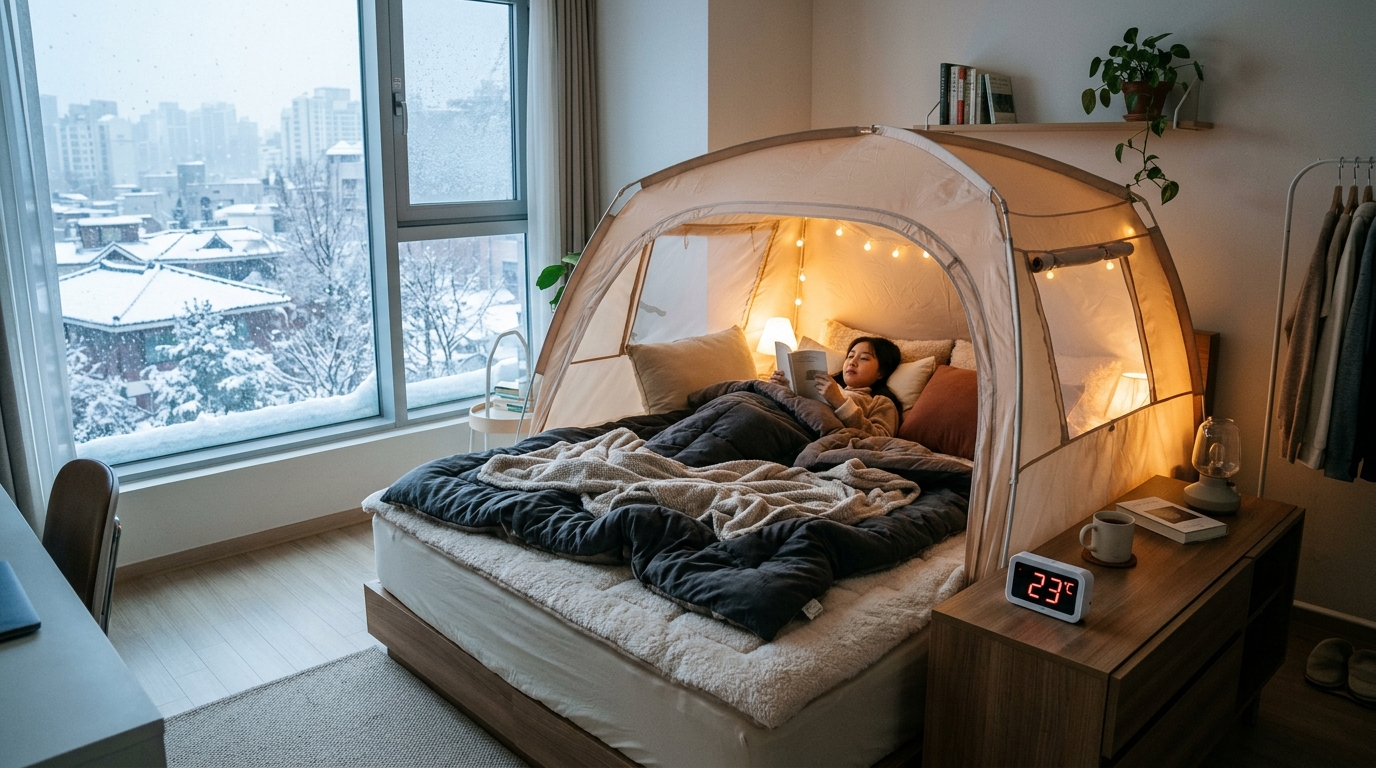
겨울철 아파트 침실에 설치된 실내 난방텐트 내부 보온 효과 및 온습도 모니터링 보도사진
▲ 원룸 및 침실 침대 위에 설치된 실내 난방텐트(보온텐트) 내부 전경. 외풍을 차단하고 체온과 카본매트 복사열을 가두어 실내 공기 온도를 3℃ 이상 끌어올리는 효과를 낸다. / 공식 보도자료 사진

틈새 난방의 과학… 실내 난방텐트의 21% 절감 잠재력과 초절전 소형 가전 생태계

바닥은 따뜻한데 코끝이 시린 '외풍(냉기)' 때문에 보일러 온도를 계속 올리는 가정이 많습니다. 이때 기적 같은 보온 효과를 발휘하는 아이템이 바로 실내 '난방텐트'입니다. 한국소비자원이 시중 7대 난방텐트 브랜드를 시험 평가한 결과에 따르면, 실내온도 20℃ 방에서 전기매트와 난방텐트를 함께 쳤을 때 텐트 내부 공기 온도는 23℃까지 올라갔습니다. 공간 전체를 덥히지 않고도 텐트 내부 공기가 3℃나 따뜻해진 것입니다.

실내 온도를 1℃ 낮출 때마다 난방 에너지가 7% 절약된다는 공식에 대입하면, 텐트 내부 온도가 3℃ 올라간다는 것은 보일러 설정을 그만큼 낮출 수 있어 약 21%의 난방비를 절감할 수 있는 엄청난 잠재력을 의미합니다. 심지어 인천대학교 산학협력단 시험에서는 난방기구를 전혀 켜지 않은 6.5℃의 냉골 환경에서도 사람이 텐트 안에 들어가 머무르는 것만으로 순수 체온에 의해 내부 온도가 5.8℃나 상승하는 결과가 입증되었습니다. 특수 보온 원단이 차가운 외풍을 완벽히 차단하고 인체 복사열을 내부에 가두는 보온 챔버 역할을 하기 때문입니다.

여기에 1인 가구의 좁은 공간에 최적화된 초절전 소형 가전들도 눈부시게 진화하고 있습니다. 책상 밑이나 침대 옆에 세워두는 신일 파티션 히터는 5겹 난연 카본 필름 구조로 소비전력이 145W에 불과해 하루 8시간을 써도 한 달 전기요금이 약 1,810원 수준입니다. 귀뚜라미의 프리미엄 3세대 카본매트(KMF 시리즈)는 에코 모드 구동 시 소비전력을 160W로 억제해 일반 가동 대비 20%의 에너지를 추가로 아껴주며, 80만 회 굽힘 내구성 시험을 통과해 하루 100번을 접어도 20년 이상 끄떡없는 내구성을 확보했습니다.

안전이 전제되지 않은 절약은 재앙… 저온화상 방지와 라텍스 금기 등 필수 안전 수칙

난방비를 아무리 많이 아낀다 한들 화재가 나거나 신체에 부상을 입는다면 돌이킬 수 없는 손실입니다. 겨울철 온열 가전을 사용할 때 반드시 지켜야 할 안전 수칙을 명심해야 합니다.

가장 주의해야 할 복병은 '저온화상'입니다. 사람의 피부는 40℃에서 50℃ 사이의 은근히 따뜻한 온도라 하더라도 장시간 접촉하고 있으면 피부 단백질이 변성되어 깊은 화상을 입게 됩니다. 특히 잠이 들면 감각이 둔해져 화상을 입고도 깨어나지 못하는 경우가 많습니다. 따라서 취침 시 온열 매트 온도는 반드시 체온 수준인 37℃ 이하로 설정해야 안전하며, 체온 조절 능력이 미숙한 영유아나 감각이 저하된 고령자는 매트 사용에 각별한 주의가 필요합니다.

둘째, 라텍스나 메모리폼 매트리스 위에는 전기장판이나 카본매트를 절대 올려놓아서는 안 됩니다. 천연고무 라텍스와 고밀도 메모리폼은 열 흡수율이 비정상적으로 높고 열을 밖으로 방출하지 못하는 치명적인 축열 특성을 가지고 있습니다. 이 위에 온열 매트를 켜두면 매트리스 내부 온도가 100도 이상 통제 불능으로 치솟아 매트리스가 녹아내리거나 대형 화재로 이어집니다. 온열 매트는 반드시 일반 스프링 매트리스나 온돌 바닥 위에 두고 사용해야 합니다.

셋째, 보관과 세탁 요령입니다. 겨울이 끝나고 매트를 보관할 때는 열선이 완전히 식은 뒤에 원래 접혀 있던 선을 따라 느슨하게 접어야 하며, 접어둔 매트 위에 무거운 이불이나 상자를 쌓아두면 내부 열선이 눌려 끊어질 수 있습니다. 세탁이 가능한 워셔블 카본매트라 하더라도 세탁기 건조기 기능은 절대 사용해서는 안 되며, 드럼세탁기 '울코스'로 부드럽게 세탁한 뒤 자연 건조해야 합니다. 아울러 실시간 전력 사용량을 스마트폰 앱으로 확인할 수 있는 '스마트 계량기(스마트 미터)'를 활용해 욕실 바닥 전열선이나 낡은 대기전력 가전의 에너지 누수를 수시로 점검하는 지혜가 필요합니다.

[In-Depth Analysis] Cutting Heating Bills by 21%: The Economics of 3rd-Gen Carbon Mats and Winter Energy Optimization

Winter Apartment Living Room Thermostat Set to 20C and 3rd-Gen Carbon Heating Mat Press Photo
▲ A modern apartment living room where the indoor thermostat is optimized to 20C with a high-efficiency 3rd-generation carbon heating mat deployed for localized warmth to prevent winter heating cost shocks. / Official Press Archive Photo
Key Takeaways
  • Switching boilers to Away Mode during short outings and lowering hot water temperature from 55C to 40C prevents sudden surges in fuel consumption.
  • Korea Energy Agency empirical tests prove that lowering indoor thermostat settings by 1C cuts energy consumption by 7%, yielding 47,540 KRW monthly savings.
  • Combining a 150W 3rd-generation carbon mat with an indoor thermal warming tent raises microclimate temperature by 3C, guarding against heating costs by 21%.

Whenever severe winter cold snaps arrive, escalating household heating bills impose direct financial burdens across urban households. By cutting the indoor thermostat by just one single degree, households can achieve an immediate 7 percent reduction in overall energy consumption. This investigative report uncovers the engineering fallacies behind common boiler habits, while examining the economics of 3rd-generation carbon mats and thermal indoor tents that deliver localized warmth for the price of a cup of coffee per month.

The Heating Bill Shock in the Era of 10M Single-Person Households: LNG Spikes 128% and Public Utility Pressures

As winter temperatures plunge across the peninsula, gas utility invoices represent the primary source of household budgetary strain. This pressure falls disproportionately on single-person households, which now constitute 34.5 percent of all households in South Korea and officially surpass the 10 million milestone. Unlike multi-member families residing in spacious dwellings who share fixed utility costs, solo dwellers living in studio apartments or efficiency units bear housing expenditures in complete isolation, absorbing the full brunt of public utility tariff adjustments.

Documented field investigations highlight severe budgetary disruptions. In Shinchang-dong, Seoul, a solo worker received a monthly gas invoice of 228,870 KRW despite maintaining identical consumption patterns from the prior year. In Mok-dong, a studio apartment resident faced a heating bill of 133,400 KRW, an amount surpassing general maintenance dues, water fees, and electric utility charges combined. In Goyang, Gyeonggi Province, an incremental 31 percent rise in physical usage triggered an 82 percent surge in billing, leaping from 75,852 KRW to 138,091 KRW.

The root cause behind this tariff surge traces directly to extreme raw material volatility in international wholesale markets. Disruptions stemming from regional conflicts propelled imported liquefied natural gas (LNG) unit prices from 15.04 USD per MMBtu in 2021 to 34.24 USD in 2022, representing an unprecedented 128 percent increase. Consequently, national annual gas imports set an all-time record of 56.7 billion USD (approximately 70 trillion KRW). As Korea Gas Corporation accumulated receivables exceeding 8.8 trillion KRW, residential gas tariffs were hiked by 38.4 percent while district heating thermal rates climbed 37.8 percent over a single calendar year.

Region & Investigative Case Gas Consumption Variance Billed Amount Fluctuations Household Budget Impact & Analytical Implications
Seoul Shinchang-dong Solo Dweller Maintained identical annual usage 228,870 KRW billed monthly Severe structural heat dissipation in older residential multi-units
Seoul Mok-dong Studio Tenant Subjective operating hours up 10% 133,400 KRW billed monthly Heating costs completely exceeded combined electric and maintenance dues
Gyeonggi Goyang Residential Unit 31% usage increase over prior year 75,852 KRW to 138,091 KRW Tariff unit price hikes compounded with usage to produce an 82% cost spike
National Solo Household Baseline Winter physical usage up 1.5x Billed amounts up 1.8x to 2.0x Progressive unit tariff structures severely amplified cold snap impacts

The Four Conventional Traps of Boiler Operation: Engineering Mechanisms of Fuel Waste

In an earnest endeavor to curtail heating expenditures, consumers routinely adopt habits that paradoxically inflate fuel consumption. Mechanical engineering analyses conducted by the Korea Energy Agency demonstrate that intuitive conservation instincts frequently conflict with thermal dynamics.

First is the pervasive assumption that turning off the boiler entirely during outdoor excursions conserves fuel. Completely disconnecting power permits indoor air and circulated radiant pipe water to chill to ambient winter temperatures. Upon re-ignition, the heating unit must operate at peak thermal combustion for extended intervals to elevate cold radiant piping back to target levels, consuming vastly more gas than continuous low-temperature operation. During short absences under eight hours, maintaining Away Mode preserves baseline loop temperatures and minimizes re-ignition penalties.

Second is the misconception that radiant underfloor heating represents the largest driver of billing totals. Empirical audits demonstrate that sanitary domestic hot water (DHW) generation constitutes the single largest consumer of residential gas. Elevating cold municipal intake water instantaneously to scalding temperatures forces the burner into maximum capacity. Lowering the default hot water supply parameter from 55C to 40C curtails excess thermal waste without diminishing personal comfort.

Third is the disregard for faucet handle positioning. Leaving mixer taps oriented toward the hot position triggers flow sensors even during momentary cold rinses, prompting ignition cycles that consume gas prior to water reaching target faucets. Reorienting handles toward cold after each use prevents unintended burner firing.

Fourth is the reliance on intermittent high-heat cycling, alternating between maximum combustion and complete shutdown. Abrupt temperature fluctuations degrade thermal efficiency. Modern condensing units operate with superior efficiency when set to continuous low-fire operation calibrated between 18C and 20C.

Korea Testing Laboratory Technical Benchmark Evaluating 3rd-Gen Carbon Heating Wire Press Photo
▲ Technical certification laboratory engineers utilizing thermal imaging radiometers and digital sensors to measure heating uniformity and electrical efficiency across 3rd-generation carbon filament mats. / Official Press Archive Photo

Verified by the Korea Energy Agency: Quantitative Savings of 7% per Degree and Behavioral Action Effects

Empirical auditing performed by the Korea Energy Agency for baseline residential households (standard annual thermal consumption of 13.0 Gcal, converting to 141.7 Nm3 monthly) provides validated metrics regarding targeted behavioral modifications.

The optimal winter indoor thermostat baseline is defined between 18C and 20C. Once room temperatures surpass 20C, each additional degree Celsius elevates thermal energy consumption by over 15 percent. Conversely, lowering target thermostat thresholds by exactly 1C yields a 7 percent reduction in aggregate fuel consumption. Eastern Power research further validates that this modest 1C adjustment eliminates approximately 10 percent of household carbon dioxide emissions.

Three mechanical plumbing interventions generate immediate verified savings. First, closing radiant distributor isolation valves in unoccupied rooms reduces monthly consumption by 38.3 Nm3, saving 25,923 KRW. Second, removing soot from combustion chambers and bleeding trapped air from radiant loops saves 14.2 Nm3, translating to 13,007 KRW. Third, lowering sanitary hot water output from 55C to 40C eliminates 9.4 Nm3, yielding 8,610 KRW. Executing these three adjustments concurrently preserves approximately 47,540 KRW monthly.

Conservation Practice Monthly Gas Reduction (Nm³) Monthly Cost Savings (KRW) Monthly CO₂ Reduction (kgCO₂) Core Mechanism & Operational Tips
Isolating Unoccupied Room Valves 38.3 Nm³ 25,923 KRW 63 kgCO₂ Close manifold valves, slightly damp main valve, and seal internal doors
Boiler Servicing & Radiator De-Aeration 14.2 Nm³ 13,007 KRW 31 kgCO₂ Eliminate burner soot and bleed loop air to maximize hydronic circulation
Lowering Domestic Hot Water (55C → 40C) 9.4 Nm³ 8,610 KRW 2 kgCO₂ Prevent thermal overheating based on 200 kg daily hot water usage
Combined Three-Pillar Protocol 61.9 Nm³ 47,540 KRW 96 kgCO₂ Maintain 40-60% humidity and wear thermal undergarments for +3C effect

3rd-Gen Carbon Mats vs Traditional Electric Blankets: Testing Truths from 10 Consumer Products

As centralized hydronic heating tariffs surge, localized thermal appliances have emerged as indispensable household investments. The market has evolved across three distinct technological generations: 1st-generation electric resistance blankets, 2nd-generation hydronic circulation mats, and 3rd-generation carbon filament mats.

First-generation mats rely on metallic nichrome alloy resistance wiring. While inexpensive, mechanical folding risks internal wire fracture, localized overheating, and electromagnetic field radiation. Second-generation hydronic mats circulate warm water via external micro-boilers; while eliminating electromagnetic exposure, they require periodic reservoir replenishment, generate pump motor vibration, and consume higher operating wattage. Third-generation carbon mats utilize carbon fiber or graphene molecular filaments that generate radiant far-infrared warmth, resisting wire fatigue, enabling machine washability, and drawing minimal electrical wattage.

Korea Consumer Agency quality assessments across 10 single-person carbon mat products revealed extensive performance variances. Pricing spanned from 31,900 KRW to 358,000 KRW, representing an 11.2-fold disparity. Surface thermal uniformity demonstrated pronounced divergence: the Kiturami KDM-921 demonstrated exceptional thermal distribution with a localized deviation of just 0.4C, while value-tier Duplex recorded a solid 3.0C variance. Conversely, poorly engineered units exhibited deviations reaching 10.5C. Thermal acceleration testing measuring progression from 20C to 35C ranged from 12 minutes for Hanil Medical to 25 minutes for KyungDong Navien.

Heating Device Type Rated Power 4 Hours Daily (Monthly) 8 Hours Daily (Monthly) 10 Hours Daily (Monthly) 4-Month Winter Total Expense
Electric Blanket Single 100W 1,540 KRW 3,090 KRW (12.0 kWh) 3,860 KRW 12,360 KRW (8-hour basis)
Electric Blanket Double 180W 2,780 KRW 5,560 KRW (21.6 kWh) 6,950 KRW 22,240 KRW (8-hour basis)
Carbon Mat Double 150W 2,310 KRW 4,630 KRW (18.0 kWh) 5,790 KRW 18,520 KRW (8-hour basis)
Ceramic Convection Heater 1,500W class 35,080 KRW Triggers Tier-3 Penalty Not Recommended Exceeds 140,000 KRW (Severe Risk)

Understanding the Korea Electric Power Corporation (KEPCO) progressive tariff structure is critical. For households consuming under 300 kWh monthly, running a 150W carbon mat for eight hours daily adds merely 4,630 KRW to monthly electric bills. However, if aggregate baseline consumption exceeds 400 kWh, Tier-3 marginal tariffs (approx. 659 KRW per kWh) elevate that identical mat expense to 14,240 KRW. High-drain ceramic convection space heaters drawing 1,500W generate monthly surcharges exceeding 35,000 KRW for four hours of daily use, rendering them counterproductive for budget-conscious heating.

Winter Bedroom Indoor Thermal Warming Tent Microclimate and Sensor Monitoring Press Photo
▲ An indoor thermal warming tent pitched over a bedroom bed, trapping body heat and carbon mat radiant warmth while deflecting drafts to boost microclimate temperatures by over 3C. / Official Press Archive Photo

The Science of Microclimate Warmth: 21% Savings with Indoor Heating Tents and Ultra-Low-Power Appliances

Cold drafts infiltrating living spaces frequently induce occupants to increase centralized boiler settings. Indoor thermal tents provide a scientific remedy by creating an insulated microclimate. Comprehensive testing by the Korea Consumer Agency demonstrated that pitching an indoor tent over a thermal mat in a 20C ambient room elevated interior air temperatures to 23C, generating an immediate 3C microclimate differential.

Correlating this 3C gain with the empirical rule that each degree reduction in whole-house thermostat settings saves 7 percent of heating energy reveals that indoor tents offer a 21 percent heating cost reduction potential. In extreme testing conducted by Incheon National University, unpowered tents placed in 6.5C environments elevated interior air by 5.8C through human metabolic body heat alone, as specialized textile membranes trapped radiant body warmth and blocked convective drafts.

Complementary low-wattage appliances further optimize localized comfort. Foldable partition heaters drawing 145W provide radiant desk warmth for 1,810 KRW per month at eight hours of daily use. Premium carbon mats featuring eco-mode firmware throttle electrical demand by 20 percent while passing 800,000-cycle bend fatigue tests, guaranteeing mechanical durability for over two decades of seasonal folding.

Savings Without Safety Is a Hazard: Preventing Low-Temperature Burns and Avoiding Latex Complications

Financial conservation must never compromise structural safety or physical well-being. Operating localized heating appliances mandates rigorous adherence to fire prevention and ergonomic safeguards.

Low-temperature contact burns represent a covert hazard. Prolonged dermal exposure to temperatures between 40C and 50C causes progressive protein denaturation and deep subcutaneous tissue injury without awakening sleeping occupants. Bedtime mat settings should never exceed 37C normal body temperature, with elderly individuals and infants requiring heightened supervision.

Furthermore, deploying electric or carbon heating mats directly atop latex or memory foam mattresses is strictly hazardous. Natural rubber latex and viscoelastic foam exhibit high thermal absorption and zero heat dissipation. Superimposing an active heating appliance causes internal temperatures to spike uncontrollably beyond 100C, causing chemical breakdown, toxic off-gassing, or catastrophic combustion. Heating mats must exclusively rest upon traditional innerspring mattresses or hard flooring.

Post-season maintenance dictates that mats should only be folded along factory seams after internal elements have completely cooled, avoiding heavy cargo stacking that fractures internal conductors. Washable carbon units must never enter heated drying machines, requiring gentle drum cycles and natural hanging dry. Finally, monitoring smart electric meters enables real-time identification of hidden thermal leaks, such as defective bathroom underfloor heating, ensuring comprehensive household energy efficiency.

PRO SOURCING ENGINE 만인의 탑 빅데이터 솔루션
★ 가입 시 600 크레딧(120회) 전원 무료

내가 찾는 상품 키워드, 지금 얼마나 검색될까?

네이버 월간 검색량 + 구글 볼륨 + 아이템스카우트 실시간 상품수와 경쟁강도 배지를 0.5초 만에 무료로 확인하세요.

신고하기

이 블로그 검색

환절기 감기 예방법 찐실천 후기와 전문가 조언으로 완성한 코와 목 관리 99% 방어 루틴

리모델링 아파트 계약금 10%는 언제 내나요? 계약서·공고문으로 확인하는 납부 시점

윤석열 탄핵·12·3 비상계엄·내란 혐의 재판까지: 근거로 확인되는 범위만 한 번에 정리
