[기획취재·민생경제] "1만 7,000원 치킨 팔아 남는 돈 2,600원"…'무료배달의 역설'과 9.8% 수수료 발(發) 이중가격제 확산 실태 심층 분석
기사 승인: 2026년 11월 6일 | 취재 및 보도: 신승엽 수석 기자 (경제·플랫폼정책 전문) | 공식 문의: 010-7330-1649 / youb1649@gmail.com
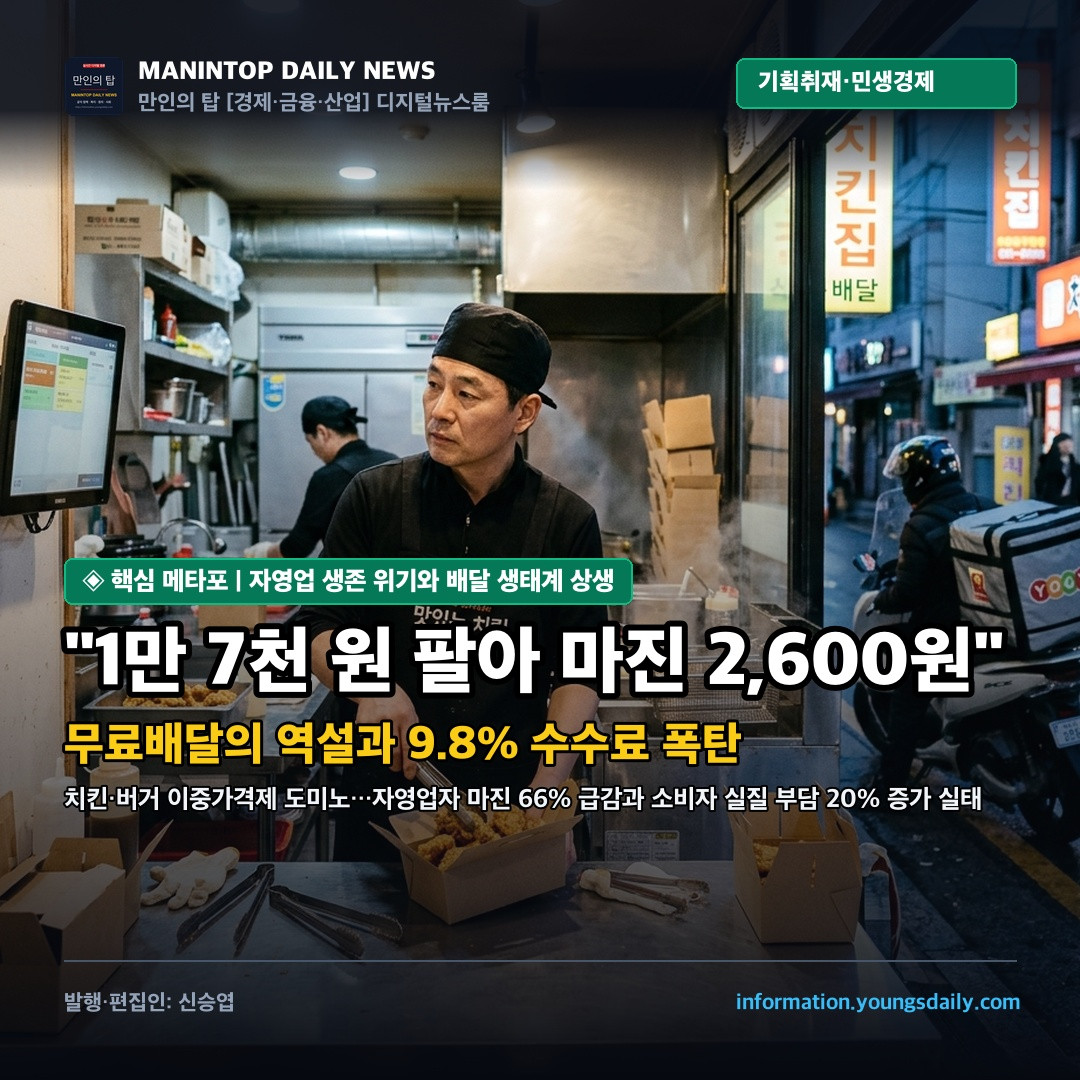
▲ 서울 도심의 한 치킨 매장에서 점주가 조리된 음식을 포장하며 태블릿 POS 단말기의 배달 수수료 내역을 살피고 있다. 바깥 골목에는 배달 라이더가 대기하고 있다. 만인의 탑
핵심 취재 팩트 요약 (Executive Summary)
- 17,900원 치킨 마진 66% 급감: 한국소비자단체협의회 원가분석 결과 전화주문 시 7,711원이던 점주 마진이 배달앱 정률제(배민원) 주문 시 2,631원으로 주저앉았다. 중개수수료(9.8%), 결제수수료(3%), 배달비(2,900원~3,630원)가 합산되어 주문액의 25~30%가 플랫폼 비용으로 빠져나간다.
- 소액 주문 수수료율 32.7% 육박: 참여연대 실태조사 결과 1만 5,000원 분식 주문 시 업주 부담 총수수료가 4,910원(32.7%)에 달해, 소액 주문 비중이 높은 골목상권 자영업자들은 월 106만 원 이상의 실질 소득 감소를 겪고 있다.
- '무료배달의 역설'과 소비자 실질 부담 20% 증가: 무료배달 표방에도 불구하고 음식값 누적 인상과 유료 멤버십 구독료(와우 7,890원 등)로 인해 1회 주문당 소비자 실질 지출은 2,990원(19.9%) 증가했다.
- 이중가격제 도미노와 외식물가 타격: 점주의 47.6%가 가격을 올렸고 34.8%가 매장가와 배달가를 다르게 받는 이중가격제를 도입했다. 햄버거 세트는 1,200원(16.4%), 치킨은 최대 5,000원 비싸졌으며, 도시락 물가지수는 전년 대비 11.1% 급등했다.
- 자영업자 vs 배달 라이더 동시 집회와 입법 공방: 2026년 11월 5일 청와대 앞 라이더 400명의 배달료 삭감 반대 집회와 국회 앞 자영업자들의 3대 규제 입법 촉구 집회가 동시에 열렸다. 공정위는 최혜대우 요구 동의의결을 기각했고 국회는 수수료 15% 상한제 입법에 속도를 내고 있다.
1. 굽네치킨 실측 마진 분석: "팔수록 적자" 구조적 메커니즘
국내 배달 플랫폼 시장 점유율 96%를 장악한 배달의민족, 쿠팡이츠, 요기요 등 '빅3'가 과거 월 8만 원 고정 광고료(정액제)에서 주문 건당 일정 비율을 떼어가는 정률제 요금제로 체제를 전면 개편하면서 골목 외식업계가 벼랑 끝으로 내몰리고 있다.
한국소비자단체협의회 물가감시센터가 발표한 굽네치킨 오리지널(판매가 17,900원)의 실제 정산 내역 분석은 배달앱 정률제의 파괴적 수탈 구조를 적나라하게 보여준다. 동일한 가격의 치킨 한 마리를 판매하더라도 소비자가 어떤 채널로 주문하느냐에 따라 점주가 손에 쥐는 최종 마진은 3분의 1 토막이 난다.
| 정산 항목 (단위: 원) | 전화 주문 (직접 배달) | 배민 가게배달 (오픈리스트) | 쿠팡이츠 (스마트 요금제) | 배민원 (배민배달 플러스) |
|---|---|---|---|---|
| 판매 가격 (A) | 17,900원 | 17,900원 | 17,900원 | 17,900원 |
| 메뉴 원가 (생닭·부자재) | 8,562원 | 8,562원 | 8,562원 | 8,562원 |
| 중개 수수료 | 0원 | 1,563원 | 1,477원 | 1,930원 (9.8%) |
| 업주 부담 배달비 | 1,000원 | 1,000원 | 3,100원 | 3,630원 |
| 결제 수수료 및 부가세 | 627원 | 1,246원 | 1,048원 | 1,147원 |
| 점주 최종 마진 | 7,711원 (기준) | 5,529원 (-28%) | 3,713원 (-52%) | 2,631원 (-66% 폭락) |
출처: 한국소비자단체협의회 물가감시센터 원가분석 보고서
전화 주문 시 7,711원에 달하던 점주 마진은 배민원 주문 시 2,631원으로 무려 66%(5,080원)나 급감한다. 여기에 22,900원짜리 '볼케이노 콤보'는 전화 주문 마진 9,223원에서 배민원 3,535원으로, 34,900원짜리 순살 곱빼기는 14,568원에서 7,422원으로 반토막이 난다.
소액 주문 구간의 수수료율은 더욱 가혹하다. 참여연대 민생희망본부가 분석한 분식점 실태에 따르면, 1만 5,000원 주문 시 중개수수료(1,170원), 결제수수료(360원), 업주 배달비(3,380원)가 차감되어 총수수료율이 매출의 32.7%(4,910원)에 육박했다. 1만 5,000원대 주문이 전체의 60%를 차지하는 해당 매장은 수수료 체계 개편 이후 매월 106만 원 이상의 실질 영업 손실을 기록하고 있다.
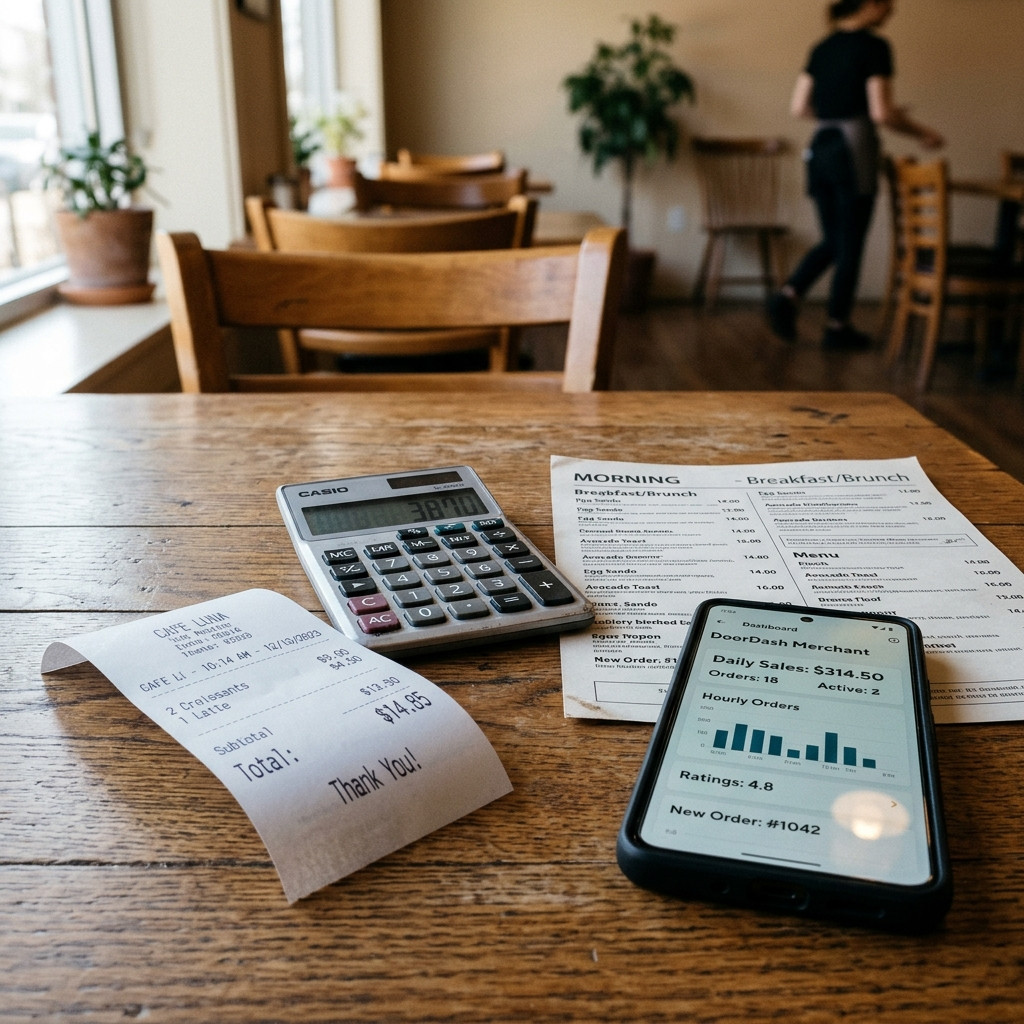
▲ 음식점 카운터 위의 POS 주문 정산 영수증과 마진 계산기, 배달 파트너 앱 화면. 정률제 수수료 인상에 대응해 매장가와 배달가를 분리하는 이중가격제가 보편화되고 있다. 만인의 탑
2. '무료배달의 역설': 소비자 실질 지출은 왜 20% 늘어났는가
플랫폼들이 대대적으로 홍보하는 '무료배달'은 소비자에게 결코 공짜가 아니었다. 다면시장 구조를 지닌 플랫폼 생태계에서 플랫폼 기업이 마케팅 비용을 입점업체에 전가하자, 마진이 붕괴된 자영업자들은 생존을 위해 메뉴 가격을 올렸고, 이는 고스란히 소비자 부담으로 귀결되었다.
무료배달 마케팅의 비용 전가 및 이중가격 확산 메커니즘
flowchart TD
    A["배달 플랫폼 간 무료배달 출혈 경쟁 가속화"] --> B["중개수수료 9.8% 인상 및 업주 부담 배달비(최대 3,400원) 전가"]
    B --> C["자영업자 마진 66% 급감 ('팔수록 적자')"]
    C --> D["매장가 대비 배달가를 1,000~5,000원 올리는 '이중가격제' 도입"]
    D --> E{"소비자의 체감 외식 비용"}
    E -->|명목상 배달비 0원| F["음식값 인상(4,000원) + 유료 멤버십 구독료(와우/배민패스) 결합"]
    F --> G["1회 주문당 소비자 실질 지출 2,990원 (19.9%) 증가 (소비자 피해 전가)"]
참여연대 이슈리포트의 모델링 분석은 충격적이다. 동일 매장에서 돈까스와 국수를 주문했을 때, 무료배달 도입 전인 2023년에는 음식값 1만 2,000원에 배달비 3,000원을 더해 총 1만 5,000원을 지출했다. 그러나 무료배달이 정착된 2025년에는 배달비는 0원이 되었지만 수수료 전가로 음식값이 1만 6,000원으로 올랐고, 월 환산 구독료(1,990원)가 더해져 최종 지출액은 1만 7,990원으로 19.9%(2,990원)나 급증했다.
이러한 비용 전가는 이중가격제의 전면 확산으로 이어졌다. 햄버거 세트의 매장 가격은 7,300원인 반면 배달앱 가격은 8,500원으로 1,200원(16.4%) 비싸게 책정되었으며, 치킨 프랜차이즈는 배달앱 메뉴 가격을 2,000원에서 최대 5,000원까지 높게 받는다. 농림축산식품부 공식 통계에 따르면 도시락 프랜차이즈의 이중가격제 도입 여파로 2024년 10월 도시락 소비자물가지수는 전년 대비 11.1%나 폭등했다.
3. 자영업자 vs 배달 라이더의 정면충돌: 2026년 11월 5일 도심 동시 집회
배달 플랫폼의 수수료 갈등은 결국 약자 간의 을(乙)과 병(丙)의 정면충돌이라는 비극적인 장면을 연출했다. 2026년 11월 5일 오전 10시, 서울 도심에서는 자영업자와 배달 라이더가 각기 다른 장소에서 서로 다른 요구를 걸고 동시에 대규모 집회를 열었다.
서울 종로구 청와대 분수광장에 집결한 수도권 배달 라이더 400여 명은 국회에서 논의 중인 '배달 수수료 상한제' 법안의 전면 철회를 요구했다. 플랫폼의 수수료 상한이 규제되면 플랫폼이 수익 감소분을 라이더에게 지급하는 건당 배달료 삭감으로 전가할 것이라는 우려 때문이다. 유류비, 정비비, 오토바이 리스료를 자부담하는 라이더들은 건당 300원만 깎여도 생계가 휘청거린다며, 배달료 삭감 방지책과 배달비 원가 산정 구조 공개를 촉구했다.
같은 시각, 여의도 국회 본청 앞에서는 '공정한 플랫폼을 위한 사장협회' 등 자영업자 단체들이 배달앱 규제 입법 촉구 성토대회를 열었다. 점주들은 9.8% 중개수수료에 3,400원 배달비, 결제수수료와 광고비까지 더해져 마진이 소멸했다며, 개별 점주의 협상력이 전무한 만큼 온라인플랫폼법(온플법)과 음식배달플랫폼법(음플법) 등 '3대 규제 입법'의 즉각적인 통과를 요구했다.
4. 상생협의체 파행과 공정위 제재 및 국회 입법 격돌
정부 주도로 100일 넘게 12차례 회의를 이어온 '배달플랫폼 상생협의체'는 매출 상위 35% 업체에 7.8% 수수료를 적용하되 배달비를 최대 3,400원으로 올리는 '차등수수료안'을 제시했으나 거센 반발에 직면했다. 시뮬레이션 결과 2만 원 주문 시 상위 점주의 총 부담액은 4,860원에서 4,960원으로 오히려 100원 늘어나는 역설이 발생했기 때문이다. 프랜차이즈 가맹점주 단체들은 일률 5% 상한제를 요구하며 상생안을 거부했다.
공정거래위원회는 배달의민족과 쿠팡이츠의 시장지배적 지위 남용에 대해 칼을 빼들었다. 2026년 6월 18일, 공정위는 플랫폼 측이 신청한 동의의결(자진시정) 절차를 전격 기각했다. 핵심 쟁점은 다른 앱보다 낮거나 동일한 가격을 강요하는 최혜대우 요구(MFN)와 와우 멤버십에 배달 무료 및 OTT를 결합한 끼워팔기(Tying) 행위다.
국회 정무위원회 계류 주요 배달앱 규제 입법안 비교
- 이강일 의원안: 중개수수료, 결제수수료, 광고비를 합산하여 총액 15% 이내로 엄격 제한하는 '총액 캡' 도입.
- 박정훈 의원안: 플랫폼의 배달비 전가 꼼수를 차단하기 위해 **배달비까지 포함한 총액 수수료를 15%로 제한**하는 강력한 통합 상한제.
- 김남근 의원안: 영세·소상공인 입점업체를 대상으로 매출 구간별 우대수수료율을 의무 적용하는 온라인플랫폼 거래공정화법 연계안.
5. 소비자 알권리와 합리적 소비 4대 체크리스트
배달앱 수수료 갈등 속에서 소비자가 '보이지 않는 비용'을 떠안지 않기 위해서는 이중가격 여부를 꼼꼼히 확인하고 합리적인 소비 습관을 실천해야 한다.
배달앱 이중가격제 피해 예방 및 합리적 소비 4대 체크리스트
6. 만인의 탑 데스크 총평: 플랫폼 독과점의 '약탈적 무료'를 끝내야
'배달비 0원'이라는 달콤한 마케팅의 이면에는 골목 자영업자의 피눈물과 배달 노동자의 고용 불안, 그리고 외식물가 도미노 인상이라는 가혹한 청구서가 숨겨져 있었다. 플랫폼이 독과점 지위를 이용해 입점업체의 가격 결정권을 침해하고 배달비를 전가하는 행태는 지속 가능한 경제 모델이 될 수 없다.
유럽연합의 디지털시장법(DMA)처럼 거대 플랫폼의 자사우대와 최혜대우 강요를 금지하고, 배달비를 포함한 실질 수수료 상한제를 조속히 법제화해야 한다. 플랫폼과 소상공인, 배달 노동자가 공존할 수 있는 공정한 상생 규칙을 확립하는 일이야말로 대한민국 민생 경제를 살리는 최우선 과제다.
기사 제보 및 민생경제 질의: 신승엽 수석 기자 / 경제·플랫폼정책 전문 에디터 (youb1649@gmail.com / 010-7330-1649)
농림축산식품부, 공정거래위원회, 한국소비자단체협의회, 참여연대 민생희망본부, 전국가맹점주협의회 공식 사료 및 실측 데이터 전수 검증 완료. 무단 전재 및 재배포 금지 © 만인의 탑.
[Special Investigation · Consumer Economy] "Only 2,600 Won Margin on a 17,000 Won Chicken": The Paradox of Free Delivery and Dual Pricing Under 9.8% App Fees
Approved: November 6, 2026 | Lead Investigative Reporter: Seung Youb Ssin, Ph.D. | Inquiries: +82-10-7330-1649 / youb1649@gmail.com
▲ A fried chicken shop owner in Seoul packs delivery orders while examining commission deductions on a wall-mounted tablet POS terminal, as a delivery courier waits outside in the evening street glow. Manintop Daily News
Executive Policy Summary
- Margins Plunge 66% on 17,900 KRW Chicken: Consumer Union of Korea cost audits confirm merchant margins plummeted from 7,711 KRW (direct phone orders) to just 2,631 KRW under platform-managed delivery. Brokerage fees (9.8%), payment fees (3%), and delivery surcharges (2,900 to 3,630 KRW) absorb 25-30% of gross order revenue.
- Small Orders Face 32.7% Total Deduction: People's Solidarity for Participatory Democracy (PSPD) field data reveals that a 15,000 KRW snack order triggers 4,910 KRW in platform fees, causing average monthly real income losses exceeding 1.06 million KRW for neighborhood eateries.
- The Paradox of Free Delivery (19.9% Real Spending Hike): While nominal delivery fees are advertised as zero, menu price inflation combined with paid subscription fees (e.g., Coupang WOW at 7,890 KRW/month) actually increased consumer out-of-pocket costs by 2,990 KRW (19.9%) per order.
- Dual-Pricing Epidemic Stirs Food Inflation: 47.6% of surveyed merchants raised prices and 34.8% implemented dual-pricing (charging higher prices on apps than in-store). Lunch box consumer price indices spiked 11.1% year-on-year.
- Rival Rallies & Legislative Showdown: On November 5, 2026, 400 delivery couriers rallied at the Blue House against potential per-delivery pay cuts, while merchants rallied at the National Assembly demanding statutory 15% fee caps. The KFTC rejected platform consent decrees, accelerating legislative crackdowns.
1. Goobne Chicken Real Profit Audit: The Collapse of Merchant Margins
South Korea's food delivery oligopoly—where Baedal Minjok (Baemin), Coupang Eats, and Yogiyo command a 96% market share—has aggressively transitioned from fixed-fee advertising models (80,000 KRW/month) to percentage-based commission structures. This structural shift has pushed independent restaurants into severe operating distress.
An itemized cost audit by the Consumer Union of Korea Price Monitoring Center on Goobne Chicken Original (17,900 KRW) demonstrates how percentage commissions cannibalize restaurant earnings:
| Cost Breakdown (KRW) | Direct Phone Order | Baemin Store Delivery | Coupang Eats Smart Plan | Baemin1 Plus Delivery |
|---|---|---|---|---|
| Menu Retail Price | 17,900 | 17,900 | 17,900 | 17,900 |
| Raw Ingredient Cost | 8,562 | 8,562 | 8,562 | 8,562 |
| Brokerage Commission | 0 | 1,563 | 1,477 | 1,930 (9.8%) |
| Merchant Delivery Fee | 1,000 | 1,000 | 3,100 | 3,630 |
| Payment & VAT Fees | 627 | 1,246 | 1,048 | 1,147 |
| Net Merchant Margin | 7,711 (Baseline) | 5,529 (-28%) | 3,713 (-52%) | 2,631 (-66% Collapse) |
Source: Consumer Union of Korea Price Monitoring Center Cost Report
While a direct phone order leaves the owner with 7,711 KRW in gross profit, fulfilling the exact same order via Baemin1 Plus leaves only 2,631 KRW—a 66% drop (5,080 KRW lost). Similarly, a 22,900 KRW Volcano Combo sees margins shrink from 9,223 KRW to 3,535 KRW.
Small ticket orders face even steeper burdens. PSPD analysis of a local diner shows that a 15,000 KRW meal incurs 4,910 KRW in combined platform fees—a staggering 32.7% effective commission rate. With 15,000 KRW orders comprising 60% of total revenue, the business suffered monthly net income reductions exceeding 1.06 million KRW.
▲ Thermal order receipt, calculator, and merchant dashboard on a counter desk. Mounting percentage fees have driven restaurants across South Korea to adopt widespread dual-pricing strategies. Manintop Daily News
2. The 'Free Delivery' Paradox: Real Consumer Spending Expands 20%
Aggressively marketed 'free delivery' campaigns have functioned as a classic multi-sided market distortion. Rather than internalizing shipping subsidies, platforms increased merchant take rates to 9.8%, forcing restaurants to raise food prices and deploy dual-pricing menus.
Cost Shift Mechanism of Platform 'Free Delivery' Schemes
flowchart TD
    A["Delivery Platforms Wage Zero-Won Delivery Marketing War"] --> B["Hike Brokerage Fees to 9.8% & Shift Up to 3,400 KRW Delivery Costs to Merchants"]
    B --> C["Merchant Margins Plunge 66% ('Operating at a Loss')"]
    C --> D["Merchants Implement Dual-Pricing (Marking Up App Menus 1,000~5,000 KRW)"]
    D --> E{"Real Consumer Out-of-Pocket Expense"}
    E -->|Nominal Delivery: 0 KRW| F["4,000 KRW Menu Markups + Monthly Subscription Fees (WOW/Baemin Pass)"]
    F --> G["Consumer Out-of-Pocket Costs Rise 2,990 KRW (+19.9%) per Order"]
PSPD modeling illustrates this mathematical sleight of hand: In 2023, ordering a cutlet and noodles cost 12,000 KRW in food plus 3,000 KRW delivery, totaling 15,000 KRW. By 2025 under 'free delivery', the food price inflated to 16,000 KRW, plus a pro-rated monthly subscription fee (1,990 KRW), bringing the total outlay to 17,990 KRW—a 19.9% (2,990 KRW) net increase.
Dual-pricing has consequently normalized: fast-food burger combos cost 7,300 KRW in stores but 8,500 KRW on apps (16.4% markup), while chicken brands charge 2,000 to 5,000 KRW premiums. Ministry of Agriculture data confirms that lunchbox consumer price indices jumped 11.1% year-on-year in October 2024 following dual-pricing rollouts.
3. Labor vs. Capital: Competing Street Protests on November 5, 2026
The mounting strain exploded into unprecedented dueling street demonstrations in central Seoul on November 5, 2026.
At the Blue House fountain plaza, 400 delivery couriers gathered to demand the withdrawal of statutory fee-cap bills, arguing that platforms will offset lost commission revenues by docking per-delivery driver compensation. Self-employed gig workers bearing motorcycle leases, fuel, and insurance warned that a mere 300 KRW cut per trip threatens baseline livelihoods, demanding transparent cost accounting.
Simultaneously at the National Assembly steps in Yeouido, the Restaurant Owners' Association for Fair Platforms held a fiery rally demanding the immediate enactment of online platform anti-monopoly laws. Merchants contended that with 9.8% commissions, 3,400 KRW delivery fees, and advertising charges erasing all profits, legislative caps on platform power are a matter of survival.
4. Regulatory Stalemate: KFTC Enforcement and Pending National Assembly Bills
Government-mediated roundtable discussions proposing tiered fee rates (7.8% for top 35% merchants paired with delivery fee hikes to 3,400 KRW) collapsed after simulations proved merchant fees would paradoxically increase by 100 KRW per 20,000 KRW order. Franchise associations rejected the compromise, insisting on a strict 5% universal cap.
On June 18, 2026, the Korea Fair Trade Commission (KFTC) decisively rejected consent decree applications from Baemin and Coupang Eats, pursuing formal penalties against Most-Favored-Nation (MFN) price-parity clauses and e-commerce bundle tying (linking WOW memberships with Coupang Eats and Coupang Play OTT).
Key Legislative Proposals Pending in the National Assembly
- Rep. Lee Kang-il Bill: Imposes a strict 15% aggregate statutory cap combining brokerage commissions, payment processing, and advertising fees.
- Rep. Park Jeong-hun Bill: Closes cost-shifting loopholes by **capping total fees at 15% inclusive of delivery charges**.
- Rep. Kim Nam-geun Bill: Mandates preferential lower commission brackets for small and micro merchants under fair platform trading statutes.
5. Consumer Empowerment: 4-Step Verification Checklist
Navigating inflationary delivery pricing requires proactive vigilance to protect household budgets and support neighborhood restaurants.
Smart Consumer Action: 4-Point Delivery Verification Checklist
6. Editorial Perspective: Terminating Predatory 'Zero-Won' Illusions
The alluring illusion of 'free delivery' has concealed a harsh reality: depleted merchant savings, gig worker precariousness, and systemic restaurant inflation. Leveraging monopolistic gatekeeper power to dictate pricing and externalize logistical overhead is fundamentally unsustainable.
Emulating the European Union's Digital Markets Act (DMA) to ban MFN clauses and enacting comprehensive fee caps that incorporate shipping surcharges represent the only path toward an equitable digital marketplace. Preserving the economic vitality of independent restaurants and delivery workers is paramount for South Korea's grassroots economy.
Consumer Economy & Platform Policy Inquiries: Seung Youb Ssin, Ph.D. / Senior Consumer Economy Editor (youb1649@gmail.com / +82-10-7330-1649)
Verified against official databases from MAFRA, KFTC, Consumer Union of Korea, PSPD, and Franchise Associations. All rights reserved © Manintop Daily News.
내가 찾는 상품 키워드, 지금 얼마나 검색될까?
네이버 월간 검색량 + 구글 볼륨 + 아이템스카우트 실시간 상품수와 경쟁강도 배지를 0.5초 만에 무료로 확인하세요.


