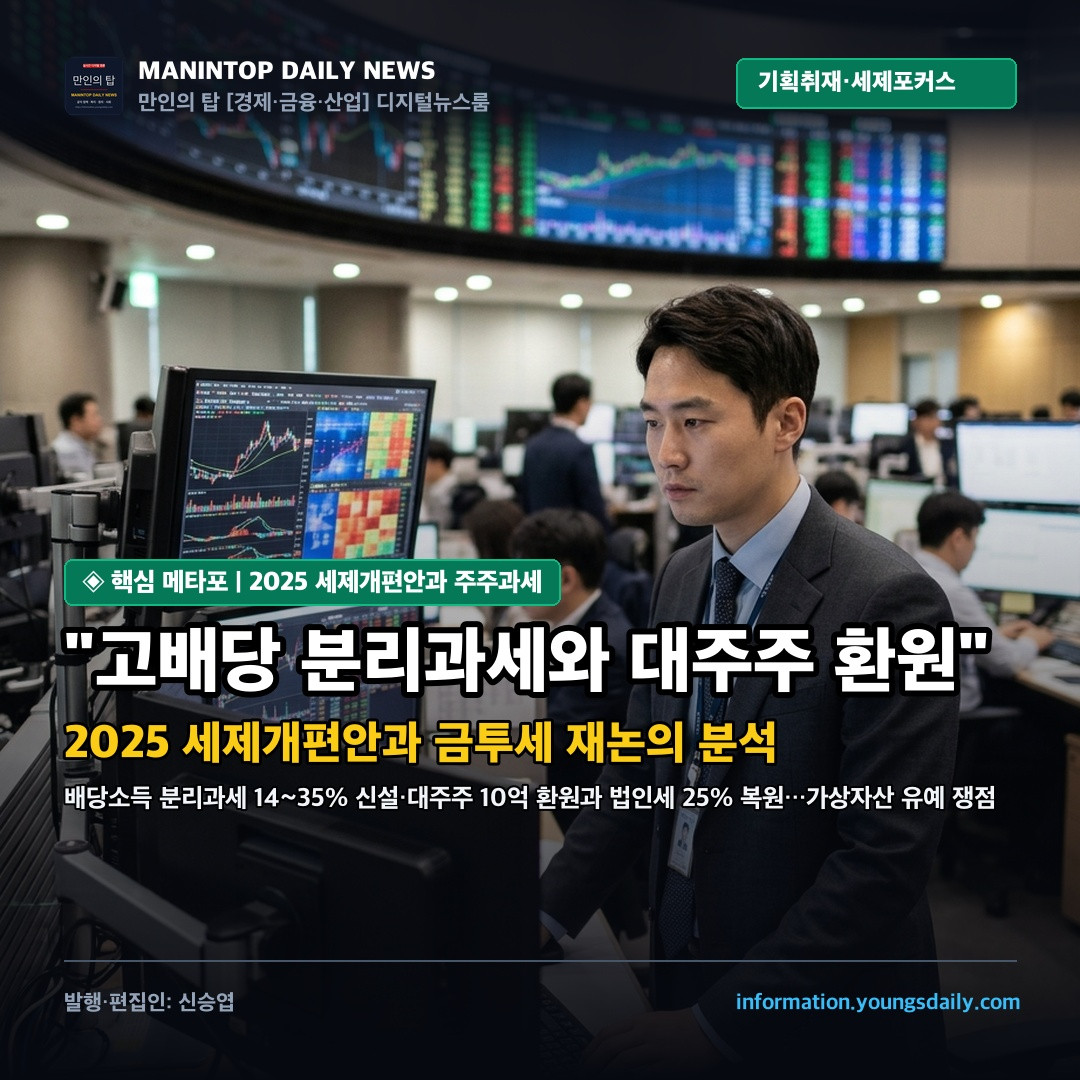
정부가 발표한 2025년 세제개편안은 고배당기업 배당소득 분리과세 신설과 주식 양도세 대주주 기준 10억 원 환원, 법인세 최고세율 25% 복원을 축으로 세수 기반 확충과 자본시장 밸류업을 동시에 겨냥하고 있습니다. 금투세 폐지 후 재부상하는 금융세제 개편 방향과 가상자산 과세 유예 논란까지 전방위로 심층 분석합니다.
▲ 여의도 증권사 트레이딩 룸에서 시장 분석관이 다중 모니터에 표출된 주식 거래량과 세제 정책 개편 자료를 정밀 점검하고 있다. 2025년 세제개편안은 고배당 분리과세와 세수 결손 방지를 위한 주요 세율 환원을 동시에 담고 있다. [사진=만인의 탑 경제부 특별취재팀]
📌 핵심 브리핑 (Key Takeaways)
고배당기업 배당소득에 대해 최고세율 45%의 종합과세 대신 14~35%의 3단계 분리과세 특례가 신설되어 2026년 배당분부터 적용됩니다.
세수 결손을 막기 위해 주식 양도소득세 대주주 기준이 50억 원에서 10억 원으로 환원되며, 증권거래세율(0.20%)과 법인세 최고세율(25%)도 원상 복원됩니다.
2024년 12월 국회에서 금투세가 공식 폐지되었으나, 2026년 코스피 급등 속에서 증권거래세와 주식 양도소득세의 구조적 전환 및 장기보유 인센티브 논의가 재부상하고 있습니다.
가상자산 과세는 국제 OECD 암호화자산 자동정보교환체계(CARF) 정착 일정과 맞물려 추가 유예 논의가 본격화되고 있습니다.
1. 서론: 재정 건전성 위기와 조세부담률 하락 속 2025년 세제개편안의 출범
정부가 세제발전심의위원회를 거쳐 확정한 2025년 세제개편안은 지난 수년간 누적되어 온 조세 정책의 과도기적 불확실성을 걷어내고, 자본시장 선진화와 국가 세입 기반 확충이라는 두 가지 난제를 동시에 해결하려는 중대한 정책적 전환점이다. 기획재정부는 자본시장 활성화 및 벤처투자 지원 강화, 응능부담 원칙에 따른 세부담 정상화, 서민·중산층·소상공인 포용적 세제 지원을 3대 핵심 축으로 제시했다.
이번 세제개편안의 배경에는 최근 가파르게 악화된 국가 재정 건전성이 자리 잡고 있다. 기획재정부 공식 통계에 따르면 대한민국의 조세부담률은 2022년 22.1%에서 2023년 19.0%, 2024년 잠정치 기준 17.6%까지 급락했다. 특히 법인세수 실적은 2022년 103조 5,000억 원에서 2023년 80조 4,000억 원, 2024년 62조 5,000억 원으로 급감하여 국가 살림에 심각한 경고등이 켜졌다. 이에 정부는 일몰이 도래한 비과세·감면 제도 중 16개 항목을 전격 정비하여 5년간 총 4조 6,000억 원 규모의 세수를 확보하고, 주요 세목의 과세표준과 세율을 정상화하기로 결정했다.
지표 항목
2020년
2022년
2023년
2024년(잠정)
세제개편 정책 목표
국내 조세부담률
18.8%
22.1%
19.0%
17.6%
세수 결손 차단 및 세입 확충
법인세수 실적
55.5조 원
103.5조 원
80.4조 원
62.5조 원
최고세율 25% 복원 정상화
비과세·감면 정비
14개 (0.3조)
12개 (0.5조)
9개 (0.1조)
12개 (1.4조)
16개 정비 (5년 누적 4.6조)
결국 이번 개편안은 단순한 증세나 감세의 일방향 정책이 아니라, 주주환원을 유도하는 인센티브 세제와 누적된 세수 결손을 보전하기 위한 환원 조치를 정교하게 결합한 패키지 조세 개혁의 성격을 띠고 있다.
2. 주주과세 및 자본시장 활성화: 고배당기업 배당소득 분리과세 14~35% 신설과 투자환류세제 개편
한국 증시의 만성적인 저평가 현상인 '코리아 디스카운트'를 해소하기 위해 상장기업의 배당 확대를 유도하는 파격적인 세제 인센티브가 도입된다. 정부는 거주자가 고배당기업으로부터 수령한 배당소득을 종합소득 과세표준(최고세율 45%)에서 제외하여 별도의 누진세율로 분리과세하는 특례 제도를 신설했다.
분리과세 혜택을 받기 위한 고배당기업 요건은 엄격하다. 전년 대비 현금배당액이 감소하지 않은 상장법인(펀드, 리츠, SPC 제외) 중 배당성향이 40% 이상이거나, 배당성향이 25% 이상이면서 직전 3년 평균 대비 배당금이 5% 이상 증가한 기업이 대상이다. 과세표준 구간에 따라 14%에서 최고 35%의 분리과세율이 적용된다.
배당소득 과세표준 구간
개편안 분리과세 세율
종합소득세 기본세율
절세 효과 및 납세 절차
2,000만 원 이하
14%
14% (원천징수)
별도 신고 없이 원천징수로 종결
2,000만 원 초과 ~ 3억 원 이하
20%
14% ~ 38% 누진과세
종합과세 대비 최대 18%p 감면 혜택
3억 원 초과 고액 배당
35%
40% ~ 45% 누진과세
최고세율(45%) 대비 10%p 감면
이 특례는 2026년 1월 1일 이후 개시하는 사업연도 배당분부터 3년간 한시 적용된다. 따라서 2026년 사업연도 결산배당이 지급되는 2027년 5월 종합소득세 신고 시점부터 개인투자자들의 체감 혜택이 본격화된다. 이와 함께 대기업의 사내유보금을 사회로 환류시키는 '투자·상생협력 촉진세제'의 환류 대상에 배당이 정식 포함되고 환류 기준 비율이 상향(투자포함형 65~85%, 투자제외형 20~40%)되어, 배당을 늘리지 않는 기업에는 20%의 추가 법인세가 부과된다.
3. 금융투자소득세(금투세) 폐지 경과와 2026년 금융세제 재설계 쟁점
주식, 채권, 펀드, 파생상품 등 모든 금융투자상품의 손익을 하나로 묶어 연간 순이익에 과세하려 했던 금융투자소득세(금투세)는 2020년 법 개정 이후 2차례의 유예와 사회적 진통 끝에 2024년 12월 10일 국회 본회의에서 소득세법 개정안이 통과되며 공식 폐지되었다.
금투세 도입 당시 설계된 안은 국내 주식 및 공모펀드 수익에 연 5,000만 원, 해외주식 및 채권 등에 연 250만 원의 기본공제를 부여하고, 과세표준 3억 원 이하는 22%, 3억 원 초과는 27.5%(지방소득세 포함)를 과세하는 구조였다. 5년간 결손금 이월공제와 손익통산이라는 선진 세제 골격을 갖추었으나, 상위 1% 큰손(전체 내국인 상장주식 시총의 53% 보유)의 국내 증시 이탈 우려와 1,440만 개인투자자의 거센 반발에 직면해 결국 폐지 수순을 밟았다. 국회예산정책처는 금투세 폐지로 인해 연평균 약 1조 3,443억 원의 세수 증대 기회가 소멸한 것으로 추산했다.
▲ 중후한 집무실 책상 위로 금융 계산기와 붉은 공인 인장이 날인된 세제개편 심의 서류가 놓여 있다. 조세 전문가들은 금투세 폐지 이후 자본시장 활성화와 세수 손실 보전 간의 균형을 맞추는 정교한 세제 설계가 필수적이라고 강조한다. [사진=만인의 탑 경제부 자료사진]
그러나 2026년 들어 코스피 지수가 9,000선을 돌파하는 전례 없는 호황을 맞이하면서 금융세제 재설계 논의가 다시 급물살을 타고 있다. 이재명 대통령은 국민경제자문회의 등 공식 석상에서 "투자 손실을 본 투자자에게도 일률적으로 부과되는 증권거래세는 역진적 측면이 있다"고 지적하며, "소액주주의 장기 보유에 대한 확실한 세제 인센티브를 부여하고 장기적으로 증권거래세와 주식 양도소득세를 균형 있게 전환하는 체계적 개편이 필요하다"고 제안했다. 이에 따라 현행 10억 원 이상 대주주에게만 부과되는 양도세를 전면 손질해 거래세를 폐지하고 주식 보유 기간에 따라 세율을 차등화하는 2단계 금융세제 로드맵 논의가 정치권과 학계를 중심으로 본격화되고 있다.
4. 가상자산 과세 연속 유예 논란과 OECD CARF 국제 공조 체계
비트코인 등 가상자산 양도·대여 소득에 대해 기본공제 250만 원을 초과하는 수익의 20%(지방세 포함 22%)를 분리과세하는 제도는 당초 2022년 시행 예정이었으나 2023년, 2025년을 거쳐 2027년(또는 2029년)으로 거듭 유예되는 진통을 겪고 있다.
과세 재유예의 결정적 요인은 국내외 거래소 간의 조세 형평성 문제다. 업비트나 빗썸 등 국내 가상자산 사업자의 거래 내역은 국세청이 투명하게 파악할 수 있지만, 바이낸스 등 해외 가상자산 거래소나 메타마스크 등 개인 탈중앙화 지갑을 통한 거래는 취득 원가와 소득 파악이 불가능해 국내 거래소 이용자에게만 세금이 부과되는 역차별이 발생하기 때문이다.
국가명
자산 법적 성격
주요 과세 방식 및 세율
장기보유 특례 및 공제
CARF 정보교환
미국
재산 (Property)
자본이득세 (단기 10~37%)
1년 초과 보유 시 0~20% 저율 과세
2029년 첫 교환
독일
사적 자산
단기 매매 소득세 과세
1년 초과 보유 처분 시 전액 비과세
2027년 첫 교환
영국
자본 자산
자본이득세 (18% 또는 24%)
연간 3,000파운드 기본공제
2027년 첫 교환
한국 (정부안)
기타소득
20% 분리과세 (지방세 포함 22%)
연간 250만 원 기본공제 (장기 혜택 전무)
2027년 (추가 유예 논의)
이에 따라 OECD가 제정한 '암호화자산 자동정보교환체계(CARF)'의 도입 시점이 과세 실행의 결정적 분기점으로 떠올랐다. 한국 등 46개국은 2027년부터 국경 간 가상자산 거래 정보를 정기 교환할 예정이지만, 세계 최대 시장인 미국은 2029년 교환을 목표로 하고 있다. 국회에서는 글로벌 과세 공조 인프라가 실질적으로 안착하는 시점인 2029년까지 과세를 유예하고, 해외 선진국처럼 1년 이상 장기 보유자에 대한 비과세 및 저율 과세 혜택을 함께 입법해야 한다는 의견이 힘을 얻고 있다.
5. 세입 기반 확충 및 주요 세율 환원: 증권거래세 0.20% 복원, 대주주 10억 환원, 법인세 최고세율 25% 환원
이번 세제개편안의 또 다른 축은 세수 결손을 보전하기 위해 과거 인하되었던 주요 세목의 세율을 이전 수준으로 되돌리는 '정상화 조치'다. 금투세 폐지로 인해 거래세 인하의 입법 전제가 상실됨에 따라 증권거래세율이 2023년 수준인 0.20%(코스피 본세 0.05%+농특세 0.15%, 코스닥 0.20%)로 전격 환원된다.
상장주식 양도소득세가 과세되는 대주주의 종목당 보유액 기준도 현행 50억 원 이상에서 종전 기준인 10억 원 이상으로 대폭 강화된다. 지분율 요건(코스피 1%, 코스닥 2%, 코넥스 4%)은 그대로 유지되며, 과세표준 3억 원 이하 20%, 3억 원 초과 25%의 세율이 부과된다. 정부는 대주주 기준 완화가 자본시장 유입에 미치는 실질적 영향이 미미했던 반면 과도한 부자 감세 논란을 촉발했던 점을 감안해 조세 형평성 차원에서 기준을 환원했다고 밝혔다.
법인세율 역시 2022년 일괄 인하되었던 각 과표 구간별 세율을 1%p씩 상향하여 최고세율을 25%로 복원한다(2억 이하 10%, 2억~200억 20%, 200억~3,000억 22%, 3,000억 초과 25%). 아울러 초대형 금융·보험사의 교육세 과표 구간(수익금액 1조 원 초과)을 신설하여 세율을 0.5%에서 1.0%로 2배 인상하고, 거주자가 이민 등을 통해 출국할 때 부과하는 국외전출세(Exit Tax) 대상에 해외 주식을 전격 편입하여 조세 회피를 차단하기로 했다.
6. 민생 안정 및 서민·중산층·소상공인 포용적 세제 지원: 보육수당 자녀당 20만 원, 예체능 학원비 공제, 노란우산공제 개편
자본시장과 법인 과세 정상화와 병행하여 서민과 중산층, 영세 자영업자의 피부에 와닿는 체감형 민생 세제 혜택도 폭넓게 신설되었다.
가계 양육비 경감을 위해 근로자가 지급받는 보육수당의 비과세 한도가 기존 월 20만 원에서 '자녀 1인당 월 20만 원'으로 대폭 확대된다. 자녀가 2명인 직장인은 연간 최대 480만 원까지 비과세 혜택을 누릴 수 있다. 아울러 초등학교 1~2학년 자녀의 예체능 학원비가 세액공제 대상에 신설 편입(연 300만 원 한도, 15% 공제)되었으며, 아르바이트 등으로 연 소득 100만 원을 초과하는 대학생 자녀라도 부모가 등록금을 지출한 경우 교육비 특별세액공제(15%)를 전액 적용받도록 문턱을 낮췄다.
소상공인과 고령층을 위한 재기 지원책도 눈에 띈다. 소상공인이 경영 악화로 노란우산공제를 중도 해지할 때 낮은 퇴직소득세율을 적용받을 수 있는 요건이 기존 '직전 3년 대비 매출 50% 이상 감소'에서 '20% 이상 감소'로 대폭 완화되었다. 폐업 후 재창업하는 영세사업자의 체납액 징수특례 한도도 5,000만 원에서 8,000만 원으로 상향되었으며, 연금저축을 종신 수령할 때 적용되는 원천징수세율도 4%에서 3%로 낮아져 노후 생활 안정을 지원한다.
7. 결론 및 향후 관전 포인트: 국회 정기회의 입법 심의와 자본시장 선진화의 향방
2025년 세제개편안은 세수 결손 극복을 위한 과세 정상화와 자본시장 선진화를 위한 주주환원 인센티브라는 두 축이 교차하는 복합적 세제 청사진이다. 이번 개편안이 실질적인 경제 활성화로 이어지기 위해서는 향후 국회 기획재정위원회와 본회의 입법 과정에서 여야 간의 치열한 법안 절충이 성공적으로 마무리되어야 한다.
특히 상장주식 양도세 대주주 기준이 10억 원으로 환원됨에 따라 연말 배당락일을 전후하여 개인투자자들의 대규모 절세성 매도 물량이 쏟아질 가능성에 대한 시장 완충 장치가 요구된다. 또한 이재명 대통령이 공론화한 증권거래세-양도소득세 체계적 전환 구상과 상법상 이사 충실의무 확대 법안이 결합될 경우, 한국 자본시장의 과세 패러다임은 근본적인 재편을 맞이하게 될 전망이다.
만인의 탑 경제부는 국회 정기회의의 세법 개정안 심사 추이와 조세소위 논의 결과를 실시간으로 밀착 취재하여, 대한민국 자본시장의 공정한 질서 확립과 국민 경제의 지속 가능한 조세 정의 구현을 정론직필로 보도할 것이다.
취재 문의 및 세제 제보: 만인의 탑 경제사회부 데스크, 신승엽 기자 (youb1649@gmail.com / 010-7330-1649)
본 기사에 인용된 2025년 세제개편안 세목별 과표 및 법정 세율, 국회예산정책처 세수 추계치는 기획재정부 공식 발표 자료와 국회 의안정보시스템 공공 기록에 근거하여 작성되었습니다. 무단 전재 및 재배포를 금합니다.
[Fiscal Focus] Separate Taxation on High-Dividend Stocks and Majority Shareholder Thresholds: Key Clashes in 2025 Tax Reform
In-Depth Fiscal Analysis · Tax Policy Focus
[In-Depth Fiscal Analysis] “Separate Taxation on Dividends and Lowering Major Shareholder Thresholds”: Comprehensive Breakdown of the 2025 Tax Reform and Capital Market Debates
The South Korean government has officially unveiled its 2025 Tax Reform Bill, aiming to simultaneously revitalize domestic capital markets and restore deteriorated fiscal revenues. This extensive investigation provides an exhaustive examination of separate dividend tax brackets ranging from 14 to 35 percent, the rollback of the major shareholder threshold from 5 billion to 1 billion KRW, the restoration of the 25 percent top corporate tax rate, structural debates over replacing securities transaction taxes following the repeal of the financial investment income tax, and international OECD CARF crypto-asset deferrals.
▲ Inside a securities trading room in Yeouido, an analyst reviews stock volume heatmaps and tax policy revisions across curved desktop monitors. The 2025 Tax Reform Bill combines separate taxation incentives for dividend-paying firms with statutory tax restorations designed to prevent persistent fiscal revenue deficits. [Photo: Manintop Daily News Economy Desk]
📌 Executive Summary (Key Takeaways)
A new three-tier separate taxation system with rates from 14 to 35 percent replaces the top 45 percent global income tax rate for dividends received from certified high-dividend corporations starting in fiscal year 2026.
To counteract severe fiscal shortfalls, the capital gains threshold for major shareholders is rolled back from 5 billion to 1 billion KRW, while securities transaction taxes (0.20 percent) and the top corporate income tax bracket (25 percent) are fully restored.
Following the formal legislative repeal of the Financial Investment Income Tax in December 2024, renewed macroeconomic debates in 2026 center on phasing out transaction taxes in favor of comprehensive holding-period incentives for long-term equity investors.
Crypto-asset taxation faces extended deferral deliberations through 2029 to synchronize domestic compliance with the multilateral OECD Crypto-Asset Reporting Framework (CARF).
1. Introduction: Fiscal Consolidation and Declining Tax Burdens Shaping the 2025 Tax Reform
Approved through the Tax Development Review Committee, the South Korean government's 2025 Tax Reform Bill represents a defining policy juncture designed to eliminate years of regulatory ambiguity while reconciling the twin objectives of capital market revitalization and fiscal consolidation. The Ministry of Economy and Finance articulated three core policy pillars: boosting capital markets and venture investments, normalizing statutory tax burdens in accordance with ability-to-pay principles, and expanding targeted relief for middle-income households and sole proprietors.
The imperative behind this fiscal restructuring lies in the steep deterioration of national tax buoyancy. Ministry of Economy and Finance records indicate that South Korea's national tax-to-GDP ratio tumbled from 22.1 percent in 2022 to 19.0 percent in 2023, touching an estimated 17.6 percent in 2024. Corporate tax receipts contracted precipitously from 103.5 trillion KRW in 2022 to 80.4 trillion KRW in 2023, down to 62.5 trillion KRW in 2024, triggering urgent national alarms over fiscal sustainability. In response, policymakers reorganized 16 expiring tax exemptions to recover 4.6 trillion KRW over five years while restoring baseline statutory rates across major tax categories.
Fiscal Metric
2020
2022
2023
2024 (Prelim.)
2025 Reform Policy Target
Tax-to-GDP Burden Ratio
18.8%
22.1%
19.0%
17.6%
Arrest revenue deficits and replenish base
Corporate Income Tax Yield
55.5T KRW
103.5T KRW
80.4T KRW
62.5T KRW
Restore 25% top corporate statutory rate
Tax Exemption Rationalization
14 items (0.3T)
12 items (0.5T)
9 items (0.1T)
12 items (1.4T)
16 items restructured (5-yr total 4.6T)
Consequently, this reform represents neither a unilateral tax hike nor an uncoordinated tax cut, but rather a coordinated policy package designed to balance shareholder return incentives with mandatory fiscal consolidation.
2. Shareholder Taxation and Capital Market Dynamism: Separate Dividend Rates and Corporate Retained Earnings
To combat the persistent Korea Discount rooted in chronically depressed dividend payout ratios, the administration introduced landmark tax incentives encouraging public corporations to enhance cash distributions. Resident shareholders receiving dividends from qualified high-dividend corporations will have their payouts carved out from global comprehensive income, which is subject to marginal rates of up to 45 percent, and taxed separately under progressive concessionary rates.
Eligibility standards for high-dividend qualification require listed firms to maintain aggregate cash distributions without year-on-year reductions and meet either a payout ratio exceeding 40 percent or a payout ratio of at least 25 percent accompanied by dividend growth of 5 percent or more relative to their three-year moving average. Qualifying dividends are categorized into three distinct tax brackets.
Dividend Taxable Base Bracket
Reformed Separate Rate
Standard Global Income Rate
Tax Relief & Administrative Protocol
Up to 20 Million KRW
14%
14% Withholding
Concluded via standard source withholding
20M to 300 Million KRW
20%
14% - 38% Progressive
Provides up to 18%p savings vs global rates
Exceeding 300 Million KRW
35%
40% - 45% Progressive
Reduces top tax burden by 10%p vs 45% cap
This separate regime will take effect for corporate earnings beginning January 1, 2026, meaning shareholders will register their first concrete savings during the May 2027 global income tax filing cycle. Concurrently, the Corporate Earnings Circulation Tax was modified to formally recognize dividends as a qualifying channel for circulating internal reserves, with mandatory recirculation thresholds raised to 65-85 percent for investment-inclusive schemes and 20-40 percent for investment-exclusive schemes, backed by a 20 percent penalty surtax on unallocated balances.
3. Trajectory of the Financial Investment Income Tax Repeal and Renewed Structural Debates
Originally designed to unify capital gains taxation across equities, bonds, investment trusts, and derivatives under an aggregate net income paradigm, the Financial Investment Income Tax was definitively repealed on December 10, 2024, when the National Assembly passed the governing Income Tax Act amendment.
The aborted framework offered a 50 million KRW annual deduction for domestic equities and a 2.5 million KRW deduction for foreign securities, imposing tax rates of 22 percent on gains up to 300 million KRW and 27.5 percent on amounts above that threshold, supported by a 5-year loss carryforward mechanism. However, market apprehensions that affluent high-net-worth investors—who account for only 1.04 percent of market participants yet control 53 percent of domestic equity capitalization—would trigger a capital flight prompted widespread investor opposition. According to the National Assembly Budget Office, abolishing the tax erased approximately 1.34 trillion KRW in projected annual revenues.
▲ An executive conference table displaying a financial calculator, bound tax audit files, and crimson certification seals. Analysts argue that following the repeal of investment income taxes, creating an equitable tax code requires balancing shareholder incentives with sustainable public revenues. [Photo: Manintop Daily News Financial Archive]
Nevertheless, as the benchmark KOSPI index surged past the historic 9,000 mark in 2026, debates over comprehensive financial tax modernization have resurfaced. President Lee Jae-myung publicly observed during economic advisory sessions that flat transaction taxes remain inherently regressive because they tax investors irrespective of trading losses. He urged policymakers to design structural holding-period incentives for long-term retail participants while eventually migrating transaction levies toward an equitable capital gains framework, prompting legislative bodies to review a dual-track financial tax reform.
4. Repeated Deferrals in Crypto-Asset Taxation and International OECD CARF Frameworks
The planned statutory tax on virtual asset gains exceeding a 2.5 million KRW threshold at a 20 percent separate rate has undergone successive deferrals from 2022 to 2023, 2025, and now toward 2027 or 2029.
The primary hurdle remains regulatory asymmetry between domestic and offshore platforms. While the National Tax Service easily monitors transaction histories on licensed Korean exchanges like Upbit and Bithumb, overseas venues such as Binance and non-custodial decentralized wallets remain opaque. Enforcing taxation in this fragmented environment would penalize compliant domestic traders while leaving offshore evasions unmonitored.
Jurisdiction
Asset Classification
Primary Tax Methodology
Holding Incentives & Deductions
CARF Initiation
United States
Property
Capital Gains Tax (Short-term 10-37%)
Long-term holding (>1 yr) taxed at 0-20%
First exchange 2029
Germany
Private Asset
Income Tax on short-term sales
100% Tax-Free if held over 1 year
First exchange 2027
United Kingdom
Capital Asset
Capital Gains Tax (18% or 24%)
Annual capital allowance of £3,000
First exchange 2027
South Korea (Bill)
Miscellaneous
20% Separate Tax (22% with local tax)
Flat 2.5M KRW deduction, no holding relief
2027 (Under review)
As a result, implementation of the OECD Crypto-Asset Reporting Framework (CARF) has become the operational pivot for tax execution. Although forty-six countries, including South Korea, intend to initiate multilateral data swaps in 2027, the United States is targeting 2029. Consequently, parliamentary leaders are pushing to postpone domestic crypto taxation until 2029 while introducing preferential tax rates for assets held over twelve months.
5. Revenue Base Replenishment and Statutory Restorations: Securities Transaction Taxes, 1B KRW Thresholds, and Corporate Rates
The second pillar of the 2025 package centers on restoring tax rates to baseline levels. Because the repeal of the financial investment tax eliminated the justification for reducing trading taxes, securities transaction rates will return to their 2023 level of 0.20 percent on both the KOSPI and KOSDAQ markets.
In addition, the ownership threshold defining a taxable major shareholder for domestic equities will be lowered from 5 billion KRW back to 1 billion KRW per issue. Ownership percentage hurdles (1 percent for KOSPI, 2 percent for KOSDAQ) remain intact, maintaining capital gains tax rates of 20 to 25 percent. Authorities explained that elevating the ceiling failed to stimulate genuine investment while generating substantial revenue shortfalls.
Corporate tax rates will similarly rise by 1 percentage point across all brackets, reinstating the 25 percent ceiling for taxable income exceeding 300 billion KRW. The bill also establishes an expanded education tax bracket for financial and insurance institutions with revenue over 1 trillion KRW, doubling their levy from 0.5 to 1.0 percent, while extending the Exit Tax to overseas equities to prevent offshore tax avoidance.
6. Inclusive Relief for Middle-Income Households and Small Businesses: Childcare Allowances, Extracurricular Credits, and Severance Shields
Alongside capital market measures, the 2025 bill introduces comprehensive tax relief provisions targeted at middle-income working families and small business proprietors.
To alleviate household rearing costs, non-taxable childcare allowance limits will expand from 200,000 KRW per employee to 200,000 KRW per child monthly, allowing parents of two dependents to exclude up to 4.8 million KRW annually. Extracurricular academy expenses for first- and second-grade elementary pupils will qualify for a 15 percent tax credit up to 3 million KRW, while post-secondary educational credits will apply to working college dependents regardless of part-time earnings.
For small business operators, eligibility standards for claiming low retirement tax rates upon early cancellation of the Yellow Umbrella mutual fund will be relaxed from a 50 percent revenue drop to a 20 percent decrease. Additionally, the collection moratorium ceiling on delinquent taxes for restarting sole proprietors will rise from 50 million to 80 million KRW, while withholding rates on life annuities will drop from 4 to 3 percent to reinforce retirement security.
7. Conclusion and Legislative Outlook: Parliamentary Deliberations and Capital Market Modernization
The 2025 Tax Reform Bill represents an integrated fiscal blueprint balancing the recovery of public tax yields with structural incentives for corporate capital efficiency. For these measures to support durable economic momentum, the National Assembly must navigate complex committee compromises during upcoming legislative reviews.
Market safeguards will be necessary as year-end ex-dividend dates approach to absorb potential portfolio selling by investors managing the lower 1 billion KRW major shareholder threshold. Furthermore, if proposals to transition from transaction taxes to holding-period capital gains are coupled with expanded corporate fiduciary duties under the Commercial Code, Korea's capital market architecture will undergo a transformative realignment.
Manintop Daily News will maintain rigorous scrutiny over committee proceedings and legislative compromises to ensure that fiscal reforms promote equitable market structures and sustainable public finance.
Editorial Inquiries & Tax Policy Tips: Manintop Daily News Economy Desk, Senior Reporter Seung Youb Ssin (youb1649@gmail.com / +82-10-7330-1649)
All statutory rates, bracket thresholds, and fiscal estimates cited herein are grounded in official disclosures from the Ministry of Economy and Finance and parliamentary records. Unauthorized reproduction or redistribution is strictly prohibited.
PRO SOURCING ENGINE만인의 탑 빅데이터 솔루션
★ 가입 시 600 크레딧(120회) 전원 무료
내가 찾는 상품 키워드, 지금 얼마나 검색될까?
네이버 월간 검색량 + 구글 볼륨 + 아이템스카우트 실시간 상품수와 경쟁강도 배지를 0.5초 만에 무료로 확인하세요.
MANINTOP NEWSLETTER
📬 만인의 탑 뉴스레터 무료 구독
오늘 보신 정책·시사 뉴스가 유익하셨나요? 매일 엄선되는 알짜 복지 혜택과 국회 실시간 속보를 이메일로 가장 먼저 받아보세요. (평생 무료)
1월이 시작되면 감기는 이미 우리 곁에 와 있습니다. 2월, 3월, 4월까지 이어지는 추위와 건조함은 코와 목을 가장 먼저 공격합니다. 아침에 일어나자마자 막혀 있는 코. 계속 흐르는 콧물. 괜히 칼칼해지는 목. 이 증상은 “시작”일 뿐입니다. 한 번 무너지면 일주일, 길면 한 달까지 끌고 갑니다. 약을 먹으면 잠깐 괜찮아집니다. 하지만 며칠 뒤 또 반복됩니다. 왜일까요? 감기는 ‘치료’의 문제가 아니라 ‘관리’의 문제이기 때문입니다. 대부분은 감기가 오고 나서 약을 찾습니다. 하지만 진짜 중요한 건 감기가 오기 전에 코와 목을 지키는 것입니다. 건조한 실내 공기, 차가운 바깥 공기, 눈에 보이지 않는 세균. 코와 목은 매일 공격받고 있습니다. 지긋지긋하죠! 그런데도 우리는 아무 준비 없이 버티고 있습니다. 이번 겨울도 그렇게 보낼 건가요? 사실 방법은 어렵지 않습니다. 코를 깨끗하게 관리하고, 목을 따뜻하게 보호하고, 점막을 촉촉하게 유지하고, 기관지를 미리 관리하고, 외부 공기를 차단하는 것. 이 다섯 가지만 꾸준히 해도 감기약 없이 겨울을 보내는 것이 충분히 가능합니다. 🔥 이제부터 그 방법을 하나씩 살펴보겠습니다. 🔥 1. 코와 목을 먼저 관리해야 하는 과학적 이유 감기의 대부분은 코 점막에서 시작됩니다. 국제 학술지 Nature Reviews Microbiology 와 Journal of Allergy and Clinical Immunology 에 실린 호흡기 감염 관련 연구들에서는, 감기 바이러스가 비강 상피세포에 먼저 부착해 증식한다는 점을 설명하고 ...
리모델링사업이 진행 중인 아파트를 매매할 때 “계약금 10%를 언제까지 내야 하느냐”는 질문이 특히 많이 나옵니다. 이주공고(이주 안내)가 7~11월쯤이라고 들으면, 그 시점에 맞춰 계약금도 움직일 것 같아서 더 헷갈리기 쉽습니다. 하지만 실제 납부기한은 ‘이주공고가 언제냐’만으로 자동 결정되지 않는 경우가 많습니다. 1) 계약금 10% 납부기한: 결국 ‘문서에 적힌 일정’이 기준 계약금 10%를 언제까지 납부해야 하는지는, 내가 서명하는 매매계약서(특약 포함) 와 사업주체/조합이 제시한 공고·안내문 에 적힌 납부 일정이 기준이 됩니다. 실제 공고문에서는 분양대금 납부의 큰 틀(계약금→중도금→잔금)을 먼저 안내하고, 상세 일정은 별도 표나 유의사항으로 제시하는 방식이 흔합니다. 또, 계약서 문구에 따라 지급 시점이 조건부로 설정될 수도 있습니다. 예를 들어 한 사례 소개 자료에서는 용역계약서에 잔금(10%) 지급시기가 “사업승인 후”로 기재되어 있었다는 점이 언급됩니다. 이런 식으로 ‘사업 단계’와 지급을 연동하는 문구가 들어가면, 질문의 답은 계약서 문구를 확인해야만 확정됩니다. 관련 내용은 링크 에서 문구 사례를 확인할 수 있습니다. 2) 입주자모집공고에서 확인되는 ‘납부 순서’와 잔금 마감 시점 공고문에 적힌 문구를 보면, 납부 순서와 잔금 마감에 대한 기준이 비교적 명확하게 제시되는 경우가 있습니다. 예를 들어 한 입주자모집공고에는 “분양금액(주택가격)은 계약금, 중도금, 잔금의 순서로 납부”하며 “잔금은 입주(열쇠 수령일) 전에 완납”해야 한다고 안내되어 있습니다. (문구 확인: 링크 ) 이 문구가 의미하는 바는 최소 2가지입니다. 분양/공급 형태의 문서에서는 ‘계약금→중도금→잔금’ 흐름이 공식적으로 안내될 수 있습니다. 잔금은 “입주(열쇠 수령)” 이전에 완납해야 한다는 마감 기준이 문서에 적혀 있을 수 있습니다. 다만, 위 공고문 문구는 잔금 마감에 대한 기준을 보여주지만, 계약금 10%의...
윤석열 전 대통령 탄핵 인용 소식을 접하면, 가장 궁금한 지점은 ‘헌재가 정확히 무엇을 위헌·위법으로 봤는가’입니다. 또한 탄핵과 별개로 진행되는 형사재판(내란 우두머리 혐의 등)이 어디까지 왔는지도 함께 정리할 필요가 있습니다. 아래 내용은 제공된 기사/게시물 스니펫과 링크에서 확인되는 범위만 모아, 일반인이 흐름을 이해하기 쉽게 정리한 것입니다. 1) 탄핵 인용 관련: 스니펫에서 확인되는 ‘판단의 골격’ 제공된 근거 중 조국혁신당 사이트에는 헌법재판소가 윤석열 탄핵 심판에서 “피청구인의 위헌·위법행위는 국민 신임 …”이라는 취지로 판단했다는 문장이 인용돼 있습니다( 링크 ). 이 인용문만 놓고 보면, ‘위헌·위법행위’가 있었는지와 그로 인해 ‘국민의 신임’이 어떻게 평가됐는지가 핵심 축으로 소개됩니다. 다만 질문에서 요청하신 세부 항목, 즉 비상계엄 선포 자체를 문제 삼은 구체적 이유, 계엄 이후 조치(포고령, 국회 통제 등)의 어떤 지점이 헌법 위반인지, 국회의 권한행사 방해 및 정치활동 제약을 어떤 논리로 판단했는지 등은, 이번에 제공된 근거의 제목/스니펫만으로는 조항·사실관계·판단 구조가 그대로 제시돼 있지 않습니다. 따라서 이 글에서는 ‘헌재가 무엇을 문제 삼았다’는 세부 리스트를 단정적으로 재구성하기보다, 현재 확인 가능한 문구 수준의 요약(위헌·위법행위 → 국민 신임의 문제로 평가)까지만 적습니다. 만약 헌재 결정문 전문(주문 및 이유)이 추가로 확인되면, 그때는 문장 단위로 ‘어떤 행위’와 ‘어떤 헌법 원리/조항’이 연결되는지(예: 권력분립, 국회의 권한, 정치적 기본권 등) 구조화해 정리하는 것이 가장 정확합니다. 2) 형사 절차(내란 혐의) 관련: 체포영장과 1심 선고 언급 탄핵 심판과 별도로, 12·3 비상계엄 사태로 내란 혐의를 받는 윤석열 대통령에 대해 2024년 12월 31일 체포 영장이 발부됐다는 BBC 보도가 있습니다( 링크 ). 해당 보도는 ‘현직 대통령’에 대한 체포영장 발부라는 점을 함께 언급합니다. 또...