“폭력 피해 도망쳤는데 또 쫓겨났다”… 가정 밖 청소년 10만과 쉼터의 배신
성북구 참극 부른 72시간 보호자 통보의 덫과 3개월 ‘쉼터돌이’ 악순환… 전국 13곳뿐인 자립지원관과 3대 기능 중심 개편안 긴급 해부
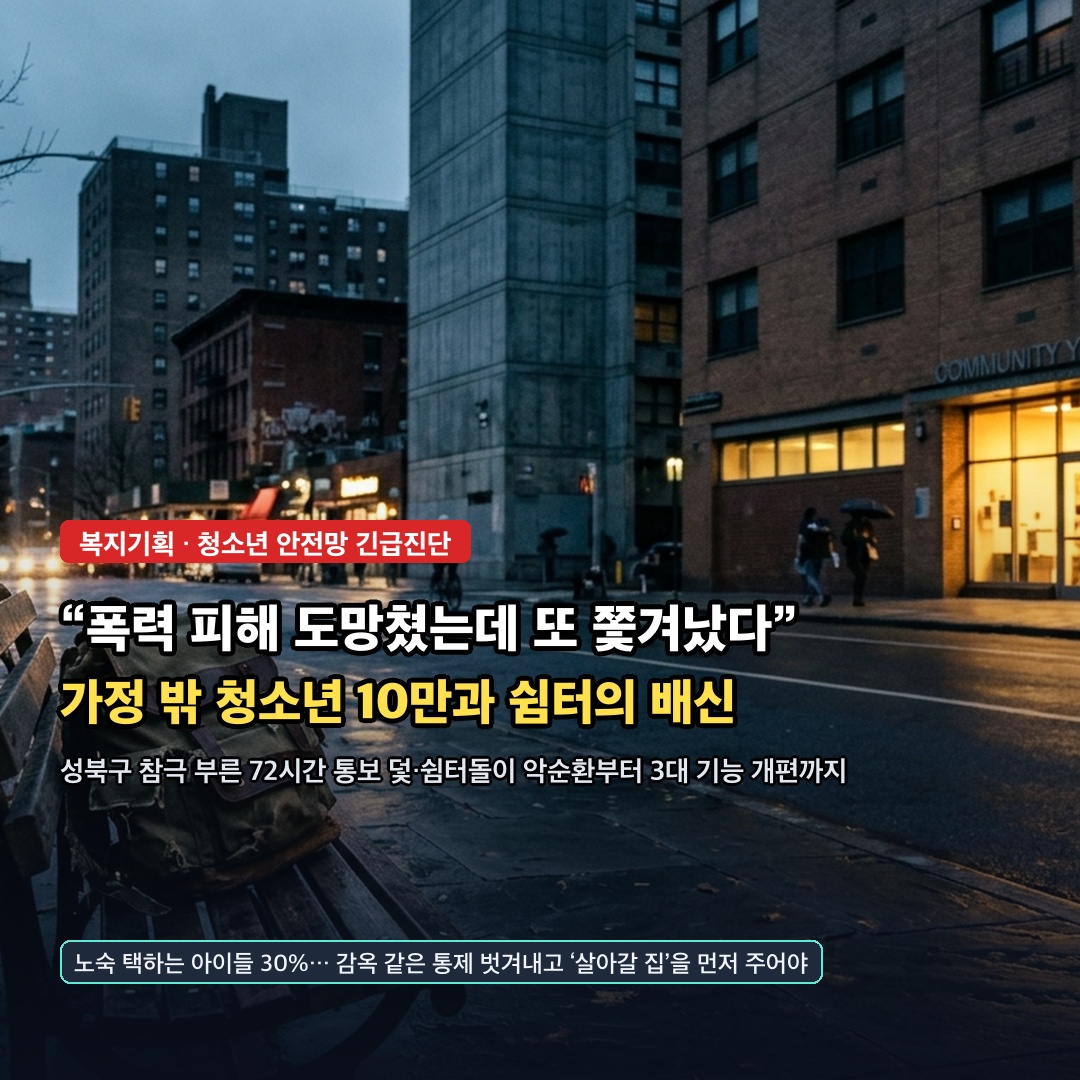
차가운 회색빛 도시 골목 끝에서 따뜻한 노란빛을 밝히고 있는 청소년 쉼터. 그러나 엄격한 통제와 규제, 보호자 통보 제도로 인해 해마다 수만 명의 위기 청소년들이 발길을 돌려 거리 노숙을 택하고 있다. / 만인의 탑 기획 사진실
2026년 11월 10일 발생한 서울 성북구 정릉동 10대 여성 살인사건은 가정 밖 청소년이 처한 중층적 범죄 노출 위험과 보호 체계의 붕괴를 적나라하게 드러냈습니다. 피해자인 15세 여성 B양은 쉼터와 숙박업소를 오가던 중 피의자 진모(59)씨의 흉기 난동에 참변을 당했습니다.
B양은 가정폭력을 피해 쉼터를 전전하다 진씨의 아들 D씨(20대)와 진씨의 전 사실혼 배우자 김모(20대)씨 일당에게 포섭되었습니다. D씨로부터 미성년자의제강간을 당하고 김씨로부터 조건만남과 절도를 강요당했던 B양은 소년분류심사원에 머물며 피해 사실을 경찰에 정직하게 털어놓았습니다.
그러나 11월 3일 퇴소 후 휴대전화를 돌려받으며 가해 세력과 다시 연결되었고, 11월 5일 쉼터에 재입소했으나 B양의 동선은 고스란히 노출되었습니다. 경찰이 김씨에 대해 성매매 강요 혐의로 구속영장을 다시 신청하고 검찰 면담을 앞두고 있던 상황에서, 진씨는 흉기와 번개탄을 미리 준비해 B양이 머물던 공유 숙소로 찾아가 무참히 살해했습니다. 고위험 증인이자 피해 청소년이었음에도 쉼터와 경찰 간의 밀착 신변 보호는 완전히 단절되어 있었습니다.

따스한 아침 햇살이 비쳐 드는 창틀 위에 놓인 빈 일기장과 김이 피어오르는 머그잔. 감금과 통제가 아닌, 마음 놓고 온전한 쉼을 얻을 수 있는 진정한 회복의 공간을 향한 위기 청소년들의 열망을 상징한다. / 만인의 탑 포토 다큐
여성가족부 위기청소년 실태조사에 따르면 매년 가출을 경험하는 청소년은 10만 명을 상회합니다. 하지만 전국 130여 개 청소년쉼터에 들어가는 인원은 연간 약 5천여 명으로, 전체의 5% 안팎에 불과합니다.
아이들이 집을 나오는 이유는 ‘놀기 위해서’가 아닙니다. 가출 원인 1순위는 ‘부모 및 가족과의 갈등’이 70.6%에 달하며, ‘가족의 폭력을 피하기 위해’라는 응답이 절반에 가까운 49.4%를 차지했습니다. 과거 16.2%에 달했던 ‘친구들과 어울리기 위해’라는 응답은 7.9%로 반토막 난 반면, 빈곤과 가정폭력으로 인한 생존형 탈가정이 주를 이루고 있습니다.
그러나 쉼터를 찾지 못한 청소년의 58.3%는 친구나 선후배 집을 전전하고, 29.6%는 건물 계단이나 공중화장실, 거리 노숙을 택하고 있습니다. 길거리 노숙을 택하는 비율이 공적 쉼터 이용률(30.2%)과 사실상 대등한 참담한 현실입니다.
| 인물 구분 | 피해자와의 관계 | 주요 혐의 및 수사 상태 |
|---|---|---|
| 진모씨 (59세 남성) | 가해자 (아들의 부친) | 특가법상 보복살인, 절도교사 등 아들 성범죄 피소에 앙심 품고 흉기 준비 후 계획 살해 |
| D씨 (20대 남성) | 진씨의 아들 | 미성년자의제강간, 절도, 사기 피해자 대상 성범죄 및 모텔 조건만남 절도 범행 |
| 김모씨 (20대 여성) | 진씨의 전 사실혼 배우자 | 아청법 위반(성매매 강요), 절도교사 피해자 숙소 제공 빌미로 성매매 강요 및 가스라이팅 |
안전한 숙식이 제공됨에도 위기 청소년들이 쉼터 문턱에서 발길을 돌려 노숙을 택하는 데는 명확한 세 가지 구조적 장벽이 존재합니다.
첫째, ‘민법상 거소지정권과 72시간 보호자 통보 의무의 역설’입니다. 민법 제914조의 친권자 거소지정권에 따라 쉼터는 입소 72시간 이내에 보호자에게 입소 사실을 알려야 합니다. 학대 피해 예외 조항이 있지만, 현장에서는 민형사상 책임을 우려해 부모에게 연락하는 일이 빈번합니다. 폭력 부모에게 거처가 노출되어 쉼터까지 찾아온 부모에게 다시 폭행당하는 비극을 겪은 아이들은 부모에게 들키지 않기 위해 거리로 숨어듭니다.
둘째, ‘보호를 빙자한 통제와 배제의 생활 규칙’입니다. 저녁 9~10시의 엄격한 통금은 야간 생계형 아르바이트나 학업을 병행해야 하는 청소년들의 입소를 원천 차단합니다. 휴대전화 강제 압수, 단체 프로그램 강요는 쉼터를 ‘보호 시설’이 아닌 ‘감옥’으로 인식하게 만들며, 사소한 규칙 위반으로 인한 강제 퇴소는 청소년의 불신을 심화시킵니다.
셋째, ‘기계적 기간 중심 체계와 쉼터돌이 양산’입니다. 일시(7일), 단기(3개월), 중장기(최장 4년)로 쪼개진 기간 상한 탓에, 청소년들은 3개월마다 짐을 싸서 다른 쉼터로 떠도는 ‘쉼터돌이’로 전락하고 있습니다. 전체 청소년복지시설의 재입소율이 50%를 넘어서는 배경입니다.
보호가 끝나거나 원가정으로 돌아갈 수 없는 청소년들에게 독립은 생존의 문제입니다. 그러나 국가의 자립 지원 정책은 가장 절박한 거리 청소년을 제도 밖으로 밀어내고 있습니다.
월 50만 원의 청소년 자립지원수당과 LH 공공임대주택 우선 추천을 받으려면 ‘쉼터에 2년 이상 연속 거주’해야 합니다. 하지만 엄격한 규율과 잦은 이동으로 연속 거주 요건을 채우지 못한 대다수 거리 청소년은 수당과 주거 지원을 신청할 자격조차 박탈당합니다.
퇴소 후 주거와 일자리를 지원하는 ‘청소년자립지원관’은 2026년 기준 전국에 단 13개소에 불과하며, 경남·경북 등 광역 도 단위 전체에 한 곳도 없는 곳이 수두룩합니다.
한국청소년상담복지개발원이 전국 169개 청소년복지시설 의견을 수렴해 마련한 차세대 운영모형은 기존의 ‘기간 중심’ 체계를 폐지하고 청소년의 위기 수준에 맞춘 ‘3대 기능 트랙(뉴쉼터)’으로 개편하는 것을 골자로 합니다.
| 트랙 구분 | 핵심 포지션 및 전환 대상 | 주요 운영 혁신 및 확충 계획 |
|---|---|---|
| 트랙 1: 응급·위기안정 |
드롭인 센터 & 긴급구호 허브 (이동·고정형 일시쉼터 전환) |
• 보호자 연락 의무 폐지, 식사·세탁 무조건 즉시 제공 • 심야 거리 아웃리치 발굴 및 신속 스크리닝 • 24개소 신설 (총 57개소로 확충) |
| 트랙 2: 집중회복 |
전문 집중치료 & 힐링 센터 (단기쉼터 및 회복지원시설 전환) |
• 임상심리사·간호사 배치로 우울·자해 전문 치료 • 소년법 1호 처분 청소년 통합 포용 케어 • 13개소 신설 (총 98개소로 확충) |
| 트랙 3: 자립전환 |
주거 중심 자립 빌드업 (중장기쉼터 및 자립지원관 전환) |
• 조건 없는 독립 주거(하우징 퍼스트) 및 자활작업장 운영 • 지원 연령 만 27~30세로 연장 및 5년 사후관리 • 17개소 신설 (총 68개소로 확충) |
연구진 분석 결과, 살던 생활권에서 즉시 보호받는 지역사회 돌봄(CIP)을 실현하기 위해서는 전국적으로 54개 시설을 신설하고 총 466억 9,300만 원의 예산을 증액해야 합니다. 현장 종사자 72.1%가 이 기능 중심 개편에 압도적으로 찬성하고 있습니다.
청소년 쉼터는 아이들을 훈계하고 통제하는 교도소가 아닙니다. 폭력과 학대로 만신창이가 된 영혼이 상처를 치유하고 숨을 고르는 가장 안전한 방주여야 합니다.
미국과 영국의 선진 모델처럼, 입소 조건이나 부모 통보라는 족쇄를 씌우지 않고 조건 없는 독립 주거를 최우선 제공하는 ‘하우징 퍼스트(Housing First)’로 국가 정책의 패러다임을 전면 전환해야 합니다.
성북구 15세 소녀의 참담한 죽음은 더 이상 방치할 수 없는 국가적 참극입니다. 10만 가정 밖 청소년들이 거리에서 범죄의 먹잇감으로 전락하기 전에, 국가가 온전하고 따뜻한 피난처를 제공하는 일이야말로 대한민국 복지의 가장 시급한 시대적 과제입니다.
“Fled from Domestic Violence Only to Be Expelled Again”: 100,000 Out-of-Home Youths and the Betrayal of Shelters
The fatal 72-hour parental notification trap behind the Seongbuk tragedy… A nationwide audit of 13 independence centers and the blueprint for a 3-track functional reform
A youth community shelter glowing with warm amber light amid towering, cold urban skyscrapers at dusk. Despite existing public facilities, excessive regulations and mandatory parental notifications drive tens of thousands of runaway youth to street homelessness each year. / MANINTOP Social Photo Desk
The November 10, 2026 homicide of a 15-year-old female adolescent, B, in a residential rental in Seongbuk-gu, Seoul, exposed the structural failure of frontline protection. B was brutally murdered by 59-year-old Jin in a premeditated assault.
Having fled severe domestic abuse, B was ensnared by Jin's 20-something son, D, and Jin's common-law ex-partner, Kim. Subjected to statutory rape by D and coerced into commercial sex robbery schemes by Kim, B courageously provided detailed evidence to police while held at a juvenile classification center.
However, following her discharge on November 3 and subsequent re-admission to a shelter on November 5, B's itinerary was exposed. With prosecutors preparing to question B and police re-applying for an arrest warrant against Kim, Jin pre-purchased weapons and tracked B to an Airbnb booked by Kim, executing a planned murder. Despite being a critical criminal witness and vulnerable minor, close protective surveillance was completely absent.
A blank journal notebook resting beside an unlatched window and a steaming ceramic mug in the morning sun. Symbolizing the profound yearning of vulnerable youth for genuine healing and unconditioned sanctuary free from punitive control. / MANINTOP Documentary Archive
Data from the Ministry of Gender Equality estimates that over 100,000 youth experience runaway episodes annually, yet fewer than 5,000 gain access to state-supported shelters.
Over 70.6% cite parental and familial conflict as their primary driver for leaving, with 49.4% explicitly fleeing severe domestic violence. Inquiries reveal that 58.3% seek refuge at friends' homes, while 29.6% resort to sleeping on public stairwells, in bathrooms, or rough sleeping on streets—a figure rivaling official shelter usage (30.2%).
| Actor | Relationship to Victim | Primary Criminal Charges & Status |
|---|---|---|
| Jin (59, Male) | Perpetrator (Father of D) | Retaliatory Murder under Aggravated Punishment Act Premeditated murder with weapons following son's sex crime indictment |
| D (20s, Male) | Son of Jin | Statutory Rape, Larceny, Fraud Sexually exploited victim; orchestrated motel robbery rings |
| Kim (20s, Female) | Former Common-Law Partner | Sex Trafficking Coercion, Larceny Instigation Coerced victim into commercial sex; booked murder venue |
Examinees and field social workers identify three major barriers repelling youth from public shelters:
First, the Civil Act's Place of Abode Designation and the 72-Hour Notification Rule: Under Civil Act Article 914, shelters are mandated to notify legal guardians within 72 hours. While exceptions exist for documented abuse, fear of civil liability leads administrators to contact parents, resulting in abusive guardians tracking down runaways and inflicting retaliatory beatings.
Second, Carceral Discipline and Discretionary Expulsions: Strict curfews between 9:00 and 10:00 PM prevent youth from holding evening employment or attending night study classes. Confiscation of mobile devices and mandatory communal programs cause youth to perceive shelters as prisons.
Third, Mechanical Duration Limits: Fragmenting shelters into temporary (up to 7 days), short-term (up to 3 months), and mid-to-long term (up to 4 years) forces youth to pack their belongings and relocate every few months, driving recidivism above 50%.
For adolescents aging out at 18 who cannot return to their biological families, independence is an uphill struggle.
State independence allowances (500,000 KRW monthly) and public housing vouchers require two consecutive years of shelter residency. The most vulnerable street youth who churn between facilities are systematically disqualified. Furthermore, specialized Youth Independence Centers number merely 13 nationwide, leaving large geographic regions without coverage.
The Korea Youth Counseling & Welfare Institute has proposed dismantling the duration-based model in favor of a 3-Track Functional Framework:
| Track | Functional Position & Target | Operational Overhaul & Expansion Plan |
|---|---|---|
| Track 1: Crisis Stabilization |
Drop-in Center & Emergency Hub (Transitioned from Temporary Shelters) |
• Abolish parental notice; immediate food and laundry care • Street outreach and standardized crisis triage • Establish 24 new hubs (57 total nationwide) |
| Track 2: Intensive Recovery |
Specialized Recovery & Healing Center (Transitioned from Short-Term Shelters) |
• Clinical psychologists and nurses for trauma and self-harm care • Unified inclusion of juvenile court referrals • Establish 13 new hubs (98 total nationwide) |
| Track 3: Independent Transition |
Housing-Centered Buildup Hub (Transitioned from Long-Term Shelters) |
• Unconditional housing first; subsidized social workplaces • Support extended to age 27–30 with 5-year post-discharge tracking • Establish 17 new hubs (68 total nationwide) |
Fulfilling this ‘Caring in Place’ model requires adding 54 facilities nationwide with an incremental budget of 46.69 billion KRW, supported by 72.1% of frontline shelter workers.
Youth shelters must not function as disciplinary detention centers. They must serve as unconditional sanctuaries providing safety and clinical healing.
Emulating international best practices in the US and UK, South Korea must adopt the ‘Housing First’ philosophy, offering unconditional stable shelter before attaching behavioral requirements. Halting the tragic cycle that claimed the life of a 15-year-old girl in Seongbuk begins with transforming state shelters into genuine havens of hope.
내가 찾는 상품 키워드, 지금 얼마나 검색될까?
네이버 월간 검색량 + 구글 볼륨 + 아이템스카우트 실시간 상품수와 경쟁강도 배지를 0.5초 만에 무료로 확인하세요.


