[심층기획] '경찰 수사 개혁과 민주적 통제' 장윤기 사건 증거인멸 파문… 보완수사권 폐지 속 100인 감찰기구와 공룡경찰 딜레마
만인의 탑 편집국11월 18, 2026
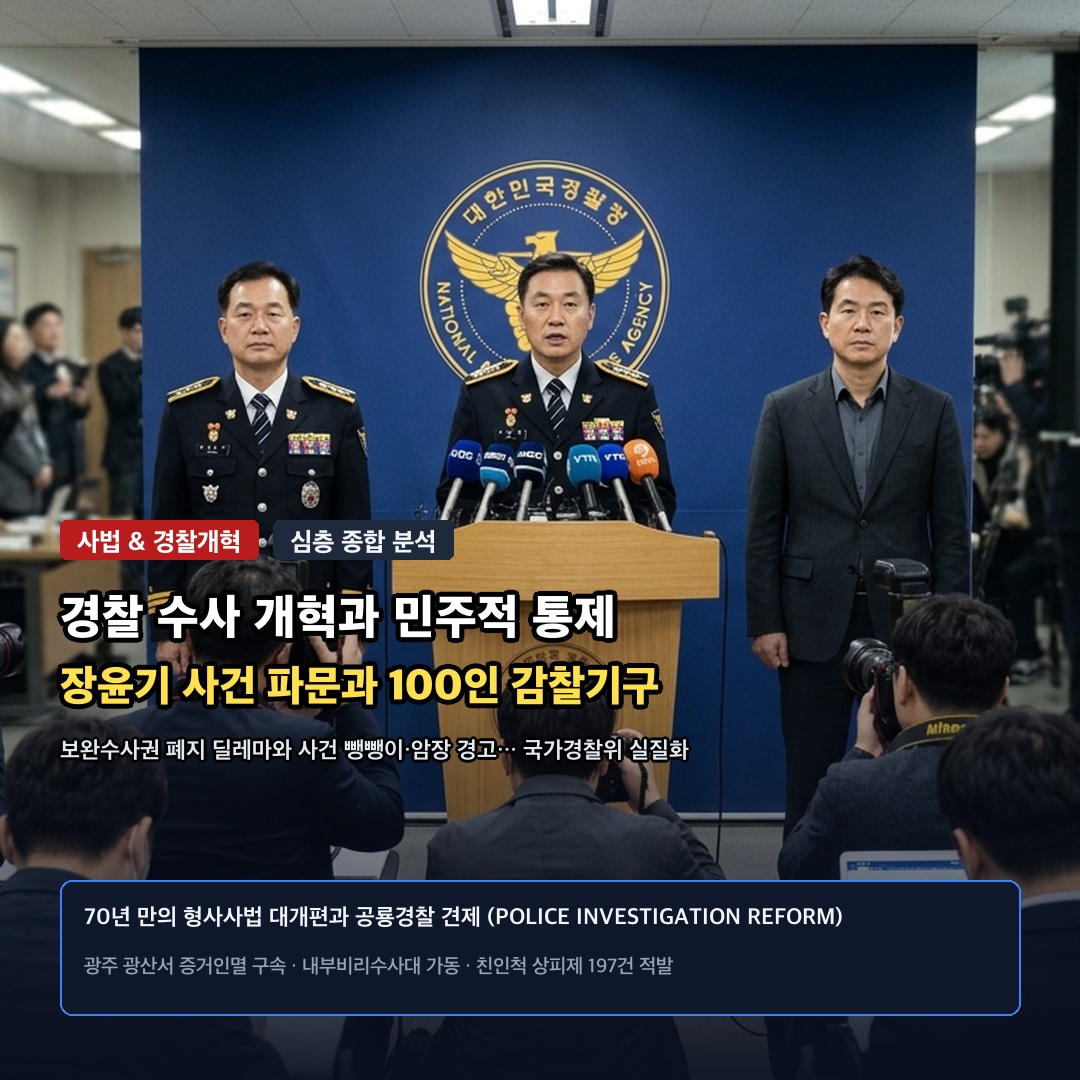
▲ 대한민국 경찰청 브리핑실에서 경찰 고위 관계자들이 형사사법 개편 및 경찰 수사 쇄신 대책을 설명하고 있다. [사진: 경찰청 제공 보도자료]
핵심 쟁점 3줄 요약 (Key Takeaways)
광주 광산경찰서 수사팀장의 장윤기 살해 사건 증거인멸 및 구속 사태로 비대해진 경찰 수사권에 대한 국민적 불신이 임계점에 도달했습니다.
2026년 검찰청 폐지와 중수청 출범에 이어 검사 보완수사권 완전 폐지가 추진되면서 '사건 뺑뺑이'와 '사건 암장'이라는 2대 사법 위기가 부각되고 있습니다.
행정안전부의 100인 민간 인권감찰기구 신설과 친인척 상피제, 이재명 대통령의 '경찰의 날' 책임성 강조 속에서 실질적 민주적 통제 장치 구축이 사법 개혁의 성패를 가를 전망입니다.
2026년 대한민국 형사사법체계는 70여 년 만의 근본적인 대전환기를 통과하고 있습니다. 지난 7월 국회 본회의에서 수사와 기소를 분리하는 형사소송법 개정안이 통과된 데 이어, 10월에는 기존 검찰청이 역사 속으로 사라지고 기소 전담 기관인 공소청과 직접수사 기구인 중대범죄수사청(중수청)이 정식 출범했습니다. 여기에 더해 여권이 검사의 보완수사권마저 전면 폐지하는 방안을 추진하면서 국가 수사 권력의 무게중심은 14만 경찰 조직으로 급격히 이동하고 있습니다. 그러나 수사 권한이 천문학적으로 커진 반면, 일선 현장의 권한 남용과 오류를 견제할 실효성 있는 민주적 통제 장치는 여전히 미흡하다는 경고음이 사법체계 전반에서 쏟아지고 있습니다. 특히 광주 광산경찰서에서 벌어진 여고생 살해범 장윤기 사건 수사 과정의 증거인멸 파문은 '공룡 경찰'에 대한 통제가 왜 지금 가장 절박한 국정 현안인지를 뼈아프게 웅변하고 있습니다.
광주 '장윤기 사건' 수사팀장 구속 파문… 23세 여고생 살해와 증거인멸의 전말
경찰 조직 전체를 거센 소용돌이 속으로 몰아넣은 도화선은 23세 피의자 장윤기의 여고생 살해 사건이었습니다. 끔찍한 강력범죄 자체로도 사회적 공분이 극에 달했으나, 진짜 충격은 경찰 수사 과정에서 터져 나왔습니다. 사건을 총괄 지휘하던 광주 광산경찰서 소속 수사팀장 A 경감이 피의자 측과의 끈끈한 연고를 바탕으로 사건을 축소·은폐하려 했다는 정황이 포착된 것입니다. 피해자 유족과 언론의 끈질긴 의혹 제기 속에 진상 조사가 진행되면서, 가해자의 부친이 증거 폐기에 직접 가담했고 수사팀장 A 경감이 핵심 증거를 은닉·인멸한 혐의가 낱낱이 드러났습니다.
결국 수사팀장 A 경감은 2026년 7월 긴급 체포되었으며, 광주지방법원에서 열린 구속전 피의자심문(영장실질심사)을 거쳐 전격 구속되었습니다. 수사의 최고 실무 책임자가 살인범 가족과 결탁해 범행 증거를 인멸하고 봐주기식 수사를 벌였다는 충격적인 사실은 국민적 공분을 일으켰습니다. 이는 검경 수사권 조정 이후 경찰이 1차 수사를 온전히 독점할 때 일선 경찰서 단위에서 어떤 파국적인 '사건 암장'이 발생할 수 있는지를 적나라하게 보여준 상징적 사건이 되었습니다.
파문은 곧바로 국회 행정안전위원회의 2026년도 국정감사 최대 쟁점으로 비화했습니다. 국회 행안위는 광주 광산경찰서 서장과 핵심 수사 관계자들을 일반증인으로 채택해 수사정보 유출과 조직적 묵인 여부를 집중 추궁했습니다. 여야 의원들은 단 한 경찰서의 개인적 일탈을 넘어, 수사 권한이 거대화된 경찰 내부에서 비위와 짬짜미를 걸러낼 자체 견제 시스템이 완전히 마비되었다는 점을 질타했습니다. 비대해진 경찰권을 민주적으로 통제할 특단의 제도적 수술 없이는 형사사법 개혁 자체가 모래성 위에 지은 누각에 불과하다는 목소리가 국회와 법조계 안팎에서 터져 나왔습니다.
2026 형사사법 대격변과 '보완수사권 폐지'… '사건 뺑뺑이'와 '암장'의 2대 뇌관
장윤기 사건이 일선 현장의 충격파였다면, 중앙 정치권과 법조계에서는 더불어민주당이 추진하는 검사 보완수사권의 완전 폐지 법안을 둘러싸고 사법 체계의 근간을 뒤흔드는 격론이 벌어지고 있습니다. 10월 출범한 공소청 검사에게서 보완수사권마저 완전히 박탈할 경우, 기소 검사는 경찰이 작성한 서류 뭉치만 보고 법원에 재판을 청구해야 하는 기계적 처분자로 전락하게 됩니다. 문제는 이 과정에서 사법 현장의 2대 뇌관으로 꼽히는 '사건 뺑뺑이'와 '사건 암장'의 위험이 극대화된다는 점입니다.
사건 뺑뺑이는 사소한 사실관계 확인이나 경미한 미비점조차 검사가 직접 확인하지 못하고 전면 경찰로 되돌려 보내야 하는 구조에서 비롯됩니다. 이미 2021년 1차 수사권 조정 이후 일선 경찰서의 사건 처리 기간은 과거 대비 2배 이상 길어져 평균 6개월에서 1년 가까이 소요되고 있습니다. 여기에 보완수사권 폐지까지 겹치면 공소청과 경찰 사이에 서류가 핑퐁처럼 오가며 피해자들의 물질적·정신적 고통은 감당하기 어려운 수준으로 가중될 수밖에 없습니다. 더욱 무서운 것은 사건 암장입니다. 검사와의 칸막이가 완전히 쳐진 상태에서 경찰이 혐의가 없다고 불송치 결정을 내리면, 전문 변호사를 선임할 여력이 없는 힘없는 서민과 피해자들의 억울한 사건은 영구히 어둠 속에 묻힐 위험에 노출됩니다.
신설된 중대범죄수사청의 인력 난맥상 역시 국가 수사 역량의 심각한 경찰 쏠림 현상을 부추기고 있습니다. 국회 행정안전위원회 국감 자료에 따르면 중수청 정원은 수사관 2,567명과 일반직 307명을 포함해 총 2,874명 규모로 설계되었습니다. 그러나 1차와 2차 특례 임용 지원자는 정원에 한참 못 미치는 1,962명에 그쳤습니다. 채용이 확정된 인력의 근무지 배치가 여전히 표류하고 있는 데다 피의자를 수용할 유치장 등 기본적 수사 인프라조차 갖추지 못해, 국가적 주요 사건과 경제·권력형 비리 수사의 실질적 부담이 고스란히 경찰 국가수사본부로 전가되는 기형적 구조가 지속되고 있습니다.
쟁점 및 제도 구분
핵심 발생 메커니즘
국민 권익 및 사법체계 영향
보완 및 견제 입법 대안
사건 처리 지연 (사건 뺑뺑이)
검사의 직접 보완수사권 폐지 시 단순 사실관계 확인조차 경찰로 전면 이송해야 하며, 공소청과 경찰 간 송치·보완요구 연쇄 반복 발생
검경 수사권 조정 이후 이미 사건 처리 기간이 2배 이상 증가한 상황에서 심각한 수사 지연 초래, 범죄 피해자의 정신적·물질적 고통 가중
검사의 보완수사 요구 1개월 내 이행 의무화 및 경찰 내 전담 부서 신설, 기한 내 불응 시 검사의 수사관서 변경 요구권 법제화
사건 암장 위험 (칸막이 수사)
수사·기소 분리로 검사와 완전한 칸막이가 형성되어 경찰이 사건을 축소하거나 불송치 종결할 경우 외부 사후 검증 수단 현저히 부족
장윤기 사건처럼 경찰 내부의 고의적 봐주기나 증거인멸 시도 차단 불가, 변호인 조력을 받기 힘든 서민 사건의 영구적 암장 위험 증대
불송치 결정에 대한 고발인의 이의신청권 완전 복원, 100인 민간 감찰기구의 불송치 사건 직권 조사권 및 경찰관 범죄 타 기관 의무 통보
중수청 인력 난맥상 (경찰 쏠림 현상)
신설 중대범죄수사청 정원 2,874명 대비 1·2차 특례지원 1,962명에 그쳐 정원 미달, 유치 공간 등 기본적 수사 인프라 구축 지연
권력형 범죄와 주요 대형 사건의 실질적 수사 부담이 고스란히 경찰 국가수사본부로 집중되어 수사 권력 독점과 과부하 동시 심화
중수청 특례 채용 유인책 확대, 인프라 조기 확충 및 장기적으로 국가수사본부와 중수청을 통합한 독립수사청 설립 검토
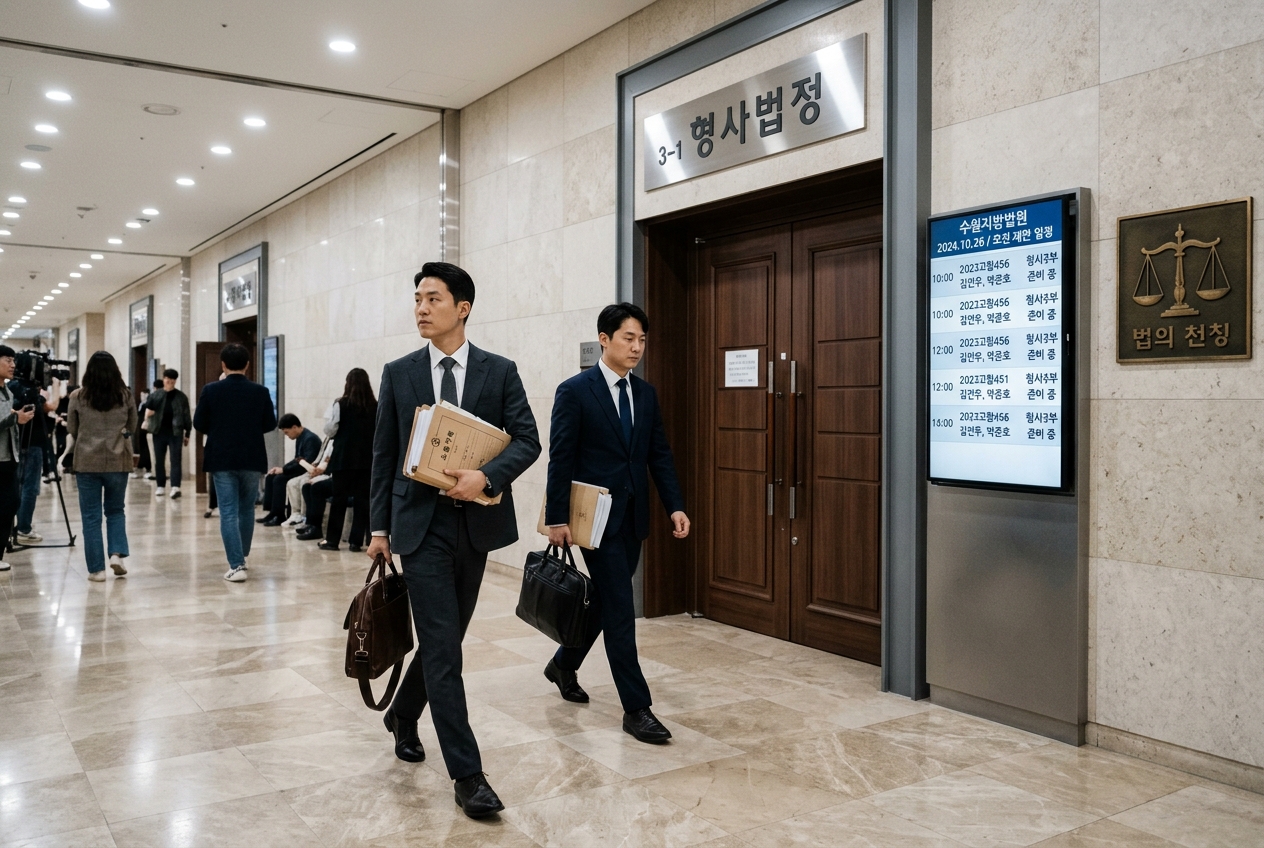
▲ 일선 지방법원 형사법정 입구에서 법조 관계자들이 사건 기록을 검토하고 있다. 비대해진 경찰 수사에 대한 실효성 있는 사법 통제 장치 마련이 시급한 화두로 떠올랐다. [사진: 사법부 공동취재단]
행안부 윤호중 장관의 3대 쇄신 로드맵… 100인 민간 감찰기구와 친인척 상피제
경찰 수사에 대한 불신이 걷잡을 수 없이 번지자, 행정안전부 윤호중 장관은 2026년 7월 16일 긴급 대국민 브리핑과 8월 4일 제34회 국무회의를 통해 강력한 쇄신책을 담은 '경찰 수사 공정성 및 민주적 통제 종합 방안'을 전격 발표했습니다. 이번 쇄신안은 경찰 내부의 부패와 연고지 유착을 원천 차단하기 위한 내부 정비와 독립적 외부 감시 체계 신설이라는 투트랙으로 설계되었습니다.
우선 내부 비리를 뿌리뽑기 위해 '순환인사제'를 대폭 강화하고 '친인척 상피제'를 전격 도입했습니다. 특정 지역 관서에 장기 근무하며 형성된 지역 토호 세력과의 짬짜미를 깨기 위한 조치입니다. 정부가 전국 경찰관을 대상으로 실시한 전수조사에서는 경찰관의 배우자나 직계존비속 등 친인척이 연루된 사건이 무려 197건이나 적발되었습니다. 행안부는 이 중 유착 우려가 짙은 44건을 즉각 관할이 다른 타 경찰관서로 긴급 이송 조치했습니다. 아울러 국가수사본부 직속으로 '내부비리수사대'를 창설해 일선 경찰관들의 수사 비위, 부패, 증거 조작 행위를 무관용 원칙으로 직접 수사하도록 했으며, 수사 부서 감찰을 민간 개방직 인권감사관에게 맡겨 비위 연루자는 수사 부서에서 영구 퇴출하기로 했습니다.
가장 눈에 띄는 대책은 외부 문민 감시를 위한 '100인 민간 경찰수사인권감찰조사기구'의 신설입니다. 행정안전부 국가경찰위원회 산하에 설치되는 이 기구는 경찰 출신을 완전히 배제하고 전원 순수 민간 전문가로 채워집니다. 일선 경찰관서의 부실수사, 불공정 수사, 증거인멸, 검사의 보완수사 요구 묵살 등을 독립적으로 조사하며, 감찰 결과에 따른 시정 권고를 경찰청이 의무적으로 이행하도록 법제화할 방침입니다. 여기에 경찰수사심의위원회를 법률 기구로 격상하고 사회적 약자 전담 소위원회를 두는 한편, 검사의 보완수사 요구를 원칙적으로 1개월 이내에 이행하도록 의무화하고 불응 시 검사가 수사팀과 수사관서 변경을 요구할 수 있는 견제 장치도 함께 마련되었습니다.
"권한 커진 만큼 책임도 막중"… 이재명 대통령의 제81주년 경찰의 날 국정 지침
2026년 10월 21일 서울 서대문구 경찰청 본청에서 거행된 제81주년 경찰의 날 기념식에서 이재명 대통령은 확대된 수사 권한에 상응하는 경찰의 뼈를 깎는 자기 혁신과 책임성을 직접 주문했습니다. 이 대통령은 기념사를 통해 대한민국 형사사법체계가 70여 년 만에 대개편을 맞이하면서 경찰의 권한이 그 어느 때보다 막중해졌으며, 권한이 커진 만큼 국민 앞에 져야 할 책임의 무게 또한 비교할 수 없을 정도로 무거워졌음을 엄중히 선언했습니다.
이 대통령은 일선 현장에서 묵묵히 헌신하는 대다수 모범 경찰관들의 노고를 치하하면서도, 단 한 번의 비리와 부실 대응이 국가 치안에 대한 국민적 신뢰를 송두리째 무너뜨릴 수 있다는 점을 직시해야 한다고 강조했습니다. 그러면서 세 가지 핵심 국정 지침을 제시했습니다. 첫째, 외부의 부당한 정치적 간섭은 철저히 막아내되 국가경찰위원회의 실질적 역할을 강화해 경찰 수사의 과정과 결과를 독립적으로 점검하는 민주적 통제 장치를 신속히 완성할 것, 둘째, 스토킹 등 관계성 범죄와 불특정 다수를 노린 이상동기 범죄에 대해 사후 처벌이 아닌 첨단 기술 기반의 '사전 예방' 치안 체계로 패러다임을 대전환할 것, 셋째, 공소청 및 중수청과의 유기적 공조를 통해 검사 보완수사권 부재로 인한 사법 공백을 원천 차단하고 전세사기·투자사기 등 민생 범죄의 불법 수익을 끝까지 추적해 환수하라는 지시였습니다.
불송치결정의 종국처분 법리와 사법 통제… 경찰국 트라우마와 시민사회의 대안
법학계와 실무 현장에서는 경찰의 불송치결정권이 지닌 법적 본질과 사법 통제의 제도적 결함을 둘러싼 학술적 논쟁이 치열하게 이어지고 있습니다. 경북대학교 법학연구원 학술지 법학논고에 게재된 연구에서 김현철 전 부산고등법원 판사는 경찰의 불송치결정을 검사의 종국처분을 전제로 한 단순한 '잠정적 처분'으로 보아서는 안 된다고 갈파했습니다. 개정 형소법상 사법경찰관이 독자적 수사 주체로 규정된 이상, 피의자의 혐의 유무를 판단해 사건을 종결하는 불송치결정은 실질적인 준사법적 '종국처분'으로 규정해야 하며, 바로 그렇기 때문에 더욱 엄격한 다층적 사법 통제 장치가 입법화되어야 한다는 지적입니다.
특히 과거 윤석열 정부 시기 행정안전부 내 '경찰국 신설'을 둘러싸고 벌어졌던 치열한 갈등은 오늘날 중요한 헌정사적 교훈을 던져줍니다. 당시 장관의 직접적인 관료적 지휘 통제 모델은 경찰의 정치적 중립성을 훼손한다는 거센 반발 속에 김창룡 청장의 사의 표명과 총경들의 삭발 투쟁이라는 극단적 파국으로 치달았습니다. 이는 비대해진 경찰권에 대한 통제가 필수적이라 하더라도, 그것이 행정부의 일방적인 밀실 지휘권 행사가 되어서는 안 되며 합의제 문민 기구를 통한 민주적 통제여야 함을 증명했습니다. 참여연대를 비롯한 시민사회가 2026년 정기국회 과제로 국가경찰위원회의 국무총리 소속 합의제 행정기관 격상, 권한과 조직을 지방으로 분산하는 실질적 자치경찰제, 정보경찰의 완전 폐지, 그리고 국수본과 중수청을 통합한 독립수사청 설립을 촉구하고 있는 이유가 바로 여기에 있습니다.
사법 통제 수단
현행 제도의 법적 한계
형사사법 실무상 부작용
학술 및 법리적 개선 과제
검사의 기록검토권 및 재수사요청권
사법경찰관이 재수사 요청에 불응할 때 강제할 수단 부재, 송치사건과 달리 직무배제 및 징계요구권(형소법 제197조의2) 결여
경찰이 불송치 결정을 고수할 경우 실질적 재수사가 무력화되어 검사의 사후 검증 기능이 형식적 통과의례로 전락
정당한 사유 없는 재수사 불응 시 담당 경찰관에 대한 직무배제 및 징계요구권을 형사소송법에 명문으로 신설
재수사 유지 시 검사의 송치요구권
수사준칙상 채증법칙 위반 등 공소제기 요건을 이유로 송치를 요구할 수 있으나 검사의 자의적 남용 우려 상존
송치요구의 적법성을 둘러싼 검경 간 법리 공방으로 사건 처리가 장기 표류하며 국민의 사법 불신 촉발
검사의 일방적 송치요구에 대한 경찰의 이의신청 제도 신설, 이견 발생 시 지방법원 또는 중립 외부위원회의 심의 절차 도입
고소인 등의 이의신청과 사건 검찰 송치
이의신청서에 구체적 불복 사유(범죄사실 및 증거)를 기재하도록 요구하는 규정 결여, 경찰 내부 자정 절차 없이 검찰 직행
단순 불복 남발로 불필요한 이중수사 유발, 경찰 내부의 자기 완결적 책임성을 약화시키고 전체 형사 절차 지연 가중
재정신청처럼 구체적 불복 사유 기재 의무화, 시·도경찰청 단위로 외부 위원 과반의 수사심의위원회를 설치해 1차 자체 심의
▲ Senior officials from the National Police Agency outline comprehensive reform measures for criminal investigations and democratic oversight during a press briefing in Seoul. [Photo: National Police Agency Press Release]
Key Takeaways
The emergency arrest and detention of a lead police inspector for destroying critical evidence in the Jang Yoon-gi murder case has escalated public distrust in expanded police authority to an unprecedented peak.
Following the dissolution of the Supreme Prosecutors' Office and the establishment of the Major Crimes Investigation Agency in 2026, legislative pushes to eliminate prosecutors' supplementary investigation rights threaten severe procedural delays and concealed cases.
With the Ministry of the Interior and Safety establishing a 100-member civilian audit panel and mandatory family-case recusals, alongside President Lee Jae-myung's call for heightened accountability on Police Day, institutional democratic checks have become the defining test of judicial reform.
In 2026, the South Korean criminal justice system is undergoing its most profound structural transformation in over seven decades. Following the National Assembly's passage of the Criminal Procedure Act amendments in July to formally separate investigation from indictment, October witnessed the historic abolition of the Supreme Prosecutors' Office and the official inauguration of both the Public Prosecutors' Office for trial prosecution and the Major Crimes Investigation Agency (MCIA) for specialized investigations. With ruling party lawmakers actively advancing legislation to completely eliminate prosecutors' supplementary investigation rights, the center of gravity in national investigative authority is rapidly tilting toward the 140,000-strong National Police Agency. However, while police powers have expanded exponentially, structural alarm bells are echoing across the legal community regarding the acute absence of effective democratic checks and balances to prevent abuse of authority and procedural negligence. The evidence tampering scandal surrounding the murder of a high school student by 23-year-old Jang Yoon-gi at Gwangju Gwangsan Police Station stands as a poignant reminder of why democratic oversight over the 'giant police' has become the nation's most urgent judicial priority.
Gwangju Jang Yoon-gi Case and the Arrest of the Lead Inspector: Murder and Evidence Tampering Scandals
The primary trigger that sent shockwaves throughout the entire law enforcement apparatus was the brutal murder committed by 23-year-old suspect Jang Yoon-gi. While the violent crime itself sparked intense public fury, the true crisis emerged from the conduct of the investigating police officers. Critical evidence surfaced indicating that Senior Inspector A, who served as the lead investigation team leader at Gwangju Gwangsan Police Station, systematically colluded with the suspect's family to minimize and conceal the facts of the case. Amid relentless investigative reporting and appeals from the victim's grieving family, it was revealed that the suspect's father actively participated in disposing of incriminating evidence while Senior Inspector A orchestrated the deliberate destruction and concealment of core physical exhibits.
Consequently, Senior Inspector A was placed under emergency arrest in July 2026 and formally detained following a pre-trial detention warrant hearing at the Gwangju District Court. The shocking revelation that the operational head of a homicide team conspired with a murderer's family to destroy evidence and grant illicit favors delivered an irreparable blow to public trust. It provided an undeniable, real-world demonstration of the catastrophic danger of concealed investigations when frontline police stations exercise unfettered, unverified primary investigative monopolies in the post-prosecutorial reform landscape.
The incident immediately escalated into the central battleground of the National Assembly Public Administration and Security Committee's 2026 parliamentary audit. Lawmakers summoned the Chief of Gwangju Gwangsan Police Station and principal investigators as formal audit witnesses, grilling them over systemic cover-ups and information leaks. Both ruling and opposition legislators fiercely condemned the reality that internal monitoring mechanisms had completely failed to intercept blatant corruption within an increasingly empowered police force. Legal scholars and civil society emphasized that unless drastic democratic oversight mechanisms are codified, the broader criminal justice restructuring remains built upon treacherous structural foundations.
2026 Criminal Justice Transformation and the Abolition of Supplementary Rights: Procedural Delays and Hidden Cases
While the Jang Yoon-gi case ignited outrage on the ground, legal scholars and political circles are fiercely disputing the legislative push by the Democratic Party to completely abolish prosecutors' supplementary investigation rights. Under this framework, prosecutors at the newly formed Public Prosecutors' Office would be barred from verifying basic facts directly, reducing them to passive clerical functionaries who must accept raw police dossiers before presenting charges to the bench. Legal practitioners warn that this artificial partition creates two catastrophic procedural bottlenecks: chronic ping-pong case delays and the permanent concealment of unresolved crimes.
Procedural delays stem from an institutional loop where prosecutors are legally prohibited from clarifying simple factual ambiguities and must return the entire file to the police for supplementary inquiry. Following the initial 2021 jurisdictional adjustments, average case resolution times at frontline stations have already more than doubled, frequently dragging from six months to well over a year. Stripping prosecutors of supplementary authority will further entrench endless document transfers between the prosecution and police, compounding the financial and psychological agony of crime victims. Even more perilous is the concealment of criminal complaints. With absolute walls erected against external prosecutorial review, unrepresented and economically vulnerable citizens whose cases are dismissed without transfer by biased officers will find their grievances permanently buried in bureaucratic darkness.
Compounding these structural imbalances is the acute staffing crisis confronting the newly established Major Crimes Investigation Agency. Parliamentary audit records submitted to the Public Administration and Security Committee reveal that while the MCIA was authorized for an establishment of 2,874 personnel (including 2,567 investigators and 307 administrative officers), total applicants across the first and second special recruitment rounds reached a meager 1,962. With regional assignments unsettled and basic physical infrastructure such as suspect holding facilities severely deficient, the operational burden of high-profile white-collar and political corruption cases has fallen almost entirely back onto the National Police Agency's National Investigation Headquarters (NIH), reinforcing monopolistic concentration.
Institutional Dimension
Key Operational Mechanism
Impact on Citizens & Justice System
Legislative & Institutional Remedies
Procedural Delays (Ping-Pong Cycles)
Abolishing prosecutors direct supplementary authority mandates transferring even minor factual checks back to police, triggering recurring dossier loops between prosecutors and police
Average case resolution durations have already doubled following the initial 2021 reforms, inflicting severe prolonged emotional and financial hardship on crime victims
Mandating police compliance with prosecutorial supplementary requests within one month, forming specialized units, and granting prosecutors rights to reassign stalled cases
Concealed Cases (Partitioned Inquiries)
Rigid barriers separating investigation from indictment deprive external authorities of effective post-hoc verification whenever police minimize cases or issue non-transfer closures
Fails to prevent deliberate cover-ups or evidence destruction as seen in the Jang case, leaving unrepresented citizens vulnerable to permanent case burial
Restoring statutory objection rights for whistleblowers in non-transfer closures, granting ex-officio audit powers to 100-member civilian bodies, and mandating external notifications
MCIA Staffing Deficits (Police Monopolies)
Special recruitment rounds drew only 1,962 applicants against an authorized quota of 2,874, compounded by acute shortages in essential facilities such as detention cells
Operational caseloads for major public corruption and financial scandals revert heavily onto the National Police Agency, exacerbating jurisdictional concentration and organizational overload
Enhancing incentives for agency recruitment, accelerating infrastructure development, and evaluating long-term integration into a unified National Investigation Agency
▲ Legal practitioners carry case files near a criminal courtroom at a district court. Establishing effective judicial checks on expanded police investigative powers has emerged as a crucial legal priority. [Photo: Judicial Press Pool]
Minister Yoon Ho-jung's Three-Point Police Reform Roadmap: 100-Member Civilian Oversight and Mandatory Recusals
To counter the unprecedented collapse of public confidence in police integrity, Minister of the Interior and Safety Yoon Ho-jung unveiled a comprehensive blueprint titled 'Measures for Police Investigation Fairness and Democratic Oversight' during an emergency national address on July 16, 2026, and a subsequent Cabinet meeting on August 4. The strategic reform package operates along a dual-track architecture: aggressive internal structural housecleaning and the erection of independent civilian oversight institutions.
To dismantle deeply rooted local networks of collusion, the ministry drastically expanded mandatory personnel rotations and enforced an unyielding conflict-of-interest recusal system for officers handling cases involving spouses or direct relatives. A nationwide government audit of police personnel uncovered no fewer than 197 active criminal cases involving police officers' immediate kin. The ministry immediately ordered the emergency reassignment of 44 high-risk cases to independent external jurisdictions. Furthermore, the National Investigation Headquarters deployed a direct internal anti-corruption squad tasked with investigating police graft, bribery, and evidence tampering under zero-tolerance rules, while transferring internal affairs inspections to open civilian human rights auditors.
The institutional cornerstone of the external oversight framework is the creation of a 100-member Civilian Police Investigation and Human Rights Inspection Panel under the National Police Commission. Entirely excluding former police officers, this independent body comprises respected civilian jurists, civic leaders, and human rights experts empowered to independently investigate flawed proceedings, evidence tampering, and ignored prosecutorial supplementary requests, with statutory mandates compelling police compliance. Complementing this are statutory elevations of Police Investigation Review Committees, dedicated panels for vulnerable demographics, mandatory one-month execution deadlines for prosecutorial supplementary demands, and legal rights enabling prosecutors to demand changes in investigating teams and jurisdictions whenever police arbitrarily stall inquiries.
'Greater Authority Demands Greater Responsibility': President Lee Jae-myung's Directives on the 81st Police Day
Addressing the nation during the 81st Police Day commemoration ceremony at the National Police Agency headquarters in Seoul on October 21, 2026, President Lee Jae-myung personally articulated the profound imperative for self-reflection and structural accountability commensurate with expanded police authority. The President declared that as South Korea overhauls its seven-decade-old criminal justice framework, the police have inherited an unprecedented mandate, and the weight of their responsibility toward the sovereign citizenry has grown proportionately heavier.
While commending the tireless dedication of the vast majority of honorable frontline officers, President Lee stressed that isolated acts of corruption and compromised integrity threaten to dismantle the public's foundational faith in the rule of law. To that end, the President established three non-negotiable governance directives: first, safeguarding operational independence from partisan political meddling while rapidly finalizing independent civilian review panels under a substantive National Police Commission; second, shifting the fundamental policing paradigm from reactive post-crime responses to predictive, technology-driven prevention against stalking and motive-less violent rampages via advanced 112 emergency networks; and third, eliminating judicial vacuums through seamless collaboration with the Public Prosecutors' Office and the MCIA, ensuring that illicit proceeds from predatory crimes such as real estate fraud and financial scams are thoroughly confiscated.
Final Disposition Doctrines of Non-Transfer Decisions and Judicial Oversight: Bureau Traumas and Civil Society Reforms
Within legal academia and the judiciary, intense debate continues regarding the doctrinal nature of police non-transfer decisions and systemic loopholes in current supervisory procedures. In a landmark treatise published in Kyungpook National University Law Review, former Busan High Court Judge Kim Hyun-cheol argued that police determinations not to transfer cases to prosecutors must no longer be treated as mere 'provisional dispositions' subordinate to ultimate prosecutorial filing. Because modern procedural revisions establish judicial police officers as autonomous investigative entities, non-transfer decisions represent substantive, quasi-judicial 'final dispositions' terminating state inquiry, necessitating far more rigorous, multi-layered statutory oversight.
In this context, the bitter clashes surrounding the establishment of the 'Police Bureau' within the Interior Ministry during the previous administration offer vital constitutional lessons. The unilateral bureaucratic directive model pursued at the time provoked ferocious institutional resistance, culminating in the resignation of Commissioner General Kim Chang-ryong and unprecedented head-shaving protests by police precinct chiefs who viewed the move as an assault on political neutrality. This constitutional experience proved that while oversight over expanded police power is essential, it must never take the form of executive political domination, but must instead rely on autonomous civilian collegial bodies. It is precisely why civil society groups such as People's Solidarity for Participatory Democracy are demanding that the 2026 National Assembly elevate the National Police Commission to an independent administrative organ under the Prime Minister, enact genuine municipal policing decentralization, completely abolish domestic intelligence policing, and merge the NIH with the MCIA to establish a genuinely independent National Investigation Agency.
Legal Oversight Instrument
Statutory Limitations
Practical Procedural Deficits
Scholarly & Statutory Reform Agenda
Dossier Review and Re-Investigation Demands
Absence of statutory enforcement mechanisms when police refuse re-investigation, lacking disciplinary or case removal authority under Article 197-2
Whenever police stubbornly maintain non-transfer stances, re-investigation becomes meaningless, reducing prosecutorial review to a hollow formality
Codifying formal prosecutorial powers in the Criminal Procedure Act to demand officer removal and disciplinary sanctions for unjustified refusals
Transfer Demands upon Maintained Non-Transfer
While rules allow demanding transfer for evidence violations sufficient for indictment, risks of arbitrary prosecutorial overreach persist
Protracted jurisdictional disputes between police and prosecutors stall case resolution, sparking public distrust in institutional competence
Establishing formal police appeal mechanisms against unilateral transfer demands, with disputes reviewed by district courts or neutral committees
Complainant Objections and Prosecutorial Referral
Lack of statutory requirements to state specific legal and factual grounds in objection briefs, bypassing internal police self-correction
1월이 시작되면 감기는 이미 우리 곁에 와 있습니다. 2월, 3월, 4월까지 이어지는 추위와 건조함은 코와 목을 가장 먼저 공격합니다. 아침에 일어나자마자 막혀 있는 코. 계속 흐르는 콧물. 괜히 칼칼해지는 목. 이 증상은 “시작”일 뿐입니다. 한 번 무너지면 일주일, 길면 한 달까지 끌고 갑니다. 약을 먹으면 잠깐 괜찮아집니다. 하지만 며칠 뒤 또 반복됩니다. 왜일까요? 감기는 ‘치료’의 문제가 아니라 ‘관리’의 문제이기 때문입니다. 대부분은 감기가 오고 나서 약을 찾습니다. 하지만 진짜 중요한 건 감기가 오기 전에 코와 목을 지키는 것입니다. 건조한 실내 공기, 차가운 바깥 공기, 눈에 보이지 않는 세균. 코와 목은 매일 공격받고 있습니다. 지긋지긋하죠! 그런데도 우리는 아무 준비 없이 버티고 있습니다. 이번 겨울도 그렇게 보낼 건가요? 사실 방법은 어렵지 않습니다. 코를 깨끗하게 관리하고, 목을 따뜻하게 보호하고, 점막을 촉촉하게 유지하고, 기관지를 미리 관리하고, 외부 공기를 차단하는 것. 이 다섯 가지만 꾸준히 해도 감기약 없이 겨울을 보내는 것이 충분히 가능합니다. 🔥 이제부터 그 방법을 하나씩 살펴보겠습니다. 🔥 1. 코와 목을 먼저 관리해야 하는 과학적 이유 감기의 대부분은 코 점막에서 시작됩니다. 국제 학술지 Nature Reviews Microbiology 와 Journal of Allergy and Clinical Immunology 에 실린 호흡기 감염 관련 연구들에서는, 감기 바이러스가 비강 상피세포에 먼저 부착해 증식한다는 점을 설명하고 ...
리모델링사업이 진행 중인 아파트를 매매할 때 “계약금 10%를 언제까지 내야 하느냐”는 질문이 특히 많이 나옵니다. 이주공고(이주 안내)가 7~11월쯤이라고 들으면, 그 시점에 맞춰 계약금도 움직일 것 같아서 더 헷갈리기 쉽습니다. 하지만 실제 납부기한은 ‘이주공고가 언제냐’만으로 자동 결정되지 않는 경우가 많습니다. 1) 계약금 10% 납부기한: 결국 ‘문서에 적힌 일정’이 기준 계약금 10%를 언제까지 납부해야 하는지는, 내가 서명하는 매매계약서(특약 포함) 와 사업주체/조합이 제시한 공고·안내문 에 적힌 납부 일정이 기준이 됩니다. 실제 공고문에서는 분양대금 납부의 큰 틀(계약금→중도금→잔금)을 먼저 안내하고, 상세 일정은 별도 표나 유의사항으로 제시하는 방식이 흔합니다. 또, 계약서 문구에 따라 지급 시점이 조건부로 설정될 수도 있습니다. 예를 들어 한 사례 소개 자료에서는 용역계약서에 잔금(10%) 지급시기가 “사업승인 후”로 기재되어 있었다는 점이 언급됩니다. 이런 식으로 ‘사업 단계’와 지급을 연동하는 문구가 들어가면, 질문의 답은 계약서 문구를 확인해야만 확정됩니다. 관련 내용은 링크 에서 문구 사례를 확인할 수 있습니다. 2) 입주자모집공고에서 확인되는 ‘납부 순서’와 잔금 마감 시점 공고문에 적힌 문구를 보면, 납부 순서와 잔금 마감에 대한 기준이 비교적 명확하게 제시되는 경우가 있습니다. 예를 들어 한 입주자모집공고에는 “분양금액(주택가격)은 계약금, 중도금, 잔금의 순서로 납부”하며 “잔금은 입주(열쇠 수령일) 전에 완납”해야 한다고 안내되어 있습니다. (문구 확인: 링크 ) 이 문구가 의미하는 바는 최소 2가지입니다. 분양/공급 형태의 문서에서는 ‘계약금→중도금→잔금’ 흐름이 공식적으로 안내될 수 있습니다. 잔금은 “입주(열쇠 수령)” 이전에 완납해야 한다는 마감 기준이 문서에 적혀 있을 수 있습니다. 다만, 위 공고문 문구는 잔금 마감에 대한 기준을 보여주지만, 계약금 10%의...
윤석열 전 대통령 탄핵 인용 소식을 접하면, 가장 궁금한 지점은 ‘헌재가 정확히 무엇을 위헌·위법으로 봤는가’입니다. 또한 탄핵과 별개로 진행되는 형사재판(내란 우두머리 혐의 등)이 어디까지 왔는지도 함께 정리할 필요가 있습니다. 아래 내용은 제공된 기사/게시물 스니펫과 링크에서 확인되는 범위만 모아, 일반인이 흐름을 이해하기 쉽게 정리한 것입니다. 1) 탄핵 인용 관련: 스니펫에서 확인되는 ‘판단의 골격’ 제공된 근거 중 조국혁신당 사이트에는 헌법재판소가 윤석열 탄핵 심판에서 “피청구인의 위헌·위법행위는 국민 신임 …”이라는 취지로 판단했다는 문장이 인용돼 있습니다( 링크 ). 이 인용문만 놓고 보면, ‘위헌·위법행위’가 있었는지와 그로 인해 ‘국민의 신임’이 어떻게 평가됐는지가 핵심 축으로 소개됩니다. 다만 질문에서 요청하신 세부 항목, 즉 비상계엄 선포 자체를 문제 삼은 구체적 이유, 계엄 이후 조치(포고령, 국회 통제 등)의 어떤 지점이 헌법 위반인지, 국회의 권한행사 방해 및 정치활동 제약을 어떤 논리로 판단했는지 등은, 이번에 제공된 근거의 제목/스니펫만으로는 조항·사실관계·판단 구조가 그대로 제시돼 있지 않습니다. 따라서 이 글에서는 ‘헌재가 무엇을 문제 삼았다’는 세부 리스트를 단정적으로 재구성하기보다, 현재 확인 가능한 문구 수준의 요약(위헌·위법행위 → 국민 신임의 문제로 평가)까지만 적습니다. 만약 헌재 결정문 전문(주문 및 이유)이 추가로 확인되면, 그때는 문장 단위로 ‘어떤 행위’와 ‘어떤 헌법 원리/조항’이 연결되는지(예: 권력분립, 국회의 권한, 정치적 기본권 등) 구조화해 정리하는 것이 가장 정확합니다. 2) 형사 절차(내란 혐의) 관련: 체포영장과 1심 선고 언급 탄핵 심판과 별도로, 12·3 비상계엄 사태로 내란 혐의를 받는 윤석열 대통령에 대해 2024년 12월 31일 체포 영장이 발부됐다는 BBC 보도가 있습니다( 링크 ). 해당 보도는 ‘현직 대통령’에 대한 체포영장 발부라는 점을 함께 언급합니다. 또...