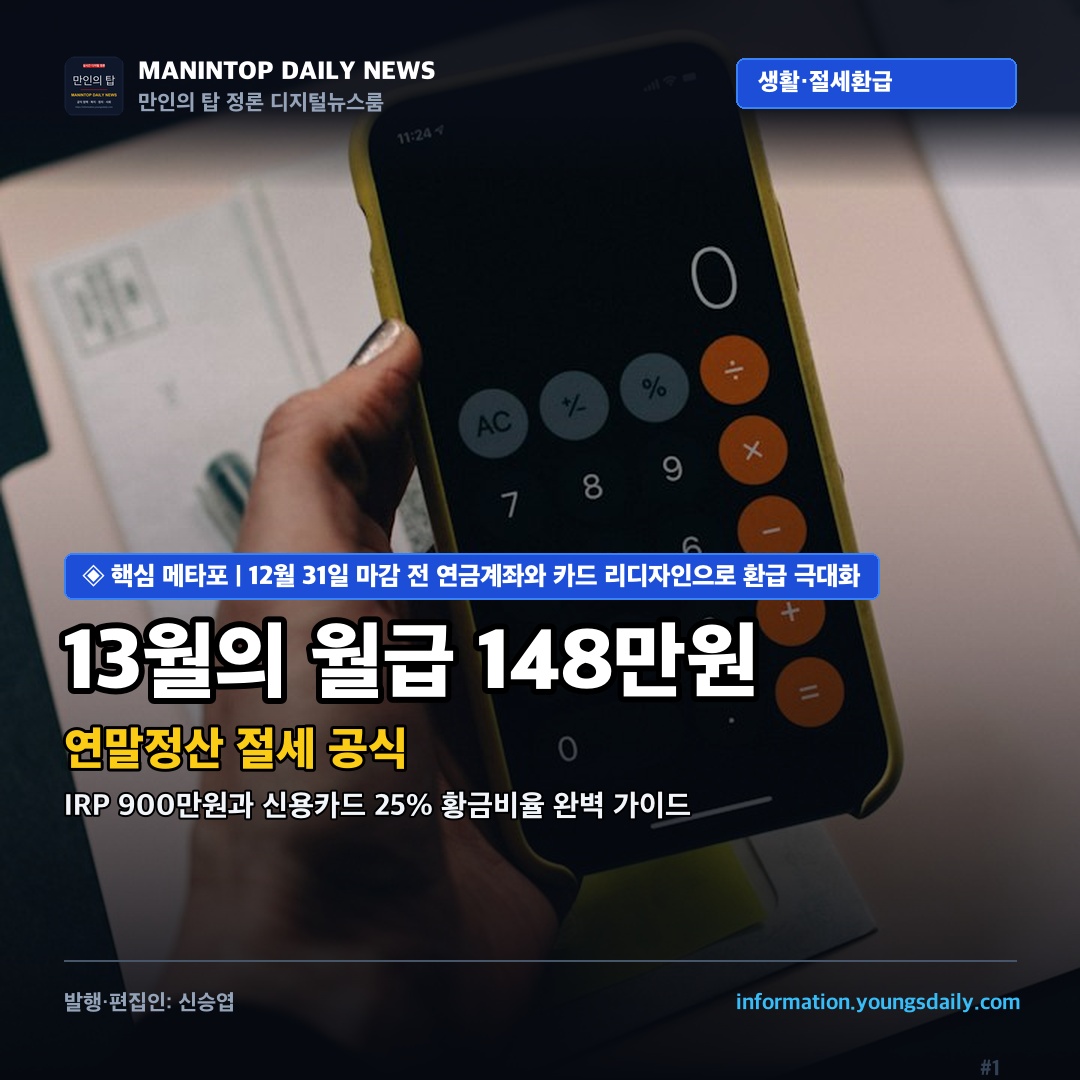
13월의 월급 148만원 챙기는 2026 연말정산 미리보기 오픈과 IRP·신용카드 절세 황금 공식
▲ 13월의 월급 148만원 챙기는 2026 연말정산 미리보기 오픈과 IRP·신용카드 절세 황금 공식 (공식 보도 자료)
📌 핵심 브리핑 · 주요 쟁점 및 핵심 요약

13월의 월급 148만원 챙기는 절세 비법을 찾기 위해 직장인들의 관심이 집중되는 가운데, 2,000만 근로소득자의 세금 환급액을 결정짓는 12월 마지막 절세 골든타임이 개막했습니다. 국세청 홈택스가 1~9월 신용카드 지출액과 전년도 공제 데이터를 바탕으로 예상 환급액을 시뮬레이션하는 '연말정산 미리보기' 서비스를 본격 가동하면서, 연말 지출 포트폴리오를 어떻게 리디자인하느냐에 따라 환급액 격차가 수십만 원에서 수백만 원까지 벌어지고 있습니다. 특히 동일한 급여를 받더라도 연금저축과 IRP 계좌에 900만 원 한도를 채웠는지, 총급여 25% 문턱을 넘긴 후 체크카드와 전통시장으로 결제 수단을 전환했는지, 그리고 맞벌이 부부간 공제 항목을 소득 구간별로 최적 배분했는지에 따라 '13월의 보너스'가 될 수도, 쓰라린 '세금 폭탄'이 될 수도 있습니다. 본 심층 가이드에서는 연 900만 원 납입으로 148만 5,000원을 돌려받는 연금계좌 전략, 신용카드 25% 문턱 탈출 공식, 맞벌이 부부 몰아주기 규칙, 안경 구입비와 결혼 세액공제 등 놓치기 쉬운 꿀팁, 그리고 12월 31일 마감 전 필수 체크리스트를 총정리합니다.

SPONSORED · ADVERTISEMENT

연금저축·IRP 세액공제: 연 900만원 한도로 최대 148.5만원 환급받는 법

연말정산 공제 항목 중 '소비한 돈'이 아니라 '미래를 위해 저축한 돈'에 대해 세금을 직접 깎아주는 가장 강력한 절세 엔진이 바로 연금저축과 IRP(개인형 퇴직연금)입니다. 연금계좌는 연말정산 환급 혜택과 더불어 운용 기간 동안 발생하는 배당소득세(15.4%)를 인출 시점까지 미뤄주는 과세이연 효과를 동시에 제공합니다. 가장 먼저 명확히 구분해야 할 점은 '연간 납입 한도'와 '세액공제 한도'의 차이입니다. 연금계좌의 연간 최대 납입 가능 금액은 1,800만 원이지만, 연말정산에서 실제 세금을 깎아주는 공제 한도는 연금저축 600만 원, IRP를 합산할 경우 연 900만 원까지입니다. 만약 연금저축에만 900만 원을 넣으면 600만 원까지만 공제되므로, 최대 한도를 채우기 위해서는 연금저축 600만 원과 IRP 300만 원을 조합하여 납입하는 것이 최적의 표준 포트폴리오입니다. 공제율은 총급여 5,500만 원(종합소득금액 4,500만 원)을 기준으로 나뉩니다. 총급여 5,500만 원 이하 근로자는 16.5%(지방소득세 포함)의 공제율이 적용되어 900만 원 납입 시 최대 148만 5,000원을 전액 환급받습니다. 반면 총급여 5,500만 원 초과 근로자는 13.2%가 적용되어 118만 8,000원을 돌려받아 29만 7,000원의 환급액 차이가 발생합니다. 여기서 주의할 점은 기준이 계약 연봉이 아니라 비과세 소득(식대, 자가운전보조금, 출산수당 등)을 차감한 '총급여'라는 사실입니다. 계약 연봉이 5,700만 원이더라도 비과세 급여가 250만 원이라면 총급여가 5,450만 원으로 산정되어 16.5%의 높은 공제율을 적용받을 수 있습니다. 납입은 12월 31일 금융기관 영업 마감 시각(오후 4~5시) 전까지 완료해야 당해 연도 세액공제로 인정됩니다.

현장 보도 및 관련 자료 사진
국세청 홈택스 연말정산 미리보기 서비스를 통해 1~9월 신용카드 지출액과 연금계좌 납입 잔액을 점검하면 환급액을 사전 예측할 수 있다.

신용카드·체크카드 소득공제: 25% 문턱 활용과 결제 수단 황금비율 공식

카드 소득공제는 지출액 전액에 대해 혜택을 주는 것이 아니라, 일정한 '소비 문턱'을 넘어선 금액부터 공제가 시작되는 독특한 계단식 구조를 취하고 있습니다. 공제의 출발점은 '총급여액의 25%' 초과 지출분입니다. 예를 들어 총급여가 5,000만 원인 직장인이라면 1년 동안 카드로 쓴 돈이 1,250만 원(25%)에 도달할 때까지는 소득공제 혜택이 0원입니다. 하지만 이 25% 문턱을 돌파하는 순간부터 어떤 결제 수단을 쓰느냐에 따라 공제율이 2배 이상 벌어집니다. 신용카드의 소득공제율은 15%에 불과하지만, 체크카드·직불카드·현금영수증은 2배인 30%, 전통시장과 대중교통 이용분은 40%의 높은 공제율이 적용됩니다. 따라서 현명한 직장인의 '결제 수단 황금 공식'은 시기별 이원화 전략입니다. 연초부터 1~9월까지 총급여의 25%를 채울 때까지는 포인트 적립, 통신비 청구 할인, 마일리지 혜택이 우수한 '신용카드'를 집중적으로 사용합니다. 이후 홈택스 미리보기를 통해 25% 문턱을 넘겼음이 확인된 10~12월부터는 공제율이 30%인 '체크카드나 현금영수증'으로 결제 수단을 전면 교체해야 공제 한도를 빛의 속도로 채울 수 있습니다. 아울러 2026년 연말정산부터는 부양 자녀 수에 따라 기본 공제 한도가 상향되어, 총급여 7,000만 원 이하 가구의 경우 무자녀 300만 원, 1자녀 350만 원, 2자녀 이상 400만 원까지 확대 적용됩니다. 단, 국세·지방세, 아파트 관리비, 초중고 수업료, 통신요금, 상품권 구입비, 해외 결제액, 월세 공제 적용분은 카드 결제를 하더라도 소득공제 대상에서 전액 제외되므로 유의해야 합니다.

연말정산 절세 핵심 항목 연간 납입 및 공제 인정 한도 소득 구간별 적용 공제율 실전 환급액 및 핵심 절세 전략
연금저축 + IRP 합산 합산 연 최대 900만원 (연금저축 600만 + IRP 300만) 총급여 5,500만원 이하 16.5% / 초과 13.2% 최대 148만 5,000원 환급 (초과자 118만 8,000원), 12월 31일 금융기관 영업시간 내 입금 필수
신용카드 소득공제 총급여의 25% 초과 사용분부터 적용 신용카드 15% / 전통시장·대중교통 40% 1~9월 포인트 혜택 우수한 신용카드로 25% 문턱을 채우고 한도 300만원(자녀수별 최대 400만원) 관리
체크카드 및 현금영수증 총급여 25% 문턱 초과 후 지출분 체크카드·직불카드·현금영수증 30% 총급여 25% 돌파 확인된 10~12월 집중 결제하여 신용카드 대비 2배 높은 공제율로 환급액 극대화
시력보정용 안경·렌즈 1인당 연 50만원 (의료비 인정 한도) 의료비 세액공제 15% (총급여 3% 초과분) 카드로 결제 시 의료비 공제와 카드 소득공제 중복 적용, 간소화 누락 대비 안경사 확인 영수증 제출
혼인신고 결혼 세액공제 부부 합산 최대 100만원 (부부 각각 50만원) 생애 1회 한정 세액 직접 감면 2024~2026년 사이 혼인신고를 마친 신혼부부 적용, 재혼 여부와 무관하게 연말정산 시 정액 감면
SPONSORED · ADVERTISEMENT

맞벌이 부부 절세 몰아주기 전략과 놓치기 쉬운 꿀포인트

맞벌이 부부는 각자 독립적으로 연말정산을 진행하지만, 부양가족 인적공제와 신용카드, 의료비 지출을 누구 앞으로 배치하느냐에 따라 부부 합산 환급액이 수십만 원 이상 차이 납니다. 절세 배분의 대원칙은 '공제 항목의 성격에 따른 이원화'입니다. 첫째, 소득공제 및 세액공제 효과를 높이려면 과세표준이 높아 높은 한계소득세율(6%~45%)을 적용받는 '소득이 높은 배우자'에게 부양가족 기본공제(1인당 150만 원), 자녀세액공제(1명 25만 원, 2명 55만 원, 3명 95만 원), 보장성 보험료 및 교육비 공제를 몰아주는 것이 압도적으로 유리합니다. 동일한 공제 금액이라도 적용되는 세율이 높을수록 감면받는 세금 액수가 커지기 때문입니다. 둘째, 지출 문턱을 넘어야 하는 항목은 반대로 '소득이 낮은 배우자'에게 몰아주어야 합니다. 신용카드 공제는 총급여의 25%, 의료비 공제는 총급여의 3%를 초과해야 공제가 시작되므로, 소득이 적은 배우자 카드로 결제하고 의료비를 지출하면 문턱 금액 자체가 낮아져 공제 조건을 훨씬 수월하게 달성할 수 있습니다. 여기에 더해 놓치기 쉬운 꿀포인트 2가지를 챙겨야 합니다. 시력보정용 안경 및 콘택트렌즈 구입비는 가족 1인당 연 50만 원까지 의료비 공제가 가능하며, 카드로 결제 시 의료비 공제(15%)와 카드 소득공제(15~30%)를 중복으로 적용받을 수 있습니다. 간소화 서비스에서 누락되기 쉬우므로 안경점에서 '시력교정용 확인 영수증'을 반드시 챙겨야 합니다. 또한 2024~2026년 사이 혼인신고를 마친 신혼부부는 생애 1회에 한해 부부 각각 50만 원씩 최대 100만 원의 '결혼 세액공제'를 받을 수 있으므로 빠짐없이 신청해야 합니다.

현장 보도 및 관련 자료 사진
총급여의 25% 문턱을 넘긴 시점부터는 공제율이 2배 높은 체크카드와 현금영수증, 전통시장 결제로 전환해야 공제 한도를 최대로 채울 수 있다.

국세청 홈택스 '연말정산 미리보기' 3단계와 12월 마감 체크리스트

🚨 신청 기한 및 주의사항 경고
연말정산의 최종 성패는 12월 한 달 동안 남은 공제 한도를 얼마나 빈틈없이 채우느냐에 달려 있습니다. 국세청 홈택스의 '연말정산 미리보기' 서비스를 활용하면 실시간 모의계산이 가능합니다. 미리보기 서비스는 총 3단계로 운영됩니다. 1단계에서는 올해 1~9월까지의 신용카드·체크카드 실제 사용액과 전년도 지급명세서 데이터를 불러와 올해 총급여와 기납부세액을 확인합니다. 2단계에서는 10~12월 카드 예상 지출액과 연금저축, IRP, 기부금 등 추가 납입 예정액을 입력하여 공제 항목별 예상 세액을 실시간으로 시뮬레이션합니다. 3단계에서는 최근 3개년간의 세 부담 추이 그래프를 확인하고 과다공제로 인한 가산세 위험을 사전에 점검합니다. 12월 31일 마감 전 반드시 점검해야 할 핵심 액션플랜은 명확합니다. 첫째, 연금저축과 IRP 계좌의 납입 잔액을 조회하여 900만 원 세액공제 한도 부족분을 12월 31일 영업시간 내에 완납합니다. 둘째, '고향사랑기부제'를 활용해 주소지 외 지자체에 10만 원을 기부하면 10만 원 전액 세액공제와 함께 3만 원 상당의 지역 특산품 답례품을 받아 13만 원의 실질 혜택을 챙깁니다. 셋째, 안경점에서 시력보정 영수증을 미리 발급받고, 올해 국가건강검진 대상자라면 12월 31일까지 수검을 완료하여 불이익을 방지해야 합니다. 12월의 철저한 사전 준비만이 새해 초 따뜻한 13월의 월급을 현실로 만들어 줄 것입니다.
RECOMMENDED STORIES · SPONSORED
발행·편집인: 신승엽
Securing the 1.48 Million Won 13th Month Salary: The 2026 Year-End Tax Settlement Guide and IRP-Card Optimization Formulas
▲ Official Press Coverage & Contextual Archive
GLOBAL EDITION · FACT BRIEFING

Securing the 1.48 Million Won 13th Month Salary: The 2026 Year-End Tax Settlement Guide and IRP-Card Optimization Formulas

Securing the 1.48 million won thirteenth-month bonus represents the ultimate financial objective for twenty million salaried workers across the country as the definitive year-end tax planning window opens. With the National Tax Service activating its online Year-End Tax Preview portal to simulate returns based on January-to-September payment records, executing tactical spending adjustments before December 31 dictates whether households enjoy substantial cash refunds or face painful additional tax bills. Even among workers earning identical salaries, strategic decisions—such as maximizing combined 9 million won contributions across Annuity Savings and IRP accounts, pivoting to debit cards and traditional markets once crossing the 25 percent salary threshold, and allocating deductions between dual-income spouses—widen refund margins by hundreds of thousands of won. This comprehensive financial manual dissects the 1.485 million won pension refund mechanism, card spending ratios, dual-income optimization principles, overlooked deductions including prescription eyewear and newlywed credits, and the essential year-end deadline checklist.

📌 Key Takeaways
  • Combined 9 Million KRW Annuity Limit: Maximize 6M KRW in annuity plus 3M KRW in IRP to secure up to 1.485 million KRW (16.5%) in cash refunds.
  • Cross the 25% Floor and Switch: Use credit cards to reach the 25% salary threshold, then transition to debit cards (30%) and markets (40%) through year-end.
  • Dual-Income Allocation and Receipts: Assign dependents to the higher earner while collecting prescription eyewear receipts (500k KRW) and marriage credits.

Maximizing Annuity Savings and IRP Deductions: Securing Up to 1.485 Million KRW

Among year-end tax deduction categories, retirement pension instruments—specifically Annuity Savings and Individual Retirement Pensions (IRP)—stand out as the most formidable wealth-defense tools because they reward future capital preservation rather than consumer expenditure. Alongside substantial tax rebates, these accounts provide valuable tax deferral on investment gains, compounding yields without immediate 15.4 percent dividend taxation. Taxpayers must strictly distinguish between annual contribution ceilings and tax-deductible caps. While combined annual deposits can reach 18 million KRW, statutory tax deductions cap at 6 million KRW for Annuity Savings and 9 million KRW when paired with an IRP. Contributing the entire 9 million KRW solely into an Annuity Savings account wastes 3 million KRW of potential relief; optimal execution mandates deploying 6 million KRW into Annuity Savings and 3 million KRW into an IRP. The tax deduction percentage pivots sharply at a 55 million KRW gross annual salary threshold (45 million KRW for comprehensive income). Workers earning 55 million KRW or below qualify for a 16.5 percent rebate rate (including local income tax), yielding a maximum cash refund of 1.485 million KRW on a 9 million KRW deposit. Individuals exceeding this threshold receive 13.2 percent, returning 1.188 million KRW—a net variance of 297,000 KRW. Crucially, statutory eligibility evaluates gross salary after subtracting non-taxable allowances such as monthly meal stipends and vehicle operation subsidies rather than total contractual compensation. Deposits must clear prior to financial institution closing hours (typically 4:00 to 5:00 PM) on December 31 to qualify for the current tax year.

Securing the 1.48 Million Won 13th Month Salary: The 2026 Year-End Tax Settlement Guide and IRP-Card Optimization Formulas press coverage photo
▲ Official Press Archive & Contextual Documentation

Card Deductions and the 25 Percent Threshold: The Golden Spending Ratio

Payment card deductions operate upon a tiered threshold architecture rather than granting blanket write-offs across all consumer purchases. The statutory starting line requires cumulative card and cash-receipt expenditures to exceed exactly 25 percent of a worker's annual gross salary. For a professional with a 50 million KRW salary, the initial 12.5 million KRW of card spending yields zero deduction. However, once this threshold is breached, the choice of payment instrument creates a twofold divergence in tax relief: credit cards confer a modest 15 percent deduction rate, whereas debit cards and registered cash receipts deliver 30 percent, rising to 40 percent for public transit and traditional market expenditures. Consequently, sophisticated tax planning demands a disciplined bifurcated timeline. From January through September, consumers should utilize high-reward credit cards offering cash back, airline miles, and merchant discounts to fulfill the 25 percent gross income prerequisite. From October through December, once the baseline threshold is surpassed, switching immediately to debit cards and cash receipts accelerates tax deductions toward statutory ceilings twice as fast. Furthermore, statutory ceilings have expanded based on household dependents: for workers earning up to 70 million KRW, baseline deduction limits scale from 3 million KRW for households without children to 3.5 million KRW for one child and 4 million KRW for two or more children. Taxpayers must note that utility bills, apartment maintenance fees, school tuition, mobile carrier tariffs, gift card purchases, and overseas charges remain strictly excluded from eligible card totals.

Core Tax Deduction Category Statutory Annual Cap Deduction Rate by Income Bracket Realized Cash Refund & Execution Strategy
Annuity Savings + IRP Combined annual cap of 9 million KRW (Annuity 6M + IRP 3M) 16.5% under 55M KRW gross salary / 13.2% above Up to 1.485 million KRW refund (1.188M KRW for higher tier); deposit prior to bank close on Dec 31
Credit Card Deduction Expenditures exceeding 25% of gross annual salary 15% on credit / 40% on public transit and markets Deploy credit cards from Jan to Sep to cross the 25% threshold; cap basic deductions up to 4 million KRW
Debit Cards & Cash Receipts Expenditures exceeding the 25% salary threshold 30% flat deduction on debit and cash receipts Concentrate spending on debit and cash receipts from Oct to Dec to secure double the deduction percentage
Prescription Eyewear & Lenses 500,000 KRW annual cap per household dependent 15% medical tax credit (exceeding 3% salary floor) Dual eligibility for both medical tax credit and card deduction; retain optician verification receipts
Marriage Registration Credit Up to 1 million KRW combined (500,000 KRW each) Direct tax subtraction applied once in a lifetime Applies to newly married couples registering between 2024 and 2026 regardless of remarriage status

Strategic Allocation for Dual-Income Couples and High-Value Hidden Deductions

Although dual-income spouses file individual tax returns, strategic cross-allocation of family dependents, credit card charges, and medical outlays alters combined household returns by substantial sums. The core formula rests upon structural divergence: high-bracket versus low-threshold sorting. First, deductions delivering direct taxable income reductions should concentrate entirely under the higher-earning spouse. Because this spouse falls into higher marginal income tax brackets (ranging between 6 and 45 percent), assigning dependent personal exemptions (1.5 million KRW per dependent), expanded child tax credits (up to 950,000 KRW for three children), and educational/insurance expenses generates exponentially larger cash savings. Second, deductions conditioned upon minimum expenditure hurdles should route through the lower-earning spouse. Because card deductions require exceeding 25 percent of gross salary and medical credits mandate surpassing 3 percent, utilizing the lower earner's profile depresses the required threshold dollar amount, unlocking deductions with substantially lower aggregate outlays. Moreover, two frequently overlooked opportunities require immediate attention. Corrective prescription eyeglasses and contact lenses qualify for up to 500,000 KRW per dependent under medical tax credits, permitting dual-stacking benefits where consumers claim both the 15 percent medical credit and 15-to-30 percent card deductions simultaneously (requiring manual optician verification receipts). Additionally, couples completing official marriage registrations between 2024 and 2026 qualify for a one-time direct Marriage Tax Credit of up to 1 million KRW (500,000 KRW per spouse).

Securing the 1.48 Million Won 13th Month Salary: The 2026 Year-End Tax Settlement Guide and IRP-Card Optimization Formulas press coverage photo
▲ Institutional Field Data & Media Archive

Three-Step Guide to Hometax Year-End Preview and the Final December Checklist

Year-end tax optimization culminates during the final weeks of December, where closing remaining contribution deficits determines ultimate tax outcomes. Deploying the National Tax Service's Hometax Year-End Preview system offers precise, real-time fiscal forecasting. The platform functions through three systematic phases. Step One aggregates verified January-to-September card transaction records alongside prior-year baseline parameters, allowing filers to project gross annual earnings and withheld taxes. Step Two incorporates estimated fourth-quarter expenditures and planned retirement deposits to forecast exact net tax adjustments. Step Three analyzes multi-year fiscal trends and flags over-deduction risks to safeguard against audit penalties. Before December 31, taxpayers must execute a prioritized four-point checklist. First, audit Annuity Savings and IRP balances and deposit any deficit necessary to fully capture the 9 million KRW ceiling before financial market cutoffs. Second, leverage the Hometown Love Donation Program: donating 100,000 KRW to local municipalities yields a 100 percent full tax rebate alongside 30,000 KRW in regional goods, generating a risk-free 130,000 KRW net economic gain. Third, collect physical optical receipts for prescription eyewear and complete scheduled National Health Screenings prior to year-end deadlines. Strategic proactive execution during December remains the sole guarantor of an enriching thirteenth-month dividend.

Publisher & Editor-in-Chief: Seung Youb Ssin, Ph.D.
PRO SOURCING ENGINE 만인의 탑 빅데이터 솔루션
★ 가입 시 600 크레딧(120회) 전원 무료

내가 찾는 상품 키워드, 지금 얼마나 검색될까?

네이버 월간 검색량 + 구글 볼륨 + 아이템스카우트 실시간 상품수와 경쟁강도 배지를 0.5초 만에 무료로 확인하세요.