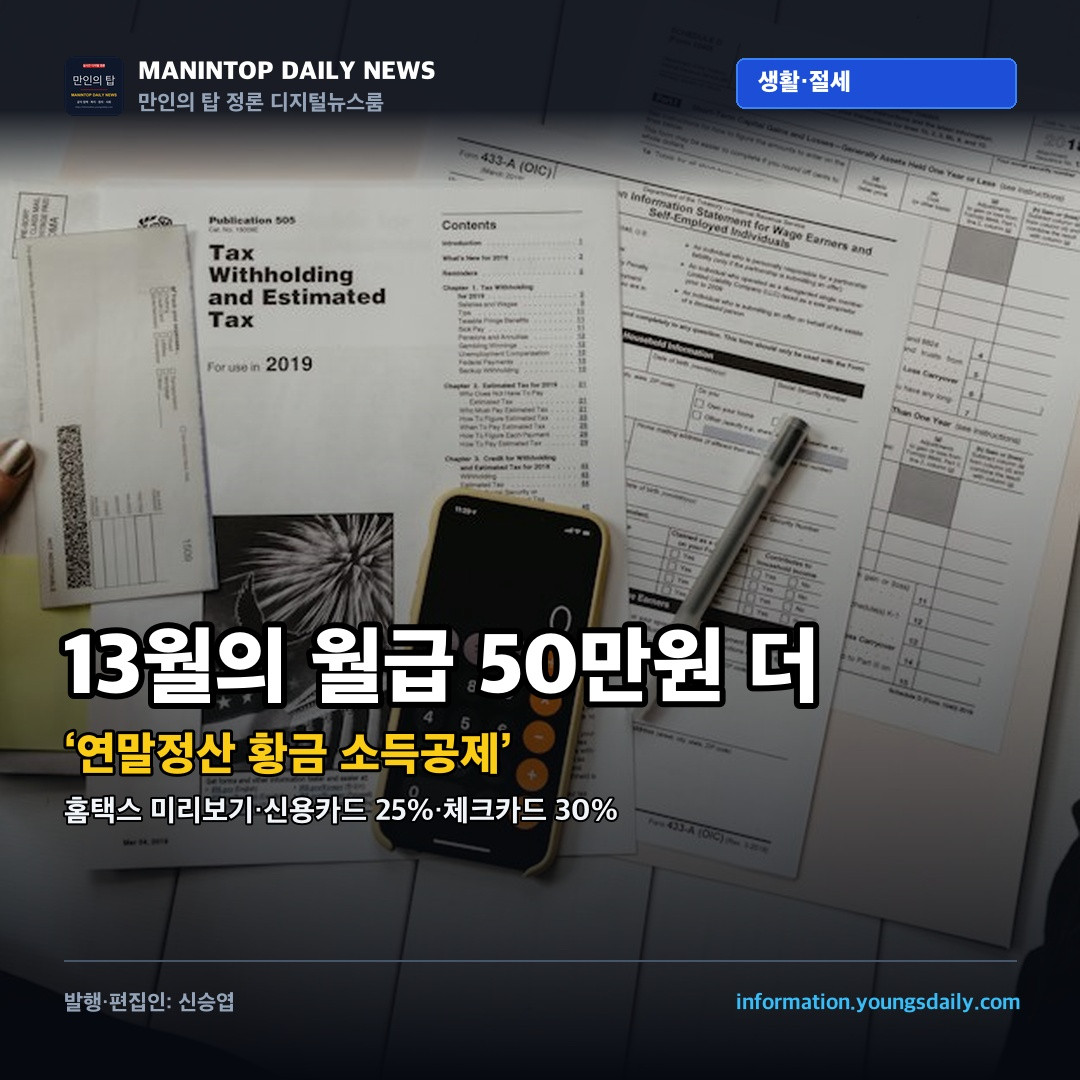
“13월의 월급 50만원 더 받는다”… 국세청 연말정산 미리보기와 신용카드 황금비율 가이드
▲ “13월의 월급 50만원 더 받는다”… 국세청 연말정산 미리보기와 신용카드 황금비율 가이드 (공식 보도 자료)
📌 핵심 브리핑 · 주요 쟁점 및 핵심 요약

13월의 월급 50만원 더 돌려받을 수 있는 결정적 기회가 11월 국세청 '연말정산 미리보기 서비스'의 개통과 함께 본격화되었습니다. 매년 연말정산 시즌마다 '세금 폭탄'을 맞을지, '13월의 보너스'를 챙길지는 남은 11월과 12월 두 달간의 결제 수단 포트폴리오를 어떻게 재편하느냐에 따라 완전히 갈립니다. 국세청 전산은 연간 총급여액의 25%에 도달할 때까지는 신용카드 사용액부터 우선 차감하고, 그 이후 초과분에 대해서는 체크카드와 현금영수증(30%)에 신용카드(15%)의 2배에 달하는 소득공제율을 부여합니다. 본 심층 가이드에서는 2026년 세제개편안의 주요 골자와 월세세액공제 1,200만 원 확대, 신용카드 25% 문턱 활용 황금비율 전략, 소득공제 제외 대상 8대 항목 팩트체크, 그리고 12월 31일 전 최대 148만 5천 원을 환급받는 연금저축·IRP 막판 납입 기술을 총정리합니다.

SPONSORED · ADVERTISEMENT

1. 2026년 세제개편안 주요 골자와 근로소득자 연말정산 핵심 개정 사항

기획재정부가 확정한 2026년 세제개편안은 서민과 중산층 근로자의 실질 가처분소득을 증대시키고 주거 및 양육 부담을 경감하는 데 방점을 찍고 있습니다. 가장 눈에 띄는 변화는 무주택 근로자를 위한 주거비 세제 혜택의 대폭 확대입니다. 총급여 8,000만 원 이하 무주택 세대주에게 적용되는 월세세액공제 대상 한도가 기존 연간 1,000만 원에서 1,200만 원으로 상향 조정되었으며, 청년(15~34세)에 대해서는 17%의 우대 공제율이 유지됩니다.

아울러 전세자금대출 원리금 상환액 소득공제(연 400만 원 한도) 대상이 주민등록상 별도 거주하는 배우자까지 확대되어 맞벌이 가구의 주거비 공제 사각지대가 해소되었습니다. 또한 근로장려세제(EITC) 단독·맞벌이 가구 최대 지급액이 330만 원에서 360만 원으로 인상되고, 기업의 출산지원금 비과세 적용 기간이 '임신일부터 출생 후 2년 이내'로 확대 적용되는 등 일하는 가정을 위한 세제 안전망이 한층 두터워졌습니다.

현장 보도 및 관련 자료 사진
▲ 연말정산 미리보기 서비스를 통해 신용카드와 체크카드 지출 내역 및 소득공제 환급액을 계산하는 근로소득자 (보도 자료)

2. 결제 수단별 공제율 격차와 25% 초과 '황금비율' 절세 공식

연말정산 소득공제 항목 중 근로소득자가 가장 쉽게 통제할 수 있는 항목은 '신용카드 등 사용금액 소득공제'입니다. 공제율은 결제 수단에 따라 신용카드 15%, 체크카드·직불카드 30%, 현금영수증 30%, 전통시장 40%, 도서·공연·영화관람료 및 헬스장·수영장 이용료 30%로 극명하게 차등화되어 있습니다. 여기서 핵심은 국세청의 공제액 산출 원리입니다.

국세청 전산은 연간 총급여액의 25%에 해당하는 '공제 문턱'을 계산할 때, 결제 일자와 상관없이 공제율이 가장 낮은 '신용카드 사용분'부터 먼저 차감합니다. 따라서 연봉의 25%까지는 카드사 할인과 포인트 적립 혜택이 풍부한 신용카드를 집중적으로 사용하고, 문턱을 넘어서는 11월과 12월의 지출은 공제율이 2배 높은 체크카드나 현금영수증으로 전격 전환하는 것이 소득공제를 극대화하는 '황금비율' 공식입니다. 예를 들어 연봉 5,000만 원 근로자가 2,500만 원을 쓸 때, 전액 신용카드를 쓰면 187.5만 원 공제에 그치지만 문턱 초과분을 체크카드로 결제하면 375만 원의 소득공제를 받아 공제액이 정확히 2배로 증가합니다.

구분 유형 지원 및 적용 대상 환급 및 해결 기준 신청 및 조치 방법
신용카드 결제분 15% 소득공제율 (포인트 및 할인 혜택) 연간 총급여의 25% 공제 문턱 채우기용 문턱 도달 시점까지 집중 사용하여 카드 혜택 극대화
체크카드·현금영수증 30% 소득공제율 (신용카드의 2배) 총급여 25% 초과 지출분 집중 결제용 문턱 초과 후 전격 전환하여 소득공제 환급액 2배 확대
전통시장 사용분 40% 최고 소득공제율 적용 전통시장 온누리상품권 및 카드 결제 기본 공제 한도와 별도로 100만~200만 원 추가 공제
도서·공연·영화·헬스장 30% 소득공제율 (총급여 7천만원 이하) 문화비 및 체육시설(수영장·체력단련장) 문화생활 및 건강관리 비용에 대한 추가 공제 혜택
연금계좌(연금저축+IRP) 13.2% ~ 16.5% 세액공제 (최대 900만원) 12월 31일까지 계좌 입금 완료 필수 연말정산 환급금 최대 148만 5천 원 현금 수령 효과
SPONSORED · ADVERTISEMENT

3. 소득공제 제외 대상 8대 항목과 추가 공제 팩트체크

열심히 카드를 긁었음에도 연말정산 집계에서 전액 제외되어 낭패를 보는 대표적인 항목들을 사전에 숙지해야 합니다. 첫째, 국세, 지방세, 자동차세, 아파트 관리비, 전기·수도·가스 요금 등 세금과 공과금은 카드 소득공제 대상에서 완전히 제외됩니다. 둘째, 스마트폰 요금과 인터넷 통신비 역시 공제되지 않으며(단말기 할부금만 인정), 신차 구매 비용과 리스료도 제외됩니다(중고차 구입비의 10%는 공제 가능). 셋째, 유치원·초·중·고·대학교 공식 등록금, 면세점 및 해외 카드 결제액, 백화점 상품권이나 모바일 기프티콘 구매액도 소득공제가 일체 불가합니다.

반면 법정 추가 공제 혜택을 적극 활용하면 기본 한도(총급여 7,000만 원 이하 기준 300만 원)를 초과하여 추가 공제를 챙길 수 있습니다. 전통시장 사용분에는 최고 수준인 40%의 공제율이 적용되며, 총급여 7,000만 원 이하 근로자의 도서, 공연, 박물관, 미술관, 영화관람료는 물론 2025년 7월부터 신설된 체육시설(수영장, 헬스장 체력단련장) 이용료에 대해서도 30%의 소득공제 혜택이 주어집니다.

현장 보도 및 관련 자료 사진
▲ 국세청 홈택스 세법 개정안을 바탕으로 연금저축 세액공제와 월세공제 증빙 서류를 정밀 점검하는 세무 현장 (보도 자료)

4. 홈택스 연말정산 미리보기 활용과 12월 31일 전 필수 금융상품

🚨 신청 기한 및 주의사항 경고
11월 국세청 홈택스(hometax.go.kr)와 손택스 모바일 앱을 통해 개통되는 '연말정산 미리보기 서비스'는 1월부터 9월까지의 실제 카드 사용액과 전년도 정산 내역을 자동으로 불러와 남은 10~12월 지출 계획을 시뮬레이션할 수 있는 결정적 도구입니다. 총급여액과 잔여 지출 예상액을 입력하면 개정 세법이 반영된 예상 환급세액(또는 추가 납부세액)을 미리 확인할 수 있어, 신용카드 25% 문턱 달성 여부를 정밀하게 점검할 수 있습니다. 또한 12월 31일 자정 전까지 반드시 챙겨야 할 최고의 절세 금융상품은 '연금계좌'입니다. 연금저축(연 600만 원 한도)과 개인형 퇴직연금 IRP를 합산하여 연간 900만 원까지 납입할 수 있으며, 총급여 5,500만 원 이하자는 16.5%의 세액공제율을 적용받아 최대 148만 5,000원의 세금을 통장으로 환급받습니다. 아울러 총급여 7,000만 원 이하 무주택 세대주는 연간 300만 원 한도의 주택청약종합저축에 납입하여 납입액의 40%(최대 120만 원)를 소득공제받을 수 있으므로 연말 전 납입 한도를 채워두는 전략이 필수적입니다.
RECOMMENDED STORIES · SPONSORED
발행·편집인: 신승엽
“Securing 500,000 Won in Additional Year-End Tax Refunds”: The Definitive Guide to NTS Previews and Strategic Card Deduction Ratios
▲ Official Press Coverage & Contextual Archive
GLOBAL EDITION · FACT BRIEFING

“Securing 500,000 Won in Additional Year-End Tax Refunds”: The Definitive Guide to NTS Previews and Strategic Card Deduction Ratios

Securing five hundred thousand won in additional year-end tax refunds represents an actionable financial milestone initiated by the launch of the National Tax Service Year-End Tax Settlement Preview Service this November. Whether wage earners face sudden tax liabilities or collect lucrative bonus refunds hinges decisively on how strategically payment instruments are allocated across remaining operational months. The National Tax Service algorithm systematically debits credit card expenditures first to fulfill the mandatory 25 percent gross income threshold, after which debit cards and cash receipts yield a 30 percent statutory deduction rate double that of credit cards. This definitive analysis details core tax reforms including monthly rent deductions expanded to 12 million won, mathematical card allocation formulas, eight non-deductible expenditure traps, and year-end pension account contributions securing up to 1.485 million won in direct tax credits.

📌 Key Takeaways
  • Strategic Pivot to Debit Cards Post-Threshold: Transitioning to debit cards and cash receipts (30 percent) after fulfilling the 25 percent gross income threshold doubles tax deductions.
  • Comprehensive Simulation via NTS HomeTax Previews: Audits January through September expenditures to mathematically project fourth-quarter allocations and secure net refunds.
  • Maximized Year-End Pension Account Contributions: Depositing up to 9 million won into personal pension and IRP accounts before December 31 generates up to 1.485 million won in direct tax credits.

1. Institutional Overview of the 2026 Tax Reforms and Key Revisions for Wage Earners

The comprehensive 2026 tax reform framework enacted by the Ministry of Economy and Finance focuses on bolstering real disposable income for middle-class wage earners while mitigating systemic housing and childcare liabilities. The cornerstone revision centers on substantial expansions in housing tax credits for non-homeowning workers. The statutory annual deduction ceiling for monthly rental housing credits applicable to wage earners earning 80 million won or less has escalated from 10 million to 12 million won, retaining a preferential 17 percent rate for young adults aged 15 to 34.

Furthermore, statutory deductions governing principal and interest repayments on residential lease loans capped at 4 million won annually now extend to separately residing spouses, effectively closing coverage gaps for dual-income households. Concurrent expansions in the Earned Income Tax Credit raise maximum disbursements from 3.3 million to 3.6 million won, while corporate maternity bonus tax exemptions extend across a broader window spanning from initial pregnancy through two years post-childbirth, establishing robust statutory protections for working families.

“Securing 500,000 Won in Additional Year-End Tax Refunds”: The Definitive Guide to NTS Previews and Strategic Card Deduction Ratios press coverage photo
▲ Official Press Archive & Contextual Documentation

2. Stratified Deduction Rates by Payment Mechanism and the 25 Percent Threshold Formula

Among itemized income deductions, payment instrument deductions represent the most agile category directly controlled by wage earners. Statutory deduction ratios diverge sharply across payment rails: 15 percent for credit cards, 30 percent for debit and prepaid cards, 30 percent for cash receipts, 40 percent for traditional municipal markets, and 30 percent for cultural and fitness expenditures. The foundational leverage point resides within the accounting algorithms executed by the National Tax Service.

During tax calculations, the National Tax Service systematically attributes expenditures toward the statutory 25 percent gross income threshold using the lowest 15 percent credit card rate first, regardless of transaction chronologies. Consequently, optimal financial architecture dictates deploying rewards-heavy credit cards exclusively until reaching the 25 percent gross compensation baseline, then executing an immediate pivot toward 30 percent debit cards and cash receipts for all subsequent fourth-quarter spending. For an earner making 50 million won spending 25 million won, channeling post-threshold purchases into debit cards yields 3.75 million won in deductions versus 1.875 million won, precisely doubling statutory tax savings.

Category Target Scope Standard / Benefit Procedure / Action
Credit Card Payments 15% Income Deduction Rate (including points and discounts) To meet the deduction threshold of 25% of annual salary Maximize card benefits by concentrating usage until the threshold is reached
Debit Cards and Cash Receipts 30% Income Deduction Rate (double that of credit cards) For concentrated payments exceeding 25% of total salary Switch to maximize income deduction refunds after surpassing the threshold
Traditional Market Expenditures Maximum income deduction rate of 40% applied Payments made using traditional market gift certificates and cards An additional deduction of 1 to 2 million won, separate from the basic deduction limit
Books, Performances, Movies, and Gyms 30% Income Deduction Rate (for total salary under 70 million won) Cultural expenses and sports facilities (swimming pools, fitness centers) Additional deduction benefits for cultural and health management costs
Pension Accounts (Pension Savings + IRP) Tax Credit of 13.2% to 16.5% (up to 9 million won) Deposits must be completed by December 31 Potential cash refund effect of up to 1,485,000 won at year-end tax settlement

3. Eight Statutory Exclusion Categories and Supplementary Cultural Deduction Parameters

Taxpayers must audit non-deductible expenditure categories to prevent inaccurate refund projections and subsequent penalty assessments. First, national taxes, municipal levies, automobile registration fees, apartment maintenance fees, and public utility tariffs are statutorily barred from payment instrument deductions. Second, mobile telecommunication fees and broadband subscriptions are non-deductible (excluding financed handset hardware installments), alongside new passenger vehicle purchases and commercial automobile leases (though 10 percent of used vehicle acquisitions qualify). Third, official academic tuition, duty-free shop purchases, overseas card charges, and mobile prepaid vouchers are fully excluded.

Conversely, aggressive utilization of supplementary categories unlocks deductions exceeding standard ceilings capped at 3 million won for earners making 70 million won or less. Traditional market expenditures unlock a premier 40 percent deduction rate, while cultural expenditures covering books, performing arts, museum admissions, cinematic screenings, and fitness facilities (including swimming pools and gyms established in mid-2025) deliver 30 percent deduction rates for eligible demographics.

“Securing 500,000 Won in Additional Year-End Tax Refunds”: The Definitive Guide to NTS Previews and Strategic Card Deduction Ratios press coverage photo
▲ Institutional Field Data & Media Archive

4. Operating NTS Previews and Year-End Pension Contributions Securing Maximum Credits

The National Tax Service Year-End Tax Settlement Preview Service accessible via HomeTax (hometax.go.kr) aggregates actual payment card records from January through September alongside historical filings, empowering workers to simulate fourth-quarter expenditure scenarios. Inputting estimated year-end compensation and fourth-quarter projections computes anticipated tax balances under prevailing tax codes, clarifying whether card expenditures satisfy the 25 percent gross income baseline.

Furthermore, capitalizing on personal pension accounts represents the premier year-end wealth preservation strategy prior to midnight on December 31. Consolidating personal pension savings (capped at 6 million won) and Individual Retirement Accounts (IRP) enables up to 9 million won in annual tax-deductible contributions. Earners generating 55 million won or less secure a 16.5 percent direct tax credit, generating an immediate cash refund of up to 1.485 million won. In parallel, non-homeowning household heads depositing into housing subscription accounts deduct 40 percent of deposits up to 3 million won (delivering up to 1.2 million won in deductions), mandating decisive contributions before year-end accounting windows close.

Publisher & Editor-in-Chief: Seung Youb Ssin, Ph.D.
PRO SOURCING ENGINE 만인의 탑 빅데이터 솔루션
★ 가입 시 600 크레딧(120회) 전원 무료

내가 찾는 상품 키워드, 지금 얼마나 검색될까?

네이버 월간 검색량 + 구글 볼륨 + 아이템스카우트 실시간 상품수와 경쟁강도 배지를 0.5초 만에 무료로 확인하세요.