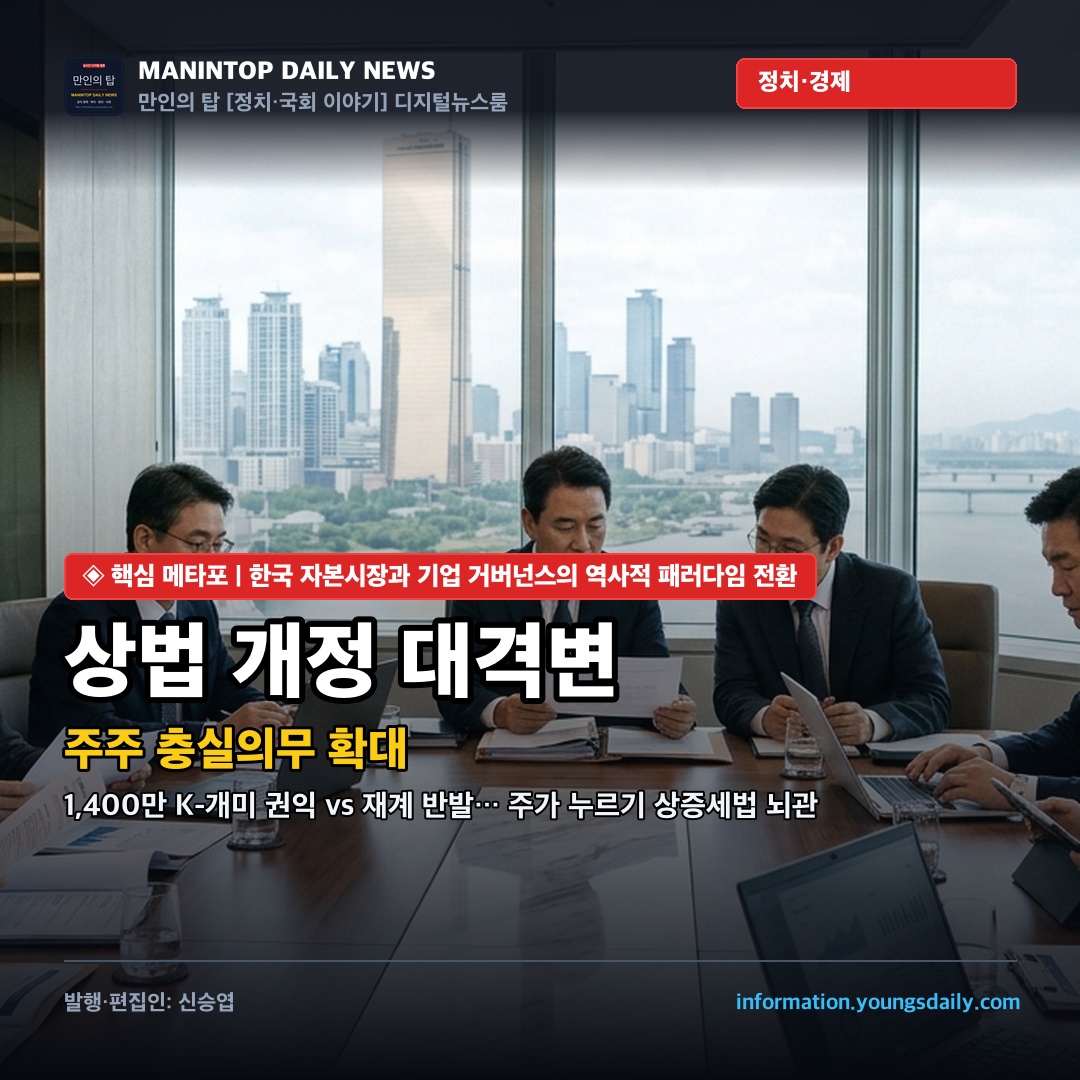
▲ 서울 여의도 주요 기업 이사회 회의실 전경. 이사의 충실의무 대상을 '회사 및 주주'로 전면 확대한 개정 상법이 공포되면서 한국 기업 거버넌스와 이사회 의사결정 체계에 지각변동이 일어나고 있다. / 공식보도자료
대한민국 자본시장과 기업 거버넌스의 근간을 뒤흔드는 상법 개정이 마침내 결실을 맺으며, 이사의 주주 충실의무 확대를 둘러싼 거대한 패러다임 전환이 본격화되었습니다. 1,400만 명에 달하는 국내 주식 투자자(K-개미)들의 숙원이었던 코리아 디스카운트 해소와 소액주주 재산권 보호라는 명분이 법제화된 반면, 재계는 소송 남발과 경영권 방어 비용 급증으로 인한 투자 위축을 호소하며 거세게 맞서고 있습니다. 상법 제382조의3 개정으로 이사의 충실의무 대상이 기존 '회사'에서 '회사 및 주주'로 확장됨에 따라, 지배주주 중심의 일방적 의사결정에 제동이 걸리고 총주주의 비례적 이익 침해가 직접적인 민사상 손해배상 책임 사유로 정립되었습니다.
거부권 딛고 국회 통과… '회사 및 주주'로 확장된 이사의 법적 책임
이번 상법 개정안은 우여곡절 끝에 국회 본회의를 통과하고 국무회의에서 공포안이 의결되면서 확정되었습니다. 과거 국회에서 야당 주도로 통과되었다가 대통령 권한대행의 재의요구권(거부권) 행사로 한 차례 폐기되었던 법안이 새 정부 출범 직후 최우선 민생·경제 입법 과제로 재추진되어 여야 합의 1호 상징 법안으로 통과된 것입니다. 수십 년간 지속된 '이사는 회사에 대해서만 책임을 질 뿐 개별 주주에게는 책임을 지지 않는다'는 대법원 판례의 사법적 공백을 입법부가 직접 메웠다는 점에서 헌정사적으로도 중대한 분수령으로 평가받습니다.
개정 상법의 핵심 조항인 제382조의3은 제1항에 이사의 충실 대상을 '회사 및 주주'로 명시하고, 제2항을 신설하여 '이사는 직무 수행 시 총주주의 이익을 보호하고 전체 주주의 이익을 공평하게 대우해야 한다'고 못 박았습니다. 특히 이 조항은 공포 즉시 효력이 발생하여 현재 진행되는 모든 상장사 이사회의 결의에 직접 적용됩니다. 이에 따라 물적분할, 계열사 합병, 자산 양수도 등 과거 지배주주에게만 유리하고 일반 주주에게 피해를 안겼던 구조개편 결정에 대해 이사 개인이 직접적인 법적 책임을 지게 되었습니다.
핵심 개정 항목
종전 규정 (개정 전)
개정 상법 핵심 내용
시행 시점 및 효력
이사의 충실의무 (제382조의3)
'회사'만을 위하여 직무 수행
'회사 및 주주', 총주주 공평 대우
공포 즉시 시행 (즉시 적용)
감사위원 3%룰 강화
특수관계인 개별 3% 우회 가능
최대주주+특수관계인 합산 3% 제한
공포 1년 뒤 시행
독립이사제 전환 및 비율
'사외이사' 명칭, 1/4 이상
'독립이사'로 전환, 1/3 이상 상향
개정안 부칙 기준 단계적 적용
전자주주총회 의무화
현장 주총 중심 (병행 미비)
상장회사 전자주총 개최 의무화
2027년 1월 1일 전면 시행
감사위원 3%룰 합산과 독립이사 의무화… 이사회 권력 재편
이사회와 주총의 권력 지형을 재편하는 후속 장치들도 잇따라 가동됩니다. 감사위원 선임 시 최대주주와 특수관계인의 의결권을 '합산 3%'로 엄격히 제한하는 규정이 공포 1년 뒤 시행되어 지분 쪼개기 편법을 차단합니다. 또한 사외이사의 명칭을 '독립이사'로 공식 전환하고 법정 의무 선임 비율을 기존 4분의 1에서 3분의 1 이상으로 상향해 이사회의 실질적 감시 기능을 강화했습니다. 나아가 2027년 1월 1일부터는 상장사의 전자주주총회 개최가 의무화되어 전국의 수많은 소액주주가 온라인으로 실시간 표결에 참여하는 진정한 주주 민주주의 시대가 열리게 됩니다.
이번 개정이 성사된 배경에는 자본시장에서 반복되었던 뼈아픈 소액주주 잔혹사가 자리 잡고 있습니다. 가장 대표적인 사례가 핵심 배터리 사업부를 단순 물적분할한 뒤 자회사로 중복 상장시켰던 LG화학 사태입니다. 모회사 주주들은 배터리 성장을 믿고 투자했으나 알짜 사업이 분사되면서 지분 희석과 주가 급락 피해를 고스란히 떠안았습니다. 그러나 당시 상법상 회사 법인의 순자산이 줄어든 것은 아니라는 이유로 이사들에게 배임이나 손해배상 책임을 묻지 못해 거센 공분을 샀습니다.
LG엔솔 물적분할부터 삼성물산 합병까지… 소액주주 수난사의 종언
시가 기준 기계적 산정 방식을 악용해 삼성물산의 기업가치가 저평가된 시점에 합병을 밀어붙였던 삼성물산·제일모직 합병 논란이나, 총수 일가 계열사에 유망 사업 기회를 넘겨주는 일감 몰아주기 관행도 소액주주들의 피눈물을 흘리게 했습니다. 대법원이 기존에 고수해 온 '회사 이익' 중심의 기계적 법리는 지배주주의 전횡을 감싸는 법적 방패로 악용되어 왔습니다. 이번 상법 개정은 이러한 주주 착취 구조를 원천 차단하고 기업 경영진이 모든 주주의 비례적 이익을 보호하도록 법적 안전판을 마련한 것입니다.
▲ 국회 정무위원회 및 법제사법위원회에서 열린 상법 개정 및 주주 보호 입법 공청회 현장. 소액주주 재산권 보호와 기업 경영권 안정 사이의 치열한 법리 공방이 이어지고 있다. / 공식보도자료
반면 한국경제인협회와 대한상공회의소를 비롯한 경제 8단체는 공동 성명을 발표하고 기업 현장이 극심한 혼란에 빠질 것이라며 강력히 반발하고 있습니다. 재계는 현행 주주대표소송과 달리 개별 주주가 직접 손해배상을 청구하는 소송이 허용되면서 이사에 대한 민·형사 소송이 남발될 것이라고 경고합니다. 특히 국내 상장사의 경영권 분쟁 공시가 2020년 216건에서 2024년 315건으로 급증했고, 이 중 93%가 소송 대응력이 취약한 중소·중견기업에 집중되어 있다는 점을 들어 해외 투기자본의 공격에 경영권이 흔들릴 수 있다고 주장합니다.
재계 5대 반대 논리와 '핀셋 개선' 공방… 경영권 분쟁 315건 시대
경제계는 또한 미국, 영국, 독일, 일본 등 주요 선진국 회사법이 이사의 충실의무 대상을 '회사'로 한정하고 있다며 글로벌 스탠다드와의 괴리를 지적합니다. 총주주의 이익이나 공평 대우라는 개념이 지나치게 모호해 헌법상 명확성의 원칙에 위배되고, 이사들이 소송을 피하기 위해 과감한 M&A와 신산업 투자를 기피하는 극도의 보수적 경영에 갇혀 국가 경제의 성장 동력이 훼손될 것이라는 논리입니다. 이에 따라 재계는 상법 전면 개정 대신 자본시장법 중심의 핀셋 규제를 촉구해 왔습니다.
이러한 상법 개정과 맞물려 금융위원회의 자본시장법 하위규정 개정(2026년 12월 9일 시행)도 자본시장의 연쇄 변화를 예고하고 있습니다. 기존의 기계적 1개월, 1주일, 최근일 평균 시가 산정 방식을 과감히 폐지하고, 시가와 자산가치, 수익가치를 종합적으로 고려한 '공정가액' 평가 방식을 전면 도입합니다. 또한 합병 시 이사회 의견서 공시를 의무화하고 계열사 간 합병 시 특수관계인의 출자 관계와 채무보증 내역을 투명하게 공개하도록 하여 헐값 합병을 통한 편법 승계를 원천 차단하기로 했습니다.
자본시장법 '공정가액' 개편과 상증세법 '주가 누르기' 2차 대전
그러나 여의도 정가에서는 또 다른 거대한 입법 뇌관이 폭발하고 있습니다. 바로 상속세 및 증여세법(상증세법) 개정안을 둘러싼 '주가 누르기' 논란입니다. 국회 이훈기 의원은 정부가 발의한 상증세법 개정안이 대주주의 인위적 주가 누르기를 막기는커녕 오히려 조장하고 있다고 직격했습니다. 정부안은 주가 누르기 판정 시 할증을 부과하도록 했지만, 본질적으로 주가가 낮을수록 상속세가 기하급수적으로 줄어드는 구조를 그대로 방치했다는 분석입니다.
이훈기 의원실의 정밀 시뮬레이션에 따르면, 순자산 1조 원인 기업의 최대주주 지분 50%를 상속할 때 시가총액이 8,000억 원이면 상속세가 3,360억 원에 달하지만, 주가를 인위적으로 눌러 시총을 1,000억 원으로 떨어뜨리면 상속세가 420억 원으로 8분의 1 토막이 납니다. 할증률을 아무리 붙여도 주가를 낮추는 것이 수천억 원의 세금을 아끼는 지름길이 되는 모순입니다. 이에 따라 이 의원은 PBR 0.8배 미만 상장사에 대해 비상장사 평가방식(순자산 80% 하한선)을 강제 적용해 주가 조작 유인을 박멸하는 대안 법안을 추진하고 있습니다.
결국 2026년 한국 자본시장은 상법의 주주 충실의무 도입, 자본시장법의 공정가액 개편, 그리고 상증세법의 주가 누르기 방지라는 3대 개혁 축이 유기적으로 맞물리는 시험대에 섰습니다. 기업 이사회는 회의록 상세화, 독립 특별위원회 설치, 합리적 주주환원 입증 등 엄격한 컴플라이언스 체계를 갖추어야 살아남을 수 있습니다. 거버넌스 투명성을 확보해 만성적인 코리아 디스카운트를 극복하고 1,400만 개미와 기업이 상생하는 선순환 자본시장을 완성할 수 있을지 시장의 이목이 집중되고 있습니다.
제도 및 쟁점
현행 및 정부안
개정 및 대안 법안
시장 파장 및 기대효과
자본시장법 합병가액
1개월·1주일 평균시가 산정
시가·자산·수익 종합 '공정가액'
2026.12.9 시행, 헐값합병 차단
이사회 합병 의견서
단순 찬반 표결만 기록
목적·가액적정성 증권신고서 공시
외부평가기관 산정 합리성 의무화
상증세법 주가 누르기
주가 누르기 적발 시 할증 부과
PBR 0.8배 미만 비상장사 평가
시총 낮출수록 절세되는 모순 방지
이사회 컴플라이언스
경영진 보고 승인 위주
독립 특별위원회 및 상세 회의록
배임죄 수사 기준 및 손배 예방
[In-Depth Analysis] Commercial Act Upheaval over Shareholder Fiduciary Duty: 14 Million Retail Investors and the Inheritance Tax Showdown
MANINTOP Political and Economic Investigative Desk | Corporate Governance and Capital Market Reform2026. 11. 13 08:15 KST
▲ Executive conference room in Yeouido, Seoul. Following the promulgation of the amended Commercial Act expanding directors' fiduciary duty to include shareholders, South Korean corporate governance and boardroom decision-making protocols face structural upheaval. / Press Coverage Photo
A fundamental paradigm shift reshaping corporate governance and capital markets has formally commenced across South Korea as landmark Commercial Act amendments expanding directors' fiduciary duty to encompass both the company and shareholders take full legal effect. While championing the long-awaited protection of property rights for fourteen million domestic retail investors and targeting the persistent Korea Discount, the legislative breakthrough faces fierce resistance from business federations warning of surging litigation risks and defensive management paralysis. By explicitly amending Article 382-3 to encompass the company and shareholders, the statutory reform dismantles controlling shareholder dominance, establishing proportional shareholder damage as a direct legal ground for civil liability.
Overcoming Vetoes to Enact Historical Parity: Directors' Legal Duty Expanded to Shareholders
The landmark amendment crossed the National Assembly plenary floor through bipartisan consensus before receiving official promulgation at a subsequent Cabinet session. Initially passed under parliamentary opposition sponsorship before being vetoed by former acting prime minister Han Duck-soo in March 2025, the measure was promptly revived as a top economic priority under the new administration, standing as the historic first bipartisan accord of the new legislative term. The statutory reform fundamentally addresses decades of judicial precedents where the Supreme Court held that corporate directors owed fiduciary duties exclusively to the corporate entity rather than individual shareholders.
The core statutory pillar, amended Article 382-3, explicitly mandates under Paragraph 1 that directors must faithfully execute their duties for the company and shareholders, while establishing Paragraph 2 requiring directors to protect the interests of total shareholders and treat all shareholders fairly. Critically, this foundational provision took effect immediately upon official promulgation, applying instantly to ongoing board deliberations across all domestic listed corporations. Corporate decisions involving physical carve-outs, subsidiary mergers, and asset transfers that historically favored controlling dynastic families at the expense of public investors now carry direct personal civil liability for corporate board members.
Core Reform Provision
Prior Statutory Standard
Amended Statutory Provision
Enforcement Timeline
Fiduciary Duty (Article 382-3)
Duty owed exclusively to Company
Company and Shareholders Equality
Immediate Enforcement
3 Percent Cap for Auditors
Individual 3 percent per affiliate
Combined 3 percent aggregated ceiling
One Year Post-Promulgation
Independent Director Quota
Outside Directors (One-Fourth)
Independent Directors (One-Third)
Phased Implementation
Mandatory Electronic Meetings
Physical Attendance Centered
Mandatory Electronic Participation
Enforced January 1, 2027
Tightening the 3 Percent Rule and Mandating Independent Directors: Realigning Boardroom Power
Comprehensive institutional mechanisms are also rolling out sequentially to reshape corporate balance of power. The three percent voting cap for appointing audit committee members has been significantly tightened by aggregating the equity holdings of largest shareholders and affiliated special parties, taking effect one year post-promulgation to eradicate evasive share-splitting maneuvers. Furthermore, statutory terminology for outside directors has transitioned to independent directors with minimum board composition quotas climbing from one-fourth to one-third. Beginning January 1, 2027, mandatory electronic shareholder voting will empower millions of dispersed retail investors to cast live ballots online without spatial constraints.
The imperative for legislative reform stemmed from chronic corporate governance abuses that inflicted severe financial trauma on public shareholders. The most notorious precedent was LG Chem's physical division of its lucrative battery manufacturing division and the subsequent duplicate listing of LG Energy Solution. Relying on battery market potential, public investors witnessed core enterprise value severed into a separate subsidiary, suffering equity dilution and sharp stock declines while receiving zero compensatory shares. Because the legal entity's aggregate balance sheet suffered no formal reduction, existing legal frameworks barred prosecutors and investors from pursuing criminal breach of trust or civil damages against board members.
From LG Carve-Out to Samsung Merger: Closing the Era of Minority Shareholder Vulnerability
Similar controversies surrounded the merger between Samsung C&T and Cheil Industries, where mechanical statutory market pricing formulas were applied during cyclical valuation troughs for Samsung C&T to facilitate dynastic control transfer. Furthermore, extensive corporate tunneling practices routinely funneled lucrative corporate growth opportunities to privately held affiliates of chaebol families. Conservative judicial interpretations focused exclusively on corporate losses functioned as legal shields for controlling families. The new Commercial Act dismantles this permissive doctrine, creating enforceable statutory safeguards that compel corporate fiduciaries to protect the proportional value of all equity owners.
▲ Policy hearing on corporate governance and shareholder rights at the National Assembly, where lawmakers, economists, and legal scholars debated balancing corporate agility against retail investor protection. / Press Coverage Photo
Conversely, eight major economic federations, including the Federation of Korean Industries and the Korea Chamber of Commerce and Industry, issued joint resolutions condemning the amendment as an institutional shock that threatens corporate competitiveness. Business leaders argue that unlike derivative lawsuits where damages flow back into corporate treasuries, authorizing direct shareholder claims will trigger widespread vexatious litigation against board directors. Warning that corporate governance disputes jumped from 216 filings in 2020 to 315 in 2024—with small and medium enterprises accounting for 93 percent of affected firms—corporate lobbies argue that vulnerable enterprises will become primary targets for activist capital.
Five Corporate Counter-Arguments and Targeted Reforms Amid 315 Annual Governance Clashes
Corporate groups also emphasize divergence from international statutory models, contending that principal jurisdictions such as the United States, Britain, Germany, and Japan anchor director duties primarily to the corporation. Business leaders argue that statutory ambiguity surrounding total shareholder interests violates constitutional clarity principles and threatens Article 119 economic coordination mandates. Facing litigation exposure, executives warn that corporate leadership will bypass transformative acquisitions and high-risk research investments, retreating into hyper-conservative decision-making that undermines national industrial growth. Consequently, the business sector urged targeted capital market adjustments over sweeping basic law revisions.
Simultaneously, comprehensive regulatory overhauls under the Capital Markets Act administered by the Financial Services Commission, scheduled for enforcement on December 9, 2026, will amplify structural market discipline. The regulatory overhaul abolishes mechanical market price formulas based on one-month, one-week, and recent closing averages, introducing holistic fair value appraisals synthesizing market, asset, and discounted cash flow earnings methodologies. The regulations also mandate comprehensive board opinion disclosures evaluating transaction fairness alongside transparent filings regarding affiliated shareholdings and debt guarantees to prevent artificial valuation transfers.
Capital Markets Act Fair Value Appraisals and the Battle Over Valuation Suppression
Meanwhile, an intense legislative confrontation has erupted across parliament regarding revisions to the Inheritance and Gift Tax Act. Representative Lee Hoon-gi publicly denounced executive tax proposals, demonstrating that existing fiscal formulas actively encourage controlling families to suppress corporate stock prices ahead of generational successions. While executive proposals impose valuation surcharges on identified price suppression firms, the underlying tax calculation continues to generate massive tax reductions whenever market capitalizations fall, sustaining deep systemic incentives to artificially depress share valuations.
Rigorous quantitative simulations produced by Representative Lee's office reveal that inheriting a 50 percent controlling stake in a firm possessing one trillion won in net asset value generates 336 billion won in inheritance taxes when market capitalization sits at 800 billion won. However, if management suppresses the market capitalization down to 100 billion won, total tax liabilities plunge to merely 42 billion won—an 87.5 percent reduction despite statutory surcharges. To eliminate this perverse incentive, Representative Lee introduced legislation enforcing unlisted asset appraisal standards with an 80 percent net asset value floor on listed firms trading beneath 0.8 times price-to-book ratios.
South Korea's capital market in 2026 stands at an unprecedented crossroads where the triad of Commercial Act fiduciary duties, Capital Markets Act fair value requirements, and inheritance tax reform converge into an integrated governance architecture. Corporate boards must rapidly institute rigorous compliance protocols, including comprehensive transcript documentation, independent transaction review committees, and quantifiable shareholder return justifications. Whether this corporate governance revolution will definitively resolve the chronic Korea Discount and cultivate sustainable long-term enterprise value represents the ultimate test for modern Korean capitalism.
Regulatory Instrument
Prior Regulatory Standard
Amended Legislative Framework
Market and Governance Effects
Capital Markets Merger Price
Mechanical arithmetic share price
Holistic Fair Value synthesis
Enforced Dec 9, 2026, halts predatory terms
Board Fairness Opinions
Simple majority voting records
Mandatory fairness filings
Strict liability for external evaluators
Price Suppression Tax Gap
Discretionary tax surcharges
0.8x PBR Net Asset Value Floor
Eradicates incentives to depress stock
Boardroom Compliance
Executive report approval
Special committees and transcripts
Mitigates criminal and civil exposures
PRO SOURCING ENGINE만인의 탑 빅데이터 솔루션
★ 가입 시 600 크레딧(120회) 전원 무료
내가 찾는 상품 키워드, 지금 얼마나 검색될까?
네이버 월간 검색량 + 구글 볼륨 + 아이템스카우트 실시간 상품수와 경쟁강도 배지를 0.5초 만에 무료로 확인하세요.
MANINTOP NEWSLETTER
📬 만인의 탑 뉴스레터 무료 구독
오늘 보신 정책·시사 뉴스가 유익하셨나요? 매일 엄선되는 알짜 복지 혜택과 국회 실시간 속보를 이메일로 가장 먼저 받아보세요. (평생 무료)
1월이 시작되면 감기는 이미 우리 곁에 와 있습니다. 2월, 3월, 4월까지 이어지는 추위와 건조함은 코와 목을 가장 먼저 공격합니다. 아침에 일어나자마자 막혀 있는 코. 계속 흐르는 콧물. 괜히 칼칼해지는 목. 이 증상은 “시작”일 뿐입니다. 한 번 무너지면 일주일, 길면 한 달까지 끌고 갑니다. 약을 먹으면 잠깐 괜찮아집니다. 하지만 며칠 뒤 또 반복됩니다. 왜일까요? 감기는 ‘치료’의 문제가 아니라 ‘관리’의 문제이기 때문입니다. 대부분은 감기가 오고 나서 약을 찾습니다. 하지만 진짜 중요한 건 감기가 오기 전에 코와 목을 지키는 것입니다. 건조한 실내 공기, 차가운 바깥 공기, 눈에 보이지 않는 세균. 코와 목은 매일 공격받고 있습니다. 지긋지긋하죠! 그런데도 우리는 아무 준비 없이 버티고 있습니다. 이번 겨울도 그렇게 보낼 건가요? 사실 방법은 어렵지 않습니다. 코를 깨끗하게 관리하고, 목을 따뜻하게 보호하고, 점막을 촉촉하게 유지하고, 기관지를 미리 관리하고, 외부 공기를 차단하는 것. 이 다섯 가지만 꾸준히 해도 감기약 없이 겨울을 보내는 것이 충분히 가능합니다. 🔥 이제부터 그 방법을 하나씩 살펴보겠습니다. 🔥 1. 코와 목을 먼저 관리해야 하는 과학적 이유 감기의 대부분은 코 점막에서 시작됩니다. 국제 학술지 Nature Reviews Microbiology 와 Journal of Allergy and Clinical Immunology 에 실린 호흡기 감염 관련 연구들에서는, 감기 바이러스가 비강 상피세포에 먼저 부착해 증식한다는 점을 설명하고 ...
리모델링사업이 진행 중인 아파트를 매매할 때 “계약금 10%를 언제까지 내야 하느냐”는 질문이 특히 많이 나옵니다. 이주공고(이주 안내)가 7~11월쯤이라고 들으면, 그 시점에 맞춰 계약금도 움직일 것 같아서 더 헷갈리기 쉽습니다. 하지만 실제 납부기한은 ‘이주공고가 언제냐’만으로 자동 결정되지 않는 경우가 많습니다. 1) 계약금 10% 납부기한: 결국 ‘문서에 적힌 일정’이 기준 계약금 10%를 언제까지 납부해야 하는지는, 내가 서명하는 매매계약서(특약 포함) 와 사업주체/조합이 제시한 공고·안내문 에 적힌 납부 일정이 기준이 됩니다. 실제 공고문에서는 분양대금 납부의 큰 틀(계약금→중도금→잔금)을 먼저 안내하고, 상세 일정은 별도 표나 유의사항으로 제시하는 방식이 흔합니다. 또, 계약서 문구에 따라 지급 시점이 조건부로 설정될 수도 있습니다. 예를 들어 한 사례 소개 자료에서는 용역계약서에 잔금(10%) 지급시기가 “사업승인 후”로 기재되어 있었다는 점이 언급됩니다. 이런 식으로 ‘사업 단계’와 지급을 연동하는 문구가 들어가면, 질문의 답은 계약서 문구를 확인해야만 확정됩니다. 관련 내용은 링크 에서 문구 사례를 확인할 수 있습니다. 2) 입주자모집공고에서 확인되는 ‘납부 순서’와 잔금 마감 시점 공고문에 적힌 문구를 보면, 납부 순서와 잔금 마감에 대한 기준이 비교적 명확하게 제시되는 경우가 있습니다. 예를 들어 한 입주자모집공고에는 “분양금액(주택가격)은 계약금, 중도금, 잔금의 순서로 납부”하며 “잔금은 입주(열쇠 수령일) 전에 완납”해야 한다고 안내되어 있습니다. (문구 확인: 링크 ) 이 문구가 의미하는 바는 최소 2가지입니다. 분양/공급 형태의 문서에서는 ‘계약금→중도금→잔금’ 흐름이 공식적으로 안내될 수 있습니다. 잔금은 “입주(열쇠 수령)” 이전에 완납해야 한다는 마감 기준이 문서에 적혀 있을 수 있습니다. 다만, 위 공고문 문구는 잔금 마감에 대한 기준을 보여주지만, 계약금 10%의...
윤석열 전 대통령 탄핵 인용 소식을 접하면, 가장 궁금한 지점은 ‘헌재가 정확히 무엇을 위헌·위법으로 봤는가’입니다. 또한 탄핵과 별개로 진행되는 형사재판(내란 우두머리 혐의 등)이 어디까지 왔는지도 함께 정리할 필요가 있습니다. 아래 내용은 제공된 기사/게시물 스니펫과 링크에서 확인되는 범위만 모아, 일반인이 흐름을 이해하기 쉽게 정리한 것입니다. 1) 탄핵 인용 관련: 스니펫에서 확인되는 ‘판단의 골격’ 제공된 근거 중 조국혁신당 사이트에는 헌법재판소가 윤석열 탄핵 심판에서 “피청구인의 위헌·위법행위는 국민 신임 …”이라는 취지로 판단했다는 문장이 인용돼 있습니다( 링크 ). 이 인용문만 놓고 보면, ‘위헌·위법행위’가 있었는지와 그로 인해 ‘국민의 신임’이 어떻게 평가됐는지가 핵심 축으로 소개됩니다. 다만 질문에서 요청하신 세부 항목, 즉 비상계엄 선포 자체를 문제 삼은 구체적 이유, 계엄 이후 조치(포고령, 국회 통제 등)의 어떤 지점이 헌법 위반인지, 국회의 권한행사 방해 및 정치활동 제약을 어떤 논리로 판단했는지 등은, 이번에 제공된 근거의 제목/스니펫만으로는 조항·사실관계·판단 구조가 그대로 제시돼 있지 않습니다. 따라서 이 글에서는 ‘헌재가 무엇을 문제 삼았다’는 세부 리스트를 단정적으로 재구성하기보다, 현재 확인 가능한 문구 수준의 요약(위헌·위법행위 → 국민 신임의 문제로 평가)까지만 적습니다. 만약 헌재 결정문 전문(주문 및 이유)이 추가로 확인되면, 그때는 문장 단위로 ‘어떤 행위’와 ‘어떤 헌법 원리/조항’이 연결되는지(예: 권력분립, 국회의 권한, 정치적 기본권 등) 구조화해 정리하는 것이 가장 정확합니다. 2) 형사 절차(내란 혐의) 관련: 체포영장과 1심 선고 언급 탄핵 심판과 별도로, 12·3 비상계엄 사태로 내란 혐의를 받는 윤석열 대통령에 대해 2024년 12월 31일 체포 영장이 발부됐다는 BBC 보도가 있습니다( 링크 ). 해당 보도는 ‘현직 대통령’에 대한 체포영장 발부라는 점을 함께 언급합니다. 또...