정치 & 헌정개혁 심층취재팀 | 선거제도 개혁 및 저널리즘 신뢰 위기 심층 분석2026. 11. 17 09:15 KST
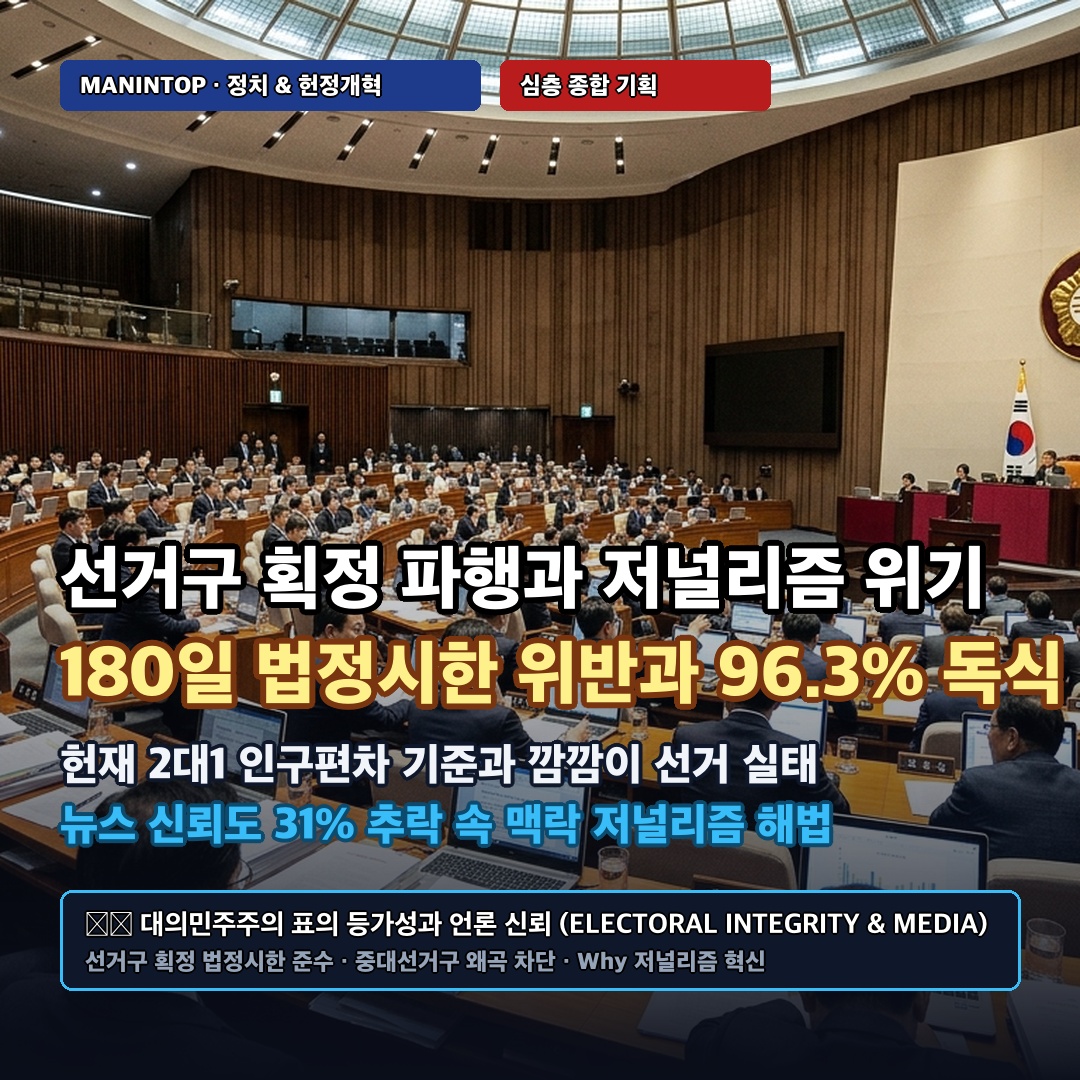
▲ 대한민국 국회 본회의장 전경. 선거 때마다 반복되는 선거구 획정 지연과 거대 양당의 기득권 셈법은 대의민주주의의 근간인 표의 등가성을 훼손하고 정치 신인의 진입을 가로막고 있습니다. [사진: 국회 프레스 풀 보도자료]
핵심 쟁점 3줄 요약
헌재 2대1 인구편차 기준에도 선거일 180일 전 획정 시한 상습 위반으로 정치 신인과 유권자 알 권리 침해
기초의회 중대선거구 시범 실시 결과 복수 공천 꼼수로 거대 양당이 109석 중 105석(96.3%) 싹쓸이 독점
뉴스 신뢰도 31% 추락과 대중의 뉴스 회피율 72% 급증 속 사건의 본질을 짚는 Why 저널리즘 혁신 시급
대한민국 민주주의의 기초이자 유권자의 참정권을 규정하는 선거구 획정이 선거 때마다 법정 시한을 넘기며 표류하는 악순환을 거듭하고 있습니다. 유권자의 한 표가 지니는 가치를 대등하게 보장하라는 헌법재판소의 엄격한 판결에도 불구하고, 정치권은 자신들의 당리당략과 의석수 계산에만 몰두하며 법이 정한 기한을 밥먹듯 어겨왔습니다. 더욱 심각한 문제는 기성 거대 정당들이 다당제 도입을 표방하며 시범 실시했던 중대선거구제마저 복수 공천이라는 변칙적인 꼼수를 통해 96.3%를 독점하며 풀뿌리 민주주의의 다양성을 철저히 압살했다는 점입니다. 여기에 정치권의 소모적인 정쟁만을 단순 중계해 온 언론을 향해 국민 10명 중 7명이 뉴스를 의도적으로 끊어버리는 72%의 뉴스 회피 현상과 31%라는 역대 최저 수준의 언론 신뢰도가 겹치며 공론장 자체가 붕괴할 위기에 처했습니다. 헌재가 제시한 2대1 인구편차의 헌법적 의미, 선거일 180일 전 시한을 둘러싼 정개특위의 무책임한 지연 실태, 20년 만에 열린 국회 전원위원회의 비례대표 격돌, 그리고 시민의 신뢰를 되찾기 위한 맥락 저널리즘의 조건을 현장 취재를 통해 심층 분석했습니다.
1. 헌재의 2대1 인구편차 혁명과 표의 등가성… '농어촌 소멸' 소수의견과 헌법적 충돌
선거구 획정에서 가장 핵심적인 헌법적 가치는 바로 유권자의 투표가치가 동등해야 한다는 표의 등가성입니다. 헌법재판소는 2014년 10월 공직선거법상 국회의원 지역선거구 구역표에 대해 재판관 6대 3 의견으로 헌법불합치 결정을 내리며 정치권에 거대한 충격을 안겼습니다. 2001년 제시했던 종전의 인구편차 허용기준인 상하 50%, 즉 인구비율 3대 1 기준을 폐기하고, 상하 33⅓%인 인구비율 2대 1 기준을 새롭게 천명한 것입니다. 과거 기준에서는 인구가 가장 많은 지역구 유권자의 표 가치가 인구가 가장 적은 지역구의 3분의 1에 불과해 평등선거 원칙을 본질적으로 훼손하고 있었습니다. 실제로 당시 서울 강남구 갑 선거구는 경북 영천시 선거구에 비해 인구가 3배에 달해 심각한 불평등을 노출했습니다. 중앙선관위가 당시 인구를 기준으로 분석한 결과, 전국 246개 선거구 중 무려 62개 선거구가 헌재가 제시한 새 기준을 초과해 전면적인 재조정 수술대에 올라야 했습니다.
헌재는 단원제 국회에서 인구가 많은 지역구의 낙선자가 얻은 득표수가 인구가 적은 지역구 당선자의 득표수보다 많은 기형적 왜곡을 방치할 수 없다고 판시했습니다. 인구편차를 방치할수록 과대대표와 과소대표가 고착화되어 지역주의 정당 구도를 심화시킨다는 경고였습니다. 하지만 당시 박한철, 이정미, 서기석 재판관은 소수의견을 통해 날카로운 반론을 제기했습니다. 국회의원 총 정수가 고정된 상태에서 인구 비례만을 기계적으로 적용하면 수도권 등 도시 지역 의석만 비대해지고 농어촌 지역구는 대거 통폐합되어 소멸 위기에 직면한다는 지적이었습니다. 도농 간의 극심한 경제력 격차를 고려할 때 농어촌 주민들의 이익을 대변할 통로를 열어두는 지역대표성의 가치 역시 소홀히 할 수 없다는 논리였습니다. 지방의회 역시 2018년 광역의원 인구편차 기준이 4대 1에서 3대 1(상하 50%)로 강화되었고, 2025년 10월 헌재가 전북 장수군 선거구에 헌법불합치 결정을 내리며 2026년 2월 19일까지 법 개정을 명령했으나 국회는 이 시한마저 무시한 채 위헌 상태를 방치하는 무책임한 행태를 이어갔습니다.
구분 및 대상 선거구
종전 허용 기준
현행 헌재 기준 및 판결
주요 판시 이유 및 대립 가치
국회의원 지역선거구
상하 50% (인구비율 3:1)
상하 33⅓% (인구비율 2:1, 2014헌마53)
1인의 투표가치가 3배 차이 나는 불평등 해소 vs 농어촌 지역대표성 약화 우려
광역의원 선거구
상하 60% (인구비율 4:1)
상하 50% (인구비율 3:1, 2018년 결정)
자치단체별 최소 1인 보장보다 표의 등가성 우선, 행정구역 대표성과의 충돌
전북 장수군 선거구 사건
종전 자치단체별 최소 1인 배정
헌법불합치 결정 (2022헌마1247)
인구 하한선 미달로 2026년 2월 19일 개정 시한 제시했으나 국회 입법 지연 방치
인구편차 초과 선거구 조정
2014년 9월 말 기준 분석
전국 246개 중 62개 선거구 미달
서울 강남갑 대 경북 영천 인구 3배 격차 등 과대·과소대표 구조 개편 요구
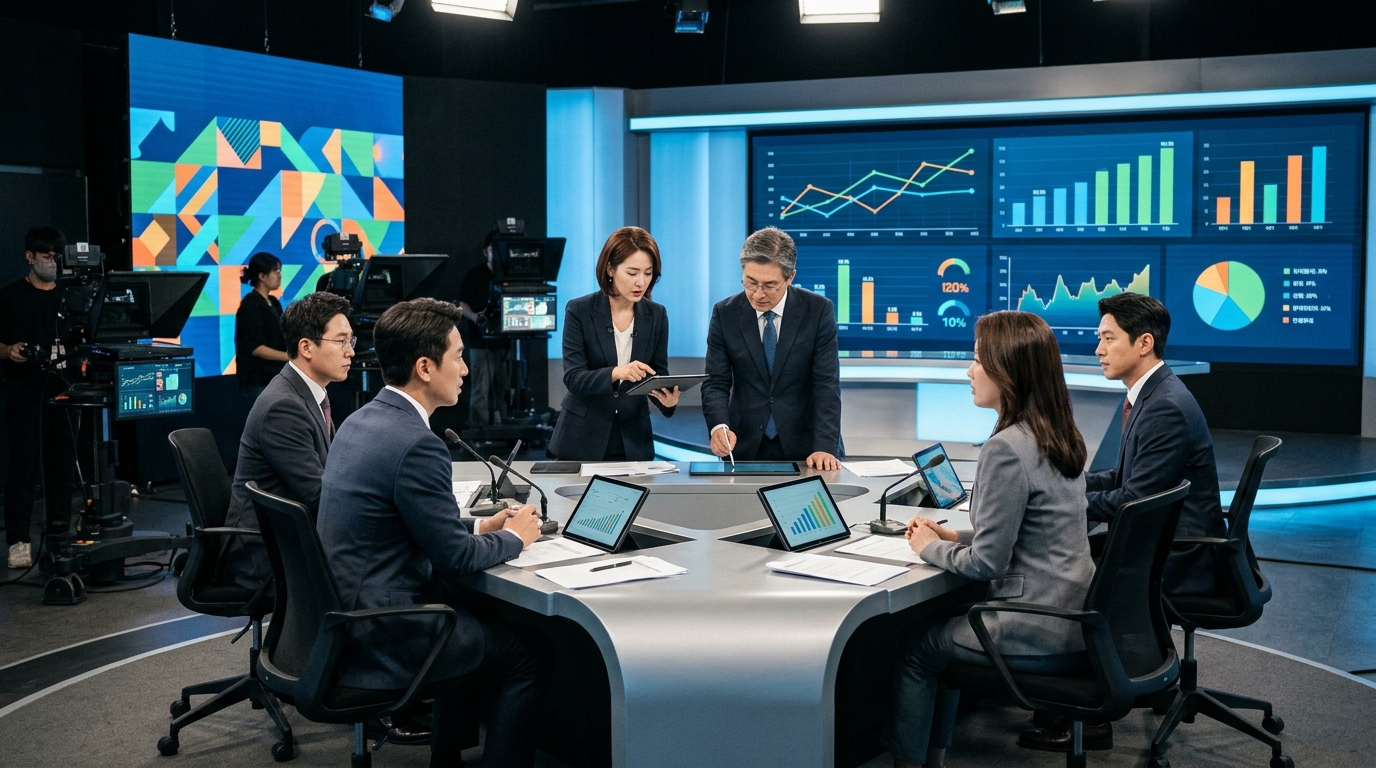
▲ 방송사 선거 개표 방송 보도국 상황실. 단순 정쟁 중계에서 벗어나 사건의 본질과 구조적 배경을 파헤치는 맥락 저널리즘이 대중의 뉴스 회피를 극복할 핵심 열쇠로 꼽힙니다. [사진: 방송기자연합회 공동취재단]
2. 선거일 180일 전 법정시한 상습 위반… '처벌 조항 없는 국회'와 깜깜이 선거의 피해
공직선거법 제24조의2는 지방선거 선거구를 선거일 180일 전까지 확정하도록 법정 시한을 명시하고 있습니다. 유권자가 출마 후보를 검증하고 입지자들이 공정한 경쟁을 펼칠 수 있도록 최소한 6개월의 준비 기간을 보장하라는 입법 취지입니다. 그러나 이 법정 기한은 대한민국 정치사에서 사실상 단 한 번도 온전히 지켜진 적이 없습니다. 2018년 지방선거에서는 선거를 불과 96일 앞두고 겨우 선거구가 정해졌고, 2022년 선거에서는 벼락치기 협상 끝에 선거일 42일 전에야 획정안이 국회를 통과했습니다. 2026년 지방선거를 앞두고도 법정 시한인 전년도 12월 5일을 수개월이나 넘기도록 여야는 평행선을 달리며 직무유기를 거듭했습니다.
국회가 이처럼 법을 대놓고 어기면서도 태연한 이유는 시한을 넘겨도 아무런 처벌이나 불이익을 받지 않는 페널티 조항의 부재에 있습니다. 거대 양당이 자당에 유리한 지역구 경계가 만들어질 때까지 고의로 획정안 처리를 미루면서, 그 피해는 고스란히 정치 신인과 유권자에게 전가됩니다. 현역 의원들은 탄탄한 조직과 높은 인지도를 바탕으로 느긋하게 선거를 준비하지만, 청년이나 신인 입지자들은 자신이 뛸 운동장의 경계조차 모른 채 발만 동동 굴러야 합니다. 실제로 강원 춘천과 원주처럼 인구 상한선을 넘어 분구가 예상되는 지역에서는 신인들이 어느 동네 유권자에게 명함을 돌려야 할지 몰라 혼란을 겪었습니다. 결국 촉박하게 정해진 선거구 속에서 유권자들은 후보의 도덕성과 공약을 꼼꼼히 따져볼 시간조차 빼앗긴 채 깜깜이 투표장으로 내몰리고 있습니다.
3. 전원위원회 20년 만의 격돌… '비례대표 75석 확대' 대 '제도 폐지·정수 축소' 팽팽
선거구 획정 파행의 이면에는 기형적인 의석 배분을 둘러싼 여야의 첨예한 수 싸움이 도사리고 있습니다. 20년 만에 소집되었던 국회 전원위원회 회의는 비례대표 의석 규모와 선거제도 개편을 놓고 극단적인 진영 대결을 여실히 보여주었습니다. 사표를 방지하고 다양한 민심을 의회에 담아내기 위해 비례대표를 확대해야 한다는 측에서는 김영배 의원이 비례대표 최소 60석 확보와 권역별 비례제를 제안했고, 윤호중·전해철 의원은 지역구를 28석 줄여 비례대표를 75석 이상으로 늘리자고 역설했습니다. 고영인 의원은 67~77석 증원을, 장경태 의원은 지역구 대 비례대표 비율을 4대 1이나 3대 1 수준으로 개편하자고 주장했으며, 심상정·홍영표 의원은 의원 세비 동결을 전제로 비례 의석 비중을 30~50%까지 대폭 끌어올려야 한다고 맞섰습니다.
반면 국민의힘 의원들은 비례대표 확대에 결사반대하며 제도의 무용론을 들고나왔습니다. 국민 여론의 80%가 국회의원 증원이나 비례대표 확대에 부정적이라는 여론조사 결과를 명분으로 내세웠습니다. 이현승·전주혜 의원은 준연동형 비례제가 꼼수 위성정당이라는 기형적 괴물을 탄생시켰다며 과거의 병립형 비례대표제로 즉각 회귀해야 한다고 주장했습니다. 윤상현 의원은 비례대표 의원들이 극단적인 진영 대결에 앞장서고 있다며 비례대표제 전면 폐지를 요구했고, 이태규·김승수 의원은 국회가 국민적 불신을 씻어내기 위해 스스로 의원 정수를 감축하는 뼈를 깎는 쇄신을 보여주어야 한다고 목소리를 높였습니다. 결국 각자의 기득권을 지키기 위한 힘겨루기 속에 정작 선거 제도의 본질인 사표 방지와 비례성 강화는 뒷전으로 밀려났습니다.
승자독식의 소선거구제를 완화하고 다당제를 안착시키겠다며 도입되었던 중대선거구제 역시 현장에서는 거대 양당의 기득권 강화 수단으로 변질되었습니다. 제8회 지방선거 당시 전국 30개 기초의원 선거구에서 3인에서 5인을 선발하는 중대선거구제가 시범 실시되었습니다. 한 선거구에서 여러 명의 당선자를 배출하므로 소수 정당이나 참신한 신인들이 지방의회에 대거 입성할 수 있을 것이라는 장밋빛 기대가 쏟아졌습니다.
그러나 뚜껑을 열어본 결과는 참담한 양당 독점이었습니다. 경제정의실천시민연합이 30개 시범 선거구의 개표 결과를 전수 분석한 데이터에 따르면, 총 당선자 109명 중 거대 양당이 차지한 의석은 무려 105석으로 96.3%에 달했습니다. 반면 원내 제3당이나 군소 정당 소속 당선자는 단 4명(3.7%)에 불과했습니다. 거대 양당이 하나의 선거구에 '1-가, 1-나, 1-다' 식으로 복수 후보를 무더기로 공천하고, 양당 지지층이 정당 기호만을 보고 줄투표를 던지면서 상위 당선권을 싹쓸이한 결과였습니다.
복수 공천을 엄격히 제한하고 정당 투표의 왜곡을 막는 제도적 장치가 결여된 중대선거구제는 오히려 거대 양당에 합법적인 독점 면허를 쥐여준 셈이 되었습니다. 더욱이 현행 공직선거법상 지방의회의 비례대표 비율은 광역의회가 10.6%(872석 중 93석), 기초의회가 12.9%(2,988석 중 386석)에 불과합니다. 비례대표 의석을 최소 30% 이상으로 대폭 확충하지 않은 채 껍데기뿐인 선거구제 개편만을 논의하는 것은 풀뿌리 지방자치를 거대 양당의 하수인으로 영구 귀속시키는 기만에 불과하다는 시민사회의 비판이 쏟아지는 이유입니다.
검증 영역 및 제도
법적 시한 및 조사 기준
실제 운용 및 실태 조사 데이터
구조적 쟁점 및 비판적 시사점
지방선거 선거구 획정 시한
공직선거법상 선거일 전 180일
2018년(96일 전), 2022년(42일 전), 2026년(도과)
시한 위반 처벌 페널티 전무, 양당 유불리 셈법으로 정치 신인과 유권자 피해
기초의회 중대선거구 시범
제8회 지방선거 3~5인 선거구
총 109석 중 거대 양당 105석(96.3%) 독식
1-가, 나 복수 공천과 줄투표로 소수정당 진입(4석, 3.7%)을 사실상 원천 차단
뉴스 전반 신뢰도 (로이터)
2024 디지털 뉴스 리포트 (47개국)
한국 신뢰도 31% (조사국 중 38위, 평균 40%)
방송사 신뢰도 50%대 유지 반면 신문사 30%대 저하, 정파적 양극화 심화
대중의 뉴스 회피율 (언론재단)
2024 전국 온라인 성인 2,612명
국민 72.1% 뉴스 의도적 회피 (편향성 3.79점)
뉴스 회피층 언론 신뢰도 24.5%로 고립 심화, 맥락 기반 Why 저널리즘 필요성
5. 뉴스 신뢰도 31%와 회피율 72%의 경고… 'Why 저널리즘' 혁신과 정파성의 덫
정치권이 이처럼 국민의 신뢰를 잃고 표류하는 동안, 권력을 감시하고 대안을 모색해야 할 언론 저널리즘 역시 사상 초유의 신뢰 위기에 직면해 있습니다. 로이터저널리즘연구소가 발표한 2024년 디지털 뉴스 리포트에 따르면, 대한민국 국민의 뉴스 전반에 대한 신뢰도는 31%에 그쳤습니다. 조사 대상 47개국 중 38위라는 최하위권 성적으로, 전 세계 평균 신뢰도인 40%보다 무려 9%포인트나 낮았습니다. 더욱 충격적인 것은 한국언론진흥재단이 성인 2,612명을 대상으로 조사한 뉴스 회피 실태입니다. 응답자의 무려 72.1%가 고의로 뉴스를 외면하고 있다고 답했습니다.
시민들이 뉴스를 기피하는 원인은 명확했습니다. 뉴스가 정치적으로 편향되어 있고(3.79점), 보고 싶지 않은 정치 인물들이 반복해서 등장하며(3.78점), 부정적인 갈등 이슈만 쏟아져 극심한 정신적 스트레스를 받기 때문(3.58점)이었습니다. 뉴스를 회피한 뒤 감정적으로 편안해졌다는 응답이 3.24점에 달했고, 뉴스 회피 집단의 언론 신뢰도는 24.5%로 비회피 집단(33.7%)보다 9.2%포인트나 낮았습니다. 정쟁의 따옴표만을 기계적으로 받아쓰는 언론의 관행이 국민들을 뉴스 공론장 밖으로 밀어내고 사회적 고립을 심화시키는 악순환을 낳고 있는 것입니다.
이러한 불신의 늪에서 공영방송 MBC가 로이터 조사와 각종 여론조사에서 2년 연속 신뢰도 1위를 기록한 배경은 저널리즘의 혁신 방향에 큰 시사점을 던집니다. 단순 발생 사실(What)만을 1분 남짓 나열하던 관행을 깨고 사건의 심층적 배경과 파장을 집요하게 파헤치는 'Why 저널리즘', 하나의 핵심 의혹을 고발과 맥락, 반론으로 묶어 연속 보도하는 '쇠사슬식 블록 편집', 그리고 시민의 고통에 공감하는 클로징 논평을 도입한 것이 주효했습니다. 국장 책임제와 주니어 기자가 참여하는 편집회의 공개 등 민주적인 내부 자율성 역시 보도의 비판 정신을 지탱하는 버팀목이 되었습니다.
그러나 특정 방송의 약진 이면에는 진영 양극화에 따른 부정적 정파성의 그늘과 정치 뉴스 편중에 따른 노동·인권·환경 이슈의 소외라는 또 다른 그늘이 공존하고 있습니다. 선거구 획정의 만성적 파행을 끝내기 위해서는 법정 시한 위반 시 정당 국고보조금을 삭감하는 등의 실질적인 페널티 도입과 복수 공천을 차단하는 정교한 제도 개혁이 단행되어야 합니다. 동시에 저널리즘 역시 권력의 나팔수나 정쟁 중계자에서 벗어나 시민의 삶을 바꾸는 맥락 저널리즘으로 거듭나야 합니다. 표의 등가성을 지키는 공정한 선거제도와 진실을 밝히는 건강한 공론장이 함께 작동할 때, 비로소 위기에 처한 대한민국 대의민주주의는 새로운 희망의 길을 찾을 수 있을 것입니다.
[In-Depth Analysis] Electoral Redistricting Gridlock and Journalism Trust Crisis: Chronic 180-Day Deadline Violations, 96.3% Duopoly, and 72% News Avoidance
▲ The Grand Plenary Chamber of the National Assembly. Chronic delays in electoral redistricting and partisan calculations undermine the fundamental principle of vote equality while sidelining emerging political voices. [Photo: National Assembly Press Pool Coverage]
Key Takeaways: 3 Core Dimensions
Chronic violations of the 180-day redistricting deadline persist despite the Constitutional Court 2:1 population ratio mandate
Pilot multi-member municipal districts allowed major parties to sweep 105 of 109 seats (96.3%) through multi-candidate nominations
With national news trust dropping to 31% and public news avoidance reaching 72%, transitioning to Why-journalism is critical
South Korea's representative democracy faces a profound crisis as electoral redistricting chronically surpasses statutory deadlines before every major election. Despite binding Constitutional Court rulings mandating strict equality of voting value, rival political parties remain preoccupied with partisan seat calculations, systematically disregarding statutory timeframes. Worse still, multi-member district experiments introduced under the banner of cultivating a multi-party system were captured through multi-nomination tactics, allowing the two dominant parties to monopolize 96.3% of contested seats and extinguish local council diversity. Compounding this institutional deadlock is an unprecedented crisis in journalism: over seven in ten citizens intentionally avoid news consumption, driving national news trust down to a dismal 31%. This investigative report examines the constitutional mandate of the 2:1 population ratio, the unpenalized stalling of the 180-day redistricting deadline, the parliamentary clashes over proportional representation, and the vital structural reforms required for contextual journalism.
1. Constitutional Court 2:1 Population Ratio Mandate: Vote Equality vs. Rural Representation
The core constitutional pillar underpinning electoral redistricting is the principle of voting equality. In October 2014, the Constitutional Court delivered a landmark ruling (2014Hun-Ma53), declaring the National Assembly district table inconsistent with the Constitution by a 6-to-3 judicial majority. The court discarded its 2001 benchmark that permitted a 50% population deviation (a 3:1 population ratio) and established a much stricter standard within 33⅓%, enforcing a 2:1 ratio. Under the prior framework, the vote of an elector in the most populous constituency carried merely one-third the constitutional weight of a vote in the smallest district, severely undermining electoral equality. Seoul's Gangnam-A district held three times the population of Yeongcheon in North Gyeongsang, exposing extreme disparities. An audit by the National Election Commission revealed that 62 out of 246 national constituencies exceeded the new population ceiling, requiring comprehensive redistricting.
The Constitutional Court underscored that in a unicameral assembly, permitting runners-up in populous districts to accumulate more votes than victorious candidates in under-populated districts distorts representative legitimacy. Allowing wide demographic deviations entrenches regionalist party monopolies and hampers balanced national development. However, Justices Park Han-chul, Lee Jung-mi, and Seo Ki-seok emphasized in their dissent that in a fixed assembly size, mechanically applying population ratios drastically expands urban seats while dissolving rural districts. Given severe socioeconomic gaps, preserving territorial representation for rural residents remains a legitimate constitutional interest. Similar scrutiny reshaped local councils in 2018 when metropolitan council deviations were narrowed from 4:1 to 3:1 (within 50%). Although the court ruled Jangsu County's district unconstitutional in October 2025 and set a revision deadline for February 19, 2026, the National Assembly allowed the date to expire without enacting required legislation.
Category and Target Constituency
Previous Population Tolerance
Current Constitutional Standard
Judicial Reasoning and Core Value Clash
National Assembly Electoral Districts
Within 50% (3:1 Population Ratio)
Within 33⅓% (2:1 Ratio, 2014Hun-Ma53)
Eliminating three-fold voting inequality vs. Concerns over rural voice erosion
Metropolitan Council Districts
Within 60% (4:1 Population Ratio)
Within 50% (3:1 Ratio, 2018 Ruling)
Vote equality prioritized over statutory 1-seat minimum per municipality
Jeonbuk Jangsu County Case
Prior guarantee of 1 seat per county
Non-Conformity Ruling (2022Hun-Ma1247)
Population below lower threshold; parliamentary inaction passed Feb 2026 deadline
Over-Disparity District Rebalancing
Analysis as of Sept 2014 population
62 out of 246 districts non-compliant
Severe 3x disparity between Seoul Gangnam-A and Yeongcheon requiring restructuring
▲ A broadcast newsroom election operations center. Moving beyond surface-level political horse races toward contextual Why-journalism is recognized as a vital remedy to combat widespread news avoidance. [Photo: Broadcast Journalists Association Coverage]
2. Chronic Violations of the 180-Day Legal Deadline: Unpenalized Inaction and Blind Elections
Article 24-2 of the Public Official Election Act stipulates that local electoral districts must be finalized at least 180 days prior to election day. This six-month window was enacted to guarantee prospective candidates fair campaign preparation and allow voters sufficient time to scrutinize political platforms. Yet this legal deadline has rarely been respected in practice. In the 2018 local elections, district boundaries were settled just 96 days before balloting; in 2022, rushed bipartisan deals finalized maps a mere 42 days before election day. Ahead of the 2026 local elections, the legal cutoff of December 5 of the preceding year passed by several months while legislative committees remained paralyzed in partisan posturing.
The persistence of chronic legislative delays stems from a systemic absence of legal penalties for non-compliance. Major parties deliberately postpone redistricting agreements until they extract favorable territorial configurations, externalizing costs entirely onto emerging candidates and the electorate. While incumbent lawmakers leverage entrenched local machines, independent and minor-party newcomers are left campaigning blindly without knowing where their district boundaries will ultimately fall. In fast-growing municipal areas like Chuncheon and Wonju facing mandatory splits, candidates struggled to identify which neighborhood voters to engage. Deprived of critical evaluation windows, citizens are pushed into hurried, uninformed voting booths.
3. Plenary Clashes After Two Decades: Proportional Expansion vs. Abolition and Seat Cuts
Beneath the surface of redistricting delays lies an intense struggle over the composition of legislative seats. The National Assembly Plenary Committee, convened for the first time in two decades, exposed stark partisan divides regarding proportional representation and electoral formulas. Advocates of proportional expansion argued that broader seat allocations are essential to curb wasted votes and reflect diverse public sentiment: Representative Kim Young-bae proposed securing at least 60 proportional seats through regional lists, while Representatives Yoon Ho-jung and Jeon Hae-cheol advocated trimming 28 local seats to expand proportional representation to 75 seats. Representative Ko Young-in pushed for 67 to 77 seats, Representative Jang Kyoung-tae urged shifting the local-to-proportional ratio to 4:1 or 3:1, and Representatives Sim Sang-jeung and Hong Young-pyo demanded expanding proportional seats to 30% or 50% under a legislative wage freeze.
Conversely, People Power Party lawmakers voiced staunch opposition, calling for the reduction or outright elimination of proportional seats. Citing surveys showing that roughly 80% of citizens oppose increasing assembly seats, Representatives Lee Hyun-seung and Jeon Joo-heya argued that semi-mixed member proportional systems bred abusive satellite parties and called for an immediate return to parallel party-list voting. Representative Yoon Sang-hyun asserted that proportional lawmakers spearhead partisan extremism and demanded the total abolition of the system. Representatives Lee Tae-kyu and Kim Seung-soo insisted that parliament should reduce its total seat count to regain public confidence. As partisan calculations dominated, core objectives of curbing wasted votes and enhancing democratic proportionality were sidelined.
4. The Duopoly Behind Multi-Member Districts: Major Parties Monopolize 96.3% via Multi-Nomination
Multi-member districts, initially championed to mitigate winner-take-all dynamics and nurture political diversity, were similarly co-opted into protective shields for dominant parties. In the 8th nationwide local elections, a pilot program testing 3-to-5 member multi-member districts was conducted across 30 municipal council constituencies. Reformers anticipated that electing multiple representatives from a single district would open local governance to minor parties and dynamic civic innovators.
The empirical outcome revealed total duopoly capture. Comprehensive post-election data analyzed by the Citizens' Coalition for Economic Justice showed that of the 109 councilors elected across the 30 pilot districts, the two dominant parties swept 105 seats, capturing an overwhelming 96.3%. Minor and third-party candidates secured merely 4 seats, or 3.7%. Dominant party machines systematically exploited multi-candidate nomination rules, fielding multiple contenders under designations like '1-A, 1-B, 1-C,' while partisan straight-ticket voting swept all available seats.
Lacking statutory bans on duplicate party nominations and protections against straight-ticket manipulation, multi-member districts effectively granted the two major parties an institutional monopoly. Currently, proportional representation accounts for only 10.6% of metropolitan councils (93 of 872 seats) and 12.9% of municipal councils (386 of 2,988 seats). Civic organizations emphasize that debating district geometries without expanding proportional quotas to at least 30% remains an empty exercise that leaves local autonomy subordinated to central party elites.
Audit Area and Institutional Framework
Statutory Timeline or Metric Baseline
Empirical Data and Survey Findings
Structural Dilemma and Policy Implications
Local Election Redistricting Timeline
180 days prior to election under election law
2018 (96 days), 2022 (42 days), 2026 (expired)
Total absence of non-compliance penalties; new entrants and voters bear the brunt
Municipal Multi-Member Pilot Results
8th Local Elections (3-5 member districts)
Major parties monopolized 105 of 109 seats (96.3%)
Multi-nominations (1-A, 1-B) and straight ticketing crushed minor parties (4 seats, 3.7%)
Overall News Trust (Reuters Institute)
2024 Digital News Report (47 countries)
Korea at 31% (38th of 47 nations; global avg 40%)
Broadcasters hold 50s% while newspapers drop to 30s%; polarized echo chambers persist
Avoiders show lower trust at 24.5%, underscoring urgent need for contextual Why-journalism
5. Alarms from 31% News Trust and 72% Avoidance: Why-Journalism Innovations and Partisan Traps
While political institutions flounder, journalistic media—entrusted to hold power accountable and foster civic deliberation—confronts an existential crisis of public trust. The Reuters Institute Digital News Report 2024 revealed that trust in news among South Koreans stands at just 31%, ranking 38th among 47 surveyed countries and trailing the global average of 40% by nine percentage points. Even more alarming, a nationwide study of 2,612 adults by the Korea Press Foundation showed that 72.1% of citizens deliberately avoid news consumption.
The drivers of news avoidance were unequivocally clear: respondents cited pervasive political bias (3.79 out of 5), repetitive appearances of polarizing figures (3.78), and mental fatigue induced by unrelieved conflict coverage (3.58). Citizens reported feeling emotionally calmer after disconnecting from news (3.24), while active avoiders exhibited an abysmal news trust rate of 24.5%—9.2 percentage points lower than non-avoiders. Mechanical reporting that merely transcribes partisan shouting matches has alienated the public, accelerating civic disengagement and polarization.
Amid widespread skepticism, public broadcaster MBC's top ranking in news trust for two consecutive years offers valuable lessons for media reform. Breaking away from one-minute superficial bulletins, the newsroom instituted 'Why-journalism' to investigate underlying structural drivers, adopted clustered multi-story blocks to provide cohesive context, and introduced empathetic closing commentary reflecting civic distress. Robust newsroom autonomy, supported by editorial accountability and transparent editorial meetings, served as a foundational bulwark for critical scrutiny.
Yet single-network achievements operate alongside broader vulnerabilities, including affective partisan polarization and the marginalization of labor, human rights, and environmental reporting. Ending chronic redistricting gridlock requires binding penalties, such as withholding state subsidies from delinquent parties, coupled with strict bans on multi-candidate nominations. Simultaneously, journalism must evolve beyond adversarial transcription toward context-rich investigative reporting that addresses civic realities. Only when equitable electoral systems operate alongside a rigorous public forum can representative democracy restore institutional trust and democratic vitality.
PRO SOURCING ENGINE만인의 탑 빅데이터 솔루션
★ 가입 시 600 크레딧(120회) 전원 무료
내가 찾는 상품 키워드, 지금 얼마나 검색될까?
네이버 월간 검색량 + 구글 볼륨 + 아이템스카우트 실시간 상품수와 경쟁강도 배지를 0.5초 만에 무료로 확인하세요.
MANINTOP NEWSLETTER
📬 만인의 탑 뉴스레터 무료 구독
오늘 보신 정책·시사 뉴스가 유익하셨나요? 매일 엄선되는 알짜 복지 혜택과 국회 실시간 속보를 이메일로 가장 먼저 받아보세요. (평생 무료)
1월이 시작되면 감기는 이미 우리 곁에 와 있습니다. 2월, 3월, 4월까지 이어지는 추위와 건조함은 코와 목을 가장 먼저 공격합니다. 아침에 일어나자마자 막혀 있는 코. 계속 흐르는 콧물. 괜히 칼칼해지는 목. 이 증상은 “시작”일 뿐입니다. 한 번 무너지면 일주일, 길면 한 달까지 끌고 갑니다. 약을 먹으면 잠깐 괜찮아집니다. 하지만 며칠 뒤 또 반복됩니다. 왜일까요? 감기는 ‘치료’의 문제가 아니라 ‘관리’의 문제이기 때문입니다. 대부분은 감기가 오고 나서 약을 찾습니다. 하지만 진짜 중요한 건 감기가 오기 전에 코와 목을 지키는 것입니다. 건조한 실내 공기, 차가운 바깥 공기, 눈에 보이지 않는 세균. 코와 목은 매일 공격받고 있습니다. 지긋지긋하죠! 그런데도 우리는 아무 준비 없이 버티고 있습니다. 이번 겨울도 그렇게 보낼 건가요? 사실 방법은 어렵지 않습니다. 코를 깨끗하게 관리하고, 목을 따뜻하게 보호하고, 점막을 촉촉하게 유지하고, 기관지를 미리 관리하고, 외부 공기를 차단하는 것. 이 다섯 가지만 꾸준히 해도 감기약 없이 겨울을 보내는 것이 충분히 가능합니다. 🔥 이제부터 그 방법을 하나씩 살펴보겠습니다. 🔥 1. 코와 목을 먼저 관리해야 하는 과학적 이유 감기의 대부분은 코 점막에서 시작됩니다. 국제 학술지 Nature Reviews Microbiology 와 Journal of Allergy and Clinical Immunology 에 실린 호흡기 감염 관련 연구들에서는, 감기 바이러스가 비강 상피세포에 먼저 부착해 증식한다는 점을 설명하고 ...
리모델링사업이 진행 중인 아파트를 매매할 때 “계약금 10%를 언제까지 내야 하느냐”는 질문이 특히 많이 나옵니다. 이주공고(이주 안내)가 7~11월쯤이라고 들으면, 그 시점에 맞춰 계약금도 움직일 것 같아서 더 헷갈리기 쉽습니다. 하지만 실제 납부기한은 ‘이주공고가 언제냐’만으로 자동 결정되지 않는 경우가 많습니다. 1) 계약금 10% 납부기한: 결국 ‘문서에 적힌 일정’이 기준 계약금 10%를 언제까지 납부해야 하는지는, 내가 서명하는 매매계약서(특약 포함) 와 사업주체/조합이 제시한 공고·안내문 에 적힌 납부 일정이 기준이 됩니다. 실제 공고문에서는 분양대금 납부의 큰 틀(계약금→중도금→잔금)을 먼저 안내하고, 상세 일정은 별도 표나 유의사항으로 제시하는 방식이 흔합니다. 또, 계약서 문구에 따라 지급 시점이 조건부로 설정될 수도 있습니다. 예를 들어 한 사례 소개 자료에서는 용역계약서에 잔금(10%) 지급시기가 “사업승인 후”로 기재되어 있었다는 점이 언급됩니다. 이런 식으로 ‘사업 단계’와 지급을 연동하는 문구가 들어가면, 질문의 답은 계약서 문구를 확인해야만 확정됩니다. 관련 내용은 링크 에서 문구 사례를 확인할 수 있습니다. 2) 입주자모집공고에서 확인되는 ‘납부 순서’와 잔금 마감 시점 공고문에 적힌 문구를 보면, 납부 순서와 잔금 마감에 대한 기준이 비교적 명확하게 제시되는 경우가 있습니다. 예를 들어 한 입주자모집공고에는 “분양금액(주택가격)은 계약금, 중도금, 잔금의 순서로 납부”하며 “잔금은 입주(열쇠 수령일) 전에 완납”해야 한다고 안내되어 있습니다. (문구 확인: 링크 ) 이 문구가 의미하는 바는 최소 2가지입니다. 분양/공급 형태의 문서에서는 ‘계약금→중도금→잔금’ 흐름이 공식적으로 안내될 수 있습니다. 잔금은 “입주(열쇠 수령)” 이전에 완납해야 한다는 마감 기준이 문서에 적혀 있을 수 있습니다. 다만, 위 공고문 문구는 잔금 마감에 대한 기준을 보여주지만, 계약금 10%의...
윤석열 전 대통령 탄핵 인용 소식을 접하면, 가장 궁금한 지점은 ‘헌재가 정확히 무엇을 위헌·위법으로 봤는가’입니다. 또한 탄핵과 별개로 진행되는 형사재판(내란 우두머리 혐의 등)이 어디까지 왔는지도 함께 정리할 필요가 있습니다. 아래 내용은 제공된 기사/게시물 스니펫과 링크에서 확인되는 범위만 모아, 일반인이 흐름을 이해하기 쉽게 정리한 것입니다. 1) 탄핵 인용 관련: 스니펫에서 확인되는 ‘판단의 골격’ 제공된 근거 중 조국혁신당 사이트에는 헌법재판소가 윤석열 탄핵 심판에서 “피청구인의 위헌·위법행위는 국민 신임 …”이라는 취지로 판단했다는 문장이 인용돼 있습니다( 링크 ). 이 인용문만 놓고 보면, ‘위헌·위법행위’가 있었는지와 그로 인해 ‘국민의 신임’이 어떻게 평가됐는지가 핵심 축으로 소개됩니다. 다만 질문에서 요청하신 세부 항목, 즉 비상계엄 선포 자체를 문제 삼은 구체적 이유, 계엄 이후 조치(포고령, 국회 통제 등)의 어떤 지점이 헌법 위반인지, 국회의 권한행사 방해 및 정치활동 제약을 어떤 논리로 판단했는지 등은, 이번에 제공된 근거의 제목/스니펫만으로는 조항·사실관계·판단 구조가 그대로 제시돼 있지 않습니다. 따라서 이 글에서는 ‘헌재가 무엇을 문제 삼았다’는 세부 리스트를 단정적으로 재구성하기보다, 현재 확인 가능한 문구 수준의 요약(위헌·위법행위 → 국민 신임의 문제로 평가)까지만 적습니다. 만약 헌재 결정문 전문(주문 및 이유)이 추가로 확인되면, 그때는 문장 단위로 ‘어떤 행위’와 ‘어떤 헌법 원리/조항’이 연결되는지(예: 권력분립, 국회의 권한, 정치적 기본권 등) 구조화해 정리하는 것이 가장 정확합니다. 2) 형사 절차(내란 혐의) 관련: 체포영장과 1심 선고 언급 탄핵 심판과 별도로, 12·3 비상계엄 사태로 내란 혐의를 받는 윤석열 대통령에 대해 2024년 12월 31일 체포 영장이 발부됐다는 BBC 보도가 있습니다( 링크 ). 해당 보도는 ‘현직 대통령’에 대한 체포영장 발부라는 점을 함께 언급합니다. 또...