When bitter winter winds howl outside, the instinctive reaction for millions is to turn up the thermostat and bundle into thick, plush fleece pajamas. Yet morning after morning, people awake feeling groggy, unrefreshed, and plagued by persistent fatigue. While conventional wisdom insists that warmth is the key to sound sleep, modern sleep physiology and environmental medicine reveal the opposite: deep, restorative slow-wave sleep requires an obligatory core body temperature drop of 0.5 to 1.0 degree Celsius. Overheated bedrooms and synthetic fabrics physically trap body heat, keeping the sympathetic nervous system in a perpetual state of hyperarousal. From the 1-degree room temperature secret to the hidden biological causes of morning static electricity and clinical data linking 88 percent of insomnia sufferers to abdominal obesity, this investigative briefing explores the evidence-based science of restorative sleep.
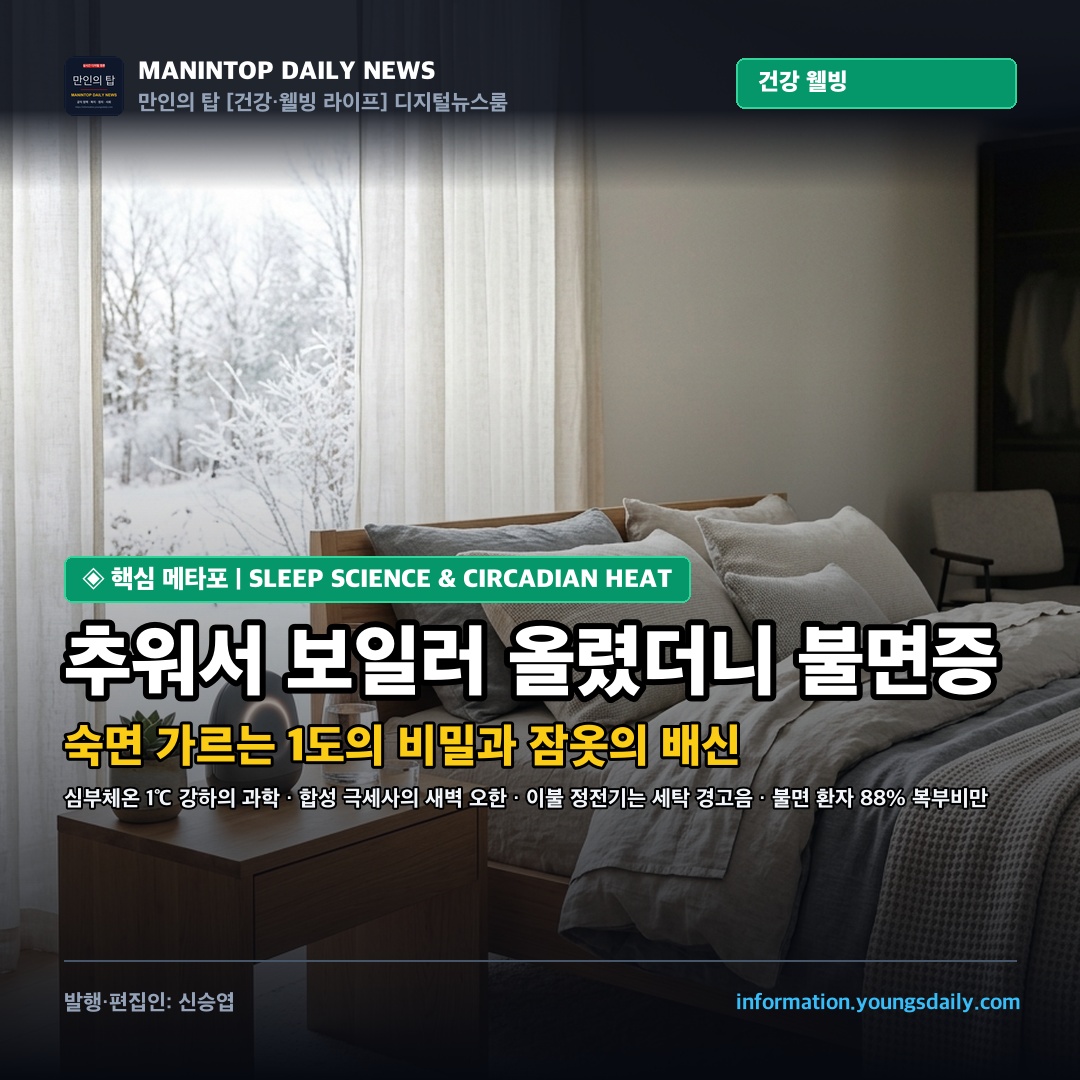
Restorative slow-wave sleep requires core body temperatures to decrease by 0.5 to 1.0 degree Celsius, demanding a cool, breathable sleep microclimate. / Graphic by Seung Youb Ssin
1. The Temperature Paradox: Why Overheating Traps the Brain in Wakefulness
In cold weather, households routinely drive indoor temperatures into the mid-20s. However, academic sleep specialists warn that excessive heating is a primary biological trigger for winter sleep fragmentation.
According to human circadian biology, core body temperature—the thermal reading of deep internal organs including the brain, heart, and liver—must naturally decline by 0.5 to 1.0 degree Celsius prior to and during sleep onset. This nocturnal cooling triggers pineal melatonin synthesis and opens the neurological gateway into restorative slow-wave sleep.
When ambient bedroom temperatures are excessively elevated, peripheral vasodilation is disrupted and internal metabolic heat cannot escape. Trapped in thermal distress, the central nervous system activates sympathetic fight-or-flight signaling, elevating heart rates and precipitating recurrent micro-awakenings.
Empirical environmental physiology studies by Pukyong National University researchers validated this mechanism. Maintaining bedrooms at a moderated 22 degrees Celsius yielded an overall sleep efficiency of 42 percent, outperforming unheated conditions (35 percent) by seven percentage points. Crucially, subjects maintained comfortable mean skin temperatures (34.5 to 35.6 degrees Celsius) across 97.8 percent of their sleep duration. Clinical consensus identifies 18 to 22 degrees Celsius as the optimal bedroom ambient temperature, coupled with 40 to 60 percent relative humidity.

Polysomnography recordings show that maintaining ambient bedroom temperatures between 18 and 22 degrees Celsius maximizes deep slow-wave sleep while suppressing nighttime awakenings.
2. The Sleepwear Trap: Why Plush Fleece Induces 3 AM Shivering
Fluffy, plush fleece pajamas dominate winter retail aisles. Yet clothing textile researchers and somnologists identify 100 percent polyester fleece sleepwear as a hidden culprit behind nocturnal awakenings.
While polyester fleece excels at trapping heat, its synthetic microfibers have virtually zero breathability and zero moisture absorption. The human body continuously releases imperceptible moisture and sweat throughout the night. Enclosed in non-porous synthetic fabrics under a heavy duvet, trapped thermal energy drives body temperatures upward, prompting profuse sweating until the sleeper unconsciously kicks off the bedding.
Unabsorbed perspiration resting on the skin then contacts cold bedroom air, evaporating rapidly and triggering an acute drop in cutaneous temperature—the classic dawn chill. Sleepers experience a turbulent thermal roller coaster, waking up exhausted at 3 or 4 AM.
The gold standard for restorative sleep is not fabric thickness, but breathability and vapor absorption. Replacing synthetic fleece with double-gauze organic cotton, brushed cotton flannel, or beechwood-derived modal permits seamless heat shedding and skin equilibrium.
| Sleep Variable & Fabric |
Thermal Exchange & Cutaneous Dynamics |
Physiological Sleep Metrics |
Optimal Practical Guidelines |
Optimized Bedroom Temp
(18 to 22 deg C) |
Facilitates peripheral vasodilation and heat dissipation, cooling core by 0.5-1.0 deg C |
42% sleep efficiency (+7%p vs unheated), 97.8% comfortable skin temp zone |
Avoid excessive floor heating; maintain slight ambient coolness with 40-60% humidity. |
Pure Cotton & Modal
(Natural Fibers) |
Natural plant fibers provide continuous airflow, absorbing nocturnal moisture instantly |
Minimizes cutaneous friction, prevents hypothermic dawn chills, stabilizes sleep cycles |
Select double-gauze or brushed cotton. Wash weekly with mild liquid neutral detergent. |
Synthetic Polyester Fleece
(Fuzzy Sleepwear) |
Zero breathability and zero absorption; traps sweat leading to abrupt nocturnal chills |
Triggers frequent micro-awakenings, elevates sympathetic stress, causes static cling |
Contraindicated for sleeping. Restrict strictly to daytime loungewear. |
Lipid Barrier Hydration
(Petrolatum Barrier) |
Reinforces intercellular lamellar lipids, suppressing transepidermal water loss |
Petrolatum suppresses water evaporation by 98% (vs 20-30% plant oils) |
Apply ceramide and petrolatum occlusives prior to sleep to eliminate nocturnal itching. |
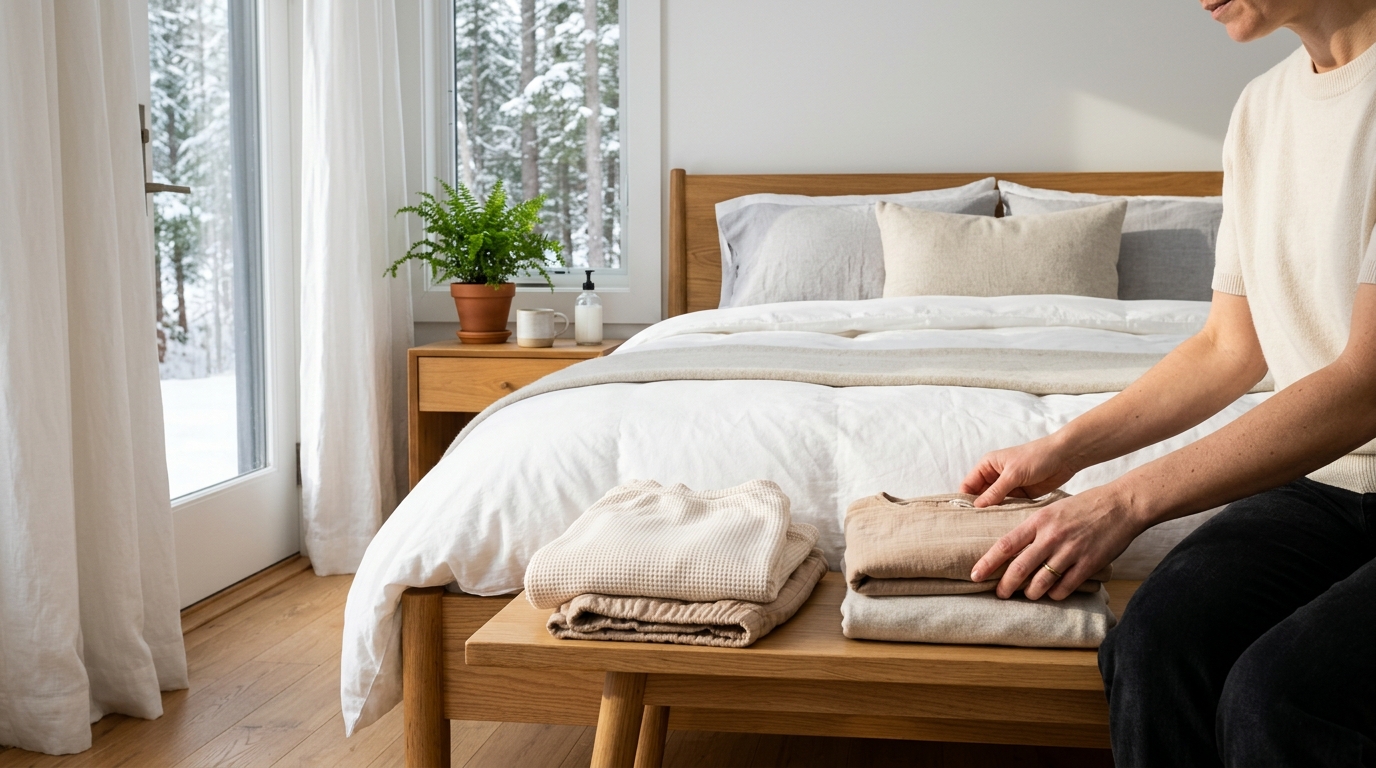
Pairing breathable cotton sleepwear with well-aired down bedding and adopting a 5-minute morning ventilation habit transforms sleep quality.
3. Static Electricity as a Warning Siren: The Fate of 200ml Nightly Perspiration
The sharp static crackle experienced when pulling back bedsheets on a winter morning is commonly dismissed as dry weather. Textile hygiene specialists explain that **static cling is a biological warning sign that bedding fibers are saturated with sebum and overdue for washing**.
Even during frigid winter nights, every adult releases approximately 200 milliliters of moisture (equivalent to a full cup of water) through respiration and insensible perspiration. While duvet surfaces may appear dry, this moisture penetrates deep into insulation batts, binding with microscopic shedding skin cells and sebum.
This oily film clogs microscopic fiber pores, destroying their innate moisture buffering capacity. When exhausted fibers rub together during movement, accumulated electrical charges cannot dissipate into ambient air, discharging violently upon touch. Excessive static confirms that bedding has reached a critical threshold of organic contamination.
Winter Bedding Laundering Protocols
- Microfiber & Cotton Quilts: Wash once every four weeks. Use mild liquid neutral detergent at 30 degrees Celsius on a gentle wool cycle. Avoid powder detergents, which leave irritating residues. A few drops of vinegar in the final rinse naturally neutralizes static. Air-dry flat in shade; avoid high-heat tumble dryers that scorch fibers.
- Goose Down Comforters: Frequent immersion strips natural feather oils, permanently destroying loft and warmth. Full washing should occur only once every 1 to 2 years. Instead, conduct monthly 2-to-3-hour shade airings to disperse internal humidity. Avoid dry cleaning and vacuum compression bags, which crush down clusters.
4. Clinical Reality: 88 Percent of Insomnia Patients Suffer Abdominal Obesity
Sleep deprivation is far more than subjective morning fatigue. A comprehensive clinical study of 175 chronic insomnia patients published in the Journal of Oriental Neuropsychiatry revealed startling metabolic correlations.
While subjects possessed average Body Mass Indexes (BMI) within normal clinical parameters, their waist-to-hip ratios demonstrated that **88.0 percent suffered from excessive abdominal visceral obesity**. By gender, 93.1 percent of female patients and 77.97 percent of male patients exhibited visceral adiposity. Chronic sleep deprivation spikes nocturnal cortisol, driving metabolic dysfunction and visceral fat accumulation.
Furthermore, Heart Rate Variability (HRV) diagnostics revealed severe autonomic exhaustion, with autonomic reserve levels (D2: 18.06 percent) severely degraded compared to operational baselines. Insomnia physically destabilizes autonomic and metabolic homeostasis.
5. Five Evidence-Based Golden Rules and the Power of 5-Minute Airing
Restoring sleep architecture without medication requires proactive circadian behavioral alignment.
The Five Essential Pre-Sleep Rules
- Warm Bath 90 Minutes Before Bed: Soaking in 38 to 40 degree Celsius water for 10 to 20 minutes dilates peripheral extremities. Entering a cool 18 to 22 degree bedroom accelerates heat loss, plunging core temperature to trigger deep sleep.
- Cool Head, Warm Feet: Wearing breathable bed socks promotes distal heat dissipation while keeping pillows cool and breathable.
- Digital Detox 60 Minutes Before Bed: Screen blue light halts melatonin synthesis. Disconnecting 60 minutes prior doubles nocturnal melatonin availability.
- Morning Sunlight Exposure: Expose eyes to 15 minutes of outdoor sunlight within 30 minutes of waking. This triggers daytime serotonin synthesis, converting precisely 15 hours later into evening melatonin.
- The 20-Minute Bed Limit: If wakeful for more than 20 minutes, leave the bedroom immediately. Engage in quiet reading under dim lighting until sleepiness returns, preserving the bed as a dedicated sleep sanctuary.
Bedroom Air Quality: Sealing bedroom windows tightly against drafts causes indoor carbon dioxide levels to surge overnight, reducing cerebral oxygenation and causing morning headaches. **A brief 5-minute cross-ventilation prior to sleep** or cracking the door open 5 to 10 centimeters prevents hypoxia. Finally, applying ceramide- and petrolatum-based moisturizers locks in moisture (blocking evaporation by 98 percent), preventing nighttime cutaneous itching.
Senior Editorial Verdict: True winter rest is achieved not through stifling heat, but through circadian cooling enabled by an optimal 18 to 22 degree bedroom. By embracing breathable cotton sleepwear, maintaining clean bedding, and adopting 5 minutes of daily fresh air and sunlight, anyone can reclaim deep, restorative sleep all winter long.


