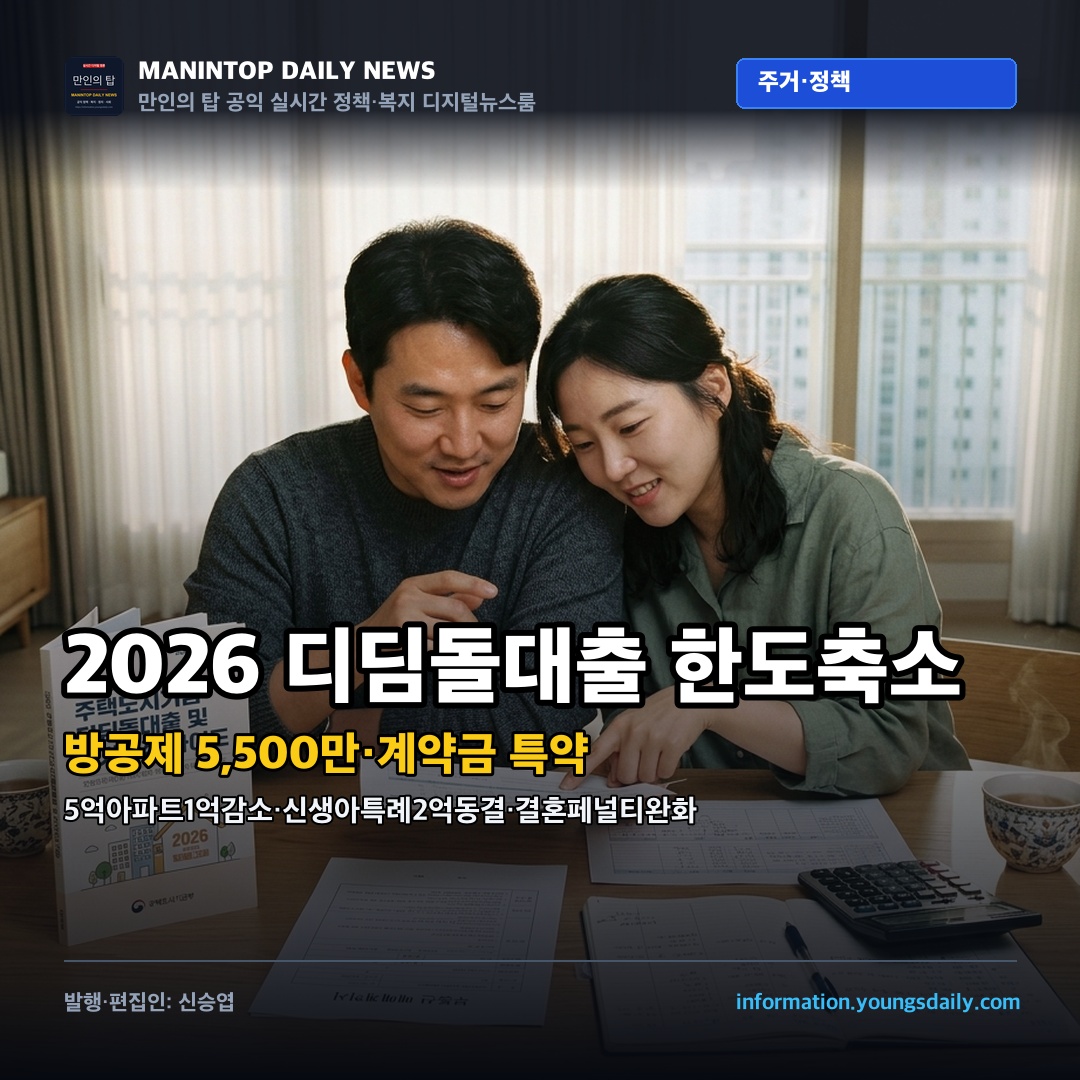
▲ 2026년 디딤돌대출 한도 축소와 신생아 특례·청년 주거지원 완벽 가이드: 방공제 5,500만 원과 계약금 보호 특약 (공식 보도 자료)
📌 핵심 브리핑 · 주요 쟁점 및 핵심 요약
수도권 아파트 디딤돌대출에 방공제 5,500만 원 차감과 한도 축소 규제가 본격화된 가운데, 5억 원 아파트 매수 시 1억 500만 원 대출 감소 산식과 신생아 특례대출 2억 원 동결 및 계약금 몰수를 막는 3대 안전 특약을 심층 분석합니다.
SPONSORED · ADVERTISEMENT
1. 수도권 디딤돌대출 방공제 5,500만 원 의무화와 한도 1억 원 증발의 진실
디딤돌대출은 연 2.65%~3.95%의 낮은 고정금리로 무주택 서민들이 가장 많이 찾는 정책 주택담보대출입니다. 기존에는 모기지신용보증(MCG)에 가입하면 집값의 최대 80%(생애최초 기준)까지 온전히 빌릴 수 있었습니다. 하지만 정부가 수도권 아파트의 MCG 가입 우회로를 전격 차단하면서, 세입자의 최우선변제금만큼 대출액에서 미리 빼버리는 '방공제'가 의무화되었습니다.
이에 따라 수도권 아파트를 살 때는 지역별로 거액의 방공제 금액이 대출금에서 깎여 나갑니다. 서울은 무려 5,500만 원이 일괄 차감되며, 경기와 인천 과밀억제권역은 4,800만 원이 차감됩니다. 여기에 생애최초 주택구입자의 대출 상한액마저 종전 3억 원에서 2억 5,000만 원으로 줄어들었습니다.
실제 서울에서 5억 원짜리 아파트를 생애최초로 살 경우 차이는 극명합니다. 기존에는 주택담보대출비율(LTV 80%)에 따라 4억 원 중 상한액인 3억 원 전액을 대출받을 수 있었습니다. 하지만 지금은 상한선 2억 5,000만 원에서 서울 방공제 5,500만 원이 강제로 빠져 최종 대출 가능액이 1억 9,500만 원으로 쪼그라듭니다. 무려 1억 500만 원의 대출금이 허공으로 사라지면서, 매수자가 순수 자기 현금으로 채워 넣어야 하는 돈이 그만큼 불어난 셈입니다.
소유권 이전 등기가 나지 않은 신축 분양 아파트의 '후취담보 대출'도 중단되어, 입주 예정자들은 연 4~5%대 시중은행 집단대출로 내몰리고 있습니다. 다만 지방 아파트와 수도권이라도 빌라·다세대·단독주택은 방공제가 면제되며, 연소득 4,000만 원 이하 가구가 3억 원 이하 저가 주택을 매수할 때도 종전 혜택을 그대로 받을 수 있습니다.
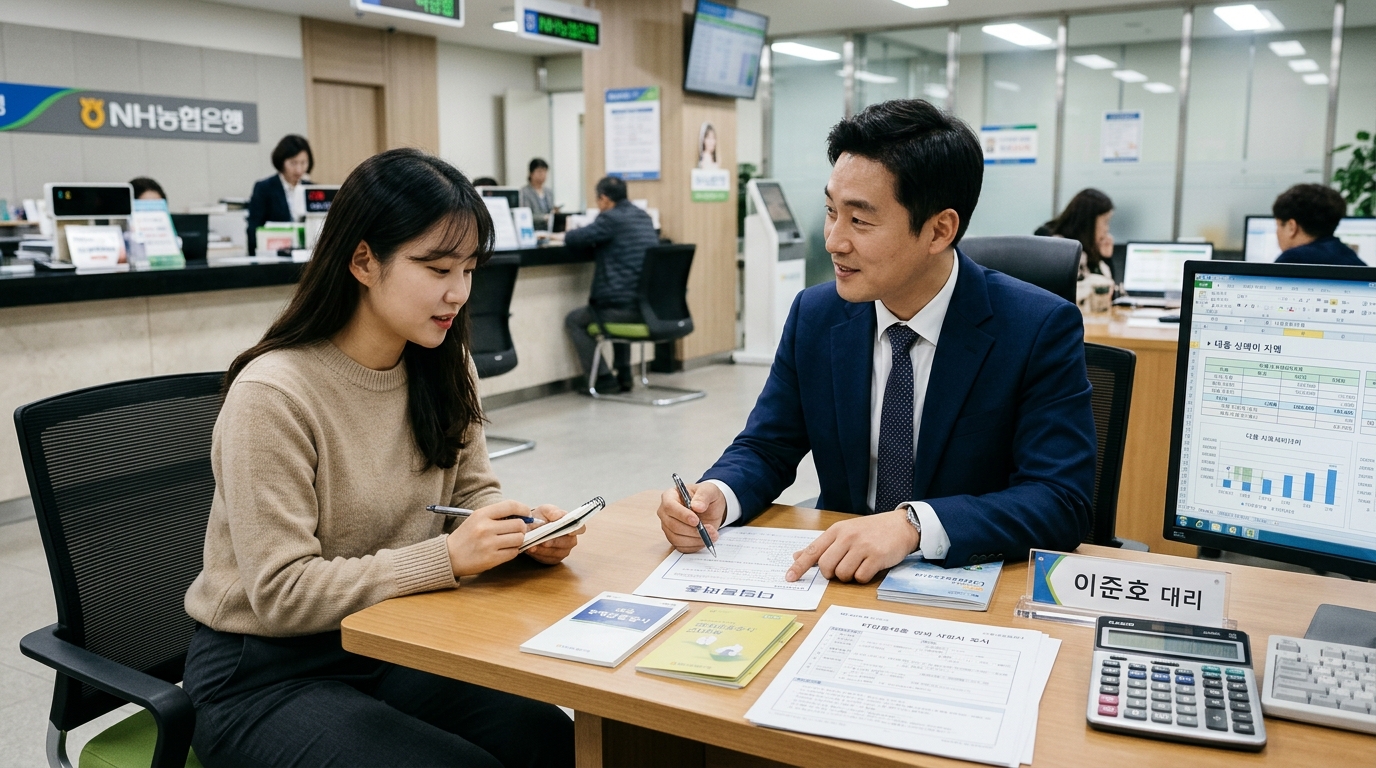
▲ 시중은행 주택도시기금 대출 상담 창구에서 창구 담당자가 내 집 마련 고객에게 디딤돌대출 방공제 차감 기준과 한도를 설명하는 모습 / 국토교통부 공식 자료
2. 신생아 특례대출 2억 상한선 동결과 '2.5억 완화 백지화'의 숨은 배경
아이를 낳은 가정의 내 집 마련을 돕는 '신생아 특례대출'은 이번 수도권 디딤돌 한도 축소와 방공제 규제에서 완전히 제외되어 실수요자들의 숨통을 틔워주고 있습니다. 대출 신청일 기준 2년 이내 출산이나 입양을 한 무주택 가구라면 방공제 차감 없이 최대 4억 원(전세는 2억 4,000만 원)까지 연 1.8%~4.5%의 파격적인 저금리로 대출받을 수 있습니다.
당초 정부는 저출산 극복을 위해 신생아 특례대출의 부부합산 소득 기준을 연 2억 5,000만 원까지 추가로 넓히겠다고 예고했습니다. 하지만 출시 1년 4개월 만에 대출 집행액이 14조 4,000억 원에 달하고 매달 1조 원 넘게 돈이 빠져나가자, 주택도시기금 고갈 우려와 수도권 집값 자극을 막기 위해 2억 5,000만 원 완화안을 전면 백지화했습니다.
이에 따라 소득 기준은 현행 맞벌이 기준 연 2억 원 이하(단벌이 1억 3,000만 원 이하)에서 최종 동결되었고, 디딤돌대출 한도 역시 5억 원에서 4억 원으로, 전세 버팀목 한도는 3억 원에서 2억 4,000만 원으로 묶였습니다. 만약 2026년 12월 31일 이전에 대출 원금을 갚는다면 통상 0.6% 붙는 중도상환수수료가 전액 면제되며, 버팀목 전세대출은 중도상환수수료가 아예 없습니다.
정책대출 및 규제 영역
기존(전년도) 지원 기준
2026년 개정·적용 기준
실수요자 자금 대응 수칙
서울 아파트 디딤돌
MCG 가입 시 방공제 면제 (LTV 80%)
방공제 5,500만 원 필수 차감 (상한 2.5억)
5억 아파트 기준 대출 1억 500만 원 감소 (현금 조달 필수)
경기·인천 과밀억제권
MCG 가입 시 방공제 면제
방공제 4,800만 원 일괄 의무 차감
실제 대출 한도 사전 역산 및 보금자리론 복수 신청
신생아 특례 디딤돌
맞벌이 2억 원 / 한도 최대 5억 원
맞벌이 2억 동결 (2.5억 백지화) / 최대 4억 원
부부 순자산 5.11억 이하, 주택 9억 이하 (방공제 면제)
신혼부부 결혼 페널티
부부합산 소득 기준 초과 시 탈락
부부 중 1인 소득 기준 충족 시 신청 허용
합산 1.2억이라도 1인 6천만 이하 시 디딤돌 가능
신축 아파트 후취담보
미등기 신축 잔금 디딤돌 지원
후취담보 기금대출 원칙적 전면 중단
시중은행 집단대출 전환 또는 사전 신용대출 확보 필요
SPONSORED · ADVERTISEMENT
3. 혼인신고 망설이던 부부 구제… '결혼 페널티' 완화와 청년 주거 혜택
그동안 미혼일 때는 각자 대출을 잘 받다가도, 결혼해서 혼인신고를 하면 부부 소득이 합산되어 정책대출이나 공공임대에서 쫓겨나는 이른바 '결혼 페널티'가 청년들의 혼인 기피 원인으로 지목되어 왔습니다. 2026년 제도 개편으로 이 같은 모순이 대폭 해결되었습니다.
이제 신혼부부가 디딤돌이나 버팀목 대출을 신청할 때 부부 합산 소득이 기준을 넘더라도, 둘 중 한 사람의 소득이 일반가구 기준(디딤돌 연 6,000만 원, 버팀목 연 5,000만 원 이하)을 충족하면 대출 신청이 가능해집니다. 예컨대 남편 연봉이 5,000만 원이고 아내 연봉이 7,000만 원이어서 합산 1억 2,000만 원으로 신혼부부 기준(8,500만 원)을 넘기더라도, 남편 소득이 6,000만 원 이하이므로 디딤돌대출을 정상 신청할 수 있는 길목이 열렸습니다. 행복주택 신혼부부 입주 월소득 기준도 939만 원으로 올라갔습니다.
청년들을 위한 '보편형 전세임대'도 새롭게 도입되었습니다. 부모의 소득과 자산을 보지 않고 오직 청년 본인의 소득(중위 140% 이하)만 따지며, 수도권 전세금을 최대 2억 4,000만 원까지 연 90% 한도로 지원합니다. 저소득 배점제가 아닌 공정한 추첨제로 뽑아 일반 청년들의 문턱을 낮췄습니다. 청년 전세보증금 반환보증료도 연소득 6,500만 원 이하 청년에게 최대 50만 원까지 환급해주며, 집주인 대신 공적 기구에 보증금을 맡겨 전세사기를 원천 차단하는 '전월세 안심신탁' 시범사업도 수도권 500호를 대상으로 본격 가동됩니다.
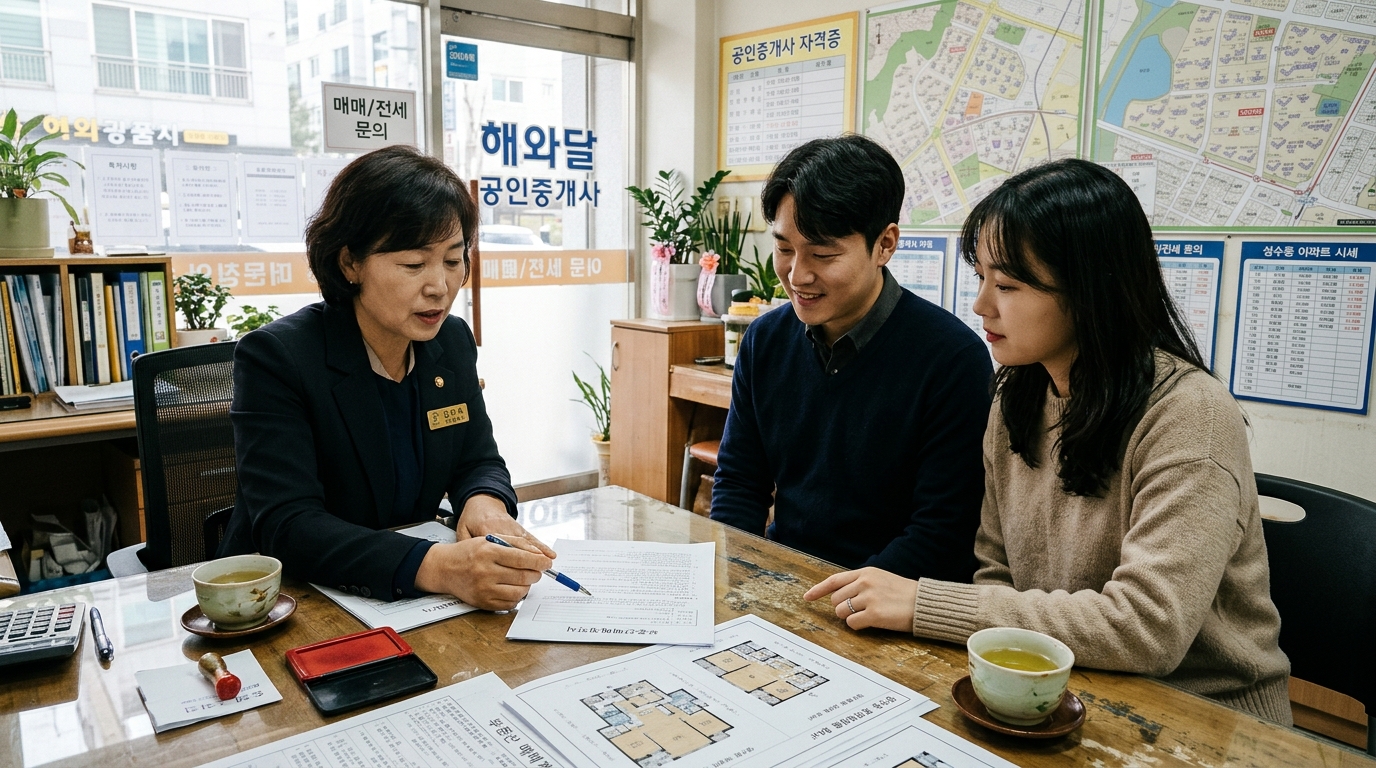
▲ 공인중개사 사무소 상담 테이블에서 공인중개사와 매수인이 대출 한도 감액 시 계약금 전액 반환 안전 특약 문구를 확인하는 현장 / 부동산 정책 현장 자료
4. 대출 깎여 잔금 못 치를 때… 계약금 100% 지키는 3대 안전 특약
부동산 매매 계약 현장에서 가장 무서운 순간은 대출 심사 결과 한도가 대폭 깎여 나오는 때입니다. 계약서에 단순히 "대출 안 나오면 계약금 돌려준다"는 두루뭉술한 한 줄만 넣었다가는 큰 낭패를 볼 수 있습니다. 매도인이 "대출이 전면 거절된 게 아니라 일부는 나왔으니, 잔금을 못 치른 건 매수인의 책임"이라며 계약금을 몰수하겠다고 버티는 분쟁이 끊이지 않기 때문입니다.
내 소중한 피땀 눈물인 계약금을 지키기 위해서는 계약서 작성 시 반드시 '한도 감액'을 명시한 방어 특약을 포함해야 합니다. 계약서 특약란에 "매도인은 매수인의 주택도시기금 디딤돌대출 신청에 적극 협조한다"는 조항을 기본으로 깔고, "매수인의 개인 신용상 결격사유가 없음에도 불구하고 정부 대출 규제나 정책 변화로 신청 금액(예: O억 원) 미만으로 감액 승인되거나 거절될 경우 계약은 소급하여 무효로 하며, 매도인은 수령한 계약금 전액을 즉시 반환한다"는 문구를 반드시 적어 넣어야 합니다.
계약 도장을 찍기 전에는 주택도시기금 포털에서 바뀐 기준(주택가액 × LTV - 방공제액)으로 대출 가능액을 반드시 역산해보고, 잔금일 차질을 막기 위해 금리가 조금 높더라도 보금자리론이나 시중은행 주택담보대출을 동시에 사전 심사받아 두는 것이 안전합니다.
A Comprehensive Guide to the Reduction of the 2026 Didirimdol Loan Limit and Special Provisions for Newborns and Youth Housing Support: Air Defense Compensation of 55 million won and Contract Deposit Protection Clause.
As the regulations on the Didirimdol loan for apartments in the metropolitan area take effect, including a deduction of 55 million won and a reduction in the loan limit, we will conduct an in-depth analysis of the implications of these changes. This includes a calculation showing a decrease of 105 million won in loans when purchasing a 500 million won apartment, the freezing of the special loan for newborns at 200 million won, and the implementation of three safety clauses to prevent the forfeiture of down payments.
📌 Key Takeaways
Seoul's limit is reduced to 55 million won, while the Gyeonggi-Incheon area sees a decrease to 48 million won, along with a reduction in the first-time homebuyer limit to 250 million won.
Concerns over fund depletion have led to the cancellation of the 250 million won easing, with the maximum limit set at 400 million won and the Jeonse limit frozen at 240 million won.
The policy stipulates that benefits will be based on the income of one spouse, and in the event of changes to loan policies, a clause for immediate refund of the down payment will be specified.
1. The Truth Behind the Mandatory 55 Million Won Security Deduction and the Disappearance of the 100 Million Won Limit for the Metropolitan Area's Didiimdol Loan
The Didiimdol loan is a popular policy mortgage for low-income households without homes, offering a low fixed interest rate of 2.65% to 3.95%. Previously, borrowers could secure up to 80% of the home price (based on first-time buyers) if they enrolled in the Mortgage Credit Guarantee (MCG). However, the government has abruptly blocked alternative routes for MCG enrollment for apartments in the metropolitan area, making the 'security deduction' mandatory, which deducts the amount equivalent to the tenant's priority repayment from the loan amount.
As a result, when purchasing an apartment in the metropolitan area, substantial security deduction amounts are subtracted from the loan based on the region. In Seoul, a staggering 55 million won is deducted, while the Gyeonggi and Incheon congestion control zones see a deduction of 48 million won. Additionally, the loan limit for first-time homebuyers has been reduced from 300 million won to 250 million won.
For instance, when purchasing a 500 million won apartment in Seoul as a first-time buyer, the difference is stark. Previously, based on a loan-to-value ratio (LTV) of 80%, borrowers could secure the full 300 million won. Now, however, with the limit set at 250 million won and the mandatory security deduction of 55 million won, the final loan amount shrinks to 195 million won. This results in a loss of 105 million won in potential loan funds, increasing the amount that the buyer must cover with their own cash.
Furthermore, 'post-acquisition mortgage loans' for newly built apartments that have not yet undergone ownership transfer registration have been halted, forcing prospective residents to resort to collective loans from commercial banks at interest rates of 4-5%. However, security deductions are exempt for apartments in provincial areas and for villas, multi-family homes, and single-family houses in the metropolitan area. Households with an annual income of 40 million won or less can still enjoy previous benefits when purchasing low-cost housing under 300 million won.
▲ Loan specialist explaining Didimdol loan limits and room deduction calculation rules to a homebuyer at a commercial bank counter / Ministry of Land, Infrastructure and Transport Archive
2. The Hidden Background of Freezing the 200 Million Won Cap on Newborn Special Loans and the Abandonment of the 250 Million Won Relaxation
The 'Newborn Special Loan', designed to assist families with newborns in purchasing homes, has been completely exempted from the recent reductions in the Didiimdol loan limits and security deduction regulations, providing relief to genuine buyers. Households that have given birth or adopted within two years of the loan application date can borrow up to 400 million won (240 million won for jeonse) at an exceptionally low interest rate of 1.8% to 4.5%, without any security deduction.
Initially, the government announced plans to expand the combined income limit for the Newborn Special Loan to 250 million won to combat low birth rates. However, after the loan disbursement reached 14.4 trillion won within just 16 months, with over 1 trillion won flowing out monthly, concerns about the depletion of the Housing and Urban Fund and the potential stimulation of housing prices in the metropolitan area led to the complete abandonment of the 250 million won relaxation plan.
Consequently, the income limit has been frozen at the current combined income threshold of 200 million won for dual-income households (130 million won for single-income households), and the Didiimdol loan limit has been reduced from 500 million won to 400 million won, while the jeonse support limit has been capped at 240 million won. If the principal of the loan is repaid before December 31, 2026, the usual early repayment fee of 0.6% will be fully waived, and there will be no early repayment fee for the jeonse support loans.
Category
Target Scope
Standard / Benefit
Procedure / Action
Seoul Apartment Stepping Stone
Exemption from the security deposit when joining MCG (LTV 80%)
Mandatory deduction of 55 million won for the security deposit (cap at 250 million won)
For a 500 million won apartment, the loan amount decreases by 105 million won (cash procurement required)
Gyeonggi and Incheon Overcrowding Control Zone
Exemption from the security deposit when joining MCG
Mandatory deduction of 48 million won for the security deposit
Pre-calculation of actual loan limits and multiple applications for the housing loan
Newborn Special Stepping Stone
Dual-income households with 200 million won / maximum limit of 500 million won
Dual-income 200 million won frozen (250 million won nullified) / maximum of 400 million won
Couples with net assets below 511 million won and housing below 900 million won (exemption from the security deposit)
Penalty for Newlywed Couples
Disqualification if combined income exceeds the threshold
Application allowed if one spouse meets the income criteria
Even with a combined income of 120 million won, if one person earns below 60 million won, stepping stone is possible
Post-Construction Apartment Backed Loans
Support for the remaining balance of unregistered new constructions
Principle of complete suspension of backed loan funding
Need to convert to group loans from commercial banks or secure pre-approval for credit loans
3. Relief for Couples Hesitant to Register Their Marriage: Easing the 'Marriage Penalty' and Housing Benefits for Youth
Previously, unmarried individuals could secure loans easily, but upon registering their marriage, their combined income would disqualify them from policy loans or public rentals, a phenomenon known as the 'marriage penalty', which has been cited as a reason for young people's reluctance to marry. This contradiction has been significantly addressed with the 2026 system reform.
Now, when newlyweds apply for Didiimdol or jeonse support loans, even if their combined income exceeds the threshold, as long as one partner's income meets the general household criteria (6 million won for Didiimdol, 5 million won for jeonse support), they can still apply for the loan. For example, if the husband earns 50 million won and the wife earns 70 million won, resulting in a combined income of 120 million won, which exceeds the newlywed threshold of 85 million won, the husband’s income of 60 million won or less allows them to apply for the Didiimdol loan normally. The income threshold for newlywed residents in happy housing has also been raised to 9.39 million won.
A new 'Universal Jeonse Rental' program has also been introduced for youth. This program does not consider the parents' income or assets, focusing solely on the young person's income (below 140% of the median), and supports jeonse amounts up to 240 million won at a 90% limit in the metropolitan area. The selection process is based on a fair lottery system rather than a low-income scoring system, lowering the barriers for ordinary youth. Additionally, young individuals with an annual income of 65 million won or less can receive a refund of up to 500,000 won for jeonse deposit guarantee fees, and a pilot project for a 'Jeonse Safety Trust' will be launched for 500 units in the metropolitan area, which will prevent jeonse fraud by entrusting deposits to public institutions instead of landlords.
▲ Licensed realtor and homebuyer reviewing contract safety contingency clauses for deposit refund in case of loan limit reductions / Real Estate Policy Field Archive
4. When Loan Reductions Prevent Final Payments: Three Key Safety Clauses to Protect Your Deposit
One of the most daunting moments in real estate transactions occurs when the loan approval results in a significant reduction in the loan limit. Simply including a vague line in the contract stating, "If the loan does not come through, the deposit will be refunded," can lead to severe consequences. Disputes arise when sellers argue that since part of the loan was approved, the buyer is responsible for the failure to complete the final payment, leading to the forfeiture of the deposit.
To protect your hard-earned deposit, it is essential to include a defensive clause specifying 'loan limit reductions' in the contract. The contract should include a basic provision stating, "The seller will actively cooperate with the buyer's application for the Housing and Urban Fund Didiimdol loan," followed by a clause that states, "If the buyer has no personal credit disqualifications, but due to government loan regulations or policy changes, the approved amount is reduced or denied to below (e.g., X million won), the contract will be retroactively void, and the seller must immediately return the entire deposit received.".
Before signing the contract, it is crucial to calculate the potential loan amount using the revised criteria (property value × LTV - security deduction) on the Housing and Urban Fund portal. To avoid any issues with the final payment, it is advisable to undergo preliminary assessments for both the Bogeumjari loan and commercial bank mortgage loans, even if it means accepting slightly higher interest rates.
Recommended Deep-Dive Investigations TOP 3
GLOBAL REPORT
1월이 시작되면 감기는 이미 우리 곁에 와 있습니다. 2월, 3월, 4월까지 이어지는 추위와 건조함은 코와 목을 가장 먼저 공격합니다. 아침에 일어나자마자 막혀 있는 코. 계속 흐르는 콧물. 괜히 칼칼해지는 목. 이 증상은 “시작”일 뿐입니다. 한 번 무너지면 일주일, 길면 한 달까지 끌고 갑니다. 약을 먹으면 잠깐 괜찮아집니다. 하지만 며칠 뒤 또 반복됩니다. 왜일까요? 감기는 ‘치료’의 문제가 아니라 ‘관리’의 문제이기 때문입니다. 대부분은 감기가 오고 나서 약을 찾습니다. 하지만 진짜 중요한 건 감기가 오기 전에 코와 목을 지키는 것입니다. 건조한 실내 공기, 차가운 바깥 공기, 눈에 보이지 않는 세균. 코와 목은 매일 공격받고 있습니다. 지긋지긋하죠! 그런데도 우리는 아무 준비 없이 버티고 있습니다. 이번 겨울도 그렇게 보낼 건가요? 사실 방법은 어렵지 않습니다. 코를 깨끗하게 관리하고, 목을 따뜻하게 보호하고, 점막을 촉촉하게 유지하고, 기관지를 미리 관리하고, 외부 공기를 차단하는 것. 이 다섯 가지만 꾸준히 해도 감기약 없이 겨울을 보내는 것이 충분히 가능합니다. 🔥 이제부터 그 방법을 하나씩 살펴보겠습니다. 🔥 1. 코와 목을 먼저 관리해야 하는 과학적 이유 감기의 대부분은 코 점막에서 시작됩니다. 국제 학술지 Nature Reviews Microbiology 와 Journal of Allergy and Clinical Immunology 에 실린 호흡기 감염 관련 연구들에서는, 감기 바이러스가 비강 상피세포에 먼저 부착해 증식한다는 점을 설명하고 ...
리모델링사업이 진행 중인 아파트를 매매할 때 “계약금 10%를 언제까지 내야 하느냐”는 질문이 특히 많이 나옵니다. 이주공고(이주 안내)가 7~11월쯤이라고 들으면, 그 시점에 맞춰 계약금도 움직일 것 같아서 더 헷갈리기 쉽습니다. 하지만 실제 납부기한은 ‘이주공고가 언제냐’만으로 자동 결정되지 않는 경우가 많습니다. 1) 계약금 10% 납부기한: 결국 ‘문서에 적힌 일정’이 기준 계약금 10%를 언제까지 납부해야 하는지는, 내가 서명하는 매매계약서(특약 포함) 와 사업주체/조합이 제시한 공고·안내문 에 적힌 납부 일정이 기준이 됩니다. 실제 공고문에서는 분양대금 납부의 큰 틀(계약금→중도금→잔금)을 먼저 안내하고, 상세 일정은 별도 표나 유의사항으로 제시하는 방식이 흔합니다. 또, 계약서 문구에 따라 지급 시점이 조건부로 설정될 수도 있습니다. 예를 들어 한 사례 소개 자료에서는 용역계약서에 잔금(10%) 지급시기가 “사업승인 후”로 기재되어 있었다는 점이 언급됩니다. 이런 식으로 ‘사업 단계’와 지급을 연동하는 문구가 들어가면, 질문의 답은 계약서 문구를 확인해야만 확정됩니다. 관련 내용은 링크 에서 문구 사례를 확인할 수 있습니다. 2) 입주자모집공고에서 확인되는 ‘납부 순서’와 잔금 마감 시점 공고문에 적힌 문구를 보면, 납부 순서와 잔금 마감에 대한 기준이 비교적 명확하게 제시되는 경우가 있습니다. 예를 들어 한 입주자모집공고에는 “분양금액(주택가격)은 계약금, 중도금, 잔금의 순서로 납부”하며 “잔금은 입주(열쇠 수령일) 전에 완납”해야 한다고 안내되어 있습니다. (문구 확인: 링크 ) 이 문구가 의미하는 바는 최소 2가지입니다. 분양/공급 형태의 문서에서는 ‘계약금→중도금→잔금’ 흐름이 공식적으로 안내될 수 있습니다. 잔금은 “입주(열쇠 수령)” 이전에 완납해야 한다는 마감 기준이 문서에 적혀 있을 수 있습니다. 다만, 위 공고문 문구는 잔금 마감에 대한 기준을 보여주지만, 계약금 10%의...
윤석열 전 대통령 탄핵 인용 소식을 접하면, 가장 궁금한 지점은 ‘헌재가 정확히 무엇을 위헌·위법으로 봤는가’입니다. 또한 탄핵과 별개로 진행되는 형사재판(내란 우두머리 혐의 등)이 어디까지 왔는지도 함께 정리할 필요가 있습니다. 아래 내용은 제공된 기사/게시물 스니펫과 링크에서 확인되는 범위만 모아, 일반인이 흐름을 이해하기 쉽게 정리한 것입니다. 1) 탄핵 인용 관련: 스니펫에서 확인되는 ‘판단의 골격’ 제공된 근거 중 조국혁신당 사이트에는 헌법재판소가 윤석열 탄핵 심판에서 “피청구인의 위헌·위법행위는 국민 신임 …”이라는 취지로 판단했다는 문장이 인용돼 있습니다( 링크 ). 이 인용문만 놓고 보면, ‘위헌·위법행위’가 있었는지와 그로 인해 ‘국민의 신임’이 어떻게 평가됐는지가 핵심 축으로 소개됩니다. 다만 질문에서 요청하신 세부 항목, 즉 비상계엄 선포 자체를 문제 삼은 구체적 이유, 계엄 이후 조치(포고령, 국회 통제 등)의 어떤 지점이 헌법 위반인지, 국회의 권한행사 방해 및 정치활동 제약을 어떤 논리로 판단했는지 등은, 이번에 제공된 근거의 제목/스니펫만으로는 조항·사실관계·판단 구조가 그대로 제시돼 있지 않습니다. 따라서 이 글에서는 ‘헌재가 무엇을 문제 삼았다’는 세부 리스트를 단정적으로 재구성하기보다, 현재 확인 가능한 문구 수준의 요약(위헌·위법행위 → 국민 신임의 문제로 평가)까지만 적습니다. 만약 헌재 결정문 전문(주문 및 이유)이 추가로 확인되면, 그때는 문장 단위로 ‘어떤 행위’와 ‘어떤 헌법 원리/조항’이 연결되는지(예: 권력분립, 국회의 권한, 정치적 기본권 등) 구조화해 정리하는 것이 가장 정확합니다. 2) 형사 절차(내란 혐의) 관련: 체포영장과 1심 선고 언급 탄핵 심판과 별도로, 12·3 비상계엄 사태로 내란 혐의를 받는 윤석열 대통령에 대해 2024년 12월 31일 체포 영장이 발부됐다는 BBC 보도가 있습니다( 링크 ). 해당 보도는 ‘현직 대통령’에 대한 체포영장 발부라는 점을 함께 언급합니다. 또...