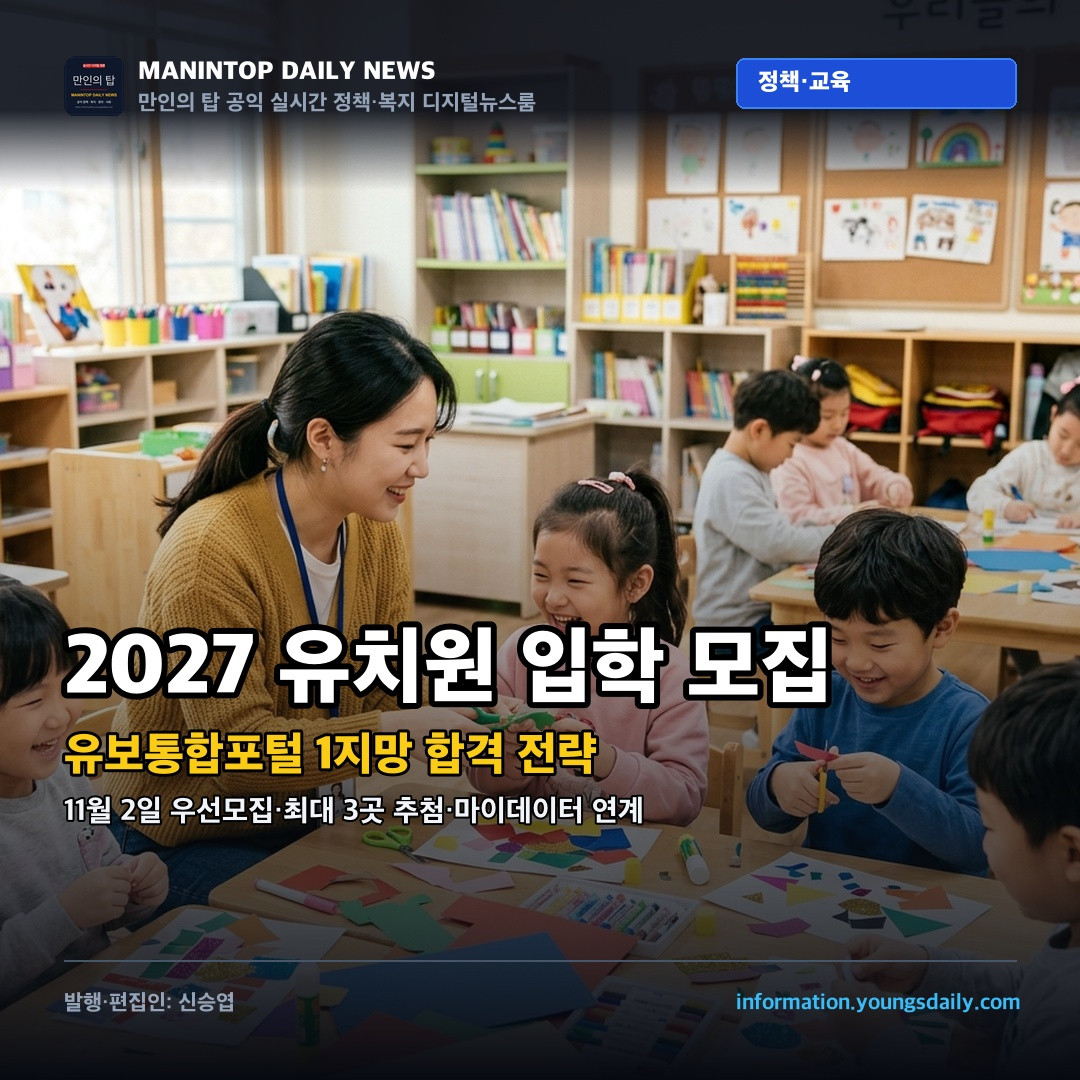
▲ 2027학년도 유치원 입학 모집 총정리: 유보통합포털 신청 일정과 1지망 합격 전략 (공식 보도 자료)
📌 핵심 브리핑 · 주요 쟁점 및 핵심 요약
2027학년도 유치원 입학 모집이 11월 2일 우선모집을 시작으로 전국 공·사립유치원에서 일제히 개시됩니다. 이번 모집은 기존의 유치원 원서 접수 사이트인 '처음학교로'와 어린이집 입소 신청 창구인 '아이사랑'이 '유보통합포털(enter.childinfo.go.kr)'로 전면 일원화된 이후 처음으로 치러지는 핵심 신입생 선발 절차입니다. 만 3세부터 만 5세 자녀를 둔 학부모들은 PC 웹과 모바일 앱을 통해 100% 온라인으로 신청할 수 있으며, 공공 마이데이터 연계로 복잡한 서류 제출 ...
SPONSORED · ADVERTISEMENT
1. 유보통합포털 일원화 및 2027학년도 유아모집 단계별 핵심 일정
2027학년도 신입생 선발은 크게 우선모집, 일반모집, 추가모집의 3단계로 질서 있게 진행됩니다. 학부모는 10월 28일부터 자녀 정보를 사전 등록하고 관심 있는 유치원이나 어린이집을 '찜하기' 기능으로 미리 목록화할 수 있습니다. 특히 행정안전부 공공 마이데이터 시스템과 연계되어 주민등록등초본 및 가족관계증명서 등 최대 20종의 자격 서류가 온라인상에서 원클릭으로 자동 검증됩니다.
우선모집은 11월 2일부터 4일까지 접수하며 11월 9일 결과를 발표합니다. 이어 일반모집은 11월 17일부터 23일까지 진행되며, 11월 26일 추첨 결과를 공개한 뒤 11월 27일부터 30일까지 최종 등록을 마감합니다. 정원 미달 유치원은 12월 1일부터 추가모집을 상시 가동합니다.
▲ 영유아 발달 맞춤형 돌봄 및 공교육 진입을 지원하는 유아교육 현장 / 교육부·복지부 공식 자료
2. 최대 3곳 복수 지원 및 100% 무작위 전산 추첨 선발 원칙
2027학년도 입학 대상은 2023년생(만 3세), 2022년생(만 4세), 2021년생(만 5세) 유아입니다. 학부모는 설립 유형(국공립·사립)과 지역에 관계없이 최대 3곳(1희망, 2희망, 3희망)의 유치원을 자유롭게 선택하여 복수 지원할 수 있습니다. 이미 다른 유치원에 재원 중인 유아가 이전을 희망하는 경우에는 최대 2곳까지 지원이 허용됩니다.
모든 선발은 접수 시점과 무관한 100% 무작위 전산 추첨 방식으로 이루어집니다. 첫날 오전 9시에 접속하든 마감 당일 오후 5시에 접수하든 당첨 확률은 완전히 동일하므로, 첫날 접속 폭주를 피해 안정적으로 접수하는 것이 권장됩니다. 다만 상위 희망 유치원에 합격하면 하위 희망 유치원의 선발 대상에서는 자동으로 제외되는 중복 합격 방지 알고리즘이 적용됩니다. 쌍둥이 지원자의 경우 개별 추첨과 다둥이 동시 추첨(연속 번호 부여) 중 학부모가 유리한 방식을 선택할 수 있습니다.
모집 구분
원서 접수 기간
추첨 결과 발표
합격자 등록 기간
사전 준비 단계
10월 28일(수)부터 상시 가능
자녀 정보 등록 및 관심 기관 찜하기
회원가입 및 본인인증 점검
우선모집 절차
11월 2일(월) 09:00 ~ 11월 4일(수) 18:00
11월 9일(월) 15:00 전산 발표
11월 10일(화) 09:00 ~ 11월 11일(수) 18:00
일반모집 절차
11월 17일(화) 09:00 ~ 11월 23일(월) 18:00
11월 26일(목) 15:00 전산 발표
11월 27일(금) 09:00 ~ 11월 30일(월) 18:00
추가모집 운영
12월 1일(화) 이후 결원 발생 시 상시
유치원별 결원 인원 개별 공지
정원 미달 기관 대상 순차 선발
SPONSORED · ADVERTISEMENT
3. 국공립 vs 사립유치원 특성 비교 및 맞벌이 방과후과정 전략
가정의 양육 패턴과 직장 환경에 따라 유치원 유형별 장단점을 꼼꼼히 대조해야 합니다. 초등학교 병설 또는 독립 단설로 운영되는 국공립유치원은 정부의 전폭적인 지원으로 기본 학비와 급·간식비 부담이 사실상 제로입니다. 넓은 교실과 운동장, 안전한 실내외 시설이 큰 장점이나, 정규 교육과정이 통상 오후 1~2시에 종료되므로 맞벌이 가구는 오후 5시에서 7시까지 지원되는 방과후 돌봄과정 추첨에 반드시 별도 합격해야 합니다.
반면 사립유치원은 음악, 미술, 영어, 체육 등 다채로운 특성화 프로그램을 원내에서 모두 소화할 수 있고 등하원 통학차량이 촘촘히 운행되어 통학 편의성이 뛰어납니다. 다만 특성화 활동비와 차량비 등 월 10~25만 원 안팎의 학부모 실부담금이 발생합니다. 맞벌이 가정은 국공립 방과후과정 접수 시 부모 모두의 재직증명서나 건강보험 자격득실확인서 등 공식 근로 증빙을 시스템에 정확히 첨부해야 우선순위 배점을 온전히 확보할 수 있습니다.
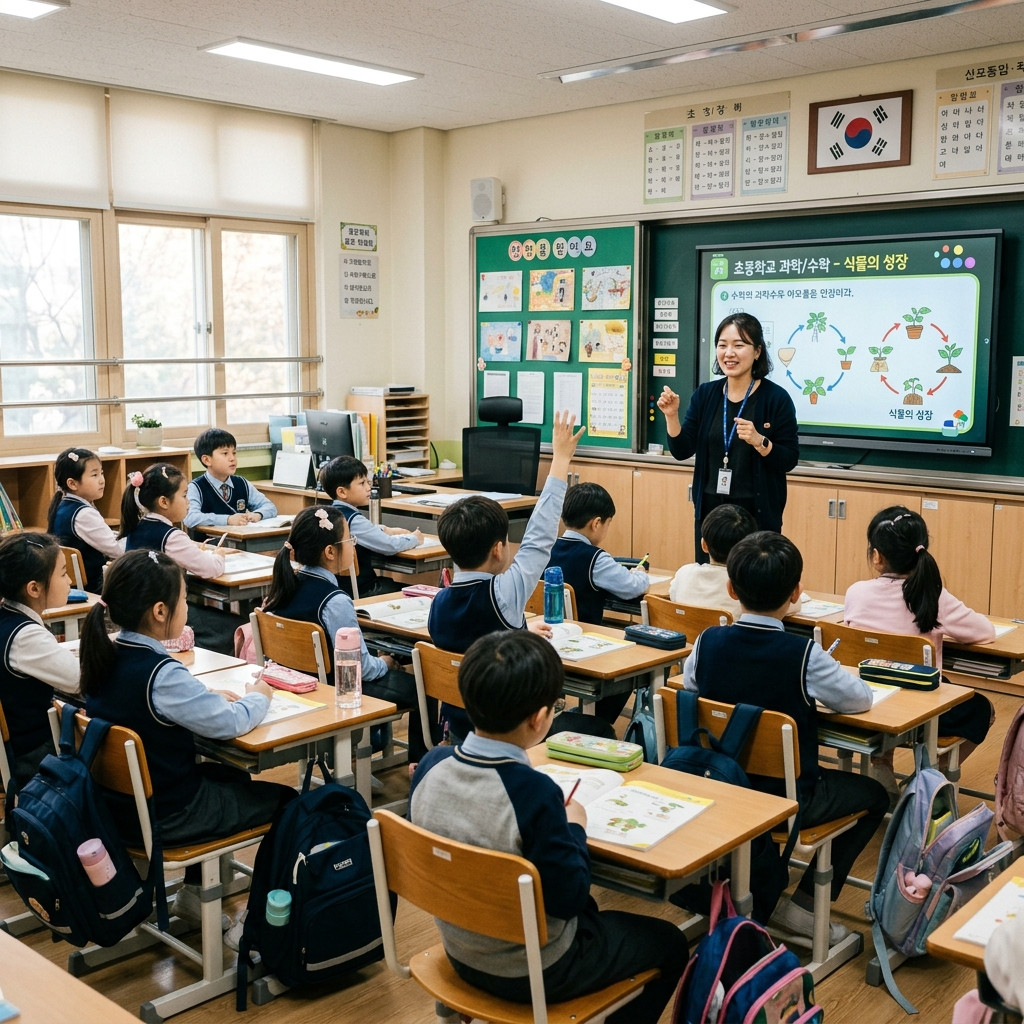
▲ 안전한 교육 시설과 방과후 돌봄과정을 갖춘 유치원 및 초등 연계 교육 현장 / 교육청 공식 자료
4. 실패 없는 1·2·3지망 황금 배분 전략 및 학부모 필수 체크리스트
한정된 3장의 지원 카드로 합격률을 극대화하려면 '공격·안정·안전'의 3단계 황금 배분 전략이 필수적입니다. 1희망에는 가장 선호도가 높거나 지역 내 경쟁이 치열한 명문 단설 또는 인기 사립유치원을 소신 지원합니다. 2희망에는 도보 통학이 가능하고 선발 정원이 비교적 넉넉한 유치원을 배치하여 중간 안전선을 구축합니다. 3희망에는 통학버스가 광범위하게 운행되거나 모집 인원이 많아 미달 또는 예비 번호 회전이 빠른 유치원을 지정함으로써 3곳 모두 탈락하는 최악의 사태를 방어해야 합니다.
선발 결과 발표 직후에는 반드시 정해진 등록 기간 내에 유보통합포털에 접속하여 온라인 '등록' 버튼을 클릭해야 합니다. 기한 내에 등록하지 않으면 합격이 자동 취소되어 예비 대기자에게 입학 권한이 넘어가므로 알람 설정이 필수적입니다. 유보통합포털을 통해 일원화된 이번 유치원 입학 시스템을 사전에 숙지하고 전략적으로 대응한다면 소중한 아이의 첫 공교육 출발을 차질 없이 완성할 수 있습니다.
Summary of Kindergarten Admission Recruitment for the 2027 Academic Year: Application Schedule for the Integrated Portal and Strategies for Success in First Choice Admissions.
The enrollment process for kindergartens for the 2027 academic year will commence on November 2 with priority admissions, starting simultaneously across all public and private kindergartens nationwide. This recruitment marks the first key selection procedure for new students since the integration of the existing kindergarten application site 'Chuhum School' and the childcare admission portal 'I Love Children' into the unified 'Integrated Child Information Portal' (enter.childinfo.go.kr). Parents of children aged 3 to 5 can apply 100% online through both PC and mobile apps, and with the connection to public MyData, the submission of complex documents has been simplified.
📌 Key Takeaways
Priority recruitment begins on November 2 and mobile one-click registration is available.
No first-come, first-served basis; completely fair lottery and prevention of duplicate admissions.
Caution: Cancellation for incomplete linkage and registration of 20 types of MyData.
1. Integration of the Early Childhood Education Portal and Key Dates for 2027 Enrollment
The selection process for new students in the 2027 academic year will be conducted in an orderly manner through three phases: priority enrollment, general enrollment, and additional enrollment. Parents can pre-register their children's information starting October 28 and can use the "favorite" feature to create a list of kindergartens or daycare centers they are interested in. Notably, this process is linked to the Ministry of the Interior and Safety's public MyData system, allowing for the online one-click automatic verification of up to 20 types of qualification documents, including resident registration and family relationship certificates.
Priority enrollment will be open from November 2 to 4, with results announced on November 9. General enrollment will take place from November 17 to 23, followed by a lottery result announcement on November 26, and final registration will close from November 27 to 30. Kindergartens that do not meet their enrollment quotas will begin additional enrollment on December 1.
▲ Early childhood educational environment supporting developmental care and public education / Ministry of Education Archive
2. Application to Up to Three Institutions and 100% Random Computerized Lottery Selection Principle
The target group for admission in the 2027 academic year includes children born in 2023 (age 3), 2022 (age 4), and 2021 (age 5). Parents can freely apply to up to three kindergartens (first choice, second choice, third choice) regardless of the type of institution (public or private) or location. For children currently enrolled in another kindergarten who wish to transfer, applications to a maximum of two institutions are permitted.
All selections will be made through a 100% random computerized lottery system, regardless of the application time. Whether a parent applies at 9 AM on the first day or at 5 PM on the last day, the chances of winning remain completely the same. Therefore, it is recommended to avoid the rush on the first day and apply in a stable manner. However, an algorithm is in place to prevent duplicate admissions; if a child is accepted into their first-choice kindergarten, they will automatically be excluded from consideration at their lower-choice institutions. For twin applicants, parents can choose between individual lotteries or simultaneous lotteries for multiple children (with consecutive numbers assigned).
Category
Target Scope
Standard / Benefit
Procedure / Action
Preparation Stage
Available from October 28 (Wednesday)
Registering child information and bookmarking interested institutions
Membership registration and identity verification check
Priority Recruitment Process
November 2 (Monday) 09:00 to November 4 (Wednesday) 18:00
Computer announcement on November 9 (Monday) at 15:00
November 10 (Tuesday) 09:00 to November 11 (Wednesday) 18:00
General Recruitment Process
November 17 (Tuesday) 09:00 to November 23 (Monday) 18:00
Computer announcement on November 26 (Thursday) at 15:00
November 27 (Friday) 09:00 to November 30 (Monday) 18:00
Additional Recruitment Operations
Ongoing after December 1 (Tuesday) in case of vacancies
Individual notifications of vacancies by each kindergarten
Sequential selection for institutions with insufficient enrollment
3. Comparison of Public vs. Private Kindergarten Characteristics and Dual-Income Family After-School Program Strategies
It is essential to carefully compare the advantages and disadvantages of different types of kindergartens based on family childcare patterns and workplace environments. Public kindergartens, whether affiliated with elementary schools or operating independently, benefit from substantial government support, resulting in virtually zero tuition and meal costs. They offer spacious classrooms, playgrounds, and safe indoor and outdoor facilities. However, regular educational programs typically end around 1 to 2 PM, meaning dual-income families must successfully apply for after-school care programs, which are available from 5 to 7 PM.
In contrast, private kindergartens provide a wide range of specialized programs, including music, art, English, and physical education, all within the institution, and offer convenient transportation services for commuting. However, parents may incur monthly costs ranging from 100,000 to 250,000 KRW for specialized activity fees and transportation. For dual-income families, it is crucial to accurately attach official employment verification documents, such as proof of employment or health insurance eligibility certificates, when applying for public after-school programs to fully secure priority points.
▲ Educational campus equipped with safe learning facilities and after-school care programs / Office of Education Archive
4. Fail-Proof Golden Distribution Strategy for First, Second, and Third Choices and Essential Checklist for Parents
To maximize acceptance rates with the limited three application slots, a three-tiered golden distribution strategy of "aggressive, stable, and safe" is essential. For the first choice, parents should confidently apply to the most preferred or highly competitive prestigious standalone or popular private kindergartens. The second choice should be a kindergarten that is within walking distance and has a relatively ample enrollment capacity, establishing a middle safety net. For the third choice, parents should designate a kindergarten with extensive transportation services or a large number of openings, ensuring that they can avoid the worst-case scenario of being rejected by all three institutions.
Immediately after the selection results are announced, it is crucial to access the Early Childhood Education Portal within the designated registration period and click the online "register" button. Failing to register within the deadline will result in automatic cancellation of acceptance, transferring the admission rights to waitlisted candidates, making alarm settings essential. By familiarizing themselves with the integrated kindergarten admission system through the Early Childhood Education Portal in advance and responding strategically, parents can ensure a smooth start to their child's first public education experience.
Recommended Deep-Dive Investigations TOP 3
GLOBAL REPORT
1월이 시작되면 감기는 이미 우리 곁에 와 있습니다. 2월, 3월, 4월까지 이어지는 추위와 건조함은 코와 목을 가장 먼저 공격합니다. 아침에 일어나자마자 막혀 있는 코. 계속 흐르는 콧물. 괜히 칼칼해지는 목. 이 증상은 “시작”일 뿐입니다. 한 번 무너지면 일주일, 길면 한 달까지 끌고 갑니다. 약을 먹으면 잠깐 괜찮아집니다. 하지만 며칠 뒤 또 반복됩니다. 왜일까요? 감기는 ‘치료’의 문제가 아니라 ‘관리’의 문제이기 때문입니다. 대부분은 감기가 오고 나서 약을 찾습니다. 하지만 진짜 중요한 건 감기가 오기 전에 코와 목을 지키는 것입니다. 건조한 실내 공기, 차가운 바깥 공기, 눈에 보이지 않는 세균. 코와 목은 매일 공격받고 있습니다. 지긋지긋하죠! 그런데도 우리는 아무 준비 없이 버티고 있습니다. 이번 겨울도 그렇게 보낼 건가요? 사실 방법은 어렵지 않습니다. 코를 깨끗하게 관리하고, 목을 따뜻하게 보호하고, 점막을 촉촉하게 유지하고, 기관지를 미리 관리하고, 외부 공기를 차단하는 것. 이 다섯 가지만 꾸준히 해도 감기약 없이 겨울을 보내는 것이 충분히 가능합니다. 🔥 이제부터 그 방법을 하나씩 살펴보겠습니다. 🔥 1. 코와 목을 먼저 관리해야 하는 과학적 이유 감기의 대부분은 코 점막에서 시작됩니다. 국제 학술지 Nature Reviews Microbiology 와 Journal of Allergy and Clinical Immunology 에 실린 호흡기 감염 관련 연구들에서는, 감기 바이러스가 비강 상피세포에 먼저 부착해 증식한다는 점을 설명하고 ...
리모델링사업이 진행 중인 아파트를 매매할 때 “계약금 10%를 언제까지 내야 하느냐”는 질문이 특히 많이 나옵니다. 이주공고(이주 안내)가 7~11월쯤이라고 들으면, 그 시점에 맞춰 계약금도 움직일 것 같아서 더 헷갈리기 쉽습니다. 하지만 실제 납부기한은 ‘이주공고가 언제냐’만으로 자동 결정되지 않는 경우가 많습니다. 1) 계약금 10% 납부기한: 결국 ‘문서에 적힌 일정’이 기준 계약금 10%를 언제까지 납부해야 하는지는, 내가 서명하는 매매계약서(특약 포함) 와 사업주체/조합이 제시한 공고·안내문 에 적힌 납부 일정이 기준이 됩니다. 실제 공고문에서는 분양대금 납부의 큰 틀(계약금→중도금→잔금)을 먼저 안내하고, 상세 일정은 별도 표나 유의사항으로 제시하는 방식이 흔합니다. 또, 계약서 문구에 따라 지급 시점이 조건부로 설정될 수도 있습니다. 예를 들어 한 사례 소개 자료에서는 용역계약서에 잔금(10%) 지급시기가 “사업승인 후”로 기재되어 있었다는 점이 언급됩니다. 이런 식으로 ‘사업 단계’와 지급을 연동하는 문구가 들어가면, 질문의 답은 계약서 문구를 확인해야만 확정됩니다. 관련 내용은 링크 에서 문구 사례를 확인할 수 있습니다. 2) 입주자모집공고에서 확인되는 ‘납부 순서’와 잔금 마감 시점 공고문에 적힌 문구를 보면, 납부 순서와 잔금 마감에 대한 기준이 비교적 명확하게 제시되는 경우가 있습니다. 예를 들어 한 입주자모집공고에는 “분양금액(주택가격)은 계약금, 중도금, 잔금의 순서로 납부”하며 “잔금은 입주(열쇠 수령일) 전에 완납”해야 한다고 안내되어 있습니다. (문구 확인: 링크 ) 이 문구가 의미하는 바는 최소 2가지입니다. 분양/공급 형태의 문서에서는 ‘계약금→중도금→잔금’ 흐름이 공식적으로 안내될 수 있습니다. 잔금은 “입주(열쇠 수령)” 이전에 완납해야 한다는 마감 기준이 문서에 적혀 있을 수 있습니다. 다만, 위 공고문 문구는 잔금 마감에 대한 기준을 보여주지만, 계약금 10%의...
윤석열 전 대통령 탄핵 인용 소식을 접하면, 가장 궁금한 지점은 ‘헌재가 정확히 무엇을 위헌·위법으로 봤는가’입니다. 또한 탄핵과 별개로 진행되는 형사재판(내란 우두머리 혐의 등)이 어디까지 왔는지도 함께 정리할 필요가 있습니다. 아래 내용은 제공된 기사/게시물 스니펫과 링크에서 확인되는 범위만 모아, 일반인이 흐름을 이해하기 쉽게 정리한 것입니다. 1) 탄핵 인용 관련: 스니펫에서 확인되는 ‘판단의 골격’ 제공된 근거 중 조국혁신당 사이트에는 헌법재판소가 윤석열 탄핵 심판에서 “피청구인의 위헌·위법행위는 국민 신임 …”이라는 취지로 판단했다는 문장이 인용돼 있습니다( 링크 ). 이 인용문만 놓고 보면, ‘위헌·위법행위’가 있었는지와 그로 인해 ‘국민의 신임’이 어떻게 평가됐는지가 핵심 축으로 소개됩니다. 다만 질문에서 요청하신 세부 항목, 즉 비상계엄 선포 자체를 문제 삼은 구체적 이유, 계엄 이후 조치(포고령, 국회 통제 등)의 어떤 지점이 헌법 위반인지, 국회의 권한행사 방해 및 정치활동 제약을 어떤 논리로 판단했는지 등은, 이번에 제공된 근거의 제목/스니펫만으로는 조항·사실관계·판단 구조가 그대로 제시돼 있지 않습니다. 따라서 이 글에서는 ‘헌재가 무엇을 문제 삼았다’는 세부 리스트를 단정적으로 재구성하기보다, 현재 확인 가능한 문구 수준의 요약(위헌·위법행위 → 국민 신임의 문제로 평가)까지만 적습니다. 만약 헌재 결정문 전문(주문 및 이유)이 추가로 확인되면, 그때는 문장 단위로 ‘어떤 행위’와 ‘어떤 헌법 원리/조항’이 연결되는지(예: 권력분립, 국회의 권한, 정치적 기본권 등) 구조화해 정리하는 것이 가장 정확합니다. 2) 형사 절차(내란 혐의) 관련: 체포영장과 1심 선고 언급 탄핵 심판과 별도로, 12·3 비상계엄 사태로 내란 혐의를 받는 윤석열 대통령에 대해 2024년 12월 31일 체포 영장이 발부됐다는 BBC 보도가 있습니다( 링크 ). 해당 보도는 ‘현직 대통령’에 대한 체포영장 발부라는 점을 함께 언급합니다. 또...