2030 영양제 다제복용의 역설과 MASH 비알코올성 지방간: 비타민 B군 상한선과 7대 간 해독 수칙
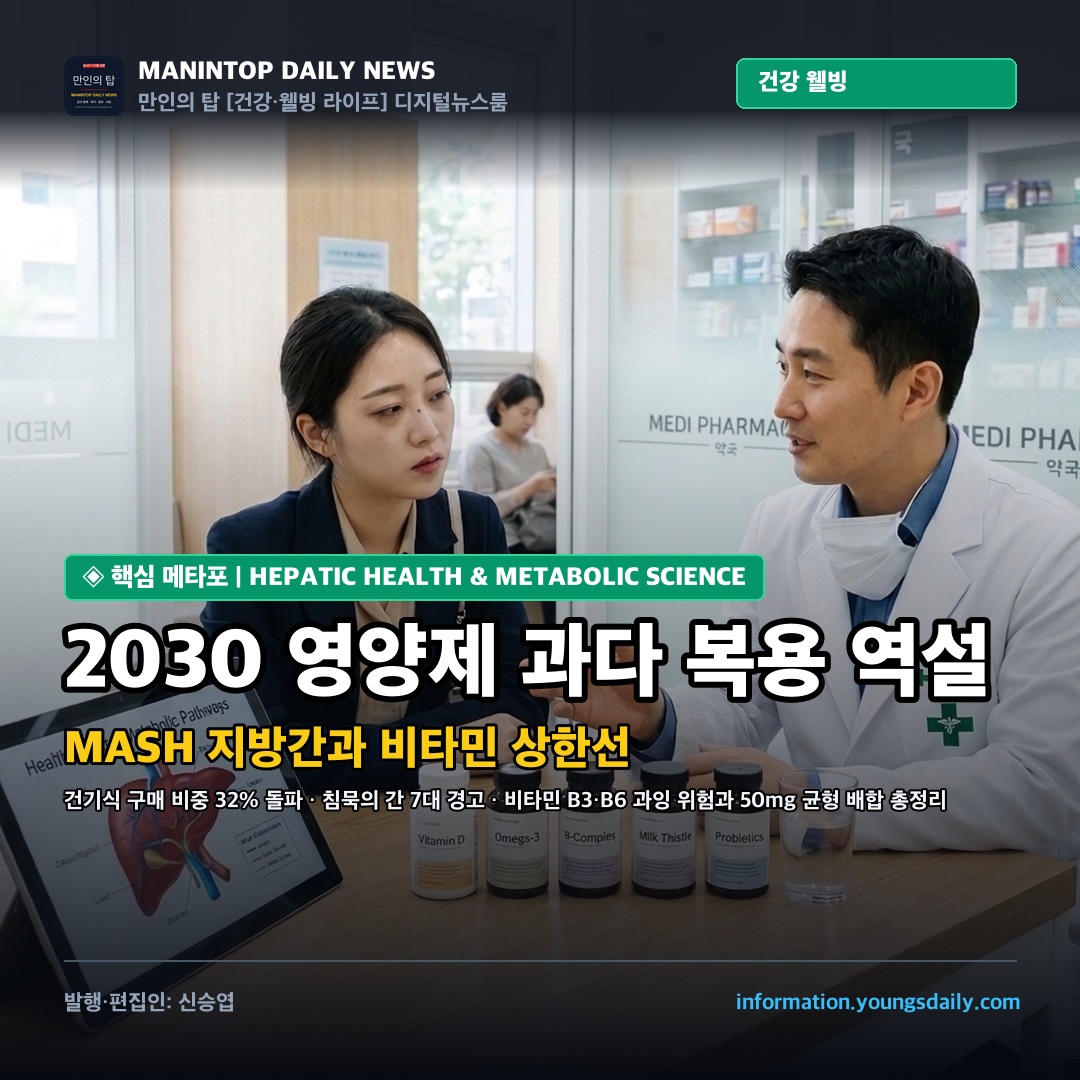
▲ 서울 시내 임상 약국에서 전문 약사가 만성 피로를 호소하는 젊은 직장인에게 비타민 B군과 밀크씨슬 등 여러 영양제를 무분별하게 중복 복용할 경우 간 효소계에 대사성 과부하가 발생할 수 있음을 상담하고 있다. 영양제 역시 간과 신장을 거쳐 대사되므로 전략적 선별 복용이 필수적이다. [사진: 만인의 탑 의학 DB]
1. 건강 챙기려다 간 망친다? 2030 영양제 '헤비 유저'의 대사 과부하 함정
최근 20대와 30대 직장인들의 책상 위를 살펴보면 비타민 B 복합제, 종합 비타민, 밀크씨슬, 오메가-3, 루테인, 마그네슘, 유산균 등 예닐곱 가지가 넘는 건강기능식품 통들이 빼곡히 들어차 있는 모습을 쉽게 볼 수 있습니다. 건강을 적극적으로 챙기며 피로를 극복하려는 젊은 세대의 열망이 반영된 현상입니다.
실제로 한국건강기능식품협회의 시장 분석 자료에 따르면, 전체 건강기능식품 구매자 중 2030 세대가 차지하는 비중은 32%로 전년 대비 무려 4%포인트나 급증했습니다. 청년층이 이제 건강기능식품 시장의 명실상부한 '큰손'으로 부상한 것입니다.
그러나 보건의료 현장에서는 심각한 우려의 목소리가 터져 나오고 있습니다. 많은 소비자들이 건강기능식품을 밥이나 과일처럼 부작용이 전혀 없는 안전한 식품으로 오인하고 있습니다. 하지만 의학적으로 영양제 속 고농축 정제 성분들은 입으로 들어가는 순간 간의 시토크롬 P450 효소계와 포합 효소를 거쳐 대사되고 신장을 통해 체외로 배설되는 엄연한 '약물적 대사 부담'을 지닙니다.
특히 성분이 중복되는 여러 영양제를 동시에 한꺼번에 털어 넣으면, 간세포 내의 해독 효소들이 포화 상태에 이릅니다. 이때 미처 처리되지 못한 독성 중간 대사산물이 간에 쌓이면서 간세포를 파괴하고 간 수치(AST, ALT)를 급격히 끌어올리는 '약인성 간 손상(DILI)'을 유발할 수 있습니다. 피로를 풀기 위해 마구잡이로 삼킨 영양제가 역설적으로 간을 혹사해 피로를 더욱 악화시키는 악순환이 발생하는 것입니다. 따라서 전문가들은 복용 중인 영양제 목록을 약사나 의사와 함께 점검하여 본인에게 꼭 필요한 2~3종으로 압축하는 '복용 목록 구조조정'이 시급하다고 조언합니다.
2. '침묵의 장기'가 보내는 조기 경고: 피로부터 뇌증 전조까지 7대 위험 신호
간은 인체에서 가장 큰 장기로서 단백질 합성, 당 대사, 영양소 저장, 알코올 및 유해 물질 해독 등 500가지 이상의 화학 공정을 묵묵히 수행합니다. 하지만 간 실질 세포 내부에는 통증을 감지하는 신경이 전혀 분포하지 않습니다. 이 때문에 간세포의 절반 이상이 파괴되거나 굳어질 때까지도 뚜렷한 통증을 느끼지 못해 '침묵의 장기'라는 별명이 붙었습니다.
하지만 간 기능이 한계에 도달하면 신체 곳곳에 미세한 경고음을 보냅니다. 이를 조기에 알아차리는 것이 만성 간염이나 간경변증으로의 악화를 막는 결정적 열쇠입니다.
여기에 더해 눈 흰자위(공막)가 노랗게 변하거나 소변 색깔이 콜라나 진한 홍차처럼 짙어지는 '황달'은 적혈구 분해 산물인 빌리루빈이 체내에 대량 축적되었음을 뜻하는 가장 위험한 응급 신호입니다. 위의 항목 중 3가지 이상이 복합적으로 나타난다면 지체 없이 병원을 찾아야 합니다.
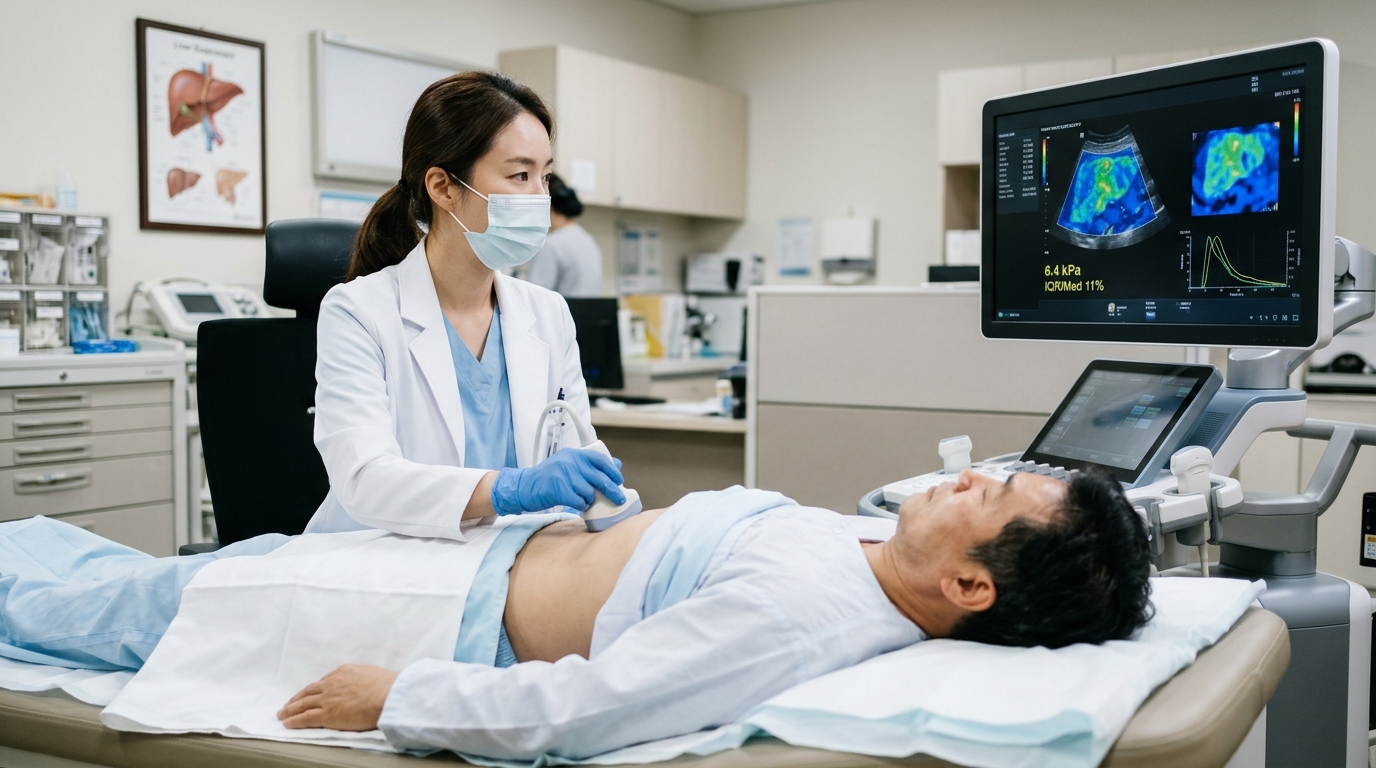
▲ 대학병원 소화기내과 검사실에서 전문의가 환자의 오른쪽 갈비뼈 부위에 초음파 탄성 탐촉자를 대고 간 섬유화 스캔(FibroScan)을 진행하고 있다. 모니터에 나타난 탄성도(kPa) 수치를 통해 바늘로 찌르는 생검 없이도 지방간이 간경변증으로 굳어지는 위험도를 정밀 측정할 수 있다. [사진: 만인의 탑 의학 DB]
3. 술 안 마셔도 간이 굳는다: 'NAFLD'에서 'MASLD·MASH'로 바뀐 이유
많은 사람들이 "나는 술을 한 방울도 입에 대지 않으니 간 질환과는 상관없다"고 방심합니다. 하지만 최근 병원을 찾는 지방간 환자의 대다수는 알코올이 아닌 탄수화물과 설탕, 비만 때문에 간이 망가진 환자들입니다.
이러한 의학적 현실을 반영해 미국간재단(ALF)과 유럽간학회 등 전 세계 학술기구는 지방간의 공식 명칭을 전면 개정했습니다. 과거 '비알코올성 지방간 질환'으로 불리던 NAFLD(Non-Alcoholic Fatty Liver Disease)는 '대사 기능 장애 관련 지방간 질환'을 뜻하는 MASLD(Metabolic dysfunction-Associated Steatotic Liver Disease)로 이름이 바뀌었습니다. 마찬가지로 단순 염증을 넘어 세포 손상이 동반되는 NASH는 MASH(대사 기능 장애 관련 지방간염)로 공식 개정되었습니다.
명칭 변경의 핵심은 지방간이 간 하나만의 문제가 아니라 당뇨병, 고지혈증, 복부 비만, 고혈압 등 '대사증후군'과 맞물린 전신 질환임을 명확히 한 것입니다. 정상 간의 경우 지방이 차지하는 비율이 5% 미만이지만, 탄산음료 속 액상과당, 흰쌀밥, 빵, 떡 등 정제 탄수화물을 과잉 섭취하면 여분의 당분이 간에서 중성지방으로 급격히 전환되어 간세포에 쌓입니다.
대중에게 친숙한 프랑스 고급 요리 '푸아그라(foie gras)'를 떠올리면 이해가 쉽습니다. 푸아그라는 거위나 오리에게 억지로 과량의 옥수수 곡물을 먹여 간세포에 지방을 가득 채운 것으로, 병리학적으로는 완벽한 조류의 지방간 상태입니다. 사람 역시 과도한 탄수화물과 액상과당을 지속적으로 섭취하면 체내에서 정확히 똑같은 기전으로 간이 기름에 절게 됩니다. 초기에는 지방 방울이 작게 맺히는 미세수포성이지만, 방치하면 지방 방울이 뭉쳐 커지면서 간세포 핵을 구석으로 밀어내고 염증과 섬유화를 일으킵니다. 다행히 지방간은 식습관 개선을 통해 원상 복구가 가능한 '가역적 질환'이지만, 치료 시기를 놓쳐 간이 돌처럼 굳어지는 간경변증이나 간암으로 넘어가면 돌이킬 수 없는 비가역적 파국을 맞게 됩니다.
4. 혈액검사부터 MRE 탄성도 지도까지: 단계별 4대 임상 진단 경로
초기 지방간과 MASH는 증상이 거의 없기 때문에 건강검진에서 우연히 발견되는 경우가 대부분입니다. 의료기관에서는 간 손상과 흉터(섬유화)의 정도를 정확히 진단하기 위해 4단계 검사를 순차적으로 진행합니다.

▲ 햇살이 비치는 주방에 마련된 간 대사 회복 식단. 기름에 튀기는 대신 에어프라이어와 찜 방식으로 조리한 살코기와 생선, 간 해독 효소를 돕는 양배추·브로콜리 등 신선한 채소와 깨끗한 물 한 잔이 간 건강을 지키는 가장 강력한 처방이다. [사진: 만인의 탑 의학 DB]
5. 피로회복제 비타민 B의 배신? 상한 섭취량 팩트와 최적 균형 배합
피로 회복을 위해 가장 널리 찾는 영양소는 단연 비타민 B군입니다. 비타민 B군은 B1(티아민), B2(리보플라빈), B3(니아신), B5(판토텐산), B6(피리독신), B7(비오틴), B9(엽산), B12(시아노코발라민) 등 8종의 복합체로 구성되어 탄수화물, 단백질, 지방을 에너지로 태우고 피로 물질인 젖산의 축적을 막는 핵심 조효소입니다.
시중에는 "비타민 B는 수용성이라 많이 먹어도 소변으로 다 빠져나가 안전하니 무조건 고함량이 최고"라는 마케팅이 만연해 있습니다. 하지만 이는 의학적으로 매우 위험한 착각입니다. 몸에 해가 나타나지 않는 최대치인 '상한 섭취량(UL)'을 넘기면 심각한 부작용이 발생합니다.
| 영양 성분 | 인체 생리 기능 및 대사 기전 | 상한 섭취량(UL) 및 과다 복용 시 임상 위험 |
|---|---|---|
| 비타민 B3 (니아신) | 에너지 대사 핵심 조효소 작용 | 상한 35mgNE. 50mgNE 이상 복용 시 모세혈관 급격 확장으로 안면 홍조, 피부 가려움, 따가움, 급격한 저혈압 유발 |
| 비타민 B6 (피리독신) | 아미노산 대사 및 신경전달물질 합성 | 고함량 장기 복용 시 역설적 간 수치 상승. 임상종양학 저널(JCO) 발표에 따르면 과다 섭취 흡연자에서 폐암 발병 위험 증가 보고 |
| 비타민 B12 (코발라민) | 적혈구 생성 및 신경세포 수초 보호 | 초고함량 섭취 시 장내 능동 수송 포화로 체내 실제 흡수율이 1% 수준으로 급감하여 고용량 실효성 상실 |
| 비타민 B2 (리보플라빈) | 세포 내 산화환원 반응 및 점막 재생 | 1회 섭취량 27mg 초과 시 더 이상 흡수되지 않고 형광 노란색 소변으로 전량 배설 |
| 밀크씨슬 (실리마린) | 간세포막 보호, 항산화, 간세포 재생 | 식약처 간 기능성 원료 인정. 임상에서 ALT/AST 강하 확인. 씨앗 재배부터 가공까지 국제 GACP 인증 원료 선택 권장 |
| UDCA (우루소데옥시콜린산) | 간 내 담즙 분비 촉진 및 노폐물 배출 | 간 혈류량 증가 및 대사 찌꺼기 배출을 돕는 전문 간장약 성분. 비타민 B군과 상호 보완 시너지 발휘 |
따라서 비타민 B군은 어느 한 성분만 100mg, 200mg씩 과도하게 들어간 제품보다는 대사 조효소의 시너지를 극대화할 수 있는 균형 배합을 골라야 합니다. 영양학계에서는 비타민 B1, B2, B6가 상호 균형을 이루는 '50mg:50mg:50mg' 균등 배합비를 가장 이상적인 표준으로 제시합니다. 여기에 간세포막을 보호하는 밀크씨슬(실리마린)이나 담즙 배출을 돕는 UDCA, 글루타치온 전구체인 NAC(N-아세틸시스테인)를 목적에 맞게 병용하는 것이 과학적인 간 보호 전략입니다.
6. 일상 속 간 대사 회복 솔루션: 에어프라이어 조리부터 금주 처방까지
영양제를 아무리 잘 챙겨 먹더라도 매일 기름진 야식을 먹고 술을 마신다면 밑 빠진 독에 물 붓기입니다. 간 기능을 근본적으로 회복시키는 4대 생활습관 처방을 실천해야 합니다.
첫째, 조리 방식을 과감히 전환해야 합니다. 기름에 바짝 튀기거나 볶는 고지방 조리법은 간세포에 중성지방 폭탄을 던지는 것과 같습니다. 기름을 쓰지 않고 고온의 공기 순환으로 조리하는 에어프라이어를 적극 활용하거나, 찜기에 찌고 데치는 조리법으로 바꾸기만 해도 체내 지질 유입을 절반 이하로 줄일 수 있습니다.
둘째, 간 해독 효소를 깨우는 밥상을 차려야 합니다. 간의 해독 대사를 촉진하는 브로콜리, 양배추 등 십자화과 채소와 부추, 마늘을 주 2회 이상 식단에 배치하십시오. 특히 탄산음료나 과일주스에 다량 함유된 '액상과당'은 장에서 흡수되자마자 간으로 직행해 지방간을 유발하는 최대 주범이므로 반드시 끊어야 합니다.
셋째, 매일 20분 이상의 규칙적인 유산소 운동입니다. 숨이 약간 찰 정도의 빠른 걷기, 자전거 타기, 수영, 가벼운 조깅은 골격근의 인슐린 감수성을 개선하여 간으로 흘러 들어가는 유리지방산을 차단하고 간에 축적된 중성지방을 태웁니다.
넷째, 완전한 금주와 7시간 이상의 숙면입니다. 알코올은 간의 지방 분해 능력을 마비시키므로 지방간 진단을 받았다면 단 한 잔의 술도 피하는 것이 원칙입니다. 또한 사람이 잠을 자는 동안 간으로 공급되는 혈류량이 평소보다 급격히 증가하여 손상된 간세포의 단백질 합성과 재생이 활발해지므로 매일 밤 규칙적인 수면을 취해야 합니다.
2030 Poly-Supplement Paradox and MASH Fatty Liver: Vitamin B Tolerable Upper Limits and 7 Liver Detox Rules
▲ A clinical pharmacist in Seoul advises a young office worker on the metabolic burden placed on hepatic enzyme systems when taking multiple dietary supplements simultaneously. Dietary supplements are metabolized through hepatic cytochrome pathways and require targeted selection. [Photo: MANINTOP Medical DB]
1. The Young Adults' Supplement Paradox: Heavy Poly-Supplementation and Drug-Induced Liver Injury
Across modern office spaces, desks are increasingly populated by rows of dietary supplements: B-complex vitamins, multivitamins, milk thistle, omega-3 fatty acids, lutein, and magnesium. While this trend illustrates proactive wellness management among young adults, clinical practitioners are raising urgent alarms regarding drug-induced liver injury (DILI).
According to recent market analyses from the Korea Health Supplements Association, young adults in their twenties and thirties now account for 32% of all health supplement purchases, representing a four-percentage-point increase year-over-year. Young consumers have firmly established themselves as key market drivers.
However, consumer perceptions often conflate supplements with ordinary benign foods. In reality, concentrated active botanical extracts and synthetic vitamins undergo extensive hepatic metabolism through cytochrome P450 enzyme cascades and renal excretion. Ingesting multiple overlapping formulations saturates phase-one and phase-two detoxification pathways, precipitating toxic intermediate accumulation, hepatocyte necrosis, and elevated serum transaminases (AST and ALT). Clinical experts advise patients to review daily supplement regimens with healthcare professionals and streamline intake to essential, evidence-backed formulations.
2. Early Warnings from the Silent Organ: Seven Clinical Signs from Fatigue to Subclinical Encephalopathy
The liver performs over five hundred vital physiological functions, including protein biosynthesis, glycogen storage, and toxin clearance. Because hepatic parenchyma lacks sensory innervation, significant tissue injury can accumulate without generating localized pain, earning the liver its designation as the silent organ.
Nevertheless, failing hepatic capacity manifests through distinctive clinical warning signs that demand prompt medical evaluation:
Furthermore, scleral icterus (yellowing of the eyes) and dark cola-colored urine indicate severe hyperbilirubinemia, signifying advanced hepatic decompensation. Experiencing three or more concurrent symptoms mandates immediate clinical evaluation.
▲ A hepatologist conducts a non-invasive liver elastography examination (FibroScan) in a university hospital gastroenterology suite. Color-coded shear-wave stiffness metrics (kPa) reliably measure hepatic fibrosis without requiring invasive needle biopsy. [Photo: MANINTOP Medical DB]
3. Beyond Alcohol: The Paradigm Shift from NAFLD to MASLD and MASH
A common misconception equates liver pathology strictly with heavy ethanol consumption. Today, the majority of steatotic liver cases arise independently of alcohol, driven by refined carbohydrates, high-fructose corn syrup, and visceral obesity.
Reflecting this epidemiological shift, international societies: including the American Liver Foundation and the European Association for the Study of the Liver: have enacted global diagnostic revisions. Non-Alcoholic Fatty Liver Disease (NAFLD) has been officially renamed Metabolic dysfunction-Associated Steatotic Liver Disease (MASLD). Concurrently, inflammatory NASH is now classified as Metabolic dysfunction-Associated Steatohepatitis (MASH).
This nomenclature highlights that hepatic lipid accumulation serves as a hepatic manifestation of systemic metabolic syndrome alongside type 2 diabetes, dyslipidemia, and arterial hypertension. While healthy liver tissue contains under 5% fat by weight, continuous high-glycemic intake accelerates de novo lipogenesis.
A vivid culinary analogy exists in traditional French foie gras, where ducks or geese are force-fed excessive grain to induce massive hepatic lipid storage: a pure avian equivalent of metabolic steatosis. In humans, excessive carbohydrates cause identical lipid accumulation. Initial microvesicular droplets coalesce into macrovesicular deposits that displace cellular nuclei, provoking lipid peroxidation, cytokine cascades, and progressive fibrosis. Fortunately, steatosis remains fully reversible through timely lifestyle modifications, whereas untreated fibrotic remodeling risks irreversible cirrhosis and hepatocellular carcinoma.
4. Four-Stage Diagnostic Algorithm: From Serum Biomarkers to Advanced MRE Mapping
Because MASLD and MASH progress silently, clinical detection relies on structured diagnostic pathways:
▲ A wholesome kitchen setup designed for hepatic metabolic recovery. Shifting from frying to air-frying or steaming, incorporating cruciferous vegetables such as broccoli and cabbage, and eliminating high-fructose corn syrup provides fundamental protection against metabolic steatohepatitis. [Photo: MANINTOP Medical DB]
5. Vitamin B Tolerable Upper Limits: Dispelling High-Dose Myths Through Balanced Formulations
Vitamin B complexes are widely sought as primary counter-fatigue supplements. The group encompasses eight water-soluble vitamins: B1 (thiamine), B2 (riboflavin), B3 (niacin), B5 (pantothenic acid), B6 (pyridoxine), B7 (biotin), B9 (folate), and B12 (cobalamin): that function interdependently as metabolic coenzymes.
A widespread commercial misconception asserts that water-soluble vitamins carry zero toxicological risk regardless of dose. However, exceeding established Tolerable Upper Intake Levels (UL) can provoke significant adverse clinical events.
| Nutrient | Biochemical Function | Tolerable Upper Limit (UL) & Clinical Overdose Risk |
|---|---|---|
| Vitamin B3 (Niacin) | NAD/NADP cellular respiration coenzyme | Upper limit 35 mg NE. Dosages exceeding 50 mg NE induce prostaglandin-mediated cutaneous flushing, intense pruritus, and precipitous hypotension. |
| Vitamin B6 (Pyridoxine) | Amino acid metabolism and neurotransmitter synthesis | Chronic high doses can paradoxically elevate liver enzymes. Large prospective studies in the Journal of Clinical Oncology link excessive supplementation to heightened lung cancer vulnerability among smokers. |
| Vitamin B12 (Cobalamin) | Erythropoiesis and neuronal myelin maintenance | Active ileal transport saturates rapidly; absorption efficiency plummets to roughly 1% at mega-doses, nullifying extreme dosage claims. |
| Vitamin B2 (Riboflavin) | Cellular redox coenzyme and mucosal integrity | Single doses exceeding 27 mg cannot be absorbed and undergo immediate urinary excretion. |
| Milk Thistle (Silymarin) | Membrane stabilization, antioxidant defense, regeneration | Validated in clinical trials to lower elevated AST/ALT. Verifying international GACP certification ensures botanical purity and standardized silybin content. |
| UDCA (Ursodeoxycholic Acid) | Hydrophilic bile acid, choleretic detoxification | Enhances hepatic microcirculation and flushes biliary sludge, operating synergistically with B vitamins. |
Consequently, evidence-based nutritional protocols favor balanced formulations over mega-doses. An equimolar 50 mg:50 mg:50 mg balance of vitamins B1, B2, and B6 optimizes coenzyme synergy without overwhelming metabolic clearance pathways. Pairing this core with GACP-certified silymarin, pharmaceutical UDCA, or N-acetylcysteine (NAC) delivers comprehensive hepatoprotective support.
6. Daily Hepatic Recovery Protocols: From Air-Fryer Cooking to Total Abstinence
Pharmacological and botanical interventions cannot compensate for ongoing dietary indiscretion. Four evidence-based lifestyle interventions establish the foundation for metabolic recovery:
First, revolutionize culinary preparation techniques. Deep frying generates harmful lipid peroxides that burden hepatic metabolism. Adopting air-frying or steaming eliminates added fats while preserving nutritional density, dramatically reducing hepatic lipid influx.
Second, incorporate hepatoprotective functional foods. Cruciferous vegetables like broccoli and cabbage contain glucosinolates that induce phase-two detoxification enzymes. Crucially, completely eliminate high-fructose corn syrup in sweetened beverages, as liquid fructose is channeled directly into hepatic lipogenesis.
Third, maintain twenty minutes of daily moderate aerobic exercise. Brisk walking, cycling, or swimming enhances peripheral skeletal muscle insulin sensitivity, curbing free fatty acid mobilization to the liver and burning intrahepatic triglyceride depots.
Fourth, enforce total alcohol abstinence and secure seven hours of restorative sleep. Ethanol acutely suppresses fatty acid oxidation; thus, patients with steatosis must abstain completely. During sleep, hepatic blood perfusion peaks, facilitating structural protein synthesis and hepatocyte repair.
내가 찾는 상품 키워드, 지금 얼마나 검색될까?
네이버 월간 검색량 + 구글 볼륨 + 아이템스카우트 실시간 상품수와 경쟁강도 배지를 0.5초 만에 무료로 확인하세요.