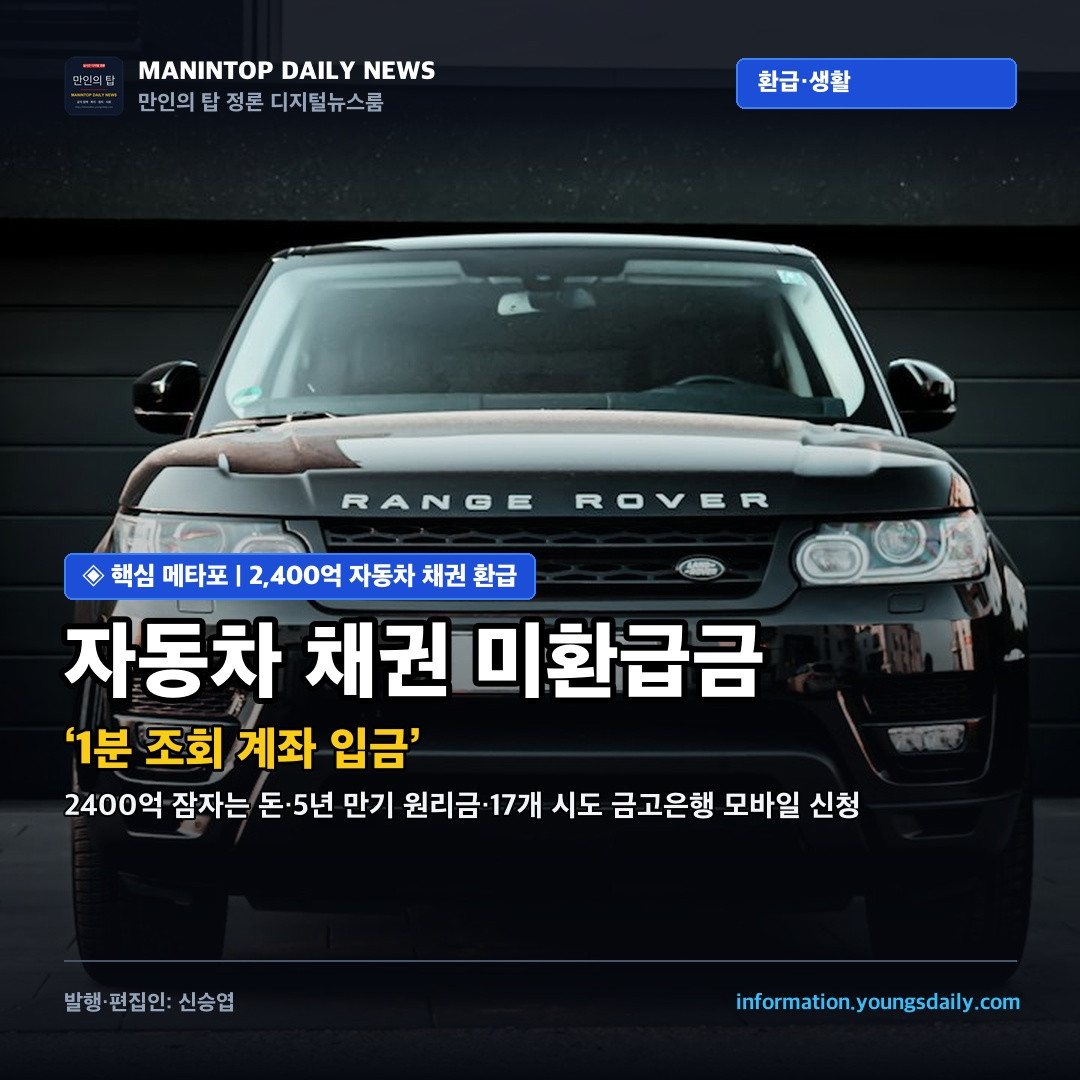
“차 샀다면 수십만 원 잠자고 있다”… 2,400억 자동차 채권 미환급금 1분 조회와 계좌 입금법
만인의 탑 편집국11월 04, 2026
▲ “차 샀다면 수십만 원 잠자고 있다”… 2,400억 자동차 채권 미환급금 1분 조회와 계좌 입금법 (공식 보도 자료)
📌 핵심 브리핑 · 주요 쟁점 및 핵심 요약
차 샀다면 수십만 원 잠자고 있다는 사실을 모른 채 만기를 넘겨 금융기관에 방치된 자동차 채권 미환급금이 전국적으로 2,400억 원에 달하는 것으로 나타났습니다. 국민이 신차를 출고하거나 중고차를 이전 등록할 때 조례에 따라 의무적으로 매입하는 지역개발채권과 도시철도채권은 5년에서 7년의 만기 거치 기간이 지나면 원금에 복리 이자가 더해져 차주에게 환급됩니다. 그러나 긴 거치 기간 탓에 매입 사실 자체를 잊어버리거나 과거 은행 창구를 직접 찾아가야 했던 번거로움 때문에 권리 행사를 포기하면서, 매년 약 20억 원의 채권이 소멸시효 경과로 지자체 금고에 자동 귀속되어 사라지고 있습니다. 본 심층 탐사 가이드에서는 공채 즉시매도와 만기 직접매입의 환급 권리 차이점, 서울·경기·인천·부산 등 전국 17개 시도별 전담 금고은행 매핑, 모바일 뱅킹을 통한 1분 비대면 계좌 환급 4단계 프로세스, 그리고 차량을 매각·폐차한 경우의 수령권 및 원금 10년·이자 5년 소멸시효 방어법을 총정리합니다.
SPONSORED · ADVERTISEMENT
1. 2,400억 원대 잠자는 자동차 채권 미환급금의 현주소와 소멸 실태
국민이 자동차를 구매하고 지방자치단체에 등록하는 과정에서 의무적으로 매입하는 지방채권(지역개발채권 및 도시철도채권) 중, 만기가 지났음에도 권리자가 찾아가지 않아 금융기관에 방치된 미환급금이 수천억 원 규모에 이르는 것으로 나타났습니다. 행정안전부 및 지방자치단체 공식 집계에 따르면 전국 미환급 채권 잔액은 2,391억 원에 달하며, 권리자가 상환 청구를 하지 않아 소멸시효가 경과함에 따라 연간 약 20억 원의 채권 원리금이 지자체 지역개발기금으로 자동 귀속되어 사라지고 있습니다.
지자체별 사례를 보면 인천광역시의 경우 미환급 채권액이 43억 원에 달하며, 한 해에만 만기가 도래하는 지역개발채권 규모가 140억 원을 넘어섭니다. 서울과 경기 등 차량 등록 대수가 압도적인 수도권 지역 역시 수백억 원대의 채권이 환급 주인을 찾지 못한 채 금융기관 전산에 잠들어 있습니다.
이러한 대규모 미환급금 발생의 주요 원인은 채권의 긴 만기 구조(5년~7년)와 과거의 복잡한 대면 상환 절차에 기인합니다. 차주가 차량 구입 당시 채권을 매입했다는 사실 자체를 망각하거나, 상환을 받기 위해 평일 낮 은행 영업점을 직접 방문해야 했던 번거로움 때문에 권리 행사를 미루다 시효를 넘기는 사례가 누적되어 왔습니다.
▲ 신차 및 중고차 등록 당시 의무 매입했던 지역개발채권과 도시철도채권의 만기 도래 여부를 확인하는 자동차 운전자 (보도 자료)
2. 자동차 채권의 매입 구조와 환급 발생 조건: 즉시매도 vs 직접보유
자동차 채권은 지방자치단체가 지역 내 도로 건설, 지하철 확충, 지방상수도 정비 등 사회간접자본(SOC) 개발 사업 자금을 조달하기 위해 주민복리 증진을 목적으로 발행하는 의무매출채권입니다. 자동차 신규 등록 및 이전 등록(중고차 매매), 각종 인허가 추진 시 법령과 조례에 따라 의무적으로 매입해야 합니다.
차량 구매 시 차주가 선택할 수 있는 채권 처리 방식은 '할인매입(즉시매도)'과 '만기환급(직접매입)' 두 가지로 명확히 구분됩니다. 대다수의 운전자는 신차 출고 시 목돈 부담을 줄이기 위해 공채 할인 수수료만 지불하고 채권을 즉시 은행에 되파는 '할인매입'을 선택합니다. 전체 차주의 약 70%~86%(경기 70%, 창원 84%, 인천 86%)가 이 방식을 택하며, 이 경우에는 채권 소유권이 매각되었으므로 환급금이 발생하지 않습니다.
반면, 초기 차량 등록 시 채권 발행 액면가 전액을 지불하고 채권을 직접 보유한 차주(전체의 약 14%~30%)에게는 5년 또는 7년의 만기 거치 기간이 경과한 후 원금과 복리 이자가 더해진 환급금이 100% 지급됩니다. 2,000만 원 상당의 차량을 구매할 경우 지자체에 따라 수십만 원에서 최대 240만 원 상당의 채권을 매입하게 되므로, 직접 보유한 차주라면 만기 시 상당한 금액의 현금을 돌려받을 수 있습니다. 한편 1,000cc 이하 경차와 친환경 전기차는 의무 매입이 면제되어 있습니다.
구분 유형
지원 및 적용 대상
환급 및 해결 기준
신청 및 조치 방법
서울특별시
도시철도채권
신한은행
원금 5년 / 이자 5년 소멸시효
경기도
지역개발채권 / 도시철도채권
NH농협은행
원금 10년 / 이자 5년 소멸시효
인천광역시
지역개발채권
신한은행, NH농협은행
2016년 이후 2,000cc 미만 면제
부산광역시
지역개발채권
부산은행
만기 5년 거치 후 원리금 상환
대전·세종·충청
지역개발채권
하나은행
모바일 하나원큐 1분 즉시 환급
대구광역시
지역개발채권
iM뱅크 (대구은행)
영업점 방문 없이 계좌 입금
SPONSORED · ADVERTISEMENT
3. 전국 17개 시도별 전담 금고은행 체계와 조회 기준
자동차 채권은 지자체 조례에 따라 매입 기준 비율과 발행 채권의 종류가 다르며, 채권 관리 및 환급 업무를 담당하는 금고은행 역시 등록 지자체별로 지정되어 있습니다. 환급금을 조회하고 신청할 수 있는 관할 금융기관은 차주의 현재 거주지가 아닌 '최초 차량 등록지 지자체'를 기준으로 엄격히 결정됩니다.
서울특별시는 도시철도채권을 발행하며 신한은행이 단독 환급 금고를 담당합니다. 인천광역시는 신한은행과 NH농협은행, 경기도는 NH농협은행이 전담합니다. 부산광역시는 부산은행, 대구광역시는 iM뱅크(대구은행), 대전·세종·충청권은 하나은행, 광주·전남권은 광주은행, 전북은 전북은행이 각각 전담 금고은행으로 지정되어 있습니다. 강원·경남·경북·울산·제주는 NH농협은행이 담당합니다.
따라서 현재 서울에 거주하더라도 과거 경기도에서 차량을 등록했다면 신한은행이 아닌 NH농협은행 모바일 앱에서 조회해야 환급 내역이 표출됩니다. 개별 은행 조회가 번거로운 경우 행정안전부 '정부24'의 '미환급금 찾기' 서비스를 통하면 전국 지자체의 미환급 채권을 통합 조회할 수 있습니다.
▲ 스마트폰 모바일 뱅킹 앱을 통해 지자체 금고은행의 미환급 채권을 비대면 조회하고 본인 계좌로 환급을 신청하는 모습 (보도 자료)
4. 모바일 1분 비대면 환급 절차와 소멸시효 방어 팩트체크
🚨 신청 기한 및 주의사항 경고
행정안전부는 2022년 3월부터 비대면 온라인 환급 시스템을 전면 가동하여 은행 방문 없이 스마트폰으로 즉시 환급받을 수 있는 환경을 구축했습니다. 모바일 뱅킹 앱에 접속하여 [공과금] 메뉴 내 [지역개발채권] 또는 [미상환 채권 조회/상환]을 선택하고 본인인증을 진행하면 미환급 원리금이 즉시 화면에 나타납니다. 본인 명의 계좌번호를 입력하면 수수료 없이 즉시 또는 1~2영업일 내에 전액 입금됩니다. 2022년 3월 이후 신규 등록 차량은 사전 환급계좌 등록제가 시행되어 만기 시 자동으로 입금됩니다.
가장 중요한 법적 쟁점은 소멸시효입니다. 지역개발채권은 만기 상환일로부터 원금 10년, 이자 5년의 소멸시효가 적용되며, 도시철도채권은 원금 5년, 이자 5년이 지나면 청구권이 박탈되어 전액 지자체 기금으로 국고 귀속됩니다. 따라서 만기 후 5년이 지나면 이자가 먼저 소멸하므로 즉각적인 조회가 필수적입니다.
또한 차량을 이미 중고차로 매각했거나 폐차한 경우라도 환급금을 전액 수령할 수 있습니다. 채권 청구권은 자동차 자체가 아닌 최초 등록 당시 채권을 매입한 '명의자 본인'에게 귀속되기 때문입니다. 실물 채권증서를 분실했더라도 전산 데이터로 전액 입증되므로 신분증과 본인인증만으로 무리 없이 환급받을 수 있습니다.
“Hundreds of Thousands of Won Sleeping for Car Buyers”: How to Reclaim Unclaimed Automobile Bonds and Expiring Interest in One Minute
Hundreds of thousands of won sleeping for car buyers remains an unclaimed reality across South Korea, where dormant automotive bond surpluses languish at financial institutions, totaling approximately 240 billion won. When citizens register newly purchased vehicles or transfer ownership of pre-owned automobiles, local ordinances mandate the statutory acquisition of regional development bonds and subway construction bonds, which mature over five to seven years to yield compounded interest alongside the original principal. However, due to extended holding horizons, car owners frequently forget the bond transaction altogether, while legacy requirements compelling physical branch visits led many to abandon claims, allowing roughly two billion won annually to extinguish under statutes of limitations and revert permanently into municipal treasuries. This investigative analysis examines structural entitlement differences between immediate discount sales and direct holding, maps designated primary depository banks across all seventeen metropolitan provinces, outlines a four-step digital refund protocol via mobile banking, and provides essential statutory guidance regarding reclaimed ownership on sold or scrapped vehicles alongside strict limitation thresholds.
📌 Key Takeaways
Dormant 240-Billion-Won Bond Surpluses: Hundreds of thousands of automobile purchasers fail to reclaim statutory regional development and urban rail bonds following 5- to 7-year maturities.
Municipal Primary Depository Mapping: Claims must be audited via the designated depository bank of the initial vehicle registration jurisdiction rather than current residential addresses.
One-Minute Digital Claims and Limitation Defense: File fee-free direct wire reimbursements via Government24 or banking portals prior to the statutory extinction of 5-year interest and 10-year principal claims.
1. Dormant Wealth: Auditing the 240-Billion-Won Automobile Bond Surplus
When citizens purchase and register motor vehicles across South Korean municipalities, statutory regulations mandate the compulsory purchase of public debt instruments—specifically Regional Development Bonds and Subway Construction Bonds. Regulatory audits conducted by the Ministry of the Interior and Safety reveal that unclaimed mature bonds held in escrow at financial institutions exceed 239.1 billion won nationwide. Because rightful creditors fail to demand redemption, approximately two billion won in matured bond balances lapse under statutory limitations each year, extinguishing permanently into regional municipal development funds.
In Incheon Metropolitan City, unclaimed bond balances surpassed 4.3 billion won, with annual maturing tranches exceeding 14 billion won. Massive urban centers such as Seoul and Gyeonggi Province mirror these conditions, holding tens of billions of won in unclaimed principal and compounded interest.
The primary structural cause behind this dormant capital lies in elongated maturity horizons spanning five to seven years, compounded by antiquated legacy protocols requiring physical branch visits during standard banking hours. Overwhelmed by procedural friction, vehicle owners consistently overlooked bond assets, allowing statutory deadlines to lapse.
▲ Official Press Archive & Contextual Documentation
2. Bond Acquisition Framework: Discount Liquidation versus Direct Holding
Automobile bonds function as statutory revenue mechanisms leveraged by local governments to finance public infrastructure projects including municipal highway construction, metropolitan subway expansion, and clean water delivery systems. Motorists registering newly acquired or secondhand vehicles are legally required to purchase bonds pegged to fiscal valuation metrics.
Vehicle buyers elect between two distinct transactional paths: 'Discount Liquidation' (immediate sale) and 'Direct Holding' (maturity redemption). The vast majority of vehicle buyers—between 70% and 86% across major jurisdictions—select immediate discounting to minimize upfront out-of-pocket acquisition costs, immediately relinquishing bond ownership in exchange for a nominal fee. These motorists possess zero refund claims.
Conversely, the roughly 14% to 30% minority of car owners who directly paid the full face value of the bond retain absolute legal title. Upon completing the five- or seven-year maturity incubation period, direct bondholders are entitled to 100% principal restitution alongside accrued compound interest. Depending on engine displacement and jurisdiction, direct bond purchases range from several hundred thousand won to 2.4 million won, delivering substantial cash windfalls upon maturity. Electric vehicles and compact cars under 1,000cc are legally exempt.
Category
Target Scope
Standard / Benefit
Procedure / Action
Seoul Special City
Urban Railway Bonds
Shinhan Bank
Principal 5 years / Interest 5 years statute of limitations
Gyeonggi Province
Regional Development Bonds / Urban Railway Bonds
NH Nonghyup Bank
Principal 10 years / Interest 5 years statute of limitations
Incheon Metropolitan City
Regional Development Bonds
Shinhan Bank, NH Nonghyup Bank
Exemption for vehicles under 2,000cc since 2016
Busan Metropolitan City
Regional Development Bonds
Busan Bank
Repayment of principal and interest after a 5-year grace period
Daejeon, Sejong, and Chungcheong
Regional Development Bonds
Hana Bank
Instant refund within 1 minute via Mobile Hana OneQ
Daegu Metropolitan City
Regional Development Bonds
iM Bank (Daegu Bank)
Account deposits without visiting a branch
3. Primary Depository Depository Mapping Across 17 Municipalities
Because municipal ordinances define bond parameters independently, bond administration and redemption workflows are executed by designated primary depository banks according to jurisdiction. Crucially, audit eligibility is determined strictly by the 'Original Vehicle Registration Municipality' rather than the claimant's current residential address.
Seoul Metropolitan City issues Subway Construction Bonds serviced exclusively through Shinhan Bank. Incheon designates Shinhan Bank and NH Nonghyup Bank, while Gyeonggi Province assigns NH Nonghyup Bank as sole custodian. Busan operates through Busan Bank, Daegu through iM Bank, Daejeon and the Chungcheong provinces through Hana Bank, Gwangju and Jeonnam through Kwangju Bank, and Jeonbuk through Jeonbuk Bank. Gangwon, Gyeongnam, Gyeongbuk, Ulsan, and Jeju are managed via NH Nonghyup Bank.
Consequently, a Seoul resident whose vehicle was historically registered in Gyeonggi Province must access NH Nonghyup mobile banking rather than Shinhan Bank to audit mature surpluses. Motorists seeking comprehensive multi-regional audits can alternatively leverage the Government24 centralized clearinghouse portal.
▲ Institutional Field Data & Media Archive
4. One-Minute Digital Refunds and Statute of Limitations Defense
In March 2022, the Ministry of the Interior and Safety operationalized nationwide digital redemption protocols, eliminating physical branch visits. By logging into authorized mobile banking applications, navigating to Utility Payments > Regional Development Bonds > Mature Bond Audit, and completing digital identity verification, motorists can view mature surpluses instantaneously. Inputting verified account credentials releases funds immediately or within one to two business days without administrative wire fees. Vehicles registered after March 2022 benefit from automated direct-deposit protocols configured during registration.
The paramount legal risk centers on statutory limitation periods. Regional Development Bonds operate under strict limitation ceilings: 10 years for principal and 5 years for accrued interest post-maturity. Subway Construction Bonds enforce an uncompromising 5-year cutoff for both principal and interest. Once the 5-year threshold expires, accumulated interest vanishes into government revenue ledgers, mandating immediate audit initiatives.
Furthermore, motorists who have subsequently resold or scrapped their vehicles retain full restitution rights. Bond ownership rights attach to the legal individual who originally registered the vehicle rather than the physical chassis. Lost physical bond certificates present zero hindrance, as transactions are digitally reconciled across municipal databases.
Recommended Deep-Dive Investigations TOP 3
GLOBAL REPORT
1월이 시작되면 감기는 이미 우리 곁에 와 있습니다. 2월, 3월, 4월까지 이어지는 추위와 건조함은 코와 목을 가장 먼저 공격합니다. 아침에 일어나자마자 막혀 있는 코. 계속 흐르는 콧물. 괜히 칼칼해지는 목. 이 증상은 “시작”일 뿐입니다. 한 번 무너지면 일주일, 길면 한 달까지 끌고 갑니다. 약을 먹으면 잠깐 괜찮아집니다. 하지만 며칠 뒤 또 반복됩니다. 왜일까요? 감기는 ‘치료’의 문제가 아니라 ‘관리’의 문제이기 때문입니다. 대부분은 감기가 오고 나서 약을 찾습니다. 하지만 진짜 중요한 건 감기가 오기 전에 코와 목을 지키는 것입니다. 건조한 실내 공기, 차가운 바깥 공기, 눈에 보이지 않는 세균. 코와 목은 매일 공격받고 있습니다. 지긋지긋하죠! 그런데도 우리는 아무 준비 없이 버티고 있습니다. 이번 겨울도 그렇게 보낼 건가요? 사실 방법은 어렵지 않습니다. 코를 깨끗하게 관리하고, 목을 따뜻하게 보호하고, 점막을 촉촉하게 유지하고, 기관지를 미리 관리하고, 외부 공기를 차단하는 것. 이 다섯 가지만 꾸준히 해도 감기약 없이 겨울을 보내는 것이 충분히 가능합니다. 🔥 이제부터 그 방법을 하나씩 살펴보겠습니다. 🔥 1. 코와 목을 먼저 관리해야 하는 과학적 이유 감기의 대부분은 코 점막에서 시작됩니다. 국제 학술지 Nature Reviews Microbiology 와 Journal of Allergy and Clinical Immunology 에 실린 호흡기 감염 관련 연구들에서는, 감기 바이러스가 비강 상피세포에 먼저 부착해 증식한다는 점을 설명하고 ...
리모델링사업이 진행 중인 아파트를 매매할 때 “계약금 10%를 언제까지 내야 하느냐”는 질문이 특히 많이 나옵니다. 이주공고(이주 안내)가 7~11월쯤이라고 들으면, 그 시점에 맞춰 계약금도 움직일 것 같아서 더 헷갈리기 쉽습니다. 하지만 실제 납부기한은 ‘이주공고가 언제냐’만으로 자동 결정되지 않는 경우가 많습니다. 1) 계약금 10% 납부기한: 결국 ‘문서에 적힌 일정’이 기준 계약금 10%를 언제까지 납부해야 하는지는, 내가 서명하는 매매계약서(특약 포함) 와 사업주체/조합이 제시한 공고·안내문 에 적힌 납부 일정이 기준이 됩니다. 실제 공고문에서는 분양대금 납부의 큰 틀(계약금→중도금→잔금)을 먼저 안내하고, 상세 일정은 별도 표나 유의사항으로 제시하는 방식이 흔합니다. 또, 계약서 문구에 따라 지급 시점이 조건부로 설정될 수도 있습니다. 예를 들어 한 사례 소개 자료에서는 용역계약서에 잔금(10%) 지급시기가 “사업승인 후”로 기재되어 있었다는 점이 언급됩니다. 이런 식으로 ‘사업 단계’와 지급을 연동하는 문구가 들어가면, 질문의 답은 계약서 문구를 확인해야만 확정됩니다. 관련 내용은 링크 에서 문구 사례를 확인할 수 있습니다. 2) 입주자모집공고에서 확인되는 ‘납부 순서’와 잔금 마감 시점 공고문에 적힌 문구를 보면, 납부 순서와 잔금 마감에 대한 기준이 비교적 명확하게 제시되는 경우가 있습니다. 예를 들어 한 입주자모집공고에는 “분양금액(주택가격)은 계약금, 중도금, 잔금의 순서로 납부”하며 “잔금은 입주(열쇠 수령일) 전에 완납”해야 한다고 안내되어 있습니다. (문구 확인: 링크 ) 이 문구가 의미하는 바는 최소 2가지입니다. 분양/공급 형태의 문서에서는 ‘계약금→중도금→잔금’ 흐름이 공식적으로 안내될 수 있습니다. 잔금은 “입주(열쇠 수령)” 이전에 완납해야 한다는 마감 기준이 문서에 적혀 있을 수 있습니다. 다만, 위 공고문 문구는 잔금 마감에 대한 기준을 보여주지만, 계약금 10%의...
윤석열 전 대통령 탄핵 인용 소식을 접하면, 가장 궁금한 지점은 ‘헌재가 정확히 무엇을 위헌·위법으로 봤는가’입니다. 또한 탄핵과 별개로 진행되는 형사재판(내란 우두머리 혐의 등)이 어디까지 왔는지도 함께 정리할 필요가 있습니다. 아래 내용은 제공된 기사/게시물 스니펫과 링크에서 확인되는 범위만 모아, 일반인이 흐름을 이해하기 쉽게 정리한 것입니다. 1) 탄핵 인용 관련: 스니펫에서 확인되는 ‘판단의 골격’ 제공된 근거 중 조국혁신당 사이트에는 헌법재판소가 윤석열 탄핵 심판에서 “피청구인의 위헌·위법행위는 국민 신임 …”이라는 취지로 판단했다는 문장이 인용돼 있습니다( 링크 ). 이 인용문만 놓고 보면, ‘위헌·위법행위’가 있었는지와 그로 인해 ‘국민의 신임’이 어떻게 평가됐는지가 핵심 축으로 소개됩니다. 다만 질문에서 요청하신 세부 항목, 즉 비상계엄 선포 자체를 문제 삼은 구체적 이유, 계엄 이후 조치(포고령, 국회 통제 등)의 어떤 지점이 헌법 위반인지, 국회의 권한행사 방해 및 정치활동 제약을 어떤 논리로 판단했는지 등은, 이번에 제공된 근거의 제목/스니펫만으로는 조항·사실관계·판단 구조가 그대로 제시돼 있지 않습니다. 따라서 이 글에서는 ‘헌재가 무엇을 문제 삼았다’는 세부 리스트를 단정적으로 재구성하기보다, 현재 확인 가능한 문구 수준의 요약(위헌·위법행위 → 국민 신임의 문제로 평가)까지만 적습니다. 만약 헌재 결정문 전문(주문 및 이유)이 추가로 확인되면, 그때는 문장 단위로 ‘어떤 행위’와 ‘어떤 헌법 원리/조항’이 연결되는지(예: 권력분립, 국회의 권한, 정치적 기본권 등) 구조화해 정리하는 것이 가장 정확합니다. 2) 형사 절차(내란 혐의) 관련: 체포영장과 1심 선고 언급 탄핵 심판과 별도로, 12·3 비상계엄 사태로 내란 혐의를 받는 윤석열 대통령에 대해 2024년 12월 31일 체포 영장이 발부됐다는 BBC 보도가 있습니다( 링크 ). 해당 보도는 ‘현직 대통령’에 대한 체포영장 발부라는 점을 함께 언급합니다. 또...