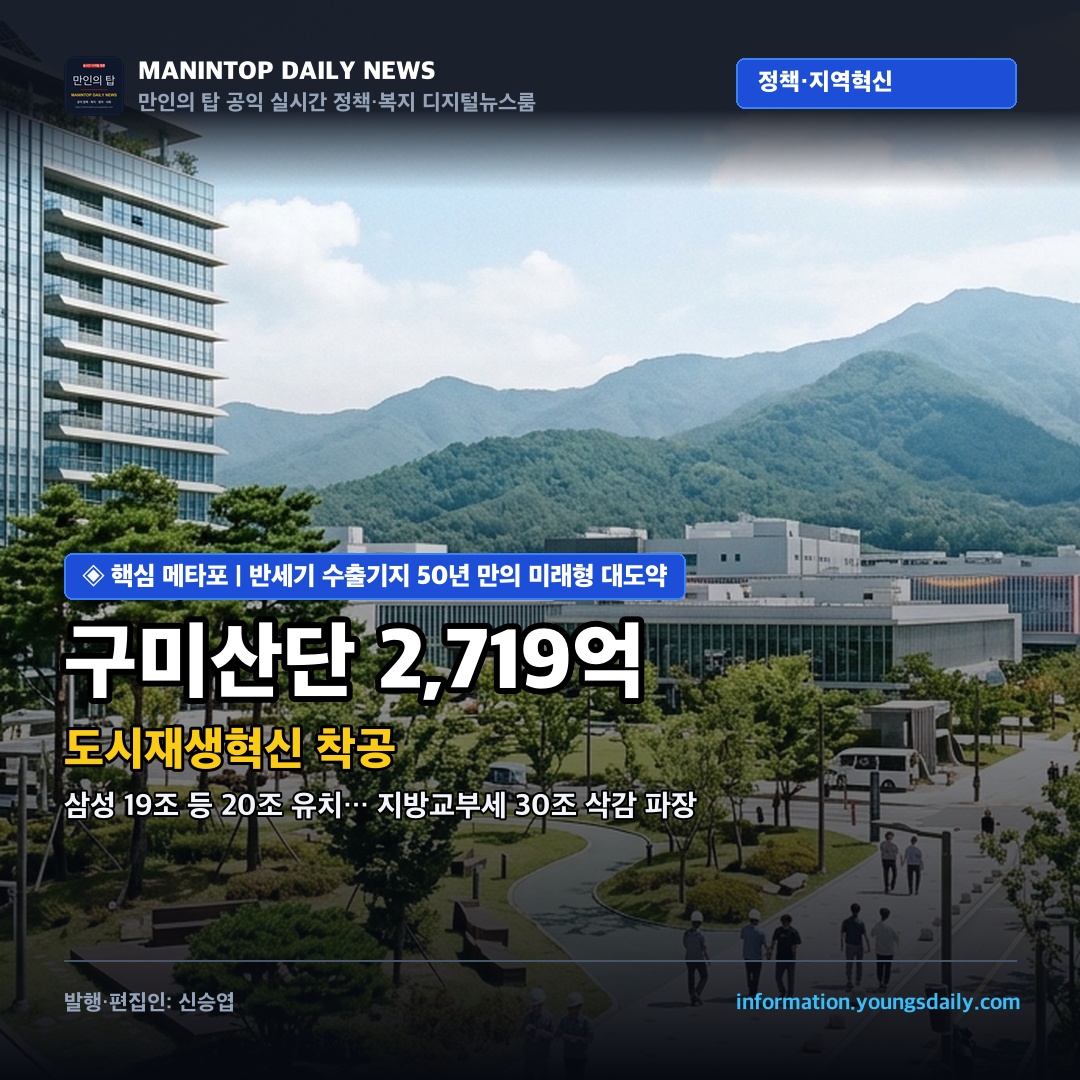
▲ 50년 노후 산단 이미지를 벗고 미래형 스마트 복합도시로 도약하는 경북 구미 제1국가산단 공단동 도시재생혁신지구 전경. 2,719억 원이 투입되어 지상 19층 랜드마크 복합타워와 청년 공공임대주택이 들어선다. / 공식보도자료
대한민국 수출의 요람이자 근대 제조업의 심장이었던 경상북도 구미시가 건립 50여 년을 맞이한 노후 산업단지의 묵은 때를 벗겨내고 미래형 첨단 스마트 복합도시로 거듭나기 위한 역사적 대도약에 착수했습니다. 민선 9기 출범 이후 속도를 내고 있는 경제·정주·공간의 3대 혁신을 주축으로, 총사업비 2,719억 원이 투입되는 구미 제1국가산업단지 공단동 도시재생혁신지구가 마침내 첫 삽을 떴습니다. 삼성전자의 19조 원 투자를 포함한 총 20조 원 규모의 매머드급 기업 투자유치 성과와 함께 도심 상권 활성화 및 광역교통망 확충이 동시다발적으로 진행되고 있습니다. 하지만 중앙정부의 미래대응기금 신설에 따른 전국 지방교부세 30조 원 삭감 논란이 거세지면서 지자체의 막대한 지방비 분담금과 재정 건전성 확보라는 엄중한 과제도 수면 위로 떠올랐습니다.
50년 노후 산단의 환골탈태… 2,719억 원 투입되는 공단동 19층 랜드마크 타워
지난 반세기 동안 한국 경제의 고도성장을 견인했던 구미 제1국가산단이 단순 제조 중심의 공장에서 청년과 첨단기업이 공존하는 미래형 복합거점으로 전면 재탄생합니다. 구미시는 공단동 249번지 일원에서 김장호 구미시장, 구자근 국회의원, 시·도의원, 경제단체 및 산학연 관계자 200여 명이 집결한 가운데 도시재생혁신지구 착공식을 열고 50년 만의 대전환을 공식 선언했습니다. 공단 발갱이 풍물단의 신명 나는 식전공연과 추진 경과보고, 시삽식으로 이어진 이번 사업은 국토교통부 국가시범지구 지정을 거쳐 연면적 7만 5,249㎡, 지하 3층~지상 19층 규모의 초고층 랜드마크 복합타워를 건립하는 초대형 프로젝트로 2030년 하반기 완공을 목표로 합니다.
새롭게 들어서는 혁신지구는 기존의 회색빛 단일 공장 부지를 벗어나 산업, 문화, 주거가 한곳에 유기적으로 집적되는 입체적 복합공간으로 조성됩니다. 첨단 R&D 역량을 결집할 지식산업센터와 창업 보육시설이 들어서는 '산업융복합 혁신지구', 근로자 전용 문화시설과 산단문화공원으로 녹지 휴식처를 제공하는 '산업문화 복합지구'가 나란히 구축됩니다. 특히 청년 기술인력과 스타트업 창업가들의 주거 안정을 돕기 위해 전용 31㎡형(공급 15평형) 102세대와 전용 44㎡형(공급 24평형) 90세대 등 총 192세대의 직주근접형 통합공공임대주택이 공급되어 청년들이 일하며 머물 수 있는 쾌적한 정주 여건을 보장합니다.
복합권역 명칭
핵심 도입 시설
공간 제원 및 세대수
정책 기능 및 기대효과
산업융복합 혁신지구
지식산업센터, R&D 업무시설, 근린생활시설
연면적 75,249㎡ 내 핵심 집적
스타트업 보육 및 첨단 R&D 집결
산업문화 복합지구
근로자 문화센터, 산단문화공원
문화선도산단 1호 프로젝트 연계
삭막한 산단 환경 개선 및 녹지 쉼터
근로상생 복합지구
통합공공임대주택 192세대
전용 31㎡(102세대) / 44㎡(90세대)
청년 기술인력 주거안정 및 직주근접
인근 연계 프로젝트
청년드림타워, 비즈니스 호텔
산단 내 도보 생활권 연결
바이어 숙박 컨벤션 및 복합생태계
삼성 19조 원 포함 총 20조 원 투자유치… 로봇·반도체 중심 첨단 제조 르네상스
도시 공간의 물리적 재생과 발맞추어 구미의 산업 지형도 고부가가치 첨단 미래산업으로 급격히 재편되고 있습니다. 구미시는 민선 9기 출범 100일 만에 삼성이 단행한 19조 원 규모의 대형 투자를 주축으로 총 20조 원에 달하는 투자유치를 성사시키며 제조 르네상스의 발판을 마련했습니다. 과거 가전과 단순 전자부품 조립에 머물렀던 체질을 반도체 소재·부품, 방위산업, 인공지능, 첨단 로봇 등 차세대 전략 산업군으로 탈바꿈시키고 있으며, 특히 삼성의 대규모 투자 라인과 연계된 '로봇 국가첨단전략산업 특화단지' 지정을 전략적으로 추진하여 국가 제조 혁신의 심장부 지위를 확고히 한다는 구상입니다.
김장호 구미시장은 착공식 현장에서 이번 사업은 대한민국 수출을 이끌어 온 구미 제1국가산단이 새로운 반세기를 향해 힘차게 비상하는 뜻깊은 출발점이라며, 대한민국 1호 문화선도산단 프로젝트 및 인근 청년드림타워, 비즈니스 호텔과 연계해 청년과 첨단기업이 제 발로 찾아오는 매력적인 산업단지로 완성하겠다고 강조했습니다. 이는 공단에 문화와 여가를 입혀 젊은 인재들의 역외 유출을 막고 지역 경제 전반에 새로운 활력을 불어넣겠다는 구체적 로드맵의 일환입니다.
대기업 온기를 골목상권으로… 62인 민생위원회와 시청 전담지원단의 쌍끌이 지원
첨단 대기업 유치로 유입되는 대규모 자본의 온기가 일반 자영업자와 서민 골목상권으로 골고루 스며들도록 민관 합동 민생 회복 기구도 전격 가동되었습니다. 구미시는 이승환 구미대학교 총장이 민간 공동위원장을 맡고 5개 분과 62명의 현장 전문가와 25명의 기관장 협력단이 참여하는 '지역경기살리기위원회'를 출범시켰습니다. 이 위원회는 요식, 유통, 청년창업 등 현장의 생생한 애로사항을 분기별로 수렴해 실질적 행정 시책으로 반영하는 정책 환류 시스템을 책임집니다.
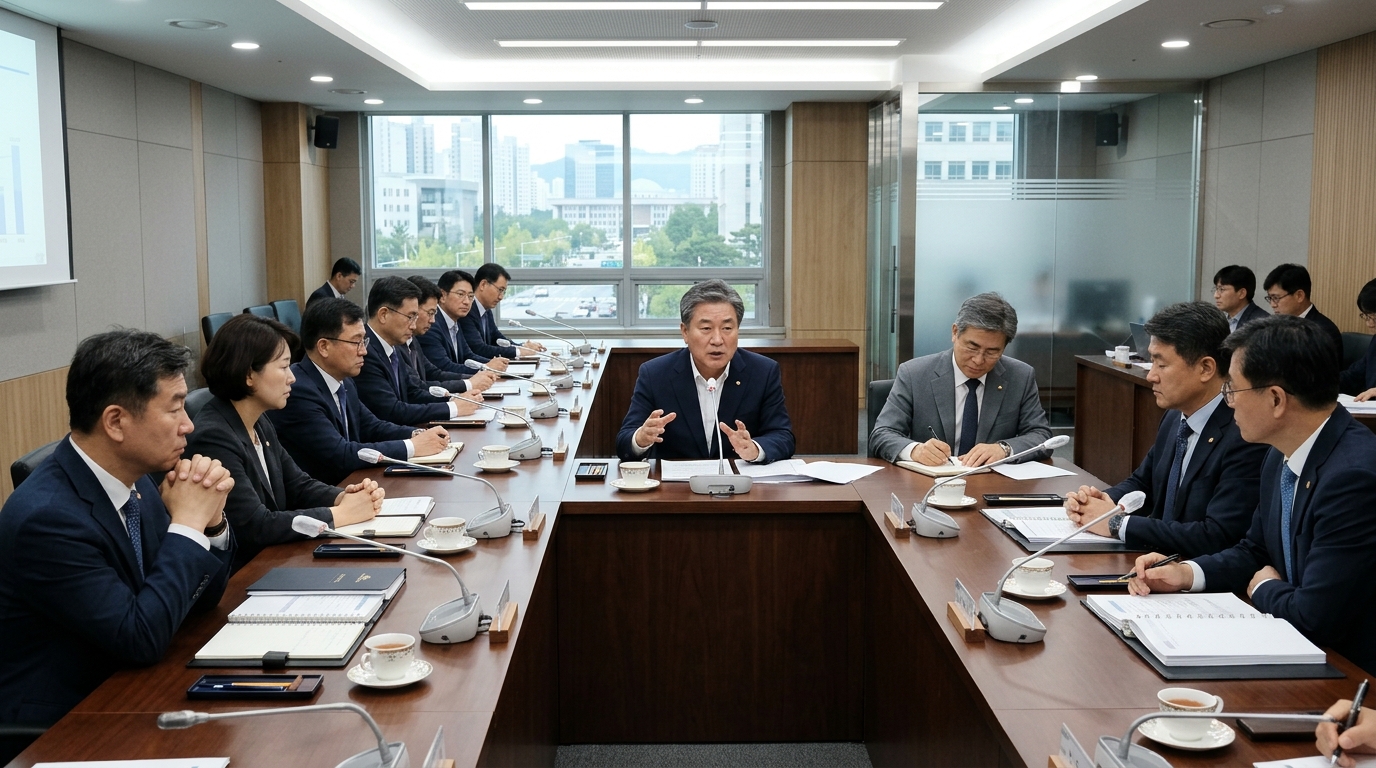
▲ 구미시청과 지역 대학 및 상공계 리더들이 참석한 지역경제 활성화 대책 회의. 대기업 투자의 온기를 골목상권으로 확산시키기 위한 민생 행정이 가동되고 있다. / 공식보도자료
구미시는 행정 내부에도 국 단위 전담조직인 '골목상권지원단'을 신설하고 산하에 골목경제과와 시장상권지원과를 편제해 민생 살리기를 제도적으로 뒷받침하고 있습니다. 소상공인 금융 부담을 덜기 위한 구미사랑상품권 발행 확대와 대출이자 차액을 보전하는 특례 지원을 강화하는 한편, 민간 배달앱 수수료 부담을 덜어주는 공공배달앱 '먹깨비'와 지역 택시 호출망 '구미토미콜' 이용을 대대적으로 활성화하고 있습니다. 아울러 반세기 숙원이었던 인동시장 재개발을 비롯해 신평시장 시설 현대화, 새마을중앙시장 국수골목 리모델링 등 3대 전통시장 환경 개선을 전폭 추진하고 있습니다.
시민들의 소비를 진작시키기 위한 지역 축제의 경제학도 돋보입니다. 전국적 인기를 얻고 있는 '구미라면축제'와 '구미푸드페스티벌', '달달한 낭만야시장' 등 구미 대표 3대 축제에 지역 상가 영수증을 제출하면 축제 참여 혜택을 제공하는 '영수증 입장제'를 전면 확대했습니다. 축제장을 찾은 관광객들의 발길이 자연스럽게 인근 골목 상권의 실질적인 매출 증대로 직결되도록 유도한 상생 모델로 호평을 받고 있습니다.
신공항 직결 고속도로부터 광역철도·KTX까지… 공간을 잇는 사통팔달 교통망
도시의 연결성과 공간 구조를 바꾸는 대형 교통 인프라 혁신도 속도감 있게 전개되고 있습니다. 대구경북 통합신공항 개항에 맞춰 구미와 군위를 잇는 고속도로망 조기 구축을 추진하고, 기획재정부 예비타당성조사를 통과한 대구경북 광역철도(서대구~동구미~의성) 노선과 구미~신공항 철도를 제5차 국가철도망 구축계획에 반영하기 위해 행정력을 집중하고 있습니다. 또한 남부내륙철도와 연계한 KTX 구미역 정차를 가시화해 기업들의 물류 경쟁력을 높이고 시민들의 장거리 이동권을 대폭 확대할 계획입니다.
도심 공간에서는 구미역 앞 광장을 복합 문화와 휴식이 공존하는 거점 광장으로 넓히고 만성 주차난을 해소할 대형 지하주차장을 조성하고 있습니다. 도심 빈 점포를 활용한 청년·여성 창업밸리 인큐베이팅과 노후 단독주택지 도시환경정비 시범사업도 병행됩니다. 시민 생활 밀착형으로는 인동보건지소 실내외 환경 리모델링을 마쳐 쾌적한 의료 서비스를 제공하고 있으며, 시청 기술직 공무원들을 대상으로 공사 하자 분석과 설계 내역서 실무 교육을 실시해 공공건축물의 시공 품질을 한 단계 끌어올렸습니다.
장밋빛 청사진 뒤 도사린 재정 뇌관… 정부 '지방교부세 30조 삭감' 논란과 지역 파장
이러한 구미시의 장밋빛 대도약 청사진 이면에는 중앙정부의 세제 개편안에 따른 대규모 지방교부세 결손이라는 엄중한 재정적 리스크가 도사리고 있습니다. 정부가 158조 5,000억 원 규모의 '미래대응기금'을 신설하면서 이를 지방교부세 법정 산정 기준인 '내국세 총액'에서 제외하는 세법 개정안을 추진함에 따라 전국 지자체 예산 편성에 비상이 걸렸습니다. 현행 법률상 보통교부세를 비롯한 정률분 교부세는 내국세 총액의 19.24%로 연동되어 있어 내국세 모수가 줄어들면 지자체로 이전되는 교부금도 직격탄을 맞게 됩니다.
국회예산정책처 분석에 따르면 158조 5,000억 원이 내국세에서 제외될 경우 내년도 교부세 정률분은 69조 7,000억 원으로 축소되어, 현행 대비 무려 30조 5,000억 원(30.4%)의 지방교부세가 일시에 증발하게 됩니다. 정부가 기금 내 지방계정으로 15조 3,000억 원을 지원하겠다고 밝혔으나, 지자체가 자율적으로 편성하는 자주재원과 달리 중앙부처의 특정 목적성 사업에 묶여 있어 지방자치재정권을 심각하게 침해한다는 비판이 거셉니다. 2,719억 원 산단재생을 비롯해 도로·철도망 분담금과 자체 복지 예산을 감당해야 하는 구미시로서는 중앙정부의 교부세 감축 파장을 면밀히 주시하며 자주재원 방어와 지방채 운용에 대한 선제적 안전판을 구축해야 할 시점입니다.
재정 지표 및 항목
현행 산정 기준
정부 개편안 추계
지자체 파장 및 쟁점
미래대응기금 규모
해당 없음 (신설)
총 158조 5,000억 원
내국세 총액 제외 법안 추진
지방교부세 정률분
내국세의 19.24% 연동
69조 7,000억 원으로 축소
30조 5,000억 원(30.4%) 급감
정부 대체 지원안
지자체 자율편성 자주재원
기금 내 지방계정 15.3조 원
국가 주도 목적성 예산 한계
구미시 등 지자체 영향
기존 인프라 매칭 정상
자체 복지·인프라 분담금 비상
2,719억 산단 및 교통망 부담 가중
[In-Depth Analysis] Gumi Launches 271.9 Billion Won Smart Industrial Megaproject: 20 Trillion Won Inflows Amid 30 Trillion Won Local Tax Cut Fears
MANINTOP Policy and Regional Economy Investigative Desk | High-Tech Industry and Urban Planning2026. 11. 13 07:15 KST
▲ Overview of the 271.9 billion won urban renewal innovation district in Gumi National Industrial Complex 1, shedding its aging manufacturing identity to emerge as a smart multifunctional hub with a nineteen-story landmark tower and public housing. / Press Coverage Photo
Gumi City in Gyeongsangbuk-do, historically celebrated as the cradle of South Korea's modern export manufacturing, has embarked on a historic transformation to shed its aging industrial image and emerge as a forward-looking smart multifunctional metropolis. Anchored by the three pillars of economic innovation, residential revitalization, and spatial restructuring advanced by the ninth local administration, the city held a groundbreaking ceremony for the 271.9 billion won urban renewal innovation district within Gumi National Industrial Complex 1. This urban overhaul coincides with an influx of 20 trillion won in high-tech corporate investments, headlined by Samsung's 19 trillion won commitment, alongside commercial district revival and regional transit integration. However, severe fiscal concerns have surfaced nationwide as the central government's proposal to establish a Future Response Fund threatens to slash statutory local allocation tax revenues by over 30 trillion won, placing substantial municipal co-financing burdens under unprecedented strain.
Metamorphosis of a 50-Year Industrial Park: A 271.9 Billion Won Landmark Complex
For the past fifty years, Gumi National Industrial Complex 1 powered South Korea's rapid economic ascent. Today, the complex is being systematically redesigned from a production-focused factory zone into an advanced ecosystem where young technical specialists and cutting-edge enterprises flourish together. At the project site in Gongdan-dong, over two hundred civic and business leaders, including Mayor Kim Jang-ho, National Assembly Representative Koo Ja-geun, provincial lawmakers, and economic dignitaries, gathered to celebrate the groundbreaking of the urban renewal innovation district. Featuring traditional folk performances, milestone presentations, and ceremonial shovel turning, the initiative represents a national pilot project designated by the Ministry of Land, Infrastructure and Transport to erect a nineteen-story high-rise multifunctional complex spanning 75,249 square meters, targeted for full completion in late 2030.
Departing from monotonous single-purpose manufacturing plants, the newly inaugurated district integrates industrial R&D, culture, and residential life within a cohesive architectural campus. The complex features an Industrial Convergence Zone housing knowledge industry centers and startup business incubators, alongside an Industrial Culture Zone providing dedicated worker wellness facilities and landscaped civic parklands. To mitigate living cost pressures for young researchers and innovative entrepreneurs, the project introduces 192 units of integrated public rental housing, including 102 units of 31-square-meter layouts and 90 units of 44-square-meter floor plans, ensuring optimal workplace proximity and comfortable living standards.
Functional Zone
Key Facilities
Scale and Specifications
Policy Objectives
Industrial Convergence Zone
Knowledge Industry Center and Offices
75,249 Square Meters Gross Floor Area
Startup Incubation and Tech R&D
Industrial Culture Zone
Worker Cultural Center and Parklands
Linked to Culture-Led Industrial Park
Green Spaces and Civic Leisure
Worker Coexistence Zone
192 Public Rental Housing Units
31 sqm (102 units) / 44 sqm (90 units)
Affordable Living and Work Proximity
Neighboring Synergies
Youth Dream Tower and Business Hotel
Integrated Pedestrian Infrastructure
Visitor Lodging and Comprehensive Hub
20 Trillion Won Corporate Inflows: Manufacturing Renaissance in Robotics and Semiconductors
Parallel to spatial renewal, Gumi's industrial landscape is shifting decisively toward high-value advanced technology sectors. Within one hundred days of the current administration's tenure, the city secured 20 trillion won in aggregate corporate investment commitments, anchored by Samsung's landmark 19 trillion won strategic allocation. The municipal economy is actively transitioning away from legacy consumer electronics assembly into semiconductor materials, defense systems, artificial intelligence, and advanced robotics. Crucially, municipal planners are strategically pursuing national designation for a Specialized Robotics Strategic Industry Cluster directly linked to Samsung's manufacturing lines, aiming to secure Gumi's status as a core national manufacturing innovation nexus.
Addressing attendees during the groundbreaking ceremony, Mayor Kim Jang-ho declared that the project marks a pivotal launching pad for Gumi National Industrial Complex 1 to soar into its next half-century of prosperity. The mayor emphasized that by integrating the complex with the nation's premier Culture-Led Industrial Park initiative, the neighboring Youth Dream Tower, and planned business hotel facilities, Gumi will evolve into an attractive environment where young talent and forward-looking corporations eagerly congregate. This coordinated approach seeks to infuse cultural amenities into industrial districts, curbing talent outflows and energizing the broader regional economy.
Channeling Industrial Capital into Local Retail: Dual-Track Governance for Small Businesses
To ensure that massive capital inflows from corporate investments effectively permeate neighborhood commercial ecosystems, municipal authorities instituted a comprehensive dual-track governance mechanism. Gumi City inaugurated the Regional Economy Revitalization Committee, co-chaired by Gumi University President Lee Seung-hwan and comprising sixty-two on-site specialists across five subcommittees, supported by a twenty-five-member advisory panel of institutional directors. Meeting quarterly, the committee directly gathers frontline feedback across restaurant, retail, and startup sectors, converting practical challenges into actionable municipal policies.
▲ Local leaders, university presidents, and commercial representatives gather for a regional economic coordination meeting in Gumi City Hall to bridge corporate investment into neighborhood businesses. / Press Coverage Photo
Administratively, Gumi established a bureau-level Alley Commercial District Support Corps within City Hall, incorporating specialized divisions for neighborhood economies and market assistance. The municipality expanded the issuance of Gumi Love Gift Certificates and reinforced secondary interest subsidies to lighten borrowing expenses for self-employed merchants. To shield local businesses from excessive intermediary commissions on private platforms, the city actively promotes the public delivery application Meokkkebi and the municipal taxi-hailing network Gumi Tomi Call. Furthermore, the city is executing long-awaited modernization projects across three traditional commercial hubs: Indong Market redevelopment, Sinpyeong Market modernization, and the Saemaeul Central Market Noodle Alley restoration.
Innovative festival economics have further energized civic retail circulation. Across Gumi's three signature festivals—the nationally acclaimed Gumi Ramyeon Festival, the Gumi Food Festival, and the Sweet Romantic Night Market—organizers expanded a receipt-based entrance system. Under this initiative, visitors who present shopping receipts from neighborhood retail outlets receive preferred admission benefits and promotional vouchers. This creative integration seamlessly directs festival foot traffic into surrounding commercial districts, creating measurable revenue expansions for local storekeepers.
From Airport Expressways to High-Speed Rail: Comprehensive Transit Networks Reshaping Connectivity
Strategic transportation infrastructure developments are also moving rapidly forward to reshape urban connectivity. In preparation for the future opening of the Daegu-Gyeongbuk Integrated New Airport, Gumi is advancing administrative procedures for an express highway connecting Gumi directly to Gunwi. Following the preliminary feasibility approval of the Daegu-Gyeongbuk Wide-Area Railway connecting Seodaegu, East Gumi, and Uiseong, municipal planners are actively lobbying for inclusion of the Gumi-Airport railway in the fifth National Railway Network Plan. Additionally, securing high-speed KTX passenger stops at downtown Gumi Station via southern inland linkages remains a priority to bolster corporate logistics and resident mobility.
Urban core revitalizations complement these regional transit expansions. The public plaza fronting Gumi Station is undergoing expansion into a dynamic civic gathering space supported by a multi-level subterranean parking facility to resolve persistent downtown congestion. Concurrently, vacant storefronts are being repurposed into incubation hubs for youth and female entrepreneurs, while deteriorating residential zones are being upgraded through pilot urban environment improvement programs. Community health infrastructure has also advanced, with comprehensive renovations of the Indong Health Sub-Center and specialized quality assurance seminars for municipal engineering officials to prevent construction defects across public structures.
Fiscal Headwinds Behind Blueprints: National 30 Trillion Won Local Tax Cut Controversy
Behind Gumi's ambitious blueprints, however, looms a formidable financial hazard arising from proposed national tax revisions. The central government is promoting legislative changes to establish a 158.5 trillion won Future Response Fund while carving out these revenues from the statutory calculation of total internal taxes. Because general local allocation taxes are legally indexed at 19.24 percent of aggregate internal taxes, reducing the statutory tax baseline delivers an immediate, severe contraction in formula-based grant disbursements transferred to local governments nationwide.
National Assembly Budget Office projections indicate that carving out 158.5 trillion won from internal tax calculations would slash next year's statutory allocation grants to 69.7 trillion won—a staggering reduction of 30.5 trillion won, representing a 30.4 percent decline. Although the central government offered to distribute 15.3 trillion won via a dedicated regional fund account, municipal leaders criticize this mechanism as restrictive earmarked funding that undermines genuine fiscal decentralization. Facing substantial co-funding obligations for the 271.9 billion won industrial renewal alongside regional transit lines and local welfare programs, Gumi City must prudently navigate these fiscal crosscurrents to safeguard its financial resilience.
Fiscal Indicator
Current Legal Standard
Government Proposal Estimate
Impact on Municipalities
Future Response Fund Scale
Not Applicable (New Fund)
158.5 Trillion Won
Carved Out from Internal Taxes
Local Allocation Grants
19.24 Percent of Internal Taxes
Shrinks to 69.7 Trillion Won
Net Decline of 30.5 Trillion Won
Alternative State Grants
Autonomous Local Revenue
15.3 Trillion Won Regional Account
Restrictive Earmarked Appropriations
Municipal Fiscal Strain
Standard Project Co-Financing
Local Funding Depletion Risk
Rising Pressure on Megaprojects
PRO SOURCING ENGINE만인의 탑 빅데이터 솔루션
★ 가입 시 600 크레딧(120회) 전원 무료
내가 찾는 상품 키워드, 지금 얼마나 검색될까?
네이버 월간 검색량 + 구글 볼륨 + 아이템스카우트 실시간 상품수와 경쟁강도 배지를 0.5초 만에 무료로 확인하세요.
MANINTOP NEWSLETTER
📬 만인의 탑 뉴스레터 무료 구독
오늘 보신 정책·시사 뉴스가 유익하셨나요? 매일 엄선되는 알짜 복지 혜택과 국회 실시간 속보를 이메일로 가장 먼저 받아보세요. (평생 무료)
1월이 시작되면 감기는 이미 우리 곁에 와 있습니다. 2월, 3월, 4월까지 이어지는 추위와 건조함은 코와 목을 가장 먼저 공격합니다. 아침에 일어나자마자 막혀 있는 코. 계속 흐르는 콧물. 괜히 칼칼해지는 목. 이 증상은 “시작”일 뿐입니다. 한 번 무너지면 일주일, 길면 한 달까지 끌고 갑니다. 약을 먹으면 잠깐 괜찮아집니다. 하지만 며칠 뒤 또 반복됩니다. 왜일까요? 감기는 ‘치료’의 문제가 아니라 ‘관리’의 문제이기 때문입니다. 대부분은 감기가 오고 나서 약을 찾습니다. 하지만 진짜 중요한 건 감기가 오기 전에 코와 목을 지키는 것입니다. 건조한 실내 공기, 차가운 바깥 공기, 눈에 보이지 않는 세균. 코와 목은 매일 공격받고 있습니다. 지긋지긋하죠! 그런데도 우리는 아무 준비 없이 버티고 있습니다. 이번 겨울도 그렇게 보낼 건가요? 사실 방법은 어렵지 않습니다. 코를 깨끗하게 관리하고, 목을 따뜻하게 보호하고, 점막을 촉촉하게 유지하고, 기관지를 미리 관리하고, 외부 공기를 차단하는 것. 이 다섯 가지만 꾸준히 해도 감기약 없이 겨울을 보내는 것이 충분히 가능합니다. 🔥 이제부터 그 방법을 하나씩 살펴보겠습니다. 🔥 1. 코와 목을 먼저 관리해야 하는 과학적 이유 감기의 대부분은 코 점막에서 시작됩니다. 국제 학술지 Nature Reviews Microbiology 와 Journal of Allergy and Clinical Immunology 에 실린 호흡기 감염 관련 연구들에서는, 감기 바이러스가 비강 상피세포에 먼저 부착해 증식한다는 점을 설명하고 ...
리모델링사업이 진행 중인 아파트를 매매할 때 “계약금 10%를 언제까지 내야 하느냐”는 질문이 특히 많이 나옵니다. 이주공고(이주 안내)가 7~11월쯤이라고 들으면, 그 시점에 맞춰 계약금도 움직일 것 같아서 더 헷갈리기 쉽습니다. 하지만 실제 납부기한은 ‘이주공고가 언제냐’만으로 자동 결정되지 않는 경우가 많습니다. 1) 계약금 10% 납부기한: 결국 ‘문서에 적힌 일정’이 기준 계약금 10%를 언제까지 납부해야 하는지는, 내가 서명하는 매매계약서(특약 포함) 와 사업주체/조합이 제시한 공고·안내문 에 적힌 납부 일정이 기준이 됩니다. 실제 공고문에서는 분양대금 납부의 큰 틀(계약금→중도금→잔금)을 먼저 안내하고, 상세 일정은 별도 표나 유의사항으로 제시하는 방식이 흔합니다. 또, 계약서 문구에 따라 지급 시점이 조건부로 설정될 수도 있습니다. 예를 들어 한 사례 소개 자료에서는 용역계약서에 잔금(10%) 지급시기가 “사업승인 후”로 기재되어 있었다는 점이 언급됩니다. 이런 식으로 ‘사업 단계’와 지급을 연동하는 문구가 들어가면, 질문의 답은 계약서 문구를 확인해야만 확정됩니다. 관련 내용은 링크 에서 문구 사례를 확인할 수 있습니다. 2) 입주자모집공고에서 확인되는 ‘납부 순서’와 잔금 마감 시점 공고문에 적힌 문구를 보면, 납부 순서와 잔금 마감에 대한 기준이 비교적 명확하게 제시되는 경우가 있습니다. 예를 들어 한 입주자모집공고에는 “분양금액(주택가격)은 계약금, 중도금, 잔금의 순서로 납부”하며 “잔금은 입주(열쇠 수령일) 전에 완납”해야 한다고 안내되어 있습니다. (문구 확인: 링크 ) 이 문구가 의미하는 바는 최소 2가지입니다. 분양/공급 형태의 문서에서는 ‘계약금→중도금→잔금’ 흐름이 공식적으로 안내될 수 있습니다. 잔금은 “입주(열쇠 수령)” 이전에 완납해야 한다는 마감 기준이 문서에 적혀 있을 수 있습니다. 다만, 위 공고문 문구는 잔금 마감에 대한 기준을 보여주지만, 계약금 10%의...
윤석열 전 대통령 탄핵 인용 소식을 접하면, 가장 궁금한 지점은 ‘헌재가 정확히 무엇을 위헌·위법으로 봤는가’입니다. 또한 탄핵과 별개로 진행되는 형사재판(내란 우두머리 혐의 등)이 어디까지 왔는지도 함께 정리할 필요가 있습니다. 아래 내용은 제공된 기사/게시물 스니펫과 링크에서 확인되는 범위만 모아, 일반인이 흐름을 이해하기 쉽게 정리한 것입니다. 1) 탄핵 인용 관련: 스니펫에서 확인되는 ‘판단의 골격’ 제공된 근거 중 조국혁신당 사이트에는 헌법재판소가 윤석열 탄핵 심판에서 “피청구인의 위헌·위법행위는 국민 신임 …”이라는 취지로 판단했다는 문장이 인용돼 있습니다( 링크 ). 이 인용문만 놓고 보면, ‘위헌·위법행위’가 있었는지와 그로 인해 ‘국민의 신임’이 어떻게 평가됐는지가 핵심 축으로 소개됩니다. 다만 질문에서 요청하신 세부 항목, 즉 비상계엄 선포 자체를 문제 삼은 구체적 이유, 계엄 이후 조치(포고령, 국회 통제 등)의 어떤 지점이 헌법 위반인지, 국회의 권한행사 방해 및 정치활동 제약을 어떤 논리로 판단했는지 등은, 이번에 제공된 근거의 제목/스니펫만으로는 조항·사실관계·판단 구조가 그대로 제시돼 있지 않습니다. 따라서 이 글에서는 ‘헌재가 무엇을 문제 삼았다’는 세부 리스트를 단정적으로 재구성하기보다, 현재 확인 가능한 문구 수준의 요약(위헌·위법행위 → 국민 신임의 문제로 평가)까지만 적습니다. 만약 헌재 결정문 전문(주문 및 이유)이 추가로 확인되면, 그때는 문장 단위로 ‘어떤 행위’와 ‘어떤 헌법 원리/조항’이 연결되는지(예: 권력분립, 국회의 권한, 정치적 기본권 등) 구조화해 정리하는 것이 가장 정확합니다. 2) 형사 절차(내란 혐의) 관련: 체포영장과 1심 선고 언급 탄핵 심판과 별도로, 12·3 비상계엄 사태로 내란 혐의를 받는 윤석열 대통령에 대해 2024년 12월 31일 체포 영장이 발부됐다는 BBC 보도가 있습니다( 링크 ). 해당 보도는 ‘현직 대통령’에 대한 체포영장 발부라는 점을 함께 언급합니다. 또...