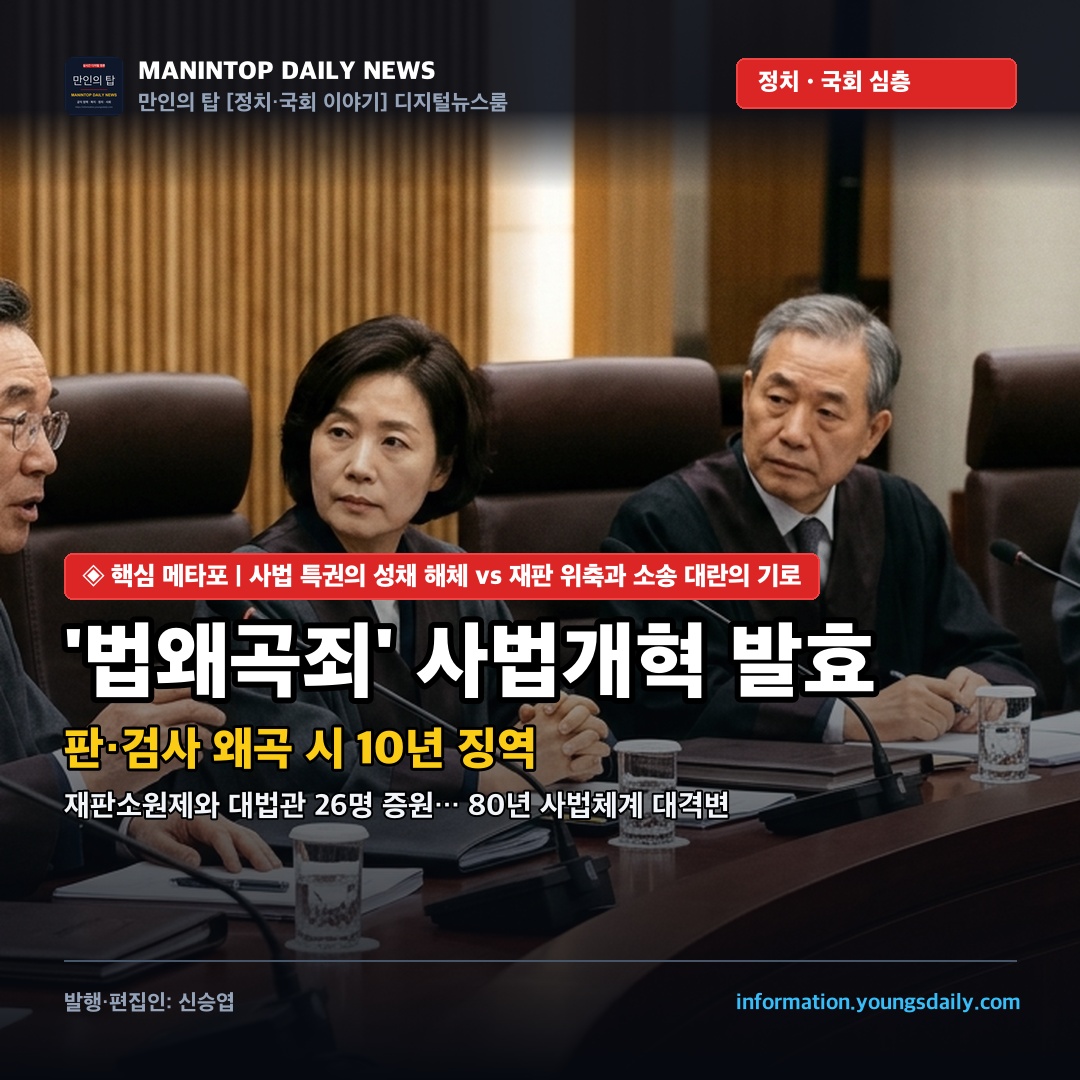
▲ 대법정 법대에서 고위 법관들이 사법개혁 3법의 정식 발효와 법왜곡죄 시행에 따른 재판 운용 방안을 심도 있게 논의하고 있다. / 공식기록사진
◈ 핵심 팩트 브리핑 (Key Fact Briefing)
법왜곡죄 전격 발효: 판·검사·경찰이 부당한 목적으로 법령 왜곡 또는 증거 조작 시 최대 10년 징역 처벌.
사법개혁 3법 완성: 형법상 법왜곡죄 신설, 대법원 판결에 대한 재판소원 허용, 대법관 26명 단계적 증원 확정.
사법불신과 판결 격차: 갤럽 조사 판결 공정성 23% 급락, 윤석열 구속취소 및 김건희 샤넬백 판례 불일치 논란.
시행 초기 고소 폭증: 시행 2주 만에 44건(118명) 접수, 7월 말 기준 피고소 판사만 529명 달해 사법 혼란 가중.
해외 입법례 및 비교: 독일 형법 제339조(1~5년 징역), 오스트리아(최대 10년) vs 미국 사법면책 원칙 정면 대립.
판사와 검사가 법을 제멋대로 왜곡하거나 증거를 조작하면 최대 징역 10년의 중형에 처하도록 한 '법왜곡죄'가 정식 발효되면서 대한민국 사법 질서가 80년 만의 최대 격변을 맞이하고 있습니다. 국회 본회의를 통과한 '사법개혁' 3법(형법·헌법재판소법·법원조직법 개정안)은 대법원 확정판결을 헌법재판소가 다시 심판하는 '재판소원제'와 '대법관 26명 증원'까지 함께 담아내며 사법권의 작동 방식을 뿌리부터 뒤흔들고 있습니다. 헌정사상 누구도 손대지 못했던 '사법 특권의 성채'를 허물어 국민의 기본권을 지키겠다는 입법 취지에도 불구하고, 법원 현장에서는 재판 위축과 묻지마 고소 남발로 인한 '사법 대란'을 우려하는 목소리가 터져 나오며 찬반 대립이 최고조에 달했습니다.
1. 대한민국 사법 80년 만의 대격변… '사법개혁 3법' 전격 발효
이번에 시행된 사법개혁 3법은 1948년 제헌 헌법으로 사법부가 출범한 지 약 80년, 그리고 1987년 민주화 헌법 체제가 정착된 지 약 40년 만에 단행된 가장 광범위한 제도 개편입니다. 2026년 2월 26일 국회 본회의 문턱을 넘고 3월 5일 국무회의 의결을 거쳐 3월 12일 공포·발효된 이번 법안은, 그동안 통제받지 않는 절대권력으로 군림해 왔던 사법 권력에 대해 민주적 견제와 실질적 형사 책임을 묻는 역사적 전환점으로 평가받습니다.
개혁의 가장 날카로운 칼날은 신설된 형법 제123조의2, 즉 '법왜곡죄'입니다. 판사나 검사, 경찰 등 범죄 수사와 재판을 맡은 공직자가 타인에게 위법하거나 부당하게 이익을 주거나 반대로 권익을 해칠 목적으로 법을 고의로 잘못 적용하면 10년 이하의 징역과 10년 이하의 자격정지에 처해집니다. 사건에 관한 증거를 인멸·은닉하거나 위조·변조된 증거임을 알면서 사용한 경우, 폭행이나 협박 등으로 위법하게 증거를 수집하거나 경험칙에 명백히 반해 사실을 인정한 경우도 모두 처벌 대상에 포함되었습니다.
구분 항목
기존 사법체계 한계
개정 법률 핵심 내용
기대 효과 및 변화
법왜곡죄 신설 (형법 제123조의2)
직권남용죄의 엄격한 판례로 판·검사의 자의적 재판 처벌 전무
부당한 목적으로 고의적 법령 오적용 및 증거 조작 시 10년 이하 징역
사법 농단 및 표적 수사 차단, 판·검사 형사책임 실효성 확보
재판소원제 도입 (헌재법 제68조)
법원 재판에 대한 헌법소원 금지로 기본권 침해 판결 시정 불가
대법원 확정판결이 헌재 결정 위배 또는 기본권 침해 시 헌법소원 허용
사법부 판결에 대한 헌법적 통제 확립 및 국민 기본권 구제 완성
대법관 26명 증원 (법원조직법)
대법관 14명이 연 5만 건 상고 처리, 심리불속행 남발과 부실 심리
2028년부터 3년간 12명 단계적 증원, 금융·노동·지재권 전문부 설치
상고심 심층 심리 보장 및 국민의 충실한 재판받을 권리 실현
사법행정 및 인사 개편
법원행정처 중심 제왕적 대법원장 권한 및 폐쇄적 관료화
비법관 참여 사법행정위원회 전환 및 대법관 추천위 다원화 추진
사법행정의 민주적 통제 및 최고법관 구성의 다양성 확보
[자료: 국회 법제사법위원회 심사보고서 및 법무부 개정 법률 해설서 종합]
2. '형법 제123조의2' 법왜곡죄 해부… 판·검사 의도적 왜곡 시 10년 징역
법조계 전문가들은 법왜곡죄의 구성요건이 매우 엄격하게 설계되었다고 분석합니다. 단순한 법률적 오판이나 과실, 판사마다 견해가 갈리는 해석의 차이는 단서 조항을 통해 명백히 제외되었습니다. 처벌을 위해서는 반드시 '부당한 목적'과 '확정적 고의'가 객관적 물증으로 입증되어야 하며, 적용 범위 역시 위헌성 시비를 줄이기 위해 '형사사건'으로 한정했습니다. 이는 기존 직권남용죄가 엄격한 판례 법리에 묶여 사법 농단이나 표적 수사를 제대로 처벌하지 못했던 한계를 돌파하기 위한 제도적 장치입니다.
이처럼 강력한 처벌법이 제정된 배경에는 국민들의 극심한 사법 불신과 잇따른 판결 논란이 자리 잡고 있습니다. 한국갤럽 조사에 따르면 '법관의 판결이 공정하다'고 믿는 국민은 23%에 불과한 반면, '법이 정치적으로 휘둘린다'는 응답은 68%에 달했습니다. 특히 서울중앙지법 지귀연 부장판사가 형사소송법상 구금일수 계산을 헌정사 최초로 '날'이 아닌 '시간' 단위로 쪼개어 윤석열 전 대통령을 구속 취소하고 석방했던 결정이나, 조희대 대법원장이 이재명 대통령의 선거법 재판에서 이례적인 초고속 파기환송을 주도한 사건 등은 사법 정의에 대한 국민적 공분을 촉발했습니다.
3. 무너진 사법 신뢰와 잇따른 판결 논란… 전관예우 카르텔을 겨눈 칼날
여기에 더해 김건희 씨의 800만 원 상당 샤넬백 수수 사건에서 우인성 재판부가 묵시적 청탁 대가성을 인정하지 않고 1심 무죄를 선고한 것은, 공무원 영향력 행사에 따른 금품 수수 시 묵시적 청탁을 폭넓게 인정해 온 대법원 전원합의체 판례와 정면으로 충돌한다는 거센 비판을 받았습니다. 뒤이어 이진관 재판부가 건진법사 전성배 씨 재판에서 샤넬백과 그라프 목걸이 수수를 포괄일죄로 묶어 알선수재 유죄를 선고하면서 고무줄 판결 논란은 정점에 달했습니다. 결국 고위관료 출신 전관 변호사들이 거액의 수임료를 받고 법리를 비틀어주는 '전관예우 카르텔'을 깨지 않고는 사법 신뢰를 회복할 수 없다는 절박함이 입법의 원동력이 되었습니다.
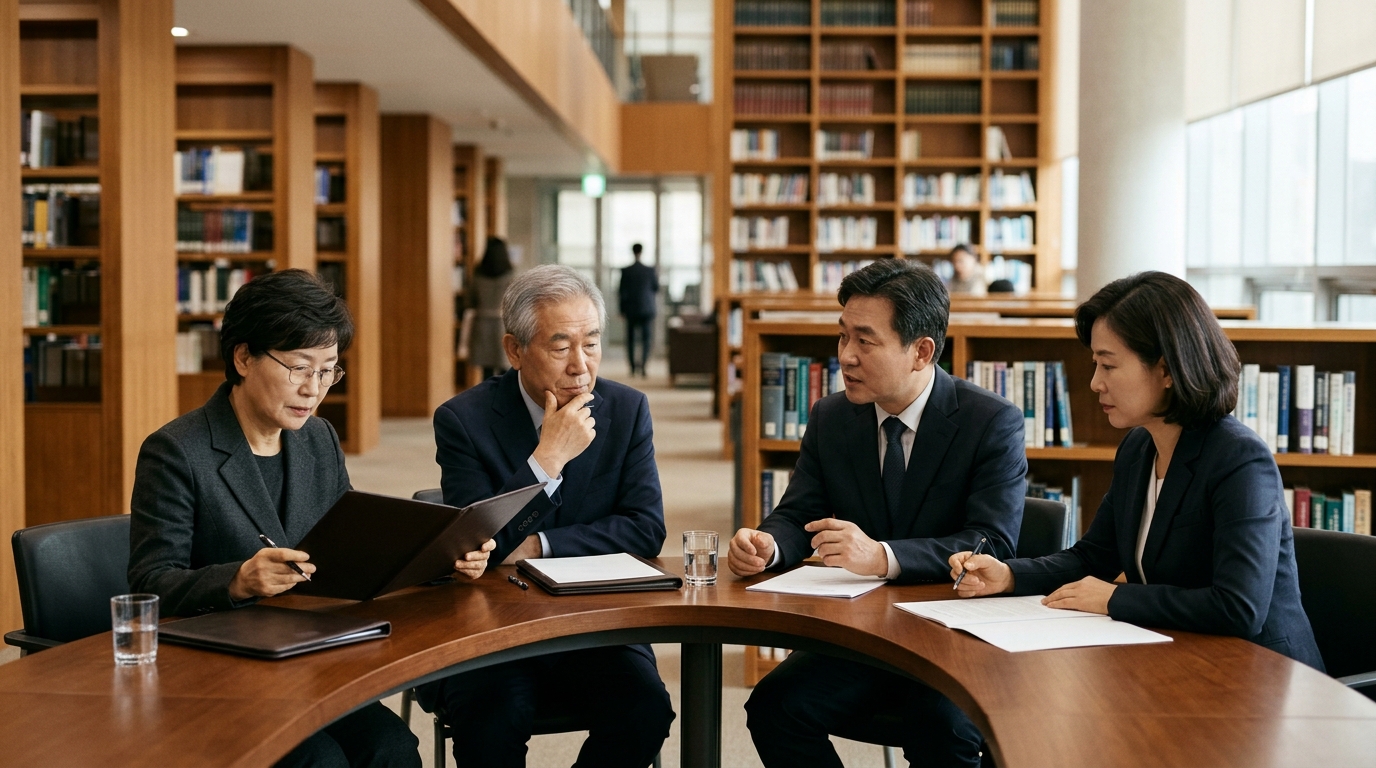
▲ 헌법학자들과 법조계 원로들이 법왜곡죄 신설에 따른 사법부 독립성 수호와 실질적 법치주의 구현 방안을 심도 있게 논의하고 있다. / 공식기록사진
찬성 측은 법왜곡죄가 사법부의 특권을 허물고 '책임 있는 자율성'을 확립할 최후의 보루라고 환영합니다. 사법 독립이란 결코 판·검사가 법을 어겨도 처벌받지 않는 치외법권을 뜻하는 것이 아니라는 주장입니다. 실제로 나치 정권하에서 법이 권력의 하수인으로 전락했던 뼈아픈 역사를 가진 독일은 형법 제339조를 통해 판·검사의 법왜곡 행위를 1년 이상 5년 이하의 징역형으로 다스리고 있으며, 오스트리아 역시 형법 제288조에 따라 최대 징역 10년형에 처하는 등 대륙법계 선진국에서는 이미 성공적으로 안착된 제도입니다.
4. 시행 첫 달부터 수천 명 피고소 파상공세… '사법의 무한루프'와 재판 위축 논란
반면 법원과 보수 법조계는 헌법상 법관의 독립을 침해하고 판사의 소신 판결을 옥죄는 악법이라며 거세게 반발합니다. 재판 결과에 불만을 품은 패소 당사자가 판사를 형사 고소하고, 검찰이나 공수처가 마음에 들지 않는 판결을 내린 판사를 수사하는 무기로 악용될 수 있다는 우려입니다. 영미법계의 미국이 연방대법원의 스파크먼(Sparkman) 판결 이래 법관의 재판 행위에 대해 강력한 '사법면책(Judicial Immunity)'을 보장하며 형사처벌을 원천 차단해 온 이유도 사법부의 독립성을 수호하기 위함이라는 지적입니다.
실제로 법 시행 첫 달부터 사법 현장에는 거센 후폭풍이 몰아치고 있습니다. 경찰청 공식 집계에 따르면 시행 불과 2주 만에 전국 경찰청에 44건의 법왜곡죄 고소가 접수되어 118명이 수사선상에 올랐습니다. 7월 말 기준으로는 고소·고발당한 판사만 무려 529명에 달했고, 경찰 3,535명과 검사 727명을 합치면 피고소인이 수천 명 규모로 폭증했습니다. 시행 첫날 조희대 대법원장과 박영재 대법관이 공직선거법 파기환송 판결로 공수처에 고발당했고, 윤 전 대통령 구속을 취소한 지귀연 부장판사도 고발 대상에 올랐습니다.
국가 및 법률
처벌 대상 및 성립 요건
형량 및 제재 수위
사법 독립 보호 장치
대한민국 (형법 제123조의2)
판·검사·수사관의 형사사건 법령 왜곡 및 증거 조작
10년 이하 징역 및 10년 이하 자격정지
합리적 재량 판단 제외 단서 및 형사사건 한정
독일 (독일 형법 제339조)
법관·공직자의 법률 지휘 중 의도적 법 왜곡 (Rechtsbeugung)
1년 이상 5년 이하의 징역형
연방대법원 판례로 '중대한 법 이탈'로 극히 엄격 제한
오스트리아 (형법 제288조)
법관·수사관이 법률 의미 또는 사실관계를 의도적으로 왜곡
최대 10년 징역 (사안 중대 시 가중)
명백한 고의 입증 의무 및 징계 절차 우선 연계
미국 (사법면책 원칙)
법관의 재판 행위에 대해 원칙적 형사처벌 면제 (Stump v. Sparkman)
민·형사 소송 면책 (탄핵 및 징계 제재)
소신 재판 보장을 위한 절대적 사법면책 원칙 확립
[자료: 비교형사법연구 및 대법원 사법정책연구원 해외 사법제도 분석 종합]
5. 재판소원제와 대법관 26명 증원… 사법 정의와 권력 균형의 미래 과제
재판 현장에서는 이른바 '묻지마 고소'가 일상화되며 파행 조짐마저 나타나고 있습니다. 1심 사기 사건에서 집행유예를 선고하자 피해자가 '왜 피고인을 감옥에 보내지 않았느냐'며 판사를 고소하거나, 저작권 소송에서 피고에게 답변서 제출을 명령한 석명권 행사를 두고 '재판 거래'라며 재판장을 고소하는 황당한 사례가 잇따르고 있습니다. 부산법원장을 지낸 강민구 변호사는 '패소자에게 고소 권력이 쥐여지면서 재판이 끝나도 끝나지 않는 사법의 무한루프가 시작됐다'고 경고했고, 한 현직 판사는 독일 법학 매체를 통해 '음주운전 뺑소니 차에 치여 혼수상태에 빠진 심정'이라며 형사재판 기피 현상을 호소했습니다.
사법개혁의 또 다른 거대한 축인 '재판소원제'와 '대법관 26명 증원'도 사법 질서를 뒤바꿔놓고 있습니다. 헌법재판소법 개정으로 대법원 확정판결이 헌재 결정에 위배되거나 헌법상 기본권을 침해한 경우 헌법소원을 낼 수 있게 되자, 법원행정처는 '사실상 4심제로 전락해 끝없는 소송 지옥이 펼쳐질 것'이라며 반발하고 헌법재판소는 '기본권 구제의 완성'이라며 팽팽히 맞섰습니다. 여기에 연간 5만 건에 달하는 상고 사건의 졸속 심리와 심리불속행 남용을 막기 위해 2028년부터 3년간 대법관을 14명에서 26명으로 늘리고 분야별 전문부를 두기로 한 조치 역시 판례의 통일성과 소부 간 판단 충돌이라는 새로운 과제를 안겨주고 있습니다.
Published: 2026-11-08 |
Desk: Manintop Politics & Policy Bureau |
Author: Dr. Seung Youb Ssin (Seung Youb Ssin, Ph.D.)
▲ Distinguished senior judges deliberate inside a grand courtroom regarding the enforcement of the Law Distortion Act and appellate restructuring. / Press Documentation
◈ Executive Briefing & Strategic Insights
Law Distortion Act Enacted: Mandates up to 10 years imprisonment for judges and prosecutors who deliberately misapply laws or fabricate evidence.
Judicial Reform Triad Enforced: Enacts law distortion penalties, allows constitutional complaints against Supreme Court rulings, and expands bench to 26 justices.
Plunging Public Confidence: Polling shows public trust at 23 percent; disputed detention dismissals and conflicting graft precedents fueled reform.
Torrent of Retaliatory Filings: 44 cases filed within two weeks; over 529 judges accused by late July, sparking fears of courtroom paralysis.
Comparative Jurisprudence: Continental models in Germany (Section 339) and Austria vs absolute judicial immunity in US legal doctrine.
Marking the most seismic structural shift in eighty years of South Korean jurisprudence, the newly enacted Law Distortion Act has taken official effect, mandating up to ten years imprisonment for judges and prosecutors who deliberately twist statutes or fabricate evidence. Passed by the National Assembly as part of a sweeping Judicial Reform package that also introduces constitutional complaints against final Supreme Court decisions and expands the Supreme Court to twenty-six justices, the legislation fundamentally alters the mechanics of judicial authority. While proponents hail the reform as dismantling an insulated fortress of judicial privilege to protect constitutional liberties, courtroom benches face rising anxiety over an impending crisis of defensive judging and retaliatory litigation loops.
1. Eighty Years of Judicial History Overhauled: The Judicial Reform Acts Take Effect
The enacted judicial reform triad represents the most far-reaching institutional overhaul since the establishment of the national judiciary under the 1948 Founding Constitution and the democratic framework of 1987. Approved by the National Assembly plenary session on February 26, 2026, ratified by the State Council on March 5, and promulgated into law on March 12, the statutory package establishes democratic oversight and criminal accountability over judicial authorities that long operated without external checks.
The sharpest cutting edge of this reform is the newly minted Article 123-2 of the Criminal Act, formally defining the crime of law distortion. Any judge, prosecutor, or law enforcement officer who intentionally misapplies statutes to confer unlawful benefits or inflict unjust detriments in criminal proceedings faces up to ten years imprisonment and ten years professional suspension. The statute specifically penalizes concealing or forging evidence, knowingly using fabricated materials, extracting evidence through intimidation or coercion, or establishing criminal guilt in blatant contradiction of empirical principles and logic.
Reform Dimension
Prior Institutional Deficits
Core Statutory Framework
Anticipated Systemic Impacts
Law Distortion Act (Article 123-2)
Zero prosecutions of jurists due to rigid abuse-of-power jurisprudence
Up to 10 years imprisonment for deliberate statutory distortion or evidence tampering
Dismantles targeted probes; ensures genuine penal accountability for jurists
Constitutional Court Review
Ban on reviewing final court verdicts left constitutional violations unredressed
Permits constitutional complaints when final rulings violate precedents or rights
Establishes constitutional scrutiny over courts and completes fundamental rights defense
Supreme Court Bench Expansion
14 justices handling 50,000 annual appeals led to widespread dismissal without review
Expands bench to 26 justices from 2028; introduces specialized panels for finance and IP
Ensures exhaustive appellate reviews and upholds the constitutional right to a fair trial
Judicial Governance Restructuring
Imperial Chief Justice authority and bureaucratic court administration
Replaces administration office with civic-included Judicial Administrative Council
Institutes democratic oversight and pluralistic composition in judicial appointments
[Source: National Assembly Judiciary Committee Records and Ministry of Justice Statutory Compendium]
2. Anatomy of the Law Distortion Act: Up to Ten Years Imprisonment for Corrupt Jurists
Legal jurisprudents emphasize that the statutory requirements were engineered with strict standards of proof. Simple judicial errors, negligence, or good-faith differences in statutory interpretation are explicitly excluded through statutory provisos. Conviction strictly requires objective evidence establishing deliberate intent and an improper subjective purpose, while application is confined exclusively to criminal cases to resolve constitutional vagueness concerns. This structure directly circumvents the legal loopholes of traditional abuse of authority charges, which rarely resulted in penal sanctions against judicial officers.
The momentum behind this draconian reform was propelled by cratering public confidence in the judicial establishment following contentious verdicts. Gallup Korea polling indicated that merely 23 percent of respondents viewed judicial decisions as fair, whereas 68 percent felt the law was politically swayed. Public outrage intensified following a Seoul Central District Court decision that suspended the detention of former President Yoon Suk-yeol by unprecedentedly calculating statutory custody in hourly units rather than full calendar days, as well as Chief Justice Cho Hee-dae's expedited remand of President Lee Jae-myung's election law proceedings.
3. Eroded Public Trust and Disputed Rulings: Piercing the Rebuttal of Judicial Privileges
Public cynicism deepened when a trial court acquitted Kim Keon-hee over receiving luxury goods by rejecting implicit solicitations, directly conflicting with Supreme Court en banc precedent that recognizes implicit requests whenever gifts are delivered to individuals capable of influencing public officials. Contradiction became undeniable when a separate judicial bench convicted another associate of mediation bribery for identical gifts treated as a single ongoing offense. The imperative to dismantle the entrenched cartel of high-ranking former jurists turned lucrative defense attorneys became the ultimate catalyst for statutory reform.
▲ Constitutional scholars and senior attorneys deliberate on judicial accountability and procedural due process during an academic legal forum. / Press Documentation
Supporters celebrate the legislation as a vital institutional bulwark securing accountable autonomy. Proponents argue that judicial independence was never intended as an extraterritorial license shielding jurists from criminal liability when laws are willfully breached. In Western continental democracies such as Germany, Section 339 of the Criminal Code punishes perversion of justice with one to five years imprisonment—a doctrine forged in reflection of Nazi judicial abuses—while Austrian penal law prescribes up to ten years imprisonment, demonstrating that judicial accountability and independence can harmoniously coexist.
4. Torrent of Criminal Filings Post-Enactment: Fears of Infinite Litigation Loops and Defensive Judging
Conversely, judicial leadership and conservative legal associations argue that the act infringes constitutional guarantees of judicial independence, severely intimidating judges from delivering conscientious rulings. Court officials fear that disgruntled litigants will routinely file criminal complaints against judges, weaponizing the statute for political harassment. Pointing to Anglo-American jurisprudence, critics note that the United States Supreme Court has upheld absolute judicial immunity since the landmark Sparkman ruling, shielding adjudicative acts from criminal indictment precisely to preserve fearless judicial decision-making.
Indeed, operational turbulence manifested immediately upon enactment. Official police records revealed that forty-four criminal complaints were filed across provincial police agencies within the first two weeks, placing 118 legal professionals under active investigation. By late July, the number of indicted or accused judges escalated to 529, alongside 3,535 police officers, 727 prosecutors, and 167 special investigators. On the first day of implementation, Chief Justice Cho Hee-dae and Justice Park Young-jae were reported to anti-corruption authorities over an election law remand, while presiding judge Ji Gwi-yeon was likewise targeted.
Country & Statute
Applicable Targets & Criteria
Penal Severity & Sanctions
Judicial Independence Safeguards
South Korea (Criminal Act Art. 123-2)
Willful legal misapplication or evidence forgery in criminal trials
Up to 10 years imprisonment and 10 years suspension
Reasonable discretion proviso; application restricted to criminal cases
Germany (Criminal Code Sec. 339)
Judges or officials perverting the law (Rechtsbeugung)
Custodial sentence of 1 to 5 years
Restricted strictly to grave departures from law and justice (Ultima Ratio)
Austria (Criminal Code Art. 288)
Intentional distortion of statutory meaning or factual determinations
Up to 10 years imprisonment in grave instances
Strict subjective burden of proof; priority linkage with disciplinary tribunals
United States (Judicial Immunity)
Judicial acts shielded from criminal prosecution (Stump v. Sparkman)
Absolute civil and criminal immunity (Impeachment only)
[Source: Comparative Criminal Law Studies and Supreme Court Judicial Policy Research Institute]
5. Constitutional Complaints and Twenty-Six Supreme Court Justices: Charting the Future of Judicial Justice
Disruptive indiscriminate filings are becoming commonplace across regional courts. Following a suspended sentence in a fraud case, the victim filed criminal charges against the presiding judge demanding to know why the defendant was spared custody. In another civil copyright dispute, a party accused the bench of judicial corruption simply because the judge ordered the respondent to submit formal clarifications. Former Busan Court Chief Kang Min-koo warned that granting litigants prosecuting power ignites an infinite loop of litigation, while a sitting judge lamented in legal commentary that the climate feels like being left in a coma after a hit-and-run accident.
The companion pillars of the reform—constitutional complaints against court judgments and expanding the Supreme Court to twenty-six justices—are equally reshaping judicial architecture. Under the revised Constitutional Court Act, citizens can petition against final Supreme Court verdicts that infringe fundamental rights, prompting the National Court Administration to decry a chaotic four-tier trial system while the Constitutional Court defends it as the apex of fundamental rights protection. Concurrently, expanding the supreme bench from fourteen to twenty-six justices by 2031 aims to alleviate staggering caseloads of 50,000 annual appeals, while raising complex challenges regarding panel coherence and precedent uniformity.
Dr. Seung Youb Ssin (Seung Youb Ssin, Ph.D.) Senior Political & Policy Correspondent This dispatch was formulated in strict accordance with statutory legislative transcripts, National Police Agency case statistics, Supreme Court en banc jurisprudence, and comparative international legal studies. All rights reserved.
PRO SOURCING ENGINE만인의 탑 빅데이터 솔루션
★ 가입 시 600 크레딧(120회) 전원 무료
내가 찾는 상품 키워드, 지금 얼마나 검색될까?
네이버 월간 검색량 + 구글 볼륨 + 아이템스카우트 실시간 상품수와 경쟁강도 배지를 0.5초 만에 무료로 확인하세요.
MANINTOP NEWSLETTER
📬 만인의 탑 뉴스레터 무료 구독
오늘 보신 정책·시사 뉴스가 유익하셨나요? 매일 엄선되는 알짜 복지 혜택과 국회 실시간 속보를 이메일로 가장 먼저 받아보세요. (평생 무료)
1월이 시작되면 감기는 이미 우리 곁에 와 있습니다. 2월, 3월, 4월까지 이어지는 추위와 건조함은 코와 목을 가장 먼저 공격합니다. 아침에 일어나자마자 막혀 있는 코. 계속 흐르는 콧물. 괜히 칼칼해지는 목. 이 증상은 “시작”일 뿐입니다. 한 번 무너지면 일주일, 길면 한 달까지 끌고 갑니다. 약을 먹으면 잠깐 괜찮아집니다. 하지만 며칠 뒤 또 반복됩니다. 왜일까요? 감기는 ‘치료’의 문제가 아니라 ‘관리’의 문제이기 때문입니다. 대부분은 감기가 오고 나서 약을 찾습니다. 하지만 진짜 중요한 건 감기가 오기 전에 코와 목을 지키는 것입니다. 건조한 실내 공기, 차가운 바깥 공기, 눈에 보이지 않는 세균. 코와 목은 매일 공격받고 있습니다. 지긋지긋하죠! 그런데도 우리는 아무 준비 없이 버티고 있습니다. 이번 겨울도 그렇게 보낼 건가요? 사실 방법은 어렵지 않습니다. 코를 깨끗하게 관리하고, 목을 따뜻하게 보호하고, 점막을 촉촉하게 유지하고, 기관지를 미리 관리하고, 외부 공기를 차단하는 것. 이 다섯 가지만 꾸준히 해도 감기약 없이 겨울을 보내는 것이 충분히 가능합니다. 🔥 이제부터 그 방법을 하나씩 살펴보겠습니다. 🔥 1. 코와 목을 먼저 관리해야 하는 과학적 이유 감기의 대부분은 코 점막에서 시작됩니다. 국제 학술지 Nature Reviews Microbiology 와 Journal of Allergy and Clinical Immunology 에 실린 호흡기 감염 관련 연구들에서는, 감기 바이러스가 비강 상피세포에 먼저 부착해 증식한다는 점을 설명하고 ...
리모델링사업이 진행 중인 아파트를 매매할 때 “계약금 10%를 언제까지 내야 하느냐”는 질문이 특히 많이 나옵니다. 이주공고(이주 안내)가 7~11월쯤이라고 들으면, 그 시점에 맞춰 계약금도 움직일 것 같아서 더 헷갈리기 쉽습니다. 하지만 실제 납부기한은 ‘이주공고가 언제냐’만으로 자동 결정되지 않는 경우가 많습니다. 1) 계약금 10% 납부기한: 결국 ‘문서에 적힌 일정’이 기준 계약금 10%를 언제까지 납부해야 하는지는, 내가 서명하는 매매계약서(특약 포함) 와 사업주체/조합이 제시한 공고·안내문 에 적힌 납부 일정이 기준이 됩니다. 실제 공고문에서는 분양대금 납부의 큰 틀(계약금→중도금→잔금)을 먼저 안내하고, 상세 일정은 별도 표나 유의사항으로 제시하는 방식이 흔합니다. 또, 계약서 문구에 따라 지급 시점이 조건부로 설정될 수도 있습니다. 예를 들어 한 사례 소개 자료에서는 용역계약서에 잔금(10%) 지급시기가 “사업승인 후”로 기재되어 있었다는 점이 언급됩니다. 이런 식으로 ‘사업 단계’와 지급을 연동하는 문구가 들어가면, 질문의 답은 계약서 문구를 확인해야만 확정됩니다. 관련 내용은 링크 에서 문구 사례를 확인할 수 있습니다. 2) 입주자모집공고에서 확인되는 ‘납부 순서’와 잔금 마감 시점 공고문에 적힌 문구를 보면, 납부 순서와 잔금 마감에 대한 기준이 비교적 명확하게 제시되는 경우가 있습니다. 예를 들어 한 입주자모집공고에는 “분양금액(주택가격)은 계약금, 중도금, 잔금의 순서로 납부”하며 “잔금은 입주(열쇠 수령일) 전에 완납”해야 한다고 안내되어 있습니다. (문구 확인: 링크 ) 이 문구가 의미하는 바는 최소 2가지입니다. 분양/공급 형태의 문서에서는 ‘계약금→중도금→잔금’ 흐름이 공식적으로 안내될 수 있습니다. 잔금은 “입주(열쇠 수령)” 이전에 완납해야 한다는 마감 기준이 문서에 적혀 있을 수 있습니다. 다만, 위 공고문 문구는 잔금 마감에 대한 기준을 보여주지만, 계약금 10%의...
윤석열 전 대통령 탄핵 인용 소식을 접하면, 가장 궁금한 지점은 ‘헌재가 정확히 무엇을 위헌·위법으로 봤는가’입니다. 또한 탄핵과 별개로 진행되는 형사재판(내란 우두머리 혐의 등)이 어디까지 왔는지도 함께 정리할 필요가 있습니다. 아래 내용은 제공된 기사/게시물 스니펫과 링크에서 확인되는 범위만 모아, 일반인이 흐름을 이해하기 쉽게 정리한 것입니다. 1) 탄핵 인용 관련: 스니펫에서 확인되는 ‘판단의 골격’ 제공된 근거 중 조국혁신당 사이트에는 헌법재판소가 윤석열 탄핵 심판에서 “피청구인의 위헌·위법행위는 국민 신임 …”이라는 취지로 판단했다는 문장이 인용돼 있습니다( 링크 ). 이 인용문만 놓고 보면, ‘위헌·위법행위’가 있었는지와 그로 인해 ‘국민의 신임’이 어떻게 평가됐는지가 핵심 축으로 소개됩니다. 다만 질문에서 요청하신 세부 항목, 즉 비상계엄 선포 자체를 문제 삼은 구체적 이유, 계엄 이후 조치(포고령, 국회 통제 등)의 어떤 지점이 헌법 위반인지, 국회의 권한행사 방해 및 정치활동 제약을 어떤 논리로 판단했는지 등은, 이번에 제공된 근거의 제목/스니펫만으로는 조항·사실관계·판단 구조가 그대로 제시돼 있지 않습니다. 따라서 이 글에서는 ‘헌재가 무엇을 문제 삼았다’는 세부 리스트를 단정적으로 재구성하기보다, 현재 확인 가능한 문구 수준의 요약(위헌·위법행위 → 국민 신임의 문제로 평가)까지만 적습니다. 만약 헌재 결정문 전문(주문 및 이유)이 추가로 확인되면, 그때는 문장 단위로 ‘어떤 행위’와 ‘어떤 헌법 원리/조항’이 연결되는지(예: 권력분립, 국회의 권한, 정치적 기본권 등) 구조화해 정리하는 것이 가장 정확합니다. 2) 형사 절차(내란 혐의) 관련: 체포영장과 1심 선고 언급 탄핵 심판과 별도로, 12·3 비상계엄 사태로 내란 혐의를 받는 윤석열 대통령에 대해 2024년 12월 31일 체포 영장이 발부됐다는 BBC 보도가 있습니다( 링크 ). 해당 보도는 ‘현직 대통령’에 대한 체포영장 발부라는 점을 함께 언급합니다. 또...