[단독] ‘30년 제국의 균열’ 젠슨 황 퇴진 위기와 120kW 블랙웰 과열… 글로벌 반도체 삼중고 심층 진단
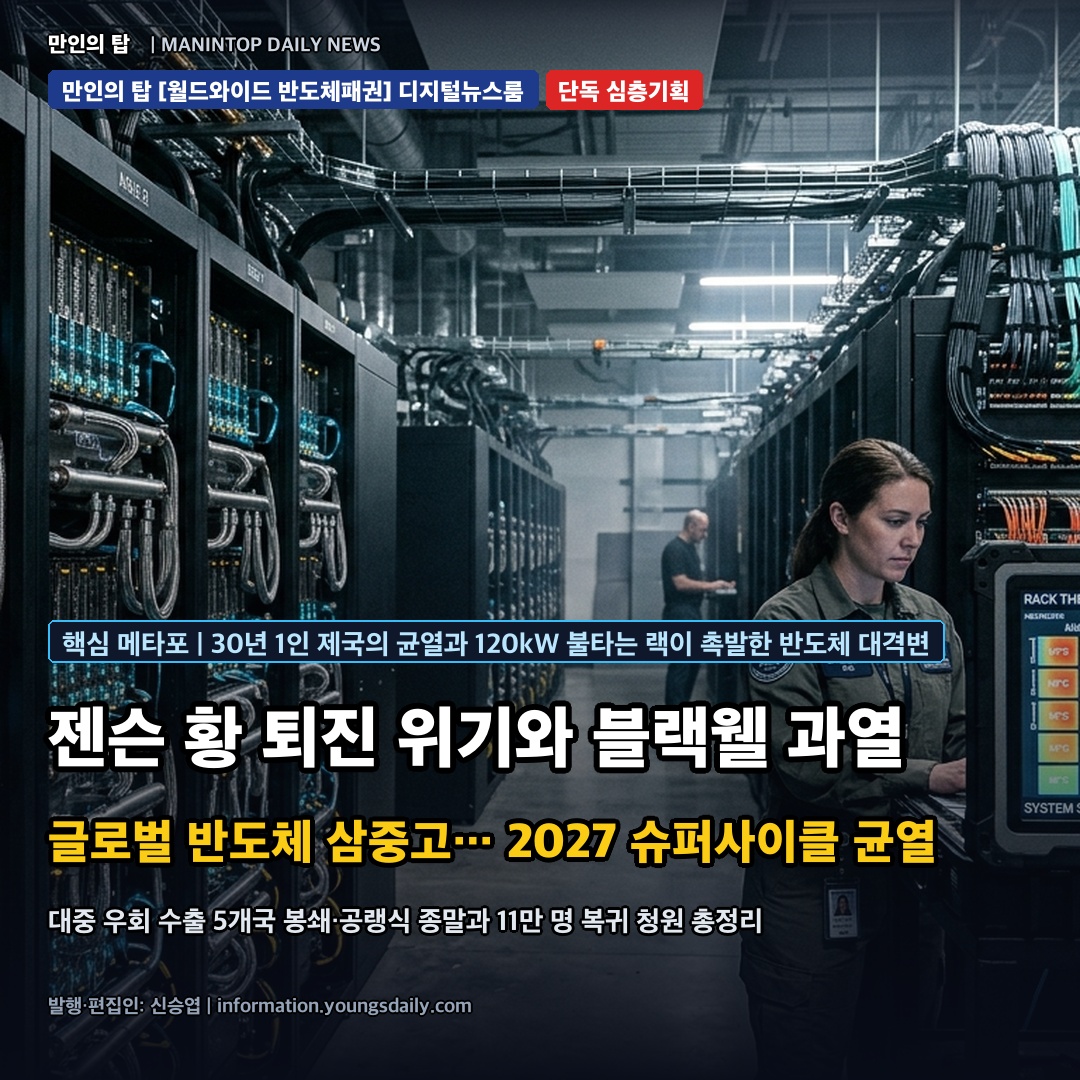
▲ 차세대 AI 하이퍼스케일 데이터센터 내부 전경. 랙당 120kW에 달하는 극단적 열 밀도로 인해 전통적인 공랭식 냉각이 한계에 부딪히며 액체 냉각 인프라 도입이 필수 과제로 부상했다. / 글로벌 인공지능 인프라 공식 보도 사진 자료
인공지능(AI) 혁명을 주도해 온 글로벌 반도체 제국 엔비디아가 창립 30년 만에 사상 최대의 복합 위기에 직면했습니다. 창업자이자 절대적 사령탑인 젠슨 황 최고경영자(CEO)가 국가 안보 첩보 조사와 개인적 스캔들로 전격 퇴진 위기에 몰리며 1인 리더십에 균열이 가고 있는 가운데, 차세대 핵심 칩인 120kW 고밀도 블랙웰 GPU의 극심한 과열과 패키징 뒤틀림 결함으로 데이터센터 인프라 전면 수정이라는 엔지니어링 난제가 겹쳤습니다. 여기에 미국 정부가 동남아 5개국을 경유하는 대중국 우회 수출로를 원천 봉쇄하면서 글로벌 반도체 증시가 연쇄 급락세로 돌아섰고, 2027년 메모리 슈퍼사이클 정점론까지 고개를 들고 있습니다. 월가와 글로벌 테크 생태계를 뒤흔든 반도체 삼중고의 실체와 11만 명 주주 청원의 전말을 심층 진단합니다.
"중국 첩보 표적설과 46억 달러의 의혹"… 젠슨 황 퇴진 위기의 내막
30년 넘게 가죽 재킷을 입고 글로벌 테크 무대를 호령하던 젠슨 황 엔비디아 최고경영자(CEO)가 일생일대의 정치·경영학적 위기에 내몰렸습니다. 미국 행정부 고위 관료들 사이에 유포된 정보 보고서에 따르면, 싱가포르에 본사를 둔 데이터센터 임대 기업 메가스피드 인터내셔널의 전직 고위 임원이 중국 정보기관에 포섭되어 젠슨 황에 대한 정보를 수집해 온 첩보가 확인되었습니다.
메가스피드는 자체 보유 현금의 1,000배가 넘는 무려 46억 달러(약 6조 1,800억 원) 상당의 엔비디아 첨단 AI 칩을 사들인 최대 고객사 중 하나였습니다. 미국 정부는 이 막대한 물량이 동남아를 거쳐 미국의 대중국 수출 규제를 뚫고 중국 인공지능 연구소로 우회 밀반입되었는지 여부를 정밀 추적해 왔습니다. 미 의회 하원의 핵심 의원들이 젠슨 황에게 직접 청문회 출석과 해명을 압박하자, 엔비디아 이사회는 사외 독립 이사들로 구성된 위원회를 꾸려 외부 법률 고문과 함께 내부 조사에 착수했습니다.
이에 맞서 글로벌 투자자와 테크 리더들은 즉각 집단행동에 돌입했습니다. 얼티미터 캐피털과 아트레이디스 매니지먼트 등 대형 주주들이 이사회에 공개서한을 보내 젠슨 황의 복귀 문을 열어두라고 촉구한 데 이어, 온라인에서 시작된 '스탠드 위드 젠슨(Stand with Jensen)' 서명 운동에는 주주 6만 명과 직원 5,000명을 포함해 전 세계 11만 명이 서명했습니다. 일론 머스크 테슬라 CEO, 팀 스위니 에픽게임즈 CEO, 개리 탄 Y콤비네이터 CEO, 박현주 미래에셋그룹 회장까지 서명 명단에 이름을 올리며 젠슨 황 없는 엔비디아의 리더십 공백을 격렬히 경고하고 있습니다.
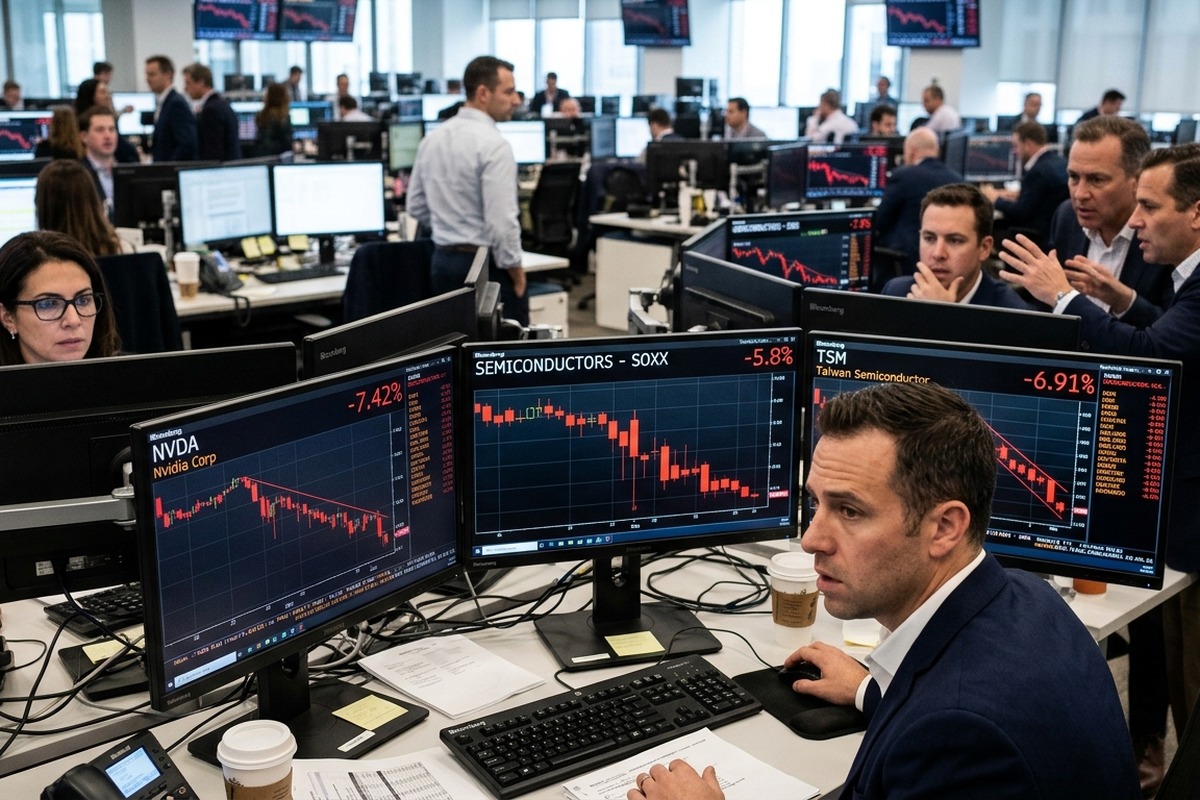
▲ 금융시장 트레이딩 룸 전경. 미 상무부의 동남아 5개국 AI 칩 수출 통제와 젠슨 황 스캔들이 겹치며 필라델피아 반도체 지수(SOX)와 SOXX ETF가 5% 이상 폭락하는 등 글로벌 증시가 요동쳤다. / 글로벌 금융시장 보도 사진 자료
"랙 하나에 120kW 뿜는다"… 블랙웰 발열 대란과 공랭식의 완전한 종말
거버넌스 위기 뒤편에서는 인류 반도체 공학 역사상 가장 혹독한 '발열과의 전쟁'이 벌어지고 있습니다. 엔비디아의 차세대 가속기 블랙웰은 단일 GPU의 열설계전력(TDP)이 최대 1,000W에 달하며, 72개 GPU를 집적한 'GB200 NVL72' 서버 랙 단 한 대가 무려 120kW의 전력을 집어삼킵니다. 기존 데이터센터의 일반 랙 전력 소모량(10~15kW)의 10배에 달하는 전례 없는 열 집중입니다.
발열 문제의 핵심 원인은 TSMC의 첨단 패키징인 CoWoS-L 공정의 '열팽창 계수(CTE) 불일치'에 있었습니다. 반도체 다이와 LSI 실리콘 브릿지, 유기물 기판이 고열 환경에서 서로 다른 비율로 팽창하면서 기판이 바이메탈처럼 휘어지는 '워피지(Warpage)' 현상이 발생했고, 마이크로 범프 접합부가 손상되어 초기 양산 수율이 60% 수준에 묶였습니다. 이에 엔비디아는 상단 메탈 레이어를 재설계하고 새 포토마스크를 적용하는 한편, 랙 프레임에 100파운드의 강철 보강재와 1,400암페어 고용량 버스바를 결합해 물리적 안정성을 확보했습니다.
이번 사태는 공기로 칩을 식히는 공랭식(Air Cooling) 시대의 완전한 종말을 알렸습니다. 냉각수를 칩 표면에 직접 순환시키는 직랭식(D2C) 액체 냉각이 기본 표준으로 자리 잡았으며, 2028년 4,400W를 소비할 파인만(Feynman) 세대부터는 서버 전체를 절연유에 통째로 담그는 완전 액침냉각(Immersion Cooling)으로의 패러다임 전환이 불가피해졌습니다.
냉각 진화 단계
냉각 기술 메커니즘
허용 전력 및 적용 세대
데이터센터 인프라 변화
1단계 (전통 공랭식)
냉각 팬과 에어컨 공기 순환에 의존
랙당 10~15kW 수준 (한계 도달)
레거시 전산실, AI 가속기 냉각 불가
2단계 (직랭식 액체)
콜드플레이트를 GPU 표면에 밀착해 냉각수 순환
랙당 20~200kW (블랙웰·루빈 세대)
데이터센터 내 냉각수 배관 및 버스바 증설
3단계 (완전 액침냉각)
비전도성 절연 플루이드에 서버 전체 침수
칩당 4,400~9,000W (2028 파인만 이후)
수조형 탱크 도입, PUE 1.05 수준 달성
4단계 (칩 내장 냉각)
실리콘 다이 내부 미세 유로를 통한 직접 순환
단일 칩 15,000W 이상 (2032 차세대)
반도체 설계와 냉각의 물리적 일체화
자료: 엔비디아 기술 백서 및 카이스트 테라랩 차세대 AI 냉각 연구 분석 종합
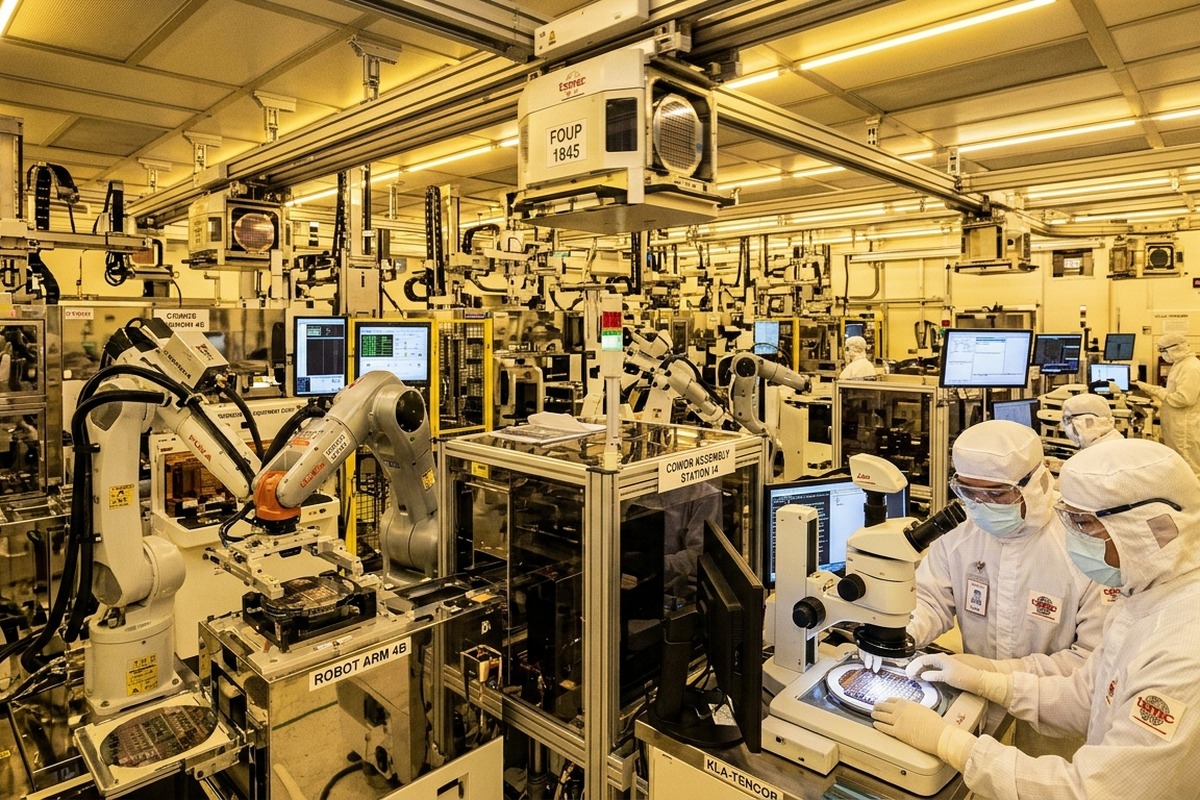
▲ 첨단 패키징 클린룸 전경. TSMC의 CoWoS 수율 병목 극복에도 불구하고, 빅테크 기업들은 공급선 다변화를 위해 삼성전자와 인텔을 백업 파운드리로 검토하며 공급망 균열을 대비하고 있다. / 글로벌 반도체 생산 제조 보도 사진 자료
"동남아 5개국까지 묶었다"… 미국의 대중 그물망과 글로벌 반도체 투매 폭풍
반도체 산업을 덮친 또 다른 거대한 파도는 미국 정부의 기습적인 대중국 우회 수출 통제였습니다. 미 상무부는 싱가포르, 말레이시아, 인도네시아, 태국 등 동남아 주요 4개국과 브라질로 수출되는 모든 첨단 AI 가속기에 대해 개별 수출 허가를 의무화하는 신규 규정을 전격 발표했습니다.
중국 기업들이 자국 내 반도체 수입이 막히자 싱가포르 등 동남아 데이터센터 인프라를 원격 클라우드로 임차해 첨단 LLM 모델을 학습시키는 우회로를 발견하고 이를 원천 봉쇄한 것입니다. 아시아의 핵심 데이터 허브인 싱가포르가 묶이면서 현지로 향하던 수십억 달러 규모의 칩 출하가 즉각 지연 위기에 처했습니다.
이 발표는 젠슨 황 스캔들과 맞물려 글로벌 반도체 증시를 집어삼켰습니다. 반도체 대표 ETF인 SOXX가 5.41% 폭락하며 142.67달러 선으로 주저앉았고, 필라델피아 반도체 지수(SOX)는 5.28% 급락했습니다. 국내 증시에서도 엔비디아의 핵심 파트너인 SK하이닉스가 하루 만에 7.89% 폭락했고, 삼성전자(-4.47%)와 마이크론(-7.62%), 인텔(-7.07%)이 동반 급락하며 코스피 지수가 3.6% 하락하는 연쇄 충격을 낳았습니다. 미국 10년물 국채 금리가 5.17%까지 치솟고 달러 인덱스가 103.53을 기록하며 신흥국 자금 이탈을 부추겼습니다.
소버린 AI의 역설적 92% 독점과 "2027년 메모리 슈퍼사이클 붕괴" 경고
이러한 위기 속에서도 엔비디아의 시장 독점력은 기이할 정도로 공고합니다. 카운터포인트 리서치에 따르면 글로벌 55개국의 '소버린(자주적) AI' 인프라 중 무려 92%가 엔비디아 GPU를 연산 기반으로 채택하고 있습니다. 데이터는 자국 내에 두지만, 두뇌인 칩과 개발 환경은 엔비디아의 '쿠다(CUDA)' 생태계에 완벽히 종속되어 대체재를 찾지 못하는 기형적 구조입니다.
하지만 메모리와 파운드리 생태계 밑바닥에서는 이미 냉각의 전조가 감지되고 있습니다. 전 삼성전자 DS부문장 경계현 상임고문은 최근 "글로벌 생산능력이 급팽창하면서 2027년 하반기부터 메모리 반도체 가격이 하락 전환할 것"이라는 뼈아픈 경고를 던졌습니다.
가장 큰 위협은 중국 창신메모리(CXMT)의 폭발적 증설입니다. CXMT는 월 웨이퍼 생산량을 2024년 10만 장에서 2026년 30만 장으로 3배나 늘리고 있으며, 이 중 20%(월 6만 장)를 HBM3 라인으로 전환해 화웨이 등 자국 NPU에 공급하고 있습니다. 한국과 미국 반도체 기업들이 고수익 HBM에 집중하는 사이 레거시 DRAM 시장이 중국의 덤핑 공세에 잠식당하고, 2027년에는 HBM 영역까지 공급 과잉의 파도가 덮칠 수 있다는 분석입니다.
급변하는 반도체 변동성 장세에서 서학개미 투자자들은 거래 비용 방어에도 유의해야 합니다. 주요 증권사의 환전 우대율(최대 95%)과 수수료 혜택(미래에셋 첫 3개월 0%, 키움 0.07~0.09%, 토스 0.10%)을 꼼꼼히 비교하고, 미국 증권거래위원회(SEC) 매도 수수료(약 0.00278%) 차감 구조를 숙지하여 실질 투자 수익률을 지켜내는 혜안이 요구되는 시점입니다.
발행·편집인: 신승엽 | information.youngsdaily.com
본 보도 기사는 미국 상무부 산업안보국(BIS) 규정 고시, 글로벌 시장조사기관 카운터포인트 리서치 통계 및 반도체 공학 학술 데이터를 정밀 검증하여 편찬되었습니다.
Global Semiconductor & AI Geopolitics | Analysis on Governance Turmoil, 120kW Cooling Shifts, and Export Controls
Official Editorial Release | Advanced Technology & International Finance Desk
[EXCLUSIVE] 'Fissures in a 30-Year Empire' Jensen Huang Leadership Crisis and 120kW Blackwell Overheating: Global Chip Trilemma
▲ Interior view of a next-generation AI hyperscale datacenter. Extreme thermal density reaching 120kW per rack has pushed conventional air cooling past its physical limits, making liquid-cooling infrastructure mandatory across the industry. / Artificial Intelligence Technology Press Archive
Nvidia, the undisputed colossus of the global artificial intelligence revolution, is confronting an unprecedented convergence of existential shocks three decades after its founding. As legendary chief executive Jensen Huang faces an abrupt leadership crisis triggered by national security espionage probes and personal scandal, catastrophic thermal density in its flagship 120kW Blackwell computing racks has forced an emergency overhaul of advanced packaging and data center cooling architectures. Compounding the turmoil, fresh United States export restrictions choking proxy semiconductor trade through Southeast Asia have sent global semiconductor equities into a sharp tailspin. From a 110,000-signature petition to prevent leadership vacuums to warnings of a 2027 memory downcycle, this comprehensive investigation analyzes the trilemma destabilizing the world's most critical tech ecosystem.
Espionage Allegations and the 4.6 Billion Dollar Channel: The Jensen Huang Crisis
Jensen Huang, the charismatic leader who has steered Nvidia in his trademark leather jacket for over three decades, is suddenly facing an unprecedented governance crisis. Intelligence memos circulating among senior United States officials revealed that a former executive of Singapore-based datacenter leasing firm Megaspeed International was allegedly targeted and recruited by Chinese intelligence to gather sensitive intelligence on Huang.
Trade registries show Megaspeed emerged as one of Nvidia's largest buyers, importing 4.6 billion dollars in advanced AI hardware in 2023 alone—an amount exceeding one thousand times its own cash holdings. Federal investigators have probed whether the entity functioned as a proxy smuggling channel rerouting export-restricted processors into Chinese research laboratories. Following pressure from prominent House lawmakers demanding formal briefings, Nvidia's board established an independent committee supported by outside legal counsel to conduct an internal inquiry.
In response, institutional investors and global tech luminaries launched massive collective action. Major shareholders including Altimeter Capital and Atreides Management addressed open letters to the board urging that pathways for Huang's return remain open. Concurrently, the grassroots Stand with Jensen petition mobilized over 110,000 signatures, including 60,000 retail shareholders, 5,000 Nvidia employees, Tesla chief Elon Musk, Epic Games CEO Tim Sweeney, Y Combinator CEO Garry Tan, and Mirae Asset Financial Group chairman Park Hyeon-joo, underscoring the peril of leadership vacuums.
▲ Trading floor monitors tracking sharp declines across technology benchmarks. The combination of Southeast Asian AI chip export licensing and executive uncertainty triggered broad selling across the Philadelphia Semiconductor Index and related equities. / Financial Market Press Archive
120kW per Rack: Blackwell Overheating Challenges and the End of Air Cooling
Behind executive headlines lies the most arduous thermal engineering confrontation in modern semiconductor history. Nvidia's flagship Blackwell architecture features individual GPU thermal design power reaching 1,000 watts, while a unified GB200 NVL72 computing cabinet draws an astounding 120 kilowatts. This concentration is ten times greater than conventional datacenter racks operating at 10 to 15 kilowatts.
The root bottleneck stemmed from coefficient of thermal expansion mismatch within TSMC's CoWoS-L packaging. Silicon dies, local silicon interconnect bridges, and organic substrate layers expanded unevenly under elevated operating temperatures, inducing substrate warpage that fractured micro-bumps and depressed initial production yields to roughly 60 percent. Nvidia addressed the defect by revising upper metallization layers, implementing revised photomasks, reinforcing rack chassis with 100 pounds of structural steel, and integrating 1,400-ampere busbars.
This inflection signals the definitive demise of air cooling for frontier AI systems. Direct-to-chip liquid cooling has become baseline requirement, while the anticipated 4,400-watt Feynman generation slated for 2028 will necessitate complete two-phase immersion cooling wherein entire server blades are submerged in non-conductive dielectric fluid.
Cooling Epoch
Thermal Dissipation Mechanism
Thermal Threshold & Generation
Datacenter Infrastructure Impact
Phase 1 (Legacy Air)
Chilled airflow circulation and high-RPM chassis fans
10 to 15 kW per cabinet (Obsolete)
Incapable of cooling advanced modern AI accelerators
Phase 2 (Direct-to-Chip)
Liquid cold plates attached directly to die surfaces
20 to 200 kW per cabinet (Blackwell / Rubin)
Mandatory plumbing manifolds and high-current busbars
Phase 3 (Full Immersion)
Submersion of entire servers in dielectric fluids
4,400 to 9,000 W per processor (2028 Feynman)
Tank-based architectures achieving PUE around 1.05
Complete structural synthesis of design and cooling
▲ Advanced packaging cleanroom environment. While TSMC has driven CoWoS yields past 98 percent, global hyperscalers are actively testing Samsung Electronics and Intel as secondary foundry backups to mitigate geopolitical single-point risks. / Semiconductor Fabrication Archive
Targeting 5 Nations: US Commerce Department Clamps Down on Proxy AI Routes
The second shockwave buffeting the sector originated from Washington. The United States Department of Commerce Bureau of Industry and Security abruptly mandated validated end-user export licenses for all advanced AI accelerators bound for Singapore, Malaysia, Indonesia, Thailand, and Brazil.
The expansion specifically targets proxy operations wherein Chinese developers lease offshore cloud infrastructure across Southeast Asia to train proprietary frontier foundation models. With Singapore—the primary connectivity junction for Southeast Asia—abruptly restricted, multi-billion-dollar shipments en route to regional hyperscale facilities face indefinite licensing delays.
The regulatory clampdown triggered severe market repercussions. The iShares Semiconductor ETF (SOXX) sank 5.41 percent to 142.67 dollars, while the Philadelphia Semiconductor Index dropped 5.28 percent. In Seoul, primary Nvidia memory partner SK Hynix tumbled 7.89 percent in a single trading session, accompanied by steep drops in Samsung Electronics (-4.47 percent), Micron Technology (-7.62 percent), and Intel (-7.07 percent). Benchmark 10-year Treasury yields climbed to 5.17 percent alongside a strengthening Dollar Index at 103.53.
The 92% Sovereign AI Monopoly and Warnings of a 2027 Memory Downcycle
Despite these vulnerabilities, Nvidia retains a monopolistic grip on national AI deployments. Research by Counterpoint indicates that across 55 sovereign nations operating proprietary large language models, 92 percent rely exclusively on Nvidia GPU infrastructure. While sovereign entities mandate localized hosting within domestic borders, computing engines remain thoroughly bound to Nvidia's proprietary CUDA programming ecosystem.
Nevertheless, warning signs are accumulating across upstream memory supply chains. Former Samsung Electronics Device Solutions chief Kyung Kye-hyun warned in recent remarks that rapidly expanding global manufacturing capacity will push memory chip pricing into cyclical downturn by the second half of 2027.
China's ChangXin Memory Technologies (CXMT) represents the foremost catalyst, aggressively expanding monthly wafer production from 100,000 in early 2024 toward 300,000 by 2026. Significantly, CXMT is dedicating roughly 20 percent of this capacity (60,000 wafers per month) toward domestic HBM3 production for Huawei NPU architectures. While Western and Korean chipmakers concentrate on premium HBM margins, Chinese competitors threaten to erode legacy DRAM market share before expanding into premium memory tiers.
In this turbulent landscape, retail investors navigating technology volatility must carefully monitor brokerage execution costs. Comparing promotional commission rates and foreign exchange conversion discounts across major brokerages remains crucial for shielding net equity returns amid elevated market volatility.
This investigative report was compiled through rigorous cross-examination of United States Department of Commerce export notices, Counterpoint Research analytics, and technical publications from semiconductor engineering bodies.
PRO SOURCING ENGINE만인의 탑 빅데이터 솔루션
★ 가입 시 600 크레딧(120회) 전원 무료
내가 찾는 상품 키워드, 지금 얼마나 검색될까?
네이버 월간 검색량 + 구글 볼륨 + 아이템스카우트 실시간 상품수와 경쟁강도 배지를 0.5초 만에 무료로 확인하세요.
MANINTOP NEWSLETTER
📬 만인의 탑 뉴스레터 무료 구독
오늘 보신 정책·시사 뉴스가 유익하셨나요? 매일 엄선되는 알짜 복지 혜택과 국회 실시간 속보를 이메일로 가장 먼저 받아보세요. (평생 무료)
1월이 시작되면 감기는 이미 우리 곁에 와 있습니다. 2월, 3월, 4월까지 이어지는 추위와 건조함은 코와 목을 가장 먼저 공격합니다. 아침에 일어나자마자 막혀 있는 코. 계속 흐르는 콧물. 괜히 칼칼해지는 목. 이 증상은 “시작”일 뿐입니다. 한 번 무너지면 일주일, 길면 한 달까지 끌고 갑니다. 약을 먹으면 잠깐 괜찮아집니다. 하지만 며칠 뒤 또 반복됩니다. 왜일까요? 감기는 ‘치료’의 문제가 아니라 ‘관리’의 문제이기 때문입니다. 대부분은 감기가 오고 나서 약을 찾습니다. 하지만 진짜 중요한 건 감기가 오기 전에 코와 목을 지키는 것입니다. 건조한 실내 공기, 차가운 바깥 공기, 눈에 보이지 않는 세균. 코와 목은 매일 공격받고 있습니다. 지긋지긋하죠! 그런데도 우리는 아무 준비 없이 버티고 있습니다. 이번 겨울도 그렇게 보낼 건가요? 사실 방법은 어렵지 않습니다. 코를 깨끗하게 관리하고, 목을 따뜻하게 보호하고, 점막을 촉촉하게 유지하고, 기관지를 미리 관리하고, 외부 공기를 차단하는 것. 이 다섯 가지만 꾸준히 해도 감기약 없이 겨울을 보내는 것이 충분히 가능합니다. 🔥 이제부터 그 방법을 하나씩 살펴보겠습니다. 🔥 1. 코와 목을 먼저 관리해야 하는 과학적 이유 감기의 대부분은 코 점막에서 시작됩니다. 국제 학술지 Nature Reviews Microbiology 와 Journal of Allergy and Clinical Immunology 에 실린 호흡기 감염 관련 연구들에서는, 감기 바이러스가 비강 상피세포에 먼저 부착해 증식한다는 점을 설명하고 ...
리모델링사업이 진행 중인 아파트를 매매할 때 “계약금 10%를 언제까지 내야 하느냐”는 질문이 특히 많이 나옵니다. 이주공고(이주 안내)가 7~11월쯤이라고 들으면, 그 시점에 맞춰 계약금도 움직일 것 같아서 더 헷갈리기 쉽습니다. 하지만 실제 납부기한은 ‘이주공고가 언제냐’만으로 자동 결정되지 않는 경우가 많습니다. 1) 계약금 10% 납부기한: 결국 ‘문서에 적힌 일정’이 기준 계약금 10%를 언제까지 납부해야 하는지는, 내가 서명하는 매매계약서(특약 포함) 와 사업주체/조합이 제시한 공고·안내문 에 적힌 납부 일정이 기준이 됩니다. 실제 공고문에서는 분양대금 납부의 큰 틀(계약금→중도금→잔금)을 먼저 안내하고, 상세 일정은 별도 표나 유의사항으로 제시하는 방식이 흔합니다. 또, 계약서 문구에 따라 지급 시점이 조건부로 설정될 수도 있습니다. 예를 들어 한 사례 소개 자료에서는 용역계약서에 잔금(10%) 지급시기가 “사업승인 후”로 기재되어 있었다는 점이 언급됩니다. 이런 식으로 ‘사업 단계’와 지급을 연동하는 문구가 들어가면, 질문의 답은 계약서 문구를 확인해야만 확정됩니다. 관련 내용은 링크 에서 문구 사례를 확인할 수 있습니다. 2) 입주자모집공고에서 확인되는 ‘납부 순서’와 잔금 마감 시점 공고문에 적힌 문구를 보면, 납부 순서와 잔금 마감에 대한 기준이 비교적 명확하게 제시되는 경우가 있습니다. 예를 들어 한 입주자모집공고에는 “분양금액(주택가격)은 계약금, 중도금, 잔금의 순서로 납부”하며 “잔금은 입주(열쇠 수령일) 전에 완납”해야 한다고 안내되어 있습니다. (문구 확인: 링크 ) 이 문구가 의미하는 바는 최소 2가지입니다. 분양/공급 형태의 문서에서는 ‘계약금→중도금→잔금’ 흐름이 공식적으로 안내될 수 있습니다. 잔금은 “입주(열쇠 수령)” 이전에 완납해야 한다는 마감 기준이 문서에 적혀 있을 수 있습니다. 다만, 위 공고문 문구는 잔금 마감에 대한 기준을 보여주지만, 계약금 10%의...
윤석열 전 대통령 탄핵 인용 소식을 접하면, 가장 궁금한 지점은 ‘헌재가 정확히 무엇을 위헌·위법으로 봤는가’입니다. 또한 탄핵과 별개로 진행되는 형사재판(내란 우두머리 혐의 등)이 어디까지 왔는지도 함께 정리할 필요가 있습니다. 아래 내용은 제공된 기사/게시물 스니펫과 링크에서 확인되는 범위만 모아, 일반인이 흐름을 이해하기 쉽게 정리한 것입니다. 1) 탄핵 인용 관련: 스니펫에서 확인되는 ‘판단의 골격’ 제공된 근거 중 조국혁신당 사이트에는 헌법재판소가 윤석열 탄핵 심판에서 “피청구인의 위헌·위법행위는 국민 신임 …”이라는 취지로 판단했다는 문장이 인용돼 있습니다( 링크 ). 이 인용문만 놓고 보면, ‘위헌·위법행위’가 있었는지와 그로 인해 ‘국민의 신임’이 어떻게 평가됐는지가 핵심 축으로 소개됩니다. 다만 질문에서 요청하신 세부 항목, 즉 비상계엄 선포 자체를 문제 삼은 구체적 이유, 계엄 이후 조치(포고령, 국회 통제 등)의 어떤 지점이 헌법 위반인지, 국회의 권한행사 방해 및 정치활동 제약을 어떤 논리로 판단했는지 등은, 이번에 제공된 근거의 제목/스니펫만으로는 조항·사실관계·판단 구조가 그대로 제시돼 있지 않습니다. 따라서 이 글에서는 ‘헌재가 무엇을 문제 삼았다’는 세부 리스트를 단정적으로 재구성하기보다, 현재 확인 가능한 문구 수준의 요약(위헌·위법행위 → 국민 신임의 문제로 평가)까지만 적습니다. 만약 헌재 결정문 전문(주문 및 이유)이 추가로 확인되면, 그때는 문장 단위로 ‘어떤 행위’와 ‘어떤 헌법 원리/조항’이 연결되는지(예: 권력분립, 국회의 권한, 정치적 기본권 등) 구조화해 정리하는 것이 가장 정확합니다. 2) 형사 절차(내란 혐의) 관련: 체포영장과 1심 선고 언급 탄핵 심판과 별도로, 12·3 비상계엄 사태로 내란 혐의를 받는 윤석열 대통령에 대해 2024년 12월 31일 체포 영장이 발부됐다는 BBC 보도가 있습니다( 링크 ). 해당 보도는 ‘현직 대통령’에 대한 체포영장 발부라는 점을 함께 언급합니다. 또...