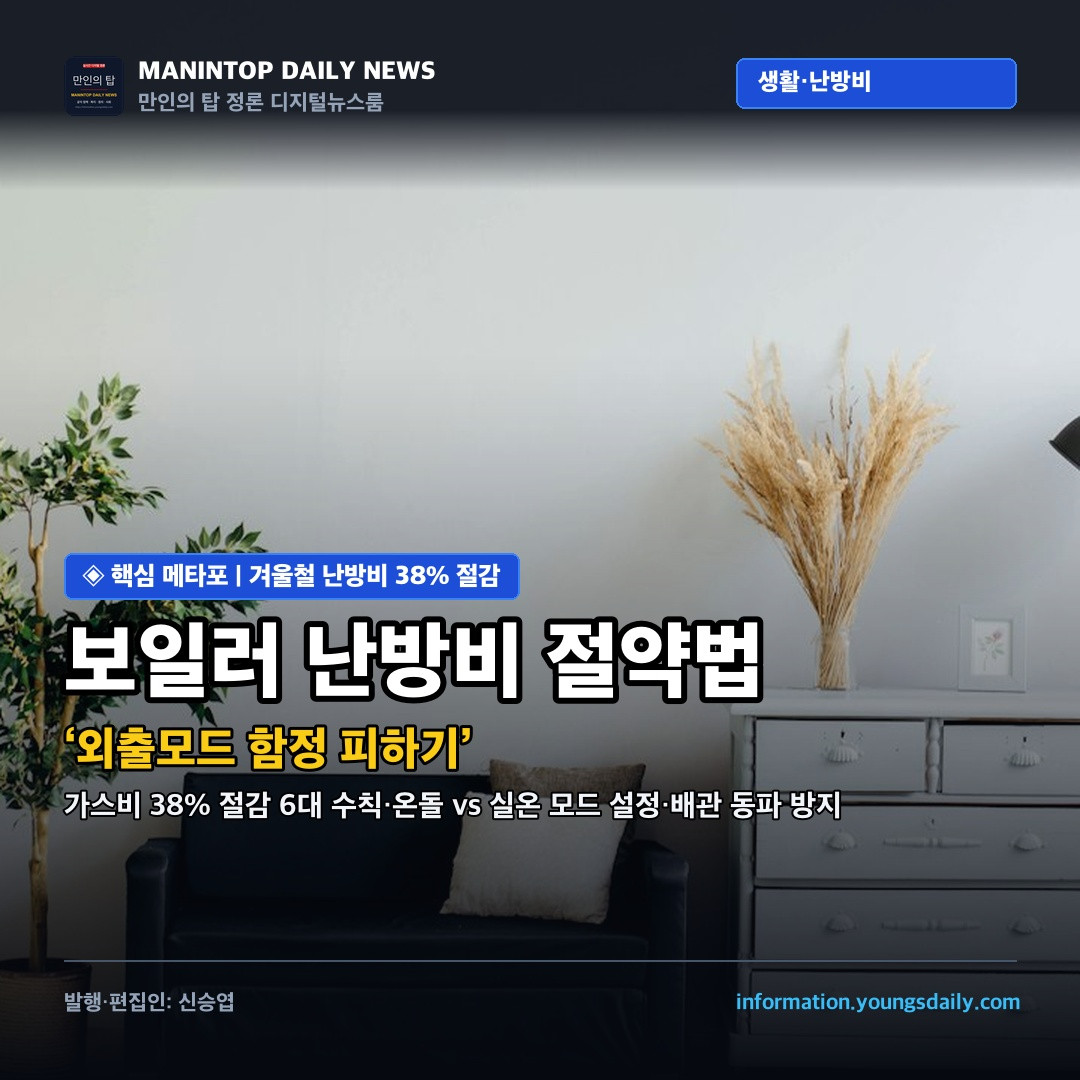
▲ “외출모드 눌렀다 가스비 폭탄”… 겨울철 보일러 난방비 38% 절감 6대 수칙과 동파 방지법 (공식 보도 자료)
📌 핵심 브리핑 · 주요 쟁점 및 핵심 요약
외출모드 눌렀다 가스비 폭탄 을 맞았다는 소비자들의 피해 호소가 잇따르는 가운데, 본격적인 초겨울 한파를 앞두고 난방비를 최대 38% 절감할 수 있는 과학적 보일러 운용법이 주목받고 있습니다. 한국에너지공단과 기계설비 전문가들의 실측 분석에 따르면, 출퇴근 등 8시간 이내 단기 외출 시 보일러를 외출 모드로 돌리면 바닥 난방수가 차갑게 식어 귀가 후 재가동 시 평소보다 2~3배 이상의 가스를 소모하는 열역학적 피크 부하가 발생합니다. 단순히 난방을 끄고 추위를 참는 대신 주거 환경에 맞춰 실온 모드와 온돌(난방수) 모드를 전략적으로 선택하고, 틈새 열손실 차단과 미사용 방 분배기 밸브 조절을 병행할 경우 가구당 월평균 36,101원의 도시가스 요금을 아낄 수 있습니다. 본 심층 가이드에서는 에너지공단 공인 6대 절약 행동요령과 주거 형태별 최적 제어 메커니즘, 에어캡과 문풍지의 정량적 단열 실험 데이터, 실내 습도 40~50% 유지와 타임블록 3구간 스케줄링, 그리고 한국가스공사 캐시백 신청 및 배관 동파 방지열선 안전 수칙을 총정리합니다.
SPONSORED · ADVERTISEMENT
1. 난방비 절감 종합 효과 및 한국에너지공단 6대 행동요령 실측 분석
겨울철 한파와 도시가스 요금 인상이 맞물리면서 서민 가계의 난방비 부담이 급증하고 있습니다. 한국에너지공단 공식 보도자료와 실측 실험 데이터에 따르면, 겨울철 일상생활에서 실천할 수 있는 6대 핵심 난방비 절약 수칙을 체계적으로 준수할 경우 한 달 도시가스 사용량의 최대 38%를 감축할 수 있으며, 가구당 월평균 약 36,101원의 경제적 절감 효과를 거둘 수 있는 것으로 확인되었습니다.
에너지공단이 입증한 6대 행동요령의 세부 절감 기여도는 다음과 같습니다. 첫째, 실내 목표 온도를 겨울철 적정 기준인 20℃로 설정하면 월 5.5%(약 5,227원)가 절약됩니다. 둘째, 온수 샤워 시간을 평소보다 5분 단축하면 온수 가열에 소모되는 도시가스의 7.2%(약 6,826원)가 즉시 절감됩니다. 셋째, 에어캡(뽁뽁이)과 문풍지, 방풍비닐로 창문 틈새 열손실을 차단하면 5.5%(약 5,227원)를 추가 방어할 수 있습니다. 넷째, 사용하지 않는 방의 난방 분배기 밸브를 미세 조절하면 4.4%(약 4,160원)가 아껴집니다.
나아가 보일러 배관 청소를 통해 난방수 순환 장애를 유발하는 침전물과 스케일을 제거하면 5.0%(약 4,760원)의 연소 효율이 개선되며, 10년 이상 된 노후 보일러를 친환경 고효율 콘덴싱 보일러로 교체할 경우 무려 10.4%(약 9,901원)의 절감 효과가 발생합니다. 이 6가지 행동요령을 복합적으로 실천할 때 누적 절감률은 38%에 달해 난방비 폭탄을 원천적으로 무력화할 수 있습니다.
▲ 실내 창가에 설치된 난방 배관과 단열재 상태를 점검하여 열손실을 막고 난방 효율을 높이는 모습 (보도 자료)
2. 보일러 제어 모드별 메커니즘과 외출 모드의 열역학적 함정
보일러를 사용할 때 가장 흔히 저지르는 치명적 실수는 출근이나 마트 방문 등 일상적인 외출 시 무심코 '외출 모드' 버튼을 누르는 행위입니다. 난방 엔지니어링 분석에 따르면 외출 모드의 부적절한 사용이야말로 가스비 폭탄을 부르는 주된 원인입니다.
보일러 제조사가 설계한 외출 모드는 실내 온도를 쾌적하게 유지하는 절전 기능이 아니라, 영하의 혹한기 속에서 보일러 내부와 직수 배관이 얼어 터지는 것을 방지하기 위해 최소한의 불꽃만 간헐적으로 켜는 '동파 방지용 초저전력 모드'입니다. 8시간 안팎의 출퇴근 시간 동안 외출 모드를 켜두면 바닥 난방수와 방바닥 콘크리트 온돌의 열용량이 완전히 식어 얼음장처럼 차가워집니다.
귀가 후 차가워진 실내를 다시 22~23℃로 올리려 할 때, 보일러는 완전히 냉각된 난방수를 끓이기 위해 버너의 연소 출력을 100% 풀가동하며 평소보다 2~3배 이상의 가스를 급격히 소모합니다. 열역학적으로 실내 온도를 1℃ 끌어올리는 데 필요한 가스 소비량은 약 7%씩 급증하므로, 완전히 식어버린 방을 재가열하는 비용이 온기를 일정하게 유지하는 비용보다 훨씬 큽니다. 따라서 8시간 이내의 단기 외출 시에는 외출 모드를 누르지 말고 '현재 설정 온도보다 2~3℃ 낮게'(예: 22℃ 유지 시 19~20℃로 설정) 조절하는 것이 가장 과학적인 절약법입니다.
구분 유형
지원 및 적용 대상
환급 및 해결 기준
신청 및 조치 방법
실내 적정온도 유지 (20℃)
설정온도 1℃ 하향 시 가스비 7% 절감
도시가스 5.5% 절감
월 약 5,227원 절약
온수 샤워 시간 단축
샤워 시간 평소보다 5분 줄이기
도시가스 7.2% 절감
월 약 6,826원 절약
창문 틈새 외풍 차단
뽁뽁이 부착 시 유리 표면온도 3℃ 상승
도시가스 5.5% 절감
월 약 5,227원 절약
미사용 방 분배기 조절
밸브 완전 차단 대신 10~20% 미세 개방
도시가스 4.4% 절감
월 약 4,160원 절약
배관 청소 및 콘덴싱 교체
배관 내 스케일 제거 및 친환경 보일러
도시가스 15.4% 절감
월 약 14,661원 절약
종합 실천 시 총 절감액
에너지공단 6대 절약 수칙 동시 실천
최대 38.0% 절감
가구당 월 36,101원 절약
SPONSORED · ADVERTISEMENT
3. 주거 환경별 보일러 최적 운용: 실온 vs 온돌 vs 예약 모드
거주하는 건물의 단열 등급과 외풍 상태에 따라 보일러 제어 모드를 다르게 설정해야 에너지 낭비를 막을 수 있습니다. 첫째, 단열이 우수하고 외풍이 거의 없는 신축 아파트는 '실온 모드(실내 모드)'가 최적입니다. 온도조절기 내부의 공기 센서가 실내 온도를 정확히 감지하므로, 목표 온도를 20~21℃로 설정하고 유지하는 것만으로 충분한 효율을 발휘합니다.
둘째, 창문이나 문틈으로 찬바람이 지속적으로 유입되는 노후 주택이나 빌라의 경우 실온 모드를 켜두면 센서가 차가운 외풍을 지속적으로 감지하여 바닥이 이미 뜨거운데도 보일러가 24시간 내내 쉬지 않고 가동되는 오류가 발생합니다. 이 경우 실내 공기 온도가 아닌 배관 속 온수 온도를 측정하는 '온돌 모드(난방수 모드)'로 전환해야 합니다. 적정 난방수 온도는 45~65℃(외풍이 극심할 경우 60~70℃)로 설정하여 바닥 열기를 안정적으로 유지해야 합니다.
셋째, 단열이 매우 취약하여 보일러를 꺼두면 실내가 급속도로 냉각되는 주택은 '예약 모드'를 활용하는 것이 유리합니다. '3~4시간마다 15~20분 가동' 주기로 설정하면 바닥이 완전히 차가워지는 현상을 방어하면서 불필요한 연속 연소를 차단할 수 있습니다. 아울러 온수 설정 온도를 최고(70℃) 대신 40~50℃('중' 수준)로 낮추고, 세면 후 수도꼭지 레버를 항상 냉수 방향으로 돌려두는 습관만으로도 미세한 보일러 불필요 점화를 완벽히 차단할 수 있습니다.
▲ 가정용 친환경 콘덴싱 보일러 기기 및 난방수 분배기 밸브를 점검하여 동파를 방지하는 설비 관리 현장 (보도 자료)
4. 단열 실험 데이터·생활 루틴과 정부 캐시백 및 동파 안전 수칙
🚨 신청 기한 및 주의사항 경고
실내에서 생성된 열기가 외부로 유출되지 않도록 차단하는 외풍 방지 시공은 보일러 가동 시간을 직접적으로 줄여줍니다. 공인 연구기관 실험에 따르면 유리창에 에어캡(뽁뽁이)을 시공할 경우 공기층의 낮은 열전도율 덕분에 유리 표면 온도가 2.5~3.0℃ 상승하며, 방풍비닐을 설치할 경우 창호 틈새 외풍 침투를 100% 완벽 차단하는 것으로 나타났습니다. 여기에 가습기를 가동해 실내 습도를 40~50%로 유지하면 공기 중 수분의 높은 비열로 인해 열대류 순환 속도가 빨라져 동일한 보일러 설정에서도 체감온도가 1~2℃ 상승합니다.
거주 패턴에 맞춰 3구간 타임블록 스케줄(기상 20.5~21℃, 주간 외출 18℃, 저녁 귀가 20.5~21.5℃, 취침 18~20℃)을 운용하고, 사용하지 않는 방의 난방 밸브는 동파 방지를 위해 완전히 잠그지 말고 10~20%만 살짝 열어두는 것이 핵심 요령입니다.
나아가 한국가스공사가 운영하는 '도시가스 절약 캐시백(k-gascashback.or.kr)'을 신청하면 동절기(12월~3월) 사용량을 전년 동기 대비 3% 이상 감축할 경우 절감량에 따라 7~8월에 현금 환급금을 돌려받을 수 있습니다. 영하 10℃ 이하 혹한기에는 배관 동파 방지를 위해 온수 수도꼭지를 미세하게 똑똑 떨어지도록 열어두고, 동파방지열선을 시공할 때는 국소 과열 화재를 막기 위해 열선이 서로 겹치거나 교차하지 않도록 일정한 간격을 유지해 감아야 합니다.
“Pressing Away Mode Triggered Utility Bill Surges”: 6 Strategic Rules to Cut Winter Heating Costs by 38 Percent and Prevent Pipe Freezing
Pressing Away Mode triggered utility bill surges for countless households across the nation, making scientific boiler temperature regulation and thermodynamic thermal preservation paramount as sub-zero cold waves arrive. According to verified empirical studies by the Korea Energy Agency alongside thermal mechanical engineering specialists, switching residential gas boilers to Away Mode during brief 8-hour workday absences allows circulating radiant floor water to chill completely, prompting gas burners to fire at maximum thermodynamic surge loads upon return that consume two to three times more gas than maintaining stable baseline temperatures. Rather than enduring uncomfortable chills through unscientific shutdowns, optimizing control algorithms between Ambient Air and Radiant Water modes, weatherstripping structural apertures, and calibrating manifold valves saves an average of 36,101 won monthly, slashing urban gas consumption by up to 38 percent. This comprehensive investigation examines the Korea Energy Agency's 6 operational rules, audits structural insulation field experiments for window bubble wraps and door seals, provides humidity-driven thermal convection protocols across 3 distinct diurnal timeblocks, and delivers full actionable guides for government winter gas cashbacks alongside freeze-prevention heat trace cable fire safety.
📌 Key Takeaways
Thermodynamic Pitfalls of Away Mode: For absences under 8 hours, maintaining baseline thermal mass by dropping targets 2 to 3 degrees beats drastic freeze-protection shutdowns.
Cutting Gas Consumption by 38 Percent: Preserving 20-degree setpoints, trimming shower durations by 5 minutes, and cracking unused radiator valves by 10 to 20 percent saves 36,101 won monthly.
Field Insulation Audits and Architectural Calibration: Deploy Ambient Mode in well-insulated apartments, Radiant Water Mode (45-65°C) in drafty housing, and window films to lift glass temperatures by 3.0°C.
1. Empirical Audit: 38 Percent Gas Reductions via Korea Energy Agency Rules
Escalating winter cold waves alongside structural municipal gas tariff revisions impose acute financial pressures on households nationwide. According to verified engineering disclosures and empirical laboratory audits published by the Korea Energy Agency, systematically adhering to six foundational heating conservation protocols slashes monthly domestic utility gas consumption by up to 38 percent, generating an average economic saving of 36,101 won per household each month.
The documented conservation breakdown demonstrates clear quantitative metrics across each operational action. First, maintaining target indoor ambient temperatures at the recommended winter threshold of 20°C trims monthly gas consumption by 5.5 percent (saving roughly 5,227 won). Second, reducing domestic hot water shower durations by five minutes directly reduces burner operational duty cycles by 7.2 percent (saving 6,826 won). Third, mitigating infiltration heat loss through window bubble insulation films, weatherstripping, and draft barriers recovers an additional 5.5 percent (saving 5,227 won). Fourth, calibrating hydronic manifold valves in unoccupied rooms captures 4.4 percent (saving 4,160 won).
Furthermore, executing hydronic heating pipe flushing to remove accumulated sediment, scale, and air locks boosts thermodynamic convective heat transfer efficiency by 5.0 percent (saving 4,760 won). Finally, replacing aged, inefficient boilers with eco-friendly condensing boilers delivers a massive 10.4 percent efficiency leap (saving 9,901 won). Synthesizing these six targeted behaviors delivers compounding operational efficiency, reaching aggregate gas demand reductions of 38 percent.
▲ Official Press Archive & Contextual Documentation
2. Control Thermodynamics: The Critical Pitfall of Away Mode Settings
The most prevalent procedural error committed by homeowners during standard daily workday departures is impulsively engaging the Away Mode control button. Thermal engineering analyses demonstrate that misapplying Away Mode during routine absences represents the single largest catalyst for extreme utility bill surges.
Boiler manufacturers engineer Away Mode not as an energy-conserving comfort standby setting, but as an ultra-low-power freeze-protection safeguard designed exclusively to pulse minimal thermal energy into internal heat exchangers to prevent physical pipe ruptures during catastrophic sub-zero freezes. When engaged during routine eight-hour office commutes, radiant floor heating water and concrete thermal slabs lose all accumulated thermal inertia, chilling to near-freezing baseline temperatures.
Upon returning and attempting to rapidly restore room temperatures to 22°C or 23°C, boiler controllers fire burners at 100 percent maximum thermodynamic output, consuming two to three times more gas than steady-state baseline operations. Because physical thermal dynamics dictate that elevating ambient temperatures by 1°C requires approximately 7 percent more fuel volume, reheating completely cold structural slabs costs significantly more than maintaining modest thermal stability. Consequently, for workday absences under eight hours, users should never engage Away Mode, but instead lower standard target temperatures by 2°C to 3°C.
Category
Target Scope
Standard / Benefit
Procedure / Action
Maintain an indoor optimal temperature (20℃)
Lowering the set temperature by 1℃ can reduce gas costs by 7%
A 5.5% reduction in city gas consumption
Approximately 5,227 won saved per month
Shorten hot water shower time
Reduce shower time by 5 minutes compared to usual
A 7.2% reduction in city gas consumption
Approximately 6,826 won saved per month
Block drafts from window gaps
Applying bubble wrap can raise the glass surface temperature by 3℃
A 5.5% reduction in city gas consumption
Approximately 5,227 won saved per month
Adjust the distribution valve in unused rooms
Instead of completely closing the valve, keep it slightly open by 10-20%
A 4.4% reduction in city gas consumption
Approximately 4,160 won saved per month
Clean pipes and replace the condenser
Remove scale from pipes and use an eco-friendly boiler
A 15.4% reduction in city gas consumption
Approximately 14,661 won saved per month
Total savings when implementing all measures
Simultaneous implementation of the six energy-saving rules by the Energy Agency
Up to 38.0% reduction
Monthly savings of 36,101 won per household
3. Architectural Optimization: Ambient Air vs Radiant Water vs Interval Timers
Aligning control modes to the physical envelope and thermal insulation characteristics of residential architecture prevents substantial energy waste.
First, contemporary apartment buildings featuring advanced structural insulation and minimal air infiltration operate with maximum efficiency under Ambient Air Mode. Because wall-mounted thermostat sensors accurately measure true room air conditions, maintaining stable target setpoints between 20°C and 21°C delivers optimal thermal comfort without boiler cycling errors.
Second, older single-family homes or villas suffering persistent cold drafts through window frames cause ambient thermostat sensors to continuously register false chill signals, running burners around the clock even when floor surfaces are excessively hot. In these environments, occupants must transition controllers to Radiant Water Mode, which regulates heat output based on circulating water temperatures rather than drafty room air. Setting hydronic supply temperatures between 45°C and 65°C ensures steady floor warmth without runaway fuel consumption.
Third, residences exhibiting poor thermal envelopes prone to rapid heat loss benefit from Interval Timer Mode, programmed to cycle burners for 15 to 20 minutes every 3 to 4 hours to preserve baseline slab warmth. Furthermore, lowering domestic hot water temperature ceilings from maximum (70°C) to moderate levels (40°C to 50°C) and establishing the discipline of keeping sink faucets pivoted toward the cold position eliminates accidental burner ignition from transient water pressure fluctuations.
▲ Institutional Field Data & Media Archive
4. Thermal Retention Audits, Daily Routines, Cashbacks, and Freeze Safety
Physical weatherstripping and convective thermal retention directly compress boiler running durations. Certified engineering experiments verify that adhering double-layered bubble insulation films to window panes lifts interior surface glass temperatures by 2.5°C to 3.0°C by leveraging the low thermal conductivity of encapsulated air pockets, while exterior windproof films eliminate 100 percent of draft pressure through frame seams. Operating ultrasonic humidifiers to maintain indoor relative humidity between 40 and 50 percent accelerates convective air circulation due to the high specific heat of airborne moisture, elevating perceived warmth by 1°C to 2°C at identical thermostat setpoints.
Occupants should adopt a 3-tier diurnal scheduling strategy (20.5°C to 21°C during morning waking hours, 18°C during daytime absences, 20.5°C to 21.5°C during evening leisure, and 18°C to 20°C during sleep) while cracking unused room manifold valves by 10 to 20 percent to maintain balanced hydronic circulation and prevent frozen dead-legs.
In addition, enrolling in the Korea Gas Corporation Winter Gas Savings Cashback program (k-gascashback.or.kr) returns direct cash rebates each summer if households reduce winter consumption by 3 percent or more relative to prior-year baselines. During extreme freezes dropping below -10°C, motorists and homeowners should leave hot water faucets dripping slightly to maintain flow inertia, while ensuring freeze-prevention heat trace cables are wrapped in parallel or non-overlapping spirals to prevent catastrophic localized overheating fires.
Recommended Deep-Dive Investigations TOP 3
GLOBAL REPORT
1월이 시작되면 감기는 이미 우리 곁에 와 있습니다. 2월, 3월, 4월까지 이어지는 추위와 건조함은 코와 목을 가장 먼저 공격합니다. 아침에 일어나자마자 막혀 있는 코. 계속 흐르는 콧물. 괜히 칼칼해지는 목. 이 증상은 “시작”일 뿐입니다. 한 번 무너지면 일주일, 길면 한 달까지 끌고 갑니다. 약을 먹으면 잠깐 괜찮아집니다. 하지만 며칠 뒤 또 반복됩니다. 왜일까요? 감기는 ‘치료’의 문제가 아니라 ‘관리’의 문제이기 때문입니다. 대부분은 감기가 오고 나서 약을 찾습니다. 하지만 진짜 중요한 건 감기가 오기 전에 코와 목을 지키는 것입니다. 건조한 실내 공기, 차가운 바깥 공기, 눈에 보이지 않는 세균. 코와 목은 매일 공격받고 있습니다. 지긋지긋하죠! 그런데도 우리는 아무 준비 없이 버티고 있습니다. 이번 겨울도 그렇게 보낼 건가요? 사실 방법은 어렵지 않습니다. 코를 깨끗하게 관리하고, 목을 따뜻하게 보호하고, 점막을 촉촉하게 유지하고, 기관지를 미리 관리하고, 외부 공기를 차단하는 것. 이 다섯 가지만 꾸준히 해도 감기약 없이 겨울을 보내는 것이 충분히 가능합니다. 🔥 이제부터 그 방법을 하나씩 살펴보겠습니다. 🔥 1. 코와 목을 먼저 관리해야 하는 과학적 이유 감기의 대부분은 코 점막에서 시작됩니다. 국제 학술지 Nature Reviews Microbiology 와 Journal of Allergy and Clinical Immunology 에 실린 호흡기 감염 관련 연구들에서는, 감기 바이러스가 비강 상피세포에 먼저 부착해 증식한다는 점을 설명하고 ...
리모델링사업이 진행 중인 아파트를 매매할 때 “계약금 10%를 언제까지 내야 하느냐”는 질문이 특히 많이 나옵니다. 이주공고(이주 안내)가 7~11월쯤이라고 들으면, 그 시점에 맞춰 계약금도 움직일 것 같아서 더 헷갈리기 쉽습니다. 하지만 실제 납부기한은 ‘이주공고가 언제냐’만으로 자동 결정되지 않는 경우가 많습니다. 1) 계약금 10% 납부기한: 결국 ‘문서에 적힌 일정’이 기준 계약금 10%를 언제까지 납부해야 하는지는, 내가 서명하는 매매계약서(특약 포함) 와 사업주체/조합이 제시한 공고·안내문 에 적힌 납부 일정이 기준이 됩니다. 실제 공고문에서는 분양대금 납부의 큰 틀(계약금→중도금→잔금)을 먼저 안내하고, 상세 일정은 별도 표나 유의사항으로 제시하는 방식이 흔합니다. 또, 계약서 문구에 따라 지급 시점이 조건부로 설정될 수도 있습니다. 예를 들어 한 사례 소개 자료에서는 용역계약서에 잔금(10%) 지급시기가 “사업승인 후”로 기재되어 있었다는 점이 언급됩니다. 이런 식으로 ‘사업 단계’와 지급을 연동하는 문구가 들어가면, 질문의 답은 계약서 문구를 확인해야만 확정됩니다. 관련 내용은 링크 에서 문구 사례를 확인할 수 있습니다. 2) 입주자모집공고에서 확인되는 ‘납부 순서’와 잔금 마감 시점 공고문에 적힌 문구를 보면, 납부 순서와 잔금 마감에 대한 기준이 비교적 명확하게 제시되는 경우가 있습니다. 예를 들어 한 입주자모집공고에는 “분양금액(주택가격)은 계약금, 중도금, 잔금의 순서로 납부”하며 “잔금은 입주(열쇠 수령일) 전에 완납”해야 한다고 안내되어 있습니다. (문구 확인: 링크 ) 이 문구가 의미하는 바는 최소 2가지입니다. 분양/공급 형태의 문서에서는 ‘계약금→중도금→잔금’ 흐름이 공식적으로 안내될 수 있습니다. 잔금은 “입주(열쇠 수령)” 이전에 완납해야 한다는 마감 기준이 문서에 적혀 있을 수 있습니다. 다만, 위 공고문 문구는 잔금 마감에 대한 기준을 보여주지만, 계약금 10%의...
윤석열 전 대통령 탄핵 인용 소식을 접하면, 가장 궁금한 지점은 ‘헌재가 정확히 무엇을 위헌·위법으로 봤는가’입니다. 또한 탄핵과 별개로 진행되는 형사재판(내란 우두머리 혐의 등)이 어디까지 왔는지도 함께 정리할 필요가 있습니다. 아래 내용은 제공된 기사/게시물 스니펫과 링크에서 확인되는 범위만 모아, 일반인이 흐름을 이해하기 쉽게 정리한 것입니다. 1) 탄핵 인용 관련: 스니펫에서 확인되는 ‘판단의 골격’ 제공된 근거 중 조국혁신당 사이트에는 헌법재판소가 윤석열 탄핵 심판에서 “피청구인의 위헌·위법행위는 국민 신임 …”이라는 취지로 판단했다는 문장이 인용돼 있습니다( 링크 ). 이 인용문만 놓고 보면, ‘위헌·위법행위’가 있었는지와 그로 인해 ‘국민의 신임’이 어떻게 평가됐는지가 핵심 축으로 소개됩니다. 다만 질문에서 요청하신 세부 항목, 즉 비상계엄 선포 자체를 문제 삼은 구체적 이유, 계엄 이후 조치(포고령, 국회 통제 등)의 어떤 지점이 헌법 위반인지, 국회의 권한행사 방해 및 정치활동 제약을 어떤 논리로 판단했는지 등은, 이번에 제공된 근거의 제목/스니펫만으로는 조항·사실관계·판단 구조가 그대로 제시돼 있지 않습니다. 따라서 이 글에서는 ‘헌재가 무엇을 문제 삼았다’는 세부 리스트를 단정적으로 재구성하기보다, 현재 확인 가능한 문구 수준의 요약(위헌·위법행위 → 국민 신임의 문제로 평가)까지만 적습니다. 만약 헌재 결정문 전문(주문 및 이유)이 추가로 확인되면, 그때는 문장 단위로 ‘어떤 행위’와 ‘어떤 헌법 원리/조항’이 연결되는지(예: 권력분립, 국회의 권한, 정치적 기본권 등) 구조화해 정리하는 것이 가장 정확합니다. 2) 형사 절차(내란 혐의) 관련: 체포영장과 1심 선고 언급 탄핵 심판과 별도로, 12·3 비상계엄 사태로 내란 혐의를 받는 윤석열 대통령에 대해 2024년 12월 31일 체포 영장이 발부됐다는 BBC 보도가 있습니다( 링크 ). 해당 보도는 ‘현직 대통령’에 대한 체포영장 발부라는 점을 함께 언급합니다. 또...