[기획] 신생아 특례대출 규제 전환과 서울 집값 양극화… '4억 축소' 충격파와 9억 이하 풍선효과 심층 해부
만인의 탑 편집국11월 06, 2026
정론 심층기획경제·부동산
[기획] 신생아 특례대출 규제 전환과 서울 집값 양극화… '4억 축소' 충격파와 9억 이하 풍선효과 심층 해부
정부가 저출산 극복을 위해 야심 차게 도입했던 신생아 특례대출의 조건을 잇달아 옥죄고 대출 총량 규제를 강화하면서 실수요자 주택 시장에 거센 지각변동이 일고 있습니다. 소득 요건 완화 계획이 전격 철회되고 디딤돌 구입자금 한도가 4억 원으로 축소되자 신혼부부의 정책대출 승인은 불과 석 달 만에 83% 이상 폭락했습니다. 이러한 금융 규제가 불러온 강남권 고가 주택의 급매물 적체와 서울 외곽 9억 이하 중저가 아파트의 신고가 경신이라는 극단적인 시장 양극화의 실체를 심층 취재했습니다.
신승엽 경제·부동산 전문기자|2026. 11. 06. 06:50 송고
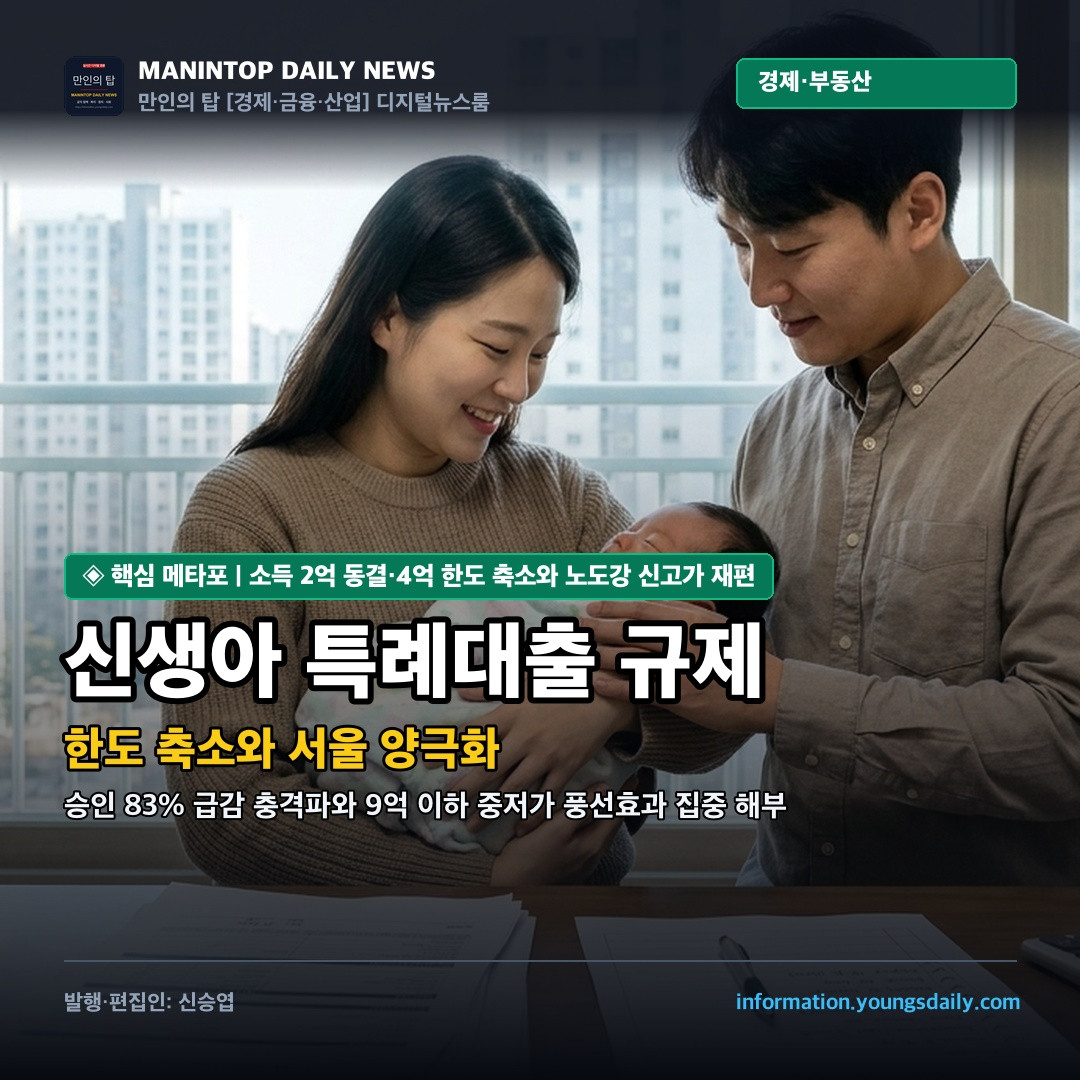
▲ 보도자료사진 — 서울 시내 아파트 거실에서 신생아를 품에 안은 30대 신혼부부가 신생아 특례대출 축소 규정 안내문과 가계 주택자금 수지 계산서를 면밀히 검토하고 있다.
1. 2026년 신생아 특례대출 핵심 조건 및 세부 기준
신생아 특례대출은 출산 가구의 주거 안정을 보장하고 자산 형성을 뒷받침하기 위해 주택도시기금에서 저리로 공급하는 핵심 정책 금융 상품입니다. 주택 구입 자금을 직접 융자해 주는 디딤돌 대출과 임차보증금을 지원하는 버팀목 대출의 두 가지 트랙으로 분리되어 운용됩니다.
시중은행 주택담보대출 금리가 연 4~5%대 안팎을 유지하는 금융 환경에서, 신생아 특례대출은 소득 구간에 따라 연 1%대 중후반에서 3%대 초반의 파격적인 저금리를 누릴 수 있습니다. 특히 총부채원리금상환비율(DSR) 규제가 전면 면제되는 막강한 제도적 특권을 보유하여 2030 실수요자들의 내 집 마련 사다리 역할을 해왔습니다.
제도 세부 항목
구입자금 대출 (디딤돌)
전세자금 대출 (버팀목)
실수요자 핵심 체크포인트
신생아 출산 요건
대출 접수일 기준 2년 이내 출산·입양 (2023년 1월 1일 이후 출생아)
대출 접수일 기준 2년 이내 출산·입양 (2023년 1월 1일 이후 출생아)
임신 중인 태아는 불인정, 입양아 포함
주택 보유 요건
무주택 세대주 또는 1주택 세대주 (구입 목적 대환)
세대원 전원 무주택 세대주 한정
1주택자 대환 시 소득 1.3억 이하만 가능
대상 주택 기준
주택가격 9억 원 이하, 전용면적 85㎡ 이하
임차보증금 수도권 5억 원, 지방 4억 원 이하
읍·면 지역은 전용 100㎡까지 허용
최대 대출 한도
최대 4억 원 (기본 5억에서 축소 적용)
최대 2억 4,000만 원 (기본 3억에서 축소)
LTV 70% (생애최초 80%), MCG 방공제 면제
부부 소득 요건
부부합산 연 2억 원 이하 (외벌이 1.3억 이하)
부부합산 연 2억 원 이하 (외벌이 1.3억 이하)
부부 중 1인 연소득 1.3억 초과 금지
순자산 평가 기준
가구 순자산가액 5억 1,100만 원 이하
가구 순자산가액 3억 4,500만 원 이하
부동산·예금·주식·차량 합산 심사
적용 대출 금리
연 1.8% ~ 4.5% (최초 5년 고정금리)
연 1.3% ~ 4.3% (2년 단위 변동금리)
추가 출산 시 1명당 0.2%p 우대 인하
특례 지원 기간
기본 5년 (추가 출산 시 1명당 +5년, 최대 15년)
기본 4년 (추가 출산 시 1명당 +4년, 최대 12년)
다자녀 출산 가구 장기 저리 지원
주택도시기금 운용 지침에 따르면 디딤돌 대출은 생애최초 주택 구입자의 경우 LTV를 최대 80%까지 열어두고 있으나, 수도권 및 규제지역 내 주택을 구입할 때는 LTV 상한선이 70%로 엄격히 제한됩니다. 아울러 모기지신용보증(MCG)에 가입하면 소액임차보증금(방공제) 차감 없이 대출 한도를 채울 수 있어, 서울 기준 약 5,500만 원의 실대출금을 추가로 확보할 수 있는 금융 테크닉이 유효합니다.
2. 정책 기조 전환: 소득 기준 동결 및 대출 한도 축소
당초 정부는 국가적 재앙으로 다가온 저출산 위기를 극복하기 위해 신생아 특례대출의 부부합산 소득 기준을 현행 2억 원에서 2억 5,000만 원까지 파격적으로 확대하겠다고 공언했습니다. 그러나 가계부채의 가파른 증가세, 서울 및 수도권 집값 과열, 주택도시기금 재원 고갈에 대한 경고음이 동시다발적으로 울리자 정책 방향을 '총량 옥죄기'로 급선회했습니다.
국토교통부는 당초 발표했던 연소득 2억 5,000만 원 상향 계획을 전격 백지화하고 2억 원으로 동결했습니다. 소득 기준이 2억 원으로 완화된 이후 신생아대출 월간 접수액이 1조 원을 상회하며 폭증하자, 정책대출이 부동산 시장의 매수세를 지나치게 자극하고 기금 건전성을 훼손한다는 지적을 수용한 결과입니다.
실제로 국토교통부 집계에 따르면 신생아대출 월별 접수 규모는 1월 1조 439억 원, 3월 1조 4,323억 원, 4월 1조 2,232억 원, 5월 1조 4,073억 원으로 치솟아, 상품 출시 이후 1년 4개월간 누적 집행액만 14조 4,781억 원(디딤돌 10조 9,259억 원, 버팀목 3조 5,522억 원)에 도달했습니다. 이에 따라 정부는 연간 정책대출 공급 계획 대비 25%를 감축 집행하는 비상 조치를 발동했습니다.
소득 기준 추가 완화 전면 백지화: 2025~2027년 출산 가구 대상 한시적 2.5억 원 상향 계획을 전격 철회하고 현행 2억 원 동결 조치 확정
대출 한도 상한선 대폭 축소: 6·27 가계대출 관리 방안에 따라 디딤돌 구입 한도는 5억 원에서 4억 원으로, 버팀목 전세 한도는 3억 원에서 2억 4,000만 원으로 각각 축소 조정
정책 금융 공급 총량 25% 감축: 주택도시기금 건전성 방어와 가계대출 팽창 억제를 위해 연간 정책대출 총공급 한도를 25% 삭감 집행
3. 6·27 대책의 후폭풍: 정책대출 승인 실적 83.3% 급감
대출 한도 축소와 공급 총량 규제가 일선 창구에 전달되면서 2030 신혼부부의 주택 구입 금융은 사실상 얼어붙었습니다. 국회 정무위원회 김재섭 의원실이 주택도시보증공사(HUG)로부터 제출받은 실측 자료에 따르면, 6·27 대책 발표 석 달 만인 9월 신생아 특례 디딤돌(구입자금) 대출 승인 건수는 476건에 머물렀습니다.
이는 대책 발표 직전인 6월의 승인 건수(2,842건)와 비교할 때 불과 90일 만에 83.3%(2,366건)나 폭락한 참담한 수치입니다. 신생아 특례대출 제도가 출범한 이래 월간 승인 실적이 1,000건 아래로 떨어진 것은 사상 최초의 사건입니다.
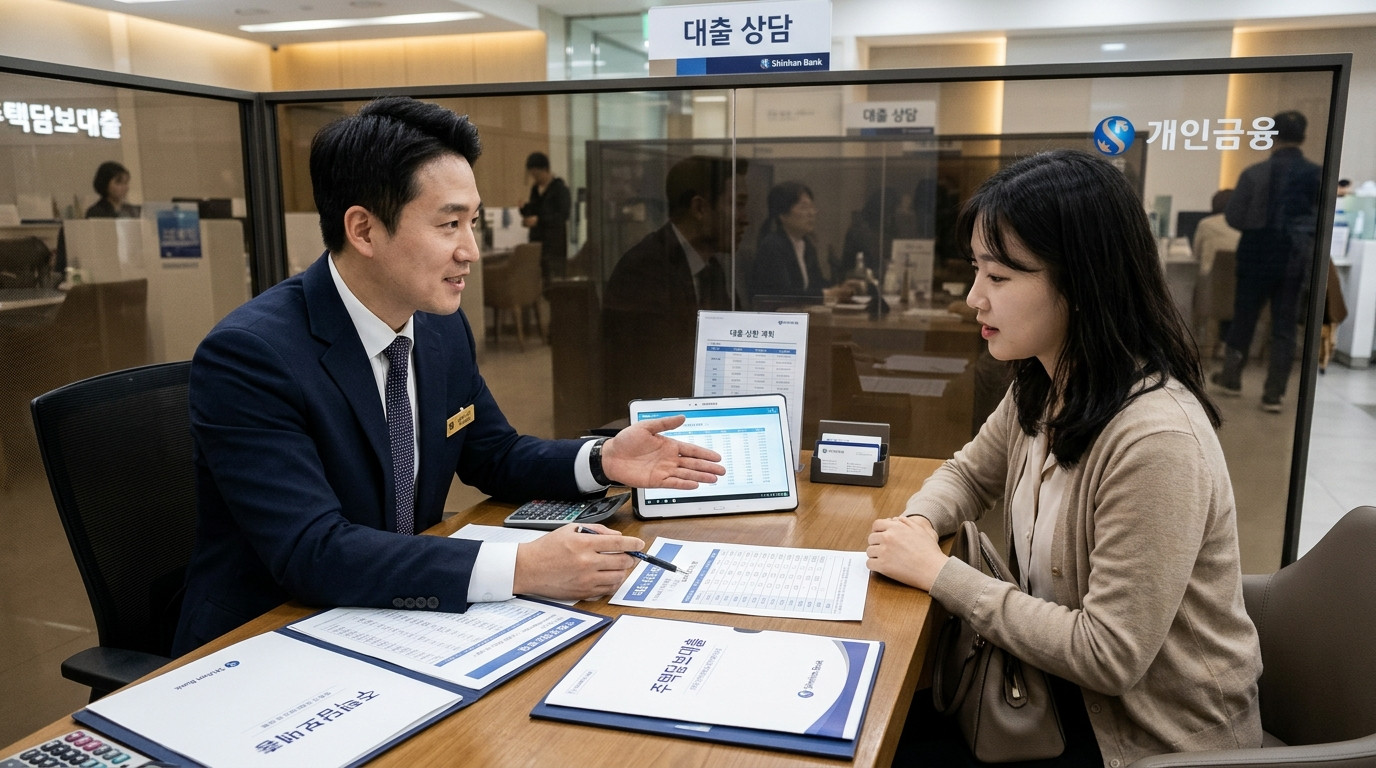
▲ 공식 보도사진 — 서울 시내 시중은행 주택금융 여신상담 창구에서 금융 상담원이 신생아 특례대출 신청자에게 4억 원 축소 한도와 강화된 심사 기준을 안내하고 있다.
전세자금용 버팀목 대출 역시 같은 기간 810건에서 393건으로 51.5% 급감했습니다. 주택 자금 신청부터 서류 심사, 현장 실사 및 최종 승인까지 약 1~2개월의 시차가 소요된다는 점을 감안하면, 정부의 고강도 규제 충격파가 8월부터 본격적으로 시장을 강타한 것으로 확인됩니다.
정부의 예산 편성 기조 역시 정책 철학의 급격한 우회전을 보여줍니다. 주택 구입 및 전세자금대출 융자 예산은 종전 14조 571억 원에서 10조 3,015억 원으로 3조 원 이상 삭감된 반면, 공공임대주택 출자 예산은 2조 9,492억 원에서 8조 3,274억 원으로 무려 2.8배 급증했습니다. 정부가 무주택 서민의 자가 취득 지원에서 공공임대 입주 유도로 정책 무게중심을 완전히 옮겼음을 증명합니다.
4. 서울 부동산 시장의 극단적 양극화와 '풍선효과'
대출 한도 삭감과 세제 개편안이 복합 작용하면서 서울 아파트 매매 시장은 '초고가 침체 대 중저가 과열'이라는 전례 없는 양극화 장세로 치닫고 있습니다. 가격대별 대출 문턱과 세 부담의 비대칭성이 시장을 두 동강 낸 것입니다.
강남권 초고가 시장에서는 시가 30억 원 이상 주택에 대한 보유세 중과 부담과 15억 초과 주택담보대출 옥죄기가 겹치며 다주택자들의 급매물이 쌓이고 있습니다. 부동산 빅데이터 플랫폼 아실 집계에 따르면 서울 아파트 전체 매물은 세제 발표 당일 6만 409건에서 불과 한 달여 만에 6만 7,695건으로 12% 폭증했습니다. 이 중 강남 3구(강남 1만 1,041건, 서초 8,975건, 송파 5,903건) 매물만 2만 5,919건으로 서울 전체 매물의 38.3%를 차지했습니다.
실제 현장에서는 강남구 압구정동 현대 1·2차 전용 대형 평형이 직전 최고가 대비 20억~30억 원 낮아진 90억 원대에 매물로 등장했고, 서초구 반포동 래미안원베일리 전용 84㎡도 최고 호가 대비 10억 원 이상 하락한 50억 원대 초반 급매물이 포착되었습니다.
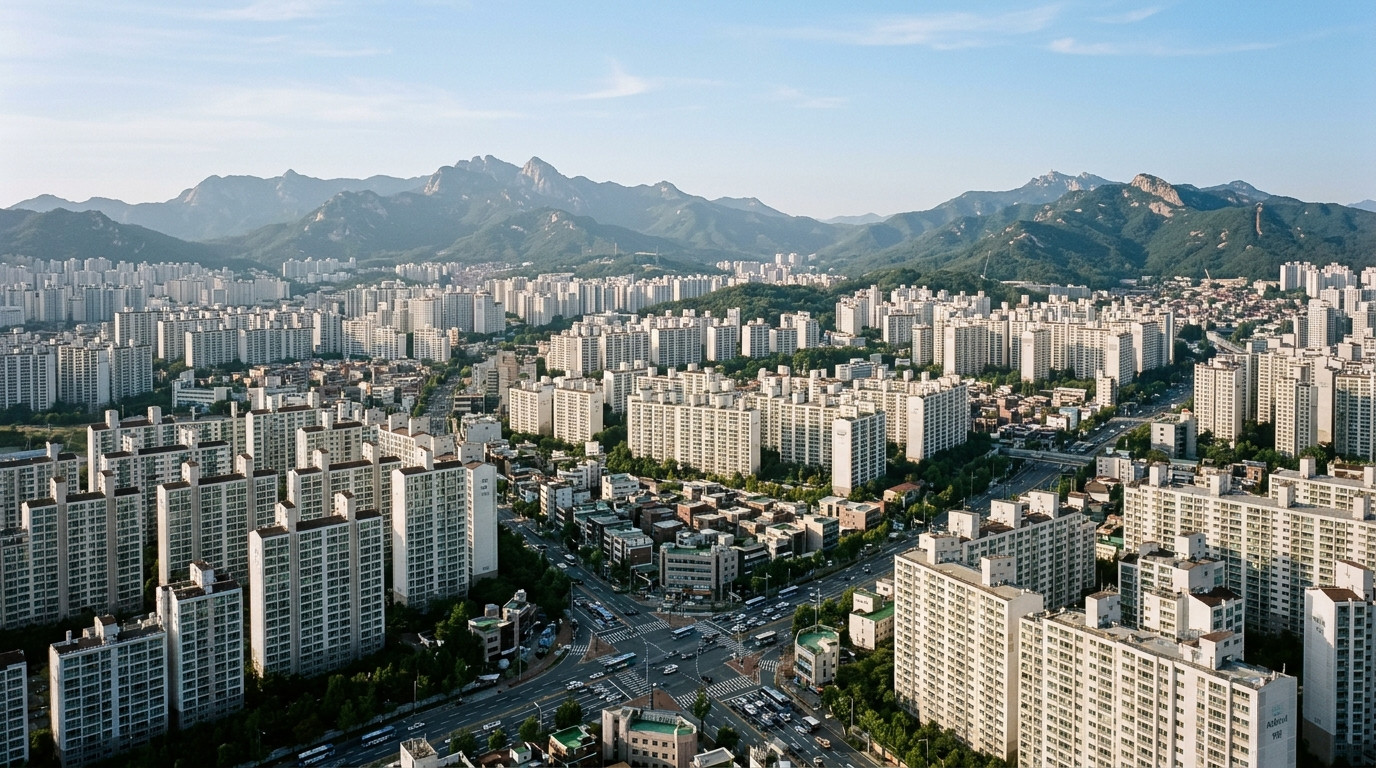
▲ 공식 보도사진 — 북한산 능선 아래로 펼쳐진 서울 강북구 및 노원구 일대 중저가 아파트 대단지 전경. 9억 원 이하 아파트를 중심으로 실수요 매수세가 집중되고 있다.
반면 신생아 특례대출(9억 원 이하, 전용 85㎡ 이하)과 일반 보금자리론 한도를 최대로 활용할 수 있는 서울 외곽 중저가 단지는 매수세가 맹렬히 유입되며 신고가를 경신하는 풍선효과가 확산되고 있습니다. 한국부동산원 주간 동향에서 서울 평균 매매가 상승률이 0.29%를 기록할 당시 노원구(0.54%), 강북구(0.55%), 성북구(0.55%), 중랑구(0.56%)가 시장 상승세를 압도적으로 견인했습니다.
대표적으로 강북구 미아동 SK북한산시티(3,830가구) 전용 84㎡는 7월 8억 원 초반에서 8월 중순 9억 2,300만 원으로 손바뀜하며 한 달 만에 1억 원 이상 치솟아 신고가를 썼습니다. 노원구 상계동 노원포레나 전용 84㎡ 역시 5월 12억 3,000만 원에서 8월 13억 7,500만 원에 거래되며 호가가 15억 원에 육박하고 있으며, 상계주공1단지 전용 41.3㎡는 5억 8,000만 원으로 1년 전 대비 2억 5,000만 원 급등했습니다.
5. 서울 자치구별 9억 이하 아파트 분포 및 실수요 관심 단지
소득 기준 2억 원 동결 하에서도 9억 원 이하 주택에 대한 정책 금융 집중 현상은 지속되고 있습니다. 부동산 플랫폼 직방 조사에 따르면 서울 시내에서 신생아 특례대출 대상이 되는 9억 원 이하·전용 85㎡ 이하 아파트는 총 66만 8,580가구로 집계되었습니다.
자치구별로는 노원구가 11만 7,723가구로 서울 전체 대출 가능 물량의 17.6%를 차지하며 압도적 1위를 기록했습니다. 이어 구로구(5만 6,799가구), 도봉구(5만 5,525가구), 강서구(5만 2,383가구), 성북구(4만 1,877가구), 중랑구(4만 530가구), 은평구(3만 4,552가구), 동대문구(2만 9,414가구) 순으로 나타나 동북권과 서남권 외곽에 집중 분포되어 있습니다.
도심 출퇴근과 학군, 주거 쾌적성을 두루 갖춰 실수요자들의 문의가 빗발치는 대표 관심 단지들의 실거래 시세를 면밀히 점검할 필요가 있습니다. 성북구 장위뉴타운의 래미안 장위포레카운티(939가구) 전용 59㎡는 8억 6,000만 원선에 안착하며 9억 턱밑까지 추격했습니다. 동대문구 이문동 대림e편한세상(1,650가구) 전용 84㎡는 지하철 1호선 신이문역 역세권 입지에 힘입어 8억 9,500만 원에 실거래되었습니다.
서대문구 북가좌동 두산위브(235가구) 전용 84㎡는 연가초등학교를 품은 입지 조건으로 7억 9,000만~8억 1,000만 원에 형성되어 있으며, 3,293가구 대단지인 DMC래미안e편한세상 전용 84㎡ 저층 물건은 8억 9,500만~9억 원선에 매수세가 맞닿아 있습니다. 아울러 강동구 암사동 선사현대(2,938가구) 전용 58㎡는 8억 1,500만~8억 7,000만 원, 영등포구 문래동 문래공원한신(376가구) 전용 59㎡는 8억 5,000만 원에 실거래되며 도심 접근성이 우수한 9억 이하 단지의 품귀 현상을 대변하고 있습니다.
6. 실수요자 및 갈아타기 가구를 위한 실전 가이드
신생아 특례대출을 활용하여 내 집을 마련하거나 고금리 대출을 대환하려는 실수요 가구는 깐깐해진 자격 심사와 숨은 복병을 사전에 철저히 검증해야 합니다. 작은 규정 차이로 대출 승인이 반려될 수 있기 때문입니다.
가장 주의해야 할 대목은 1주택자의 대환대출 소득 기준입니다. 신규 주택을 구입할 때는 맞벌이 부부합산 소득 요건이 연 2억 원 이하로 적용되지만, 기존 주택담보대출을 갈아타는 대환대출은 부부합산 연소득이 1억 3,000만 원을 초과하면 접수 자체가 불가능합니다. 신규 구입과 대환의 소득 커트라인이 다르다는 점을 간과하여 낭패를 보는 사례가 속출하고 있습니다.
만 39세 이하의 무주택 세대주라면 초기 원금 상환액을 최소화하고 상환액을 점진적으로 늘려가는 '체증식 분할상환 방식'을 적극 활용하는 것이 유리합니다. 출산 초기 영유아 양육비 지출이 집중되는 2030 맞벌이 가구의 월 현금 흐름을 안정적으로 방어하는 강력한 무기입니다.
이 밖에도 대출 접수일 기준 2년 이내 출생아만 인정되며 임신 중 태아는 신청 대상에서 제외된다는 점, 부부합산 소득이 2억 원 이하라도 부부 중 1인의 연소득이 1억 3,000만 원을 넘어서는 안 된다는 점, 가구 순자산이 디딤돌 기준 5억 1,100만 원을 초과하면 거절된다는 점, 대출 실행 후 해당 주택에 1개월 내 전입하여 1년 이상 실거주해야 한다는 의무 조항을 반드시 숙지해야 합니다. 다행히 2026년부터는 혼인신고를 하지 않은 사실혼 관계의 출산 부부도 법적 동일 혜택을 받을 수 있도록 제도가 보완되었습니다.
신생아 특례대출 규제 개편 핵심 Q&A
Q1. 당초 발표되었던 연소득 2억 5,000만 원 상향은 언제부터 시행되나요?
시행되지 않고 전격 철회되었습니다. 정부는 주택도시기금 재원 고갈과 가계부채 증가를 우려하여 2억 5,000만 원 상향 계획을 전면 백지화하고 부부합산 연소득 2억 원 이하로 동결했습니다.
Q2. 기존 1주택자도 연소득 2억 원 기준을 적용받아 대환대출을 받을 수 있나요?
적용받을 수 없습니다. 신규 주택 구입 시에는 부부합산 2억 원 이하가 적용되지만, 기존 주택담보대출을 신생아대출로 대환할 때는 부부합산 연소득이 1억 3,000만 원 이하여야만 신청이 가능합니다.
Q3. 디딤돌 구입자금 대출 한도는 왜 5억 원에서 4억 원으로 줄었나요?
정부의 6·27 가계부채 관리 대책에 따라 정책대출 공급 총량이 축소되면서, 디딤돌 구입자금 한도는 5억 원에서 4억 원으로, 버팀목 전세자금 한도는 3억 원에서 2억 4,000만 원으로 각각 축소되었습니다.
Exclusive In-Depth AnalysisEconomy & Real Estate
[In-Depth Analysis] Newborn Special Mortgage Loan Tightening and Seoul Housing Polarization: Impact of Cap Reductions to KRW 400M and the Balloon Effect Below KRW 900M
South Korea aggressive policy pivot tightening the Newborn Special Mortgage Loan framework has sent shockwaves through real estate markets and prospective homebuyer households. As plans to raise income ceilings were abruptly rescinded and the Didimdol purchase loan cap was slashed to KRW 400 million, loan approval numbers for newlywed couples plummeted by over 83 percent in just three months. This regulatory tightening, combined with sweeping real estate tax reforms, has ignited extreme market polarization: high-end luxury residences in Gangnam are accumulating distressed listings, while sub-KRW 900 million residential complexes across outer Seoul are setting new all-time pricing highs.
By Seung Youb Ssin, Senior Real Estate Correspondent|Published Nov. 06, 2026, 06:50 KST
▲ Editorial Documentary Photo — A young South Korean married couple in their early 30s holding their newborn infant review tightened policy mortgage documents and household financing statements in their Seoul apartment living room. (Press Archive)
1. Core Qualifications and Revised Benchmarks for 2026 Newborn Special Loans
The Newborn Special Mortgage Loan serves as South Korea flagship policy finance vehicle operated under the National Housing and Urban Fund, purposefully engineered to bolster housing stability and long-term asset building for childbirth households. The framework operates through two distinct loan vehicles: the Didimdol facility for direct home purchases and the Beotimmok facility for residential jeonse rental deposit financing.
Against prevailing commercial mortgage borrowing rates hovering between 4 and 5 percent annually, the Newborn Special Loan offers ultra-concessional interest rates between 1.8 and 3.0 percent depending on tiered income brackets. Most critically, the program retains an exceptional institutional advantage by standing entirely exempt from Stress Debt Service Ratio (DSR) lending restrictions, functioning as an indispensable housing ladder for young homebuyers.
Regulatory Parameter
Purchase Loan (Didimdol)
Jeonse Deposit Loan (Beotimmok)
Key End-User Checklist Point
Childbirth Benchmark
Birth or adoption within 2 years of filing (born after Jan 1, 2023)
Birth or adoption within 2 years of filing (born after Jan 1, 2023)
Unhoused household head or single-home head (refinancing)
Strictly unhoused household members across all dependents
Refinancing restricted to income below KRW 130M
Property Threshold
Valuation under KRW 900M; net area 85㎡ or below
Lease deposit under KRW 500M (Capital) or KRW 400M (Provincial)
Rural areas permit unit areas up to 100㎡
Maximum Loan Limit
Up to KRW 400M (slashed from original KRW 500M cap)
Up to KRW 240M (slashed from original KRW 300M cap)
LTV 70% (80% first-time); MCG room deduction waiver
Household Income
Combined under KRW 200M (single earner under KRW 130M)
Combined under KRW 200M (single earner under KRW 130M)
Neither individual spouse may exceed KRW 130M
Net Asset Evaluation
Net household wealth at or below KRW 511M
Net household wealth at or below KRW 345M
Aggregated assessment across property, cash, equities
Applicable Interest Rate
1.8% to 4.5% annually (initial 5-year fixed rate)
1.3% to 4.3% annually (2-year variable rate intervals)
0.2%p rate cut per additional childbirth event
Special Rate Duration
Base 5 years (+5 years per child, maximum 15 years)
Base 4 years (+4 years per child, maximum 12 years)
Extended concessional window for multi-child families
Operational guidelines from the housing fund allow loan-to-value (LTV) limits up to 80 percent exclusively for verified first-time buyers; however, purchasing residential units within the Seoul metropolitan area or regulatory restriction zones enforces an unyielding 70 percent ceiling. Furthermore, by subscribing to Mortgage Credit Guarantees (MCG), borrowers can execute borrowing capacity without standard statutory small-tenant deposit deductions, securing approximately KRW 55 million in additional liquidity in Seoul.
2. Strategic Policy Pivot: Income Cap Freezes and Borrowing Ceiling Cuts
The government initially announced grand commitments to expand combined household income thresholds from KRW 200 million up to KRW 250 million to tackle demographic birth rate crises. However, as household debt growth accelerated, metropolitan home valuations overheated, and statutory housing fund reserves depleted rapidly, policymakers executed a sudden turn toward restrictive lending containment.
The Ministry of Land, Infrastructure and Transport formally scrapped its proposed expansion to KRW 250 million, freezing the ceiling permanently at KRW 200 million. Following earlier income threshold relaxations to KRW 200 million, monthly loan filings surged past KRW 1 trillion continuously, triggering sharp warnings that subsidized public financing was amplifying speculative asset bubbles while undermining institutional solvency.
Data compiled by the ministry reveals that monthly submission totals soared from KRW 1.04 trillion in January to KRW 1.43 trillion in March, KRW 1.22 trillion in April, and KRW 1.41 trillion in May. Over 16 months since product debut, cumulative executed disbursements reached an unprecedented KRW 14.48 trillion (KRW 10.93 trillion for Didimdol purchases and KRW 3.55 trillion for Beotimmok jeonse). In response, administrative authorities enforced an emergency 25 percent reduction across annual policy lending quotas.
Cancellation of Proposed Income Ceiling Expansion: Plans to temporarily raise household eligibility to KRW 250 million for 2025-2027 childbirth cohorts were completely abandoned, cementing the threshold at KRW 200 million
Downscaling of Statutory Borrowing Caps: Under the June 27 household lending control package, the Didimdol purchase cap dropped from KRW 500 million to KRW 400 million, and Beotimmok jeonse limits fell from KRW 300 million to KRW 240 million
Aggregate Policy Lending Quota Cut by 25%: Total annual state credit allocations were curtailed by a quarter to protect sovereign housing fund balances and curb macro debt expansion
3. Aftermath of the June 27 Package: Loan Approvals Plummet 83.3%
As downscaled borrowing limits and strict allocation rationing trickled down to bank branches, retail mortgage financing for young couples froze almost instantaneously. Physical records submitted by the Housing and Urban Guarantee Corporation (HUG) to Representative Kim Jae-seup of the National Assembly National Policy Committee show that September approval volume for the Newborn Didimdol purchase facility collapsed to just 476 transactions.
Benchmarked against the 2,842 approvals registered in June immediately prior to the measure announcement, this indicates a staggering 83.3 percent (2,366 cases) plunge within 90 days. This marks the first occasion since the program inception that monthly approval volumes have fallen below the 1,000 threshold.
▲ Editorial Documentary Photo — A senior retail loan specialist at a major commercial bank branch in central Seoul outlines downscaled KRW 400 million borrowing limits and tightened underwriting benchmarks to a mortgage applicant. (Press Archive)
Concurrently, approvals for Beotimmok jeonse rental deposit facilities contracted by 51.5 percent from 810 to 393 cases over the identical timeframe. Because statutory underwriting, income verification, and appraisal procedures mandate a one to two month processing window, the severe downstream impact of government restrictions manifested forcefully starting in August.
Shifting budgetary allocations further highlight an aggressive realignment in state fiscal priorities. Annual financing appropriations for direct home purchase and jeonse loans were slashed by over KRW 3 trillion from KRW 14.06 trillion to KRW 10.30 trillion. Conversely, capital contributions allocated for public rental housing expansion surged 2.8-fold from KRW 2.95 trillion to KRW 8.33 trillion, confirming a systemic administrative shift away from subsidizing homeownership toward public tenancy.
4. Severe Urban Polarization and the Sub-900M Balloon Phenomenon
The compounding collision between reduced policy credit and real estate tax restructuring has polarized the Seoul residential ecosystem into diametrically opposed trajectories: stagnation in ultra-luxury towers versus price surges in affordable mid-tier housing.
Across affluent Gangnam districts, escalating comprehensive real estate tax burdens on properties valued above KRW 3 billion coupled with strict commercial borrowing barriers have prompted multi-homeowners to dump inventory. Real estate data provider Asil reports that active Seoul apartment listings jumped 12 percent from 60,409 units on tax announcement day to 67,695 units within a single month. Gangnam, Seocho, and Songpa together accounted for 25,919 units or 38.3 percent of the entire municipal inventory buildup.
In market transactions, large-area units in Apgujeong Hyundai Towers 1 and 2 emerged on the market at KRW 9.0 billion—slashed by KRW 2.0 billion to KRW 3.0 billion below historic peaks. Similarly, an 84-square-meter unit at Raemian One Bailey in Banpo was listed in the low KRW 5.0 billion range, down more than KRW 1.0 billion from ceiling quotes.
▲ Editorial Documentary Photo — Dense clusters of mid-tier residential apartment complexes across Nowon-gu and Gangbuk-gu in northern Seoul beneath Mount Bukhansan, where end-user demand below KRW 900 million remains concentrated. (Press Archive)
In stark contrast, sub-KRW 900 million residential complexes in outer districts—which fully satisfy Newborn Special Loan eligibility and statutory 85-square-meter boundaries—have experienced an aggressive buyer influx, driving record-breaking contract transactions. While average weekly Seoul appreciation posted 0.29 percent in Korea Real Estate Board releases, northern districts led gains powerfully: Nowon-gu (0.54%), Gangbuk-gu (0.55%), Seongbuk-gu (0.55%), and Jungnang-gu (0.56%).
At SK Bukhansan City (3,830 units) in Mia-dong, Gangbuk-gu, an 84-square-meter unit surged from the low KRW 800 million bracket in July to KRW 923 million in mid-August, establishing a fresh all-time high within 30 days. Nowon Forena in Sanggye-dong saw 84-square-meter contracts jump from KRW 1.23 billion in May to KRW 1.375 billion in August with asking quotes reaching KRW 1.5 billion, while Sanggye Jugong Complex 1 (41.3 square meters) advanced to KRW 580 million, up KRW 250 million year-over-year.
5. Geographic Inventory Distribution and High-Priority Complexes Under KRW 900M
Despite frozen income limits, residential demand concentrated within sub-KRW 900 million assets continues to define metropolitan transaction patterns. Research by proptech platform Zigbang reveals that Seoul contains 668,580 eligible apartment units matching the sub-KRW 900 million and 85-square-meter policy criteria.
Nowon-gu ranks first across Seoul with 117,723 units, representing 17.6 percent of the entire municipal qualifying inventory pool. It is followed in volume by Guro-gu (56,799 units), Dobong-gu (55,525 units), Gangseo-gu (52,383 units), Seongbuk-gu (41,877 units), Jungnang-gu (40,530 units), Eunpyeong-gu (34,552 units), and Dongdaemun-gu (29,414 units), reflecting heavy geographic clustering across the northeastern and southwestern perimeters.
Key benchmark complexes balancing downtown transit access, academic zones, and living infrastructure command intense scrutiny. In Jangwi New Town, Seongbuk-gu, a 59-square-meter unit at Raemian Jangwi Forecounty (939 units) consolidated at KRW 860 million, nearing the policy threshold. In Dongdaemun-gu, an 84-square-meter residence at Imun Daelim e-Pyeonhansesang (1,650 units) traded at KRW 895 million, bolstered by direct subway line 1 station access.
In Seodaemun-gu, an 84-square-meter home at Bukgajwa Doosan Weve (235 units) adjacent to Yeonga Elementary School trades between KRW 790 million and KRW 810 million, while low-floor 84-square-meter inventory in the 3,293-unit DMC Raemian e-Pyeonhansesang development ranges between KRW 895 million and KRW 900 million. Additionally, a 58-square-meter unit at Amsa Seonsa Hyundai (2,938 units) in Gangdong-gu commands KRW 815 million to KRW 870 million, and a 59-square-meter unit at Mullae Park Hanshin (376 units) in Yeongdeungpo-gu executed at KRW 850 million, underlining chronic supply scarcity for quality housing under KRW 900 million.
6. Practical Execution Strategy and Risk Guide for Young Families
Young households preparing to acquire real estate or refinance burdensome existing debt via Newborn Special Loans must navigate stringent eligibility hurdles and procedural checkpoints, where minor miscalculations can trigger immediate rejection.
The single most critical procedural trap involves the diverging income ceiling for existing single-home refinancing. While new property acquisitions permit combined dual-income ceilings up to KRW 200 million, refinancing applications for existing mortgage debt enforce a strict KRW 130 million limit. Prospective applicants who assume the KRW 200 million purchase rule applies equally to refinancing routinely face administrative disqualification.
For unhoused household heads aged 39 or younger, adopting the progressive balloon repayment option presents substantial cash-flow advantages. By minimizing initial principal payments and expanding amortization obligations over subsequent years, young dual-earner couples can preserve vital monthly liquidity during peak childcare expense windows.
Prospective borrowers must also verify that their qualifying child was born within two years of application (excluding unborn fetuses), that neither spouse individually earns above KRW 130 million, that total household net worth does not surpass KRW 511 million for Didimdol loans, and that they physically move into the property within one month to complete mandatory 1-year continuous physical residency. Importantly, beginning in 2026, de facto common-law couples with newborns are officially eligible for identical statutory benefits without formal civil marriage registration.
Newborn Special Loan Regulatory Overhaul FAQ
Q1. When will the proposed KRW 250M household income expansion take effect?
It will not take effect. The South Korean government formally rescinded the proposed expansion to KRW 250 million due to housing fund depletion and macro debt expansion risks, cementing the ceiling at KRW 200 million.
Q2. Can existing single-home owners refinance up to the KRW 200M income threshold?
No. While newly acquired properties allow combined earnings up to KRW 200 million, refinancing existing mortgages into Newborn Special Loans requires household income at or below KRW 130 million.
Q3. Why was the Didimdol purchase loan borrowing cap reduced from KRW 500M to KRW 400M?
Under the June 27 household credit control package, sovereign quotas were reduced by 25 percent, lowering the Didimdol purchase ceiling to KRW 400 million and Beotimmok rental limits to KRW 240 million.
1월이 시작되면 감기는 이미 우리 곁에 와 있습니다. 2월, 3월, 4월까지 이어지는 추위와 건조함은 코와 목을 가장 먼저 공격합니다. 아침에 일어나자마자 막혀 있는 코. 계속 흐르는 콧물. 괜히 칼칼해지는 목. 이 증상은 “시작”일 뿐입니다. 한 번 무너지면 일주일, 길면 한 달까지 끌고 갑니다. 약을 먹으면 잠깐 괜찮아집니다. 하지만 며칠 뒤 또 반복됩니다. 왜일까요? 감기는 ‘치료’의 문제가 아니라 ‘관리’의 문제이기 때문입니다. 대부분은 감기가 오고 나서 약을 찾습니다. 하지만 진짜 중요한 건 감기가 오기 전에 코와 목을 지키는 것입니다. 건조한 실내 공기, 차가운 바깥 공기, 눈에 보이지 않는 세균. 코와 목은 매일 공격받고 있습니다. 지긋지긋하죠! 그런데도 우리는 아무 준비 없이 버티고 있습니다. 이번 겨울도 그렇게 보낼 건가요? 사실 방법은 어렵지 않습니다. 코를 깨끗하게 관리하고, 목을 따뜻하게 보호하고, 점막을 촉촉하게 유지하고, 기관지를 미리 관리하고, 외부 공기를 차단하는 것. 이 다섯 가지만 꾸준히 해도 감기약 없이 겨울을 보내는 것이 충분히 가능합니다. 🔥 이제부터 그 방법을 하나씩 살펴보겠습니다. 🔥 1. 코와 목을 먼저 관리해야 하는 과학적 이유 감기의 대부분은 코 점막에서 시작됩니다. 국제 학술지 Nature Reviews Microbiology 와 Journal of Allergy and Clinical Immunology 에 실린 호흡기 감염 관련 연구들에서는, 감기 바이러스가 비강 상피세포에 먼저 부착해 증식한다는 점을 설명하고 ...
리모델링사업이 진행 중인 아파트를 매매할 때 “계약금 10%를 언제까지 내야 하느냐”는 질문이 특히 많이 나옵니다. 이주공고(이주 안내)가 7~11월쯤이라고 들으면, 그 시점에 맞춰 계약금도 움직일 것 같아서 더 헷갈리기 쉽습니다. 하지만 실제 납부기한은 ‘이주공고가 언제냐’만으로 자동 결정되지 않는 경우가 많습니다. 1) 계약금 10% 납부기한: 결국 ‘문서에 적힌 일정’이 기준 계약금 10%를 언제까지 납부해야 하는지는, 내가 서명하는 매매계약서(특약 포함) 와 사업주체/조합이 제시한 공고·안내문 에 적힌 납부 일정이 기준이 됩니다. 실제 공고문에서는 분양대금 납부의 큰 틀(계약금→중도금→잔금)을 먼저 안내하고, 상세 일정은 별도 표나 유의사항으로 제시하는 방식이 흔합니다. 또, 계약서 문구에 따라 지급 시점이 조건부로 설정될 수도 있습니다. 예를 들어 한 사례 소개 자료에서는 용역계약서에 잔금(10%) 지급시기가 “사업승인 후”로 기재되어 있었다는 점이 언급됩니다. 이런 식으로 ‘사업 단계’와 지급을 연동하는 문구가 들어가면, 질문의 답은 계약서 문구를 확인해야만 확정됩니다. 관련 내용은 링크 에서 문구 사례를 확인할 수 있습니다. 2) 입주자모집공고에서 확인되는 ‘납부 순서’와 잔금 마감 시점 공고문에 적힌 문구를 보면, 납부 순서와 잔금 마감에 대한 기준이 비교적 명확하게 제시되는 경우가 있습니다. 예를 들어 한 입주자모집공고에는 “분양금액(주택가격)은 계약금, 중도금, 잔금의 순서로 납부”하며 “잔금은 입주(열쇠 수령일) 전에 완납”해야 한다고 안내되어 있습니다. (문구 확인: 링크 ) 이 문구가 의미하는 바는 최소 2가지입니다. 분양/공급 형태의 문서에서는 ‘계약금→중도금→잔금’ 흐름이 공식적으로 안내될 수 있습니다. 잔금은 “입주(열쇠 수령)” 이전에 완납해야 한다는 마감 기준이 문서에 적혀 있을 수 있습니다. 다만, 위 공고문 문구는 잔금 마감에 대한 기준을 보여주지만, 계약금 10%의...
윤석열 전 대통령 탄핵 인용 소식을 접하면, 가장 궁금한 지점은 ‘헌재가 정확히 무엇을 위헌·위법으로 봤는가’입니다. 또한 탄핵과 별개로 진행되는 형사재판(내란 우두머리 혐의 등)이 어디까지 왔는지도 함께 정리할 필요가 있습니다. 아래 내용은 제공된 기사/게시물 스니펫과 링크에서 확인되는 범위만 모아, 일반인이 흐름을 이해하기 쉽게 정리한 것입니다. 1) 탄핵 인용 관련: 스니펫에서 확인되는 ‘판단의 골격’ 제공된 근거 중 조국혁신당 사이트에는 헌법재판소가 윤석열 탄핵 심판에서 “피청구인의 위헌·위법행위는 국민 신임 …”이라는 취지로 판단했다는 문장이 인용돼 있습니다( 링크 ). 이 인용문만 놓고 보면, ‘위헌·위법행위’가 있었는지와 그로 인해 ‘국민의 신임’이 어떻게 평가됐는지가 핵심 축으로 소개됩니다. 다만 질문에서 요청하신 세부 항목, 즉 비상계엄 선포 자체를 문제 삼은 구체적 이유, 계엄 이후 조치(포고령, 국회 통제 등)의 어떤 지점이 헌법 위반인지, 국회의 권한행사 방해 및 정치활동 제약을 어떤 논리로 판단했는지 등은, 이번에 제공된 근거의 제목/스니펫만으로는 조항·사실관계·판단 구조가 그대로 제시돼 있지 않습니다. 따라서 이 글에서는 ‘헌재가 무엇을 문제 삼았다’는 세부 리스트를 단정적으로 재구성하기보다, 현재 확인 가능한 문구 수준의 요약(위헌·위법행위 → 국민 신임의 문제로 평가)까지만 적습니다. 만약 헌재 결정문 전문(주문 및 이유)이 추가로 확인되면, 그때는 문장 단위로 ‘어떤 행위’와 ‘어떤 헌법 원리/조항’이 연결되는지(예: 권력분립, 국회의 권한, 정치적 기본권 등) 구조화해 정리하는 것이 가장 정확합니다. 2) 형사 절차(내란 혐의) 관련: 체포영장과 1심 선고 언급 탄핵 심판과 별도로, 12·3 비상계엄 사태로 내란 혐의를 받는 윤석열 대통령에 대해 2024년 12월 31일 체포 영장이 발부됐다는 BBC 보도가 있습니다( 링크 ). 해당 보도는 ‘현직 대통령’에 대한 체포영장 발부라는 점을 함께 언급합니다. 또...