초고령사회 진입과 함께 연간 10조 원 규모로 폭증한 사적 간병비가 ‘간병 파산’과 ‘간병 살인’이라는 사회적 재난으로 번지면서, 정부가 요양병원 간병비 건강보험 급여화 시범사업에 본격 착수했습니다. 2030년까지 중증 환자 8만 5천 명을 대상으로 5년간 6조 5천억 원의 건보 재정을 투입하는 추진 로드맵과 본인부담상한제 제외 논란, 병실 기준 수가의 한계, 재정 건전성 우려까지 명과 암의 5대 핵심 쟁점을 전방위로 심층 분석합니다.
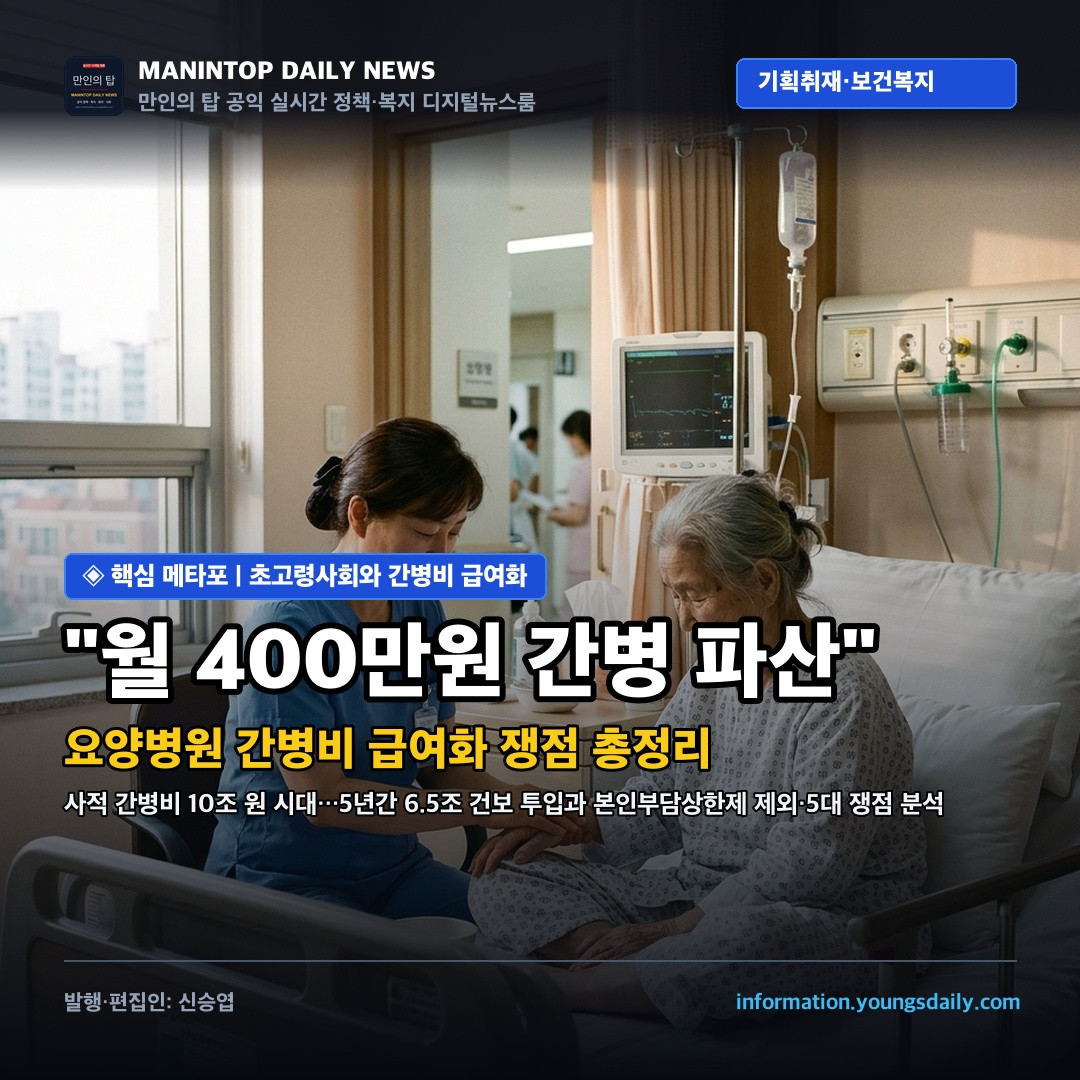
▲ 수도권의 한 요양병원 병실에서 전문 간병인이 거동이 불편한 고령 환자를 정성스럽게 돌보고 있다. 정부는 월 수백만 원에 달하는 사적 간병 부담을 공적 보장 체계로 흡수하기 위해 요양병원 간병 급여화 시범사업을 본격 가동한다. [사진=만인의 탑 보건복지부 특별취재팀]
📌 핵심 브리핑 (Key Takeaways)
정부는 2027년 상반기 요양병원 간병 급여화 시범사업을 본격 시행하여 2030년까지 전국 500개 병원, 중증 환자 8만 5,000명으로 확대할 계획입니다.
일당 수가는 6만 3,971원~11만 1,949원, 환자 본인부담률은 30% 내외로 설정되어 기존 월 370만~500만 원 선이던 사적 간병비가 월 60만~100만 원 선으로 경감됩니다.
그러나 간병 급여 본인부담금이 ‘연간 본인부담상한제’ 적용에서 제외되어 기존 공동간병(월 50만~70만 원) 이용자 대비 실질 체감 혜택이 미미하다는 지적이 팽배합니다.
향후 5년간 6조 5,000억 원의 건보 재정이 소요되는 가운데, 병실(4인실) 중심 수가 산정으로 인한 중증 환자 기피와 요양병원 경영 악화 우려 등 5대 구조적 쟁점이 맞서고 있습니다.
1. ‘간병 파산’과 사적 간병비 10조 원 시대의 사회적 비극
초고령사회로 진입한 대한민국 보건의료 현장은 급증하는 돌봄 수요와 치솟는 간병비로 인해 가계 경제가 마비되는 심각한 위기에 봉착해 있다. 치료 중심의 건강보험 보장성 확대에도 불구하고, 돌봄(Care) 영역은 오랜 기간 사적 비급여 사각지대에 방치되면서 환자 가족에게 온전한 재정적·육체적 부담을 전가해 왔다.
국회입법조사처와 여의도연구원 분석에 따르면 국내 사적 간병비 시장 규모는 2008년 약 3조 6,000억 원 수준에서 2018년 8조 원을 돌파했고, 최근에는 연간 10조 원을 넘어선 것으로 추산된다. 입원 환자가 1:1 개인 간병인을 고용할 경우 일당은 13만~15만 원에 달하며, 가래 흡인(석션), 콧줄(비위관), 체위 변경 등 중증 처치가 필요하거나 주말 수당·식대를 합산할 경우 일당은 16만~17만 원, 월평균 400만~500만 원까지 치솟는다.
지표 항목
실측 수치 및 지표
사회적 파급효과 및 가계 영향
연간 사적 간병비 시장
10조 원 돌파 (2025~2026 추산)
2008년 3.6조 원, 2018년 8조 원 대비 폭발적 증가세
월평균 개인 간병비
370만 원 ~ 500만 원
일당 13만~15만 원 (중증·야간·식대 포함 시 16만~17만 원)
고령 가구 소득 대비 비중
노인 가구 중위소득(224만 원)의 1.7배
30대 자녀 가구 중위소득(509만 원)의 50% 이상 잠식
사적 간병 결제 관행
1주일 단위 현금 선결제 (주 100만 원 안팎)
가계 유동성 즉각 고갈 및 고금리 카드론·신용대출 유입
한국은행 분석에 따르더라도 월 370만 원의 간병비는 65세 이상 고령 가구 월 중위소득(224만 원)의 1.7배에 달한다. 3년 투병에 1억 원이 넘는 간병비를 지출해 전재산을 탕진하는 ‘간병 파산’, 장기간의 간병 피로와 빈곤 속에 환자를 살해하는 ‘간병 살인’, 학업과 생업을 포기하고 부모 간병에 갇히는 청년 ‘영 케어러(Young Carer)’의 비극이 일상화되었다.
2. 정부의 ‘요양병원 간병 급여화’ 추진 로드맵 및 제도 개편 골자
보건복지부와 건강보험심사평가원은 이러한 간병 비극을 끊어내기 위해 요양병원 간병비 급여화를 국정과제로 추진 중이다. 2026년 하반기 건강보험정책심의위원회(건정심) 보고와 시범기관 공모를 완료하고, 2027년 상반기부터 본격적인 시범사업을 가동해 2030년까지 전국 500여 개 의료중심 요양병원, 중증 환자 8만 5,000명을 대상으로 급여 혜택을 정착시킨다는 구상이다.
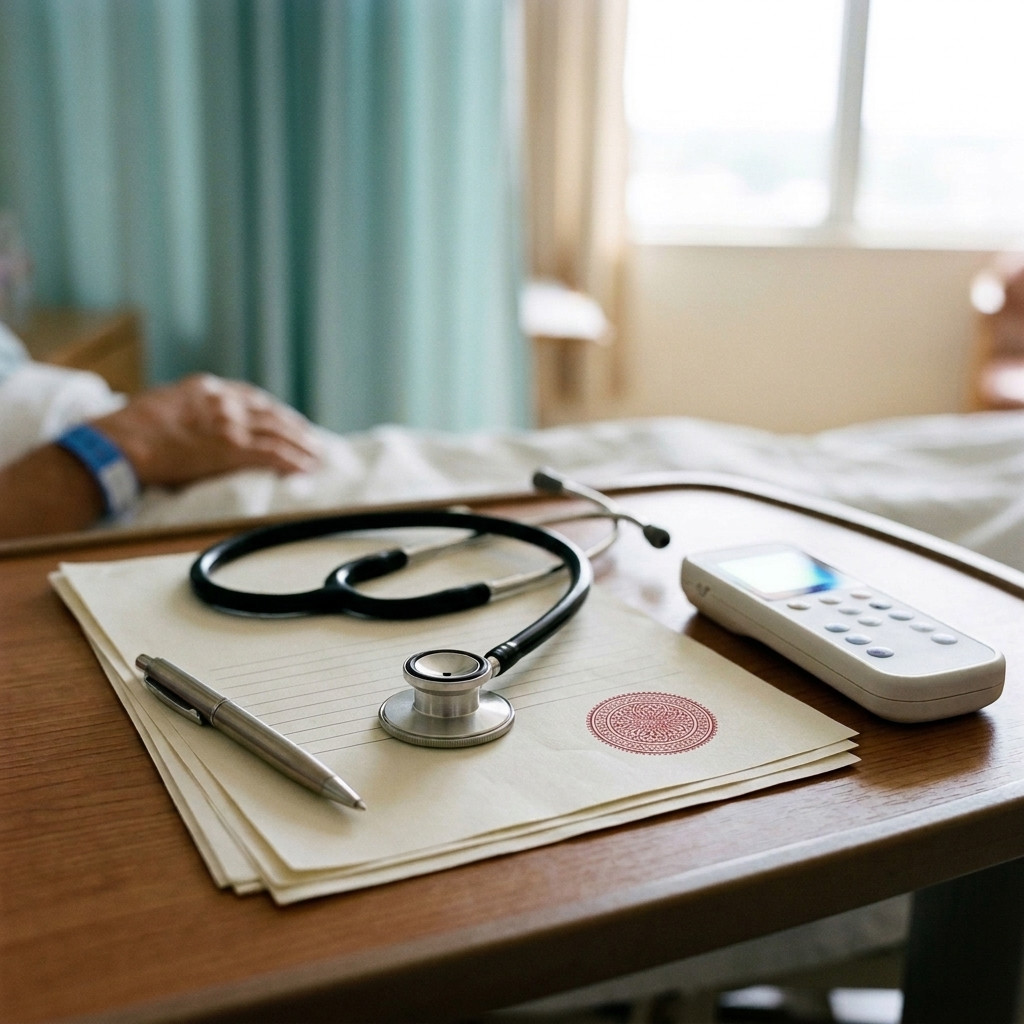
▲ 요양병원 병실 테이블 위에 놓인 의료용 청진기와 보건복지부 간병 급여화 평가 지침 문서. [사진=만인의 탑 보건복지부]
📋 [정부 요양병원 간병 급여화 5대 핵심 개편안]
급여 대상 자격: 전체 입원 환자 중 의료 필요도가 높은 ‘의료 최고도·고도·중도’ 환자 및 장기요양 1~2등급 판정자, 치매·파킨슨 중증 환자 우선 한정.
간병 수가 및 본인부담: 일당 6만 3,971원~11만 1,949원 설정. 환자 본인부담률 30% 내외(월 60만~100만 원 선), 차상위계층 20% 적용.
인력 고용 체계: 간병인의 요양병원 직접고용 의무화, 주 40시간 근로기준법 준수, 2교대/3교대 근무, 간병인 1인당 환자 4~6명 배치.
병상 환경 강화: 기준병상을 기존 6인실에서 4인실로 상향 조정하고 2027년부터 요양병원 의료기관 인증 획득 의무화.
소요 재정 추계: 5년간(2026~2030년) 건강보험 재정 총 6조 5,000억 원 투입 (연간 1.9조~3.4조 원 규모).
3. 간병 급여화의 명(明): 환자 가계 보호와 돌봄 일자리 선진화
간병 급여화 정책이 가져올 가장 뚜렷한 기대 효과는 사적 간병비 지출의 획기적 경감이다. 개인 간병인을 고용해 매월 370만~500만 원을 지출하던 중증 환자 보호자는 30% 본인부담 적용 시 월 60만~100만 원 선으로 부담이 낮아져 파산 위기를 면할 수 있다.
또한 음성적 인력소개소를 통해 24시간 연속 노동에 시달리던 사적 간병인이 병원 직접고용 근로자로 전환되어 4대 보험, 퇴직금, 주 40시간 근로 및 최저임금을 보장받게 됨으로써 돌봄 노동의 안정성과 질적 향상이 기대된다. 아울러 4인실 중심의 병상 환경 개선과 비급여 통제를 통해 부실 요양병원의 구조조정과 병상 질서 정상화가 촉진될 전망이다.
4. 간병 급여화의 암(暗): 보건의료 현장의 5대 핵심 쟁점과 한계
그러나 보건복지 현장과 전문가들 사이에서는 정부의 급여화 모델이 내포한 구조적 결함과 부작용에 대한 우려가 극에 달해 있다.
5대 쟁점 구분
현장의 우려 및 구조적 결함
예상 파급효과 및 정책적 리스크
쟁점 1: 본인부담상한제 제외
간병 급여 본인부담금을 연간 상한제에서 완전 배제
기존 공동간병(월 50만~70만 원) 이용자 입장에서 급여화 후(월 80만~100만 원) 혜택 체감 부재 및 부담 증가 역전
쟁점 2: 건보 재정 고갈
5년간 6조 5,000억 원 투입, 건보료율 8% 상한 도달
당기수지 적자 전환과 맞물려 건보 적립금 조기 고갈 및 국민 건보료 대폭 인상 압박
쟁점 3: 병원 경영 적자
간병인 직접고용 시 4대 보험·퇴직금·최저임금 추가 발생
병실당 수백만 원 적자 우려, 1~2등급 충족 요양병원 부족으로 지방 병원 배제 심화
쟁점 4: 시설 중심 수가 오류
환자의 ‘간병 필요도’가 아닌 ‘4인실/6인실’ 병상 기준으로 수가 산정
손이 많이 가는 중증 환자 입원 기피, 경증 환자 위주 선별 입원하는 역선택 발생
쟁점 5: 사회적 입원 쏠림
요양시설로 가야 할 환자가 급여 혜택을 좇아 요양병원으로 대거 이동
지역사회 통합돌봄 체계 와해 및 비자격 간병인 관리 부재로 의료사고 위험 상존
5. 성공적 제도 안착을 위한 보건의료 전문가 4대 제언
보건복지 전문가들과 의료 현장에서는 간병 급여화가 ‘재정 먹는 하마’로 전락하지 않고 실질적인 국민 안전망으로 안착하기 위해 다음 4대 핵심 과제가 선행되어야 한다고 촉구한다.
환자 간병 필요도 중심 수가 재설계: 4인실·6인실 등 시설 규모가 아니라, 일상생활 수행능력(ADL), 체위 변경, 석션 등 환자의 실제 간병 투입량에 따라 차등 수가를 책정하여 중증 환자 기피 현상을 원천 차단해야 한다.
본인부담률 20% 인하 및 상한제 편입: 진료비 본인부담 기준(20%)과의 형평성을 맞추고, 간병 급여비를 연간 본인부담상한제 합산액에 포함시켜 저소득 취약계층의 간병 사각지대를 실질적으로 해소해야 한다.
요양병원과 요양시설 간 기능 재정립: 의료적 처치가 시급한 환자는 요양병원으로, 단순 돌봄 환자는 요양시설이나 재가 돌봄으로 유도하는 전달체계 개편을 병행하고, 치료 기능이 없는 거주형 요양병원은 과감히 퇴출해야 한다.
간병인 국가 자격제 도입 및 지방 인프라 확충: 돌봄 인력의 전문성과 환자 안전을 담보하기 위해 일정 시간 교육 및 실습을 이수한 자에게 국가 자격을 부여하는 ‘간병사 국가자격제도’를 도입하고, 수도권 쏠림을 막기 위한 지방 수당을 신설해야 한다.
6. 결론: 초고령사회 지속 가능한 돌봄 복지의 정착을 향하여
요양병원 간병 급여화는 가족의 희생에만 의존하던 전근대적 돌봄 체계를 국가가 책임지는 공적 보장 체계로 전환하는 중대한 사회적 분기점이다. 그러나 6조 5,000억 원의 혈세가 투입되는 정책인 만큼, 정교한 수가 설계와 재정 지속가능성, 현장 요양병원의 수용성이 정밀하게 조율되지 않는다면 또 다른 사회적 갈등을 낳을 수 있다.
만인의 탑 보건복지부는 향후 건정심 세부 계획 발표와 시범사업 전개 과정을 면밀히 추적 취재하여, 국민의 건강권과 가계 안전을 지키는 정론직필 보도를 이어갈 것이다.
취재 문의 및 보건의료 정책 제보: 만인의 탑 보건복지부 데스크, 신승엽 기자 (youb1649@gmail.com / 010-7330-1649)
본 심층 리포트는 보건복지부, 건강보험심사평가원, 국회입법조사처 공식 발표 자료 및 대한요양병원협회 정책 자문 보고서에 근거하여 작성되었습니다. 무단 전재 및 재배포를 금합니다.
Special Healthcare Investigation · Public Welfare
[Special Report] “Halting $3,000 Monthly Caregiving Bankruptcies”: Inside Korea's Long-Term Hospital Care Subsidy Roadmap and 5 Critical Clashes
As South Korea enters a super-aged society, out-of-pocket private caregiving expenditures surpassing 10 trillion KRW annually have sparked widespread family bankruptcies. In response, the Ministry of Health and Welfare has launched a phased National Health Insurance caregiving reimbursement roadmap for long-term convalescent hospitals, committing 6.5 trillion KRW over five years. This comprehensive investigation analyzes the policy blueprint alongside five structural clashes regarding out-of-pocket spending caps, fiscal depletion risks, and facility-driven tariff distortions.
▲ Inside a geriatric convalescent hospital in the Seoul metropolitan area, a professional caregiver assists an elderly patient. The South Korean government has initiated a pilot program to incorporate long-term hospital caregiving into the National Health Insurance benefit package. [Photo: Manintop Daily News Health & Welfare Desk]
📌 Executive Summary (Key Takeaways)
The Ministry of Health and Welfare plans to formally roll out its convalescent hospital caregiving subsidy pilot in 2027, expanding to 500 institutions and 85,000 severe-need patients by 2030.
Statutory daily reimbursement ranges from 63,971 to 111,949 KRW with a 30 percent copay, reducing out-of-pocket costs from 3.7~5.0 million KRW to 600,000~1,000,000 KRW monthly.
However, excluding these caregiving copayments from the annual out-of-pocket maximum ceiling raises serious concerns that benefits will fail to surpass existing shared-ward arrangements (500,000~700,000 KRW).
Requiring 6.5 trillion KRW in fiscal outlays over five years, the initiative faces five major challenges including nursing hospital operating deficits and facility-based fee distortions that risk cherry-picking milder cases.
1. The 10-Trillion-Won Crisis: Private Caregiving Bankruptcies and Tragic Realities
South Korea's demographic transition into a super-aged population has precipitated an acute crisis in long-term convalescent healthcare. While medical advancements have lengthened life expectancy, the chronic caregiving domain has long languished as an unregulated out-of-pocket blind spot, shifting crushing financial liabilities entirely onto households.
According to National Assembly Legislative Research Services and Yeouido Institute data, private caregiving expenditures soared from 3.6 trillion KRW in 2008 to over 8 trillion KRW in 2018, recently eclipsing 10 trillion KRW per annum. Daily rates for private caregivers range from 130,000 to 150,000 KRW, escalating to 160,000~170,000 KRW when intensive procedures such as sputum suctioning, nasogastric feeding, or weekend premiums are involved, totaling 4~5 million KRW monthly.
Analytical Metric
Observed Statistic & Level
Socioeconomic Impact
Annual Private Caregiving Market
Exceeds 10 Trillion KRW
Nearly tripled from 3.6 trillion KRW in 2008
Average Monthly Private Care Expense
3.7M ~ 5.0M KRW ($2,800 ~ $3,800)
Daily rate of 130,000~170,000 KRW including meals & premiums
Share of Senior Household Income
1.7x Senior Median Income (2.24M KRW)
Absorbs over 50% of adult children median household income
Payment Settlement Practices
Weekly Advance Cash Payments (~1M KRW/wk)
Paralyzes household liquidity, driving borrowing from high-interest lenders
Bank of Korea findings confirm that an average monthly caregiving expenditure of 3.7 million KRW represents 170 percent of a senior household's median income. Protracted illnesses have triggered family bankruptcies, domestic murder-suicides among exhausted elderly caregivers, and structural career paralysis for young carers.
2. Government Subsidy Roadmap: Policy Milestones and Structural Criteria
To absorb private care burdens into universal social safety nets, the Ministry of Health and Welfare has established a phased implementation schedule. Following health insurance policy committee appraisals in late 2026, pilot operations commence in early 2027, scaling toward 500 accredited medical-focused nursing hospitals and 85,000 severe-need inpatients by 2030.
▲ Clinical stethoscope alongside Ministry of Health and Welfare convalescent care subsidy evaluation directives. [Photo: Manintop Daily News Health & Welfare Desk]
📋 [5 Core Pillars of the Long-Term Care Reimbursement Model]
Eligibility Criteria: Confined strictly to high-medical-need categories (Highest, High, and Moderate Medical Dependency), Long-Term Care Grades 1~2, and severe dementia/Parkinson's patients.
Reimbursement Rates & Copay: Statutory tariffs fixed between 63,971 and 111,949 KRW daily. General copayment set at 30 percent (600,000~1,000,000 KRW monthly), discounted to 20 percent for near-poverty tiers.
Labor & Staffing Model: Mandates direct hospital employment, compliance with 40-hour workweeks under labor standards, two- or three-shift rotations, and 1 caregiver per 4~6 patients.
Ward Standards: Standard wards upgraded from 6-bed to 4-bed configurations with mandatory hospital accreditation enforcement by 2027.
Fiscal Budget: 6.5 trillion KRW in National Health Insurance outlays over five years (2026~2030), averaging 1.9~3.5 trillion KRW annually.
3. The Promise: Restoring Household Solvency and Professionalizing Care Labor
The immediate promise of the policy is dramatic financial relief. Families currently bearing 3.7 to 5.0 million KRW monthly for individual care will see expenses shrink to 600,000~1,000,000 KRW under 30 percent copay provisions, shielding them from bankruptcy.
Transitioning care staff from unregulated, informal agency brokers into formal hospital employees guarantees statutory benefits, severance reserves, and rotational shifts, elevating caregiver dignity and clinical hygiene standards across inpatient facilities.
4. The Peril: 5 Critical Structural Clashes and Implementation Bottlenecks
Despite noble intentions, healthcare economists and hospital administrators highlight serious vulnerabilities that threaten systemic viability.
Core Clash
Structural Vulnerability
Anticipated Systemic Risk
1. Ceiling Exclusion
Exclusion from annual Out-of-Pocket Maximum Cap
Patients under existing informal shared wards (500,000~700,000 KRW) see no net savings or higher costs under subsidized 4-bed models (800,000~1,000,000 KRW)
2. Fiscal Depletion
6.5 trillion KRW fiscal demand near 8% statutory premium cap
Hospital direct employment creates mandatory 4-insurance and severance liabilities
Generates structural operating losses per ward; accreditation filters disqualify over 70% of regional hospitals
4. Facility-Based Tariff
Tariff pegged to ward size (4-bed vs 6-bed) rather than patient care intensity
Incentivizes hospitals to cherry-pick lighter-care patients while turning away heavy-care bedridden cases
5. Social Admissions
Incentivizes non-acute social admissions from residential care homes
Distorts integrated community care delivery without formal national caregiver licensing standards
5. Strategic Recommendations: 4 Imperatives for Sustainable Policy Anchoring
Healthcare policy scholars and hospital associations emphasize that preventing caregiving subsidies from devolving into a fiscal black hole requires enacting four prerequisites.
Transition to Care-Intensity Reimbursement: Replace ward-size fees with dynamic tariffs tied directly to patient Activities of Daily Living (ADL), turning, and respiratory suction demands to eliminate admission cherry-picking.
Lower Copays to 20% and Include Within Out-of-Pocket Cap: Align copays with acute hospital inpatient standards (20%) and include them within the annual statutory ceiling to shield low-income households.
Demarcate Hospital vs Nursing Facility Roles: Enforce functional distinctions funneling medically acute cases into hospitals while diverting non-acute custodial care to residential facilities and home-based services.
Establish National Caregiver Certification: Legislate state credentialing standards to ensure specialized clinical training and introduce regional hardship allowances to solve provincial staffing shortages.
6. Conclusion: Striking Equilibrium Between Social Dignity and Fiscal Health
Incorporating long-term hospital caregiving into universal public insurance marks a transformative evolution from family-borne burdens toward state responsibility. However, committing 6.5 trillion KRW requires airtight tariff design and fiscal discipline to avoid systemic exhaustion.
Manintop Daily News Health & Welfare Desk will maintain continuous investigative scrutiny over pilot outcomes, reimbursement calculations, and patient rights.
Healthcare Inquiries & Policy Reports: Seung Youb Ssin, Ph.D. / Senior Healthcare Policy Editor (youb1649@gmail.com / 010-7330-1649)
Compiled and verified through official records released by the Ministry of Health and Welfare, Health Insurance Review and Assessment Service (HIRA), and Korea Convalescent Hospital Association. All rights reserved.
PRO SOURCING ENGINE만인의 탑 빅데이터 솔루션
★ 가입 시 600 크레딧(120회) 전원 무료
내가 찾는 상품 키워드, 지금 얼마나 검색될까?
네이버 월간 검색량 + 구글 볼륨 + 아이템스카우트 실시간 상품수와 경쟁강도 배지를 0.5초 만에 무료로 확인하세요.
MANINTOP NEWSLETTER
📬 만인의 탑 뉴스레터 무료 구독
오늘 보신 정책·시사 뉴스가 유익하셨나요? 매일 엄선되는 알짜 복지 혜택과 국회 실시간 속보를 이메일로 가장 먼저 받아보세요. (평생 무료)
1월이 시작되면 감기는 이미 우리 곁에 와 있습니다. 2월, 3월, 4월까지 이어지는 추위와 건조함은 코와 목을 가장 먼저 공격합니다. 아침에 일어나자마자 막혀 있는 코. 계속 흐르는 콧물. 괜히 칼칼해지는 목. 이 증상은 “시작”일 뿐입니다. 한 번 무너지면 일주일, 길면 한 달까지 끌고 갑니다. 약을 먹으면 잠깐 괜찮아집니다. 하지만 며칠 뒤 또 반복됩니다. 왜일까요? 감기는 ‘치료’의 문제가 아니라 ‘관리’의 문제이기 때문입니다. 대부분은 감기가 오고 나서 약을 찾습니다. 하지만 진짜 중요한 건 감기가 오기 전에 코와 목을 지키는 것입니다. 건조한 실내 공기, 차가운 바깥 공기, 눈에 보이지 않는 세균. 코와 목은 매일 공격받고 있습니다. 지긋지긋하죠! 그런데도 우리는 아무 준비 없이 버티고 있습니다. 이번 겨울도 그렇게 보낼 건가요? 사실 방법은 어렵지 않습니다. 코를 깨끗하게 관리하고, 목을 따뜻하게 보호하고, 점막을 촉촉하게 유지하고, 기관지를 미리 관리하고, 외부 공기를 차단하는 것. 이 다섯 가지만 꾸준히 해도 감기약 없이 겨울을 보내는 것이 충분히 가능합니다. 🔥 이제부터 그 방법을 하나씩 살펴보겠습니다. 🔥 1. 코와 목을 먼저 관리해야 하는 과학적 이유 감기의 대부분은 코 점막에서 시작됩니다. 국제 학술지 Nature Reviews Microbiology 와 Journal of Allergy and Clinical Immunology 에 실린 호흡기 감염 관련 연구들에서는, 감기 바이러스가 비강 상피세포에 먼저 부착해 증식한다는 점을 설명하고 ...
리모델링사업이 진행 중인 아파트를 매매할 때 “계약금 10%를 언제까지 내야 하느냐”는 질문이 특히 많이 나옵니다. 이주공고(이주 안내)가 7~11월쯤이라고 들으면, 그 시점에 맞춰 계약금도 움직일 것 같아서 더 헷갈리기 쉽습니다. 하지만 실제 납부기한은 ‘이주공고가 언제냐’만으로 자동 결정되지 않는 경우가 많습니다. 1) 계약금 10% 납부기한: 결국 ‘문서에 적힌 일정’이 기준 계약금 10%를 언제까지 납부해야 하는지는, 내가 서명하는 매매계약서(특약 포함) 와 사업주체/조합이 제시한 공고·안내문 에 적힌 납부 일정이 기준이 됩니다. 실제 공고문에서는 분양대금 납부의 큰 틀(계약금→중도금→잔금)을 먼저 안내하고, 상세 일정은 별도 표나 유의사항으로 제시하는 방식이 흔합니다. 또, 계약서 문구에 따라 지급 시점이 조건부로 설정될 수도 있습니다. 예를 들어 한 사례 소개 자료에서는 용역계약서에 잔금(10%) 지급시기가 “사업승인 후”로 기재되어 있었다는 점이 언급됩니다. 이런 식으로 ‘사업 단계’와 지급을 연동하는 문구가 들어가면, 질문의 답은 계약서 문구를 확인해야만 확정됩니다. 관련 내용은 링크 에서 문구 사례를 확인할 수 있습니다. 2) 입주자모집공고에서 확인되는 ‘납부 순서’와 잔금 마감 시점 공고문에 적힌 문구를 보면, 납부 순서와 잔금 마감에 대한 기준이 비교적 명확하게 제시되는 경우가 있습니다. 예를 들어 한 입주자모집공고에는 “분양금액(주택가격)은 계약금, 중도금, 잔금의 순서로 납부”하며 “잔금은 입주(열쇠 수령일) 전에 완납”해야 한다고 안내되어 있습니다. (문구 확인: 링크 ) 이 문구가 의미하는 바는 최소 2가지입니다. 분양/공급 형태의 문서에서는 ‘계약금→중도금→잔금’ 흐름이 공식적으로 안내될 수 있습니다. 잔금은 “입주(열쇠 수령)” 이전에 완납해야 한다는 마감 기준이 문서에 적혀 있을 수 있습니다. 다만, 위 공고문 문구는 잔금 마감에 대한 기준을 보여주지만, 계약금 10%의...
윤석열 전 대통령 탄핵 인용 소식을 접하면, 가장 궁금한 지점은 ‘헌재가 정확히 무엇을 위헌·위법으로 봤는가’입니다. 또한 탄핵과 별개로 진행되는 형사재판(내란 우두머리 혐의 등)이 어디까지 왔는지도 함께 정리할 필요가 있습니다. 아래 내용은 제공된 기사/게시물 스니펫과 링크에서 확인되는 범위만 모아, 일반인이 흐름을 이해하기 쉽게 정리한 것입니다. 1) 탄핵 인용 관련: 스니펫에서 확인되는 ‘판단의 골격’ 제공된 근거 중 조국혁신당 사이트에는 헌법재판소가 윤석열 탄핵 심판에서 “피청구인의 위헌·위법행위는 국민 신임 …”이라는 취지로 판단했다는 문장이 인용돼 있습니다( 링크 ). 이 인용문만 놓고 보면, ‘위헌·위법행위’가 있었는지와 그로 인해 ‘국민의 신임’이 어떻게 평가됐는지가 핵심 축으로 소개됩니다. 다만 질문에서 요청하신 세부 항목, 즉 비상계엄 선포 자체를 문제 삼은 구체적 이유, 계엄 이후 조치(포고령, 국회 통제 등)의 어떤 지점이 헌법 위반인지, 국회의 권한행사 방해 및 정치활동 제약을 어떤 논리로 판단했는지 등은, 이번에 제공된 근거의 제목/스니펫만으로는 조항·사실관계·판단 구조가 그대로 제시돼 있지 않습니다. 따라서 이 글에서는 ‘헌재가 무엇을 문제 삼았다’는 세부 리스트를 단정적으로 재구성하기보다, 현재 확인 가능한 문구 수준의 요약(위헌·위법행위 → 국민 신임의 문제로 평가)까지만 적습니다. 만약 헌재 결정문 전문(주문 및 이유)이 추가로 확인되면, 그때는 문장 단위로 ‘어떤 행위’와 ‘어떤 헌법 원리/조항’이 연결되는지(예: 권력분립, 국회의 권한, 정치적 기본권 등) 구조화해 정리하는 것이 가장 정확합니다. 2) 형사 절차(내란 혐의) 관련: 체포영장과 1심 선고 언급 탄핵 심판과 별도로, 12·3 비상계엄 사태로 내란 혐의를 받는 윤석열 대통령에 대해 2024년 12월 31일 체포 영장이 발부됐다는 BBC 보도가 있습니다( 링크 ). 해당 보도는 ‘현직 대통령’에 대한 체포영장 발부라는 점을 함께 언급합니다. 또...