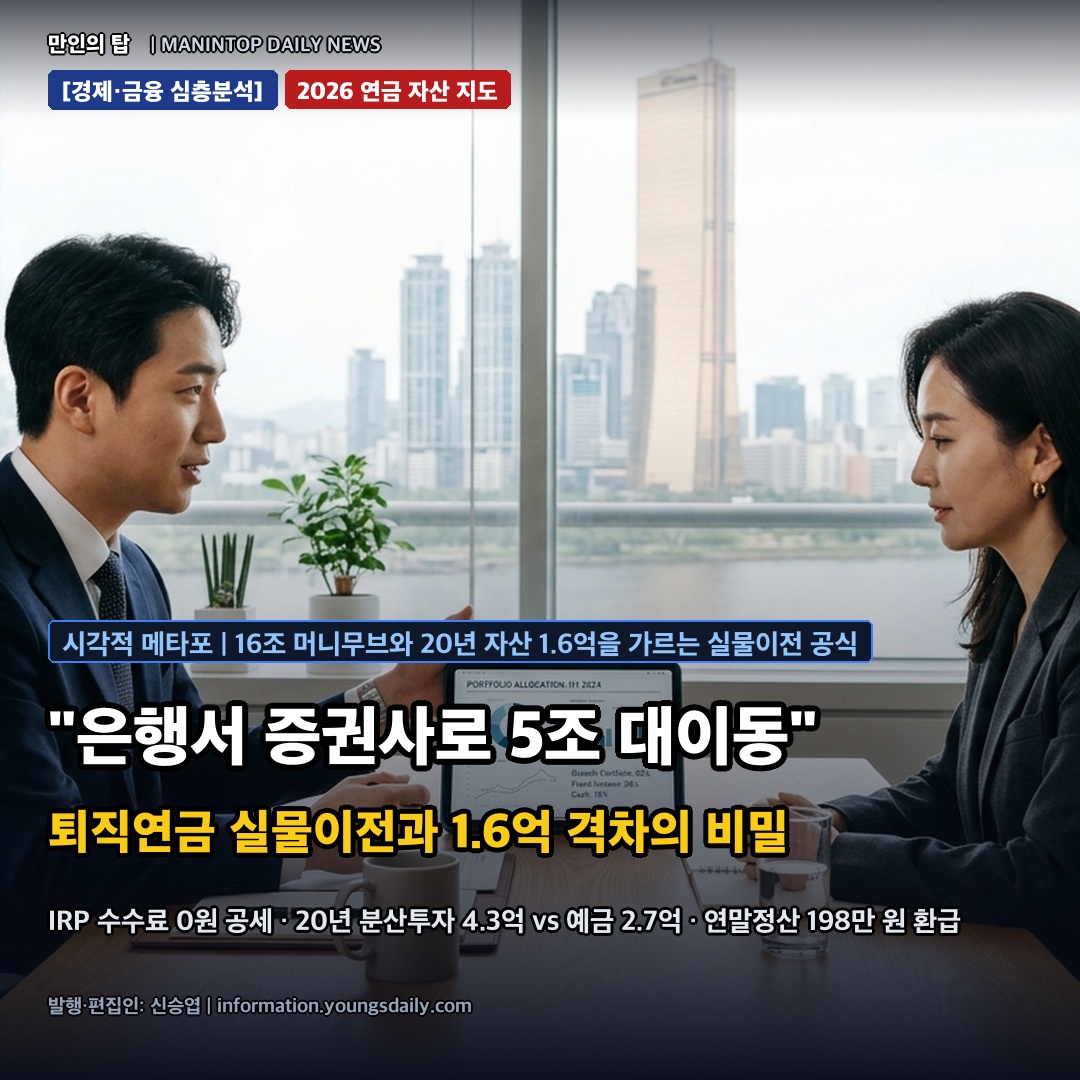
▲ 서울 여의도 자산관리 센터에서 금융 전문 상담역이 고객과 함께 퇴직연금 실물이전 절차와 TDF 및 ETF 자산배분 전략을 점검하고 있다. [사진=금융투자협회 제공]
[핵심 보도 요약 : 3대 쟁점]
퇴직연금 실물이전 제도 도입 후 15조 9,000억 원의 머니무브 발생과 은행에서 증권사로 5조 2,225억 원이 쏠린 배경 해부
비대면 IRP 수수료 0원 공세와 20년 방치 시 1억 5,728만 원(약 1.6억 원)까지 벌어지는 직장인 자산 격차의 실체
퇴직금 5억 원 연금 수령 시 1억 8,642만 원 추가 수령 효과와 ISA 만기 연계 연말정산 최대 198만 원 세액공제 로드맵
잠자던 400조 원의 대이동: 은행에서 증권사로 5조 원이 쏠린 까닭
국내 400조 원 규모의 퇴직연금 시장에서 은행에서 증권사로 5조 원이 넘는 자금이 대이동하는 사상 초유의 머니무브가 펼쳐지고 있습니다. 2024년 말 도입된 퇴직연금 실물이전 서비스로 기존 예금이나 펀드를 해지하지 않고도 금융사를 손쉽게 갈아탈 수 있게 되면서, 만년 제자리걸음이던 연금 자산에 유례없는 유동성이 공급된 것입니다.
금융감독원이 집계한 퇴직연금 실물이전 현황에 따르면 제도 시행 이후 누적 실물이전 신청 금액은 15조 9,000억 원(약 25만 건)에 달했습니다. 영업일 기준으로 매일 261억 원, 409건의 연금 계좌가 금융사를 옮겨 탄 셈입니다. 특히 2026년 상반기에만 6조 9,000억 원이 이동해 전년 동기 대비 두 배 이상 가파른 증가세를 나타냈습니다.
자금 이동의 가장 두드러진 특징은 '탈(脫)은행, 향(向)증권'입니다. 전체 실물이전 금액 중 은행에서 증권사로 이동한 규모는 5조 2,225억 원으로 전체의 33%를 차지해 단일 경로 중 압도적 1위를 기록했습니다. 업권별 순유출입에서도 증권사에는 4조 1,513억 원이 순유입된 반면 은행에서는 3조 9,714억 원, 보험사에서는 1,799억 원이 순유출되었습니다. 개인이 직접 운용하는 확정기여형(DC)과 개인형 퇴직연금(IRP) 가입자들이 상장지수펀드(ETF) 실시간 매매가 가능하고 수수료가 저렴한 증권사로 대거 자금을 옮긴 결과입니다.
▲ 금융당국과 연금 전문가들이 퇴직연금 실물이전 전산망 안정화와 가입자 수수료 인하 정책을 논의하고 있다. [사진=금융감독원 제공]
수수료 820만 원의 함정과 20년 1.6억 격차: '김 과장 vs 박 과장' 시뮬레이션의 경고
연금 자산의 머니무브를 가속화한 첫 번째 방아쇠는 '수수료 격차'입니다. 퇴직연금은 잔액에 비례해 매년 운용·자산관리 수수료가 부과됩니다. 증권사들은 점유율 확보를 위해 비대면 개설 IRP의 수수료를 전면 무료화(0.00%)했습니다. 반면 시중은행은 연 0.15~0.30%, 보험사는 연 0.16~0.465%의 수수료를 지속적으로 징수하고 있습니다.
금융감독원 분석에 따르면 퇴직급여 2억 원과 개인부담금 6,000만 원이 든 IRP를 은행 대면 창구에서 개설해 10년간 유지할 경우 발생하는 수수료는 820만 원에 달합니다. 반면 동일한 금액을 비대면 전용 계좌로 개설하면 수수료가 0원으로, 개설 채널 선택만으로 820만 원의 실질 소득 차이가 발생합니다.
수익률의 복리 효과는 더욱 충격적입니다. 금융감독원이 과거 20년간의 실측 데이터를 적용해 산출한 '김 과장 vs 박 과장' 시뮬레이션에 따르면, 매년 1,000만 원씩 20년간 총 2억 원을 똑같이 납입했음에도 자산 격차는 극명했습니다. 정기예금에 방치한 박 과장의 최종 잔고는 2억 7,220만 원에 그친 반면, 글로벌 지수 ETF와 타깃데이트펀드(TDF)로 분산투자한 김 과장의 잔고는 4억 2,948만 원에 달했습니다. 두 사람의 노후 자산 격차는 무려 1억 5,728만 원(약 1.6억 원)으로 벌어졌습니다.
퇴직연금 운용 채널
증권사 비대면 IRP
시중은행 퇴직연금
보험사 퇴직연금
운용·자산관리 수수료
연 0.00% (완전 무료)
연 0.15% ~ 0.30%
연 0.16% ~ 0.465%
1.5억 적립 시 연 수수료
0원
연 23만 ~ 45만 원
연 24만 ~ 70만 원
ETF 실시간 매매 지원
전 종목 장중 실시간 매매
일부 신탁형 상품 한정
실시간 매매 불가
위험자산 최대 한도
TDF 활용 시 실질 93.7%
법정 70% 제한
원리금보장형 쏠림
퇴직금 5억 원의 마법: 일시금 대신 20년 연금 받으면 1.86억 원 더 번다
은퇴 시점에 도달한 직장인들이 가장 많이 범하는 실수는 퇴직금을 일시금으로 한꺼번에 수령하는 것입니다. 55세 직장인이 법정 퇴직금 5억 원을 일시금으로 인출하면 약 4,500만 원의 퇴직소득세가 원천징수되어 손에 쥐는 돈은 4억 5,500만 원에 불과합니다.
반면 5억 원 전액을 세전 상태 그대로 IRP 계좌로 이체한 뒤 연 3% 안정 운용을 거쳐 20년간 분할 수령하면 최종 세후 수령액은 6억 4,142만 원으로 급증합니다. 일시금 수령 대비 무려 1억 8,642만 원의 실질 이득이 발생하는 것입니다. 이는 연금 수령 시 세법상 퇴직소득세가 30~40% 감면될 뿐만 아니라, 세금을 즉시 떼이지 않고 이연된 원금이 계속해서 복리 수익을 불려나가기 때문입니다.
특히 2026년 개정 세법에 따라 21년 차 이후 수령 구간이 신설되어 퇴직소득세 감면율이 최대 50%까지 확대되었습니다. 여기서 직장인들이 반드시 챙겨야 할 실무 팁이 바로 '연차 쌓기 전략'입니다. 세법상 매년 1만 원만 연금으로 수령해도 1개 연차가 인정됩니다. 따라서 은퇴 후 당장 큰돈이 필요 없더라도 55세 도달 즉시 최소 금액으로 연금을 개시해 두면, 10년 뒤 목돈을 인출할 때 40~50% 감면된 최저 세율을 적용받을 수 있습니다. 이미 일반 계좌로 세후 퇴직금을 입금받았더라도 60일 이내에 IRP로 입금하고 과세이연을 신청하면 기납부한 세금을 전액 환급받을 수 있습니다.
▲ 직장인이 노트북을 통해 퇴직연금 실물이전 신청 절차와 연말정산 세액공제 환급 시뮬레이션을 점검하고 있다. [사진=금융투자협회 제공]
IRP 70% 규제 뚫는 TDF 마법과 연말정산 198만 원 환급 골든룰
IRP 계좌를 직접 굴릴 때 마주치는 가장 큰 걸림돌은 법률상 '위험자산 70% 한도 규정'입니다. 주식형 ETF 등 공격적 자산은 계좌 잔액의 70%까지만 매수할 수 있고 나머지 30%는 채권이나 예금 등 비위험자산으로 채워야 합니다. 은퇴까지 20년 이상 남은 젊은 직장인에게 30% 안전자산 의무 배치는 장기 기대수익률을 갉아먹는 족쇄가 될 수 있습니다.
스마트 투자자들은 '적격 TDF'를 활용해 이 규제를 완벽하게 뚫어내고 있습니다. 생애주기 자산배분(글라이드패스)을 갖추고 잔여 기간이 5년 이상인 적격 TDF는 법적으로 비위험자산(안전자산)으로 분류됩니다. 만약 위험자산 70%에 미국 S&P500 ETF를 100% 채우고, 비위험자산 30%에 주식 편입 비중이 79.1%에 달하는 적격 TDF 2060을 편입하면, 계좌 전체의 실질 주식 투자 비중은 93.73%까지 극대화됩니다. 규정 위반 없이 포트폴리오의 93% 이상을 주식 상승 차익에 노출시키는 합법적 고수익 전략입니다.
여기에 연말정산 세액공제 극대화 전략이 결합됩니다. 연금저축(연 600만 원)과 IRP(합산 900만 원)를 채우면 총급여 5,500만 원 이하 기준 16.5% 공제율이 적용되어 148만 5,000원을 돌려받습니다. 아울러 3년 만기가 도래한 중개형 ISA 자금을 60일 내 연금계좌로 전환 입금하면 전환액의 10%(최대 300만 원)가 추가 공제 한도로 부여되어, 당해 연도 총 1,200만 원 한도에서 최대 198만 원의 현금 환급을 완성할 수 있습니다.
[직장인 퇴직연금·절세 5대 핵심 실천 수칙 : 잠자는 연금 깨우는 골든룰]
비대면 IRP 계좌 개설로 평생 수수료 820만 원 절약: 은행 대면 창구 대신 증권사 모바일 앱으로 비대면 개설하여 0.00% 수수료를 확보하십시오.
실물이전 전 모바일 사전조회로 손실 방지: 옮겨갈 금융사에서 취급하지 않는 상품만 선별 현금화되는지 미리 확인하십시오.
적격 TDF 편입으로 IRP 70% 한도 합법적 우회: 안전자산 30% 영역에 주식 비중 79% TDF를 담아 계좌 전체 주식 비중을 93%까지 끌어올리십시오.
만 55세 도달 즉시 최소 금액 연금 개시: 연 1만 원만 인출해도 연차가 쌓이므로 10년을 미리 채워 40~50% 최저 감면세율을 선점하십시오.
연금저축 600만 + IRP 300만 + ISA 만기 연계: 12월 말 결산 전 총 1,200만 원 한도를 채워 연말정산 198만 원 환급을 극대화하십시오.
발행·편집인: 신승엽 | information.youngsdaily.com.
[In-Depth Analysis] The KRW 5T Bank-to-Brokerage Migration: Inside Pension Asset Portability and the KRW 160M Wealth Gap
▲ A financial advisor consults with a retail client regarding retirement pension asset portability, TDF glidepaths, and ETF allocations in Yeouido, Seoul. [Photo: Korea Financial Investment Association]
[Executive Briefing : 3 Critical Takeaways]
Over KRW 15.9 trillion transferred under pension asset portability as KRW 5.2 trillion shifted directly from commercial banks to securities brokerages.
Brokerages offer 0.00% zero-fee mobile IRPs, widening the 20-year retirement capital gap between active allocators and passive depositors to KRW 157 million.
Opting for 20-year phased annuity payouts over lump-sum cash yields KRW 186 million in extra net capital, with annual tax credits reaching KRW 1.98 million.
Unfreezing KRW 400T in Dormant Capital: Why Over KRW 5T Shifted to Brokerages
South Korea's KRW 400 trillion retirement pension ecosystem is undergoing an unprecedented structural reallocation as over KRW 5 trillion in capital migrated from commercial banks to securities brokerages. With the launch of retirement pension asset portability services, depositors are no longer required to liquidate underlying deposits or funds to change custodians, injecting dynamic market liquidity into long-dormant retirement wealth.
Official Financial Supervisory Service statistics indicate that cumulative portability transfers reached KRW 15.9 trillion across approximately 250,000 accounts. On any given business day, an average of KRW 26.1 billion and 409 retirement accounts switch financial providers. Transfer momentum accelerated sharply in the first half of 2026, logging KRW 6.9 trillion—more than double the KRW 3.2 trillion registered during the same period last year.
The defining trajectory of this capital wave is the massive shift from banking halls to investment brokerages. Out of all asset portability transfers, bank-to-brokerage flows accounted for KRW 5.2225 trillion, capturing a dominant 33% plurality among all migration pathways. In net institutional balances, securities brokerages absorbed a net inflow of KRW 4.1513 trillion, while banks and insurers suffered net outflows of KRW 3.9714 trillion and KRW 179.9 billion respectively. Self-directed Defined Contribution (DC) and Individual Retirement Pension (IRP) holders relocated aggressively to capture real-time ETF execution and zero-fee structures.
▲ Financial authorities and industry experts evaluate operational stability and consumer fee reduction frameworks for pension asset portability. [Photo: Financial Supervisory Service]
The KRW 8.2M Fee Trap and the 20-Year KRW 160M Divergence: Lessons from Real Simulations
The primary catalyst propelling pension portability is pronounced fee disparity. Retirement pension accounts incur recurring annual custody and administration fees proportional to asset balances. Major securities brokerages abolished all account maintenance fees (0.00%) for mobile-originated non-face-to-face IRP accounts, whereas commercial banks levy 0.15% to 0.30% annually, and insurance carriers charge up to 0.465%.
FSS empirical data demonstrates that holding an IRP account with KRW 200 million in severance pay and KRW 60 million in voluntary contributions through traditional bank branches generates KRW 8.2 million in cumulative maintenance fees over a decade. In contrast, an identical portfolio held via a zero-fee digital brokerage account incurs zero fees, yielding an immediate KRW 8.2 million net saving purely based on channel onboarding.
The compounding impact of investment performance is even more pronounced. In an official 20-year retrospective simulation tracking two employees contributing KRW 10 million annually (KRW 200 million principal), the passive depositor keeping funds in fixed bank deposits accumulated KRW 272.2 million. Meanwhile, the active allocator deploying global index ETFs and target-date funds grew their balance to KRW 429.48 million. The resulting terminal wealth gap exceeded KRW 157.28 million, underscoring the compounding penalty of passive asset neglect.
Pension Custody Channel
Brokerage Digital IRP
Commercial Bank Pension
Insurance Carrier Pension
Custody & Admin Fee
0.00% p.a. (Completely Free)
0.15% ~ 0.30% p.a.
0.16% ~ 0.465% p.a.
Annual Fee on KRW 150M
KRW 0
KRW 230K ~ 450K p.a.
KRW 240K ~ 700K p.a.
Real-Time ETF Trading
Full intraday market orders
Restricted trust models
Unavailable
Effective Equity Limit
Up to 93.7% via Qualified TDF
Statutory 70% restriction
Heavy principal-guaranteed bias
The KRW 500M Payout Decision: Earning KRW 186M More via 20-Year Annuity Distribution
The most expensive misstep retiring professionals make is electing lump-sum severance cashouts. A 55-year-old employee withdrawing KRW 500 million in statutory severance pay triggers approximately KRW 45 million in mandatory retirement income tax withholding, locking in net proceeds of KRW 455 million.
Conversely, transferring the gross KRW 500 million balance into an IRP and drawing phased annual installments over 20 years (assuming 3.0% annual portfolio growth) yields total net cash distributions of KRW 641.42 million. This generates an incremental KRW 186.42 million in retirement wealth. The windfall stems from statutory tax discounts of 30% to 40% combined with compounding investment returns on tax-deferred undistributed capital.
Furthermore, under revised 2026 tax codes, a new discount bracket for distributions beyond 21 years expands retirement income tax relief to 50%. A crucial strategic takeaway is establishing tenure early: taking as little as KRW 10,000 annually counts as a completed distribution year under tax law. Initiating minimal payouts at age 55 ensures that by year 11, any subsequent large withdrawals qualify for maximum 40% to 50% statutory tax abatements. Even if severance pay was inadvertently received into a personal checking account, depositing the funds into an IRP within 60 days triggers full withholding tax refunds.
▲ A professional employee tracks retirement pension asset portability workflows and calculates year-end tax credit refunds on desktop and mobile tools. [Photo: Korea Financial Investment Association]
Bypassing the 70% IRP Risk Cap with TDFs and Maximizing KRW 1.98M Tax Credits
When self-directing IRP portfolios, the primary hurdle is the statutory 70% risk-asset ceiling, which mandates that at least 30% of total assets be allocated to conservative instruments like bonds or cash deposits. For younger workers with decades until retirement, a compulsory 30% drag in fixed income compromises terminal capital accumulation.
Sophisticated allocators resolve this restriction by leveraging Qualified Target Date Funds (TDF). Because TDFs feature automated glidepath rebalancing, funds with over five years until target maturity are legally categorized as non-risk assets. By allocating 70% of an IRP into US S&P 500 or Nasdaq 100 ETFs, and deploying the remaining 30% into a Qualified TDF 2060 (which carries 79.1% equity exposure), the effective portfolio-wide equity exposure reaches 93.73%—fully compliant with regulations while optimizing capital appreciation.
This allocation strategy pairs seamlessly with annual tax optimization. Combining Pension Savings (KRW 6M) and IRP contributions (KRW 3M) secures an immediate KRW 1.485 million refund under the standard 16.5% tax credit rate. Furthermore, rolling matured Brokerage ISA funds into pension accounts within 60 days unlocks an additional 10% deduction allowance (up to KRW 3M), elevating total annual tax deductions to KRW 12 million and generating up to KRW 1.98 million in cash rebates.
[Retirement Wealth & Tax Mastery : 5 Essential Rules for Capital Growth]
Open Zero-Fee Digital IRPs to Save KRW 8.2M: Onboard through digital mobile brokerage apps to permanently secure a 0.00% custody fee baseline.
Perform Pre-Transfer Inquiries to Prevent Involuntary Sales: Verify that target custodians support all existing portfolio assets prior to initiating portability requests.
Deploy Qualified TDFs to Achieve 93% Equity Exposure: Utilize the non-risk legal status of TDFs to overcome the 70% risk cap and compound global equity growth.
Initiate Minimal Payouts at Age 55 to Build Distribution Tenure: Withdrawing token sums annually completes distribution tiers, unlocking 40% to 50% tax abatements later.
Synthesize Pension Savings, IRP, and Matured ISAs: Maximize contributions up to the expanded KRW 12 million ceiling to secure up to KRW 1.98 million in tax refunds.
1월이 시작되면 감기는 이미 우리 곁에 와 있습니다. 2월, 3월, 4월까지 이어지는 추위와 건조함은 코와 목을 가장 먼저 공격합니다. 아침에 일어나자마자 막혀 있는 코. 계속 흐르는 콧물. 괜히 칼칼해지는 목. 이 증상은 “시작”일 뿐입니다. 한 번 무너지면 일주일, 길면 한 달까지 끌고 갑니다. 약을 먹으면 잠깐 괜찮아집니다. 하지만 며칠 뒤 또 반복됩니다. 왜일까요? 감기는 ‘치료’의 문제가 아니라 ‘관리’의 문제이기 때문입니다. 대부분은 감기가 오고 나서 약을 찾습니다. 하지만 진짜 중요한 건 감기가 오기 전에 코와 목을 지키는 것입니다. 건조한 실내 공기, 차가운 바깥 공기, 눈에 보이지 않는 세균. 코와 목은 매일 공격받고 있습니다. 지긋지긋하죠! 그런데도 우리는 아무 준비 없이 버티고 있습니다. 이번 겨울도 그렇게 보낼 건가요? 사실 방법은 어렵지 않습니다. 코를 깨끗하게 관리하고, 목을 따뜻하게 보호하고, 점막을 촉촉하게 유지하고, 기관지를 미리 관리하고, 외부 공기를 차단하는 것. 이 다섯 가지만 꾸준히 해도 감기약 없이 겨울을 보내는 것이 충분히 가능합니다. 🔥 이제부터 그 방법을 하나씩 살펴보겠습니다. 🔥 1. 코와 목을 먼저 관리해야 하는 과학적 이유 감기의 대부분은 코 점막에서 시작됩니다. 국제 학술지 Nature Reviews Microbiology 와 Journal of Allergy and Clinical Immunology 에 실린 호흡기 감염 관련 연구들에서는, 감기 바이러스가 비강 상피세포에 먼저 부착해 증식한다는 점을 설명하고 ...
리모델링사업이 진행 중인 아파트를 매매할 때 “계약금 10%를 언제까지 내야 하느냐”는 질문이 특히 많이 나옵니다. 이주공고(이주 안내)가 7~11월쯤이라고 들으면, 그 시점에 맞춰 계약금도 움직일 것 같아서 더 헷갈리기 쉽습니다. 하지만 실제 납부기한은 ‘이주공고가 언제냐’만으로 자동 결정되지 않는 경우가 많습니다. 1) 계약금 10% 납부기한: 결국 ‘문서에 적힌 일정’이 기준 계약금 10%를 언제까지 납부해야 하는지는, 내가 서명하는 매매계약서(특약 포함) 와 사업주체/조합이 제시한 공고·안내문 에 적힌 납부 일정이 기준이 됩니다. 실제 공고문에서는 분양대금 납부의 큰 틀(계약금→중도금→잔금)을 먼저 안내하고, 상세 일정은 별도 표나 유의사항으로 제시하는 방식이 흔합니다. 또, 계약서 문구에 따라 지급 시점이 조건부로 설정될 수도 있습니다. 예를 들어 한 사례 소개 자료에서는 용역계약서에 잔금(10%) 지급시기가 “사업승인 후”로 기재되어 있었다는 점이 언급됩니다. 이런 식으로 ‘사업 단계’와 지급을 연동하는 문구가 들어가면, 질문의 답은 계약서 문구를 확인해야만 확정됩니다. 관련 내용은 링크 에서 문구 사례를 확인할 수 있습니다. 2) 입주자모집공고에서 확인되는 ‘납부 순서’와 잔금 마감 시점 공고문에 적힌 문구를 보면, 납부 순서와 잔금 마감에 대한 기준이 비교적 명확하게 제시되는 경우가 있습니다. 예를 들어 한 입주자모집공고에는 “분양금액(주택가격)은 계약금, 중도금, 잔금의 순서로 납부”하며 “잔금은 입주(열쇠 수령일) 전에 완납”해야 한다고 안내되어 있습니다. (문구 확인: 링크 ) 이 문구가 의미하는 바는 최소 2가지입니다. 분양/공급 형태의 문서에서는 ‘계약금→중도금→잔금’ 흐름이 공식적으로 안내될 수 있습니다. 잔금은 “입주(열쇠 수령)” 이전에 완납해야 한다는 마감 기준이 문서에 적혀 있을 수 있습니다. 다만, 위 공고문 문구는 잔금 마감에 대한 기준을 보여주지만, 계약금 10%의...
윤석열 전 대통령 탄핵 인용 소식을 접하면, 가장 궁금한 지점은 ‘헌재가 정확히 무엇을 위헌·위법으로 봤는가’입니다. 또한 탄핵과 별개로 진행되는 형사재판(내란 우두머리 혐의 등)이 어디까지 왔는지도 함께 정리할 필요가 있습니다. 아래 내용은 제공된 기사/게시물 스니펫과 링크에서 확인되는 범위만 모아, 일반인이 흐름을 이해하기 쉽게 정리한 것입니다. 1) 탄핵 인용 관련: 스니펫에서 확인되는 ‘판단의 골격’ 제공된 근거 중 조국혁신당 사이트에는 헌법재판소가 윤석열 탄핵 심판에서 “피청구인의 위헌·위법행위는 국민 신임 …”이라는 취지로 판단했다는 문장이 인용돼 있습니다( 링크 ). 이 인용문만 놓고 보면, ‘위헌·위법행위’가 있었는지와 그로 인해 ‘국민의 신임’이 어떻게 평가됐는지가 핵심 축으로 소개됩니다. 다만 질문에서 요청하신 세부 항목, 즉 비상계엄 선포 자체를 문제 삼은 구체적 이유, 계엄 이후 조치(포고령, 국회 통제 등)의 어떤 지점이 헌법 위반인지, 국회의 권한행사 방해 및 정치활동 제약을 어떤 논리로 판단했는지 등은, 이번에 제공된 근거의 제목/스니펫만으로는 조항·사실관계·판단 구조가 그대로 제시돼 있지 않습니다. 따라서 이 글에서는 ‘헌재가 무엇을 문제 삼았다’는 세부 리스트를 단정적으로 재구성하기보다, 현재 확인 가능한 문구 수준의 요약(위헌·위법행위 → 국민 신임의 문제로 평가)까지만 적습니다. 만약 헌재 결정문 전문(주문 및 이유)이 추가로 확인되면, 그때는 문장 단위로 ‘어떤 행위’와 ‘어떤 헌법 원리/조항’이 연결되는지(예: 권력분립, 국회의 권한, 정치적 기본권 등) 구조화해 정리하는 것이 가장 정확합니다. 2) 형사 절차(내란 혐의) 관련: 체포영장과 1심 선고 언급 탄핵 심판과 별도로, 12·3 비상계엄 사태로 내란 혐의를 받는 윤석열 대통령에 대해 2024년 12월 31일 체포 영장이 발부됐다는 BBC 보도가 있습니다( 링크 ). 해당 보도는 ‘현직 대통령’에 대한 체포영장 발부라는 점을 함께 언급합니다. 또...