정신요양시설 인권 침해와 정신건강복지법 총정리…5대 입원 유형·격리 강박 금지·퇴원심사·신고 절차
만인의 탑 편집국11월 24, 2026
정신요양시설 인권 보호와 정신건강복지법상 입원·격리 제한·구제 절차를 상징적으로 표현한 대표 이미지. 기사 이해를 돕기 위해 제작한 설명 이미지이며 실제 현장 사진이나 공식 화면이 아닙니다.
정신요양시설과 정신의료기관 내부의 인권 침해 문제가 사회적 쟁점으로 부각되면서, 현행 법령이 어떤 요건으로 입원과 입소를 허용하고 어떤 절차로 당사자의 신체 자유를 보호하는지에 대한 확인 수요가 높아지고 있다. 대한민국에서 정신질환자의 입원·입소와 처우 기준을 규율하는 핵심 법률은 「정신건강증진 및 정신질환자 복지서비스 지원에 관한 법률」(약칭 정신건강복지법)이다.
특히 현장에서는 자발적 입소와 비자의적 강제 입소의 경계, 보호의무자 자격 요건, 격리·강박 시행의 적법성, 퇴원 거부 시 구제 수단을 정확히 알지 못해 당사자와 가족이 제때 권리를 행사하지 못하는 사례가 반복된다. 국가법령정보센터, 보건복지부, 국립정신건강센터, 국가인권위원회의 공식 기준을 바탕으로 5대 입원 유형, 격리·강박 제한 원칙, 공적 심사 및 신고 절차를 한눈에 정리했다.
정신건강복지법상 5대 입원·입소 유형과 법적 요건
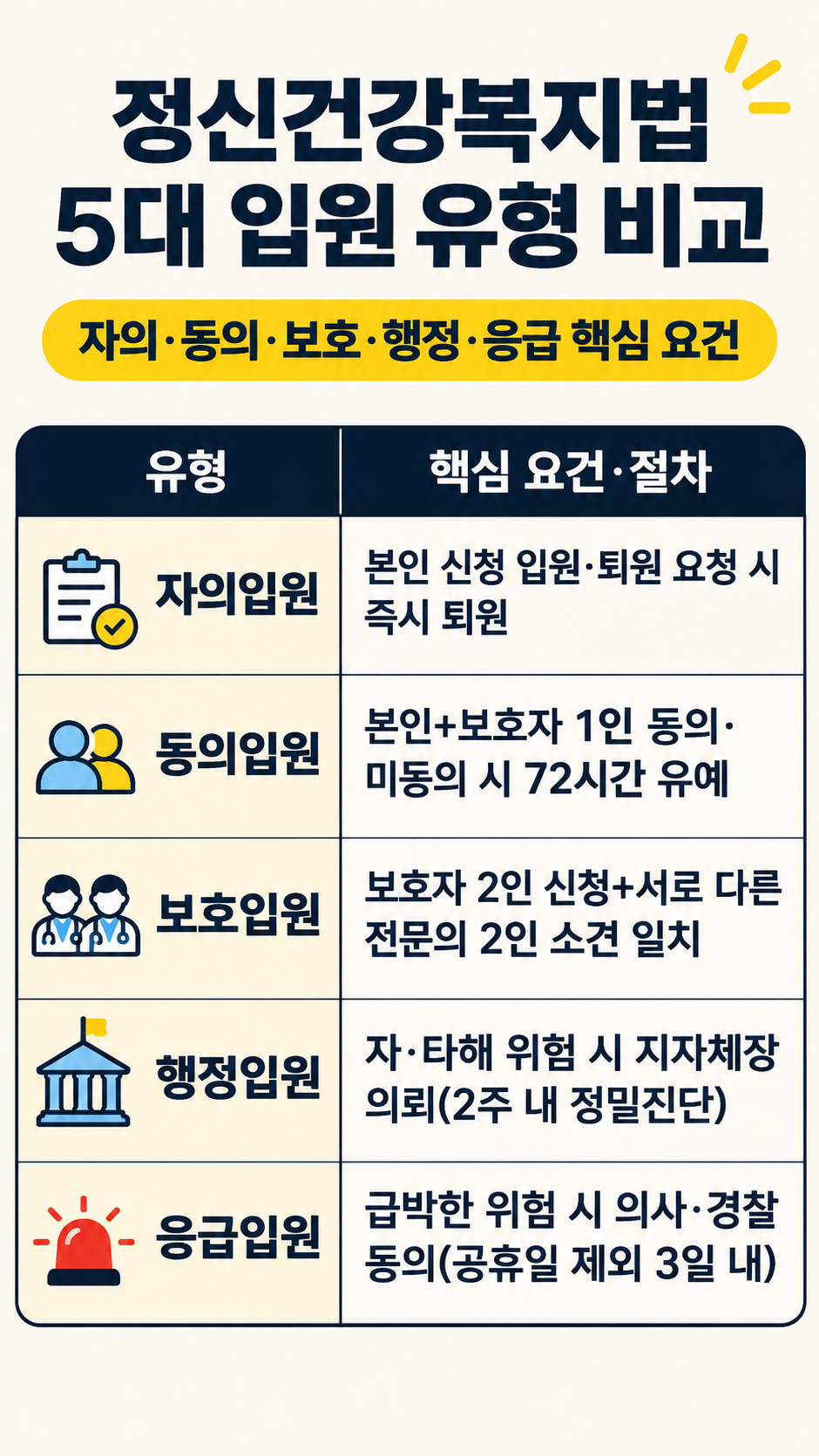
정신건강복지법은 당사자의 의사 존중을 원칙으로 삼고, 본인의 동의 여부와 위급성에 따라 입원·입소 유형을 다섯 갈래로 엄격히 구분한다. 본인이 직접 신청하는 자의입원등(제41조)과 본인 신청에 보호의무자 동의가 결합된 동의입원등(제42조)은 자발적 유형에 속하며, 보호입원(제43조)·행정입원(제44조)·응급입원(제50조)은 비자의적 유형에 해당한다.
유형
근거 조문
신청·결정 주체
퇴원·퇴소 원칙 및 제한 기간
자의입원등
제41조
정신질환자 본인 신청
퇴원(소) 신청 시 지체 없이 퇴원 조치, 2개월마다 퇴원 의사 확인 의무
동의입원등
제42조
본인 신청 + 보호의무자 동의
본인 퇴원 신청 시 원칙적 퇴원, 단 보호의무자 미동의 및 전문의 치료 필요 진단 시 72시간 내 비자의입원 전환 가능
보호의무자 입원등
제43조
보호의무자 2명 이상 신청 + 전문의 진단
자·타해 위험성과 치료·요양 필요성 동시 충족 필수, 퇴원 거부 시 사유 및 퇴원심사 청구권 서면 고지
행정입원
제44조
시·군·구청장 진단·보호 신청
자·타해 위험 의심자 대상 지정정신의료기관 의뢰, 입원적합성심사 및 연장 심사 대상
응급입원
제50조
의사와 경찰관 동의(경찰관·구급대원 호송, 입원 후 지체 없이 전문의 진단)
급박한 자·타해 위험 시 3일 이내(공휴일 제외) 한시 입원
자의입원등으로 입소한 사람은 본인이 퇴소를 원할 때 시설이나 병원의 장이 지체 없이 퇴소 조치를 해야 하며, 장기 체류를 막기 위해 2개월마다 본인의 입원 유지 의사를 다시 확인해야 한다. 동의입원등의 경우에도 본인이 원하면 퇴원이 원칙이지만, 보호의무자가 동의하지 않고 정신건강의학과 전문의가 계속 치료 필요성을 진단하면 최대 72시간 동안 퇴원을 보류한 채 보호입원이나 행정입원으로 전환할 수 있다.
비자의입원 가운데 가장 쟁점이 잦은 보호의무자에 의한 입원등(제43조)은 법정 자격을 갖춘 보호의무자 2명 이상의 신청과 전문의의 진단이 모두 있어야 성립하며, 2주 이내에 서로 다른 정신의료기관 소속 전문의 2명의 일치된 소견이 확보되어야 입원을 계속할 수 있다. 국가인권위원회 조사에서 반복 지적되는 대표적 위법 유형은 보호의무자 결격 사유가 있는 사람이 동의서를 작성했거나, 자·타해 위험성 없이 가족 갈등이나 돌봄 부담만으로 장기 입소를 유지하는 경우다.
정신건강복지법 제41조~제50조에 따른 5대 입원·입소 유형과 핵심 법적 요건 요약 카드. 기사 이해를 돕기 위해 제작한 설명 이미지이며 실제 현장 사진이나 공식 화면이 아닙니다.
정신요양시설 격리·강박 금지 원칙과 위법 판단 기준
정신건강복지법 제7장은 정신의료기관과 정신요양시설에서 수용된 사람의 인권을 조문별로 엄격히 보호한다. 부당한 노동 강요 금지(제69조 제3항), 폭행·가혹행위 금지(제72조 제2항), 통신·면회의 자유 제한 금지(제74조)가 명시돼 있으며, 제75조는 정당한 의학적 사유 없이 격리 또는 신체적 제한(강박)을 가하는 행위를 명확히 금지하고 있다. 이를 위반해 전문의 지시 없이 격리·강박을 시행하면 1년 이하의 징역 또는 1천만 원 이하의 벌금 등 형사처벌 대상이 된다.
예외적으로 환자 본인이나 타인의 안전을 보호하기 위해 다른 대체 수단이 전혀 없는 긴급 상황에 한해 격리나 강박이 검토될 수 있으나, 이 경우에도 까다로운 절차적 요건이 적용된다. 첫째, 간호사나 시설 종사자의 임의 판단이나 단순 전화 지시가 아니라 정신건강의학과 전문의의 대면 진료와 명시적 지시가 전제되어야 한다. 둘째, 목적 달성에 필요한 최소한의 시간(성인 기준 1회 최대 격리 12시간·강박 4시간) 동안만 시행해야 하며 징벌이나 관리 편의 목적으로 연장할 수 없다. 셋째, 시행 사유, 시작 및 종료 시각, 주기적 관찰 기록(격리 최소 1시간·강박 최소 30분 간격), 해제 사유를 진료·생활 기록에 빠짐없이 남겨야 한다.
국가인권위원회는 정신요양시설 실태조사와 진정 조사에서 전화 지시에 의존한 장시간 강박, 휴대전화·서신 등 외부 통신의 전면 차단, 외출·외박의 일괄 제한, 퇴소 신청서 접수 거부 등을 중대한 인권 침해 유형으로 판단해 왔다. 이러한 위법 사실이 확인되면 인권위는 시설 장과 관할 지방자치단체에 시정 조치와 관련자 직무교육을 권고하고, 폭행·불법 감금 등 중대 사안은 수사 기관에 고발 또는 수사 의뢰를 진행한다.
입원적합성심사·정신건강심사·절차조력인 권리 구제 체계
비자의입원이 남용되거나 장기화하는 문제를 막기 위해 현행 법령은 다층적인 공적 심사 장치를 두고 있다. 보호입원이나 행정입원이 이뤄지면 최초 입원일로부터 1개월 이내에 국립정신건강센터 등 국가 지정 기관에 설치된 입원적합성심사위원회(제46조)가 입원의 적법성과 필요성을 독립적으로 심사한다. 이때 당사자 본인이나 보호자는 위원회에 대면조사와 의견진술을 직접 신청할 수 있으며, 요건 미비가 드러나면 즉시 퇴원 명령이 내려진다.
입원·입소 이후에도 당사자나 보호의무자는 언제든 관할 특별자치시장·특별자치도지사·시장·군수·구청장에게 퇴원등 또는 처우개선 심사를 청구할 수 있으며(제55조), 지자체장은 지체 없이 시·도(광역) 또는 시·군·구(기초)에 설치된 소관 정신건강심사위원회에 회부해 심사를 진행해야 한다(제53조·제54조·제56조, 기초 심사 불복 시 14일 이내 광역 재심사 청구 가능). 특히 제43조 제9항과 제10항에 따라 입소자나 보호의무자가 퇴소를 신청했는데 시설 장이 치료 필요성이나 위험성을 이유로 이를 거부한다면, 시설 장은 거부 사유와 함께 퇴원심사를 청구할 수 있는 권리와 절차를 반드시 서면으로 고지해야 한다. 서면 고지를 누락하거나 청구서 발송을 방해하는 행위 자체가 위법이다.
당사자가 시설 내부에서 스스로 법적 서류를 작성하거나 진술을 준비하기 어려운 현실을 보완하기 위해 절차조력서비스도 제도화되어 운영되고 있다. 절차조력인은 비자의입원 당사자가 입원적합성심사, 퇴원심사 청구, 국가인권위원회 진정, 인신보호법상 구제청구 등 법적 권리를 실질적으로 행사할 수 있도록 상담과 절차 동행을 지원한다.
정신요양시설 인권 침해 의심 시 신고 창구(112·1331·129)와 퇴원심사 청구 4단계 안내 카드. 기사 이해를 돕기 위해 제작한 설명 이미지이며 실제 현장 사진이나 공식 화면이 아닙니다.
인권 침해 의심 시 단계별 신고 및 대응 체크리스트
정신요양시설이나 정신의료기관에서 폭행, 가혹행위, 부당한 격리·강박, 퇴소 거부, 외부 연락 차단이 의심된다면 증거 확보와 공적 창구 동시 접수가 가장 중요하다. 첫째, 긴급한 신체 위해나 불법 감금이 진행 중이라면 즉시 경찰(112)에 신고해 현장 출동과 신변 보호를 요청해야 한다. 둘째, 시설 내 인권 침해 진정과 직권조사 요청은 국가인권위원회 인권상담전화(1331) 또는 공식 누리집을 통해 당사자 본인뿐 아니라 가족·지인·종사자 등 제3자도 접수할 수 있다.
셋째, 시설 인허가와 지도·점검 권한을 가진 관할 시·군·구청 복지 담당 부서나 보건복지상담센터(129)에 행정 점검을 민원으로 병행 접수하면 시설 운영 실태와 기록물 보존 여부를 신속히 확인할 수 있다. 넷째, 퇴원·퇴소 거부에 대해서는 관할 지자체장(시·군·구청장 등)에게 퇴원심사를 청구해 광역·기초 정신건강심사위원회의 판단을 구하고, 정신건강 위기 상담이 필요할 때는 24시간 운영되는 정신건강위기상담전화(1577-0199)의 도움을 받을 수 있다. 신고 전에는 일시·장소·가해자·목격자·면회 및 통화 제한 정황·진단서나 문자 기록을 날짜순으로 정리해 두는 것이 조사 착수에 유리하다.
Editorial key visual representing legal safeguards, admission standards, and human rights protections in mental health care facilities. Editorial illustration prepared for reader clarity; not a photograph of an actual event or official screen capture.
Renewed public scrutiny over human rights violations inside mental health care facilities and psychiatric hospitals in South Korea has driven strong demand for clear legal facts on how admission, seclusion, restraint, and discharge are regulated. The core statute governing these protections is the Act on the Improvement of Mental Health and the Support for Welfare Services for Mental Patients, commonly known as the Mental Health Welfare Act.
In practice, residents and families frequently struggle to exercise statutory rights because the boundary between voluntary and involuntary admission, guardian eligibility rules, legal limits on restraint, and formal appeal channels are complex. Based on primary statutes and official guidance from the Korea Ministry of Government Legislation, the Ministry of Health and Welfare, the National Center for Mental Health, and the National Human Rights Commission of Korea, this guide outlines the five admission categories, restraint prohibitions, and step-by-step remedies.
Five Statutory Admission Categories Under the Mental Health Welfare Act
South Korean mental health law prioritizes voluntary care and divides admission to psychiatric medical institutions and mental health care facilities into five statutory tracks depending on patient consent and clinical urgency. Voluntary admission (Article 41) and consent-based admission (Article 42) require the person's own application, whereas guardian-initiated admission (Article 43), administrative admission (Article 44), and emergency admission (Article 50) constitute involuntary tracks subject to strict external review.
Admission Type
Statutory Basis
Initiating Authority
Discharge Rule and Statutory Limit
Voluntary Admission
Article 41
Patient's own application
Immediate discharge upon patient request; discharge intent must be reconfirmed every 2 months
Consent-Based Admission
Article 42
Patient application plus guardian consent
Discharge upon request in principle; if guardian objects and a psychiatrist confirms treatment need, conversion to involuntary track permitted within 72 hours
Guardian-Initiated Admission
Article 43
Application by 2 or more legal guardians plus psychiatrist diagnosis
Requires both self-or-other harm risk and treatment/care need; refusal of discharge requires written notice of reasons and review rights
Administrative Admission
Article 44
Mayor, county governor, or district head
Referral to a designated psychiatric institution for persons suspected of self-or-other harm risk; subject to suitability and extension reviews
Emergency Admission
Article 50
Physician and police officer consent (escorted by police or emergency responder; prompt psychiatrist diagnosis upon admission)
Temporary admission for urgent self-or-other harm risk, limited to within 3 days excluding public holidays
Under Article 41, a facility or hospital director must release a voluntarily admitted resident without delay once a discharge request is submitted, and must verify the resident's willingness to stay every two months. Under Article 42, if a resident seeks release without guardian consent and a psychiatric specialist diagnoses ongoing treatment need, the institution may hold discharge for up to 72 hours strictly to convert the status into a legally reviewed involuntary admission.
Guardian-initiated admission under Article 43 generates the largest share of rights disputes. Both legal eligibility of at least two guardians and a psychiatric specialist's confirmation of both treatment need and risk of harm are mandatory, and continued hospitalization beyond two weeks requires concurring diagnoses from two psychiatrists affiliated with different institutions. Human rights investigations have repeatedly cited cases where disqualified guardians signed consent forms or where long-term confinement continued without clinical risk of harm.
Vertical summary card outlining the five statutory admission types and legal criteria under Articles 41 to 50 of the Mental Health Welfare Act. Editorial illustration prepared for reader clarity; not a photograph of an actual event or official screen capture.
Prohibition of Unlawful Seclusion and Physical Restraint
Chapter 7 of the Mental Health Welfare Act protects institutionalized persons through distinct statutory safeguards: forced labor is prohibited under Article 69 Paragraph 3, assault and cruelty under Article 72 Paragraph 2, unlawful restrictions on communication and visits under Article 74, and unjustified seclusion or physical restraint under Article 75. Imposing seclusion or restraint without a psychiatrist's order violates Article 75 and carries criminal penalties of up to one year in prison or a fine of up to 10 million won.
Exceptionally, seclusion or physical restraint may be considered only when no less-restrictive alternative exists to prevent imminent physical harm to the resident or others. Even then, strict procedural safeguards apply. First, restraint must follow an in-person clinical evaluation and explicit order by a psychiatric specialist rather than informal staff discretion or phone-only instructions. Second, duration must be kept to the strict minimum necessary (maximum single episode of 12 hours for seclusion or 4 hours for physical restraint in adults) and never used as punishment or for staffing convenience. Third, staff must record the clinical justification, start and end times, periodic safety checks (at least hourly during seclusion and every 30 minutes during restraint), and termination reasons in detail.
In periodic inspections and complaint investigations, the National Human Rights Commission of Korea has flagged prolonged restraint ordered over the phone, total restriction of external communication, blanket denial of outings, and obstruction of discharge applications as serious human rights violations. Where violations are substantiated, the commission recommends corrective action and staff training to the facility and local government, and refers severe cases such as assault or unlawful confinement for criminal investigation.
Public Review Bodies and Procedural Assistance Services
To prevent abuse or prolonged involuntary confinement, South Korean law establishes independent multi-tier review mechanisms. For involuntary admissions under Articles 43 and 44, an Admission Suitability Review Committee established under Article 46 at national mental health institutions reviews the legality and necessity of admission within one month of initial entry. Residents and families may directly request an in-person interview and submit statements, and the committee can order immediate release if legal requirements are not met.
Beyond initial suitability review, residents or guardians may petition the local mayor, county governor, or district head under Article 55 at any time for discharge review or treatment improvement, and the local government head must refer the petition without delay to the competent provincial or municipal Mental Health Review Board established under Articles 53, 54, and 56 (with a 14-day window to appeal a municipal decision to the provincial board). Under Article 43 Paragraphs 9 and 10, whenever a facility director refuses a discharge request based on clinical need or safety risk, the director is legally obligated to notify the applicant in writing of the refusal grounds and the right to request a formal discharge review. Withholding written notice or blocking petition submission is itself unlawful.
Recognizing that institutionalized residents often face practical barriers when drafting petitions, South Korea also operates procedural assistance services. Trained procedural assistants provide counseling and accompaniment so involuntary patients can effectively exercise rights before suitability committees, review boards, human rights agencies, and courts under the Habeas Corpus Act.
Vertical four-step guide detailing reporting hotlines (112, 1331, 129) and discharge review procedures when rights violations are suspected. Editorial illustration prepared for reader clarity; not a photograph of an actual event or official screen capture.
Step-by-Step Reporting Channels When Abuse Is Suspected
When assault, cruelty, unlawful restraint, denial of discharge, or communication blockades are suspected inside a mental health care facility, documenting facts and notifying multiple official authorities simultaneously is critical. First, if imminent physical harm or unlawful detention is occurring, contact the police immediately at 112 for emergency intervention and protection. Second, file a human rights petition with the National Human Rights Commission of Korea via its hotline 1331 or official portal; petitions may be submitted not only by the resident, but also by family members, acquaintances, or facility staff.
Third, report administrative oversight concerns to the welfare division of the local city, county, or district office or the Ministry of Health and Welfare Call Center at 129 to trigger on-site inspection and record audits. Fourth, file a formal discharge or treatment improvement review petition with the relevant local government head for referral to the municipal or provincial Mental Health Review Board, and use the 24-hour Mental Health Crisis Counseling Hotline at 1577-0199 when immediate clinical crisis guidance is needed. Preparing a chronological record of dates, locations, witnesses, call or visit restrictions, and written notices strengthens formal investigation.
Sources Reviewed
Korea Ministry of Government Legislation (Mental Health Welfare Act): https://www.law.go.kr/
1월이 시작되면 감기는 이미 우리 곁에 와 있습니다. 2월, 3월, 4월까지 이어지는 추위와 건조함은 코와 목을 가장 먼저 공격합니다. 아침에 일어나자마자 막혀 있는 코. 계속 흐르는 콧물. 괜히 칼칼해지는 목. 이 증상은 “시작”일 뿐입니다. 한 번 무너지면 일주일, 길면 한 달까지 끌고 갑니다. 약을 먹으면 잠깐 괜찮아집니다. 하지만 며칠 뒤 또 반복됩니다. 왜일까요? 감기는 ‘치료’의 문제가 아니라 ‘관리’의 문제이기 때문입니다. 대부분은 감기가 오고 나서 약을 찾습니다. 하지만 진짜 중요한 건 감기가 오기 전에 코와 목을 지키는 것입니다. 건조한 실내 공기, 차가운 바깥 공기, 눈에 보이지 않는 세균. 코와 목은 매일 공격받고 있습니다. 지긋지긋하죠! 그런데도 우리는 아무 준비 없이 버티고 있습니다. 이번 겨울도 그렇게 보낼 건가요? 사실 방법은 어렵지 않습니다. 코를 깨끗하게 관리하고, 목을 따뜻하게 보호하고, 점막을 촉촉하게 유지하고, 기관지를 미리 관리하고, 외부 공기를 차단하는 것. 이 다섯 가지만 꾸준히 해도 감기약 없이 겨울을 보내는 것이 충분히 가능합니다. 🔥 이제부터 그 방법을 하나씩 살펴보겠습니다. 🔥 1. 코와 목을 먼저 관리해야 하는 과학적 이유 감기의 대부분은 코 점막에서 시작됩니다. 국제 학술지 Nature Reviews Microbiology 와 Journal of Allergy and Clinical Immunology 에 실린 호흡기 감염 관련 연구들에서는, 감기 바이러스가 비강 상피세포에 먼저 부착해 증식한다는 점을 설명하고 ...
리모델링사업이 진행 중인 아파트를 매매할 때 “계약금 10%를 언제까지 내야 하느냐”는 질문이 특히 많이 나옵니다. 이주공고(이주 안내)가 7~11월쯤이라고 들으면, 그 시점에 맞춰 계약금도 움직일 것 같아서 더 헷갈리기 쉽습니다. 하지만 실제 납부기한은 ‘이주공고가 언제냐’만으로 자동 결정되지 않는 경우가 많습니다. 1) 계약금 10% 납부기한: 결국 ‘문서에 적힌 일정’이 기준 계약금 10%를 언제까지 납부해야 하는지는, 내가 서명하는 매매계약서(특약 포함) 와 사업주체/조합이 제시한 공고·안내문 에 적힌 납부 일정이 기준이 됩니다. 실제 공고문에서는 분양대금 납부의 큰 틀(계약금→중도금→잔금)을 먼저 안내하고, 상세 일정은 별도 표나 유의사항으로 제시하는 방식이 흔합니다. 또, 계약서 문구에 따라 지급 시점이 조건부로 설정될 수도 있습니다. 예를 들어 한 사례 소개 자료에서는 용역계약서에 잔금(10%) 지급시기가 “사업승인 후”로 기재되어 있었다는 점이 언급됩니다. 이런 식으로 ‘사업 단계’와 지급을 연동하는 문구가 들어가면, 질문의 답은 계약서 문구를 확인해야만 확정됩니다. 관련 내용은 링크 에서 문구 사례를 확인할 수 있습니다. 2) 입주자모집공고에서 확인되는 ‘납부 순서’와 잔금 마감 시점 공고문에 적힌 문구를 보면, 납부 순서와 잔금 마감에 대한 기준이 비교적 명확하게 제시되는 경우가 있습니다. 예를 들어 한 입주자모집공고에는 “분양금액(주택가격)은 계약금, 중도금, 잔금의 순서로 납부”하며 “잔금은 입주(열쇠 수령일) 전에 완납”해야 한다고 안내되어 있습니다. (문구 확인: 링크 ) 이 문구가 의미하는 바는 최소 2가지입니다. 분양/공급 형태의 문서에서는 ‘계약금→중도금→잔금’ 흐름이 공식적으로 안내될 수 있습니다. 잔금은 “입주(열쇠 수령)” 이전에 완납해야 한다는 마감 기준이 문서에 적혀 있을 수 있습니다. 다만, 위 공고문 문구는 잔금 마감에 대한 기준을 보여주지만, 계약금 10%의...
윤석열 전 대통령 탄핵 인용 소식을 접하면, 가장 궁금한 지점은 ‘헌재가 정확히 무엇을 위헌·위법으로 봤는가’입니다. 또한 탄핵과 별개로 진행되는 형사재판(내란 우두머리 혐의 등)이 어디까지 왔는지도 함께 정리할 필요가 있습니다. 아래 내용은 제공된 기사/게시물 스니펫과 링크에서 확인되는 범위만 모아, 일반인이 흐름을 이해하기 쉽게 정리한 것입니다. 1) 탄핵 인용 관련: 스니펫에서 확인되는 ‘판단의 골격’ 제공된 근거 중 조국혁신당 사이트에는 헌법재판소가 윤석열 탄핵 심판에서 “피청구인의 위헌·위법행위는 국민 신임 …”이라는 취지로 판단했다는 문장이 인용돼 있습니다( 링크 ). 이 인용문만 놓고 보면, ‘위헌·위법행위’가 있었는지와 그로 인해 ‘국민의 신임’이 어떻게 평가됐는지가 핵심 축으로 소개됩니다. 다만 질문에서 요청하신 세부 항목, 즉 비상계엄 선포 자체를 문제 삼은 구체적 이유, 계엄 이후 조치(포고령, 국회 통제 등)의 어떤 지점이 헌법 위반인지, 국회의 권한행사 방해 및 정치활동 제약을 어떤 논리로 판단했는지 등은, 이번에 제공된 근거의 제목/스니펫만으로는 조항·사실관계·판단 구조가 그대로 제시돼 있지 않습니다. 따라서 이 글에서는 ‘헌재가 무엇을 문제 삼았다’는 세부 리스트를 단정적으로 재구성하기보다, 현재 확인 가능한 문구 수준의 요약(위헌·위법행위 → 국민 신임의 문제로 평가)까지만 적습니다. 만약 헌재 결정문 전문(주문 및 이유)이 추가로 확인되면, 그때는 문장 단위로 ‘어떤 행위’와 ‘어떤 헌법 원리/조항’이 연결되는지(예: 권력분립, 국회의 권한, 정치적 기본권 등) 구조화해 정리하는 것이 가장 정확합니다. 2) 형사 절차(내란 혐의) 관련: 체포영장과 1심 선고 언급 탄핵 심판과 별도로, 12·3 비상계엄 사태로 내란 혐의를 받는 윤석열 대통령에 대해 2024년 12월 31일 체포 영장이 발부됐다는 BBC 보도가 있습니다( 링크 ). 해당 보도는 ‘현직 대통령’에 대한 체포영장 발부라는 점을 함께 언급합니다. 또...