정치·의회 심층취재팀 | 국회 입법 대치 및 국가 재정 구조 분석2026. 11. 15 09:05 KST
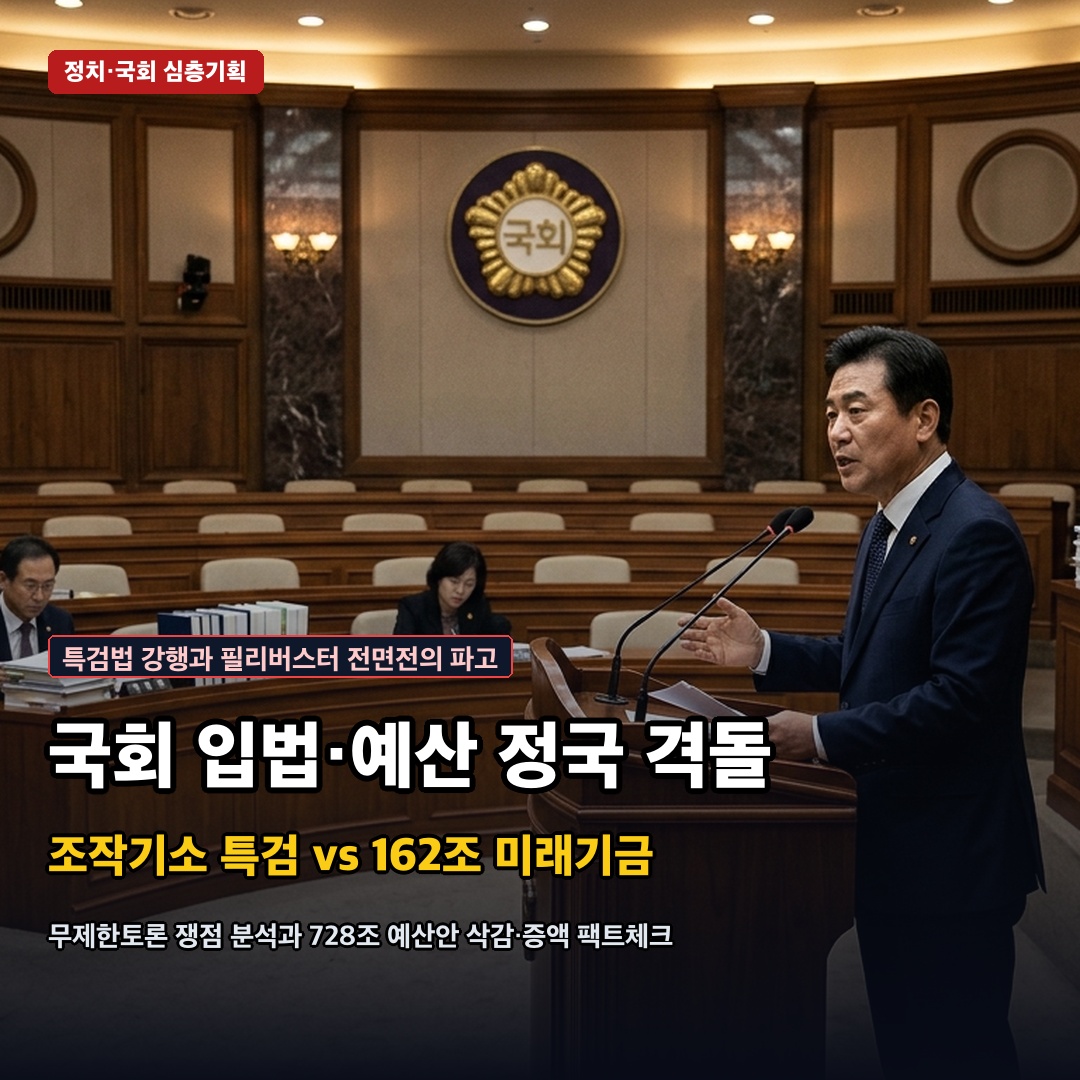
▲ 국회 본회의장 중앙 연단에서 의원이 조작기소 특검법 처리에 반대하며 심야 무제한토론(필리버스터)을 이어가고 있다. 여야는 쟁점 법안과 예산안을 둘러싸고 사활을 건 의회 대치를 지속하고 있다. [사진: 국회 프레스 풀]
2026년 정기국회가 쟁점 법안 처리를 둘러싼 여야의 극한 대치와 무제한토론(필리버스터), 그리고 사상 최대 규모의 차기년도 정부 예산안을 둘러싼 치열한 수 싸움으로 급격히 얼어붙고 있습니다. 더불어민주당이 주도한 이른바 '조작기소 특검법'이 본회의에 상정되자 국민의힘이 전면적인 필리버스터로 맞서며 국회 본회의장은 팽팽한 밤샘 대결의 장으로 변모했습니다. 이번 특검법은 3대 특검과 2차 종합 특검 등에 이어 현 정부 출범 이후 7번째로 추진되는 특별검사 법안으로, 정국의 뇌관으로 부상했습니다. 여기에 727조 9,000억 원 규모의 2026년도 본예산안 확정과 162조 원에 달하는 대규모 '미래대응기금' 신설을 둘러싸고 여당의 '미래 성장동력 선점론'과 야당의 '총선용 사금고 선심성 예산론'이 정면으로 충돌하고 있습니다. 입법과 예산이라는 국회의 양대 핵심 축이 동시에 파행으로 치닫는 이면에 자리한 법리적 쟁점과 권력 지형의 실태를 심층 취재했습니다.
1. 조작기소 특검법 본회의 강행과 필리버스터 전면전의 전말
국회 본회의 파행의 직접적 도화선은 조정식 국회의장 주재로 열린 여야 원내대표 회동 결렬이었습니다. 민주당 한병도 원내대표는 조작기소 특검법을 비롯해 민주유공자법, 주택공급활성화 3법(도시정비법·도시재정비촉진법·용산공원법), 초광역특구 특별위원회 구성 결의안 등 6개 안건의 본회의 일괄 처리를 강력히 요구했습니다. 반면 국민의힘 정점식 원내대표는 조작기소 특검법이 본회의에 상정될 경우 모든 안건에 대해 무제한토론을 신청하거나 본회의 자체를 보이콧하겠다고 배수진을 쳤습니다. 결국 타협점을 찾지 못한 채 민주당이 단독으로 법안 부의를 밀어붙였고, 국민의힘 의원들이 표결에 불참하며 강력 항의하는 가운데 법안은 본회의 문턱을 넘었습니다.
조작기소 특검법 통과 직후 정국은 곧바로 '2라운드 필리버스터' 전선으로 이동했습니다. 민주당이 민주유공자법과 주택 3법의 순차적 처리를 예고하자, 국민의힘은 안건별 무제한토론을 이어가며 결사 저지 태세를 굳혔습니다. 특히 민주유공자법을 둘러싸고 여야는 타협 없는 가치관 충돌을 벌이고 있습니다. 민주당은 야당의 지적을 반영해 기존 유공자 법률보다 지원 혜택을 대폭 축소한 합리적 수정안이라며 조속한 통과를 주장하는 반면, 국민의힘은 단순 피해 보상과 국가 영웅을 기리는 유공자 지정은 엄연히 다르다고 반박합니다. 국민의힘은 과거 동의대 사건이나 남민전 사건 등 사회적 논란이 컸던 인사들까지 심사 대상에 포함될 수 있다며 여론전을 총동원하고 있습니다.
갈등의 불씨는 사법부로까지 옮겨붙고 있습니다. 더불어민주당은 사법개혁의 기치를 내걸고 조희대 대법원장에 대한 국정조사 요구안을 본회의에 보고한 뒤 의결하는 방안을 검토해 왔습니다. 비록 당내 추가 의견 수렴을 거치며 일시 숨고르기에 들어갔으나, 여당 지도부는 사법 신뢰 회복을 위해 필요하다면 언제든 국정조사 카드를 다시 꺼내 들 수 있음을 분명히 했습니다. 입법부가 최고 사법기관의 수장을 정조준하는 초유의 카드를 쥐고 흔들면서, 여야 간의 정쟁은 3권 분립의 헌법적 기본 틀을 뒤흔드는 극한의 대치 국면으로 치닫고 있습니다.
2. 수사 대상 통폐합과 대통령 요청 독소조항 삭제 공방
국회 법사위 법안심사소위를 거친 조작기소 특검법 수정안은 당초 발의안과 비교해 수사 대상과 구조에서 적지 않은 변화를 겪었습니다. 원안에 개별적으로 포함되었던 12건의 수사 대상 중 이재명 대통령 관련 피고인 사건 8건이 대폭 통폐합 정리되었습니다. 대신 서해 공무원 피격 및 동해 선원 북송 사건, 문재인 전 대통령 사위 취업 관련 뇌물 의혹 수사, 월성 원전 1호기 경제성 조작 의혹 수사, 사드(THAAD) 기밀 유출 혐의 수사 등 지난 정부와 안보·외교 현안을 둘러싼 직전 정권의 주요 검찰 수사들이 수사 대상 목록에 신규로 대거 이름을 올렸습니다.
이번 입법 과정에서 가장 큰 정치적 변곡점은 특별검사의 '공소취소 권한'과 '타 수사기관 사건 이첩 요구권'의 전격 삭제였습니다. 당초 원안 제8조 제7항에 규정되어 있던 공소 유지 여부 결정권과 제8조 제1항의 타 기관 사건 이첩 요구권은 여권 내부에서도 '위인설법(특정인을 위한 입법)'이자 과도한 권한 남용이라는 거센 비판을 받았습니다. 이에 김의겸 법사위 여당 간사는 '대통령의 직접 요청에 따라 공소취소와 관련된 독소조항을 말끔히 삭제했다'고 밝혔습니다. 그러나 야당 간사인 박형수 국민의힘 의원은 '수정안을 가져온 것 자체가 애초 법안이 졸속이자 특정인을 위한 방탄용이었음을 자인한 꼴'이라며 법안의 정당성을 근본부터 부정했습니다.
구분
사건 분류
주요 세부 수사 대상 내용
여야 쟁점 및 법적 평가
통폐합 사건
대통령 관련 피고인 사건
원안 12건 중 이재명 대통령 관련 8건을 단일 사건으로 대폭 통폐합
여당 과잉수사 규명 vs 야당 위인설법 방탄 특혜
신규 추가
안보·남북관계 사건
서해 공무원 피격 및 동해 선원 북송 사건 관련 표적 조작 의혹
안보 사안의 정치 사법화 논란 재점화
신규 추가
전직 대통령 관련 수사
문재인 전 대통령 사위 취업 관련 뇌물수수 의혹 수사 진상규명
정치보복성 기획수사 규명 vs 정당한 수사 방해
신규 추가
에너지 정책 수사 의혹
월성 원전 1호기 경제성 조작 의혹 관련 감사원·검찰 수사
공공 정책 감사에 대한 사법적 단죄 공방
독소조항 삭제
특검 공소취소·이첩권
대통령 직접 요청으로 공소취소권(원안 제8조 제7항) 및 이첩요구권 전격 삭제
대통령실 결단 vs 애초 법안의 졸속성 자인
3. 728조 본예산과 162조 미래대응기금의 여야 정면충돌
입법 전쟁과 맞물려 국회 예산결산특별위원회의 2026년도 예산안 심사장은 또 하나의 거대한 전장으로 타올랐습니다. 최대 화두는 162조 원 규모로 신설되는 '미래대응기금'입니다. 정부와 민주당은 반도체 호황에 따른 추가 세수를 재원으로 인공지능(AI), 첨단 바이오, 양자 등 미래 성장동력을 선점하기 위한 '미래 투자 저수지'라고 사수 방침을 밝혔습니다. 반면 국민의힘은 국회의 헌법상 예산 심의권을 회피하려는 '2028년 총선용 사금고'이자 '대통령 쌈짓돈'으로 규정하고 전액 삭감과 기금 신설 불가를 선언했습니다. 야당은 초과 세수를 국가채무 상환에 우선 투입하고 11조 5,000억 원의 민생 예산을 증액하자고 맞불을 놓았습니다.
더욱이 미래대응기금은 여권 내부에서도 지방재정 파탄에 대한 심각한 우려를 낳았습니다. 기금 적립액이 내국세 연동 지방교부세 산정 기준에서 제외되면서 전국 지자체에 배분될 법정 재원이 30조 원 이상 축소된다는 사실이 드러났기 때문입니다. 이에 따라 국회 심의 과정에서 정부가 국회 의결 없이 기금 주요 지출을 변경할 수 있는 자율 한도를 정부안인 30%에서 20%로 낮추는 통제 장치가 검토되었습니다. 화려한 미래 성장 구호 이면에서 풀뿌리 지방자치의 숨통을 조이는 재정 역설이 여야 공방의 핵심 뇌관으로 작용한 셈입니다.
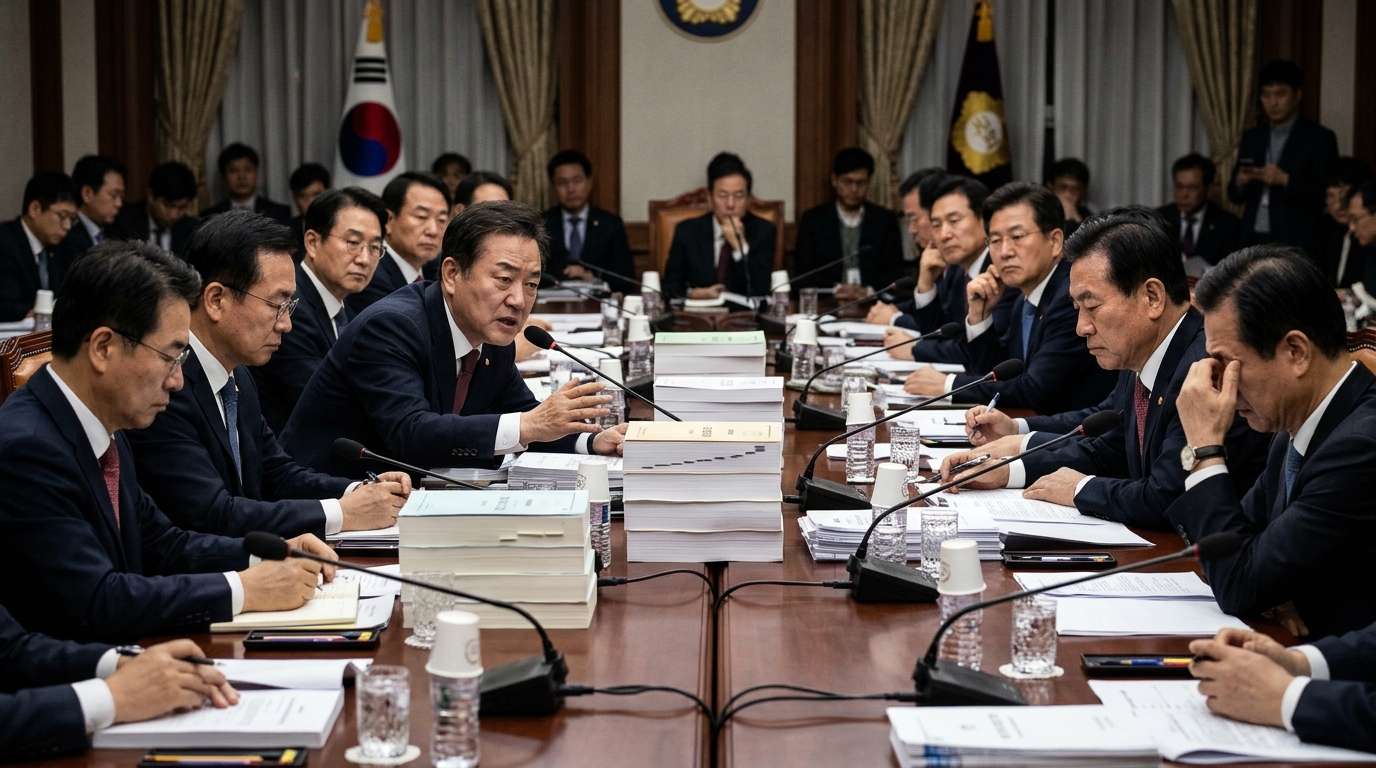
▲ 국회 예산결산특별위원회 협상 회의실에서 여야 지도부와 예산 당국자들이 수조 원대 감액과 증액 항목을 정밀 대조하고 있다. 162조 원 규모 미래대응기금 편성을 둘러싼 공방은 예산 심의의 최대 뇌관이었다. [사진: 국회 예결위 프레스 풀]
국회예산정책처가 확정한 '2026년도 예산안 심의 결과'에 따르면, 국회는 2021년도 이후 5년 만에 헌법상 법정 시한인 12월 2일을 준수하며 727조 8,791억 원(약 727.9조 원)의 본예산을 통과시켰습니다. 정부안 대비 총지출은 1,269억 원 순감했으며, 관리재정수지 적자는 107조 8,000억 원(GDP 대비 3.9%), 국가채무는 1,413조 8,000억 원(GDP 대비 51.6%)으로 확정되었습니다. 12대 분야별로는 보건·복지·고용 분야가 269조 1,000억 원, R&D 분야가 35조 5,000억 원으로 전년 대비 대폭 증액된 반면, 일반·지방행정(121.4조 원)과 산업·중소기업(31.8조 원)은 감액 조정되었습니다.
세부 사업 조정에서는 묻지마 예산에 대한 국회의 현미경 칼질이 두드러졌습니다. 10개 부처에 난립했던 AI 응용제품 신속상용화(AX-Sprint 300) 사업에서 2,785억 원이 깎였고, AI혁신펀드 1,000억 원은 전액 삭감되었습니다. 중기부 모태펀드 출자금 역시 2,800억 원 감액되었습니다. 반면 통상 압박 대응을 위해 기재부 소관 '대미투자 지원 프로그램'이 1조 1,000억 원 규모로 전격 신설되었고, 정부 행정전산망 먹통 방지를 위한 노후장비 통합구축 예산이 2,523억 원 대폭 증액되었습니다. 아울러 비수도권 대중교통비 환급을 지원하는 K-패스 우대 예산 305억 원도 순증되었습니다.
지표 구분
2025년 본예산 (추경)
2026년 정부안 vs 확정예산
국회 심의 변동 및 재정 평가
총수입
651.6조 원 (642.4조 원)
정부안 674.2조 -> 확정 675.2조 원
1.0조 원 순증 (전년 추경 대비 +32.8조 원)
총지출
673.3조 원 (703.3조 원)
정부안 728.0조 -> 확정 727.9조 원
1,269억 원 순감 (전년 추경 대비 +24.6조 원)
통합재정수지
△21.7조 원 (△60.8조 원)
정부안 △53.8조 -> 확정 △52.7조 원
1.1조 원 개선 (전년 대비 +8.1조 원 개선)
관리재정수지 (GDP 대비)
△73.9조 (△2.8%) / 추경 △111.6조
정부안 △109.0조 -> 확정 △107.8조 원
GDP 대비 △3.9% (0.1%p 소폭 개선)
국가채무 (GDP 대비)
1,273.3조 (48.1%) / 추경 1,301.9조
정부안 1,415.2조 -> 확정 1,413.8조 원
GDP 대비 51.6% (1.3조 감액에도 채무비율 급증)
4. 국회 필리버스터의 법적 메커니즘과 '회기 쪼개기' 4대 쟁점
정국이 파행될 때마다 등장하는 무제한토론(필리버스터)은 국회법 제106조의2에 근거를 둔 합법적 의사진행 방해 제도입니다. 1851년 카리브해 해적을 뜻하는 스페인어 '필리부스테로'에서 유래한 이 제도는 2012년 국회선진화법 도입 당시 다수의 일방적 입법 독주를 막고 소수파의 발언권을 보장하기 위해 신설되었습니다. 재적의원 3분의 1(100석) 이상의 요구서가 제출되면 국회의장은 반드시 토론을 개시해야 하며, 의원 1인당 시간제한 없이 단 한 차례 연설할 수 있습니다. 토론을 강제 종결시키려면 종결 동의안 제출 24시간 후 재적의원 5분의 3(180석) 이상의 무기명 찬성을 얻어야 합니다.
그러나 현실 정치에서 필리버스터는 소수파 보호라는 본래 취지를 상실한 채 파행 수단으로 변질되었습니다. 가장 큰 쟁점은 다수당이 2~3일짜리 초단기 회기를 쪼개어 의결하는 이른바 '살라미 전술'입니다. 국회법상 해당 회기가 종료되면 무제한토론이 자동 종결되는 조항을 악용해 5분의 3 의결정족수를 편법 우회하는 관행이 굳어졌습니다. 이에 국회입법조사처는 필리버스터가 시작된 이후에는 회기 결정의 건 역시 '재적 5분의 3 찬성'을 요구하도록 법을 고쳐야 한다고 지적합니다. 아울러 헌법재판소가 회기 결정 건을 필리버스터 대상에서 제외한 판례와 체포동의안·탄핵안 등 법정 시한이 걸린 안건과의 충돌 문제, 다수당의 찬성토론 남용, 의제 외 발언 금지 원칙 등 4대 쟁점이 제도의 맹점으로 꼽힙니다.
5. 국회법 제86조 체계·자구 심사권과 의회민주주의의 과제
필리버스터와 직회부 사태를 낳는 구조적 근원은 국회법 제86조에 규정된 법제사법위원회의 '체계·자구 심사권'에 있습니다. 모든 상임위를 통과한 법안이 본회의로 가기 전 법사위의 문턱을 넘어야 하다 보니, 법사위는 사실상 타 상임위 법안을 쥐고 흔드는 '상왕 상임위'로 군림해 왔습니다. 이에 국회는 60일 이상 이유 없이 심사가 지연될 경우 소관 상임위 재적 5분의 3 찬성으로 본회의에 직접 부의를 요구할 수 있도록 개정했으나, 이는 여야 간 대화와 타협을 이끌어내기보다는 다수당의 본회의 직회부와 소수당의 필리버스터 맞불이라는 극한 대립의 악순환을 고착화시켰습니다.
원 구성 협상 파행에서 시작된 입법 갈등이 본회의 직회부, 필리버스터 강행, 회기 쪼개기 종료, 단독 표결로 이어지는 기형적 승자독식 구조는 의회민주주의의 본령을 심각하게 훼손하고 있습니다. 특검법 공방과 728조 원 예산안 심의가 국민을 위한 정책 경쟁이 아닌 진영 간의 사활을 건 진흙탕 싸움으로 변질되는 현실은 국회에 대한 국민적 불신을 키울 뿐입니다. 무제한토론의 제도적 허점을 정비하고 법사위의 월권 구조를 개혁하여 소수파를 진정으로 존중하고 타협을 강제하는 '숙의 민주주의'의 제도를 시급히 복원해야 할 시점입니다.
[In-Depth Analysis] Forcing the Special Counsel Act and the Filibuster Showdown: Dissecting Parliamentary Gridlock, the 728 Trillion Won Budget, and the 162 Trillion Won Future Fund
▲ A lawmaker delivers a late-night filibuster speech at the central rostrum of the National Assembly plenary chamber in Seoul, protesting the unilateral advancement of the Special Counsel Act. [Photo: National Assembly Press Pool]
In 2026, South Korea's regular parliamentary session has frozen into a state of acute paralysis, engulfed in an escalating clash over contentious legislation, continuous filibusters, and high-stakes maneuvering over a historic national budget. When the ruling Democratic Party forced the controversial Special Counsel Act on Rigged Prosecutions onto the plenary floor, the conservative opposition People Power Party launched an around-the-clock filibuster, transforming the National Assembly into an intense late-night legislative battlefield. Marking the seventh independent counsel initiative advanced under the current administration, the bill has emerged as a major political flashpoint. Compounding this institutional deadlock, deliberations over the 727.88 trillion won fiscal year 2026 budget and the establishment of a monumental 162 trillion won Future Response Fund have pitted the ruling party's sovereign future-investment doctrine against the opposition's condemnation of an unaccountable general election slush fund. This investigative analysis dissects the legal mechanics, fiscal allocations, and structural dynamics driving both legislative and budgetary pillars into unprecedented gridlock.
1. Forcing the Special Counsel Act and the Filibuster Showdown
The legislative explosion was detonated by the collapse of high-level floor leadership negotiations presided over by National Assembly Speaker Cho Jeong-sik. Democratic Party floor leader Han Byung-do demanded the simultaneous plenary passage of six priority items: the Special Counsel Act on Rigged Prosecutions, the Meritorious Persons of Democratic Movements Act, a package of three real estate revitalization laws, and a resolution creating a special committee for mega-regional economic zones. Conversely, People Power Party floor leader Chung Jeom-sik warned that bringing the Special Counsel Act to the floor would trigger an indefinite filibuster across all scheduled bills and a total boycott of plenary proceedings. Unable to forge common ground, the ruling party advanced the legislation unilaterally, passing the measure while opposition lawmakers boycotted the final vote in vehement protest.
Following the passage of the special counsel measure, parliamentary conflict immediately transitioned into a secondary filibuster campaign. As the Democratic Party signaled its intent to advance the Meritorious Persons of Democratic Movements Act alongside housing bills, the opposition mobilized for serial round-the-clock resistance. The Meritorious Persons bill reflects an irreconcilable ideological divide: the ruling party asserts that statutory compensation has been scaled back compared to other veteran categories, representing a necessary reconciliation measure. Conversely, the opposition insists that commercial compensation for past democratic movements must remain fundamentally distinct from conferring sovereign hero status, cautioning that ambiguous statutory criteria could grant veteran honors to individuals involved in historic controversies such as the Dong-eui University incident or the South Korean National Liberation Front case.
The legislative battle lines have aggressively expanded to encompass the judiciary. Democratic lawmakers previously drafted a formal parliamentary inquiry targeting Supreme Court Chief Justice Cho Hee-dae, exploring floor authorization under the banner of comprehensive judicial reform. While the party temporarily deferred plenary introduction to gather broader institutional consensus, senior legislative leaders emphasized that the judicial inquiry remains an active option to address public trust in the courts. By leveraging parliamentary investigation powers directly against the head of the judicial branch, the inter-party confrontation threatens foundational constitutional checks and balances.
2. Consolidating Investigation Targets and Excising Contentious Clauses
During committee markup in the Legislation and Judiciary Committee, the Special Counsel Act underwent structural modifications compared to its initial draft. Of the twelve investigation targets originally specified, eight individual cases involving President Lee Jae-myung were consolidated into a single unified category. Concurrently, lawmakers incorporated sensitive probes conducted under the preceding administration, including the West Sea fisheries official shooting and East Sea fishermen repatriation, bribery allegations surrounding former President Moon Jae-in's son-in-law, economic viability audits of the Wolsong Nuclear Reactor No. 1, and investigations into alleged leaks of THAAD national defense secrets.
The most critical procedural turning point occurred with the complete excision of the special counsel's authority to dismiss existing criminal indictments and mandate case transfers from other law enforcement bodies. Originally codified under Article 8, Paragraphs 1 and 7, these provisions drew fierce condemnation across legal circles as unconstitutional overreach engineered for specific defendants. Democratic Representative Kim Eui-kyeom, the committee's lead majority member, stated that the indictment-withdrawal powers were cleanly eliminated following an explicit request from the president. Nevertheless, opposition ranking member Representative Park Hyung-soo countered that introducing sweeping amendments served as an overt admission that the initial bill was an unconstitutional instrument of political defense.
Category
Target Case Classification
Detailed Scope of Investigation
Partisan Controversy & Legal Assessment
Consolidated Cases
President-related Indictments
Consolidation of 8 distinct cases regarding President Lee Jae-myung
Exposing prosecutorial abuse vs Unconstitutional immunity shield
New Addition
National Security & Inter-Korean Cases
West Sea fisheries official shooting and East Sea fishermen repatriation
Re-igniting the politicization of sovereign defense affairs
New Addition
Former Presidential Family Probes
Bribery probe into employment of Moon Jae-in's son-in-law
Auditing retaliatory political probes vs Lawful prosecution defense
Judicial criminalization of executive policy transitions
Clause Excised
Indictment Dismissal & Transfer Powers
Complete deletion of indictment withdrawal (Art. 8 Sec. 7) upon presidential request
Decisive executive concession vs Admission of initial legislative recklessness
3. Clash Over the 728 Trillion Won Budget and the 162 Trillion Won Future Fund
Parallel to the statutory confrontation, the National Assembly Special Committee on Budgets and Accounts turned into an intense ideological arena over the 2026 fiscal plan. The epicenter of the debate centers on the proposed 162 trillion won Future Response Fund. The administration and ruling lawmakers framed the fund as a strategic sovereign investment reservoir financed by surging corporate tax revenues to establish market leadership across artificial intelligence, advanced biotechnology, and quantum computing. Conversely, the opposition People Power Party condemned the mechanism as an extralegal slush fund designed to circumvent parliamentary appropriation authority ahead of the 2028 general elections, demanding its complete elimination in favor of direct national debt retirement and an 11.50 trillion won expansion in targeted livelihood programs.
The Future Response Fund provoked significant internal resistance regarding regional fiscal autonomy. Because allocations transferred into the fund are statutorily excluded from the baseline calculations for internal tax-linked local allocation grants, municipal budgets faced severe projected shortfalls exceeding 30 trillion won. In response to mounting legislative scrutiny, parliament tightened statutory safeguards, reducing the executive's unilateral discretionary spending threshold within the fund from the proposed 30 percent down to 20 percent. Beneath the rhetoric of strategic tech investment, the administrative diversion of grassroots municipal revenue emerged as a primary fiscal controversy.
▲ Bipartisan floor leaders and Ministry of Economy and Finance officials deliberate over expenditure adjustments during a closed-door budget conference. Deliberations over the 162 trillion won Future Response Fund served as the central flashpoint. [Photo: National Assembly Budget Committee Press Pool]
According to official audit data published by the National Assembly Budget Office, parliament met its constitutional December 2 deadline for the first time in five years, enacting a 727.88 trillion won general expenditure budget. Total spending was trimmed by 126.90 billion won against the executive proposal, with the managed fiscal deficit settling at 107.80 trillion won (3.9 percent of GDP) and national debt reaching 1,413.80 trillion won (51.6 percent of GDP). Across twelve primary fiscal sectors, appropriations for health, welfare, and employment expanded to 269.10 trillion won, and national R&D investments rebounded to 35.50 trillion won, whereas general administrative transfers (121.40 trillion won) and industrial subsidies (31.80 trillion won) were curtailed.
Legislative review excised opportunistic program padding while introducing vital commercial safeguards. Lawmakers cut 278.50 billion won from fragmented AI commercialization projects (AX-Sprint 300) dispersed across ten ministries, eliminated the 100.00 billion won AI Innovation Fund, and reduced fund-of-funds allocations by 280.00 billion won. Conversely, parliament created a 1.10 trillion won US Investment Support Program under the Ministry of Economy and Finance to help domestic manufacturers navigate bilateral trade agreements, while appropriating 252.30 billion won to upgrade aging central government servers and eliminate critical administrative network blackouts. Additionally, national transit subsidy programs (K-Pass) were expanded by 30.50 billion won to support rural commuters.
Fiscal Metric
2025 Base Budget (Supp.)
2026 Executive Proposal vs Enacted
Parliamentary Adjustment & Evaluation
Total Revenue
651.6T Won (642.4T Won)
674.2T Won Prop. -> 675.2T Won Enacted
1.0T Won net increase (+32.8T won vs 2025 supp.)
Total Expenditure
673.3T Won (703.3T Won)
728.0T Won Prop. -> 727.9T Won Enacted
126.9B Won net reduction (+24.6T won vs 2025 supp.)
Consolidated Fiscal Balance
△21.7T Won (△60.8T Won)
△53.8T Won Prop. -> △52.7T Won Enacted
1.1T Won improvement (+8.1T won improvement YoY)
Managed Fiscal Balance (% GDP)
△73.9T (△2.8%) / Supp. △111.6T
△109.0T Won Prop. -> △107.8T Won Enacted
△3.9% of GDP (0.1%p marginal deficit recovery)
National Debt (% GDP)
1,273.3T (48.1%) / Supp. 1,301.9T
1,415.2T Won Prop. -> 1,413.8T Won Enacted
51.6% of GDP (Rapid growth despite 1.3T won net cut)
4. Legal Mechanics of the Filibuster and Four Core Procedural Dilemmas
Codified under Article 106-2 of the National Assembly Act, the filibuster represents a statutory procedural device designed to protect minority parties against majoritarian legislative steamrolling. Deriving from the 1851 Spanish term filibustero—referencing maritime privateers—the mechanism was integrated into Korean law via the 2012 Parliamentary Advancement Act. Upon receiving a petition signed by at least one-third of sitting legislators (100 members), the Speaker is statutorily mandated to open an unlimited floor debate. Each lawmaker may speak once without time limits, and the debate can only be terminated through session expiration, an absence of speakers, or a three-fifths supermajority vote (180 members) conducted 24 hours after a closure motion.
In operational practice, the filibuster has increasingly been subverted into a routine tool of procedural obstruction and majoritarian circumvention. Foremost among procedural controversies is the majority party's deployment of salami tactics—fragmenting legislative sessions into ultra-short periods of two to three days to trigger automatic filibuster termination upon session expiration without assembling a 180-seat supermajority. The National Assembly Research Service argues that determining session lengths while a filibuster is active should require a three-fifths threshold. Furthermore, constitutional rulings exempting session-length motions, statutory deadlines governing arrest and impeachment petitions, majoritarian abuse of alternating floor time, and the strict enforcement of relevance rules represent persistent systemic flaws.
5. Article 86 Gatekeeping Powers and the Imperative of Parliamentary Democracy
The institutional origin of recurring floor battles lies in Article 86 of the National Assembly Act, which grants the Legislation and Judiciary Committee gatekeeping jurisdiction over statutory wording and legal coherence. Because bills cleared by subject-matter committees must secure judiciary committee endorsement before reaching the plenary floor, the committee historically functioned as a supreme legislative bottleneck. While procedural revisions established that bills delayed over sixty days can be discharged directly to the plenary floor by a three-fifths committee vote, this mechanism has institutionalized an adversarial cycle: majority parties bypass committee bottlenecks through floor discharges, prompting immediate opposition filibusters.
The institutional decay linking committee apportionment breakdowns to unilateral floor discharges, prolonged filibusters, session fragmentation, and single-party votes subverts the essence of representative democracy. Reducing special counsel disputes and the 728 trillion won national budget to zero-sum partisan warfare alienates citizens and paralyzes governance. Reforming filibuster loopholes and restructuring the gatekeeping prerogatives of the judiciary committee are imperative steps to re-anchor parliament in genuine deliberation, minority protection, and consensual governance.
1월이 시작되면 감기는 이미 우리 곁에 와 있습니다. 2월, 3월, 4월까지 이어지는 추위와 건조함은 코와 목을 가장 먼저 공격합니다. 아침에 일어나자마자 막혀 있는 코. 계속 흐르는 콧물. 괜히 칼칼해지는 목. 이 증상은 “시작”일 뿐입니다. 한 번 무너지면 일주일, 길면 한 달까지 끌고 갑니다. 약을 먹으면 잠깐 괜찮아집니다. 하지만 며칠 뒤 또 반복됩니다. 왜일까요? 감기는 ‘치료’의 문제가 아니라 ‘관리’의 문제이기 때문입니다. 대부분은 감기가 오고 나서 약을 찾습니다. 하지만 진짜 중요한 건 감기가 오기 전에 코와 목을 지키는 것입니다. 건조한 실내 공기, 차가운 바깥 공기, 눈에 보이지 않는 세균. 코와 목은 매일 공격받고 있습니다. 지긋지긋하죠! 그런데도 우리는 아무 준비 없이 버티고 있습니다. 이번 겨울도 그렇게 보낼 건가요? 사실 방법은 어렵지 않습니다. 코를 깨끗하게 관리하고, 목을 따뜻하게 보호하고, 점막을 촉촉하게 유지하고, 기관지를 미리 관리하고, 외부 공기를 차단하는 것. 이 다섯 가지만 꾸준히 해도 감기약 없이 겨울을 보내는 것이 충분히 가능합니다. 🔥 이제부터 그 방법을 하나씩 살펴보겠습니다. 🔥 1. 코와 목을 먼저 관리해야 하는 과학적 이유 감기의 대부분은 코 점막에서 시작됩니다. 국제 학술지 Nature Reviews Microbiology 와 Journal of Allergy and Clinical Immunology 에 실린 호흡기 감염 관련 연구들에서는, 감기 바이러스가 비강 상피세포에 먼저 부착해 증식한다는 점을 설명하고 ...
리모델링사업이 진행 중인 아파트를 매매할 때 “계약금 10%를 언제까지 내야 하느냐”는 질문이 특히 많이 나옵니다. 이주공고(이주 안내)가 7~11월쯤이라고 들으면, 그 시점에 맞춰 계약금도 움직일 것 같아서 더 헷갈리기 쉽습니다. 하지만 실제 납부기한은 ‘이주공고가 언제냐’만으로 자동 결정되지 않는 경우가 많습니다. 1) 계약금 10% 납부기한: 결국 ‘문서에 적힌 일정’이 기준 계약금 10%를 언제까지 납부해야 하는지는, 내가 서명하는 매매계약서(특약 포함) 와 사업주체/조합이 제시한 공고·안내문 에 적힌 납부 일정이 기준이 됩니다. 실제 공고문에서는 분양대금 납부의 큰 틀(계약금→중도금→잔금)을 먼저 안내하고, 상세 일정은 별도 표나 유의사항으로 제시하는 방식이 흔합니다. 또, 계약서 문구에 따라 지급 시점이 조건부로 설정될 수도 있습니다. 예를 들어 한 사례 소개 자료에서는 용역계약서에 잔금(10%) 지급시기가 “사업승인 후”로 기재되어 있었다는 점이 언급됩니다. 이런 식으로 ‘사업 단계’와 지급을 연동하는 문구가 들어가면, 질문의 답은 계약서 문구를 확인해야만 확정됩니다. 관련 내용은 링크 에서 문구 사례를 확인할 수 있습니다. 2) 입주자모집공고에서 확인되는 ‘납부 순서’와 잔금 마감 시점 공고문에 적힌 문구를 보면, 납부 순서와 잔금 마감에 대한 기준이 비교적 명확하게 제시되는 경우가 있습니다. 예를 들어 한 입주자모집공고에는 “분양금액(주택가격)은 계약금, 중도금, 잔금의 순서로 납부”하며 “잔금은 입주(열쇠 수령일) 전에 완납”해야 한다고 안내되어 있습니다. (문구 확인: 링크 ) 이 문구가 의미하는 바는 최소 2가지입니다. 분양/공급 형태의 문서에서는 ‘계약금→중도금→잔금’ 흐름이 공식적으로 안내될 수 있습니다. 잔금은 “입주(열쇠 수령)” 이전에 완납해야 한다는 마감 기준이 문서에 적혀 있을 수 있습니다. 다만, 위 공고문 문구는 잔금 마감에 대한 기준을 보여주지만, 계약금 10%의...
윤석열 전 대통령 탄핵 인용 소식을 접하면, 가장 궁금한 지점은 ‘헌재가 정확히 무엇을 위헌·위법으로 봤는가’입니다. 또한 탄핵과 별개로 진행되는 형사재판(내란 우두머리 혐의 등)이 어디까지 왔는지도 함께 정리할 필요가 있습니다. 아래 내용은 제공된 기사/게시물 스니펫과 링크에서 확인되는 범위만 모아, 일반인이 흐름을 이해하기 쉽게 정리한 것입니다. 1) 탄핵 인용 관련: 스니펫에서 확인되는 ‘판단의 골격’ 제공된 근거 중 조국혁신당 사이트에는 헌법재판소가 윤석열 탄핵 심판에서 “피청구인의 위헌·위법행위는 국민 신임 …”이라는 취지로 판단했다는 문장이 인용돼 있습니다( 링크 ). 이 인용문만 놓고 보면, ‘위헌·위법행위’가 있었는지와 그로 인해 ‘국민의 신임’이 어떻게 평가됐는지가 핵심 축으로 소개됩니다. 다만 질문에서 요청하신 세부 항목, 즉 비상계엄 선포 자체를 문제 삼은 구체적 이유, 계엄 이후 조치(포고령, 국회 통제 등)의 어떤 지점이 헌법 위반인지, 국회의 권한행사 방해 및 정치활동 제약을 어떤 논리로 판단했는지 등은, 이번에 제공된 근거의 제목/스니펫만으로는 조항·사실관계·판단 구조가 그대로 제시돼 있지 않습니다. 따라서 이 글에서는 ‘헌재가 무엇을 문제 삼았다’는 세부 리스트를 단정적으로 재구성하기보다, 현재 확인 가능한 문구 수준의 요약(위헌·위법행위 → 국민 신임의 문제로 평가)까지만 적습니다. 만약 헌재 결정문 전문(주문 및 이유)이 추가로 확인되면, 그때는 문장 단위로 ‘어떤 행위’와 ‘어떤 헌법 원리/조항’이 연결되는지(예: 권력분립, 국회의 권한, 정치적 기본권 등) 구조화해 정리하는 것이 가장 정확합니다. 2) 형사 절차(내란 혐의) 관련: 체포영장과 1심 선고 언급 탄핵 심판과 별도로, 12·3 비상계엄 사태로 내란 혐의를 받는 윤석열 대통령에 대해 2024년 12월 31일 체포 영장이 발부됐다는 BBC 보도가 있습니다( 링크 ). 해당 보도는 ‘현직 대통령’에 대한 체포영장 발부라는 점을 함께 언급합니다. 또...