‘동일노동 동일임금’ 법적 기준과 대법원 판례·국회 입법 쟁점 총정리…남녀고용평등법 제8조부터 호봉제·직무급 노사 갈등까지
만인의 탑 편집국11월 23, 2026
국회 의사당 전경, 수평을 이룬 황금 균형 저울, 대한민국 법전과 급여명세서로 동일노동 동일임금의 법적 기준과 입법 논의를 상징한 대표 이미지. 기사 이해를 돕기 위해 제작한 설명 이미지이며 실제 현장 사진이나 공식 화면이 아닙니다.
정규직과 비정규직, 대기업과 중소기업, 원청과 하청 사이에 고착화된 노동시장 이중구조를 완화할 해법으로 ‘동일가치노동 동일임금’ 원칙의 근로기준법 명문화와 임금체계 개편 논의가 다시 속도를 내고 있다. 정부 업무보고에서 연내 추진 로드맵과 임금정보 실태조사 확대가 제시되고 국회에서도 관련 법안이 잇따라 논의되면서, 현행 법령이 어디까지 동일임금을 보장하고 있는지, 법원은 어떤 기준으로 ‘동일한 가치의 노동’을 판단하는지에 대한 관심이 높아지고 있다.
국가법령정보센터에 등재된 남녀고용평등법·기간제법·파견법 조문, 대법원 주요 판례, 고용노동부 업무보고와 국회도서관·한국노동연구원(KLI)·한국노동사회연구소 연구자료를 바탕으로 동일가치노동 동일임금의 현행 법적 근거와 한계, 대법원 4대 판단 기준, 국회 입법 쟁점, 그리고 호봉제와 직무급제를 둘러싼 노동계와 경영계의 입장을 균형 있게 정리한다.
현행 법적 근거(남녀고용평등법·기간제법·파견법)와 4대 한계
현재 대한민국 법체계에서 ‘동일가치노동 동일임금’ 원칙을 명시한 대표 조항은 ‘남녀고용평등과 일·가정 양립 지원에 관한 법률(남녀고용평등법)’ 제8조다. 제8조 제1항은 사업주에게 동일한 사업 내의 동일 가치 노동에 대하여 동일한 임금을 지급할 의무를 부과하며, 임금차별을 목적으로 별개 사업을 설립한 경우에도 동일한 사업으로 간주한다(제8조 제3항). 제9조는 임금 외 복리후생에서도 남녀 차별을 금지하고 있으며, 제8조 제1항 위반 시 3년 이하의 징역 또는 3,000만 원 이하의 벌금에 처한다(제37조 제2항).
구분
현행 법령 근거
적용 대상·비교 기준
제재·구제 절차 및 한계
남녀고용평등법
제8조·제9조·제26조·제29조의2·제30조·제37조
동일 사업 내 남녀 간 ‘동일 가치 노동’ (기술·노력·책임·작업조건)
위반 시 3년 이하 징역·3천만 원 벌금, 고의·반복 시 최대 3배 배상, 사업주 입증책임 / 동일 성별 고용형태 차별 적용 한계
기간제법·파견법
기간제법 제8조 / 파견법 제21조
동일 사업(장) 내 ‘동종 또는 유사한 업무’ 수행 정규직·직접고용 근로자
차별적 처우일(종료일)부터 6개월 내 노동위원회 시정 신청 / 직무가 다른 동일가치노동·원하청 격차 구제 한계
대법원 판단 기준
2002도3883·2010다101011·2015두46321·2015다254873
직무 4대 요소(기술·노력·책임·작업조건) + 학력·경력·근속연수 종합 고려
객관적 직무평가 기준 부재 시 하급심 판단 엇갈림 발생
근로기준법 개정 쟁점
김형동·박홍근·강병원 의원안 등 + 정부 로드맵
근로기준법 제6조·제6조의2 고용형태 차별금지 및 동일가치노동 명문화
죄형법정주의 명확성 충돌, 원·하청 적용 범위, 비고용 우회(풍선효과) 논란
구제 절차 역시 강화돼 있다. 차별적 처우가 있은 날(계속되는 경우 종료일)부터 6개월 이내에 노동위원회에 시정을 신청할 수 있고(제26조), 고의적이거나 반복적인 차별에는 손해액의 최대 3배까지 배상 명령을 내릴 수 있으며(제29조의2), 분쟁 시 차별이 없었다는 입증책임은 전적으로 사업주가 부담한다(제30조). 비정규직과 관련해서는 기간제법 제8조와 파견법 제21조가 기간제·단시간·파견근로자에게 ‘동종 또는 유사한 업무’에 종사하는 정규직·사용사업주 근로자와 비교해 합리적 이유 없는 차별을 금지하고 있다.
그러나 현행 법령은 구조적 공백이 뚜렷하다. 첫째, 남녀고용평등법은 성별 임금 격차 시정이 목적이어서 같은 성별 사이의 정규직·비정규직·무기계약직 차별에 곧바로 적용하기 어렵다. 둘째, 기간제법과 파견법은 ‘동일가치노동’이 아니라 ‘동종·유사 업무’를 비교 대상으로 삼아, 업무 명칭이나 배치가 조금만 달라도 비교 대상자가 없다는 이유로 구제에서 배제되는 사례가 적지 않다. 셋째, 직접 근로계약 관계와 ‘동일한 사업’을 전제하므로 대기업 원청과 협력사 하청 근로자 간 임금 격차는 현행법 테두리 밖에 놓여 있다. 넷째, 근로기준법 제6조의 ‘사회적 신분’에 고용형태가 포함되는지에 관한 대법원 판례도 아직 확립되지 않았다.
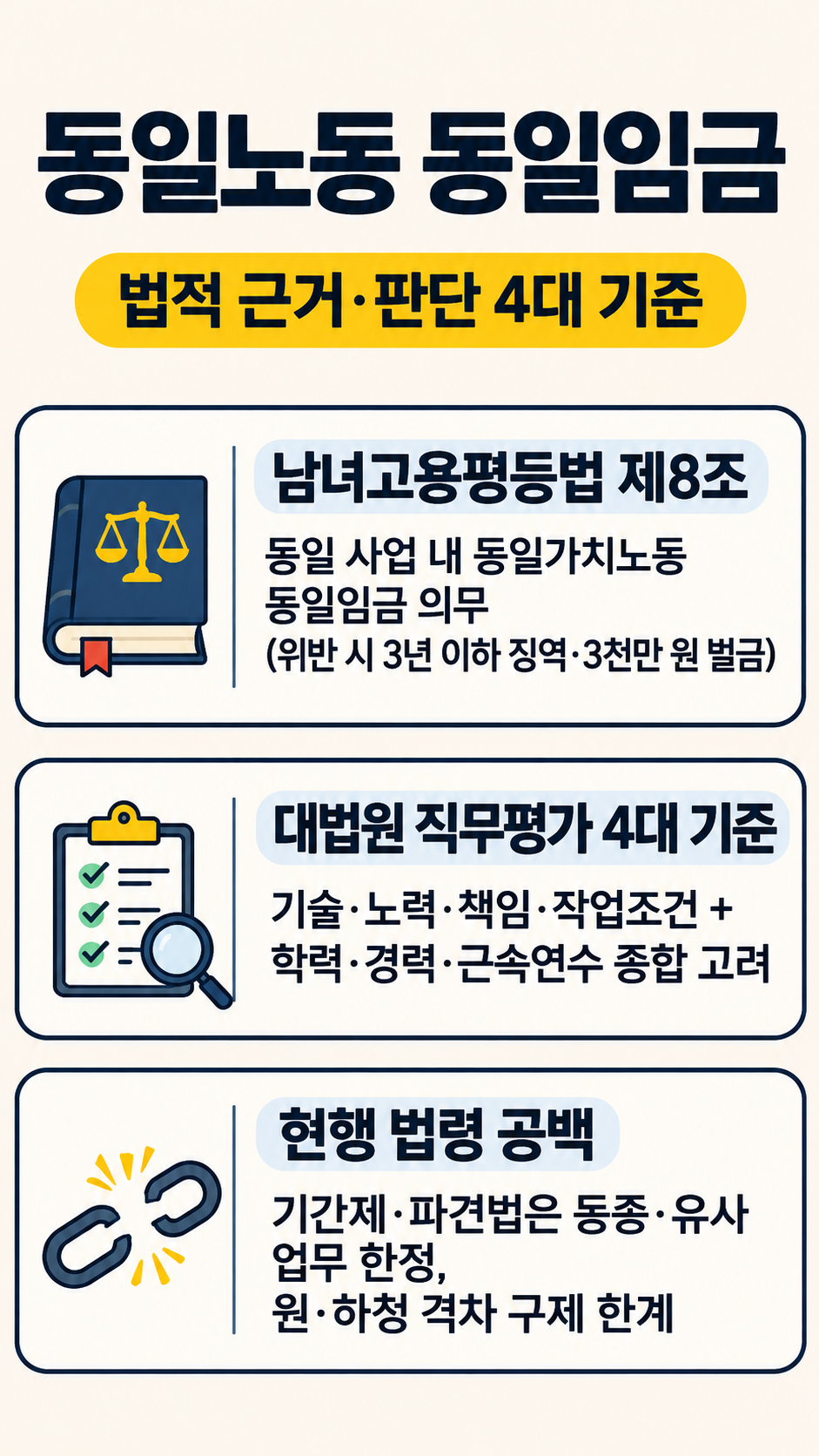
남녀고용평등법 제8조와 기간제법·파견법 근거, 대법원 직무평가 4대 기준(기술·노력·책임·작업조건) 및 현행 법령 한계를 정리한 세로형 정보카드. 기사 이해를 돕기 위해 제작한 설명 이미지이며 실제 현장 사진이나 공식 화면이 아닙니다.
대법원 ‘동일가치노동’ 판단 4대 기준과 핵심 판례
법원과 고용노동부 예규는 서로 다른 직무라 하더라도 객관적 직무평가에 의해 본질적으로 같은 가치가 인정되면 동일가치노동으로 본다. 법령과 예규가 제시하는 직무평가 4대 기준은 기술(자격증·학위·습득 경험 등 업무수행 능력 수준), 노력(육체적 노동강도와 정신적 긴장·부담), 책임(기계·설비·재정·안전에 대한 의무 범위와 사업주 의존도), 작업조건(소음·열·물리·화학적 위험·고립 등 작업환경)이다.
대법원 판례는 네 차례 핵심 분기점을 거쳐 구체화됐다. 2003년 3월 14일 선고 2002도3883 판결(이른바 ‘한길사건’)은 타일 제조공장의 남녀 공정 간 임금 차별 사건에서 남성 중심의 육체적 노력 편향을 바로잡고 동일가치노동 동일임금 위반을 인정한 최초의 대법원 판결로 꼽힌다. 이어 2013년 3월 14일 선고 2010다101011 판결은 직무 내용이 다소 다르더라도 객관적 직무평가를 통해 본질적으로 동일한 가치가 인정되면 동일가치노동에 해당한다고 판시했다.
2019년 3월 14일 선고 2015두46321 판결에서는 4대 직무 요소뿐 아니라 근로자의 학력·경력·근속연수 등 인적 요소를 종합적으로 고려해야 한다는 판단 틀을 제시했고, 같은 해 12월 24일 선고 2015다254873 판결은 기간제에서 무기계약직으로 전환된 근로자 역시 동종·유사 업무를 수행하는 기존 정규직보다 불리한 근로조건을 적용받아서는 안 된다고 해석했다. 다만 실제 소송 현장에서는 기업마다 표준 직무평가 도구가 정비되지 않아 1심과 항소심의 판단이 엇갈리는 한계가 여전히 남아 있다.
근로기준법 명문화 국회 입법 쟁점과 정부 로드맵
이 같은 사각지대를 메우기 위해 국회에서는 동일가치노동 동일임금 원칙을 근로기준법에 직접 명문화하려는 개정안들이 여야를 막론하고 발의·논의돼 왔다. 김형동 의원안은 근로기준법 제6조 차별금지 사유에 ‘고용형태’를 추가하고 제6조의2를 신설해 동일가치노동 동일임금 원칙과 파견근로자 포함 규정을 담았다. 박홍근 의원안은 4대 평가 기준 외에 ‘대체가능성’ 요소를 추가하는 방안을 제시했고, 강병원 의원안은 동일가치노동 정의 조항과 함께 위반 시 3년 이하 징역 또는 3,000만 원 이하 벌금의 형사 처벌 조항을 명시했다.
정부 역시 노동시장 이중구조 완화를 위한 단계적 로드맵을 추진 중이다. 고용노동부 업무보고 등에 따르면 근로기준법 명문화 검토와 병행해, 객관적 임금 비교 인프라를 확충하기 위해 임금정보 실태조사 대상을 기존 3만 3,000개소에서 6만 6,000개소로 두 배 늘리고 임금직업정보시스템 시각화 기능을 강화하며 공공부문 선도 초기업교섭 모델을 민간으로 확산하는 방안이 담겼다.
입법 과정에서 가장 첨예한 법리적 쟁점은 세 가지다. 첫째는 처벌과 실효성의 딜레마다. 선언적 노력 의무만 규정하면 현장 변화가 더디고, 반대로 형사 처벌을 도입하면 ‘동일가치노동’ 개념의 모호성 때문에 죄형법정주의의 명확성 원칙에 어긋날 수 있다는 지적이 제기된다. 둘째는 남녀고용평등법(‘동일가치노동’)과 기간제·파견법(‘동종·유사 업무’) 간 기준 충돌 정리 문제다. 셋째는 직접 고용 사업장 내부만 규율할 경우 원·하청 격차 해소 효과가 제한적일 뿐 아니라, 기업이 규제를 피해 특수고용직·프리랜서 등 비고용 인력 활용을 늘리는 ‘풍선효과’가 나타날 수 있다는 우려다.
근로기준법 명문화 국회 입법안, 30년 근속 2.95배 임금 격차, 호봉제 대 직무급 노사 입장 및 사회적 합의 대안을 정리한 세로형 정보카드. 기사 이해를 돕기 위해 제작한 설명 이미지이며 실제 현장 사진이나 공식 화면이 아닙니다.
호봉제 vs 직무급제 현황과 노동계·경영계 입장 차이
동일노동 동일임금 논의는 결국 한국 특유의 연공형 호봉제를 직무급 중심으로 바꿀 수 있느냐는 임금체계 개편 문제와 맞닿아 있다. 국회도서관과 노동연구자료에 인용된 국내 임금 구조 지표를 보면, 30년 이상 장기 근속자의 임금은 1년 미만 근속자의 2.95배로 일본(2.27배)이나 독일(1.8배)보다 연공성이 훨씬 강하며, 중소기업 월평균 임금(약 350만 원)은 대기업(약 540만 원)의 65% 수준에 머물러 있다. 2024년 6월 기준 전체 사업체의 64.0%는 체계적인 임금체계 자체가 없는 반면, 300인 이상 대기업 사업장은 호봉급 58.0%, 직무급 32.4%로 대·중소기업 간 이중구조가 뚜렷하다.
이 지점에서 노동계와 경영계의 시각차는 선명하다. 노동계는 기업 단위에서 일방적으로 추진되는 직무급 전환이 기존 근속·호봉 임금을 깎고 성과 평가로 노동 통제를 강화하는 수단으로 쓰일 수 있다며 신중·반대 입장을 보인다. 따라서 개별 기업에 임금 개편을 강요하기보다 산별교섭 법제화와 초기업 단위 연대임금 체계를 먼저 구축해 대·중소기업과 원·하청 격차를 줄여야 한다고 주장한다.
반면 경영계는 외형상 같은 업무를 맡더라도 근로자 개인의 숙련도, 문제 해결 능력, 생산성 기여도가 다른 만큼 법률로 일률적인 동일임금을 강제하기는 어렵다는 입장이다. 획일적 직무급 도입이나 형사 처벌 확대보다는 기업의 지불 능력과 직무·성과주의를 반영해 노사가 자율적으로 유연한 임금체계를 설계할 수 있도록 제도적 자율성을 보장해야 한다는 논리다.
사회적 합의 과제와 향후 입법 점검 포인트
전문가와 국회 연구보고서들이 공통으로 제시하는 절충안은 ‘공정한 직무평가’와 ‘복합형 임금체계’다. 사무·관리직에 유리하게 작용하는 기술(평균 비중 약 35%)과 책임(약 36%) 편중을 바로잡고 현장직의 작업조건(약 12%) 과소평가를 보완하는 노사 공동 직무평가위원회를 두어 신뢰를 확보해야 한다는 지적이다. 또한 순수 직무급의 급격한 도입 대신 기본급 비중을 80~90% 수준으로 단순화하면서 직무 가치에 숙련도와 일정 수준의 근속을 결합한 ‘직무숙련급·직무근속급’과 브로드 밴딩(임금 구간 유연화)이 현실적 대안으로 거론된다.
정년연장 논의와 맞물려 2025~2027년 산별 시범사업, 2028~2029년 공공·대기업 제도화, 2030년 이후 2차 노동시장 확산으로 이어지는 단계적 전환 시나리오도 제시되고 있다. 향후 국회 논의에서는 근로기준법 명문화 조문의 적용 범위(원·하청 및 고용형태 포함 여부), 노동위원회 차별시정 기능 강화, 그리고 공적 임금정보 공개 인프라가 실제 노사 합의와 어떻게 결합될지가 핵심 관전 포인트가 될 전망이다.
Lead editorial visual symbolizing equal pay for work of equal value with the National Assembly dome, balanced brass scales, law code and payslip. Editorial illustration prepared for reader clarity; not a photograph of an actual event or official screen capture.
Debate over codifying the principle of "equal pay for work of equal value" into South Korea's Labor Standards Act and reforming traditional wage structures has returned to center stage as policymakers seek to narrow entrenched labor-market dualism between regular and non-regular workers, large conglomerates and smaller suppliers. With the Ministry of Employment and Labor outlining a staged roadmap and expanded wage-survey infrastructure alongside pending bills in the National Assembly, understanding current statutory boundaries, Supreme Court criteria and the divide between labor and management is essential.
Drawing on the Equal Employment Opportunity Act, Fixed-Term Employment Act and Worker Dispatch Act on the Korean Law Information Center, landmark Supreme Court decisions, Ministry of Employment and Labor briefings, National Assembly Library policy briefs and Korea Labor Institute (KLI) research, this analysis outlines South Korea's legal framework, judicial four-factor standards, legislative hurdles and the seniority-pay versus job-based-pay debate.
Current Statutory Framework and Four Structural Gaps
Under current South Korean law, the explicit statutory home of equal pay for work of equal value is Article 8 of the Equal Employment Opportunity and Work-Family Balance Assistance Act. Article 8(1) mandates equal wages for work of equal value within the same business, while Article 8(3) treats separate business entities established to discriminate on pay as a single business. Article 9 prohibits gender discrimination in non-wage benefits, and Article 37(2) punishes violations of Article 8(1) with up to three years in prison or a fine up to KRW 30 million.
Dimension
Current Legal Basis
Scope and Comparison Standard
Enforcement and Structural Limits
Equal Employment Opportunity Act
Arts. 8, 9, 26, 29-2, 30, 37
Equal value work between men and women within the same business (skill, effort, responsibility, working conditions)
Up to 3 yrs prison / KRW 30M fine; up to 3x punitive damages; employer bears burden of proof / Limited to gender pay gaps
Fixed-Term and Dispatch Acts
Fixed-Term Act Art. 8 / Dispatch Act Art. 21
"Same or similar work" compared against regular or client-company employees
Labor Relations Commission filing within 6 months / Does not cover different jobs of equal value or subcontractor gaps
4 job factors plus holistic review of education, experience and tenure
Lack of standardized job-evaluation tools creates divergent lower-court outcomes
Labor Standards Act Debate
Pending Assembly bills and Labor Ministry roadmap
Adding employment status to Art. 6 and codifying equal-value pay in Art. 6-2
Constitutional clarity concerns for criminal penalties, contractor limits and non-employee shift risks
Redress mechanisms are substantial: workers may petition the Labor Relations Commission within six months of a discriminatory act (or its end date) under Article 26, intentional or repeated violations carry punitive damages of up to three times actual loss under Article 29-2, and the employer bears the full burden of proof under Article 30. Separately, Article 8 of the Fixed-Term Employment Act and Article 21 of the Worker Dispatch Act bar unreasonable discrimination against fixed-term, part-time and dispatched workers performing "the same or similar work" as comparable regular employees.
Four structural gaps persist nonetheless. First, the Equal Employment Opportunity Act targets gender-based pay disparities and does not directly address disparities among same-gender workers across different contract statuses. Second, the Fixed-Term and Dispatch Acts apply a narrower "same or similar duties" test rather than "work of equal value," often leaving workers without a legal comparator when job titles diverge slightly. Third, direct-employment and single-business boundaries leave primary-contractor versus subcontractor pay gaps largely outside statutory reach. Fourth, the Supreme Court has not definitively established whether employment status qualifies as "social status" under Article 6 of the Labor Standards Act.
Vertical information card summarizing South Korea's statutory provisions, the Supreme Court's four job-evaluation factors and current legal gaps. Editorial illustration prepared for reader clarity; not a photograph of an actual event or official screen capture.
The Supreme Court's Four Job-Value Criteria and Landmark Rulings
Courts and Ministry of Employment and Labor guidelines define work of equal value as tasks that are identical or substantially alike, or distinct jobs recognized as essentially equal in value through objective job evaluation. Four statutory criteria anchor that evaluation: skill (licenses, degrees and acquired competence), effort (physical exertion and mental strain), responsibility (scope of obligations over equipment, budgets and safety, plus employer reliance) and working conditions (noise, heat, physical or chemical hazards and isolation).
Four Supreme Court rulings shaped current doctrine. In 2002Do3883 (March 14, 2003), the Court issued its first ruling finding an equal-pay violation in a tile factory case by rejecting gender-biased weightings of physical labor. In 2010Da101011 (March 14, 2013), it confirmed that distinct duties qualify as equal-value work when objective job evaluation establishes equivalent intrinsic value.
In 2015Du46321 (March 14, 2019), the Court ruled that courts must weigh employee-specific attributes — education, career experience and length of service — alongside the four job factors. Later that year, in 2015Da254873 (December 24, 2019), the Court held that indefinite-term contract workers converted from fixed-term roles may not receive inferior conditions compared with existing regular staff performing the same or similar duties. Even so, the absence of widely accepted national job-evaluation standards continues to produce inconsistent lower-court decisions.
National Assembly Codification Bills and Government Roadmap
Lawmakers across party lines have introduced bills to embed equal pay for equal value directly into the Labor Standards Act. Proposals include adding employment status as a protected category under Article 6 and creating Article 6-2 covering equal-value pay and dispatched workers (Rep. Kim Hyung-dong's bill), adding "substitutability" as an explicit evaluation factor (Rep. Park Hong-keun's bill), and codifying a formal definition paired with criminal penalties of up to three years' imprisonment or a KRW 30 million fine (Rep. Kang Byung-won's bill).
In parallel, the Ministry of Employment and Labor's policy roadmap combines legal review of Labor Standards Act codification with data infrastructure: doubling wage-survey coverage from 33,000 to 66,000 workplaces, upgrading visual wage-benchmarking tools on the national wage-occupation portal and piloting supra-enterprise bargaining models led by the public sector.
Three core legal dilemmas dominate legislative scrutiny. First, a purely declarative mandate risks weak real-world compliance, whereas criminal penalties invite constitutional challenges under the principle of legal certainty because "equal value" lacks a bright-line formula. Second, harmonizing the "equal value" test under gender-equality law with the "same or similar duties" test under fixed-term and dispatch statutes remains unresolved. Third, stricter intra-firm rules may fail to bridge primary-subcontractor gaps while incentivizing firms to shift tasks to independent contractors and freelancers outside employment law.
Vertical information card outlining Labor Standards Act bills, Korea's 2.95x tenure wage gap, labor-management positions and hybrid pay alternatives. Editorial illustration prepared for reader clarity; not a photograph of an actual event or official screen capture.
Seniority Pay vs. Job-Based Pay: Labor and Management Positions
The equal-pay debate directly intersects with South Korea's seniority-heavy pay system. Research cited by the National Assembly Library and labor institutes shows employees with 30+ years of tenure earn 2.95 times as much as workers with under one year — far steeper than Japan (2.27x) or Germany (1.8x) — while average monthly pay at small and midsize enterprises (roughly KRW 3.5 million) stands near 65 percent of large-enterprise pay (roughly KRW 5.4 million). As of June 2024, 64.0 percent of all establishments had no formal wage grid, whereas among workplaces with 300 or more workers, 58.0 percent used seniority-based pay and 32.4 percent used job-based pay.
Labor unions and employers remain sharply divided on reform. Organized labor cautions that employer-driven transitions to job-based pay risk becoming a tool for downward wage adjustment and tighter management control, arguing instead for legalizing industry-level collective bargaining and building cross-enterprise solidarity wage structures first.
Employers counter that individual proficiency, problem-solving ability and productivity vary widely even within identical roles, making legally mandated uniform pay impractical. Business groups advocate preserving firm-level autonomy to design flexible job- and performance-linked compensation aligned with each company's ability to pay rather than imposing uniform statutory mandates or criminal sanctions.
Pathways to Social Consensus and Legislative Watchpoints
Policy researchers increasingly point toward hybrid pay systems backed by joint labor-management evaluation. Rebalancing job-evaluation weights — which historically favor white-collar roles via heavy weighting on skill (roughly 35 percent) and responsibility (roughly 36 percent) while undervaluing physical working conditions (roughly 12 percent) — through joint committees is viewed as a prerequisite for trust. Combining base-pay simplification (80 to 90 percent base share) with hybrid job-plus-skill or job-plus-tenure grids and broadbanding offers a pragmatic bridge away from pure seniority pay.
Linked with ongoing retirement-age extension talks, staged transition models envision industry-level pilots (2025-2027), institutionalization across public entities and large firms (2028-2029) and broader adoption across secondary labor markets from 2030 onward. Upcoming National Assembly deliberations will hinge on how far statutory scope extends across contract types and supply chains, how Labor Relations Commission remedies are strengthened and whether transparent wage benchmarks can anchor durable labor-management agreements.
Sources Reviewed
Korean Law Information Center, Equal Employment Opportunity Act (Arts. 8, 9, 26, 29-2, 30, 37), Fixed-Term Employment Act (Art. 8) and Worker Dispatch Act (Art. 21): https://www.law.go.kr/
Ministry of Employment and Labor, Annual Policy Briefing and Wage-Information Survey Roadmap: https://www.moel.go.kr/
National Assembly Library National Strategy Portal, Job-Based Pay and Social Consensus in an Era of Extended Retirement: https://www.nanet.go.kr/
Korea Labor Institute (KLI), Legal Standards for Equal Pay for Work of Equal Value: https://www.kli.re.kr/
PRO SOURCING ENGINE만인의 탑 빅데이터 솔루션
★ 가입 시 600 크레딧(120회) 전원 무료
내가 찾는 상품 키워드, 지금 얼마나 검색될까?
네이버 월간 검색량 + 구글 볼륨 + 아이템스카우트 실시간 상품수와 경쟁강도 배지를 0.5초 만에 무료로 확인하세요.
MANINTOP NEWSLETTER
📬 만인의 탑 뉴스레터 무료 구독
오늘 보신 정책·시사 뉴스가 유익하셨나요? 매일 엄선되는 알짜 복지 혜택과 국회 실시간 속보를 이메일로 가장 먼저 받아보세요. (평생 무료)
1월이 시작되면 감기는 이미 우리 곁에 와 있습니다. 2월, 3월, 4월까지 이어지는 추위와 건조함은 코와 목을 가장 먼저 공격합니다. 아침에 일어나자마자 막혀 있는 코. 계속 흐르는 콧물. 괜히 칼칼해지는 목. 이 증상은 “시작”일 뿐입니다. 한 번 무너지면 일주일, 길면 한 달까지 끌고 갑니다. 약을 먹으면 잠깐 괜찮아집니다. 하지만 며칠 뒤 또 반복됩니다. 왜일까요? 감기는 ‘치료’의 문제가 아니라 ‘관리’의 문제이기 때문입니다. 대부분은 감기가 오고 나서 약을 찾습니다. 하지만 진짜 중요한 건 감기가 오기 전에 코와 목을 지키는 것입니다. 건조한 실내 공기, 차가운 바깥 공기, 눈에 보이지 않는 세균. 코와 목은 매일 공격받고 있습니다. 지긋지긋하죠! 그런데도 우리는 아무 준비 없이 버티고 있습니다. 이번 겨울도 그렇게 보낼 건가요? 사실 방법은 어렵지 않습니다. 코를 깨끗하게 관리하고, 목을 따뜻하게 보호하고, 점막을 촉촉하게 유지하고, 기관지를 미리 관리하고, 외부 공기를 차단하는 것. 이 다섯 가지만 꾸준히 해도 감기약 없이 겨울을 보내는 것이 충분히 가능합니다. 🔥 이제부터 그 방법을 하나씩 살펴보겠습니다. 🔥 1. 코와 목을 먼저 관리해야 하는 과학적 이유 감기의 대부분은 코 점막에서 시작됩니다. 국제 학술지 Nature Reviews Microbiology 와 Journal of Allergy and Clinical Immunology 에 실린 호흡기 감염 관련 연구들에서는, 감기 바이러스가 비강 상피세포에 먼저 부착해 증식한다는 점을 설명하고 ...
리모델링사업이 진행 중인 아파트를 매매할 때 “계약금 10%를 언제까지 내야 하느냐”는 질문이 특히 많이 나옵니다. 이주공고(이주 안내)가 7~11월쯤이라고 들으면, 그 시점에 맞춰 계약금도 움직일 것 같아서 더 헷갈리기 쉽습니다. 하지만 실제 납부기한은 ‘이주공고가 언제냐’만으로 자동 결정되지 않는 경우가 많습니다. 1) 계약금 10% 납부기한: 결국 ‘문서에 적힌 일정’이 기준 계약금 10%를 언제까지 납부해야 하는지는, 내가 서명하는 매매계약서(특약 포함) 와 사업주체/조합이 제시한 공고·안내문 에 적힌 납부 일정이 기준이 됩니다. 실제 공고문에서는 분양대금 납부의 큰 틀(계약금→중도금→잔금)을 먼저 안내하고, 상세 일정은 별도 표나 유의사항으로 제시하는 방식이 흔합니다. 또, 계약서 문구에 따라 지급 시점이 조건부로 설정될 수도 있습니다. 예를 들어 한 사례 소개 자료에서는 용역계약서에 잔금(10%) 지급시기가 “사업승인 후”로 기재되어 있었다는 점이 언급됩니다. 이런 식으로 ‘사업 단계’와 지급을 연동하는 문구가 들어가면, 질문의 답은 계약서 문구를 확인해야만 확정됩니다. 관련 내용은 링크 에서 문구 사례를 확인할 수 있습니다. 2) 입주자모집공고에서 확인되는 ‘납부 순서’와 잔금 마감 시점 공고문에 적힌 문구를 보면, 납부 순서와 잔금 마감에 대한 기준이 비교적 명확하게 제시되는 경우가 있습니다. 예를 들어 한 입주자모집공고에는 “분양금액(주택가격)은 계약금, 중도금, 잔금의 순서로 납부”하며 “잔금은 입주(열쇠 수령일) 전에 완납”해야 한다고 안내되어 있습니다. (문구 확인: 링크 ) 이 문구가 의미하는 바는 최소 2가지입니다. 분양/공급 형태의 문서에서는 ‘계약금→중도금→잔금’ 흐름이 공식적으로 안내될 수 있습니다. 잔금은 “입주(열쇠 수령)” 이전에 완납해야 한다는 마감 기준이 문서에 적혀 있을 수 있습니다. 다만, 위 공고문 문구는 잔금 마감에 대한 기준을 보여주지만, 계약금 10%의...
윤석열 전 대통령 탄핵 인용 소식을 접하면, 가장 궁금한 지점은 ‘헌재가 정확히 무엇을 위헌·위법으로 봤는가’입니다. 또한 탄핵과 별개로 진행되는 형사재판(내란 우두머리 혐의 등)이 어디까지 왔는지도 함께 정리할 필요가 있습니다. 아래 내용은 제공된 기사/게시물 스니펫과 링크에서 확인되는 범위만 모아, 일반인이 흐름을 이해하기 쉽게 정리한 것입니다. 1) 탄핵 인용 관련: 스니펫에서 확인되는 ‘판단의 골격’ 제공된 근거 중 조국혁신당 사이트에는 헌법재판소가 윤석열 탄핵 심판에서 “피청구인의 위헌·위법행위는 국민 신임 …”이라는 취지로 판단했다는 문장이 인용돼 있습니다( 링크 ). 이 인용문만 놓고 보면, ‘위헌·위법행위’가 있었는지와 그로 인해 ‘국민의 신임’이 어떻게 평가됐는지가 핵심 축으로 소개됩니다. 다만 질문에서 요청하신 세부 항목, 즉 비상계엄 선포 자체를 문제 삼은 구체적 이유, 계엄 이후 조치(포고령, 국회 통제 등)의 어떤 지점이 헌법 위반인지, 국회의 권한행사 방해 및 정치활동 제약을 어떤 논리로 판단했는지 등은, 이번에 제공된 근거의 제목/스니펫만으로는 조항·사실관계·판단 구조가 그대로 제시돼 있지 않습니다. 따라서 이 글에서는 ‘헌재가 무엇을 문제 삼았다’는 세부 리스트를 단정적으로 재구성하기보다, 현재 확인 가능한 문구 수준의 요약(위헌·위법행위 → 국민 신임의 문제로 평가)까지만 적습니다. 만약 헌재 결정문 전문(주문 및 이유)이 추가로 확인되면, 그때는 문장 단위로 ‘어떤 행위’와 ‘어떤 헌법 원리/조항’이 연결되는지(예: 권력분립, 국회의 권한, 정치적 기본권 등) 구조화해 정리하는 것이 가장 정확합니다. 2) 형사 절차(내란 혐의) 관련: 체포영장과 1심 선고 언급 탄핵 심판과 별도로, 12·3 비상계엄 사태로 내란 혐의를 받는 윤석열 대통령에 대해 2024년 12월 31일 체포 영장이 발부됐다는 BBC 보도가 있습니다( 링크 ). 해당 보도는 ‘현직 대통령’에 대한 체포영장 발부라는 점을 함께 언급합니다. 또...