AI 데이터센터 전력난에 'SMR 원자력 르네상스' 가속… 글로벌 빅테크 쟁탈전과 K-원전 생태계 총력
만인의 탑 편집국11월 03, 2026
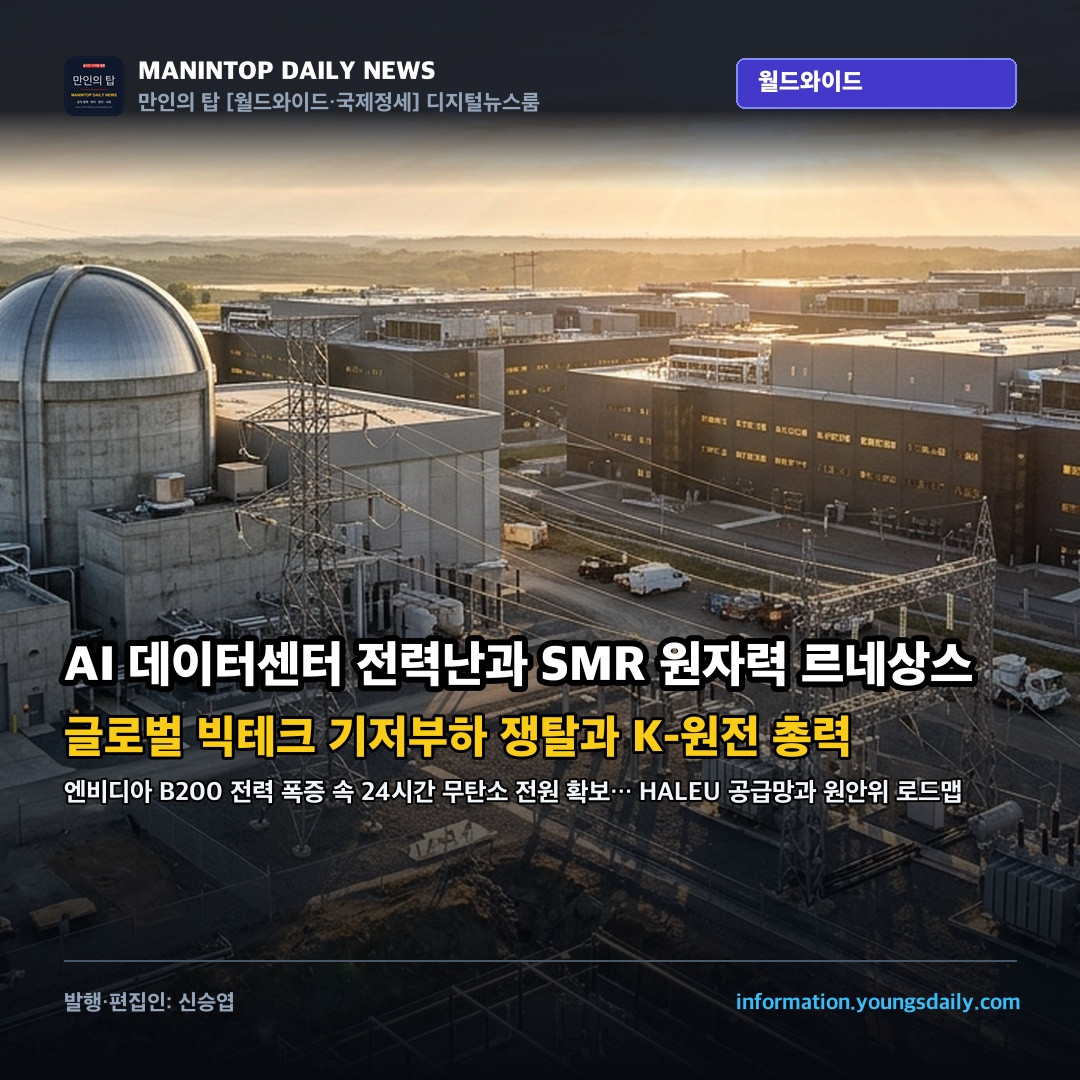
▲ AI 데이터센터의 전력 폭증에 대응하여 차세대 SMR과 원자력 르네상스가 글로벌 에너지 지형을 재편하고 있다 (만인의 탑 그래픽 리포트)
생성형 인공지능(AI)과 초거대언어모델(LLM)의 폭발적 확산으로 엔비디아 B200 칩셋 1장당 최대 1,000W, 100MW급 하이퍼스케일 데이터센터 1곳당 10만 가구 분량의 전력을 연중무휴 소모하는 전력 폭증 사태가 빚어지면서, 글로벌 에너지 시장의 패러다임이 '탈탄소 기저부하(Base Load)' 전원인 소형모듈원자로(SMR)와 원자력으로 급격히 회귀하고 있습니다. 간헐성과 낮은 설비이용률(태양광 21%, 풍력 32%)로 인해 99.999% 가용성을 요구하는 AI 연산을 지탱할 수 없게 되자, 아마존(엑스-에너지 12기 960MW PPA 및 5억 달러 투자), 구글(카이로스 파워 500MW 구매), 마이크로소프트(스리마일섬 TMI 1호기 835MW 20년 재가동), 메타와 오픈AI(오클로 및 테라파워 기가와트급 전력 확보) 등 빅테크 공룡들이 원전 선점에 천문학적 자본을 쏟아붓고 있습니다. 미국 에너지부(DOE)가 2026년 7월 4일 독립기념일까지 민간 선진원자로 3기의 최초 임계 달성을 추진하고 트럼프 행정부가 2050년 400GW 원전 4배 확대를 천명한 가운데, 고순도 저농축 우라늄(HALEU) 연료 공급망 부재와 CAT2 시설 구축 지연이 상용화의 최대 병목으로 부상했습니다. 이에 맞서 두산에너빌리티, HD현대, 삼성물산 등 한국 원전 파운드리 제조사들이 글로벌 SMR 공급망의 핵심 축으로 도약하고 있으며, 원자력안전위원회가 2026년 2월 발표한 'SMR 규제체계 구축 로드맵'을 통해 선제적 인허가 체계 개편에 박차를 가하고 있습니다.
핵심 팩트 브리핑 (Core Fact Briefing)
엔비디아 B200 칩당 1,000W 소모 및 데이터센터 전력 급증: 100MW 데이터센터 1곳이 10만 가구 전력 소모, 미 데이터센터 전력 비중 2020년 4%에서 2028년 최대 12% 급등 전망
빅테크 원전 쟁탈전과 기저부하 확보: 아마존 Xe-100 SMR 12기(960MW) PPA 및 5억 달러 투자, 구글 카이로스 파워 500MW 계약, MS 스리마일섬 1호기(835MW) 20년 재가동 독점 계약
미 DOE 규제 우회 시범사업과 2050년 400GW 행정명령: 2026년 7월 4일까지 ASMR 3기 최초 임계 달성 추진, 원전 4배 확대 및 테라파워 와이오밍 케머러 원자로 착공
HALEU 핵연료 공급망 병목과 한국 원전 파운드리 도약: 10~19.75% 농축 우라늄 및 CAT2 인프라 부족 속 두산에너빌리티·HD현대·삼성물산 핵심 기자재 공급 선점 및 원안위 규제 로드맵 발표
1. 엔비디아 B200과 AI 데이터센터의 전력 폭증… 재생에너지 한계와 ‘기저부하’ 원전 부상
인공지능(AI)과 거대언어모델(LLM)의 급격한 확산은 전 세계 전력 인프라의 근간을 뒤흔들고 있습니다. 엔비디아의 차세대 AI 슈퍼칩인 블랙웰(Blackwell B200) 단 1장이 소비하는 전력은 최대 1,000W에 달하며, 수만 장의 첨단 가속기가 탑재되는 하이퍼스케일 데이터센터 1곳(100MW 기준)은 약 10만 가구가 사용하는 전력량을 365일 24시간 단일 부지에서 집중 소비합니다. 미국 에너지정보청(EIA)과 로런스버클리국립연구소(LBNL)에 따르면, 미국 내 데이터센터 전력 소비 비중은 2020년 4%에서 2026년 6%를 거쳐 2028년에는 최대 12%까지 폭증할 전망입니다.
대규모 행렬 연산을 수만 개 노드에 분산 처리하는 AI 학습 특성상, 순간적인 정전이나 전압 강하가 발생하면 수십억 원에서 수조 원에 달하는 모델 체크포인트 연산 손실이 발생합니다. 따라서 99.999%(Five Nines) 이상의 무중단 전력 신뢰성이 요구됩니다. 그러나 태양광과 풍력의 평균 설비이용률(가동률)은 각각 21%와 32% 수준에 불과하여 밤이나 무풍 시 발전량이 급감하는 치명적인 '간헐성(Intermittency)'을 안고 있습니다. 배터리 에너지저장장치(ESS)로 이를 보완할 경우 발전단가(LCOE+)가 MWh당 200달러를 넘어서는 막대한 추가 비용이 발생합니다.
반면 우라늄 1g이 석탄 3톤에 맞먹는 압도적 에너지 밀도를 지닌 원자력은 설비이용률이 93%에 달해 기상 여건과 무관하게 연중무휴 고밀도 전력을 공급할 수 있는 유일한 '탈탄소 기저부하(Clean Base Load)' 전원입니다. 이에 따라 탄소중립(RE100)을 선언했으나 데이터센터 확장으로 온실가스 배출량이 30~50% 급증하는 역설에 직면한 글로벌 빅테크 기업들이 원자력과 SMR로 전격 회귀하고 있습니다.
2. 글로벌 빅테크의 원전·SMR 확보 격전… 아마존·구글·MS의 전방위 PPA와 지분 투자
AI 인프라 주도권을 장악하기 위해 글로벌 빅테크 공룡들은 기존 대형 원전의 재가동 전력구매계약(PPA)부터 차세대 SMR 지분 투자 및 핵융합 발전 선구매까지 공격적인 자본 배치를 단행하고 있습니다. 아마존(Amazon)은 차세대 가스로 SMR 개발사인 엑스-에너지(X-energy)에 5억 달러(약 6,700억 원)를 직접 투자하고, 미국 전력회사 AEP와 협력하여 인디애나주 옛 석탄화력 부지에 80MW급 Xe-100 원자로 12기를 건설해 총 960MW 전력을 확보하는 초대형 프로젝트를 가동했습니다.
특히 아마존의 인디애나 프로젝트는 데이터센터 구내에 발전소를 직결하는 기존 자가발전(Behind-The-Meter, BTM) 방식에서 탈피하여, 생산 전력을 전량 공공 전력망(Grid)에 공급하고 장기 PPA를 체결하는 모델을 채택했습니다. 이는 데이터센터의 대규모 전력 독점으로 인해 인근 주민들의 주택용 전기요금이 최대 13%까지 인상되고 배전망 과부하가 초래된다는 사회적 반발을 선제적으로 차단하기 위한 정교한 상생 전략입니다.
구글(Google) 역시 용융염 냉각 선진 SMR 선도기업인 카이로스 파워(Kairos Power)와 총 500MW 규모의 전력 구매 계약을 체결하고, 테네시주 에르메스 2(Hermes 2, 50MW) 시범 원자로를 2026년 4월 착공하기로 확정했습니다. 마이크로소프트(MS)는 1979년 2호기 노심용융 사고 이후 2019년 경제성 악화로 멈췄던 펜실베이니아주 스리마일섬(TMI) 원전 1호기(835MW)를 2027년 부활시키기 위해 콘스텔레이션 에너지와 20년 독점 PPA를 체결했습니다. 여기에 메타(Meta)와 오픈AI(OpenAI)의 샘 올트먼 역시 오클로(Oklo)와 빌 게이츠의 테라파워(TerraPower)에 수조 원대 선구매 권리를 확보하며 원자력 확보전에 뛰어들었습니다.
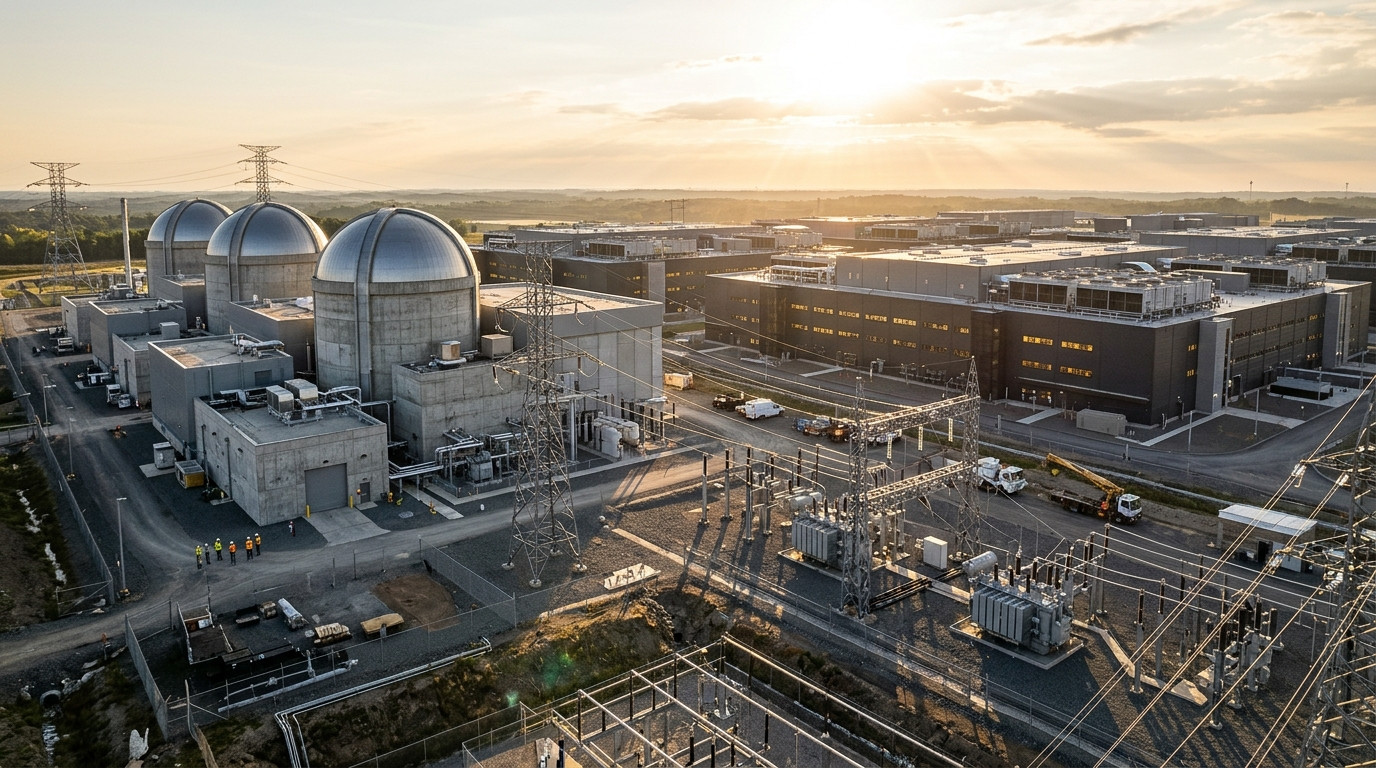
▲ AI 데이터센터 단지에 24시간 무탄소 기저부하 전력을 직결 공급하는 차세대 SMR 발전 시설 (보도사진 자료)
3. 미 에너지부(DOE) 규제 패러다임 전환과 트럼프 행정부 원전 4배 확대 행정명령
글로벌 AI 경쟁이 국가 안보 패권 다툼으로 비화되면서 미국 정부는 60여 년간 유지되어 온 원자력 규제 패러다임을 뿌리부터 뒤흔들고 있습니다. 원자력규제위원회(NRC)의 기존 심사 절차가 최소 수년에서 10년 이상 소요되어 혁신 기업들의 기술 실증을 가로막는다는 지적이 잇따르자, 미 에너지부(DOE)는 'DOE Reactor Pilot Program'을 전격 가동했습니다.
본 프로그램은 원자력법(Atomic Energy Act)에 규정된 연방정부 자체 인가 권한을 발동하여 NRC의 복잡한 민간 상업 라이선스를 우회하는 파격적인 모델입니다. DOE는 2026년 7월 4일 미국 독립기념일까지 최소 3기 이상의 선진 소형원자로(ASMR)의 최초 임계(Criticality, 자립적 핵분열 연쇄반응 도달)를 공식 목표로 설정했습니다. 이미 2025년 11월 Valar Atomics가 첫 임계에 성공한 데 이어, Antares Nuclear, Radiant Industries, Aalo Atomics 등이 실증 원자로 가동을 앞두고 있습니다.
정책적 드라이브는 행정부 최상층부에서도 가속화되고 있습니다. 도널드 트럼프 미국 대통령은 현재 약 100GW 수준인 미국 원자력 발전 용량을 2050년까지 400GW로 4배 확대하는 원자력 산업 육성 행정명령에 서명했습니다. 이에 발맞추어 와이오밍주 케머러에서는 테라파워의 나트륨(Natrium, 345MW) 소듐냉각고속로가 NRC 건설 허가를 받아 미국 최초의 상업용 선진 원자로로 착공에 들어갔으며, 유타주와 네브래스카주 등 10개 이상의 주 정부가 신규 원전 모라토리엄을 해제하고 SMR 부지 선정을 서두르고 있습니다.
4. 차세대 선진 SMR(ASMR) 상용화의 최대 아킬레스건… HALEU 핵연료 공급망 병목
소형모듈원자로(SMR)의 눈부신 기술적 청사진에도 불구하고, 원자로를 가동할 '핵연료 공급망'의 부재는 전체 산업의 생사를 가를 최대 아킬레스건으로 떠올랐습니다. 기존 대형 경수로는 3~5% 농축도의 저농축 우라늄(LEU)을 사용하지만, 테라파워의 나트륨, 엑스-에너지의 Xe-100 등 대다수 차세대 선진 SMR(ASMR)은 10~19.75% 농축도인 '고순도 저농축 우라늄(HALEU)'을 필수적으로 요구합니다. HALEU는 노심 크기를 극단적으로 줄이면서도 출력을 높이고 핵연료 교체 주기를 수년으로 연장할 수 있는 핵심 물질입니다.
문제는 전 세계 HALEU 상업 공급을 사실상 독점해 온 러시아 국영 원자력기업(Rosatom)산 핵연료 수입이 2022년 우크라이나 침공 이후 전면 금지되었다는 점입니다. 서방 세계에는 HALEU를 대량 생산할 상업 농축 시설은 물론, 농축된 가스(UF6)를 고체 금속이나 산화물로 바꾸는 탈산소 변환(Deconversion) 시설과 성형가공 공장이 거의 전무한 실정입니다. 카네기 국제평화재단(CEIP)의 분석에 따르면, HALEU 농축 및 가공 시설은 고도의 물리적 방호가 요구되는 'Category 2 (CAT2)' 보안 등급을 충족해야 하므로 수조 원의 막대한 설비 투자가 수반됩니다.
이로 인해 핵연료 공급사는 장기 의무구매 계약(Take-or-Pay) 없이 선투자를 꺼리고, 원자로 스타트업은 수입이 없는 상태에서 선급금을 낼 수 없는 전형적인 '닭과 계란의 딜레마'에 빠져 있습니다. 미 DOE가 센트러스(Centrus)와 제너럴 매터에 각각 9억 달러를 지원하고 영국 정부가 우렌코(Urenco)에 1억 9,600만 파운드를 투입했으나, 서방의 HALEU 공급망이 안정화되는 시점은 일러야 2029년~2030년대 초반으로 전망됩니다. 연료가 없어 완공된 원자로를 돌리지 못하는 사태가 현실화될 수 있다는 경고가 나오는 이유입니다.
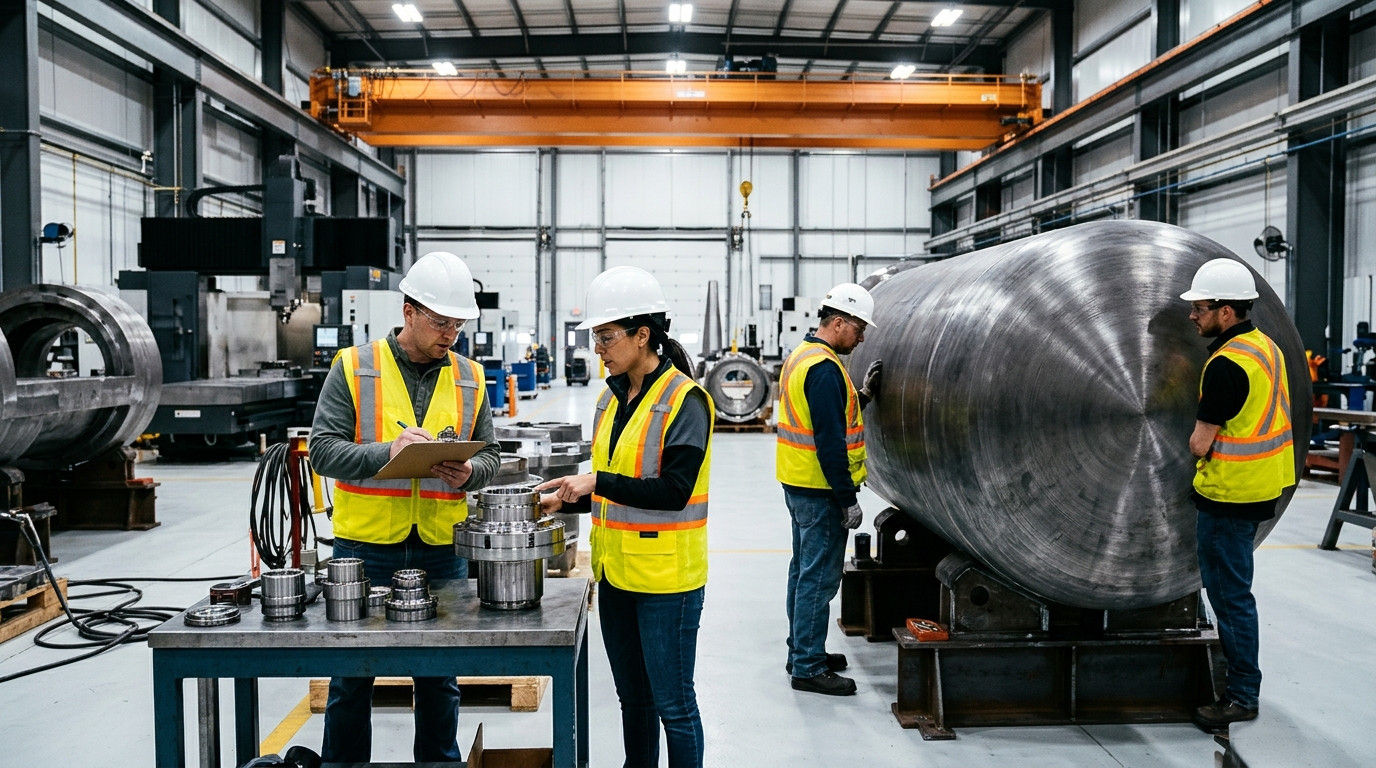
▲ 대형 단조 프레스와 정밀 가공 장비를 갖춘 원전 파운드리 제조 공장 내부 (현장 보도사진)
5. K-원전 제조 생태계의 파운드리 도약과 원안위 ‘SMR 규제 로드맵’ 과제
미국과 유럽이 오랜 탈원전 정책으로 중공업 원전 제조 인프라의 공동화를 겪는 사이, 압도적인 단조 및 주기자재 제작 역량을 보존해 온 한국 원전 생태계가 글로벌 SMR 시장의 '핵심 파운드리(위탁생산 기지)'로 급부상하고 있습니다. 두산에너빌리티와 한국수력원자력은 아마존, 엑스-에너지와 4자 전략 협력을 맺고 Xe-100 원자로 압력용기 단조품 공급을 선점했으며, 뉴스케일파워(NuScale)의 핵심 주기자재 공급사이자 지분 투자자로 확고한 입지를 구축했습니다.
국내 대기업들의 글로벌 합종연횡도 전방위로 확대되고 있습니다. DL이엔씨는 엑스-에너지와 SMR 플랜트 설계·조달·시공(EPC) 파트너십을 체결했으며, HD현대중공업과 SK이노베이션은 빌 게이츠의 테라파워에 대규모 지분 투자를 단행하고 해상 부유식 SMR 공동 개발을 추진 중입니다. 삼성물산 건설부문 역시 카이로스 파워 및 뉴스케일파워와 손잡고 글로벌 데이터센터 전력망 구축 사업에 뛰어들었습니다.
이러한 산업적 모멘텀을 뒷받침하기 위해 원자력안전위원회는 2026년 2월 12일 제2026-2회 회의에서 '소형모듈원자로(SMR) 규제체계 구축 로드맵'을 공식 발표했습니다. 기존 대형 경수로 중심 규제에서 탈피하여 2030년까지 선박, 열공급, 수소생산 등 비경수로 노형(HTGR, SFR, MSR)을 포괄하도록 법률을 개편하고, 인허가 예측 가능성을 높이기 위한 '사전검토 제도'를 연내 도입하기로 했습니다. 다만 한국형 혁신 SMR(i-SMR, 170MWe)의 2028년 표준설계인가 목표 달성과 글로벌 수출을 위해서는, 국가첨단전략기술 지정 누락 우려 등 국내 정책적·정치적 불확실성을 조속히 해소하고 전력망 접속을 적극 지원해야 한다는 목소리가 높습니다.
📊 글로벌 빅테크 기업별 원자력 및 SMR 전력 확보 프로젝트 추진 현황
빅테크 기업
파트너사 및 대상 노형
투자 및 계약 규모
핵심 추진 내용 및 전략적 특징
아마존 (Amazon)
엑스-에너지 (X-energy) / AEP
엑스-에너지 $5억 직접투자 Xe-100 12기 (960MW) PPA
인디애나주 옛 석탄화력 부지에 80MW급 SMR 12기 배치. 자가발전(BTM) 대신 공공 전력망 공급 방식으로 전기요금 전가 논란 차단. 2039년까지 5GW 신규 원전 추진.
구글 (Google)
카이로스 파워 (Kairos Power)
최대 500MW SMR 전력 구매
용융염 냉각(MSR) 방식 선진 SMR 채택. 테네시주 에르메스 2(Hermes 2, 50MW) 시범 원자로 2026년 4월 착공. 2030~2035년 상업 운전 목표.
마이크로소프트 (MS)
콘스텔레이션 에너지 / 헬리온
20년 독점 PPA ($16억 설비투자)
1979년 사고 후 2019년 멈춘 스리마일섬(TMI) 1호기(835MW) 2027년 부활 독점 구매 (미 DOE 10억 달러 대출보증). 헬리온 에너지와 50MW 핵융합 PPA 병행.
메타 (Meta)
오클로 (Oklo) / 테라파워
1.2GW 선구매 (최대 2.8GW 권리)
샘 올트먼이 투자한 오클로의 액체금속고속로 전력 대규모 선점. 빌 게이츠의 테라파워(Natrium) 개발 자금 지원을 통한 중장기 기저부하 확보.
오픈AI (OpenAI)
오클로 (Oklo) / 스타게이트
$1,000억 프로젝트 (5GW 구상)
샘 올트먼 CEO가 이사회 의장인 오클로 중심. 5GW급 차세대 초대형 AI 데이터센터 클러스터 '스타게이트' 전력원으로 전용 SMR 단지 도입 추진.
* 자료: 각 기업 공식 공시, 미국 에너지부(DOE), IEA 및 한국경제·중앙일보 언론 보도 종합
첨단에너지·AI산업 특별취재발행인 겸 편집인: 신승엽 (Seung Youb Ssin)
Global Edition (English)
[In-Depth] AI Datacenter Power Crunch Accelerates SMR Renaissance: Big Tech Procurement Race and Korea's Nuclear Ecosystem
▲ AI Data Center Power Surge and the Small Modular Reactor (SMR) Nuclear Renaissance / Official Press Photo Archive
The exponential scaling of generative artificial intelligence and large language models—epitomized by Nvidia's Blackwell B200 GPUs consuming up to 1,000 watts per chip and 100-megawatt hyperscale campuses devouring the continuous power equivalence of 100,000 households—has catalyzed a structural pivot toward small modular reactors (SMRs) and advanced nuclear power as irreplaceable baseload energy. Confronting the inherent intermittency and low capacity factors of solar (21 percent) and wind (32 percent), which cannot sustain 99.999 percent uptime without catastrophic checkpoint computation loss, global technology conglomerates have unleashed an unprecedented capital deployment. Amazon (investing $500 million in X-energy for twelve Xe-100 SMRs totaling 960MW), Google (contracting 500MW from Kairos Power's molten-salt reactors), Microsoft (anchoring a 20-year recommissioning of the 835MW Three Mile Island Unit 1), Meta, and OpenAI are fiercely securing gigawatt-scale atomic capacity. With the U.S. Department of Energy fast-tracking civilian reactor criticality by July 4, 2026, under emergency Atomic Energy Act authority and the Trump administration targeting 400GW by 2050, the structural bottleneck has shifted to the High-Assay Low-Enriched Uranium (HALEU) supply chain and Category 2 facility deficits. Amid Western manufacturing attrition, South Korean heavy industrial giants—spearheaded by Doosan Enerbility, HD Hyundai, and Samsung C&T—have emerged as the essential global SMR manufacturing foundry, reinforced by the Nuclear Safety and Security Commission's February 2026 SMR Regulatory Modernization Roadmap.
Core Fact Briefing
Nvidia B200 1,000W chip consumption drives datacenter power surge: 100MW hyperscale facilities consume 100,000 households worth of power, with U.S. datacenter grid share rising from 4% to 12% by 2028.
Big Tech atomic energy procurement race: Amazon commits $500M to X-energy for 960MW (12 Xe-100 units), Google contracts 500MW from Kairos Power, and Microsoft finances the 835MW Three Mile Island Unit 1 restart.
U.S. DOE Pilot Program bypasses NRC delays targeting July 4, 2026 criticality: Trump administration issues executive mandate to quadruple nuclear capacity to 400GW by 2050 alongside TerraPower Natrium groundbreaking.
HALEU fuel supply bottlenecks meet Korean manufacturing foundry dominance: Shortages of 10-19.75% enriched uranium and CAT2 conversion facilities position Doosan Enerbility, HD Hyundai, and NSSC roadmap at the core of the SMR ecosystem.
1. Nvidia B200 GPU Power Surge and Datacenter Demand: Renewable Intermittency and Baseload Nuclear
The meteoric rise of generative artificial intelligence and frontier large language models is causing seismic shifts across the international power sector. A single unit of Nvidia's flagship Blackwell B200 GPU draws up to 1,000 watts of electrical power, while a standard 100-megawatt hyperscale data center campus concentrates the continuous power consumption of approximately 100,000 residential homes onto a single footprint. Empirical projections from the Lawrence Berkeley National Laboratory (LBNL) and the U.S. Energy Information Administration (EIA) indicate that data center electricity demand across the United States will surge from 4 percent of aggregate generation in 2020 to 6 percent in 2026, piercing 12 percent by 2028.
Because distributed AI training clusters synchronize matrix calculations across tens of thousands of accelerator nodes simultaneously, an unexpected power disruption or voltage sag results in catastrophic loss of training checkpoints, costing millions to billions of dollars. AI compute demands strict 99.999 percent (Five Nines) power availability. However, variable renewable resources—solar photovoltaic and onshore wind—exhibit average national capacity factors of merely 21 percent and 32 percent, respectively. Relying solely on renewables necessitates enormous overbuilding and battery energy storage systems (BESS), driving firming levelized costs (LCOE+) above $203 per megawatt-hour.
In contrast, nuclear fission yields extreme energy density—one gram of uranium produces energy equivalent to three metric tons of coal—achieving an unmatched baseline capacity factor of 93 percent. Nuclear power delivers round-the-clock, emissions-free, high-density electricity independent of diurnal cycles or weather conditions. Facing the paradox of corporate carbon emissions soaring 30 to 50 percent between 2019 and 2024 despite ambitious RE100 commitments, hyperscale technology operators are pivoting decisively toward nuclear energy and Small Modular Reactors (SMRs) as the sole physical foundation for scalable AI infrastructure.
2. Big Tech Scramble for Nuclear and SMR Fleets: Amazon, Google, and Microsoft Aggressive PPAs
To secure unconstrained compute scaling, technology conglomerates are deploying capital across the entire atomic frontier—ranging from long-term power purchase agreements (PPAs) on decommissioned gigawatt-scale reactors to strategic equity in advanced SMR ventures and commercial fusion startups. Amazon committed $500 million in direct equity financing to advanced gas-cooled reactor developer X-energy, partnering with utility American Electric Power (AEP) to evaluate twelve 80MWe Xe-100 SMR units (totaling 960MW) on a former coal site in Sullivan County, Indiana.
Crucially, Amazon's Indiana SMR project marks a strategic divergence from the controversial Behind-The-Meter (BTM) co-location model. Instead of siphoning power directly behind regional substations, the project feeds all 960MW into the regional transmission organization (PTO) under a grid-delivered PPA. This structure directly circumvents intense public backlash regarding retail electricity inflation; recent macroeconomic analyses indicate that hyper-concentrated data centers raise local residential electricity rates by up to 13 percent due to capital outlays on local grid augmentation.
Concurrently, Alphabet's Google executed an anchor PPA with Kairos Power for up to 500MW of molten-salt-cooled reactor output, scheduling groundbreaking on the Hermes 2 (50MW) demonstration unit in Oak Ridge, Tennessee, for April 2026. Microsoft orchestrated the historic revival of the 835MW Three Mile Island Unit 1 in Pennsylvania—shuttered since 2019 following decades of safe operation after the 1979 Unit 2 accident—under a 20-year exclusive PPA with Constellation Energy. Concurrently, Meta and OpenAI leadership (spearheaded by Sam Altman) have locked in multi-gigawatt power reservation rights with Oklo and Bill Gates's TerraPower, cementing nuclear power as the premier infrastructure moat.
▲ Next-generation Small Modular Reactor facility delivering continuous baseload electricity to an adjacent AI data center campus / Official Press Photo
3. U.S. Department of Energy Regulatory Pilot Program and 400GW Nuclear Expansion Mandate
Recognizing that artificial intelligence leadership is inextricably bound to sovereign energy dominance, the United States government is fundamentally overhauling its sixty-year-old nuclear regulatory architecture. Frustrated by the Nuclear Regulatory Commission's (NRC) protracted licensing timetables, which regularly require five to ten years for novel reactor designs, the U.S. Department of Energy (DOE) instituted the DOE Reactor Pilot Program.
This initiative deploys statutory authorization embedded within the Atomic Energy Act of 1954, allowing the DOE to authorize and host private experimental reactors directly on federal laboratory reservations, bypassing standard NRC Part 50/52 licensing hurdles. The DOE established a strict milestone: achieving initial criticality across at least three advanced commercial SMR prototypes by July 4, 2026 (the U.S. Semiquincentennial). Following Valar Atomics' successful criticality benchmark in November 2025, commercial pioneers including Antares Nuclear, Radiant Industries, and Aalo Atomics are finalizing final safety assessments.
At the executive level, President Donald Trump signed a sweeping executive mandate directing federal agencies to quadruple aggregate U.S. nuclear capacity from roughly 100GW today to 400GW by 2050 through streamlined permitting, federal loan guarantees, and defense procurement backstops. State-level adoption is surging in tandem: Wyoming hosted the formal construction kickoff for TerraPower's 345MWe Natrium sodium-cooled reactor in Kemmerer, Utah approved Holtec SMR-300 developments in Green River, and Minnesota dismantled its decades-old moratorium on new atomic construction.
4. Structural Bottlenecks in Advanced SMR Commercialization: HALEU Fuel Supply and CAT2 Infrastructure
Despite the technological momentum surrounding next-generation reactors, the absence of an operational fuel cycle represents an existential vulnerability threatening the commercial timeline of the entire SMR industry. While legacy light-water reactors consume Low-Enriched Uranium (LEU) enriched to between 3 and 5 percent U-235, high-efficiency advanced SMRs—including sodium fast reactors, high-temperature gas-cooled systems, and molten salt designs—mandate High-Assay Low-Enriched Uranium (HALEU), enriched from 10 to 19.75 percent. HALEU unlocks exceptional core power densities, prolonged refueling intervals, and passive thermal safety.
However, Western sanctions following Russia's 2022 invasion of Ukraine severed reliance on Tenex (Rosatom), which previously maintained a global monopoly on commercial HALEU exports. The Western alliance lacks operational commercial enrichment, deconversion (converting gaseous UF6 into solid oxides or metal alloys), and fabrication facilities. Carnegie Endowment for International Peace analyses highlight that processing HALEU requires Category 2 (CAT2) regulatory security infrastructure—mandating armed security perimeters, criticality safeguards, and air-tight physical containment—which escalates capital expenditures into billions of dollars.
This dynamic has produced a paralyzing 'chicken-and-egg' impasse: commercial enrichers such as Urenco and Centrus decline to risk billions on CAT2 fabrication plants absent binding multi-year take-or-pay volume guarantees, while pre-revenue reactor developers lack the balance sheets to issue capital advances. Although the U.S. DOE awarded dual $900 million contracts to Centrus and General Matter and the UK invested £196 million into Urenco's Capenhurst facility, industrial-scale Western HALEU delivery is not projected to stabilize until 2029 to 2031—creating an acute risk that initial advanced SMR deployments will face idle containment structures devoid of fuel.
▲ Advanced nuclear heavy manufacturing facility fabricating precision forged steel reactor pressure vessels / Field Archive
5. South Korean SMR Manufacturing Foundry Expansion and NSSC Regulatory Modernization Roadmap
As decades of nuclear stagnation hollowed out the heavy manufacturing and nuclear forging capabilities of North America and Western Europe, South Korea's heavy industrial ecosystem has emerged as the indispensable 'foundry' of the global SMR renaissance. Possessing world-class ultra-heavy forging presses, automated welding lines, and rigorous nuclear quality assurance, Doosan Enerbility and Korea Hydro & Nuclear Power (KHNP) signed four-party strategic cooperation agreements with Amazon and X-energy to forge reactor pressure vessels for the Xe-100, while serving as primary fabricator and equity partner for NuScale Power.
South Korean industrial conglomerates are rapidly securing dominant positions across the SMR value chain. DL E&C forged engineering, procurement, and construction (EPC) alliances with X-energy; HD Hyundai and SK Innovation injected strategic capital into Bill Gates's TerraPower to co-develop offshore floating nuclear power platforms; and Samsung C&T aligned with Kairos Power and NuScale to execute international nuclear EPC projects dedicated to powering hyperscale AI campuses.
To provide institutional certainty for this industrial expansion, South Korea's Nuclear Safety and Security Commission (NSSC) formally published its landmark SMR Regulatory Modernization Roadmap in February 2026. Transitioning from prescriptive light-water standards, the NSSC is codifying performance-based rules covering non-light-water designs (high-temperature gas, sodium fast, and molten salt systems) across marine propulsion, industrial heat, and hydrogen production by 2030, while launching pre-application design reviews in 2026. However, to maximize the export competitiveness of South Korea's indigenous innovative SMR (i-SMR, targeting standard design approval by 2028), stakeholders emphasize the urgent necessity of dispelling political policy ambiguities, granting national strategic technology tax incentives, and accelerating domestic grid modernization.
📊 Big Tech Nuclear and SMR Power Procurement Commitments Matrix
Technology Giant
Partner & Reactor Technology
Capital & Capacity Commitment
Strategic Implementation & Key Features
Amazon
X-energy / AEP
$500M Direct Equity in X-energy 12 Xe-100 Units (960MW) PPA
Deploying twelve 80MW SMRs on a former Indiana coal site. Replaces BTM with a public grid PPA model to prevent consumer rate inflation. Targeting 5GW by 2039.
Google
Kairos Power
Up to 500MW SMR PPA Portfolio
Adopting fluoride salt-cooled high-temperature reactor technology. Groundbreaking on Hermes 2 (50MW) demo reactor in Oak Ridge scheduled for April 2026. Target commercial operation 2030-2035.
Microsoft
Constellation Energy / Helion
20-Year Exclusive PPA ($1.6B Capex)
Recommissioning the 835MW Three Mile Island Unit 1 by 2027 backed by $1.0B in DOE loan guarantees. Simultaneously contracted a 50MW commercial fusion PPA with Helion Energy.
Meta
Oklo / TerraPower
1.2GW Advance Offtake (up to 2.8GW)
Securing fast-spectrum nuclear power from Oklo while co-financing engineering developments with Bill Gates's TerraPower to hedge long-term AI data center capacity.
OpenAI
Oklo / Project Stargate
$100B Stargate Campus (5GW Target)
Led by Sam Altman (Board Chair of Oklo). Envisioning multi-reactor microgrid campuses to directly power the next generation of multi-gigawatt frontier training clusters.
* Sources: Official Corporate Disclosures, U.S. Department of Energy (DOE), International Energy Agency (IEA), and Industry Reports
Global Energy & AI Infrastructure DeskPublisher & Editor-in-Chief: Seung Youb Ssin
PRO SOURCING ENGINE만인의 탑 빅데이터 솔루션
★ 가입 시 600 크레딧(120회) 전원 무료
내가 찾는 상품 키워드, 지금 얼마나 검색될까?
네이버 월간 검색량 + 구글 볼륨 + 아이템스카우트 실시간 상품수와 경쟁강도 배지를 0.5초 만에 무료로 확인하세요.
MANINTOP NEWSLETTER
📬 만인의 탑 뉴스레터 무료 구독
오늘 보신 정책·시사 뉴스가 유익하셨나요? 매일 엄선되는 알짜 복지 혜택과 국회 실시간 속보를 이메일로 가장 먼저 받아보세요. (평생 무료)
1월이 시작되면 감기는 이미 우리 곁에 와 있습니다. 2월, 3월, 4월까지 이어지는 추위와 건조함은 코와 목을 가장 먼저 공격합니다. 아침에 일어나자마자 막혀 있는 코. 계속 흐르는 콧물. 괜히 칼칼해지는 목. 이 증상은 “시작”일 뿐입니다. 한 번 무너지면 일주일, 길면 한 달까지 끌고 갑니다. 약을 먹으면 잠깐 괜찮아집니다. 하지만 며칠 뒤 또 반복됩니다. 왜일까요? 감기는 ‘치료’의 문제가 아니라 ‘관리’의 문제이기 때문입니다. 대부분은 감기가 오고 나서 약을 찾습니다. 하지만 진짜 중요한 건 감기가 오기 전에 코와 목을 지키는 것입니다. 건조한 실내 공기, 차가운 바깥 공기, 눈에 보이지 않는 세균. 코와 목은 매일 공격받고 있습니다. 지긋지긋하죠! 그런데도 우리는 아무 준비 없이 버티고 있습니다. 이번 겨울도 그렇게 보낼 건가요? 사실 방법은 어렵지 않습니다. 코를 깨끗하게 관리하고, 목을 따뜻하게 보호하고, 점막을 촉촉하게 유지하고, 기관지를 미리 관리하고, 외부 공기를 차단하는 것. 이 다섯 가지만 꾸준히 해도 감기약 없이 겨울을 보내는 것이 충분히 가능합니다. 🔥 이제부터 그 방법을 하나씩 살펴보겠습니다. 🔥 1. 코와 목을 먼저 관리해야 하는 과학적 이유 감기의 대부분은 코 점막에서 시작됩니다. 국제 학술지 Nature Reviews Microbiology 와 Journal of Allergy and Clinical Immunology 에 실린 호흡기 감염 관련 연구들에서는, 감기 바이러스가 비강 상피세포에 먼저 부착해 증식한다는 점을 설명하고 ...
리모델링사업이 진행 중인 아파트를 매매할 때 “계약금 10%를 언제까지 내야 하느냐”는 질문이 특히 많이 나옵니다. 이주공고(이주 안내)가 7~11월쯤이라고 들으면, 그 시점에 맞춰 계약금도 움직일 것 같아서 더 헷갈리기 쉽습니다. 하지만 실제 납부기한은 ‘이주공고가 언제냐’만으로 자동 결정되지 않는 경우가 많습니다. 1) 계약금 10% 납부기한: 결국 ‘문서에 적힌 일정’이 기준 계약금 10%를 언제까지 납부해야 하는지는, 내가 서명하는 매매계약서(특약 포함) 와 사업주체/조합이 제시한 공고·안내문 에 적힌 납부 일정이 기준이 됩니다. 실제 공고문에서는 분양대금 납부의 큰 틀(계약금→중도금→잔금)을 먼저 안내하고, 상세 일정은 별도 표나 유의사항으로 제시하는 방식이 흔합니다. 또, 계약서 문구에 따라 지급 시점이 조건부로 설정될 수도 있습니다. 예를 들어 한 사례 소개 자료에서는 용역계약서에 잔금(10%) 지급시기가 “사업승인 후”로 기재되어 있었다는 점이 언급됩니다. 이런 식으로 ‘사업 단계’와 지급을 연동하는 문구가 들어가면, 질문의 답은 계약서 문구를 확인해야만 확정됩니다. 관련 내용은 링크 에서 문구 사례를 확인할 수 있습니다. 2) 입주자모집공고에서 확인되는 ‘납부 순서’와 잔금 마감 시점 공고문에 적힌 문구를 보면, 납부 순서와 잔금 마감에 대한 기준이 비교적 명확하게 제시되는 경우가 있습니다. 예를 들어 한 입주자모집공고에는 “분양금액(주택가격)은 계약금, 중도금, 잔금의 순서로 납부”하며 “잔금은 입주(열쇠 수령일) 전에 완납”해야 한다고 안내되어 있습니다. (문구 확인: 링크 ) 이 문구가 의미하는 바는 최소 2가지입니다. 분양/공급 형태의 문서에서는 ‘계약금→중도금→잔금’ 흐름이 공식적으로 안내될 수 있습니다. 잔금은 “입주(열쇠 수령)” 이전에 완납해야 한다는 마감 기준이 문서에 적혀 있을 수 있습니다. 다만, 위 공고문 문구는 잔금 마감에 대한 기준을 보여주지만, 계약금 10%의...
윤석열 전 대통령 탄핵 인용 소식을 접하면, 가장 궁금한 지점은 ‘헌재가 정확히 무엇을 위헌·위법으로 봤는가’입니다. 또한 탄핵과 별개로 진행되는 형사재판(내란 우두머리 혐의 등)이 어디까지 왔는지도 함께 정리할 필요가 있습니다. 아래 내용은 제공된 기사/게시물 스니펫과 링크에서 확인되는 범위만 모아, 일반인이 흐름을 이해하기 쉽게 정리한 것입니다. 1) 탄핵 인용 관련: 스니펫에서 확인되는 ‘판단의 골격’ 제공된 근거 중 조국혁신당 사이트에는 헌법재판소가 윤석열 탄핵 심판에서 “피청구인의 위헌·위법행위는 국민 신임 …”이라는 취지로 판단했다는 문장이 인용돼 있습니다( 링크 ). 이 인용문만 놓고 보면, ‘위헌·위법행위’가 있었는지와 그로 인해 ‘국민의 신임’이 어떻게 평가됐는지가 핵심 축으로 소개됩니다. 다만 질문에서 요청하신 세부 항목, 즉 비상계엄 선포 자체를 문제 삼은 구체적 이유, 계엄 이후 조치(포고령, 국회 통제 등)의 어떤 지점이 헌법 위반인지, 국회의 권한행사 방해 및 정치활동 제약을 어떤 논리로 판단했는지 등은, 이번에 제공된 근거의 제목/스니펫만으로는 조항·사실관계·판단 구조가 그대로 제시돼 있지 않습니다. 따라서 이 글에서는 ‘헌재가 무엇을 문제 삼았다’는 세부 리스트를 단정적으로 재구성하기보다, 현재 확인 가능한 문구 수준의 요약(위헌·위법행위 → 국민 신임의 문제로 평가)까지만 적습니다. 만약 헌재 결정문 전문(주문 및 이유)이 추가로 확인되면, 그때는 문장 단위로 ‘어떤 행위’와 ‘어떤 헌법 원리/조항’이 연결되는지(예: 권력분립, 국회의 권한, 정치적 기본권 등) 구조화해 정리하는 것이 가장 정확합니다. 2) 형사 절차(내란 혐의) 관련: 체포영장과 1심 선고 언급 탄핵 심판과 별도로, 12·3 비상계엄 사태로 내란 혐의를 받는 윤석열 대통령에 대해 2024년 12월 31일 체포 영장이 발부됐다는 BBC 보도가 있습니다( 링크 ). 해당 보도는 ‘현직 대통령’에 대한 체포영장 발부라는 점을 함께 언급합니다. 또...