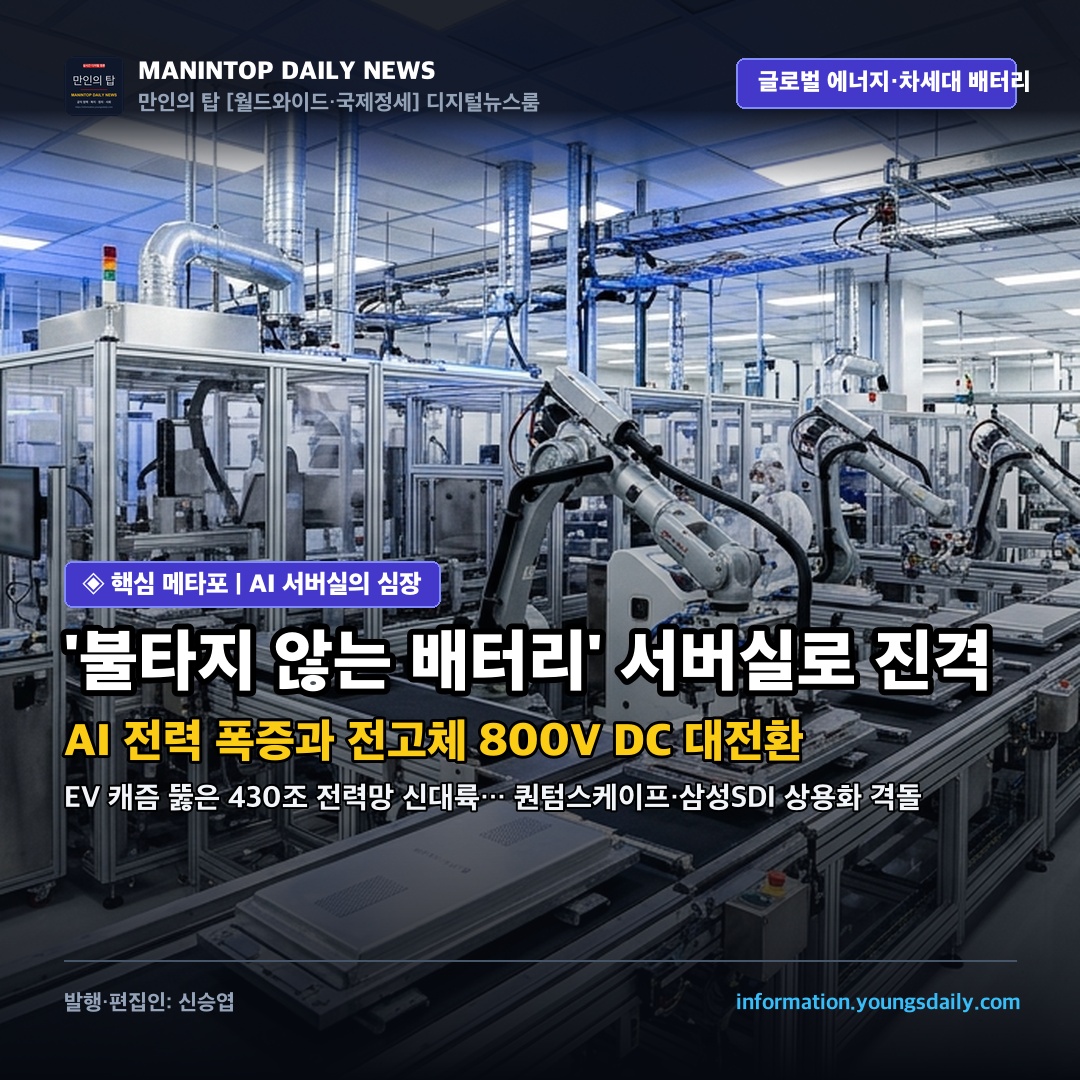
▲ 차세대 전고체 배터리 자동화 파일럿 설비에서 정밀 로봇 시스템이 AI 데이터센터 랙용 고밀도 셀 모듈을 정밀 조립하고 있다. / 공식 산업 자료 사진
'불타지 않는 배터리' 서버실로 진격… AI 전력 폭증과 전고체 대전환
인공지능(AI)과 고성능 컴퓨팅(HPC)의 폭발적 연산 확산으로 단일 하이퍼스케일 데이터센터가 중소 도시 전체에 맞먹는 기가와트(GW)급 전력을 소모하는 시대가 도래하면서, 전 세계 에너지 인프라와 배터리 산업이 사상 최대의 패러다임 전환을 맞이하고 있다. 과거 웹 서버 랙당 10kW 수준이던 전력 밀도가 차세대 AI 가속기와 GPU 클러스터 탑재로 랙당 100kW를 넘어 메가와트(MW)급으로 치솟자, 기존 400V 교류(AC) 전력망의 고질적인 열 손실과 공간 낭비가 빅테크의 최대 병목으로 부상했다. 이에 맞서 2차전지 시장은 전기차(EV) 수요 둔화(캐즘)를 뚫고 2035년 3,172억 달러(약 430조 원) 규모로 팽창하고 있으며, AI 데이터센터용 백업 전원(BBU)과 대용량 에너지 저장 장치(BESS) 비중이 전체 수요의 35%로 폭증하고 있다. 특히 변압기 부피를 80% 줄이고 구리 사용량을 28.6% 절감하는 800V 직류(DC) 및 반도체 변압기(SST) 아키텍처의 급부상과 함께, 300°C 이상의 극단적 열적 안정성을 무기로 서버실 화재를 원천 차단하는 퀀텀스케이프의 'QS 파워블록'과 삼성SDI의 'S-Line' 무음극 은-카본(Ag-C) 전고체 배터리가 데이터센터의 핵심 심장으로 진격하고 있다. 1,000조 원대 AI 인프라의 전력 핏줄을 바꾸는 전고체 배터리 상용화 레이스의 전모를 현장 취재를 통해 입체적으로 해부한다.
EV 캐즘 뚫는 430조 구원투수… 전기차에서 AI 데이터센터 전력망으로 축 이동
글로벌 2차전지 산업이 전기차(EV) 보급 둔화와 일시적 수요 정체(캐즘)를 극복할 새로운 초격차 성장 엔진을 확보했다. 국제에너지기구(IEA)에 따르면 전 세계 데이터센터 전력 소비량은 2030년까지 현재의 두 배 이상 폭증할 것으로 전망되며, 단일 하이퍼스케일 시설이 소비하는 전력량이 이미 원자력 발전소 1기에 맞먹는 수준에 도달했다. 시장조사기관 데이타엠 인텔리전스(DataM Intelligence)는 글로벌 2차전지 시장이 2035년 3,172억 8,000만 달러(약 430조 원) 규모로 도약하며, 이 중 AI 데이터센터 비상 백업 전원(BBU)과 대규모 전력망 안정화용 에너지 저장 장치(BESS)가 전체 수요의 35%를 차지할 것으로 분석했다.
특히 초거대 언어 모델 훈련과 추론 시 발생하는 급격한 전력 스파이크(Pulse Load)를 실시간으로 흡수해야 하는 고속 응답(Fast-Response) BESS 시장은 2026년 3억 7,300만 달러에서 2032년 22억 9,000만 달러로 연평균 35.3%라는 경이로운 속도로 팽창하고 있다. 단순히 정전에 대비하는 소극적 비상 전원을 넘어, 밀리초 단위의 미세 전력 변동을 실시간으로 보상하고 그리드 전압 강하를 방어하는 능동형 전력 제어 레이어로 배터리의 위상이 격상되면서 글로벌 배터리 제조사들의 핵심 격전지가 전기차 조립 공장에서 실리콘밸리 하이퍼스케일 서버실로 급격히 재편되고 있다.
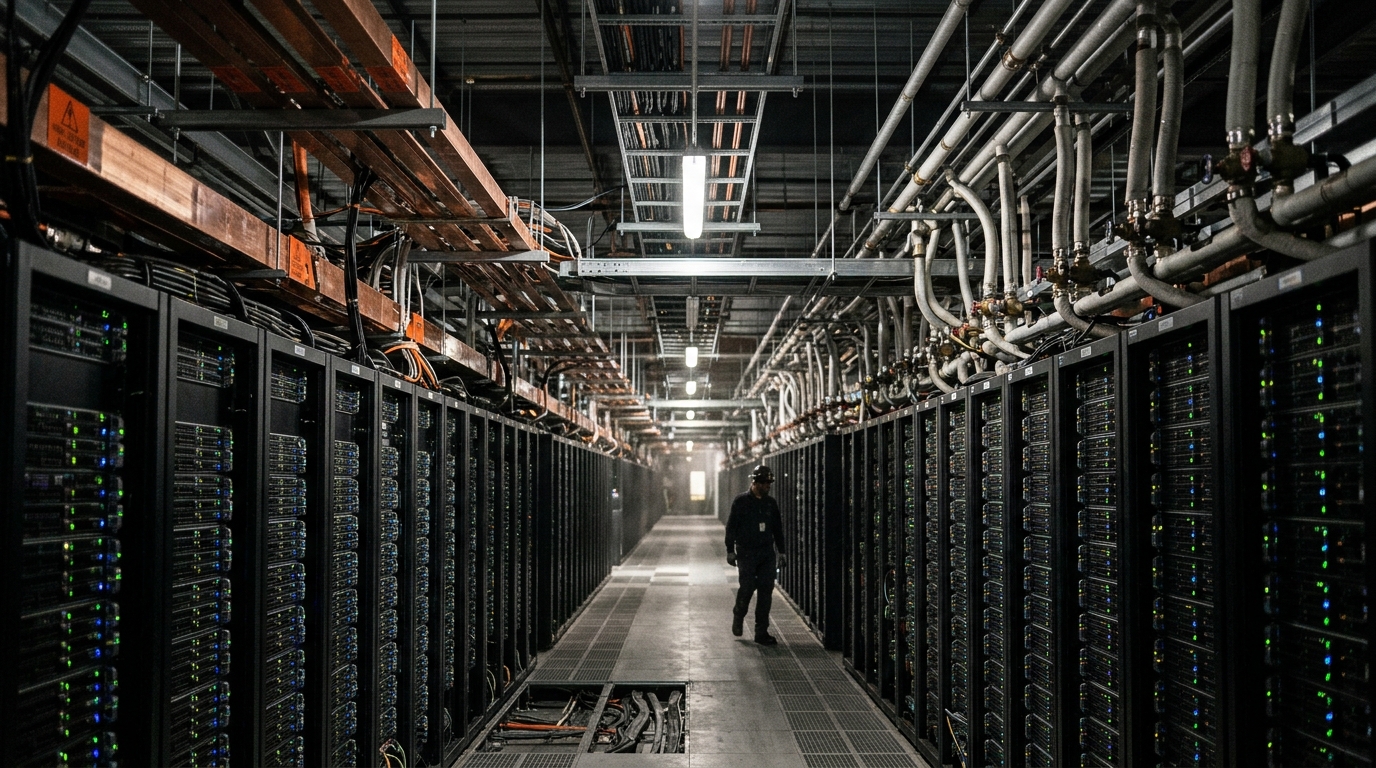
▲ 랙당 100kW 이상의 극단적 전력 수요를 감당하기 위해 천장형 800V 직류 버스바와 액체 냉각 매니폴드가 직결된 차세대 하이퍼스케일 AI 서버실 전경. / 현장 보도 사진
400V 교류의 종말과 800V 직류 대전환… 반도체 변압기(SST)가 여는 전력 효율 혁명
수십 년간 데이터센터 전력 분배의 표준이었던 400V 교류(LVAC) 인프라는 랙당 100kW를 넘어서는 AI 연산 부하 앞에서 물리적 한계에 부딪혔다. 기존 AC 시스템은 계통 중전압(20kV)을 상용주파수 변압기(LFT)로 강압한 뒤, 대형 온라인 UPS에서 AC-DC 정류와 DC-AC 역변환을 거치고, 다시 PDU 변압기와 서버 전원 공급 장치(PSU)를 거치는 4~5단계의 직렬 변환을 반복해 왔다. 이 과정에서 발생하는 열 손실과 '전력 캐스케이딩(Cascading) 손실'로 인해 글로벌 데이터센터의 평균 전력 사용 효율(PUE)은 지난 6년간 정체를 면치 못했다.
이에 엔비디아, OCP(Open Compute Project), 구글, 메타 등 빅테크 연합은 변환 단계를 단 2단계로 압축하는 '800V 직류(800V DC) + 반도체 변압기(SST)' 아키텍처를 전격 도입하고 있다. 알토(Aalto) 대학교 1.6MW 블록 시뮬레이션에 따르면, 800V DC와 실리콘 카바이드(SiC) 기반 SST를 연계할 경우 단일 블록당 연간 364.7MWh의 손실을 절감할 수 있다. 100MW 규모 하이퍼스케일 센터 기준으로 환산하면 연간 약 27억 원(182만 유로)의 전기요금을 아끼는 수치다. 또한 전압을 두 배로 높여 전류를 절반으로 줄임으로써 100m 버스바 기준 구리(Cu) 도체 사용량을 3,638kg에서 2,598kg으로 무려 28.6% 감축하고, 무거운 철심 변압기와 UPS가 차지하던 설비 공간(Gray Space)을 3분의 1로 축소해 실제 수익을 창출하는 AI 서버 배치 공간(White Space)을 획기적으로 넓혔다.
서버실 화재 원천 차단… 퀀텀스케이프 '파워블록'과 삼성SDI 'S-Line'의 상용화 격돌
800V 직류 전력망의 완성은 화재 위험을 근본적으로 제거한 차세대 전고체 배터리의 결합으로 완성된다. 서버 한 대당 수억 원을 호가하는 수만 대의 AI 칩이 밀집한 하이퍼스케일 데이터센터에서 액체 전해질 배터리의 열폭주(Thermal Runaway)는 인프라 전체를 잿더미로 만들 수 있는 치명적 재앙이다. 미국 전고체 배터리 선도 기업 퀀텀스케이프(QuantumScape)는 2026년 10월, AI 데이터센터 랙 내부(In-Rack)에 직접 장착 가능한 전고체 리튬메탈 시스템 'QS 파워블록(PowerBlock)'을 공개했다. 기존 OCP 표준 BBU 대비 전력 밀도를 4배 끌어올리고 백업 런타임을 5배 연장했으며, 기존 배터리가 180°C 부근에서 열폭주를 시작하는 것과 달리 300°C 이상의 고온에서도 완벽한 열적 안정성을 유지한다.
퀀텀스케이프는 독일 뮐바워 그룹(Muehlbauer Group)과 파트너십을 체결하고 산호세 '이글 라인(Eagle Line)'을 기반으로 100MWh 규모 전고체 양산 라인 구축(2028년 양산)에 착수했다. 한국의 삼성SDI 역시 수원 R&D 센터에 6,500㎡ 규모의 전고체 배터리 파일럿 라인 'S-Line'을 가동하며 2027년 완전 전고체 배터리(ASB) 상용화를 선언했다. 삼성SDI는 독자 무음극 기술을 적용한 고출력 AI 데이터센터 전용 BBU 플랫폼을 앞세워 글로벌 클라우드 기업들을 공략하고 있으며, 일본 이데미츠 코산과 토요타 역시 213억 엔을 투입해 지바현에 연간 3GWh 규모의 황화물계 고체 전해질 대형 공장을 2027년 6월 완공하고 대량 양산에 돌입한다.
[심층 비교 분석] 차세대 800V 직류 전력망 아키텍처 및 글로벌 전고체 배터리 핵심 명세 대조
기존 400V 교류 체계와 차세대 800V 직류 SST 아키텍처의 정량적 에너지 성능을 대조하고, 글로벌 주요 배터리 기업들이 전개하고 있는 AI 데이터센터용 전고체 배터리의 핵심 사양과 상용화 로드맵을 심층 비교 분석한다.
구분 (영역)
레거시 400V AC / 기존 배터리
차세대 800V DC + SST / 전고체 배터리
정량적 개선 효과 및 핵심 시사점
전력망 변환 단계 및 효율
4~5단계 직렬 변환 (LFT $\rightarrow$ UPS $\rightarrow$ PDU $\rightarrow$ PSU), 캐스케이딩 손실 심각
2단계 직결 변환 (SiC SST $\rightarrow$ 800V DC 버스바 $\rightarrow$ 칩셋 공급)
100MW 센터 기준 연간 27억 원(182만 유로) 전력비 절감, 블록당 연 364.7MWh 절약
도체 자재 및 시설 면적
100m 송전 시 3상 AC 3,638kg 구리 소요, 무거운 변압기·UPS로 그레이스페이스 과다
2선 DC 2,598kg 구리 소요 (28.6% 감축), 고주파 SST로 변압기 부피 80% 감축
전력 인프라 면적 1/3로 축소, 수익 창출형 IT 서버 공간(White Space) 확장
에너지 저장 및 열적 안정성
액체 전해질 사용으로 180°C 부근 열폭주 발생, 서버실 화재 취약성 노출
무음극 전고체 셀(300°C 이상 열적 안정성), 전력밀도 4배 및 런타임 5배 향상
화재 위험 원천 차단으로 랙 내부(In-Rack BBU) 직접 설치 및 무중단 가동 달성
글로벌 산업 생태계 주도권
전기차(EV) 의존도 80% 이상, 전기차 캐즘에 따른 실적 둔화 및 재고 부담
2035년 산업 인프라/BESS 비중 35% 급증, 퀀텀스케이프·삼성SDI 양산 레이스
430조 2차전지 시장의 구원투수로 등극, AI 빅테크 OCP 직류 표준화 장악
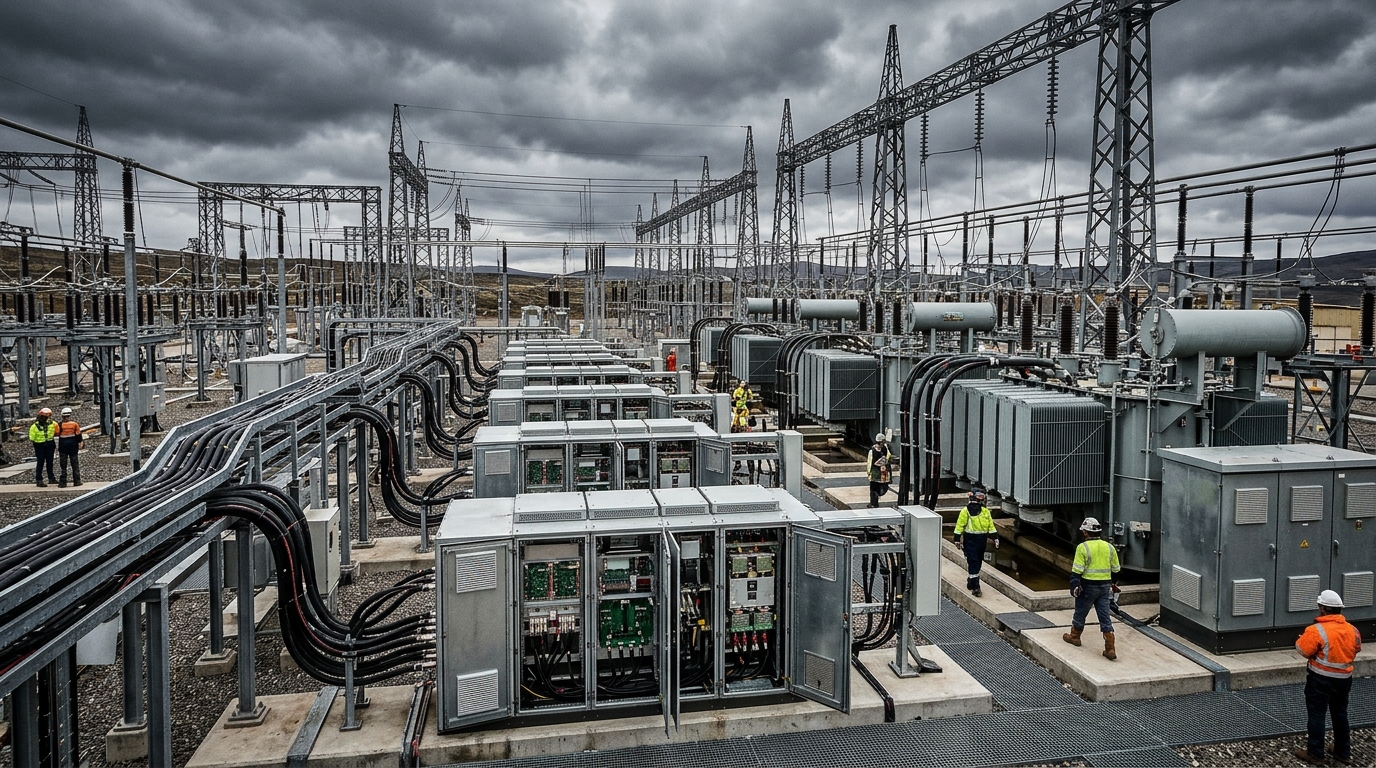
▲ 고주파 SiC 전력 반도체 스위칭을 통해 중전압 교류를 800V 직류로 직접 변환하는 산업용 반도체 변압기(SST) 및 스위치기어 인프라. / 공식 연구 자료
무음극 은-카본(Ag-C)과 황화물계 난제 극복… 410Wh/kg 차세대 에너지 밀도의 미래
전고체 배터리가 데이터센터의 전력 혁명을 이끌기 위해서는 학계와 산업계가 오랫동안 씨름해 온 3대 난제, 즉 리튬 덴드라이트(Dendrite) 성장, 고체전해질-리튬 간 계면 부반응, 그리고 방전 시 발생하는 계면 공극(Void) 형성을 극복해야 했다. 미국 노스이스턴(Northeastern) 대학교 연구진에 따르면, 음극재를 사전에 넣지 않는 '무음극(Anode-Free)' 황화물계 전고체 배터리는 기존 리튬이온 배터리(250Wh/kg)를 압도하는 410Wh/kg의 초고에너지 밀도를 실현하여 랙 공간 효율을 극대화할 수 있다.
이러한 난제를 돌파하기 위해 삼성전자 종합기술원과 삼성SDI가 '네이처 에너지'에 발표한 10㎛ 두께의 '은-카본(Ag-C) 복합 나노인터레이어' 기술이 글로벌 표준으로 부상했다. 은(Ag) 입자가 리튬과 합금화되어 덴드라이트 없는 균일한 전착을 유도하고, 나노 카본층이 고체전해질과의 부반응을 물리적으로 차단함으로써 1,000 사이클 이상의 초장수명과 99.8%의 경이로운 쿨롱 효율을 입증했다. 여기에 위스콘신 대학교 매디슨 연구진이 프로판 화염 가혹 실험을 통해 입증했듯, 세라믹 고체전해질은 화염 전파 속도가 기존 대비 수십 분의 일 수준에 불과해 화재 발생 시 골든타임을 확보해 준다. AI 데이터센터의 전력 핏줄이 교류에서 직류로, 리튬이온에서 전고체로 대전환하면서 1,000조 원대 AI 하드웨어 생태계의 판도가 새로 쓰이고 있다.
월드와이드 차세대배터리·전력인프라 전문 취재팀발행인 겸 편집인: 신승엽 (Seung Youb Ssin)
▲ Automated robotic precision arms fabricating high-density solid-state lithium-metal battery modules tailored for AI server halls. / Official Industry Archive
Solid-State Batteries Enter the Server Hall: AI Power Crunch Triggers the 800V DC Energy Revolution
The exponential acceleration of generative artificial intelligence and high-performance computing has ushered in an unprecedented energy paradigm, transforming hyperscale data centers into gigawatt-scale municipal power consumers. As compute rack densities escalate from legacy 10-kilowatt thresholds to beyond 100 kilowatts and megawatt-class clusters, the systemic thermal and transmission bottlenecks of traditional 400V alternating current (AC) grids have forced a fundamental architectural reckoning. Concurrently, the global secondary battery industry is aggressively navigating the electric vehicle demand chasm, with total market capitalization projected to reach $317.2 billion by 2035 as data center battery backup units (BBU) and grid-scale storage (BESS) surge to encompass 35% of total volume. The transition to 800V direct current (DC) distribution paired with Solid-State Transformers (SST) slashes copper material mass by 28.6% and compresses power infrastructure footprints by over 60%. Within this high-efficiency framework, non-flammable solid-state lithium-metal batteries—spearheaded by QuantumScape's in-rack 'QS PowerBlock' retaining thermal stability beyond 300°C and Samsung SDI's anode-free silver-carbon 'S-Line'—are seizing mission-critical dominance. This investigation dissects the multi-hundred-billion-dollar convergence of solid-state electrochemistry and hyperscale AI computing.
Pivoting Beyond the EV Chasm: AI Data Center Grids Anchor a $317 Billion Energy Market
The global secondary battery industry has unlocked an unprecedented structural growth vector capable of transcending the temporary plateau in electric vehicle adoption. According to analytical forecasts from the International Energy Agency (IEA), total electricity demand across global computing facilities is projected to double by 2030, with individual gigawatt-scale hyperscale campuses matching the power consumption of entire municipal metropolitan areas. Market research from DataM Intelligence indicates the global battery market will surge to $317.2 billion by 2035, with mission-critical infrastructure applications—primarily in-rack battery backup units (BBU) and large-scale battery energy storage systems (BESS)—expanding to constitute 35% of cumulative manufacturing demand.
Crucially, the fast-response BESS segment engineered to mitigate severe microsecond pulse loads generated during multi-trillion-parameter AI training is expanding at a compound annual growth rate of 35.3%, scaling from $373 million in 2026 to $2.29 billion by 2032. Evolving far beyond passive standby generation, electrochemical storage has transformed into an active power conditioning layer stabilizing busbar voltages. Consequently, global cell manufacturers are aggressively shifting their primary capital deployment targets from automotive assembly lines to hyperscale computing halls.
▲ A state-of-the-art hyperscale computing corridor deploying overhead 800V DC busbars and direct-to-chip cooling infrastructure. / Field Documentary Press
The Sunset of 400V AC: How 800V DC and Solid-State Transformers Rewrite Facility Efficiency
The legacy 400V low-voltage alternating current (LVAC) distribution architecture that underpinned server halls for decades has hit an absolute thermodynamic ceiling under modern 100-kilowatt-plus GPU cluster densities. Traditional facilities route medium-voltage utility feeds (e.g., 20kV) through low-frequency iron-core transformers (LFT), centralized double-conversion online UPS systems performing AC-DC-AC dual rectification, intermediate power distribution unit (PDU) transformers, and server-level power supply units. This serialized conversion sequence creates severe cascading thermal dissipation, causing facility Power Usage Effectiveness (PUE) metrics to stagnate across the industry for over six years.
To bypass these compounding losses, industry consortia including NVIDIA, the Open Compute Project (OCP), Google, and Meta are spearheading an architectural transition to 800V direct current (800V DC) paired with silicon carbide (SiC) Solid-State Transformers (SST). Empirical 24-hour dynamic load simulations conducted by Aalto University across a 1.6MW power block demonstrated annual energy loss reductions of 364.7 megawatt-hours per block. Scaled across a standard 100MW campus, this architecture secures over $2.9 million (27 billion KRW) in direct annual operating expenditure savings. By doubling transmission voltage and halving current, copper conductor mass across a 100-meter busbar run drops 28.6% from 3,638 kilograms to 2,598 kilograms, while slashing mechanical grey space footprints by over 60% to maximize revenue-generating computational white space.
Eliminating Thermal Runaway in Server Halls: QuantumScape PowerBlock Meets Samsung SDI S-Line
The structural viability of 800V DC architectures reaches maturity through the integration of non-flammable solid-state electrochemistry. Inside facilities hosting tens of thousands of advanced accelerators valued at hundreds of millions of dollars, liquid electrolyte thermal runaway poses existential risk. Addressing this vulnerability, QuantumScape unveiled its 'QS PowerBlock' in October 2026—a solid-state lithium-metal energy storage system tailored specifically for in-rack AI deployment. The architecture achieves a four-fold increase in volumetric power density and extends backup runtimes five-fold relative to OCP ORV3 baselines, maintaining total thermal stability beyond 300°C compared to conventional cells that initiate catastrophic decomposition around 180°C.
QuantumScape has partnered with Germany's Muehlbauer Group to establish a 100MWh automated production facility leveraging its San Jose Eagle Line, targeting commercial scaling by 2028. Concurrently, South Korea's Samsung SDI is operating its 6,500-square-meter 'S-Line' pilot facility in Suwon, targeting commercial all-solid-state battery (ASB) deployment by 2027. Samsung SDI's proprietary anode-free silver-carbon platform directly targets hyperscalers requiring ultra-high-rate emergency discharge capabilities. Simultaneously, Japan's Idemitsu Kosan and Toyota are investing 21.3 billion yen to complete a commercial 3GWh sulfide electrolyte plant in Chiba by June 2027 to supply automotive and industrial lines.
Comprehensive Comparative Analysis: Legacy vs. 800V DC SST Grids and Global Solid-State Battery Specifications
The comparative matrix below details the quantitative performance divergence between legacy 400V AC distribution and next-generation 800V DC SST frameworks, alongside primary technological specifications and commercialization timelines across leading solid-state battery innovators.
Domain / Specification
Legacy 400V AC / Lithium-Ion Baseline
Next-Gen 800V DC SST / Solid-State System
Quantitative Advantage & Strategic Impact
Grid Topology & Efficiency
4 to 5 serialized conversions (LFT to UPS to PDU to PSU) inducing severe cascading losses
2-stage direct conversion via SiC SST directly feeding 800V DC busbars
Annual power savings of $2.9M (1.82M EUR) per 100MW campus; 364.7 MWh saved per 1.6MW block
Conductor Mass & Footprint
3-phase AC busbar requires 3,638 kg copper per 100m; heavy transformer/UPS footprint
2-wire DC busbar requires 2,598 kg copper (28.6% drop); SST shrinks transformer mass by 80%
Mechanical grey space compressed by over 60%, maximizing revenue-generating server white space
Energy Density & Safety
Flammable liquid electrolytes trigger thermal runaway decomposition near 180°C
Total elimination of server fire hazards allows safe, dense in-rack BBU deployment
Commercialization & Ecosystem
Over 80% dependency on automotive EV demand, heavily pressured by market chasm
Industrial BESS expanding to 35% of $317B market by 2035; QuantumScape and SDI scaling
New financial bedrock for cell makers; hyperscalers establish proprietary DC grid standards
▲ An industrial Solid-State Transformer (SST) conversion facility leveraging SiC semiconductors to bridge medium-voltage feeds to 800V DC. / Official Research Archive
Overcoming Dendrites with Silver-Carbon Interlayers: The Frontier of 410 Wh/kg Anode-Free Chemistry
Harnessing solid-state cells for industrial computing requires overcoming three foundational electrochemical degradation mechanisms: uneven lithium nucleation causing separator-penetrating dendrites, parasitic electrolyte-metal reduction layers, and interfacial void formation during stripping. Research from Northeastern University highlights that sulfide-based anode-free solid-state batteries (AFSSB) eliminate heavy graphite anodes entirely, achieving gravimetric energy densities of 410 watt-hours per kilogram compared to legacy lithium-ion thresholds of approximately 250 Wh/kg.
The preeminent technical breakthrough addressing these interfacial challenges is the 10-micrometer silver-carbon (Ag-C) nanocomposite interlayer developed by Samsung. Silver nanoparticles form dynamic alloys with migrating lithium to enforce uniform planar deposition, while the carbon matrix isolates the sulfide electrolyte from reduction, delivering over 1,000 deep cycles and an average Coulombic efficiency of 99.8%. Furthermore, rigorous propane flame testing conducted at the University of Wisconsin-Madison confirmed that ceramic solid-state architectures exhibit flame propagation speeds vastly slower than volatile organic solvents, affording essential response margins for facility personnel. As computational infrastructure shifts from AC to DC and liquid to solid state, the technological bedrock of generative computing is undergoing an irreversible revolution.
1월이 시작되면 감기는 이미 우리 곁에 와 있습니다. 2월, 3월, 4월까지 이어지는 추위와 건조함은 코와 목을 가장 먼저 공격합니다. 아침에 일어나자마자 막혀 있는 코. 계속 흐르는 콧물. 괜히 칼칼해지는 목. 이 증상은 “시작”일 뿐입니다. 한 번 무너지면 일주일, 길면 한 달까지 끌고 갑니다. 약을 먹으면 잠깐 괜찮아집니다. 하지만 며칠 뒤 또 반복됩니다. 왜일까요? 감기는 ‘치료’의 문제가 아니라 ‘관리’의 문제이기 때문입니다. 대부분은 감기가 오고 나서 약을 찾습니다. 하지만 진짜 중요한 건 감기가 오기 전에 코와 목을 지키는 것입니다. 건조한 실내 공기, 차가운 바깥 공기, 눈에 보이지 않는 세균. 코와 목은 매일 공격받고 있습니다. 지긋지긋하죠! 그런데도 우리는 아무 준비 없이 버티고 있습니다. 이번 겨울도 그렇게 보낼 건가요? 사실 방법은 어렵지 않습니다. 코를 깨끗하게 관리하고, 목을 따뜻하게 보호하고, 점막을 촉촉하게 유지하고, 기관지를 미리 관리하고, 외부 공기를 차단하는 것. 이 다섯 가지만 꾸준히 해도 감기약 없이 겨울을 보내는 것이 충분히 가능합니다. 🔥 이제부터 그 방법을 하나씩 살펴보겠습니다. 🔥 1. 코와 목을 먼저 관리해야 하는 과학적 이유 감기의 대부분은 코 점막에서 시작됩니다. 국제 학술지 Nature Reviews Microbiology 와 Journal of Allergy and Clinical Immunology 에 실린 호흡기 감염 관련 연구들에서는, 감기 바이러스가 비강 상피세포에 먼저 부착해 증식한다는 점을 설명하고 ...
리모델링사업이 진행 중인 아파트를 매매할 때 “계약금 10%를 언제까지 내야 하느냐”는 질문이 특히 많이 나옵니다. 이주공고(이주 안내)가 7~11월쯤이라고 들으면, 그 시점에 맞춰 계약금도 움직일 것 같아서 더 헷갈리기 쉽습니다. 하지만 실제 납부기한은 ‘이주공고가 언제냐’만으로 자동 결정되지 않는 경우가 많습니다. 1) 계약금 10% 납부기한: 결국 ‘문서에 적힌 일정’이 기준 계약금 10%를 언제까지 납부해야 하는지는, 내가 서명하는 매매계약서(특약 포함) 와 사업주체/조합이 제시한 공고·안내문 에 적힌 납부 일정이 기준이 됩니다. 실제 공고문에서는 분양대금 납부의 큰 틀(계약금→중도금→잔금)을 먼저 안내하고, 상세 일정은 별도 표나 유의사항으로 제시하는 방식이 흔합니다. 또, 계약서 문구에 따라 지급 시점이 조건부로 설정될 수도 있습니다. 예를 들어 한 사례 소개 자료에서는 용역계약서에 잔금(10%) 지급시기가 “사업승인 후”로 기재되어 있었다는 점이 언급됩니다. 이런 식으로 ‘사업 단계’와 지급을 연동하는 문구가 들어가면, 질문의 답은 계약서 문구를 확인해야만 확정됩니다. 관련 내용은 링크 에서 문구 사례를 확인할 수 있습니다. 2) 입주자모집공고에서 확인되는 ‘납부 순서’와 잔금 마감 시점 공고문에 적힌 문구를 보면, 납부 순서와 잔금 마감에 대한 기준이 비교적 명확하게 제시되는 경우가 있습니다. 예를 들어 한 입주자모집공고에는 “분양금액(주택가격)은 계약금, 중도금, 잔금의 순서로 납부”하며 “잔금은 입주(열쇠 수령일) 전에 완납”해야 한다고 안내되어 있습니다. (문구 확인: 링크 ) 이 문구가 의미하는 바는 최소 2가지입니다. 분양/공급 형태의 문서에서는 ‘계약금→중도금→잔금’ 흐름이 공식적으로 안내될 수 있습니다. 잔금은 “입주(열쇠 수령)” 이전에 완납해야 한다는 마감 기준이 문서에 적혀 있을 수 있습니다. 다만, 위 공고문 문구는 잔금 마감에 대한 기준을 보여주지만, 계약금 10%의...
윤석열 전 대통령 탄핵 인용 소식을 접하면, 가장 궁금한 지점은 ‘헌재가 정확히 무엇을 위헌·위법으로 봤는가’입니다. 또한 탄핵과 별개로 진행되는 형사재판(내란 우두머리 혐의 등)이 어디까지 왔는지도 함께 정리할 필요가 있습니다. 아래 내용은 제공된 기사/게시물 스니펫과 링크에서 확인되는 범위만 모아, 일반인이 흐름을 이해하기 쉽게 정리한 것입니다. 1) 탄핵 인용 관련: 스니펫에서 확인되는 ‘판단의 골격’ 제공된 근거 중 조국혁신당 사이트에는 헌법재판소가 윤석열 탄핵 심판에서 “피청구인의 위헌·위법행위는 국민 신임 …”이라는 취지로 판단했다는 문장이 인용돼 있습니다( 링크 ). 이 인용문만 놓고 보면, ‘위헌·위법행위’가 있었는지와 그로 인해 ‘국민의 신임’이 어떻게 평가됐는지가 핵심 축으로 소개됩니다. 다만 질문에서 요청하신 세부 항목, 즉 비상계엄 선포 자체를 문제 삼은 구체적 이유, 계엄 이후 조치(포고령, 국회 통제 등)의 어떤 지점이 헌법 위반인지, 국회의 권한행사 방해 및 정치활동 제약을 어떤 논리로 판단했는지 등은, 이번에 제공된 근거의 제목/스니펫만으로는 조항·사실관계·판단 구조가 그대로 제시돼 있지 않습니다. 따라서 이 글에서는 ‘헌재가 무엇을 문제 삼았다’는 세부 리스트를 단정적으로 재구성하기보다, 현재 확인 가능한 문구 수준의 요약(위헌·위법행위 → 국민 신임의 문제로 평가)까지만 적습니다. 만약 헌재 결정문 전문(주문 및 이유)이 추가로 확인되면, 그때는 문장 단위로 ‘어떤 행위’와 ‘어떤 헌법 원리/조항’이 연결되는지(예: 권력분립, 국회의 권한, 정치적 기본권 등) 구조화해 정리하는 것이 가장 정확합니다. 2) 형사 절차(내란 혐의) 관련: 체포영장과 1심 선고 언급 탄핵 심판과 별도로, 12·3 비상계엄 사태로 내란 혐의를 받는 윤석열 대통령에 대해 2024년 12월 31일 체포 영장이 발부됐다는 BBC 보도가 있습니다( 링크 ). 해당 보도는 ‘현직 대통령’에 대한 체포영장 발부라는 점을 함께 언급합니다. 또...