먹는 알츠하이머병 치료 후보물질 AR1001의 임상 3상에서 서로 다른 두 결과가 나왔다. 기존 증상완화제를 복용하지 않은 환자 집단에서는 위약보다 병의 악화를 늦추는 효과가 통계적으로 확인됐다. 그러나 전체 환자 집단에서는 같은 결론을 내릴 만큼 분명한 차이가 나오지 않았다. 환자와 가족이 알아야 할 핵심은 효과가 확인된 대상과 아직 확인되지 않은 범위를 함께 보는 것이다.
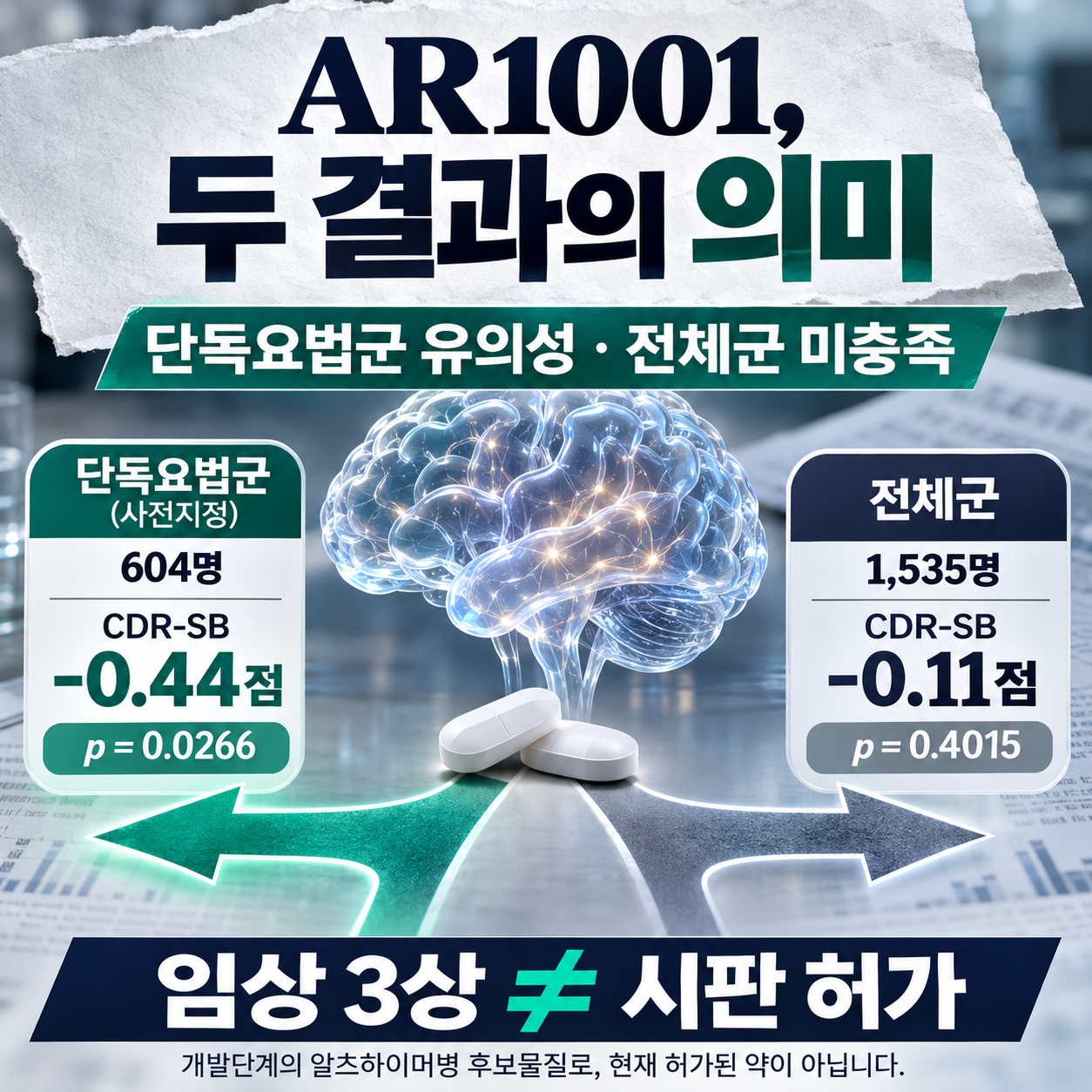
AI 생성 설명 이미지. 뇌 모형과 갈라지는 경로는 두 분석 결과를 상징하며 실제 제품·환자·임상 현장 사진이 아닙니다. 회사 발표 기준 단독요법군 604명은 CDR-SB −0.44점(p=0.0266), 전체 1,535명은 −0.11점(p=0.4015)이었습니다. 임상 결과 발표는 시판 허가와 다릅니다.
무엇을, 누구에게 시험했나
아리바이오는 미국 동부시간 11월 16일 보스턴에서 열린 알츠하이머병 임상시험 학회 CTAD에서 POLARIS-AD의 주요 결과를 발표했다. 현재 공개된 수치는 회사가 발표한 ‘탑라인’, 즉 핵심 결과를 먼저 정리한 자료다. 전체 분석 자료에 대한 최종 심사 결과와는 구분해야 한다.
미국 임상시험 등록정보에 따르면 이 시험은 초기 알츠하이머병 환자 1,535명을 대상으로 했다. 참가자를 무작위로 나눠 AR1001 30mg 또는 유효성분이 없는 위약을 하루 한 번, 52주 동안 투여했다. 참가자와 평가자가 투여 내용을 알지 못하도록 한 비교시험이다. 여기서 30mg은 연구에 사용한 용량이며 일반 독자에게 권하는 복용량이 아니다.
주요 평가 도구는 CDR-SB였다. 기억력뿐 아니라 판단, 일상 활동, 개인위생 등을 함께 살피는 치매 평가척도다. 총점은 0~18점이며 높을수록 인지·생활 기능의 손상이 크다. 따라서 치료 뒤 점수가 덜 올라갔는지가 중요하다.
회사가 말하는 단독요법군은 시험 시작 당시 아세틸콜린에스테라제 억제제나 메만틴 등 기존 알츠하이머병 증상완화제를 쓰지 않은 참가자들이다. 이 집단은 604명이었다. 모든 종류의 약을 전혀 복용하지 않은 사람이라는 뜻은 아니다.
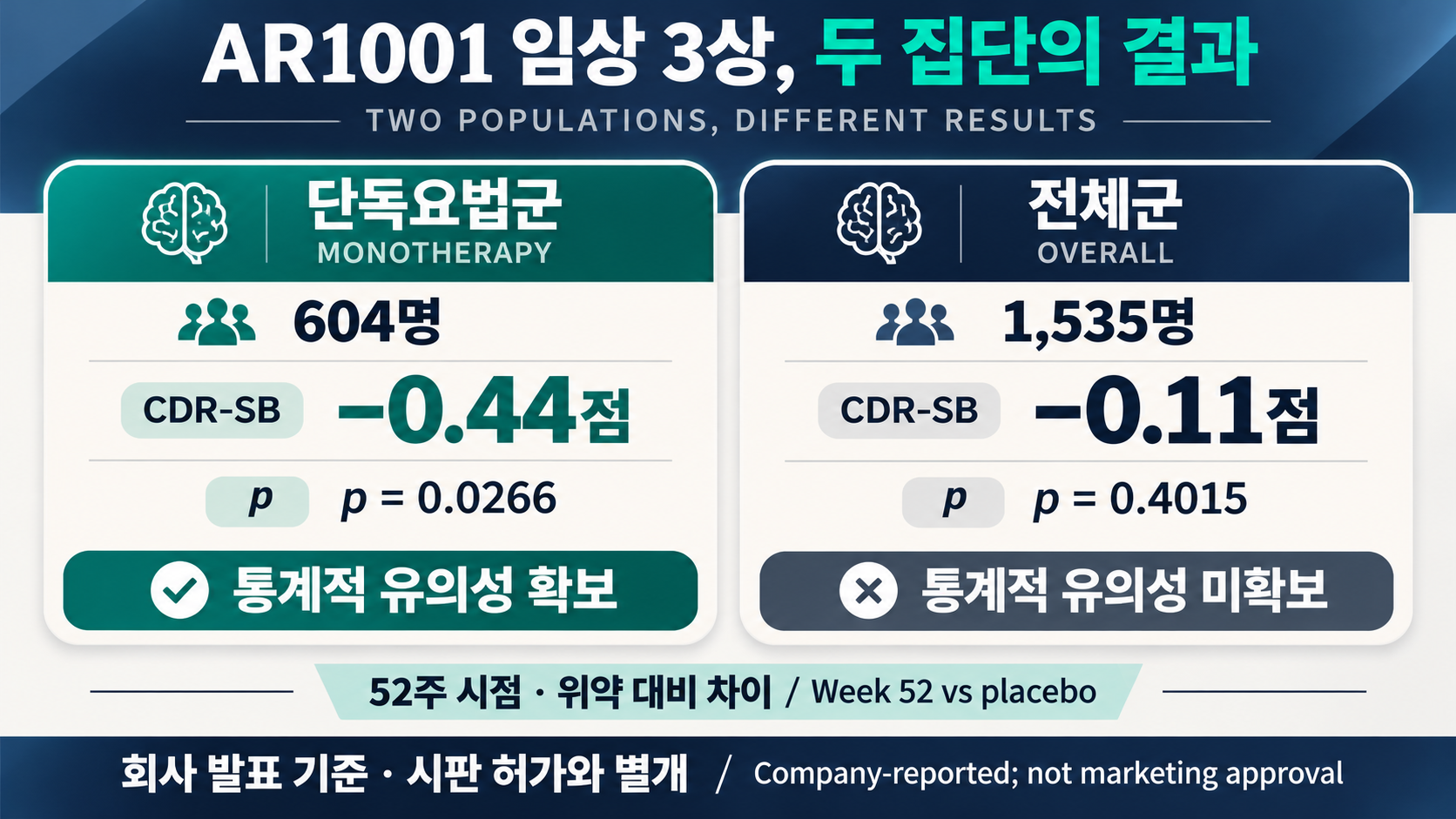
비교 항목
단독요법군
전체 환자군
분석 대상
604명
1,535명
52주 CDR-SB 위약 대비 차이
−0.44점
−0.11점
유의확률(p값)
0.0266
0.4015
회사가 발표한 통계 판정
유의성 확보
유의성 미확보
마이너스 부호는 위약군보다 점수 상승이 작았다는 뜻이다. 회사는 단독요법군의 결과를 ‘임상적 악화 31% 지연’으로 설명했다. 이는 환자의 기억력이 31% 회복됐다거나, 31%가 완치됐다는 뜻이 아니다. 집단 사이의 점수 변화 차이를 상대적인 비율로 나타낸 것이다.
통계적 유의성은 정해진 분석 기준에서 우연만으로 설명하기 어려운 차이가 관찰됐다는 뜻이다. p값을 ‘약이 효과가 있을 확률’이나 ‘성공할 확률’로 읽어서는 안 된다. 전체군에서 유의성이 없었다는 결과도 함께 제시해야 효과를 과장하지 않을 수 있다.
회사 발표는 두 집단을 미리 정해 평가했으며, 여러 검정을 고려한 절차에 따라 한 집단에서 유의성을 확보하면 주요 유효성 목표를 충족하는 설계였다고 설명한다. 10월 14일 갱신된 시험 등록정보에도 두 집단의 CDR-SB 평가가 각각 기재돼 있다. 다만 이번 기사에서는 전체 통계분석계획 원문이나 규제기관과의 협의 문서를 확보하지 못했다. 세부 기준의 분할 수치나 FDA·EMA가 결과를 승인했다는 주장은 단정하지 않는다.
AI 생성 정보 이미지. 회사 발표에 따른 52주 위약 대비 CDR-SB 차이: 단독요법군 604명 −0.44점(p=0.0266), 전체군 1,535명 −0.11점(p=0.4015). 전체군에서는 통계적 유의성을 확보하지 못했습니다.
전체군 결과가 약했던 이유는 아직 확인해야
두 집단의 결과가 다르다고 해서 기존 약이 AR1001의 효과를 방해했다고 바로 결론 내릴 수는 없다. 환자 특성, 기존 치료, 분석 방식 등을 살펴야 한다. 공개된 주요 결과만으로 약물 상호작용이나 병용군의 효과를 확정할 수 없다.
다른 인지검사도 한 방향으로만 해석하기 어렵다. ADAS-Cog13은 기억·언어 등 13개 항목을 평가하는 검사이고, MMSE는 인지 기능을 간단히 살피는 검사다. 회사가 제시한 단독요법군 ADAS-Cog13의 위약 대비 차이는 −1.16점, p값은 0.0798이었다. MMSE 차이는 +0.7점, p값은 0.0232였다. 이런 추가 지표는 여러 검사를 함께 했다는 점과 분석계획을 고려해 해석해야 한다. 유리한 수치만 골라 전체 효과가 증명됐다고 표현할 수 없다.
몸속 변화를 수치로 살피는 생체표지자 결과도 임상적 이익과 구분해야 한다. p-tau217은 알츠하이머병과 관련해 측정하는 변형된 타우 단백질의 한 형태다. 회사 발표에 나온 p-tau217 변화는 혈장이 아닌 뇌척수액 검사 결과다. 뇌척수액은 뇌와 척수 주변을 흐르는 액체다. 단독요법군에서 위약 대비 −5.34pg/mL의 차이가 보고됐지만, 이런 변화 자체가 환자의 일상생활 개선이나 장기 효과를 확정하지는 않는다.
회사 발표에서 중대한 이상사례 비율은 AR1001군 10.0%, 위약군 9.8%였다. 반면 이상사례로 시험약 투여를 중단한 비율은 각각 5.2%, 1.7%로 차이가 있었다. 설사는 7.7% 대 4.4%였다. 중대한 이상사례 비율이 비슷하다는 사실만으로 일상적인 불편이나 장기 복용 부담이 없다고 말할 수는 없다.
또 ‘이상사례’는 투약 이후 관찰된 건강 문제를 뜻하며, 모든 사례가 약 때문에 생겼다는 의미는 아니다. 원인과 정도를 따로 평가해야 한다. 같은 이유로 특정 부작용이 요약 발표에 언급되지 않았다는 것만으로 위험이 전혀 없다고 단정해서도 안 된다.
복용하는 약이라는 편의성은 주목할 만하다. 다만 서로 다른 시험의 환자 구성과 기간을 무시한 채 CDR-SB 점수 차이만 나란히 놓고 기존 주사 치료제보다 우월하다고 평가할 수는 없다. 직접 비교한 시험 결과가 필요하다.
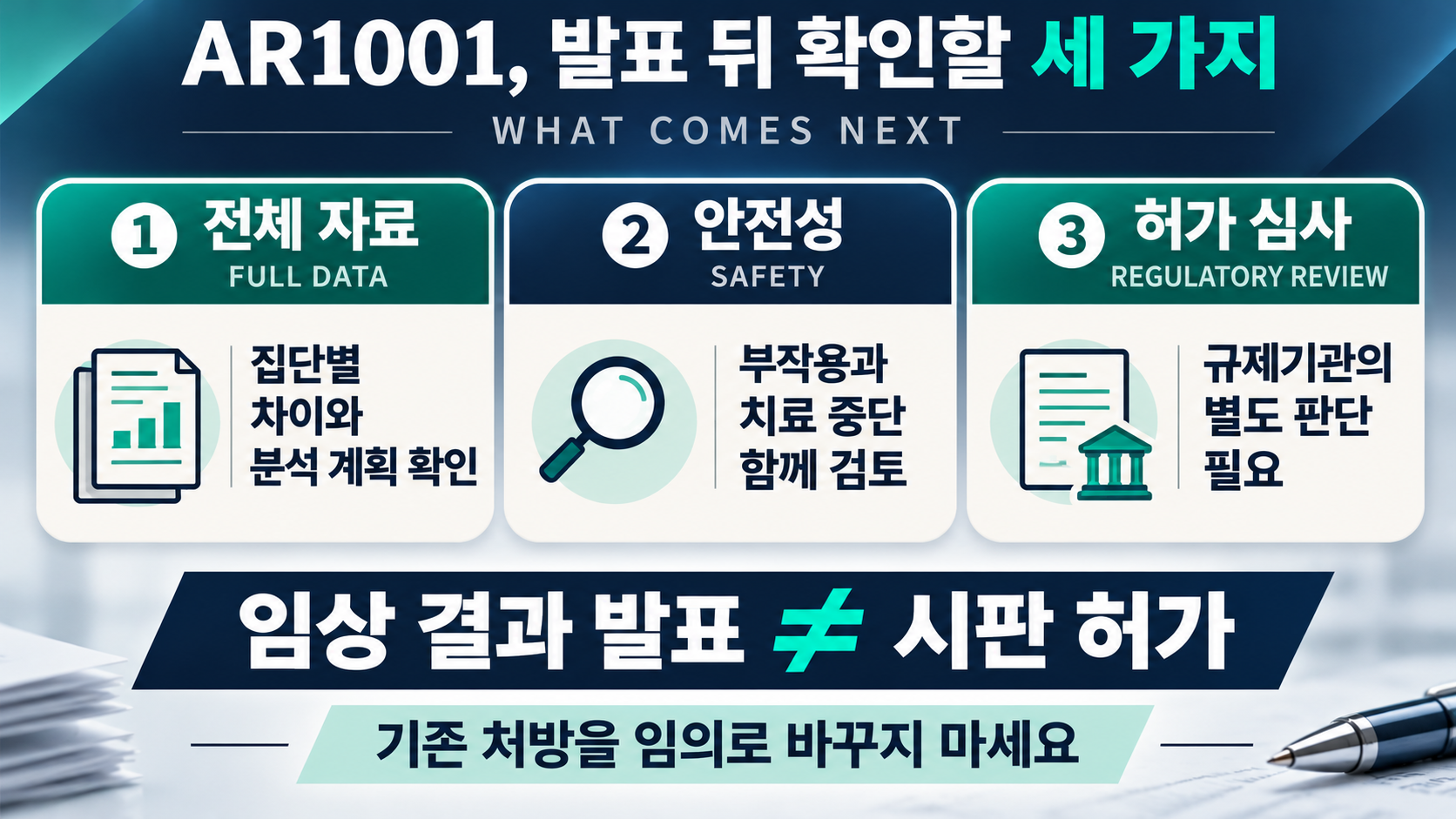
AI 생성 정보 이미지. 다음 확인 사항은 집단별 차이와 분석계획을 포함한 전체 자료, 부작용과 치료 중단을 포함한 안전성, 규제기관의 별도 허가 심사입니다. 임상 결과 발표를 이유로 기존 처방을 임의로 바꾸면 안 됩니다.
허가와 판권은 다음 단계…환자가 지금 확인할 것
AR1001은 알츠하이머병 치료용으로 아직 허가되지 않은 후보물질이다. 회사는 전체 결과를 FDA와 논의하겠다고 밝혔다. 임상시험에서 목표를 충족했다는 회사 발표와 규제기관의 판매 허가는 서로 다른 단계다. 허가 여부·대상 환자·추가 자료 요구는 앞으로 확인할 사항이다.
상업화 계약도 완료된 판매와 구분해야 한다. 푸싱제약은 11월 17일 공식 공시에서 미국·유럽·일본 등을 포함한 글로벌 추가 지역의 독점 옵션을 아직 행사하지 않았고, 관련 자료를 평가해 결정하겠다고 밝혔다. 기존 계약 대상 지역의 판권과 이 추가 옵션은 같은 것이 아니다. 옵션이 행사되더라도 해당 지역에서 판매하려면 별도의 의약품 심사가 필요하다.
환자와 가족에게 이번 결과는 새로운 치료 가능성에 관한 소식이다. 지금 받을 수 있는 치료가 바뀌었다는 안내는 아니다. 단독요법군 결과만 보고 기존 처방을 임의로 끊거나 바꾸는 근거로 삼아서는 안 된다. 다음 진료에서는 현재 복용약과 일상생활의 변화를 정리해 의료진과 상의하는 것이 좋다.
앞으로 볼 지점은 전체 연구결과와 세부 분석의 공개, 규제기관과의 협의 내용, 장기 안전성 자료다. 기대할 만한 신호와 남은 불확실성을 함께 보는 것이 이번 발표를 가장 정확하게 읽는 방법이다.
편집 안내: 첨부 브리핑을 바탕으로 공개된 시험 등록정보와 회사·학회·규제기관 자료를 대조했습니다. 임상 수치는 회사 발표에 따른 것이며, 환자별 치료 효과를 보장하지 않습니다.
MANINTOP Newsroom | Sources checked: November 19, 2026
A 52-week difference on a dementia rating scale was reported in 604 participants not using existing symptomatic treatments.
The analysis of all 1,535 participants did not reach statistical significance.
Trial results are separate from marketing approval; adverse events and treatment discontinuation also matter.
The phase 3 trial of the oral Alzheimer’s disease candidate AR1001 produced two different findings. Among participants not taking existing symptomatic treatments, the drug showed a statistically significant reduction in worsening compared with placebo. Across the full study population, the difference was not sufficiently clear to support the same conclusion. For patients and families, the key is to understand both the population showing a signal and the limits of what has been demonstrated.
AI-generated illustration, not a photograph of a product, patient or trial site. The brain model and diverging paths represent the two analyses. Company-reported CDR-SB differences: monotherapy, 604 participants, −0.44 points (p=0.0266); overall, 1,535 participants, −0.11 points (p=0.4015). Trial results are not marketing approval.
What was tested, and in whom?
AriBio announced the main findings from POLARIS-AD at the CTAD Alzheimer’s clinical trials conference in Boston on November 16, U.S. Eastern time. The currently available figures are company-reported topline findings—a first summary of key outcomes. They are distinct from a final regulatory assessment of the complete data.
The ClinicalTrials.gov record lists 1,535 participants with early Alzheimer’s disease. Participants were randomly assigned to AR1001 30mg or an inactive placebo once daily for 52 weeks. Participants and assessors were kept unaware of treatment allocation. The 30mg dose describes the study regimen, not a dosage recommendation for readers.
The main measure was CDR-SB, a dementia rating scale covering memory, judgment, everyday activities and personal care. Scores range from 0 to 18; higher scores indicate greater cognitive and functional impairment. A smaller increase therefore indicates less worsening.
The monotherapy and overall analyses gave different answers
In the company’s announcement, the monotherapy population consisted of participants who were not taking an acetylcholinesterase inhibitor or memantine at baseline. There were 604 such participants. This does not mean they were taking no medicines of any kind.
Measure
Monotherapy population
Overall population
Participants
604
1,535
Week-52 CDR-SB difference versus placebo
−0.44 points
−0.11 points
p-value
0.0266
0.4015
Company-reported statistical conclusion
Significant
Not significant
The negative sign indicates a smaller rise in the score than with placebo. The company described the monotherapy finding as 31% slowing of clinical decline. That is not a 31% recovery of memory or a 31% cure rate. It expresses a between-group difference in score changes as a relative percentage.
Statistical significance means that an observed difference met a predefined analytical standard for evidence against chance alone. A p-value is not the probability that a drug works or will succeed. Reporting the non-significant overall finding alongside the monotherapy result helps avoid overstating the evidence.
The company says both populations were prespecified and that meeting the efficacy criterion in at least one population, under a procedure accounting for multiple tests, would meet the primary objective. The study record updated on October 14 also lists CDR-SB outcomes for both populations. For this article, however, the complete statistical analysis plan and records of discussions with regulators were not obtained. We therefore do not assert specific allocations of statistical thresholds or claim that the FDA or EMA has endorsed the results.
AI-generated information graphic. Company-reported week-52 CDR-SB differences versus placebo: monotherapy, 604 participants, −0.44 points (p=0.0266), statistically significant; overall, 1,535 participants, −0.11 points (p=0.4015), not statistically significant. These results are separate from marketing approval.
Why the overall result was weaker remains a question
Different findings in the two populations do not establish that existing medicines interfered with AR1001. Patient characteristics, prior treatment and analytical methods need examination. The topline findings alone cannot establish a drug interaction or settle the effect in participants using concomitant treatment.
Additional cognitive measures also require care. ADAS-Cog13 assesses 13 cognitive items, including memory and language; MMSE is a brief cognitive screening measure. The company reported a monotherapy difference versus placebo of −1.16 points on ADAS-Cog13, with p=0.0798, and +0.7 points on MMSE, with p=0.0232. Such additional outcomes must be interpreted in light of multiple testing and the analysis plan. Selecting only favorable values would not establish an overall treatment effect.
Biomarkers are measurable indicators of changes in the body and should be separated from clinical benefit. The marker p-tau217 is a modified form of the tau protein measured in Alzheimer’s research. The p-tau217 finding in the company announcement concerned cerebrospinal fluid, not blood plasma. This is the fluid surrounding the brain and spinal cord. A monotherapy difference of −5.34pg/mL versus placebo was reported, but that change alone does not establish improved everyday functioning or a lasting benefit.
Consider both serious adverse events and treatment discontinuation
The company reported serious adverse events in 10.0% of AR1001 recipients and 9.8% of placebo recipients. However, adverse events led to treatment discontinuation in 5.2% and 1.7%, respectively. Diarrhea was reported in 7.7% versus 4.4%. Similar serious-event rates do not mean there is no day-to-day discomfort or burden associated with long-term use.
An adverse event is a health problem observed after treatment; it does not automatically mean the drug caused it. Causation and severity require separate assessment. Equally, a particular event not being mentioned in a summary announcement does not establish that its risk is absent.
The convenience of an oral medicine is noteworthy. But comparing CDR-SB differences across separate trials, while ignoring differences in patients and study duration, cannot establish superiority over existing injectable treatments. A direct comparative study would be needed.
AI-generated information graphic: three things to check next. Full data: population differences and the analysis plan. Safety: adverse events and treatment discontinuation. Regulatory review: a separate decision by regulators. Trial results do not equal marketing approval. Do not change an existing prescription without medical advice.
Approval and licensing are further steps—not immediate treatment access
AR1001 remains an investigational candidate for Alzheimer’s disease. The company says it plans to discuss the complete findings with the FDA. A sponsor’s statement that a trial met its objective is distinct from a regulator granting marketing approval. Approval, the eligible patient population and any requests for further evidence remain matters to establish.
Commercial agreements must also be distinguished from completed sales. In its November 17 official filing, Fosun Pharma said it had not exercised its exclusive option for additional global territories, including the United States, Europe and Japan, and would evaluate the data before deciding. Existing territorial licenses and this additional option are separate. Even if exercised, marketing the medicine would still require the relevant regulatory approvals.
For patients and families, the results are news about a possible future treatment, not an announcement that currently available care has changed. The monotherapy finding is not a reason to stop or alter an existing prescription without medical advice. A useful step before the next appointment is to record current medicines and changes in everyday functioning for discussion with the treating clinician.
The next points to watch are publication of the complete findings and detailed analyses, the outcome of regulatory discussions, and longer-term safety data. Both the encouraging signal and the remaining uncertainty belong in the picture.
Editorial note: This article was developed from the supplied briefing and checked against public trial registration, company, conference and regulatory materials. The clinical figures are company-reported and do not guarantee an individual patient’s response.
PRO SOURCING ENGINE만인의 탑 빅데이터 솔루션
★ 가입 시 600 크레딧(120회) 전원 무료
내가 찾는 상품 키워드, 지금 얼마나 검색될까?
네이버 월간 검색량 + 구글 볼륨 + 아이템스카우트 실시간 상품수와 경쟁강도 배지를 0.5초 만에 무료로 확인하세요.
MANINTOP NEWSLETTER
📬 만인의 탑 뉴스레터 무료 구독
오늘 보신 정책·시사 뉴스가 유익하셨나요? 매일 엄선되는 알짜 복지 혜택과 국회 실시간 속보를 이메일로 가장 먼저 받아보세요. (평생 무료)
1월이 시작되면 감기는 이미 우리 곁에 와 있습니다. 2월, 3월, 4월까지 이어지는 추위와 건조함은 코와 목을 가장 먼저 공격합니다. 아침에 일어나자마자 막혀 있는 코. 계속 흐르는 콧물. 괜히 칼칼해지는 목. 이 증상은 “시작”일 뿐입니다. 한 번 무너지면 일주일, 길면 한 달까지 끌고 갑니다. 약을 먹으면 잠깐 괜찮아집니다. 하지만 며칠 뒤 또 반복됩니다. 왜일까요? 감기는 ‘치료’의 문제가 아니라 ‘관리’의 문제이기 때문입니다. 대부분은 감기가 오고 나서 약을 찾습니다. 하지만 진짜 중요한 건 감기가 오기 전에 코와 목을 지키는 것입니다. 건조한 실내 공기, 차가운 바깥 공기, 눈에 보이지 않는 세균. 코와 목은 매일 공격받고 있습니다. 지긋지긋하죠! 그런데도 우리는 아무 준비 없이 버티고 있습니다. 이번 겨울도 그렇게 보낼 건가요? 사실 방법은 어렵지 않습니다. 코를 깨끗하게 관리하고, 목을 따뜻하게 보호하고, 점막을 촉촉하게 유지하고, 기관지를 미리 관리하고, 외부 공기를 차단하는 것. 이 다섯 가지만 꾸준히 해도 감기약 없이 겨울을 보내는 것이 충분히 가능합니다. 🔥 이제부터 그 방법을 하나씩 살펴보겠습니다. 🔥 1. 코와 목을 먼저 관리해야 하는 과학적 이유 감기의 대부분은 코 점막에서 시작됩니다. 국제 학술지 Nature Reviews Microbiology 와 Journal of Allergy and Clinical Immunology 에 실린 호흡기 감염 관련 연구들에서는, 감기 바이러스가 비강 상피세포에 먼저 부착해 증식한다는 점을 설명하고 ...
리모델링사업이 진행 중인 아파트를 매매할 때 “계약금 10%를 언제까지 내야 하느냐”는 질문이 특히 많이 나옵니다. 이주공고(이주 안내)가 7~11월쯤이라고 들으면, 그 시점에 맞춰 계약금도 움직일 것 같아서 더 헷갈리기 쉽습니다. 하지만 실제 납부기한은 ‘이주공고가 언제냐’만으로 자동 결정되지 않는 경우가 많습니다. 1) 계약금 10% 납부기한: 결국 ‘문서에 적힌 일정’이 기준 계약금 10%를 언제까지 납부해야 하는지는, 내가 서명하는 매매계약서(특약 포함) 와 사업주체/조합이 제시한 공고·안내문 에 적힌 납부 일정이 기준이 됩니다. 실제 공고문에서는 분양대금 납부의 큰 틀(계약금→중도금→잔금)을 먼저 안내하고, 상세 일정은 별도 표나 유의사항으로 제시하는 방식이 흔합니다. 또, 계약서 문구에 따라 지급 시점이 조건부로 설정될 수도 있습니다. 예를 들어 한 사례 소개 자료에서는 용역계약서에 잔금(10%) 지급시기가 “사업승인 후”로 기재되어 있었다는 점이 언급됩니다. 이런 식으로 ‘사업 단계’와 지급을 연동하는 문구가 들어가면, 질문의 답은 계약서 문구를 확인해야만 확정됩니다. 관련 내용은 링크 에서 문구 사례를 확인할 수 있습니다. 2) 입주자모집공고에서 확인되는 ‘납부 순서’와 잔금 마감 시점 공고문에 적힌 문구를 보면, 납부 순서와 잔금 마감에 대한 기준이 비교적 명확하게 제시되는 경우가 있습니다. 예를 들어 한 입주자모집공고에는 “분양금액(주택가격)은 계약금, 중도금, 잔금의 순서로 납부”하며 “잔금은 입주(열쇠 수령일) 전에 완납”해야 한다고 안내되어 있습니다. (문구 확인: 링크 ) 이 문구가 의미하는 바는 최소 2가지입니다. 분양/공급 형태의 문서에서는 ‘계약금→중도금→잔금’ 흐름이 공식적으로 안내될 수 있습니다. 잔금은 “입주(열쇠 수령)” 이전에 완납해야 한다는 마감 기준이 문서에 적혀 있을 수 있습니다. 다만, 위 공고문 문구는 잔금 마감에 대한 기준을 보여주지만, 계약금 10%의...
윤석열 전 대통령 탄핵 인용 소식을 접하면, 가장 궁금한 지점은 ‘헌재가 정확히 무엇을 위헌·위법으로 봤는가’입니다. 또한 탄핵과 별개로 진행되는 형사재판(내란 우두머리 혐의 등)이 어디까지 왔는지도 함께 정리할 필요가 있습니다. 아래 내용은 제공된 기사/게시물 스니펫과 링크에서 확인되는 범위만 모아, 일반인이 흐름을 이해하기 쉽게 정리한 것입니다. 1) 탄핵 인용 관련: 스니펫에서 확인되는 ‘판단의 골격’ 제공된 근거 중 조국혁신당 사이트에는 헌법재판소가 윤석열 탄핵 심판에서 “피청구인의 위헌·위법행위는 국민 신임 …”이라는 취지로 판단했다는 문장이 인용돼 있습니다( 링크 ). 이 인용문만 놓고 보면, ‘위헌·위법행위’가 있었는지와 그로 인해 ‘국민의 신임’이 어떻게 평가됐는지가 핵심 축으로 소개됩니다. 다만 질문에서 요청하신 세부 항목, 즉 비상계엄 선포 자체를 문제 삼은 구체적 이유, 계엄 이후 조치(포고령, 국회 통제 등)의 어떤 지점이 헌법 위반인지, 국회의 권한행사 방해 및 정치활동 제약을 어떤 논리로 판단했는지 등은, 이번에 제공된 근거의 제목/스니펫만으로는 조항·사실관계·판단 구조가 그대로 제시돼 있지 않습니다. 따라서 이 글에서는 ‘헌재가 무엇을 문제 삼았다’는 세부 리스트를 단정적으로 재구성하기보다, 현재 확인 가능한 문구 수준의 요약(위헌·위법행위 → 국민 신임의 문제로 평가)까지만 적습니다. 만약 헌재 결정문 전문(주문 및 이유)이 추가로 확인되면, 그때는 문장 단위로 ‘어떤 행위’와 ‘어떤 헌법 원리/조항’이 연결되는지(예: 권력분립, 국회의 권한, 정치적 기본권 등) 구조화해 정리하는 것이 가장 정확합니다. 2) 형사 절차(내란 혐의) 관련: 체포영장과 1심 선고 언급 탄핵 심판과 별도로, 12·3 비상계엄 사태로 내란 혐의를 받는 윤석열 대통령에 대해 2024년 12월 31일 체포 영장이 발부됐다는 BBC 보도가 있습니다( 링크 ). 해당 보도는 ‘현직 대통령’에 대한 체포영장 발부라는 점을 함께 언급합니다. 또...