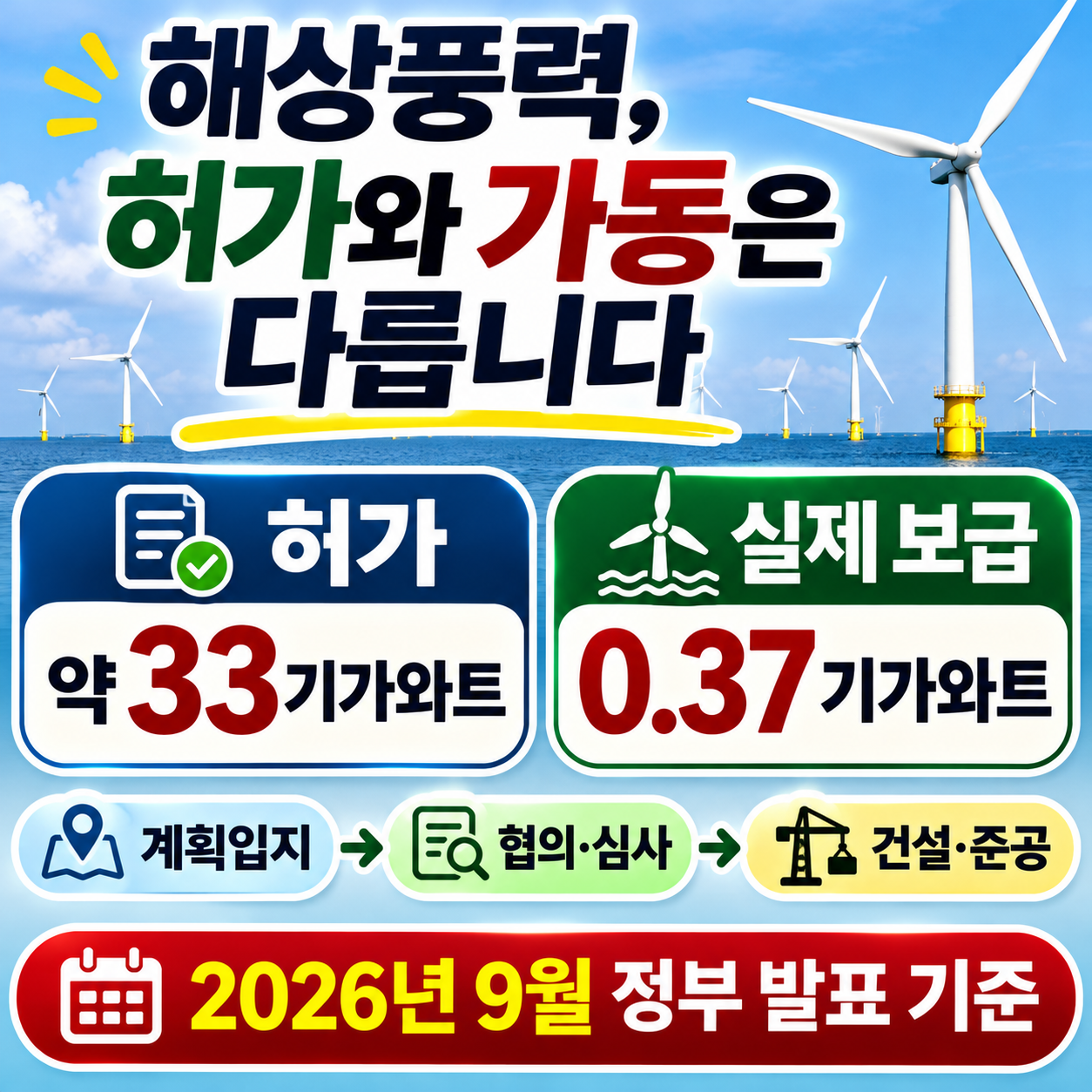
2026년 9월 정부 발표에 제시된 해상풍력 허가와 실제 보급 규모. 지정 GPTs로 제작한 인공지능 설명 이미지이며 실제 현장 사진이 아닙니다.
만인의 탑 편집국
정부가 입지를 먼저 찾는 계획입지 체계가 가동됐다. 예비지구 지정, 발전지구 확정, 실제 준공은 다른 단계이며 주민 이익공유도 개별 조건을 확인해야 한다.
해상풍력의 핵심 변화는 바다에 풍력발전기를 더 세우겠다는 목표만이 아니다. 민간사업자가 입지를 찾고 각종 협의에 나서던 방식에서, 정부가 입지의 조건을 먼저 살피고 지방정부와 주민 협의를 진행한 뒤 사업자를 고르는 체계로 옮겨가는 것이다. 발전사업자에게는 일정의 예측 가능성, 어민과 연안 주민에게는 사업 초기에 의견을 반영할 수 있는지가 중요해졌다.
25기가와트, 같은 숫자라도 뜻이 다르다
국무조정실이 2026년 9월 2일 제1회 해상풍력발전위원회 개최와 함께 낸 자료는 2031년까지 25기가와트 규모의 예비지구 지정을 추진한다고 밝혔다. 같은 자료의 2035년 25기가와트는 누적 보급 목표다. 앞의 숫자는 후보 입지의 규모이고, 뒤의 숫자는 실제 설비 보급을 겨냥한다. 두 숫자를 같은 실적으로 합산하면 안 된다. 정부 발표와 원문 첨부
발표 당시 누적 허가 물량은 약 33기가와트, 실제 보급은 0.37기가와트였다. 이 수치는 허가와 가동 사이의 차이를 보여 주는 9월 발표 기준이다. 과거의 0.12기가와트 안팎 수치를 오늘의 보급 현황처럼 쓰거나, 허가 물량 전체를 이미 발전 중인 설비로 계산해서는 안 된다.
정부 계획에는 2030년 10.5기가와트 ‘준·착공’과 누적 보급 전망 3.1기가와트도 함께 나온다. 공사를 시작한 사업과 완공된 사업을 묶은 준·착공 목표는 전기를 생산하는 완공 설비만을 뜻하지 않는다. 계획입지로 추진되는 물량의 보급 시작 시점도 ‘빠르면 2033년’이라는 전망이며 확정 준공일이 아니다.
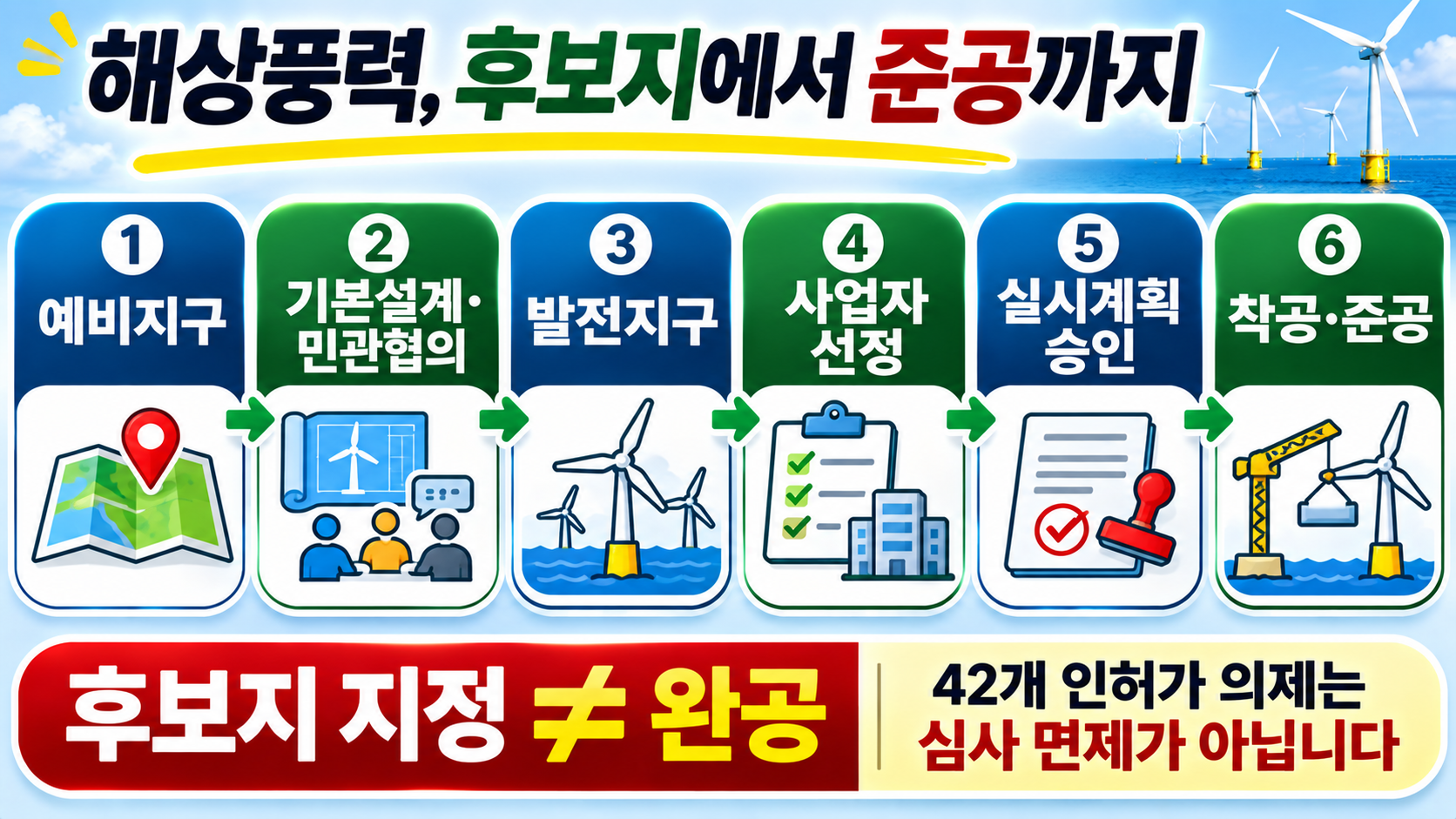
계획입지의 단계와 실제 건설·준공은 구분한다. 지정 GPTs로 제작한 인공지능 설명 이미지이며 실제 현장 사진이 아닙니다.
후보 바다에서 발전소까지, 단계별로 남는 질문
계획입지는 예비지구 지정에서 끝나지 않는다. 정부가 풍황, 환경, 어업활동, 해상교통과 군사작전 정보를 검토하고, 기본설계와 지역 협의를 거쳐 발전지구를 정한다. 이후 사업자 선정과 실시계획 승인, 공사와 준공 단계가 이어진다.
단계
독자가 구분할 내용
예비지구 지정
검토할 해역의 범위가 어디인지
기본설계·민관협의
발전기 배치, 전력망 연결, 조업·주민 영향이 어떻게 반영되는지
발전지구 지정
어떤 조건으로 개발 지구가 확정됐는지
사업자 선정
수행 능력과 비용, 환경·상생 계획을 어떻게 평가했는지
실시계획 승인
실제 설계와 필요한 협의·평가가 갖춰졌는지
착공·준공
계획한 설비가 실제로 건설되고 운영 단계에 들어갔는지
이 표는 각 단계에서 문서를 읽을 때 살필 질문을 정리한 것이다. 후보 지역으로 거론됐다는 소식만으로 발전지구 지정이나 주민 보상 확정을 판단하지 않아야 한다. 공식 고시의 날짜, 해역 경계, 사업 단계가 출발점이다.
인허가 ‘의제’는 검토가 모두 사라진다는 뜻이 아니다
정부는 28개 법률의 42개 인허가 사항을 집중 처리하는 방안을 설명한다. 법 제27조의 ‘의제’란 정해진 실시계획 승인 등을 받았을 때 열거된 인허가도 받은 것으로 보는 법적 처리다. 개별 절차를 각각 반복하는 부담을 줄이는 장치이지 어떤 해역이든 심사 없이 개발할 수 있다는 뜻은 아니다. 해상풍력법 제27조
실시계획 승인을 신청하는 사업자는 법 제26조에 따른 환경성평가를 하고 평가서를 제출해야 한다. 해양수산부와의 협의 절차도 규정돼 있다. 환경성 검토 특례를 ‘환경평가가 완전히 면제됐다’고 해석하면 실제 절차를 놓치게 된다. 해상풍력법 현행 본문
정부가 절차 집중 처리의 시간을 제시하더라도 입지 조사부터 발전소 준공까지 전 과정이 그 기간 안에 끝난다는 뜻은 아니다. 설비 발주, 시공, 전력망 연결과 지역 협의는 따로 살펴야 한다. 비용이 줄 것이라는 정부 기대와 특정 사업의 실제 공사비·전력 판매가격이 확정됐다는 사실도 구분해야 한다.
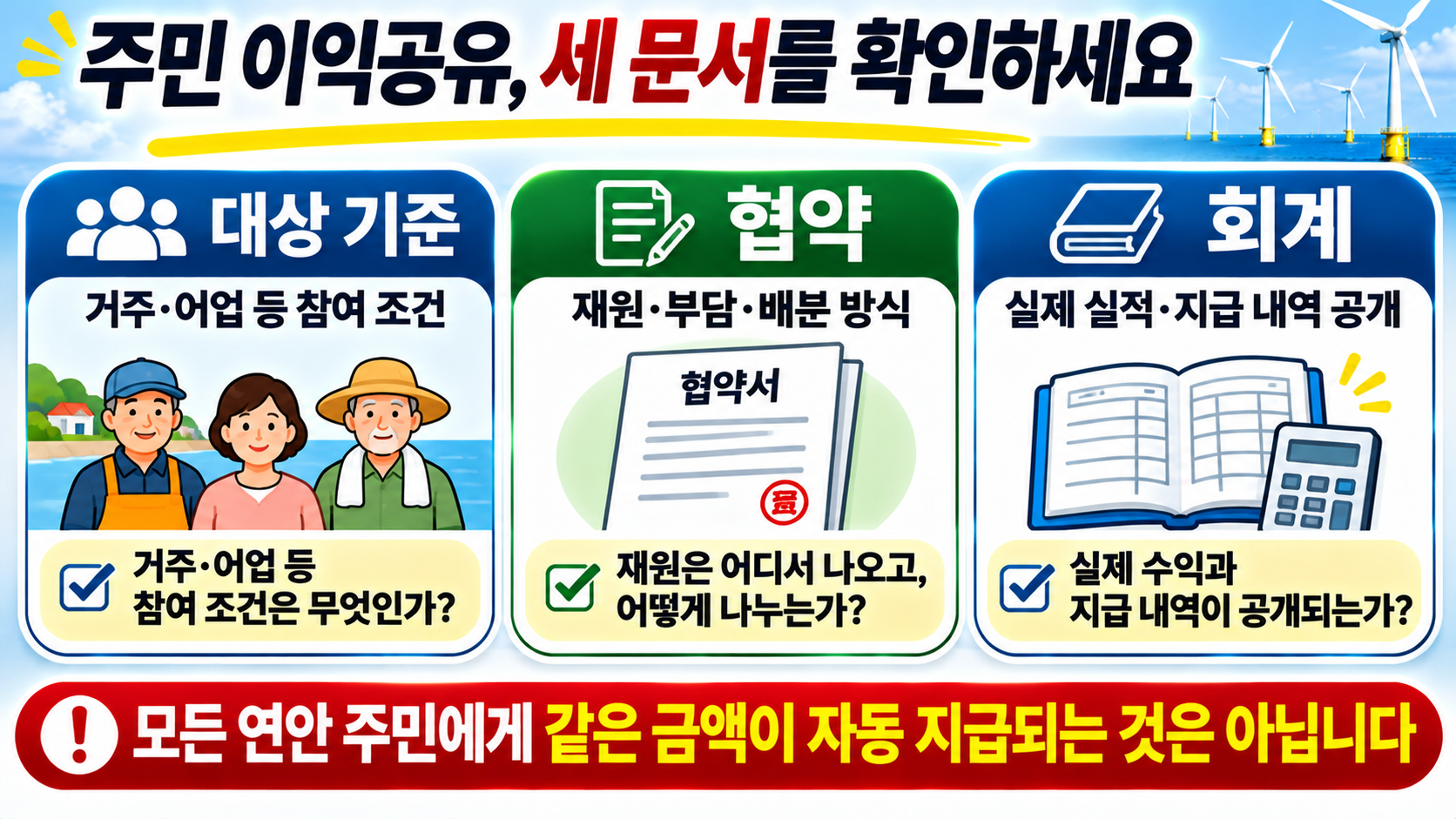
주민 이익공유는 대상·협약·회계 문서를 확인해야 한다. 지정 GPTs로 제작한 인공지능 설명 이미지이며 실제 현장 사진이 아닙니다.
어민뿐 아니라 송전선로 경과지 주민도 협의 대상
법 제17조의 민관협의회에는 어업인단체, 주민대표, 관계 전문가와 송전선로가 지나는 지역의 주민대표 등 이해관계자가 참여한다. 협의 대상에는 기본설계안, 발전지구 지정·변경·해제, 주민참여 이익공유 사업, 수산업과 지역경제 활성화가 포함된다.
따라서 설명회가 열렸는지만 확인할 일은 아니다. 자신이 사는 곳이나 조업하는 해역이 논의에 포함되는지, 대표가 어떤 방식으로 정해졌는지, 제시한 의견이 기본설계와 협의 결과에 어떻게 남았는지를 확인할 필요가 있다. 해상 설비와 육상 송전선로의 영향도 따로 기록해야 한다.
협의가 원활하지 않을 때의 분쟁조정 절차도 법과 시행령에 마련돼 있다. 시행령 제14조는 지자체장의 조정 신청, 위원회의 조정안 권고, 민관협의회의 재협의와 동의 여부 통보 절차를 정한다. 원칙적인 조정안 작성 기한은 신청서를 받은 날부터 45일이며 부득이한 사정에 따른 연장이 가능하다. 권고를 받은 지자체장은 다시 협의하고 30일 안에 동의 여부를 알려야 한다. 권고가 곧 모든 당사자의 합의라는 뜻은 아니다. 현행 시행령
‘바람연금’ 약속을 볼 때는 재원과 대상부터
주민참여 이익공유의 제도적 근거가 있다는 사실만으로 모든 해안 주민에게 같은 금액이 지급되는 것은 아니다. 참여 자격, 사업별 약정, 투자 방식, 발전 수입과 비용 등 실제 조건을 확인해야 한다. 다른 지역의 과거 배당 실적을 자신의 확정 수입으로 옮겨 계산해서도 안 된다.
주민이 검토할 문서는 세 가지로 나눌 수 있다. 첫째는 자신의 거주·어업활동이 대상에 들어가는지 정한 기준이다. 둘째는 돈을 누가 내고 어떤 기준으로 나누는지 적은 협약과 사업 구조다. 셋째는 지급 실적과 회계 공개 자료다. 손실 보상, 주변지역 지원, 투자 참여에 따른 수익은 성격이 다르므로 한 항목으로 섞지 않는 편이 좋다.
특히 ‘연금’이라는 이름만 보고 원금이나 수익이 보장되는 금융상품으로 이해해서는 안 된다. 투자 참여가 필요한 사업이라면 납입액, 차입 여부, 지급 순서와 사업 지연 시 처리까지 확인해야 한다. 이는 개별 사업 참여를 권하는 내용이 아니라 계약을 읽을 때 살필 항목이다.
기존 사업은 허가 시점과 편입 조건을 나눠 봐야
특별법에는 기존 사업자를 위한 경과조치와 편입 경로가 있다. 따라서 새 체계가 생겼다는 이유만으로 모든 기존 사업권이 자동 취소된다고 말할 수 없다. 기존 허가의 시점·조건과 특별법 편입 요건을 각 사업별로 검토해야 한다. 정부도 제도 편입을 희망하는 사업자가 일정 요건을 충족할 경우 지원하는 방향을 발표했다.
신규 풍황계측기와 신규 발전사업허가는 시행 시점도 다르다. 법 제33조제2항의 계측기 관련 제한은 2025년 3월 25일부터, 제1항의 예비지구·발전지구 밖 신규 전기사업 허가 제한은 2028년 3월 26일부터 적용하도록 정했다. 계측기 조항에는 해상풍력발전사업자가 발전지구에 설치하는 경우의 예외가 있다. 원래 허가가 있다는 사실과 새 신청을 할 수 있다는 판단을 혼동하지 않아야 한다.
계획입지의 성과는 발표된 용량만으로 평가하기 어렵다. 지정 고시, 협의 결과, 환경성평가, 사업자 선정과 실제 준공을 이어서 확인해야 한다. 주민에게는 구체적인 참여 조건이 공개되는지, 전기 소비자에게는 비용 절감이 실제 공급가격과 요금에 어떻게 반영되는지가 후속 점검 대상이다. 제도 도입만으로 당장 전기요금이 내려간다고 단정할 단계는 아니다.
자료 확인: 2026년 11월 20일. 보급 현황과 일정은 인용한 정부 발표의 기준일·계획을 구분했다. 개별 지구의 최신 지정 여부나 특정 주민의 보상·배당을 확정하는 기사가 아니다.
Offshore wind's “42 deemed approvals”: what changes, and what still needs scrutiny?
Offshore-wind licensing and installed capacity reported by the government in September 2026. AI editorial illustration created with the designated GPT; not a photograph of an actual event.
MANINTOP Newsroom
Government-led site planning is under way. Designating a preliminary zone, confirming a development zone and completing a wind farm are different milestones. Community benefit sharing also depends on specific conditions.
The central change in offshore wind is not simply a larger installation target. The system moves from individual developers finding sites and pursuing consultations to government examining sites first, working with local authorities on community consultation and then selecting developers. Predictability matters to developers; early influence over decisions matters to fishers and coastal residents.
The same 25-gigawatt figure can describe different things
The September 2, 2026 government announcement accompanying the first Offshore Wind Power Committee meeting proposed preliminary zones representing 25 gigawatts by 2031. Its 25-gigawatt figure for 2035 is a cumulative deployment target. One concerns candidate sites; the other concerns installed capacity. They cannot be added together as completed output. Government announcement and attachment
The announcement reported approximately 33 gigawatts of licensed projects and 0.37 gigawatts actually deployed. Those are September figures illustrating the gap between licensing and operation. An older figure of roughly 0.12 gigawatts should not be presented as today's deployment total, nor should the entire licensed pipeline be described as operating capacity.
The government's plans also contain a 2030 figure of 10.5 gigawatts for completed projects and construction starts combined, alongside a 3.1-gigawatt cumulative deployment forecast. A measure including construction starts does not count only completed facilities producing electricity. Deployment from planned-site projects was envisaged from 2033 at the earliest; that is a forecast, not a guaranteed completion date.
Distinguish planned-site procedures from construction and completion. AI editorial illustration created with the designated GPT; not a photograph of an actual event.
From candidate waters to a wind farm: questions at each stage
The process does not end with a preliminary-zone designation. Government examines wind conditions, environmental factors, fisheries, maritime traffic and military operations; basic design and local consultation precede development-zone designation. Developer selection, implementation-plan approval, construction and completion follow.
Stage
What readers should distinguish
Preliminary-zone designation
The boundaries of the waters under consideration
Basic design and public-private consultation
Turbine layout, grid connection and fishing and resident impacts
Development-zone designation
The conditions attached to the confirmed development area
Developer selection
Assessment of capability, costs, environmental measures and community plans
Implementation-plan approval
Completion of actual design and required consultations and assessments
Construction and completion
Whether planned facilities have actually been built and entered operation
These are questions to ask when reading the documents at each stage. Being mentioned as a candidate location does not establish development-zone designation or confirmed compensation. Start with the date of the official notice, maritime boundaries and project stage.
Deemed approvals do not eliminate every review
Government describes coordinated handling of 42 approval matters under 28 statutes. Under Article 27, specified implementation-plan approval and related actions have the legal effect of granting listed permissions. This reduces repetitive procedures; it does not authorize development in any waters without review. Article 27
Developers seeking implementation-plan approval must conduct an environmental assessment and submit a report under Article 26. Consultation with the Ministry of Oceans and Fisheries is also prescribed. Treating the special assessment procedure as a complete environmental-review exemption misrepresents the process. Current Act
A government timetable for coordinated processing is not a promise that everything from site investigation to wind-farm completion will finish within that period. Equipment procurement, construction, grid connection and local consultation still require scrutiny. Expected cost reductions are also different from confirmed construction costs or electricity-sale prices for a particular project.
Check eligibility, agreements and accounting documents for community benefit sharing. AI editorial illustration created with the designated GPT; not a photograph of an actual event.
Consultation includes transmission-route residents as well as fishers
Article 17 provides for a public-private consultative body involving fishing organizations, resident representatives, experts and representatives of communities along transmission routes. Its subjects include basic design; designation, modification or cancellation of development zones; community participation and benefit-sharing arrangements; and fisheries and local economic development.
Holding a presentation is therefore not the only test. Residents and fishers should check whether their homes or fishing grounds are represented, how representatives were selected and how their comments appear in the design and consultation outcomes. Impacts from offshore facilities and onshore transmission routes should be recorded separately.
The Act and its Enforcement Decree also provide dispute-adjustment procedures. Article 14 of the Decree addresses applications by local government heads, committee recommendations, renewed consultation and notification of agreement. In principle, the committee has 45 days after receipt to prepare a recommendation, subject to extension for unavoidable circumstances. The recipient local authority must reconvene consultation and report agreement or disagreement within 30 days. A recommendation is not itself unanimous agreement. Current Enforcement Decree
A “wind pension” promise requires checking funding and eligibility
A legal basis for community participation does not guarantee the same payment to every coastal resident. Eligibility, project agreements, investment structures, generation revenue and costs must be checked. Historical distributions elsewhere cannot be treated as an individual's guaranteed future income.
Residents can separate the documents into three groups: eligibility rules relating to residence or fishing activity; agreements and structures specifying who contributes and how money is distributed; and payment records and financial disclosures. Compensation for losses, support for surrounding communities and investment returns are different categories.
The label “pension” does not by itself imply guaranteed principal or returns. Where participation requires investment, examine contributions, borrowing, payment priority and arrangements for project delays. These are contract-reading questions, not a recommendation to invest in a particular scheme.
Existing projects require separate checks on permits and transition conditions
The special Act contains transitional provisions and routes for existing developers to enter the new framework. It is therefore inaccurate to say that all existing project rights are automatically cancelled. Each project's permit date and conditions, as well as eligibility for transition, require examination. Government has also announced support for developers wishing to enter the framework when specified requirements are met.
Restrictions on new wind-measuring equipment and new generation permits have different effective dates. The equipment-related restriction in Article 33(2) applies from March 25, 2025; Article 33(1)'s restriction on new electricity-business permits outside preliminary and development zones applies from March 26, 2028. The equipment provision includes an exception for an offshore-wind developer installing equipment in a development zone. Holding an existing permit and being entitled to make a new application are different questions.
Planned siting cannot be judged solely by announced capacity. Follow designation notices, consultation outcomes, environmental assessments, developer selection and actual completion. Residents need transparent participation conditions; electricity customers need evidence of how cost savings reach supply prices and tariffs. Introducing the system alone does not establish an immediate reduction in household electricity bills.
Information checked November 20, 2026. Deployment figures and schedules retain the dates and status of the cited government announcement. This article does not certify the latest designation of an individual zone or any resident's compensation or distribution entitlement.
PRO SOURCING ENGINE만인의 탑 빅데이터 솔루션
★ 가입 시 600 크레딧(120회) 전원 무료
내가 찾는 상품 키워드, 지금 얼마나 검색될까?
네이버 월간 검색량 + 구글 볼륨 + 아이템스카우트 실시간 상품수와 경쟁강도 배지를 0.5초 만에 무료로 확인하세요.
MANINTOP NEWSLETTER
📬 만인의 탑 뉴스레터 무료 구독
오늘 보신 정책·시사 뉴스가 유익하셨나요? 매일 엄선되는 알짜 복지 혜택과 국회 실시간 속보를 이메일로 가장 먼저 받아보세요. (평생 무료)
1월이 시작되면 감기는 이미 우리 곁에 와 있습니다. 2월, 3월, 4월까지 이어지는 추위와 건조함은 코와 목을 가장 먼저 공격합니다. 아침에 일어나자마자 막혀 있는 코. 계속 흐르는 콧물. 괜히 칼칼해지는 목. 이 증상은 “시작”일 뿐입니다. 한 번 무너지면 일주일, 길면 한 달까지 끌고 갑니다. 약을 먹으면 잠깐 괜찮아집니다. 하지만 며칠 뒤 또 반복됩니다. 왜일까요? 감기는 ‘치료’의 문제가 아니라 ‘관리’의 문제이기 때문입니다. 대부분은 감기가 오고 나서 약을 찾습니다. 하지만 진짜 중요한 건 감기가 오기 전에 코와 목을 지키는 것입니다. 건조한 실내 공기, 차가운 바깥 공기, 눈에 보이지 않는 세균. 코와 목은 매일 공격받고 있습니다. 지긋지긋하죠! 그런데도 우리는 아무 준비 없이 버티고 있습니다. 이번 겨울도 그렇게 보낼 건가요? 사실 방법은 어렵지 않습니다. 코를 깨끗하게 관리하고, 목을 따뜻하게 보호하고, 점막을 촉촉하게 유지하고, 기관지를 미리 관리하고, 외부 공기를 차단하는 것. 이 다섯 가지만 꾸준히 해도 감기약 없이 겨울을 보내는 것이 충분히 가능합니다. 🔥 이제부터 그 방법을 하나씩 살펴보겠습니다. 🔥 1. 코와 목을 먼저 관리해야 하는 과학적 이유 감기의 대부분은 코 점막에서 시작됩니다. 국제 학술지 Nature Reviews Microbiology 와 Journal of Allergy and Clinical Immunology 에 실린 호흡기 감염 관련 연구들에서는, 감기 바이러스가 비강 상피세포에 먼저 부착해 증식한다는 점을 설명하고 ...
리모델링사업이 진행 중인 아파트를 매매할 때 “계약금 10%를 언제까지 내야 하느냐”는 질문이 특히 많이 나옵니다. 이주공고(이주 안내)가 7~11월쯤이라고 들으면, 그 시점에 맞춰 계약금도 움직일 것 같아서 더 헷갈리기 쉽습니다. 하지만 실제 납부기한은 ‘이주공고가 언제냐’만으로 자동 결정되지 않는 경우가 많습니다. 1) 계약금 10% 납부기한: 결국 ‘문서에 적힌 일정’이 기준 계약금 10%를 언제까지 납부해야 하는지는, 내가 서명하는 매매계약서(특약 포함) 와 사업주체/조합이 제시한 공고·안내문 에 적힌 납부 일정이 기준이 됩니다. 실제 공고문에서는 분양대금 납부의 큰 틀(계약금→중도금→잔금)을 먼저 안내하고, 상세 일정은 별도 표나 유의사항으로 제시하는 방식이 흔합니다. 또, 계약서 문구에 따라 지급 시점이 조건부로 설정될 수도 있습니다. 예를 들어 한 사례 소개 자료에서는 용역계약서에 잔금(10%) 지급시기가 “사업승인 후”로 기재되어 있었다는 점이 언급됩니다. 이런 식으로 ‘사업 단계’와 지급을 연동하는 문구가 들어가면, 질문의 답은 계약서 문구를 확인해야만 확정됩니다. 관련 내용은 링크 에서 문구 사례를 확인할 수 있습니다. 2) 입주자모집공고에서 확인되는 ‘납부 순서’와 잔금 마감 시점 공고문에 적힌 문구를 보면, 납부 순서와 잔금 마감에 대한 기준이 비교적 명확하게 제시되는 경우가 있습니다. 예를 들어 한 입주자모집공고에는 “분양금액(주택가격)은 계약금, 중도금, 잔금의 순서로 납부”하며 “잔금은 입주(열쇠 수령일) 전에 완납”해야 한다고 안내되어 있습니다. (문구 확인: 링크 ) 이 문구가 의미하는 바는 최소 2가지입니다. 분양/공급 형태의 문서에서는 ‘계약금→중도금→잔금’ 흐름이 공식적으로 안내될 수 있습니다. 잔금은 “입주(열쇠 수령)” 이전에 완납해야 한다는 마감 기준이 문서에 적혀 있을 수 있습니다. 다만, 위 공고문 문구는 잔금 마감에 대한 기준을 보여주지만, 계약금 10%의...
윤석열 전 대통령 탄핵 인용 소식을 접하면, 가장 궁금한 지점은 ‘헌재가 정확히 무엇을 위헌·위법으로 봤는가’입니다. 또한 탄핵과 별개로 진행되는 형사재판(내란 우두머리 혐의 등)이 어디까지 왔는지도 함께 정리할 필요가 있습니다. 아래 내용은 제공된 기사/게시물 스니펫과 링크에서 확인되는 범위만 모아, 일반인이 흐름을 이해하기 쉽게 정리한 것입니다. 1) 탄핵 인용 관련: 스니펫에서 확인되는 ‘판단의 골격’ 제공된 근거 중 조국혁신당 사이트에는 헌법재판소가 윤석열 탄핵 심판에서 “피청구인의 위헌·위법행위는 국민 신임 …”이라는 취지로 판단했다는 문장이 인용돼 있습니다( 링크 ). 이 인용문만 놓고 보면, ‘위헌·위법행위’가 있었는지와 그로 인해 ‘국민의 신임’이 어떻게 평가됐는지가 핵심 축으로 소개됩니다. 다만 질문에서 요청하신 세부 항목, 즉 비상계엄 선포 자체를 문제 삼은 구체적 이유, 계엄 이후 조치(포고령, 국회 통제 등)의 어떤 지점이 헌법 위반인지, 국회의 권한행사 방해 및 정치활동 제약을 어떤 논리로 판단했는지 등은, 이번에 제공된 근거의 제목/스니펫만으로는 조항·사실관계·판단 구조가 그대로 제시돼 있지 않습니다. 따라서 이 글에서는 ‘헌재가 무엇을 문제 삼았다’는 세부 리스트를 단정적으로 재구성하기보다, 현재 확인 가능한 문구 수준의 요약(위헌·위법행위 → 국민 신임의 문제로 평가)까지만 적습니다. 만약 헌재 결정문 전문(주문 및 이유)이 추가로 확인되면, 그때는 문장 단위로 ‘어떤 행위’와 ‘어떤 헌법 원리/조항’이 연결되는지(예: 권력분립, 국회의 권한, 정치적 기본권 등) 구조화해 정리하는 것이 가장 정확합니다. 2) 형사 절차(내란 혐의) 관련: 체포영장과 1심 선고 언급 탄핵 심판과 별도로, 12·3 비상계엄 사태로 내란 혐의를 받는 윤석열 대통령에 대해 2024년 12월 31일 체포 영장이 발부됐다는 BBC 보도가 있습니다( 링크 ). 해당 보도는 ‘현직 대통령’에 대한 체포영장 발부라는 점을 함께 언급합니다. 또...