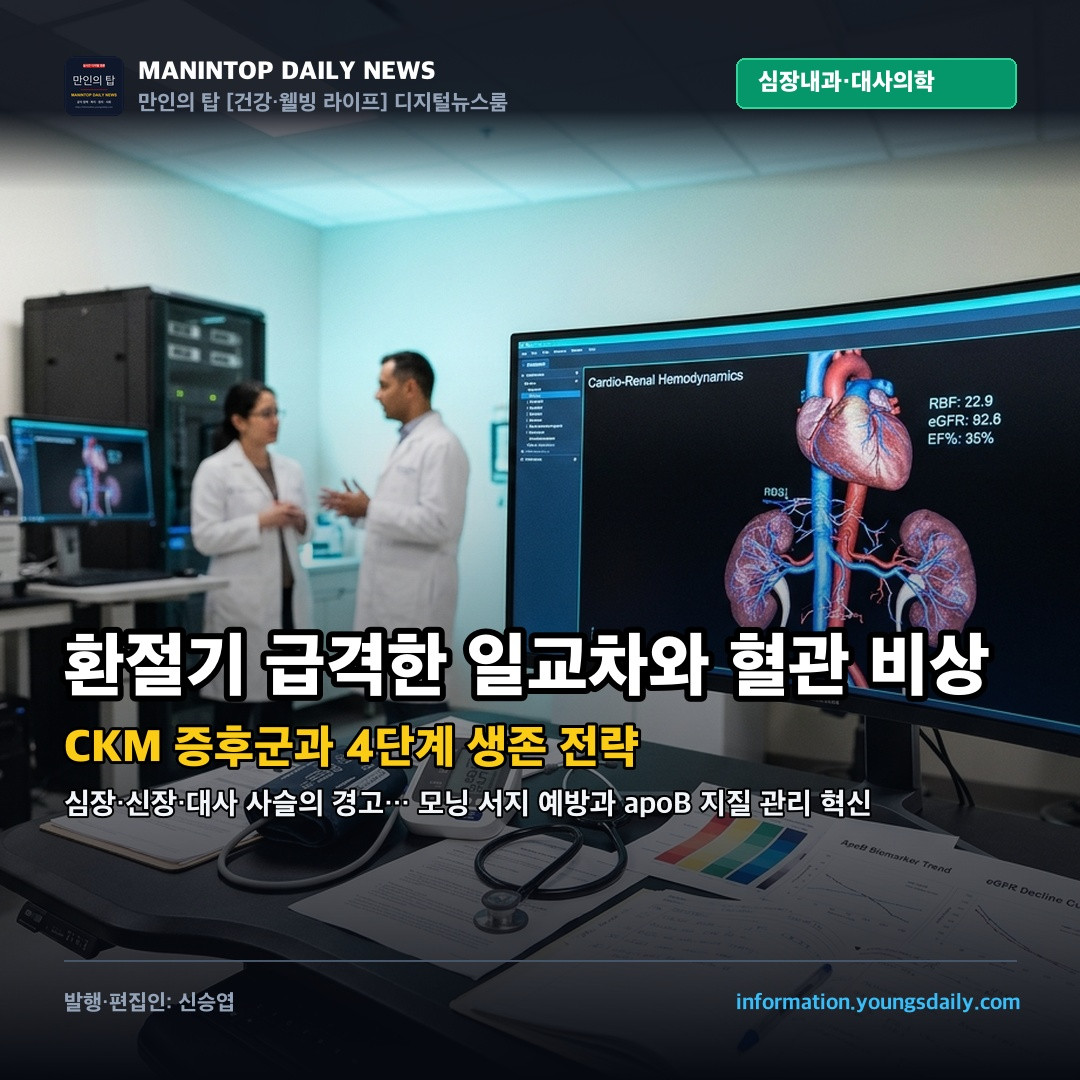
▲ 심혈관·신장·대사(CKM) 질환의 상호작용을 보여주는 정밀 임상 워크스테이션과 모닝 서지 혈압 모니터링 환경 (사진=만인의 탑 에디토리얼 DB / CDN 배포)
더욱이 최근 의학계에서는 심혈관 질환을 단순히 심장 하나의 고립된 문제가 아니라, 비만, 제2형 당뇨병, 만성콩팥병(CKD)과 한 몸처럼 얽혀 있는 'CKM(Cardiovascular-Kidney-Metabolic, 심혈관-신장-대사) 증후군'의 거대한 연속 병태생리로 규정하고 있습니다. 환절기 돌연사를 부르는 '모닝 서지(Morning Surge)'의 위험 기전부터 4050 세대 대사증후군 급증 실태, 미국심장협회(AHA) 공인 CKM 4단계 병기, 그리고 기존 LDL을 넘어 혈관 파괴 입자를 직접 계측하는 apoB 지질 관리 혁신까지 심층 분석합니다.
📌 핵심 요약 (Key Takeaways)
- 환절기 일교차와 혈관 쇼크: 하루 기온 차가 8~10℃ 구간일 때 심근경색 발생 위험이 최고조에 달함. 교감신경 흥분과 노르에피네프린 분비로 취약 죽상경화반 파열 및 급성 혈전 형성 유발.
- 기상 후 3시간 '모닝 서지': 수면 중 안정되었던 혈압이 기상 직후 찬 공기와 활동으로 급상승. 가정혈압 기준 135/85 mmHg 이상 지속 시 즉각적인 재평가 필요. 흉통이 10~20분 이상 지속되면 즉시 119 이송 필수.
- 4050 대사증후군 급증: 국민건강보험공단 2024 통계연보 기준 50대 남성 유병률 30.6% 폭등. 높은 혈압이 최다 요인이며, 3~5% 체중 감량만으로도 인슐린 저항성과 대사 위험요인 동시 개선 가능.
- 미국심장협회(AHA) 공인 CKM 증후군 5단계: Stage 0(건강)부터 Stage 1(비만/대사이상 초기), Stage 2(고혈압·당뇨·CKD 복합), Stage 3(무증상 심혈관 손상), Stage 4(임상 발병)까지 연속체 관리.
- 만성콩팥병(CKD) 침묵의 위협: 국내 성인 13.8%(7명 중 1명)가 앓고 있으나 환자의 90%가 인지하지 못함. 사구체여과율(eGFR)과 소변 알부민-크레아티닌 비율(uACR) 2대 선별검사 필수.
- 치료 패러다임 전환과 apoB 지질 혁신: 단순 혈당 강하를 넘어 심장·신장을 동시 보호하는 SGLT2i 및 GLP-1RA 조기 도입. 지질의 질량이 아닌 입자 개수를 직접 세는 아포지단백질 B(apoB) 검사로 잔여 동맥경화 위험 원천 차단.
1. 환절기 심혈관계 위협의 병태생리와 '모닝 서지' 기전
환절기와 겨울철의 급격한 기온 강하는 인체의 자율신경계와 순환기 체계에 극심한 물리적·생리적 스트레스를 부과합니다. 찬 공기에 노출되는 순간 피부 표면의 혈관이 체온 누출을 막기 위해 급격히 수축하며, 교감신경계가 자극되어 노르에피네프린과 에피네프린 등 카테콜아민 계열의 스트레스 호르몬이 과다 분비됩니다. 이는 혈관 저항성을 급격히 끌어올려 혈압을 상승시키고 심박수를 빠르게 만들어 심근의 산소 요구량을 폭발적으로 증가시킵니다.
주목할 점은 건강한 혈관이 단지 기온 변화만으로 순식간에 막히지는 않는다는 사실입니다. 심장내과 전문의들의 공통된 지적에 따르면, 기저에 이미 관상동맥 내벽에 누적되어 있던 '취약한 죽상경화반(Vulnerable Plaque)'이 물리적 파동을 견디지 못하고 파열되는 것이 급성 심근경색의 직접적인 뇌관입니다. 혈압 급상승으로 인해 지방질 병변의 섬유성 피막이 찢어지면, 혈관 내막이 노출되면서 혈소판이 전광석화처럼 응집하여 거대한 혈전(피떡)을 형성하고, 이것이 관상동맥을 100% 폐색시켜 심장근육 괴사를 일으킵니다.
계절별 인구 10만 명당 심근경색 발생률 (건보공단-기상청 10개년 연계 분석)
- 봄 (환절기 극심): 10만 명당 63.1명 (3월 연간 최다 피크 기록)
- 겨울 (혹한기): 10만 명당 61.3명 (12월 지속적 한파 피크 기록)
- 가을 (초겨울 진입): 10만 명당 59.5명 (일교차 8~10℃ 이상 벌어지는 시기 집중)
- 여름 (상대적 안정): 10만 명당 57.1명 (연간 최저 수준 기록)
연구진의 정밀 분석에 따르면, 절대적인 기온 수치보다 더 위험한 요인은 바로 '하루 일교차가 8~10℃ 이상 벌어지는 환경'입니다. 자율신경계 조절 능력이 저하된 고령층, 고혈압 환자, 기저 심혈관 질환자는 급격한 온도 격차에 즉각 대응하지 못해 혈관 수축과 혈압 불안정이 극대화됩니다.
특히 수면 중 부교감신경 우위로 안정되었던 혈압이 기상과 동시에 교감신경 항진으로 치솟는 '모닝 서지(Morning Surge)'는 돌연사의 주범입니다. 하루 중 심근경색과 뇌졸중의 약 절반 이상이 기상 후 3시간 이내에 집중됩니다. 가정혈압 측정 시 아침 혈압이 지속적으로 135/85 mmHg 이상으로 측정된다면 모닝 서지 고위험 신호이므로 즉시 주치의와 혈압약 복용 시점 및 용량을 재조정해야 합니다. 만약 가슴 중앙부를 쥐어짜거나 짓누르는 통증이 10~20분 이상 이어지며 식은땀, 호흡곤란, 턱·어깨 방사통이 동반된다면 일체 지체 없이 119에 연락해 권역심뇌혈관센터로 이송되어야 합니다.
2. 4050 세대 대사증후군 유병률 급증과 연쇄 합병증
대한민국이 65세 이상 고령 인구 비율 20%를 넘어서며 초고령사회에 안착한 가운데, 국가 경제의 중심축인 40대와 50대 중장년층의 대사 지표는 심각한 경고음을 울리고 있습니다. 국민건강보험공단이 발표한 '2024 건강검진 통계연보'에 따르면 40대와 50대의 대사증후군 유병률이 가파른 우상향 곡선을 그리고 있습니다.
- 40대 전체 유병률: 2020년 16.7% ➔ 2024년 18.9% (2.2%p 증가)
- 50대 전체 유병률: 2020년 21.2% ➔ 2024년 24.8% (3.6%p 증가)
- 50대 남성 유병률: 2020년 25.6% ➔ 2024년 30.6% (5.0%p 폭등, 10명 중 3명 이상 유병)
대사증후군은 복부비만(허리둘레 남성 90cm, 여성 85cm 이상), 높은 혈압(130/85 mmHg 이상 또는 약물 복용), 높은 공복혈당(100 mg/dL 이상 또는 약물 복용), 높은 중성지방(150 mg/dL 이상), 낮은 HDL 콜레스테롤(남성 40 mg/dL, 여성 50 mg/dL 미만) 등 5가지 위험요인 중 3가지 이상을 충족하는 상태를 의미합니다. 통계상 4050 세대에서 가장 높은 비율로 발견되는 위험요인은 단연 '높은 혈압'이었으며, 그 뒤를 공복혈당 상승과 복부비만이 뒤따랐습니다.
대사증후군이 치명적인 이유는 인슐린 저항성과 전신성 만성 미세염증을 촉발하기 때문입니다. 대사증후군 보유자는 정상인 대비 제2형 당뇨병 발병 위험이 무려 5배, 심혈관계 질환 발병 위험이 1.5~3배 치솟으며, 대사기능장애 관련 지방간염(MASLD), 만성콩팥병(CKD), 각종 암 발생률까지 동반 상승합니다. 하지만 과체중 환자가 본인 체중의 단 3~5%만 감량해도 내장지방이 대폭 줄어들며 5대 대사 지표가 동시에 정상화되는 강력한 가역적 회복력을 발휘할 수 있습니다.

▲ 대학병원 심장내과 및 내분비대사내과 전문의가 관상동맥 CT와 신장 eGFR 지표를 종합 분석하며 환자 맞춤형 치료를 상담하고 있다 (사진=만인의 탑 에디토리얼 DB / CDN 배포)
3. CKM(심혈관·신장·대사) 증후군의 개념과 Stage 0~4 연속체
미국심장협회(AHA)가 2023년 정립한 CKM(Cardiovascular-Kidney-Metabolic) 증후군은 심장, 콩팥, 췌장 및 지방 조직의 질환을 개별 진료과의 분절된 문제가 아닌 하나의 유기적 사슬로 파악하는 21세기 최신 통합 의학 모델입니다. 심혈관계(Cardiovascular), 신장계(Kidney), 대사계(Metabolic)는 신경호르몬 축과 체액 조절, 혈관 내피세포 기능을 통해 끊임없이 상호작용하므로, 어느 한 장기가 무너지면 도미노처럼 다른 장기로 손상이 파급됩니다.
| CKM 병기 | 임상적 정의 및 병태생리 상태 | 핵심 치료 목표 및 개입 전략 |
|---|---|---|
| Stage 0 | CKM 관련 위험인자가 전혀 없는 완전한 정상 상태 | 원발성 예방, 이상적인 생활습관 유지 |
| Stage 1 | 과체중 또는 비만, 복부비만, 초기 공복혈당 장애 | 체중 3~5% 이상 감량, 영양·운동 집중 치료 |
| Stage 2 | 고혈압, 제2형 당뇨병, 고중성지방혈증, 초기 만성콩팥병(CKD) | 혈압·혈당 엄격 조절, 신장·심장 보호 약물 조기 투여 |
| Stage 3 | 무증상 심혈관 손상(관상동맥 칼슘화, 좌심실 비대) 또는 중등도-중증 CKD | 표적장기 손상 차단, SGLT2i/GLP-1RA 적극 병용 |
| Stage 4 | 임상적 심혈관질환(심근경색, 협심증, 심부전, 뇌졸중, 말기신부전) 발병 | 다학제 집중 심장-신장 통합 치료, 재발 방지 |
여기서 가장 경계해야 할 핵심 장기는 바로 만성콩팥병(CKD)입니다. 신장은 사구체 여과 기능이 50% 이상 망가질 때까지 환자가 자각할 수 있는 통증이나 이상 증상이 거의 없는 대표적인 침묵의 장기입니다. 대한신장학회에 따르면 국내 성인 7명 중 1명(13.8%)이 만성신장질환을 앓고 있지만, 환자의 무려 90%가 본인의 신장이 망가지고 있다는 사실조차 인지하지 못한 채 방치하고 있습니다. 따라서 CKM 증후군 예방을 위해서는 혈액 검사를 통한 eGFR(추정 사구체여과율, 60 mL/min/1.73m² 미만 시 의심)과 소변 검사를 통한 uACR(소변 알부민 대 크레아티닌 비율, 미세단백뇨 감지) 2대 필수 검사를 정기 건강검진 항목에 반드시 포함해야 합니다.
4. 치료 패러다임 전환: SGLT2i·GLP-1RA와 apoB 지질 관리 혁신
과거 성인병 치료가 당화혈색소(HbA1c)나 혈압 수치 자체를 떨어뜨리는 '단일 지표 교정'에 머물렀다면, CKM 시대의 치료는 환자의 장기적인 생존율 향상과 심장·신장의 동시 보호(Cardio-Renal Protection)로 패러다임이 전면 전환되었습니다.
2026년 대한당뇨병학회 추계 국제학술대회(ICDM 2026)에서 세계적 석학인 대런 맥과이어 교수가 강조했듯, 죽상경화성 심혈관질환(ASCVD), 심부전, 만성콩팥병 위험이 동반된 환자에게는 단순 혈당 강하제가 아닌 SGLT2 억제제와 GLP-1 수용체 작용제가 표준 치료의 1선으로 권고됩니다. SGLT2 억제제는 신장에서 포도당 배출을 유도하면서 사구체 내 고압(Hyperfiltration)을 떨어뜨려 신장 기능 보존과 심부전 입원율을 극적으로 낮추며, GLP-1 수용체 작용제는 체중 감량과 함께 혈관 염증을 억제하여 죽상경화반 파열을 물리적으로 차단합니다.
지질 관리의 세대교체: 왜 LDL-C 대신 apoB(아포지단백질 B)인가?
기존의 LDL 콜레스테롤 검사는 입자 속에 담긴 콜레스테롤의 '무게(mg/dL)'만을 측정합니다. 하지만 비만, 당뇨병, 대사증후군 환자는 중성지방이 많은 작은 고밀도 잔여 지단백질이 늘어나면서 LDL-C 수치는 정상이거나 낮게 측정되는 '수치적 착시 현상(Discordance)'이 빈번히 발생합니다.
반면 apoB(아포지단백질 B)는 혈관 벽 내막을 침투해 죽상동맥경화를 일으키는 모든 병원성 지단백질 입자(LDL, VLDL, IDL 등)마다 정확히 단 1개씩만 결합되어 있습니다. 즉, apoB를 측정하면 혈관을 파괴하는 죽상경화 유발 입자의 실제 개수를 오차 없이 정확히 셀 수 있습니다. 미국심장학회(ACC)와 국내 순환기학회는 CKM 고위험군 및 당뇨 환자의 잔여 혈관 위험을 원천 차단하기 위해 apoB 및 비-HDL-C(총콜레스테롤 - HDL-C) 검사의 임상 적용을 강력히 권고하고 있습니다.
5. 환절기 심혈관·대사 건강 국민 실천 수칙
환절기 돌연사를 예방하고 CKM 증후군 악화를 막기 위해 국민들이 일상에서 즉시 실천해야 할 3대 안전 수칙은 다음과 같습니다.
- 기상 직후 보온 및 이불 속 스트레칭: 아침 기상 시 갑자기 일어나 찬 공기에 노출되지 않도록, 이불 속에서 1~2분간 가벼운 스트레칭으로 혈관을 깨운 후 서서히 일어납니다. 실내 온도는 18~20℃를 유지하고 외출 시 모자, 목도리, 장갑을 착용합니다. 사우나 후 냉탕 입욕이나 급격한 찬 공기 노출은 절대 금물입니다.
- 아침 무리한 운동 자제 및 식단 혁신: 교감신경이 치솟는 새벽 찬 공기 속 달리기나 무거운 웨이트 트레이닝은 심장마비의 뇌관이 됩니다. 운동은 기온이 오른 낮이나 오후 시간대에 빠르게 걷기 등 유산소 운동(주당 150분 이상)으로 진행합니다. 식단에서는 국물 요리의 나트륨을 대폭 줄이고, 통곡물, 채소, 등푸른 생선 중심의 저탄수화물 지중해식 식단을 실천합니다.
- 정확한 가정혈압 측정과 독감 백신 접종: 아침 기상 후 1시간 이내, 배뇨 후 약 복용 전 1~2분간 안정을 취한 상태에서 혈압을 측정합니다. 135/85 mmHg 이상이 반복되면 주치의와 상담하십시오. 또한 심혈관 환자에게 인플루엔자 바이러스 감염은 혈전 형성과 심근경색을 촉발하는 직접적 도화선이 되므로, 환절기 독감 예방접종을 반드시 완료해야 합니다.
[In-Depth Medical Report] Seasonal Vascular Shock and Morning Surge Alert: 4-Stage Clinical Guide to Conquering Cardiovascular-Kidney-Metabolic (CKM) Syndrome
Furthermore, contemporary global cardiology and internal medicine have shifted their paradigm from viewing cardiovascular disease as an isolated cardiac issue to recognizing it as a systemic continuum intertwined with obesity, type 2 diabetes, and chronic kidney disease (CKD)—collectively conceptualized as Cardiovascular-Kidney-Metabolic (CKM) syndrome. This in-depth investigative report examines the pathological triggers behind deadly 'morning surges', the rapid rise of metabolic syndrome among adults in their 40s and 50s, the American Heart Association (AHA) Stage 0 to 4 staging framework, and the lipid management revolution centered around apolipoprotein B (apoB).
📌 Executive Summary (Key Takeaways)
- Thermal Swings and Vascular Shock: When diurnal temperature variation spans between 8 and 10 degrees Celsius, acute myocardial infarction rates reach peak concentrations. Excessive sympathetic outflow and norepinephrine surges rupture vulnerable atheromatous plaques, triggering rapid arterial thrombosis.
- The Post-Waking 'Morning Surge' Danger: Resting sleep blood pressure spikes violently upon waking due to cold exposure and physical reactivation. Home blood pressure measurements consistently exceeding 135/85 mmHg require urgent pharmacological reassessment. Unrelieved chest compression lasting over 10 to 20 minutes demands immediate emergency transport.
- Metabolic Syndrome Spike in Middle-Aged Adults: According to National Health Insurance data, metabolic syndrome prevalence among men in their 50s has jumped to 30.6 percent, with elevated blood pressure being the most pervasive driver. Modest weight reductions of 3 to 5 percent provide profound reversal across all metabolic components.
- AHA-Defined CKM Syndrome Stages 0 Through 4: A five-tier clinical framework spanning Stage 0 (pristine health), Stage 1 (excess adiposity and subclinical metabolic changes), Stage 2 (established hypertension, diabetes, elevated triglycerides, or CKD), Stage 3 (subclinical cardiovascular damage), and Stage 4 (clinical cardiovascular events).
- The Silent Toll of Chronic Kidney Disease (CKD): Affecting 13.8 percent of Korean adults, over 90 percent remain unaware due to the absence of early symptoms. Routine screening must integrate both estimated glomerular filtration rate (eGFR) and urine albumin-to-creatinine ratio (uACR).
- Therapeutic Paradigm Shift and apoB Particle Counting: Modern management prioritizes multi-organ protection through early initiation of SGLT2 inhibitors and GLP-1 receptor agonists. Transitioning from LDL cholesterol mass to direct atherogenic particle counting via apolipoprotein B (apoB) effectively eliminates residual cardiovascular risk.
1. Pathophysiology of Seasonal Vascular Threat and the Morning Surge Mechanism
Sharp drop-offs in ambient temperature during seasonal shifts impose immense hemodynamic and physiological strain on the autonomic nervous system and peripheral vasculature. Upon cutaneous exposure to cold air, peripheral arterial vascular beds reflexively constrict to conserve central thermal homeostasis, accompanied by rapid sympathetic nervous system excitation and substantial secretion of catecholamines, including norepinephrine and epinephrine. This dramatically escalates peripheral systemic vascular resistance, sending arterial blood pressure and myocardial heart rate soaring while multiplying cardiac workload.
Crucially, pristine coronary vessels rarely occlude solely due to transient temperature drops. According to leading clinical cardiologists, the genuine anatomical culprit lies within pre-existing 'vulnerable atheromatous plaques' lining the coronary intima. Surges in systolic blood pressure and pulsed hemodynamic shear stress rupture the fragile fibrous caps of these lipid-rich lesions, exposing prothrombotic subendothelial matrix to circulating platelets. Within seconds, platelet aggregation triggers explosive occlusive thrombus formation, culminating in transmural acute myocardial infarction.
Ten-Year Seasonal Myocardial Infarction Incidence per 100,000 Population
- Spring (Transitional Swings): 63.1 cases per 100,000 (Annual peak recorded in March)
- Winter (Sustained Cold): 61.3 cases per 100,000 (Persistent cold-weather peak in December)
- Autumn (Early Cold Influx): 59.5 cases per 100,000 (Concentrated during diurnal fluctuations of 8 to 10°C)
- Summer (Relative Baseline): 57.1 cases per 100,000 (Lowest annual incidence)
Epidemiological analyses demonstrate that the most volatile trigger is not absolute low temperature alone, but rather a daily temperature discrepancy exceeding 8 to 10 degrees Celsius. Older demographics, hypertensive individuals, and patients with established coronary artery disease possess impaired autonomic baroreceptor responses, leaving them vulnerable to unbuffered hemodynamic swings.
Furthermore, the steep rise in arterial pressure occurring immediately upon waking—known clinically as the 'morning surge'—represents the deadliest temporal window. More than half of all acute coronary events and cerebral infarctions materialize within the first three hours following awakening. When home blood pressure readings consistently surpass 135/85 mmHg, immediate medical consultation is imperative to recalibrate antihypertensive chronotherapy. Should substernal squeezing pressure persist beyond 10 to 20 minutes accompanied by diaphoresis, dyspnea, or radiating pain to the jaw or left arm, emergency medical services must be contacted immediately.
2. Soaring Metabolic Syndrome Prevalence in Middle-Aged Adults and the Cascade of Complications
While South Korea has officially transitioned into a super-aged society where individuals aged 65 and older comprise over 20 percent of the total population, the metabolic health profile of the core working demographic—adults in their 40s and 50s—has deteriorated markedly. According to the 2024 Health Examination Statistical Yearbook released by the National Health Insurance Service, metabolic syndrome prevalence has escalated across the middle-aged cohort.
- Adults in Their 40s: Rose from 16.7 percent in 2020 to 18.9 percent in 2024 (Up 2.2 percentage points)
- Adults in Their 50s: Rose from 21.2 percent in 2020 to 24.8 percent in 2024 (Up 3.6 percentage points)
- Men in Their 50s: Surged from 25.6 percent in 2020 to 30.6 percent in 2024 (A massive 5.0 percentage point leap; nearly one in three men affected)
Metabolic syndrome is clinically defined by the co-occurrence of at least three out of five classic risk criteria: abdominal obesity (waist circumference exceeding 90 cm in men, 85 cm in women), elevated blood pressure (130/85 mmHg or higher, or ongoing medication), elevated fasting plasma glucose (100 mg/dL or higher, or active antidiabetic therapy), hypertriglyceridemia (150 mg/dL or higher), and low HDL cholesterol (below 40 mg/dL in men, 50 mg/dL in women). Nationwide screening data reveal that 'elevated blood pressure' constitutes the single most prevalent risk factor among Korean adults in their 40s and 50s, followed closely by impaired fasting glucose and visceral adiposity.
This insidious condition fuels hyperinsulinemia, insulin resistance, and systemic low-grade vascular inflammation. Consequently, individuals with metabolic syndrome experience a fivefold higher risk of developing type 2 diabetes and a 1.5- to 3-fold escalation in cardiovascular disease events, alongside marked surges in metabolic dysfunction-associated steatohepatitis (MASLD) and chronic kidney disease. Remarkably, achieving a modest 3 to 5 percent reduction in baseline body weight significantly attenuates visceral fat deposits and substantially restores insulin sensitivity across all five metabolic components.
3. The Conceptual Framework of CKM Syndrome and the Stage 0 to 4 Continuum
Formally codified by the American Heart Association (AHA) in 2023, Cardiovascular-Kidney-Metabolic (CKM) syndrome represents a contemporary clinical paradigm that consolidates cardiovascular disorders, chronic kidney dysfunction, type 2 diabetes, and obesity into a unified systemic pathophysiological continuum. Because the cardiovascular, renal, and metabolic organ systems communicate continuously through neurohormonal feedback loops, fluid balance regulators, and endothelial signaling, functional failure in any single domain inevitably triggers a destructive domino effect across the others.
| CKM Stage | Clinical Definition and Pathophysiological State | Primary Management Goal and Strategic Intervention |
|---|---|---|
| Stage 0 | Complete absence of identifiable CKM risk factors | Primary primordial prevention, preserving optimal lifestyle behaviors |
| Stage 1 | Excess adiposity, abdominal obesity, or early impaired fasting glycemia | Intentional weight loss (3-5% or greater), medical nutrition and exercise therapy |
| Stage 2 | Established hypertension, type 2 diabetes, hypertriglyceridemia, or early CKD | Rigorous multi-risk target control, early organ-protective pharmacotherapy |
| Stage 3 | Subclinical cardiovascular disease (coronary calcification, LVH) or moderate-to-severe CKD | Preventing progression to overt events, aggressive SGLT2i and GLP-1RA therapy |
| Stage 4 | Clinical cardiovascular disease (CAD, heart failure, stroke, or end-stage renal disease) | Multidisciplinary intensive cardio-renal management, secondary prevention |
Among the CKM triad, Chronic Kidney Disease (CKD) poses the greatest diagnostic challenge. Because renal functional reserve masks pathological decay until more than 50 percent of nephron filtration capacity is irreparably damaged, CKD remains notoriously asymptomatic. According to the Korean Society of Nephrology, approximately 13.8 percent of Korean adults suffer from CKD, yet an astonishing 90 percent remain completely oblivious to their renal decline. Consequently, robust CKM screening necessitates two complementary laboratory assessments: estimated glomerular filtration rate (eGFR, indicating disease when below 60 mL/min/1.73m²) and urine albumin-to-creatinine ratio (uACR, detecting early microvascular glomerular leakage).
4. The Therapeutic Evolution: SGLT2i, GLP-1RA, and the apoB Lipid Paradigm
While historical chronic disease management focused almost exclusively on lowering surrogate biochemical markers such as hemoglobin A1c (HbA1c) or isolated blood pressure thresholds, the modern CKM era is guided by patient-centered, long-term prognostic enhancement and simultaneous cardio-renal protection.
As emphasized by clinical trialists during the International Congress of Diabetes and Metabolism (ICDM 2026), patients presenting with atherosclerotic cardiovascular disease (ASCVD), heart failure, or CKD should receive early foundational therapy with sodium-glucose cotransporter-2 (SGLT2) inhibitors and glucagon-like peptide-1 receptor agonists (GLP-1RAs). SGLT2 inhibitors lower intraglomerular pressure, reduce renal hyperfiltration, halt nephron loss, and dramatically curtail heart failure hospitalizations. Concurrently, GLP-1 receptor agonists deliver profound weight reduction, downregulate systemic vascular inflammation, and stabilize atheromatous plaques against mechanical rupture.
A Paradigm Shift in Lipidomics: Why apoB Outperforms Traditional LDL-C
Standard LDL cholesterol assays quantify solely the 'mass' of cholesterol (mg/dL) transported within low-density lipoprotein particles. However, in individuals with obesity, insulin resistance, type 2 diabetes, or metabolic syndrome, lipid remodeling generates an abundance of small, dense LDL and triglyceride-rich remnant particles. In these patients, measured LDL-C often appears deceitfully normal or low—a phenomenon known clinically as 'discordance'.
In stark contrast, apolipoprotein B (apoB) is present in a strict one-to-one stoichiometric ratio on every single atherogenic lipoprotein particle (LDL, VLDL, IDL, and remnants). Measuring apoB directly counts the absolute number of vascular-invading, plaque-generating particles in circulation. Both the American College of Cardiology (ACC) and international consensus guidelines now strongly recommend incorporating apoB and non-HDL cholesterol (Total Cholesterol minus HDL-C) into routine clinical risk stratification to eliminate hidden residual vascular threats.
5. Evidence-Based Lifestyle Directives for Seasonal Cardiovascular Protection
To mitigate the acute hazard of seasonal cardiovascular catastrophe and halt the progression of CKM syndrome, citizens should integrate three evidence-based preventive behaviors into daily life.
- Gradual Morning Awakening and Thermal Insulation: Avoid abrupt rising into chilly environments upon awakening. Spend 1 to 2 minutes performing gentle bed stretches to awaken peripheral circulation before standing. Maintain indoor room temperatures between 18 and 20 degrees Celsius, and wear layered outerwear, scarves, and gloves during early excursions. Abrupt cold water immersion following hot baths or saunas must be strictly avoided.
- Refraining from Strenuous Early-Morning Exercise and Dietary Refinement: Engaging in high-intensity cardiovascular or heavy resistance training in brisk early morning air triggers acute sympathetic crises. Exercise should be scheduled during warmer afternoon hours, focusing on moderate-intensity aerobic activities (brisk walking for at least 150 minutes weekly). Dietary habits should minimize sodium intake from processed broths while emphasizing unrefined whole grains, seasonal vegetables, and omega-3-rich fatty fish.
- Accurate Home Blood Pressure Monitoring and Influenza Immunization: Monitor blood pressure within one hour of waking, following urination and prior to medication ingestion, after resting calmly for several minutes. Persistent readings equal to or exceeding 135/85 mmHg necessitate prompt physician consultation. Furthermore, because influenza infection triggers severe systemic endothelial inflammation and plaque destabilization, annual flu vaccination is an indispensable cardiovascular safeguard.
기획취재 및 의학감수: 신승엽 수석에디터 (Seung Youb Ssin, Ph.D. / Editor-in-Chief)
소속: 만인의 탑 디지털뉴스룸 건강·의학 데스크 (MANINTOP Health & Medical Desk)
저작권 안내: 본 기사의 저작권은 인터넷 신문사 '만인의 탑'에 있으며 무단 전재 및 재배포를 금합니다. Copyright © 2026 MANINTOP. All rights reserved.
내가 찾는 상품 키워드, 지금 얼마나 검색될까?
네이버 월간 검색량 + 구글 볼륨 + 아이템스카우트 실시간 상품수와 경쟁강도 배지를 0.5초 만에 무료로 확인하세요.


