| 대한민국판 서울 16.5℃ 맑음
🔍 기사 검색 🔑 로그인 · 구독 신문사 소개 기사 제보
/
LIFE & INFO 삶의 지혜
MANINTOP DAILY NEWS 우리들의 삶을 윤택하게 하는 정보를 담은 뉴스
DAILY NEWS 유익한 정보
만 인 의 탑
우리들의 삶을 윤택하게 하는 정보를 담은 뉴스
MANINTOP DAILY NEWS
인터넷신문 | https://information.youngsdaily.com

[기획] 스트레스 DSR 3단계 전면 시행과 '금리 역주행' 쇼크… 연봉 1억도 대출 1.2억 삭감 금융 절벽 해부
정론 심층기획 경제·부동산

[기획] 스트레스 DSR 3단계 전면 시행과 '금리 역주행' 쇼크… 연봉 1억도 대출 1.2억 삭감 금융 절벽 해부

금융당국의 가계부채 총량 옥죄기와 스트레스 DSR 3단계 전면 시행이 겹치면서 대출 시장에 사상 초유의 한파가 몰아치고 있습니다. 한국은행의 기준금리 인하 기조에도 시중은행들이 가산금리를 인위적으로 올리는 '금리 역주행'을 단행하며 신규 주담대 금리는 연 4.88%까지 치솟았고, 연봉 1억 원 고소득자마저 대출 한도가 1억 2,000만 원이나 증발했습니다. 서울시 1만 5,000가구 실태조사 결과 청년층은 총자산의 42%에 달하는 대출금이 깎여나가며 주거 사다리가 붕괴되었고, 매수세는 6억 원 미만 외곽 중저가로 내몰리고 있습니다. 금융 절벽의 현주소를 입체 해부합니다.
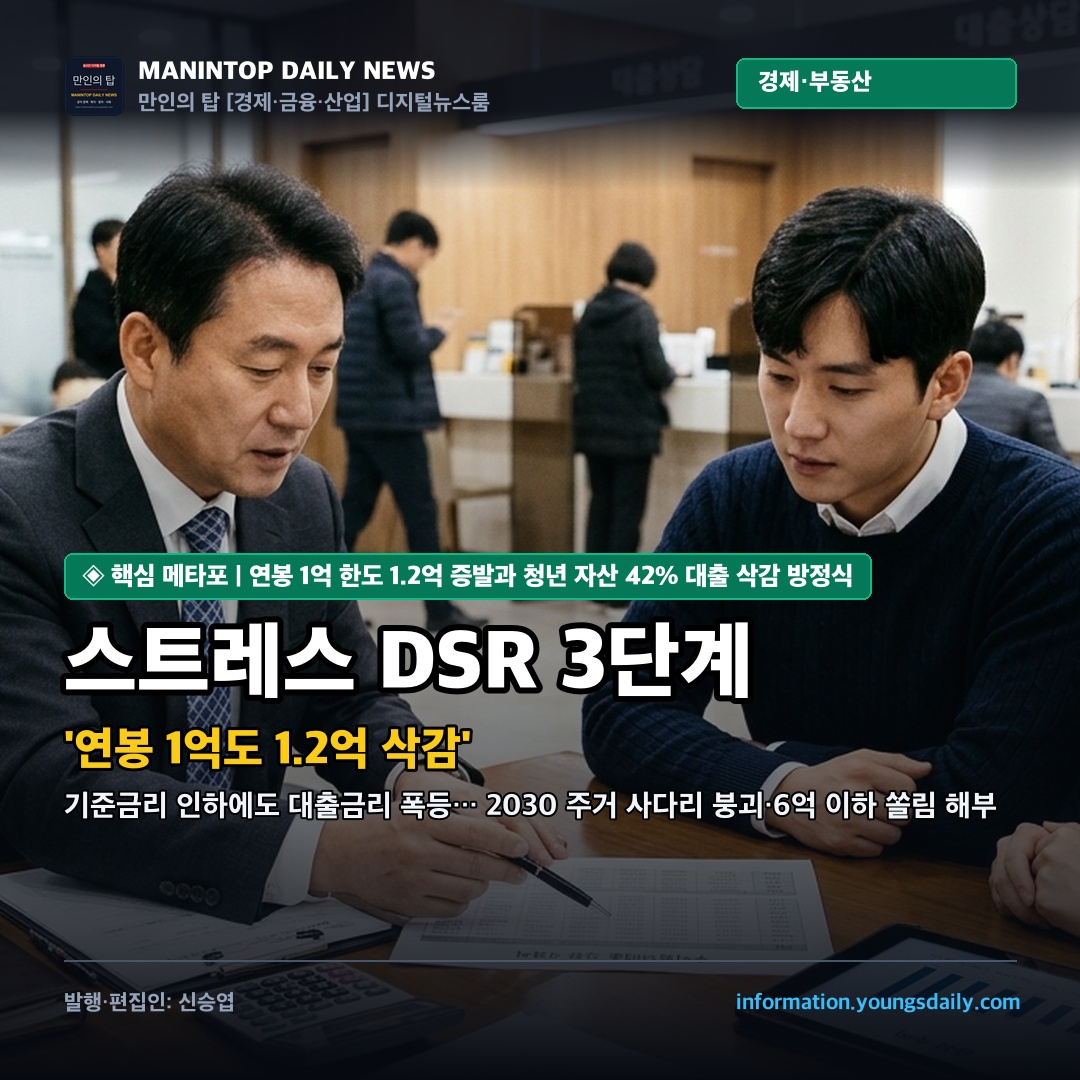
시중은행 대출 창구에서 스트레스 DSR 3단계 한도 축소 상담을 받는 고객
▲ 보도자료사진 — 서울 시내 한 시중은행 여신상담 창구에서 금융 상담원이 스트레스 DSR 3단계 전면 시행에 따른 주택담보대출 한도 축소 산정표와 월리금 상환 계획서를 차주에게 설명하고 있다.

1. 스트레스 DSR 3단계 전면 시행과 차주별 대출 한도 축소

금융당국이 가계부채 팽창을 억제하기 위해 단행한 스트레스 DSR 3단계 전면 시행은 기존 1·2단계와 비교할 수 없을 만큼 강력한 규제 파괴력을 발휘하고 있습니다. 미래의 금리 변동 위험을 사전에 차단한다는 명분으로 산정 금리에 가산금리를 얹는 이 제도는, 3단계부터 제1금융권 은행뿐만 아니라 제2금융권의 모든 주택담보대출과 잔액 1억 원을 초과하는 신용대출, 기타 대출 등 사실상 전 금융권의 모든 가계대출을 촘촘히 옭아매고 있습니다.

기본 스트레스 금리는 연 1.50%가 적용되며, 수도권 주택담보대출에 대해 예외 없는 고강도 잣대가 적용됩니다. 금융위원회와 뱅크샐러드의 시뮬레이션에 따르면 연 소득 1억 원 차주(30년 만기, 원리금균등상환, 대출 금리 연 4.5% 기준)의 주택담보대출 한도는 변동금리 기준 규제 전 6억 5,800만 원에서 3단계 5억 5,600만 원으로 무려 1억 2,000만 원(18.2%)이나 감축됩니다.

대출 금리 유형 규제 적용 전 한도 1단계 (가산 0.38%) 2단계 수도권 (가산 1.20%) 2단계 비수도권 (가산 0.75%) 3단계 전면 시행 (가산 1.50%) 규제 전 대비 총 감소액
변동금리 주택담보대출 6억 5,800만 원 6억 3,000만 원 5억 7,400만 원 6억 400만 원 5억 5,600만 원 1억 2,000만 원 감소 (-18.2%)
혼합형(주기형) 대출 6억 5,800만 원 6억 4,100만 원 6억 600만 원 6억 2,400만 원 5억 9,400만 원 6,400만 원 감소 (-9.7%)

혼합형 대출의 경우에도 고정금리 기간이 5년 이상 9년 미만인 상품의 스트레스 금리 반영 비율이 기존 60%에서 80%로 확대되면서 한도가 6,400만 원 깎였습니다. 고소득자인 연봉 1억 원 차주조차 1억 원 이상의 현금을 추가로 마련하지 못하면 아파트 계약을 해지당할 수 있는 치명적 한도 절벽이 현실화되었습니다.

2. 기준금리 인하 속 대출금리 폭등: '금리 역주행'과 관치금융 논란

최근 금융시장을 뒤흔든 최대 뇌관은 한국은행의 기준금리 동결 및 인하 신호에도 불구하고 시중은행의 주택담보대출 금리가 거꾸로 치솟는 기이한 '금리 역주행' 현상입니다. 대출 지표금리인 은행채 5년물(AAA·무보증) 금리는 기준금리 인하 기대로 지속 하락했으나, KB국민·신한·하나·우리 등 4대 시중은행의 5년 고정 주담대 금리는 상단과 하단 모두 0.56%~0.75%p 이상 급등했습니다.

이 기현상의 배후에는 금융당국의 무리한 총량 규제가 자리 잡고 있습니다. 금융감독원이 연초 경영계획을 초과한 은행에 페널티를 부과하겠다고 압박하자, 은행들이 대출 수요를 억누르기 위해 마진에 해당하는 '가산금리'를 수차례에 걸쳐 인위적으로 올렸기 때문입니다. 그 결과 예금은행의 신규 취급액 기준 주담대 평균 금리는 연 4.88%까지 치솟아 실수요자의 이자 부담을 수백만 원씩 가중시켰습니다.

한국은행 거시경제 보고서와 은행채 금리 역주행 차트를 분석하는 데스크
▲ 공식 보도사진 — 서울 시내 금융 연구실 데스크에 한국은행 통화신용정책 보고서와 은행채 5년물 금리 및 시중은행 주담대 가산금리 급등 추이를 비교 분석한 경제 지표가 놓여 있다.

은행들은 여기서 그치지 않고 임대인 소유권 이전 조건부 전세대출과 대환대출(대출 갈아타기)을 전면 중단했습니다. 정부가 이자 부담을 덜어주겠다며 대환대출 인프라를 구축해 놓고 정작 창구를 틀어막아 버리자, '관치금융의 배신'이라는 차주들의 분노가 폭발했습니다. 이후 금융위가 연간 가계대출 증가율 목표를 1.5%에서 3.0%로 상향하자, 주요 은행들이 빗장을 풀면서 5대 은행 가계대출 잔액이 한 달 만에 2조 7,717억 원 급증(총 783조 6,057억 원)하는 등 정책 혼선이 극에 달했습니다.

3. 서울시 청년·신혼부부 주거사다리 붕괴: 자산의 42% 대출 삭감

대출 규제의 칼날은 자산 형성 초기 단계에 있는 2030 청년층과 신혼부부의 목을 가장 먼저 겨누었습니다. 서울시가 국가 승인 통계인 '2024 서울시 주거실태조사(1만 5,000가구 대상)'의 마이크로데이터를 정밀 분석한 결과, 대출 규제 강화가 무주택 서민의 내 집 마련 기회를 원천 박탈하고 있음이 실증되었습니다.

서울 시내 무주택 216만 가구 중 76.4%(165만 가구)가 주거 안정을 위해 내 집 마련이 절실하다고 응답했습니다. 청년 무주택 가구(89만)의 88.0%, 신혼부부 가구(21만)의 86.6%가 투기가 아닌 '실거주 목적'으로 주택 구입을 희망하고 있습니다. 그러나 대출 규제 전후 대출 가능액을 비교한 결과는 참담합니다.

서울시 무주택 계층 평균 보유 총자산 규제 전 대출 가능액 규제 후 대출 가능액 감소한 대출액 (추가 필요자금) 총자산 대비 감소액 비율
전체 무주택 실수요 가구 1억 8,379만 원 2억 6,555만 원 2억 46만 원 6,509만 원 감소 35.4%
청년 실수요 가구 (2030) 1억 4,945만 원 2억 5,513만 원 1억 9,282만 원 6,231만 원 감소 41.7% (자산의 4할 증발)
신혼부부 실수요 가구 3억 2,598만 원 4억 776만 원 3억 772만 원 1억 4만 원 감소 30.7%

청년 무주택 가구는 규제 전 2억 5,513만 원까지 빌릴 수 있었으나 규제 후 1억 9,282만 원으로 대출 한도가 6,231만 원 축소되었습니다. 이 줄어든 6,231만 원은 청년 가구가 피땀 흘려 모은 전체 총자산(1억 4,945만 원)의 무려 41.7%에 달합니다. 신혼부부 역시 대출 가능액이 1억 4만 원이나 증발했습니다. 부모의 현금 지원을 기대할 수 없는 흙수저 청년과 신혼부부는 주거 사다리에서 강제로 밀려나 평생 전월세 난민으로 전락할 위기에 처했습니다.

4. 서울 및 수도권 부동산 시장 거래 재편: '6억 미만' 쏠림과 외곽 절벽

대출 한도가 쪼그라들자 수도권 부동산 매매 시장은 극단적인 양극화로 찢어졌습니다. 서울 아파트 평균 매매가격이 12억 3,000만 원에 달하지만, 주담대 한도가 제한되고 DSR 규제가 옥죄어오자 매수 수요가 상대적으로 대출 실행이 가능한 6억 원 미만 중저가 아파트로 쏠리는 풍선효과가 발생했습니다.

국토교통부 실거래가 공개시스템에 따르면 서울 아파트 매매 거래 중 6억 원 미만 주택 비중은 전년 동기 대비 5.0%p 상승한 21.9%를 기록했습니다. 분기별로는 1분기 21.3%에서 2분기 20.5%, 3분기에는 25.4%까지 치솟아 서울 아파트 매매 4건 중 1건이 6억 원 미만에서 체결되었습니다. 중저가 아파트가 밀집한 노원구(24.3%), 도봉구(12.3%), 구로구(9.3%)에 매수세가 집중되었습니다.

서울 노원구 및 도봉구 일대 6억 미만 중저가 아파트 단지 전경
▲ 공식 보도사진 — 서울 노원구 및 도봉구 일대 중저가 아파트 대단지 전경. 대출 규제 강화 이후 6억 원 미만 아파트로 매수 수요가 집중되며 서울 시내 거래 점유율이 25%를 돌파했다.

반면 대출 의존도가 높은 서울 외곽 지역은 매수 심리가 얼어붙으며 주간 거래량이 30% 이상 급감하는 '거래 절벽'에 직면했습니다. 이와 대조적으로 현금 부자들이 집결한 강남 3구와 용산구는 대출 규제의 타격을 거의 받지 않고 신고가 행진을 이어가며 자산 격차를 벌렸습니다. 경기도에서는 서울에서 밀려난 수요가 유입되며 6억 원 이상 거래 비중이 40.0%로 확대되는 등 수도권 전역이 왜곡된 순환매에 휩싸였습니다.

5. 2025~2026년 금융감독원 가계부채 총량 관리 및 5대 감독 방향

금융감독원은 거시경제 불안과 가계부채 팽창, 부동산 PF 부실에 맞서 '5대 전략목표(안정·신뢰·상생·미래·쇄신)'와 '14대 핵심과제'를 확정하고 고강도 금융 감독에 착수했습니다.

첫째, '안정' 목표 하에 GDP 대비 가계부채 비율의 점진적 하향 관리를 최우선 과제로 삼았습니다. 스트레스 DSR 3단계의 시장 안착을 철저히 모니터링하고 개별 은행의 연간 가계대출 이행 실적을 현장 점검하여 초과 시 페널티를 부과합니다. 또한 부동산 PF 부실 사업장에 대해 1개월 내 평가, 2개월 내 재구조화를 명령하는 구조조정을 단행하고, 예금자보호한도 상향(5,000만 원에서 1억 원)에 따른 제2금융권 자금 쏠림과 대출 남발을 차단합니다.

둘째, '신뢰'와 '상생' 목표를 통해 은행 중도상환수수료 체계를 합리화하고 금리인하요구권 실효성을 강화하며, 저축은행·상호금융의 중저신용자 대출에 예대율 인센티브를 부여합니다. 셋째, '미래'와 '쇄신'을 통해 은행 여신 마이크로데이터 자동수집 시스템을 구축하여 부동산 여신 쏠림을 정밀 감시하고 생산적 산업 자금으로의 대전환을 추진합니다.

6. 실수요 차주를 위한 실전 자금 조달 가이드 및 체크리스트

스트레스 DSR 3단계와 금리 역주행의 파고를 넘어야 하는 실수요 차주들은 자금 조달 전략을 전면 재정비해야 합니다. 첫째, 주택 매매 계약 시 반드시 '대출 미승인 또는 한도 축소 시 계약금 무상 반환' 특약을 계약서에 명시해야 합니다. 한도가 수천만 원 깎여 잔금을 치르지 못할 경우 계약금을 몰취당하는 사고를 예방하는 최소한의 안전장치입니다.

둘째, 대출 상품 선택 시 순수 변동금리보다 '혼합형(5년 고정)'이나 '주기형' 상품을 적극 검토해야 합니다. 3단계 규제에서도 고정금리 기간이 긴 상품은 스트레스 가산금리가 차등 감면되므로 변동금리보다 한도를 수천만 원 더 확보할 수 있습니다.

셋째, 기존 부채의 사전 정리입니다. 주담대를 신청하기 전 마이너스 통장이나 신용대출 잔액을 일부 상환하면 DSR 한도를 유의미하게 늘릴 수 있습니다. 디딤돌·보금자리론 등 정책 금융 대상 요건을 사전 확인하여 시중은행의 고강도 규제를 우회하는 전략적 판단이 요구됩니다.

가계부채 규제 및 스트레스 DSR 핵심 Q&A

Q1. 스트레스 DSR 3단계가 적용되면 실제 납부하는 대출 이자도 올라가나요?

아닙니다. 스트레스 금리는 대출 한도를 산정할 때만 가산되는 규제 지표이므로, 실제 매월 납부하는 대출 이자율이 인상되는 것은 아닙니다. 다만 대출받을 수 있는 최대 한도가 줄어듭니다.

Q2. 혼합형이나 주기형 고정금리 대출이 변동금리보다 유리한 이유는 무엇인가요?

혼합형과 주기형 대출은 금리 변동 위험이 적다고 평가되어 스트레스 가산금리 반영 비율이 차등 감면(0~80%)되므로, 100% 반영되는 변동금리보다 대출 한도를 수천만 원 더 많이 확보할 수 있습니다.

Q3. 주담대 신청 직전에 신용대출을 먼저 받으면 왜 위험한가요?

1억 원 초과 신용대출 역시 스트레스 DSR 3단계가 100% 적용되므로, 신용대출을 먼저 일으킬 경우 DSR 한도가 조기에 소진되어 본 주택담보대출 한도가 1억 원 이상 삭감될 수 있습니다.

Exclusive In-Depth Analysis Economy & Real Estate

[In-Depth Analysis] Nationwide Implementation of Stress DSR Stage 3 and the Interest Rate Inversion Shock: Up to KRW 120M Cut Even for High Earners

The full nationwide implementation of Stress DSR Stage 3 alongside stringent aggregate household debt caps has triggered unprecedented disruption across South Korea mortgage lending landscape. Defying benchmark rate cut trajectories from the Bank of Korea, major commercial banks aggressively inflated lending spreads, driving fresh mortgage interest rates up to an average of 4.88 percent and slashing allowable borrowing limits by up to KRW 120 million even for high-earning households. Comprehensive microdata covering 15,000 Seoul households reveals that young prospective buyers saw borrowing capacity cut by 41.7 percent of their total net worth, driving intense market polarization into sub-KRW 600 million residential properties.
Bank loan officer explaining Stress DSR lending limits across consultation desk
▲ Editorial Documentary Photo — A commercial banking loan specialist outlines borrowing cap reductions under Stress DSR Stage 3 and monthly amortization schedules to a prospective homebuyer couple at a branch in Seoul. (Press Archive)

1. Nationwide Implementation of Stress DSR Stage 3 and Contraction of Borrowing Limits

The comprehensive implementation of Stress DSR Stage 3, enacted by financial authorities to contain household debt expansion, exerts unprecedented regulatory leverage across credit markets. Designed to pre-emptively absorb future interest rate fluctuations by factoring hypothetical stress margins into debt capacity calculations, Stage 3 expands beyond commercial bank mortgages to cover secondary non-bank lenders, personal credit lines exceeding KRW 100 million, and all ancillary household liabilities nationwide.

The regulatory framework applies a baseline stress spread of 1.50 percent, enforcing strict underwriting criteria across the Seoul metropolitan area. According to simulation analytics from the Financial Services Commission and BankSalad, an applicant earning KRW 100 million annually (benchmarked at a 30-year maturity, equal principal-and-interest amortization, and 4.5% baseline rate) experiences a variable mortgage borrowing reduction from KRW 658 million prior to regulations down to KRW 556 million under Stage 3, representing an acute contraction of KRW 120 million (18.2 percent).

Mortgage Interest Structure Pre-Regulation Limit Stage 1 (+0.38% Spread) Stage 2 Capital (+1.20%) Stage 2 Regional (+0.75%) Stage 3 Nationwide (+1.50%) Aggregate Reduction Amount
Variable Rate Mortgage KRW 658.0 Million KRW 630.0 Million KRW 574.0 Million KRW 604.0 Million KRW 556.0 Million KRW 120.0 Million Cut (-18.2%)
Hybrid Periodic Mortgage KRW 658.0 Million KRW 641.0 Million KRW 606.0 Million KRW 624.0 Million KRW 594.0 Million KRW 64.0 Million Cut (-9.7%)

Even for hybrid periodic products, loans featuring fixed intervals between five and nine years saw stress weighting ratios expand from 60 percent to 80 percent, resulting in a KRW 64 million reduction. High-earning households earning six figures face critical financing deadlocks unless they mobilize hundreds of millions in supplementary equity reserves.

2. Rising Mortgage Rates Amid Policy Rate Cuts: Rate Inversion and Administrative Distortions

The primary disruption shaking monetary policy centers on an acute interest rate inversion, where commercial borrowing costs surged despite easing signals from the central bank. While 5-year AAA bank debenture yields declined in anticipation of benchmark easing, 5-year fixed mortgage rates across major tier-one lenders (KB Kookmin, Shinhan, Hana, Woori) jumped 0.56 to 0.75 percentage points at both ends of the lending corridor.

This inversion stems from administrative interventions into lending volumes. As regulators threatened sanctions against banks surpassing preliminary lending targets, commercial lenders arbitrarily expanded lending margins to suppress retail credit demand. Consequently, the average interest rate on newly originated mortgages climbed to 4.88 percent, imposing severe debt-servicing burdens on retail borrowers.

Macroeconomic reports from the Bank of Korea and bond yield analysis desk
▲ Editorial Documentary Photo — Bank of Korea monetary policy reports alongside comparative financial charts illustrating the divergent trajectory between falling market yields and rising commercial bank lending margins in a Seoul economic research office. (Press Archive)

Lenders further shuttered conditional jeonse rental deposit loans and refinancing channels. While government initiatives actively promoted automated loan-switching platforms to lower household debt costs, bank desks simultaneously blocked incoming transfers, sparking sharp public criticism over state-directed credit distortions. Subsequent adjustments raising annual loan growth targets from 1.5 percent to 3.0 percent prompted banks to re-open channels, triggering a KRW 2.77 trillion surge in five major banks retail debt within thirty days to reach KRW 783.61 trillion.

3. Collapse of the Housing Ladder for Seoul Youth and Newlyweds: 42% of Net Worth Slashed

The tightening of credit limits struck young professionals and newlywed couples disproportionately hard. Microdata analysis of the 2024 Seoul Housing Survey (covering 15,000 representative households) demonstrates that macro credit curbs have dismantled the primary capital accumulation ladder for non-homeowners.

Among Seoul 2.16 million unhoused households, 76.4 percent (1.65 million) stated that homeownership was essential for family stability, with 88.0 percent of unhoused young adults (890,000 households) and 86.6 percent of newlyweds (210,000 households) citing genuine residential security rather than speculative investment. Comparative debt capacity metrics expose severe balance-sheet impairment.

Unhoused Demographic Group Average Net Assets Pre-Regulation Debt Cap Post-Regulation Debt Cap Contraction in Credit (Capital Deficit) Deficit Ratio to Total Net Assets
All Unhoused End-Users KRW 183.79 Million KRW 265.55 Million KRW 200.46 Million KRW 65.09 Million Reduction 35.4%
Young Adult Households (2030) KRW 149.45 Million KRW 255.13 Million KRW 192.82 Million KRW 62.31 Million Reduction 41.7% of Household Net Worth
Newlywed Households KRW 325.98 Million KRW 407.76 Million KRW 307.72 Million KRW 100.04 Million Reduction 30.7%

Allowable borrowing limits for young adult households fell from KRW 255.13 million down to KRW 192.82 million, creating an unbridgeable capital deficit of KRW 62.31 million. This reduction represents an astonishing 41.7 percent of the entire average asset base (KRW 149.45 million) accumulated by young applicants. Newlywed couples suffered a credit reduction of KRW 100.04 million, locking prospective buyers out of homeownership and forcing families into perpetual tenancy.

4. Transaction Realignment Across Seoul and Gyeonggi: Rush Below KRW 600M vs. Peripheral Freezes

As debt limits tightened, the metropolitan housing market bifurcated into extreme behavioral patterns. With average Seoul apartment valuations standing at KRW 1.23 billion, restricted debt limits redirected buyers toward affordable residential properties valued below KRW 600 million.

Ministry of Land, Infrastructure and Transport transaction data indicates that transactions under KRW 600 million captured 21.9 percent of all Seoul apartment transactions, climbing 5.0 percentage points year-over-year. By the third quarter, this proportion rose to 25.4 percent, meaning one out of every four contracts executed below the KRW 600 million mark, concentrated heavily in Nowon-gu (24.3%), Dobong-gu (12.3%), and Guro-gu (9.3%).

Dense residential apartment complexes in Nowon-gu and Dobong-gu Seoul
▲ Editorial Documentary Photo — Dense residential high-rise apartment complexes in northern Seoul, where transactions under KRW 600 million captured over a quarter of municipal turnover following mortgage curbs. (Press Archive)

Conversely, credit-dependent outer Seoul neighborhoods experienced transaction freezes, with weekly transaction volumes falling over 30 percent. In contrast, cash-rich buyers in Gangnam, Seocho, Songpa, and Yongsan remained insulated from lending restrictions, sustaining record transactions. In Gyeonggi Province, displaced metropolitan demand lifted transactions above KRW 600 million to 40.0 percent of regional volume, driven by Yongin and Hwaseong.

5. Financial Supervisory Service 2025-2026 Roadmap and Five Core Supervisory Pillars

In response to macroeconomic volatility and property project financing risks, the Financial Supervisory Service finalized its strategic agenda centered on five core operational pillars: Stability, Trust, Mutual Growth, Future Innovation, and Internal Reform.

Under the Stability objective, regulators prioritize the steady reduction of household debt relative to gross domestic product. Authorities are monitoring the rollout of Stress DSR Stage 3 through onsite bank examinations while enforcing restructuring across distressed property project financing ventures within 60 days. Regulators are also monitoring potential deposit flows into non-bank institutions following the planned expansion of deposit insurance caps from KRW 50 million to KRW 100 million.

6. Practical Borrowing Execution Playbook and Checklist for Genuine End-Users

End-users navigating Stress DSR Stage 3 and artificial rate spreads must deploy defensive financing strategies. First, purchase contracts must include explicit contractual escape clauses stipulating the unconditional return of initial deposits if mortgage limits are curtailed below agreed underwriting levels.

Second, applicants should evaluate hybrid or 5-year periodic mortgage products rather than unhedged variable rate structures. Because fixed components receive preferential reductions in stress interest margins, borrowers can preserve tens of millions of won in borrowing capacity compared to variable structures.

Finally, existing credit liabilities must be restructured prior to application. Repaying revolving credit lines or overdraft facilities restores essential DSR bandwidth. Inquirers should also assess eligibility under state policy mortgages like Didimdol to bypass commercial underwriting limits.

Household Debt Regulations & Stress DSR FAQ

Q1. Does the implementation of Stress DSR Stage 3 raise actual mortgage interest payments?

No. The stress spread functions solely as a regulatory stress-test benchmark to determine maximum borrowing limits and does not alter the actual contractual interest rate applied to monthly repayments.

Q2. Why do periodic fixed-rate mortgages preserve higher debt limits than variable products?

Because periodic and hybrid loans insulate borrowers from near-term rate volatility, regulators apply reduced stress spreads (0% to 80%), preserving substantially higher principal limits than variable products.

Q3. Why is opening an unsecured credit line immediately before a mortgage risky?

Under Stage 3, credit debt exceeding KRW 100 million carries full stress interest weighting, causing rapid DSR exhaustion that can slash allowable mortgage limits by over KRW 100 million.

PRO SOURCING ENGINE 만인의 탑 빅데이터 솔루션
★ 가입 시 600 크레딧(120회) 전원 무료

내가 찾는 상품 키워드, 지금 얼마나 검색될까?

네이버 월간 검색량 + 구글 볼륨 + 아이템스카우트 실시간 상품수와 경쟁강도 배지를 0.5초 만에 무료로 확인하세요.

신고하기

이 블로그 검색

환절기 감기 예방법 찐실천 후기와 전문가 조언으로 완성한 코와 목 관리 99% 방어 루틴

리모델링 아파트 계약금 10%는 언제 내나요? 계약서·공고문으로 확인하는 납부 시점

윤석열 탄핵·12·3 비상계엄·내란 혐의 재판까지: 근거로 확인되는 범위만 한 번에 정리
