[심층기획] '전속계약 분쟁과 탬퍼링 공방' 민희진 배임 송치로 본 K-엔터 명암… 80억 선투자와 3년 재제작 금지의 딜레마
만인의 탑 편집국11월 17, 2026
[심층기획] '전속계약 분쟁과 탬퍼링 공방' 민희진 배임 송치로 본 K-엔터 명암… 80억 선투자와 3년 재제작 금지의 딜레마
문화 & 엔터법무 심층취재팀 | 연예인 전속계약 분쟁 및 탬퍼링 법적 쟁점 심층 분석2026. 11. 17 09:40 KST
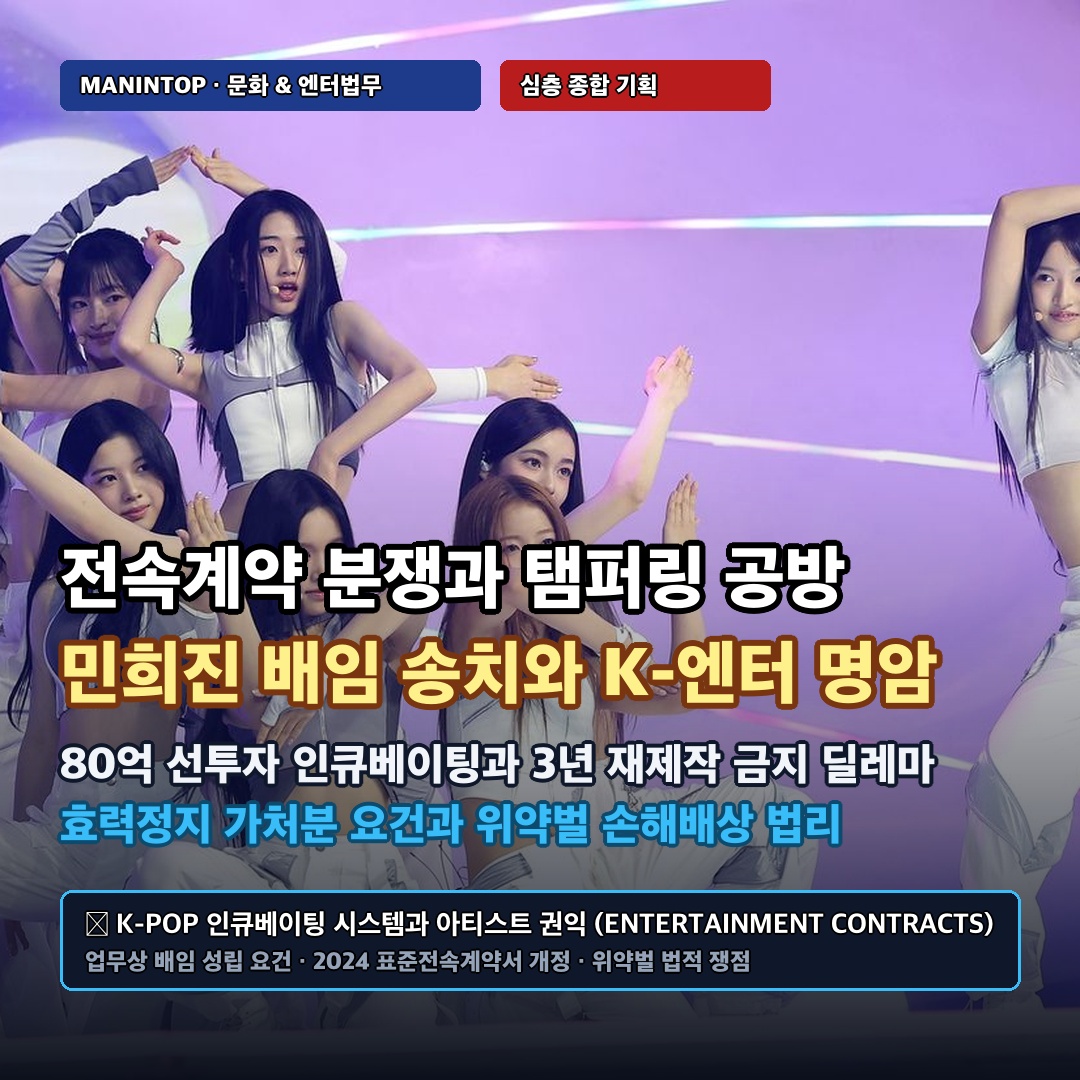
▲ 대규모 K-POP 콘서트 무대와 화려한 퍼포먼스 전경. 막대한 선투자가 수반되는 인큐베이팅 시스템과 아티스트의 창작 권익 사이에서 전속계약 분쟁과 탬퍼링을 둘러싼 법적 공방이 격화되고 있습니다. [사진: 대중음악공연 프레스 풀 보도자료]
핵심 쟁점 3줄 요약
민희진 전 대표 뉴진스 계약 해지 관여 혐의로 마포서 업무상 배임 송치… 용산서 경영권 탈취 불송치 사건과 분리 전개
형법상 배임죄의 '구체적 실해 발생 위험' 입증과 경영판단의 원칙 적용 여부가 향후 공소청 및 재판부의 최대 쟁점
문체부 표준계약서 3년 재제작 금지의 실효성 한계 속 효력정지 가처분 인용 요건과 위약벌 감액 불가 법리 충돌
세계 시장을 무대로 눈부신 성장을 거듭해 온 대한민국 K-POP 엔터테인먼트 산업이 전속계약 분쟁과 탬퍼링(전속계약 기간 중 사전접촉 및 계약 파기 유도) 공방으로 사상 초유의 소용돌이에 휘말렸습니다. 단순한 연예인과 소속사 사이의 감정적 갈등을 넘어, 이제는 수백억 원대 기업 가치와 형사 처벌이 걸린 대규모 법적 전쟁으로 번지는 양상입니다. 2026년 11월 16일 서울 마포경찰서가 민희진 전 어도어 대표를 그룹 뉴진스의 전속계약 해지 관여 혐의로 서울서부지방공소청에 불구속 송치하면서 사태는 새로운 사법적 분수령을 맞았습니다. 앞서 피프티 피프티의 80억 원 선투자금 분쟁과 엑소 첸백시 사태를 거치며 문화체육관광부가 동일 콘텐츠 재제작 금지 기간을 3년으로 늘린 표준전속계약서 개정안을 내놓았지만, 현장에서는 여전히 실효성 논란이 끊이지 않고 있습니다. 수사기관의 송치 전말과 업무상 배임죄의 5대 성립 요건, 탬퍼링을 바라보는 제작자 단체와 문화평론가의 첨예한 시각차, 그리고 효력정지 가처분과 위약벌 법리를 현장 중심으로 입체 취재했습니다.
1. 민희진 전 대표 '업무상 배임' 송치 전말… 용산서 불송치와 마포서 수사의 결정적 차이
서울 마포경찰서가 2026년 11월 16일 민희진 전 어도어 대표(현 오케이레코즈 대표)를 업무상 배임 혐의로 서울서부지방공소청에 불구속 송치한 사건은 가요계 전반에 거대한 충격을 던졌습니다. 어도어 측이 지난해 1월 민 전 대표를 경찰에 고소한 지 1년 10개월 만의 수사 결론입니다. 경찰은 민 전 대표가 2024년 그룹 뉴진스 멤버들이 어도어에 전속계약 해지를 일방적으로 통보하고 독자 행보를 걷는 과정에서, 사내이사라는 법적 지위를 이용해 부당한 영향력을 행사하여 계약 해지를 사실상 유도하거나 주도했다고 판단했습니다. 반면 함께 고소당했던 어도어 전 부대표 2인에 대해서는 범행 관련성이 적다고 보아 혐의없음 처분을 내렸습니다.
이번 마포서 송치 사건을 정확히 이해하기 위해서는 앞서 진행된 서울 용산경찰서의 수사와 명확히 구별해야 합니다. 하이브가 2024년 4월 고발했던 용산서 사건은 민 전 대표의 어도어 경영권 탈취 모의 여부가 핵심 쟁점이었으며, 경찰은 지난해 7월 혐의없음으로 불송치 결정을 내렸다가 검찰(공소청)의 보완수사 요구로 재수사가 진행 중입니다. 반면 이번 마포서 사건은 어도어가 직접 고소한 사안으로, 아티스트의 전속계약 해지 개입 여부라는 구체적 행위에 초점이 맞춰져 있습니다. 이에 대해 민 전 대표 측은 피의자 본인도 모르는 사이에 수사 잠정 결론이 언론에 유출된 것은 수사 공보 규칙 위반이자 특정 세력과의 유착 의혹이라며 강하게 반발했습니다. 또한 지분 구조상 경영권 찬탈은 불가능하며 뉴진스의 계약 해지를 유도한 사실이 전혀 없다고 혐의를 전면 부인하고 있어 향후 치열한 법정 공방을 예고하고 있습니다.
구분 및 수사 관서
고소·고발 주체 및 접수 시점
핵심 혐의 및 수사 쟁점
수사기관 처분 결과 및 향후 사법 절차
서울 용산경찰서 수사 사건
하이브 (2024년 4월 업무상 배임 고발)
어도어 경영권 탈취 계획 수립 및 실행 착수 여부
지난해 7월 혐의없음 불송치 후 공소청 보완수사 요구로 재수사 진행
서울 마포경찰서 수사 사건
어도어 (지난해 1월 업무상 배임 고소)
뉴진스 멤버들의 전속계약 해지 통보 개입 및 유도(탬퍼링)
2026년 11월 16일 업무상 배임 혐의 불구속 송치 (서울서부지방공소청 계류)
어도어 전 부대표 2인 처분
어도어 (공동 피고소인)
민 전 대표와의 배임 공모 및 계약 해지 관여 여부
경찰 수사 결과 사건 관련성 미약 판단으로 혐의없음 불송치 처분
민 전 대표 측 공식 반박
민희진 전 대표 법률대리인
수사 공보 규칙 위반, 용산서 불송치 원용, 해지 유도 부인
특정 언론 유출 유착 의혹 제기 및 지분 구조상 경영권 찬탈 불가 강조
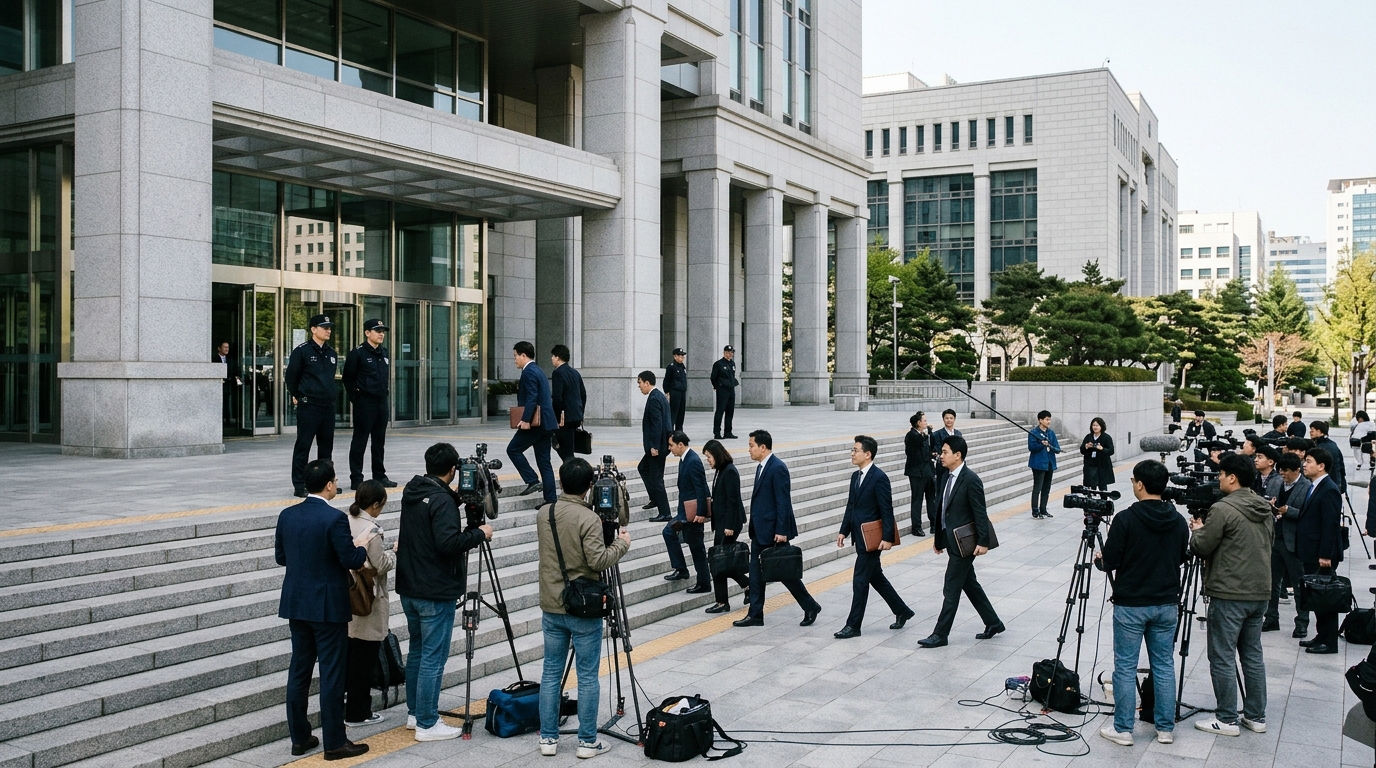
▲ 서울 주요 법원 앞 전경. 연예인 전속계약 분쟁이 민사상 효력정지 가처분을 넘어 사내이사의 업무상 배임 혐의 등 형사 사건으로 번지며 사법부의 엄격한 법리 판단이 요구되고 있습니다. [사진: 사법부 공동취재단]
2. 형법 제356조 업무상 배임 5대 성립 요건… '구체적 실해 위험'과 경영판단 원칙의 공방
향후 공소청의 기소 여부와 법정 판결을 좌우할 핵심 열쇠는 형법 제356조의 업무상 배임죄 성립 요건에 있습니다. 형법상 업무상 배임죄는 업무상 임무에 위배하여 재산상 이익을 취득하거나 제3자로 하여금 이를 취득하게 하여 회사에 재산상 손해를 가했을 때 성립하며, 10년 이하의 징역 또는 3천만 원 이하의 벌금에 처해지는 중범죄입니다. 대법원 판례에 따르면 업무상 배임이 유죄로 확정되기 위해서는 타인의 사무를 처리하는 자라는 신분, 업무상 임무위배 행위, 배임의 고의, 재산상 손해 발생, 그리고 본인 또는 제3자의 이익 취득이라는 5대 요건이 빈틈없이 입증되어야 합니다.
법정의 최대 쟁점은 대표이사에서 해임된 후 사내이사로 재직하던 민 전 대표의 행위가 과연 회사에 대한 구체적 실해 발생의 위험을 초래했는가에 모아집니다. 대법원은 배임죄의 손해에 대해 현실적인 손해뿐만 아니라 경제적 관점에서 현실적 손해와 다름없을 정도의 구체적인 위험을 초래한 경우도 포함된다고 일관되게 판시해 왔습니다. 하지만 단순한 채권적 다툼이나 가능성 수준의 막연한 위험만으로는 배임죄가 성립하지 않습니다. 더욱이 기업 경영자가 회사를 위한 합리적 판단을 내린 경우 처벌하지 않는 경영판단의 원칙(Business Judgment Rule)이 적용될 수 있는지도 뜨거운 쟁점입니다. 아티스트의 이탈이 사내이사의 고의적인 임무위배 결과인지, 아니면 회사의 부당한 처우에 맞선 아티스트 자체의 자율적 판단이었는지를 입증하는 과정에서 법리적 격돌이 불가피합니다.
이번 사태가 유독 대중과 산업계의 뜨거운 관심을 받는 근본적인 배경에는 최근 K-POP 생태계를 강타한 탬퍼링 트라우마가 자리 잡고 있습니다. 탬퍼링은 스포츠 업계에서 유래한 용어로 전속계약 기간이 남아 있는 선수나 아티스트를 사전에 불법 접촉하여 계약을 파기하도록 유도하는 행위를 뜻합니다. 중소 기획사의 기적이라 불리며 글로벌 빌보드 차트를 휩쓸었던 피프티 피프티 사태가 대표적입니다. 당시 소속사는 약 80억 원에 달하는 거액을 선투자하여 신인 그룹을 정상에 올려놓았으나 외부 세력의 불법 강탈 시도로 팀이 공중분해 위기에 처했다고 호소했고, 법원이 멤버들의 가처분 신청을 기각하며 탬퍼링의 위험성을 공론화시켰습니다.
이후 대형 기획사인 SM엔터테인먼트와 그룹 엑소의 핵심 유닛인 첸백시(첸·백현·시우민) 사이에서도 사전 접촉과 이적을 둘러싼 분쟁이 터져 나오면서 탬퍼링은 산업의 명운을 흔드는 핵심 뇌관으로 부상했습니다. 천문학적인 투자 비용과 수년간의 연습생 육성 과정을 거쳐야만 스타가 탄생하는 K-POP 비즈니스 모델의 특성상, 완성된 아티스트를 중간에 가로채 가는 행위가 용인된다면 자본력이 취약한 중소 제작사들은 한순간에 파산할 수밖에 없다는 위기감이 팽배해졌습니다.
그러나 탬퍼링 문제를 바라보는 시각은 산업계 내부에서도 극명하게 엇갈립니다. 한국대중음악산업협회(회장 우승현)를 필두로 한 제작자 단체들은 K-POP의 성공이 기획사의 막대한 선투자 리스크를 바탕으로 구축된 고유한 인큐베이팅 시스템 덕분이라고 강조합니다. 협회는 2026년 11월 뉴욕타임스(NYT)가 국내 아티스트의 계약서를 인용하며 K-POP을 억압적 통제로 묘사한 데 대해 강력한 유감을 표명했습니다. 한국의 주요 기획사들은 정부의 표준계약서와 법률 테두리 안에서 국가표준 청소년 부속합의서를 체결하고 사내 전문 의료진 케어를 도입하는 등 자정 노력을 다하고 있으며, 비밀유지의무가 있는 계약서를 왜곡 유출하는 행위가 산업의 성과를 훼손하고 있다고 반박했습니다.
반면 대중문화평론가 김헌식 박사를 비롯한 비판적 진영에서는 탬퍼링 방지법 도입 논의에 앞서 K-POP 기획사의 수직적이고 불공정한 구조 개선이 선행되어야 한다고 맞섭니다. 서구의 에이전시와 달리 한국의 기획사는 10대 미성년자를 선발해 장기간 합숙 훈련시키는 육성형 모델이기 때문에 태생적으로 동등한 계약 관계가 성립하기 어렵다는 지적입니다. 데뷔 초에는 불합리한 처우와 열정페이를 견뎌내야 하고, 팀이 대세로 성장한 후에도 불투명한 정산 구조로 인해 권리를 침해당하는 구조적 문제가 잔존한다는 것입니다. 따라서 탬퍼링 방지법이 일방적으로 기획사의 기득권만을 지키는 방패막이가 되어서는 안 되며, 아티스트의 정당한 권익을 보호하는 제도적 장치가 반드시 균형 있게 마련되어야 한다는 목소리가 높습니다.
결국 전속계약 분쟁의 본질은 수십억 원의 위험을 감수하는 기획사의 투자 자본 보호와 창작 주체인 아티스트의 기본권 및 직업 선택의 자유라는 두 헌법적 가치가 정면으로 충돌하는 구조적 딜레마에 있습니다. 신뢰가 깨진 상태에서 7년이라는 장기 계약에 묶여 청춘을 소모해야 하는 아티스트의 고통과, 수년간 피땀 흘려 키워낸 결실을 하루아침에 빼앗길 위기에 처한 제작사의 절박함이 타협점 없이 부딪히는 것이 오늘날 K-POP 분쟁의 비극적인 자화상입니다.
이러한 갈등을 봉합하기 위해 문화체육관광부는 2024년 6월 3일, 6년 만에 대중문화예술인 표준전속계약서 개정안을 고시했습니다. 핵심 골자는 가수가 소속사를 이적할 경우 기존 기획사에서 발매했던 콘텐츠와 동일하거나 유사한 결과물을 다시 제작해 판매하지 못하도록 금지하는 기간을 기존 1년에서 3년으로 대폭 늘린 것입니다. 이적 직후 이전 소속사의 IP를 그대로 활용해 거둘 수 있는 기대수익을 차단함으로써 탬퍼링을 사전 억제하겠다는 취지입니다. 아울러 퍼블리시티권이 예술인에게 원천 귀속됨을 명시하고, 기획사가 상표권을 이전할 때 정산 비용 외에 부당한 양도 대가를 요구하지 못하도록 금지했습니다.
그러나 현장에서는 3년 재제작 금지 조항 역시 현실적 한계가 뚜렷하다는 지적이 쏟아집니다. 아티스트가 새로운 기획사에서 원작곡가와 협의해 편곡을 바꾸거나 리메이크 형태로 음원을 발매할 경우, 이전 소속사가 저작권법상 이를 실질적으로 가로막을 방법이 없기 때문입니다. 이로 인해 법조계에서는 단순한 표준계약서 권고를 넘어, 탬퍼링이 입증될 경우 법원이 직권으로 감액할 수 없는 강력한 위약벌 조항을 계약서에 명시해야만 실효성 있는 억제력을 발휘할 수 있다는 제언이 힘을 얻고 있습니다.
실무상 전속계약 분쟁이 터지면 아티스트 측은 민사집행법 제300조 제2항에 따라 전속계약 효력정지 가처분을 최우선으로 신청합니다. 대법원 확정 판결까지 수년이 걸리는 본안 소송을 기다리다가는 치명적인 활동 공백과 경력 단절을 겪기 때문입니다. 법원은 당사자 간의 신뢰관계가 회복 불가능할 정도로 파탄 났는지(피보전권리)와 활동 기회 차단으로 인한 현저한 손해 발생 위험(보전의 필요성)을 엄격히 심사합니다. 반면 소속사는 막대한 손해배상 예정액(위약금)이나 위약벌을 청구하며 맞소송을 제기합니다. 민법 제398조 제2항에 따라 법원이 부당하게 과다하다고 판단하면 직권으로 감액할 수 있는 위약금과 달리, 채무 이행을 강제하기 위한 사적 제재금인 위약벌은 원칙적으로 감액이 불가능하여 양측의 사활을 건 공방이 펼쳐집니다.
오늘날 연예인 전속계약 분쟁은 전통적인 가요와 연기 영역을 넘어 MCN 크리에이터의 채널 소유권, 인플루언서의 SNS 전속 범위, 버츄얼 스트리머의 2D·3D 아바타 캐릭터 IP 분쟁으로까지 급속히 번져가고 있습니다. K-컬처가 지속 가능한 미래 산업으로 도약하기 위해서는 불투명한 정산 관행과 인격권 침해를 뿌리 뽑는 기획사의 체질 개선이 필수적입니다. 동시에 불법적인 탬퍼링을 발본색원할 수 있는 엄정한 사법적 잣대와 법적 강제력을 지닌 표준계약서의 안착이 시급합니다. 창작자의 존엄성과 제작사의 투자 가치가 상호 신뢰 속에서 공존할 때, 비로소 K-POP은 세계를 감동시키는 진정한 문화 강국의 꽃을 피울 수 있을 것입니다.
[In-Depth Analysis] Exclusive Contract Disputes and Tampering Battles: Criminal Breach Charges, 8-Billion-Won Investments, and the 3-Year Remake Barrier
Culture & Entertainment Law Investigative Desk | In-Depth Structural Analysis of Exclusive Contracts2026. 11. 17 09:40 KST
▲ A large-scale K-pop concert arena and live performance. Intensive front-loaded investments and artist rights remain locked in conflict as disputes over exclusive contracts and poaching allegations escalate. [Photo: Pop Music Concert Press Pool Coverage]
Key Takeaways: 3 Core Dimensions
Former ADOR CEO Min Hee-jin transferred on criminal breach charges regarding NewJeans contract termination, distinct from Yongsan takeover case
Proof of concrete property loss risks versus the Business Judgment Rule represents the primary battleground for prosecutors and judges
Extended 3-year reproduction restrictions in revised standard contracts collide with civil injunction benchmarks and non-reducible penalties
South Korea's global K-pop entertainment industry has been thrust into an unprecedented legal tempest driven by escalating exclusive contract disputes and poaching allegations known as tampering. Moving far beyond tabloid gossip, these high-stakes clashes involve tens of millions of dollars in corporate valuation and severe criminal liability. On November 16, 2026, the Seoul Mapo Police Station transferred Min Hee-jin, former CEO of ADOR and current head of OK Records, to the Seoul Western District Public Prosecutor's Office on charges of occupational breach of trust, alleging her unlawful inducement of NewJeans' contract termination. This follows the 8-billion-won front-loaded investment crisis of Fifty Fifty and the public rift of EXO's CBX, prompting government ministries to extend content reproduction bans from one year to three years under revised standard contracts. This investigative report provides an in-depth analysis of criminal breach doctrines, divergent industry perspectives, and the legal mechanics governing contract injunctions and liquidated penalties.
1. Transfer of Former ADOR CEO Min Hee-jin on Breach Charges: Distinguishing Yongsan and Mapo Cases
The decision by the Seoul Mapo Police Station on November 16, 2026, to transfer former ADOR CEO Min Hee-jin without detention on criminal breach of trust charges represents a critical turning point for the music industry. The police concluded an investigation initiated in January of the previous year following a criminal complaint lodged by ADOR. Police investigators determined that while serving as an inside director in 2024, Min leveraged her corporate authority to exert undue influence, systematically inducing and orchestrating NewJeans' unilateral contract termination notice against ADOR. Conversely, two former ADOR vice presidents named as co-respondents were discharged without charges due to insufficient causal connection to the alleged criminal acts.
To understand the legal significance of the Mapo transfer, it is essential to distinguish it from the earlier investigation conducted by the Seoul Yongsan Police Station. The Yongsan case, initiated by HYBE's April 2024 complaint, centered on allegations of an attempted corporate takeover of ADOR. That case resulted in a non-transfer decision in July 2025 before prosecutors ordered a supplementary re-investigation. In contrast, the Mapo case directly targets the specific act of inducing artists to breach exclusive contracts. Min's legal team vehemently denounced the transfer, characterizing the preliminary leak of police findings to specific media outlets as a blatant violation of criminal public information rules and alleging illicit coordination. Denying all charges, Min asserted that ADOR's equity structure rendered any corporate usurpation structurally impossible and maintained that she never induced the artists' departure.
Police Jurisdiction and Case
Complainant and Filing Date
Core Allegations and Investigative Focus
Outcome and Current Procedural Stage
Seoul Yongsan Police Station
HYBE (Filed April 2024 for Criminal Breach)
Formulating and executing an ADOR management takeover plan
Non-transfer (cleared) July 2025; currently under re-investigation upon prosecutor order
Seoul Mapo Police Station
ADOR (Filed January 2025 for Criminal Breach)
Intervening in and inducing NewJeans contract termination (tampering)
Transferred without detention on breach charges Nov 16, 2026 (Seoul Western District)
Two Former ADOR Vice Presidents
ADOR (Co-respondents)
Joint conspiracy in criminal breach and contract termination
Discharged without charges due to lack of direct causality or involvement
Formal Defense by Min Hee-jin
Legal Counsel for Former CEO Min
Breach of investigation public rules, Yongsan ruling cited, denial
▲ Front plaza of the Seoul court complex. Entertainment contract disputes are expanding beyond civil injunctions into criminal breach of trust charges, requiring rigorous judicial scrutiny. [Photo: Judiciary Press Pool Coverage]
2. Five Legal Pillars of Criminal Breach: Material Risk of Concrete Damage vs. Business Judgment
The core judicial determinant governing whether formal indictment occurs lies in Article 356 of the Korean Criminal Code regarding occupational breach of trust. The statute penalizes individuals who violate occupational duties to obtain pecuniary benefits for themselves or third parties, causing financial harm to the principal, carrying penalties up to ten years imprisonment or fines up to thirty million won. Under established Supreme Court precedents, five indispensable legal requirements must be proven beyond a reasonable doubt: managing the business of another, breach of occupational duty, intentionality, infliction of property damage, and acquisition of pecuniary benefit.
The primary battleground centers on whether Min's actions while retaining an inside directorship generated a material risk of concrete property loss for ADOR. The Supreme Court consistently holds that property damage includes not only realized monetary losses but also situations where a concrete, immediate hazard of property depreciation is created from an economic perspective. However, speculative or abstract hazards fail to meet this threshold. Furthermore, courts must weigh the Business Judgment Rule, which shields corporate directors from criminal liability when decisions are made in good faith with reasonable care. Determining whether the artists' departure stemmed from deliberate director misconduct or represented autonomous decisions prompted by agency friction remains the paramount legal battle.
3. The Tampering Shockwave: From Fifty Fifty 8-Billion-Won Investments to the CBX Exodus
Widespread industry sensitivity surrounding this case is deeply rooted in the structural trauma of tampering that has disrupted the K-pop ecosystem. Originally borrowed from professional sports to describe the illicit poaching of talent under contract, tampering emerged as a systemic hazard during the Fifty Fifty scandal. A small agency that achieved historic global Billboard success saw its trajectory derailed when external parties allegedly attempted to poach the quartet, endangering approximately eight billion won in unrecovered upfront investments. The Seoul Central District Court's subsequent dismissal of the members' injunction request underscored the judicial illegitimacy of arbitrary contract repudiations.
The subsequent standoff between SM Entertainment and EXO members Chen, Baekhyun, and Xiumin further demonstrated that even legacy conglomerates remain vulnerable to contract poaching. Because the K-pop business model relies on extensive multi-year capital outlays to train, house, and brand trainees before generating revenue, allowing external operators to siphon off established talent threatens to bankrupt independent and mid-tier agencies unable to absorb sudden roster losses.
4. Safeguarding Incubator Risk vs. Reforming Trainee Exploitation: Production Association vs. Cultural Critics
Nevertheless, perspectives on tampering remain sharply divided across the creative spectrum. Producer groups, led by President Woo Seung-hyun of the Korea Entertainment Producer's Association, argue that K-pop's global competitiveness relies on agency willingness to bear significant upfront risks within specialized incubation systems. In November 2026, the association expressed deep regret over a New York Times report that characterized standard agency contracts as oppressive instruments. The association stressed that Korean entertainment companies comply with national youth supplementary agreements guaranteeing educational, sleep, and health rights while deploying specialized in-house medical care, cautioning that leaking confidential agreements distorts legitimate industry achievements.
Conversely, cultural critics such as Dr. Kim Hern-sik contend that addressing tampering requires dismantling structural inequalities within the trainee system. Unlike Western talent agencies that function as booking representatives, Korean agencies recruit young minors for years of mandatory dormitory training, creating inherently unequal power dynamics. Trainees frequently endure austere conditions and opaque financial accountings, which later fuel irreconcilable friction once artists achieve stardom. Critics argue that legislative safeguards against poaching must not serve as unilateral shields for agency dominance and insist that transparent accounting and artist protections must be enacted concurrently.
At its core, exclusive contract litigation reflects an unavoidable collision between corporate capital preservation and the constitutional autonomy of creative talent. Trapping artists in fractured seven-year relationships stifles dynamic careers, yet permitting immediate departures leaves agencies stripped of intellectual property built through years of organizational sacrifice. Balancing these competing constitutional interests represents K-pop's central governance challenge.
Category and Evaluation Dimension
Prior Rule or Precedent Standard
2024 Revision and Governing Doctrine
Practical Effectiveness and Industry Debate
Content Remake Ban Period
1-year prohibition on remaking and selling
Extended to 3 years to curb tampering incentives
Vulnerable to circumvention via composer agreements and acoustic rearrangements
Publicity and Trademark Rights
Ambiguous ownership leading to frequent litigation
Publicity rights vested in artists; trademarks strictly delimited
Prohibits demanding asset transfer fees for trademarks already funded in settlements
Injunction Suspending Contract
Civil Execution Act Article 300 Clause 2
Reviewing claims (trust breakdown) and necessity (urgency) | Essential tactical remedy to avert career loss caused by multi-year litigation
Liquidated Damages vs Penalties
Liquidated Damages (Civil Act Article 398)
Contractual penalties cannot be reduced; real damages added
Growing calls for non-reducible penalties to impose decisive costs on tampering
5. The 2024 Standard Contract 3-Year Remake Barrier: Injunction Benchmarks and Liquidated Penalties
To alleviate recurring disputes, the Ministry of Culture, Sports and Tourism promulgated sweeping revisions to standard entertainment contracts in June 2024. A key amendment extends the restriction on reproducing or distributing content identical or similar to previous agency releases from one year to three years. By suppressing immediate commercial monetization upon switching agencies, the provision seeks to eliminate financial incentives for premature contract termination. The revised framework also clarifies that publicity rights originate with the artist while prohibiting agencies from conditioning trademark transfers on additional reimbursement fees already settled in previous accountings.
Industry practitioners nonetheless question the practical efficacy of the three-year reproduction restriction. Because artists can re-record compositions with rearranged instrumentals or produce cover variations under direct licenses from original song composers, copyright law provides previous agencies with limited grounds to block newly released recordings. Consequently, legal scholars and entertainment attorneys emphasize that incorporating non-reducible contractual penalties (liquidated penalties), rather than ordinary damage estimates, represents the only decisive deterrent against calculated poaching.
When contract conflicts erupt, artists typically file preliminary injunctions under Article 300 of the Civil Execution Act to suspend contract validity. Because plenary litigation often spans several years, injunctions provide an indispensable procedural remedy to prevent career-ending inactivity. Courts rigorously examine whether mutual trust has collapsed beyond repair and evaluate the immediate danger of irreparable professional harm. In response, agencies file substantial counterclaims for liquidated damages or contractual penalties. Unlike estimated damages which judges may reduce under Article 398 of the Civil Act, contractual penalties function as punitive deterrents that cannot be judicially diminished, transforming these battles into existential struggles.
Contract litigation is now expanding rapidly across digital frontiers, encompassing YouTube channel ownership disputes within multi-channel networks, comprehensive exclusivity over influencer social channels, and virtual streamer avatar intellectual property rights. For the Korean cultural wave to sustain its international trajectory, agencies must modernize corporate governance, eradicate opaque settlement accounting, and respect personal rights. Concurrently, rigorous judicial enforcement and legally binding contractual frameworks are vital to eradicate illicit poaching. Only when creative dignity and legitimate capital investment coexist in mutual trust can K-pop achieve enduring global leadership.
PRO SOURCING ENGINE만인의 탑 빅데이터 솔루션
★ 가입 시 600 크레딧(120회) 전원 무료
내가 찾는 상품 키워드, 지금 얼마나 검색될까?
네이버 월간 검색량 + 구글 볼륨 + 아이템스카우트 실시간 상품수와 경쟁강도 배지를 0.5초 만에 무료로 확인하세요.
MANINTOP NEWSLETTER
📬 만인의 탑 뉴스레터 무료 구독
오늘 보신 정책·시사 뉴스가 유익하셨나요? 매일 엄선되는 알짜 복지 혜택과 국회 실시간 속보를 이메일로 가장 먼저 받아보세요. (평생 무료)
1월이 시작되면 감기는 이미 우리 곁에 와 있습니다. 2월, 3월, 4월까지 이어지는 추위와 건조함은 코와 목을 가장 먼저 공격합니다. 아침에 일어나자마자 막혀 있는 코. 계속 흐르는 콧물. 괜히 칼칼해지는 목. 이 증상은 “시작”일 뿐입니다. 한 번 무너지면 일주일, 길면 한 달까지 끌고 갑니다. 약을 먹으면 잠깐 괜찮아집니다. 하지만 며칠 뒤 또 반복됩니다. 왜일까요? 감기는 ‘치료’의 문제가 아니라 ‘관리’의 문제이기 때문입니다. 대부분은 감기가 오고 나서 약을 찾습니다. 하지만 진짜 중요한 건 감기가 오기 전에 코와 목을 지키는 것입니다. 건조한 실내 공기, 차가운 바깥 공기, 눈에 보이지 않는 세균. 코와 목은 매일 공격받고 있습니다. 지긋지긋하죠! 그런데도 우리는 아무 준비 없이 버티고 있습니다. 이번 겨울도 그렇게 보낼 건가요? 사실 방법은 어렵지 않습니다. 코를 깨끗하게 관리하고, 목을 따뜻하게 보호하고, 점막을 촉촉하게 유지하고, 기관지를 미리 관리하고, 외부 공기를 차단하는 것. 이 다섯 가지만 꾸준히 해도 감기약 없이 겨울을 보내는 것이 충분히 가능합니다. 🔥 이제부터 그 방법을 하나씩 살펴보겠습니다. 🔥 1. 코와 목을 먼저 관리해야 하는 과학적 이유 감기의 대부분은 코 점막에서 시작됩니다. 국제 학술지 Nature Reviews Microbiology 와 Journal of Allergy and Clinical Immunology 에 실린 호흡기 감염 관련 연구들에서는, 감기 바이러스가 비강 상피세포에 먼저 부착해 증식한다는 점을 설명하고 ...
리모델링사업이 진행 중인 아파트를 매매할 때 “계약금 10%를 언제까지 내야 하느냐”는 질문이 특히 많이 나옵니다. 이주공고(이주 안내)가 7~11월쯤이라고 들으면, 그 시점에 맞춰 계약금도 움직일 것 같아서 더 헷갈리기 쉽습니다. 하지만 실제 납부기한은 ‘이주공고가 언제냐’만으로 자동 결정되지 않는 경우가 많습니다. 1) 계약금 10% 납부기한: 결국 ‘문서에 적힌 일정’이 기준 계약금 10%를 언제까지 납부해야 하는지는, 내가 서명하는 매매계약서(특약 포함) 와 사업주체/조합이 제시한 공고·안내문 에 적힌 납부 일정이 기준이 됩니다. 실제 공고문에서는 분양대금 납부의 큰 틀(계약금→중도금→잔금)을 먼저 안내하고, 상세 일정은 별도 표나 유의사항으로 제시하는 방식이 흔합니다. 또, 계약서 문구에 따라 지급 시점이 조건부로 설정될 수도 있습니다. 예를 들어 한 사례 소개 자료에서는 용역계약서에 잔금(10%) 지급시기가 “사업승인 후”로 기재되어 있었다는 점이 언급됩니다. 이런 식으로 ‘사업 단계’와 지급을 연동하는 문구가 들어가면, 질문의 답은 계약서 문구를 확인해야만 확정됩니다. 관련 내용은 링크 에서 문구 사례를 확인할 수 있습니다. 2) 입주자모집공고에서 확인되는 ‘납부 순서’와 잔금 마감 시점 공고문에 적힌 문구를 보면, 납부 순서와 잔금 마감에 대한 기준이 비교적 명확하게 제시되는 경우가 있습니다. 예를 들어 한 입주자모집공고에는 “분양금액(주택가격)은 계약금, 중도금, 잔금의 순서로 납부”하며 “잔금은 입주(열쇠 수령일) 전에 완납”해야 한다고 안내되어 있습니다. (문구 확인: 링크 ) 이 문구가 의미하는 바는 최소 2가지입니다. 분양/공급 형태의 문서에서는 ‘계약금→중도금→잔금’ 흐름이 공식적으로 안내될 수 있습니다. 잔금은 “입주(열쇠 수령)” 이전에 완납해야 한다는 마감 기준이 문서에 적혀 있을 수 있습니다. 다만, 위 공고문 문구는 잔금 마감에 대한 기준을 보여주지만, 계약금 10%의...
윤석열 전 대통령 탄핵 인용 소식을 접하면, 가장 궁금한 지점은 ‘헌재가 정확히 무엇을 위헌·위법으로 봤는가’입니다. 또한 탄핵과 별개로 진행되는 형사재판(내란 우두머리 혐의 등)이 어디까지 왔는지도 함께 정리할 필요가 있습니다. 아래 내용은 제공된 기사/게시물 스니펫과 링크에서 확인되는 범위만 모아, 일반인이 흐름을 이해하기 쉽게 정리한 것입니다. 1) 탄핵 인용 관련: 스니펫에서 확인되는 ‘판단의 골격’ 제공된 근거 중 조국혁신당 사이트에는 헌법재판소가 윤석열 탄핵 심판에서 “피청구인의 위헌·위법행위는 국민 신임 …”이라는 취지로 판단했다는 문장이 인용돼 있습니다( 링크 ). 이 인용문만 놓고 보면, ‘위헌·위법행위’가 있었는지와 그로 인해 ‘국민의 신임’이 어떻게 평가됐는지가 핵심 축으로 소개됩니다. 다만 질문에서 요청하신 세부 항목, 즉 비상계엄 선포 자체를 문제 삼은 구체적 이유, 계엄 이후 조치(포고령, 국회 통제 등)의 어떤 지점이 헌법 위반인지, 국회의 권한행사 방해 및 정치활동 제약을 어떤 논리로 판단했는지 등은, 이번에 제공된 근거의 제목/스니펫만으로는 조항·사실관계·판단 구조가 그대로 제시돼 있지 않습니다. 따라서 이 글에서는 ‘헌재가 무엇을 문제 삼았다’는 세부 리스트를 단정적으로 재구성하기보다, 현재 확인 가능한 문구 수준의 요약(위헌·위법행위 → 국민 신임의 문제로 평가)까지만 적습니다. 만약 헌재 결정문 전문(주문 및 이유)이 추가로 확인되면, 그때는 문장 단위로 ‘어떤 행위’와 ‘어떤 헌법 원리/조항’이 연결되는지(예: 권력분립, 국회의 권한, 정치적 기본권 등) 구조화해 정리하는 것이 가장 정확합니다. 2) 형사 절차(내란 혐의) 관련: 체포영장과 1심 선고 언급 탄핵 심판과 별도로, 12·3 비상계엄 사태로 내란 혐의를 받는 윤석열 대통령에 대해 2024년 12월 31일 체포 영장이 발부됐다는 BBC 보도가 있습니다( 링크 ). 해당 보도는 ‘현직 대통령’에 대한 체포영장 발부라는 점을 함께 언급합니다. 또...