NPL 부실채권 투자, 개인이 직접 살 수 있을까…3개월 연체 기준과 경매 배당 구조 정리
만인의 탑 편집국11월 21, 2026
부실채권(NPL) 투자는 3개월 연체 기준, 매입 자격 제한, 선순위 공제 후 배당 구조를 함께 확인해야 한다. 만인의 탑 편집국이 제작한 설명 이미지이며 실제 현장 사진이나 공식 화면이 아닙니다.
만인의 탑 편집국
부실채권(NPL)은 연체가 3개월 이상 이어져 금융기관이 고정이하여신으로 분류한 채권을 뜻한다. 그러나 대부업법 제9조의4에 따라 일반 개인은 금융기관이나 대부업체로부터 부실채권을 직접 매입할 수 없으며, 실제 경매 배당금 역시 등기부상 채권최고액이 아니라 선순위 공제 후 실채권액 한도에서 결정된다.
부동산 경매와 금융 시장에서 NPL(Non-Performing Loan, 부실채권)이라는 용어가 자주 오르내린다. 싼값에 채권을 사들여 높은 배당 수익을 얻을 수 있다는 홍보 문구도 쉽게 눈에 띈다. 하지만 법령상 매입 자격 제한과 법원 경매의 배당 순서를 정확히 구분하지 않으면 계약 자체가 위법 소지에 놓이거나 원금 손실을 겪을 수 있다. 2026년 11월 21일 기준 국가법령정보센터의 대부업법·시행령·은행업감독규정과 금융당국·공공기관 안내를 토대로 NPL의 분류 기준, 매입 자격, 거래 방식과 배당 계산 구조를 정리했다. 이 기사는 제도 해설이며 특정 투자나 수익을 권유·보장하지 않는다.
3개월 연체가 갈라놓는 금융권 여신 5단계
금융기관은 빌려준 돈의 회수 가능성을 차주의 상환 능력과 연체 기간에 따라 다섯 단계로 나눈다. 은행업감독규정 등 금융당국의 자산건전성 분류 기준에서 정상과 요주의는 아직 부실채권으로 보지 않는다. 반면 고정, 회수의문, 추정손실 세 단계는 합쳐서 고정이하여신, 즉 부실채권(NPL)으로 분류한다.
분류 단계
주요 연체 기간 기준
부실채권(NPL) 해당 여부
의미와 관리 구분
정상
연체 없음 또는 1개월 미만
미해당
정상 상환 및 일반 관리 자산
요주의
1개월 이상 ~ 3개월 미만
미해당
상환 능력 저하 잠재 요인 점검 대상
고정
3개월 이상
해당 (NPL 진입)
회수 위험 발생, 담보 처분 등 관리 강화
회수의문
3개월 이상 ~ 12개월 미만
해당 (NPL)
상환 능력 현저 악화, 회수예상가액 초과 부분
추정손실
12개월 이상
해당 (NPL)
회수 불능이 확실시되는 손실 추정 자산
이 표에서 가장 중요한 분기점은 연체 3개월이다. 연체가 3개월 미만이면 요주의 단계에 머물지만, 3개월 이상으로 넘어가면 최소 고정 단계로 내려앉아 본격적인 부실채권이 된다. 금융기관은 고정이하여신 비중이 커질수록 더 많은 대손충당금을 쌓아야 하므로, 재무 건전성 비율을 관리하기 위해 일정 시점에 부실채권을 묶어 외부 적격 기관에 매각한다. 시장에서 말하는 NPL 매물은 바로 이 과정에서 금융권 밖으로 나오는 채권을 가리킨다.
금융권 여신 5단계 중 3개월 이상 연체된 고정이하여신이 NPL이며, 대부업법 제9조의4는 일반 개인의 직접 매입을 제한한다. 만인의 탑 편집국이 제작한 설명 이미지이며 실제 현장 사진이나 공식 화면이 아닙니다.
일반 개인은 왜 부실채권을 직접 살 수 없나
과거에는 일반 개인도 경매 물건의 근저당권부 채권을 직접 할인 매입하는 사례가 있었다. 그러나 자격이 검증되지 않은 개인이나 무등록 업자가 채권을 넘겨받은 뒤 채무자에게 과도한 추심을 벌이는 부작용이 잇따랐다. 이에 따라 2016년 7월 시행된 개정 대부업 등의 등록 및 금융이용자 보호에 관한 법률(대부업법)과 시행령은 채권을 넘겨받을 수 있는 자격을 법으로 엄격히 제한했다.
대부업법 제9조의4 제3항은 대부업자 또는 여신금융기관이 등록된 대부업자나 여신금융기관 등 대통령령으로 정한 자가 아닌 상대방에게 대부계약에 따른 채권을 양도하지 못하도록 규정한다. 같은 법 시행령 제6조의4 및 금융위원회 고시가 허용하는 적법한 양수 주체는 대부채권매입추심업으로 정식 등록한 대부업자, 은행·저축은행·캐피탈 같은 여신금융기관, 그리고 예금보험공사·정리금융회사·한국자산관리공사(캠코)·한국주택금융공사·농업협동조합자산관리회사 등 법령 및 고시상 공공기관·특수법인으로 한정된다.
이 규정을 어기고 자격이 없는 일반 개인에게 채권을 양도한 금융기관이나 대부업자는 3년 이하의 징역 또는 3천만 원 이하의 벌금 대상이 된다. 또한 개인이 등록 없이 반복적으로 부실채권을 매입해 추심·회수를 업으로 삼으면 무등록 대부업 등 법적 처벌 위험에 놓인다. 따라서 금융기관이나 유동화 회사가 정식 등록증이 없는 일반 개인과 직접 채권양도 계약을 맺는 것은 원칙적으로 불가능하다.
개인 참여 경로와 론세일·채무인수의 구조 차이
일반 개인 명의로 직접 매입이 막혀 있기 때문에 실무에서 거론되는 참여 방식은 크게 법인 설립, 간접투자, 그리고 경매 연계 조건부 계약으로 나뉜다. 각 방식은 법적 지위와 위험 구조가 전혀 다르다.
참여 및 거래 방식
법적 주체와 구조
핵심 위험과 점검 사항
대부법인 설립
자기자본 등 요건을 갖춰 대부채권매입추심업 정식 등록
등록 유지 의무, 추심 규제 준수, 법인 운영 비용 부담
간접투자
제도권 자산운용사 펀드·수익증권 등에 출자
운용 보수, 기초 자산 부실화 시 원금 손실 가능성
론세일(채권양도)
적격 주체가 채권과 근저당권을 통째로 양수
근저당권 이전 부기등기와 확정일자 양도 통지·승낙 필수
채무인수(조건부)
경매 물건 직접 낙찰을 전제로 채무 지위 인수 약정
제3자가 더 높은 가격으로 낙찰 시 계약 무효·계획 차질
적격 법인이 채권 자체를 넘겨받는 론세일 방식에서는 매입 대금을 모두 치렀다고 권리 이전이 자동으로 마무리되지 않는다. 부동산 등기부에 근저당권 이전 부기등기를 마쳐야 하고, 민법상 요건에 따라 채무자에게 도달하는 확정일자 있는 채권양도 통지 또는 채무자의 승낙을 갖추어야 제3자와 채무자에게 대항할 수 있다. 이 절차가 지연되면 그사이 다른 이해관계인과 권리 충돌이 생길 수 있다.
개인 투자자에게 종종 소개되는 채무인수 방식 역시 조건부 계약이라는 점을 분명히 이해해야 한다. 채무인수는 투자자가 해당 경매 물건을 직접 낙찰받는다는 전제 아래 성립한다. 만약 법원 경매 기일에 제3자가 더 높은 가격을 써내어 낙찰을 받아 버리면 채무인수 계약은 목적을 잃고 무효가 되거나 약정에 따라 계약금만 돌려받게 된다. 원금 보장이나 확정 수익처럼 설명하는 홍보 문구와 실제 계약 조항은 반드시 분리해서 읽어야 한다.
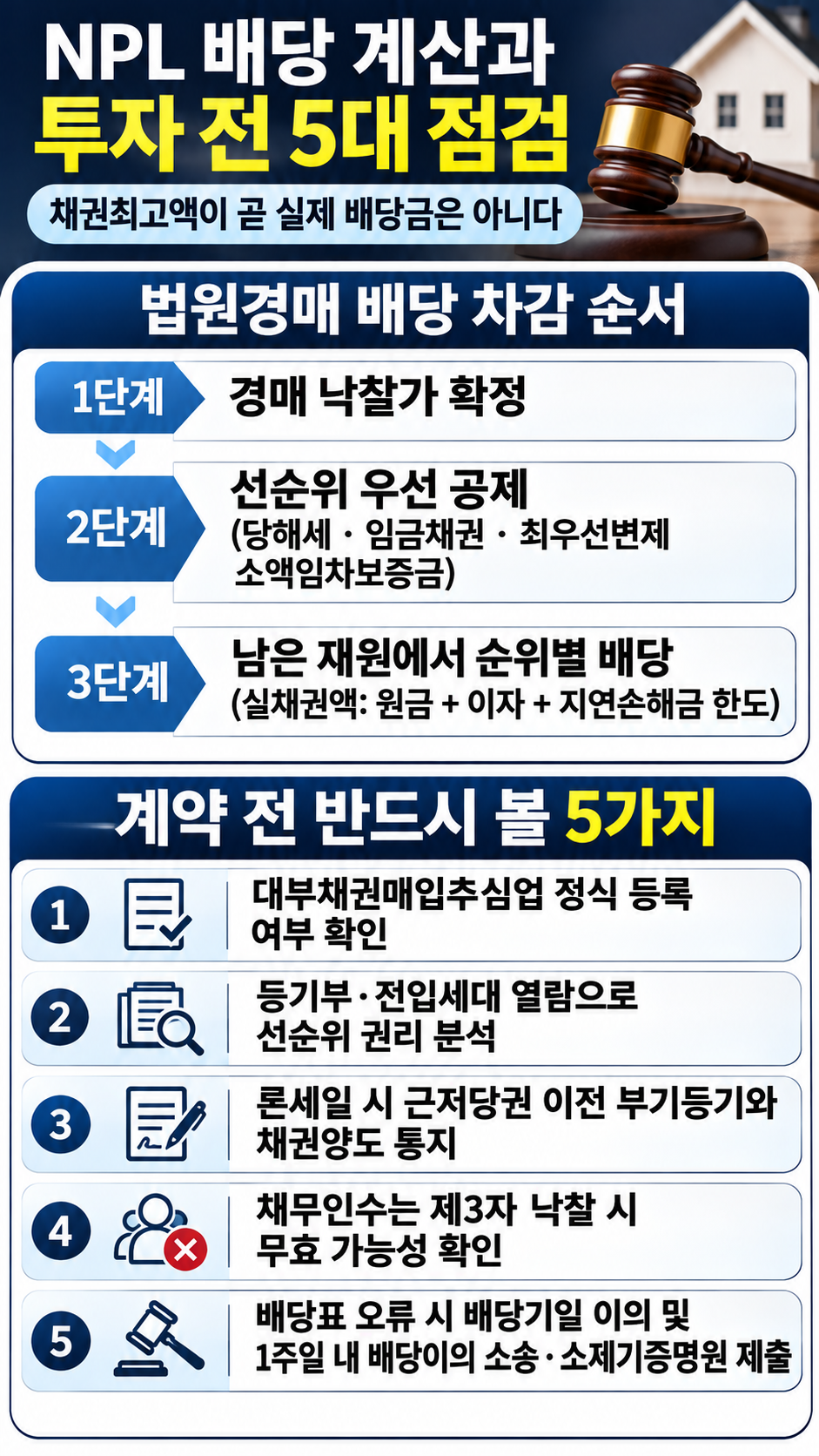
법원경매 배당은 채권최고액이 아니라 당해세·임금채권·소액임차보증금 선순위 공제 뒤 실채권액 한도에서 계산된다. 만인의 탑 편집국이 제작한 설명 이미지이며 실제 현장 사진이나 공식 화면이 아닙니다.
채권최고액과 실제 배당금이 다른 이유
경매와 연결된 부실채권 계산에서 가장 흔한 오해는 등기부등본에 적힌 채권최고액 전액을 그대로 배당받을 수 있다고 믿는 것이다. 채권최고액은 담보권자가 받을 수 있는 최대 한도일 뿐이며, 법원이 실제로 나누어 주는 금액은 원금과 약정 이자, 지연손해금을 합산한 실채권액 범위 안에서만 인정된다. 채무자가 원금 일부를 이미 갚았거나 연체 이자 계산 기간이 짧다면 실채권액은 채권최고액보다 훨씬 적을 수 있다.
더 중요한 변수는 배당 순위다. 부동산이 경매로 팔려 낙찰 대금이 법원에 들어오더라도 근저당권자가 첫 번째로 돈을 가져가는 것이 아니다. 법원 배당 절차에서는 해당 부동산 자체에 부과된 국세·지방세인 당해세, 근로기준법상 최우선변제 임금채권, 그리고 주택·상가임대차보호법상 최우선변제 소액임차보증금이 근저당권보다 앞서 공제된다. 이러한 선순위 공제 항목을 모두 빼고 남은 금액이 부족하면 후순위이거나 심지어 1순위 근저당권 채권이라 해도 예상보다 적은 금액만 배당받아 원금 손실이 발생한다.
이해를 돕기 위한 단순 가정 계산을 예로 들 수 있다. 가령 등기부상 채권최고액이 3억 원이고 실제 원금과 이자 합계가 2억 5천만 원인 담보 채권이 있다고 가정할 때, 낙찰가가 2억 6천만 원으로 결정되더라도 집행비용과 선순위 당해세·소액임차보증금으로 4천만 원이 먼저 빠져나가면 실제 배당 가능 재원은 2억 2천만 원으로 줄어든다. 이처럼 매입가가 채권최고액보다 낮아 보인다는 이유만으로 수익을 장담할 수 없다. 이 숫자는 구조 설명을 위한 가정이며 실제 개별 사건의 배당표는 법원 서류로 직접 산출해야 한다.
계약 전 확인해야 할 다섯 가지 절차와 기한
부실채권 관련 상품이나 경매 연계 계약을 검토할 때는 수익률 표보다 법적 자격과 법원 절차를 먼저 대조해야 한다.
거래 상대방의 적법 등록 여부 확인: 부실채권을 보유·매각하거나 공동 투자를 제안하는 업체가 정식 여신금융기관이거나 대부채권매입추심업 등록 법인인지 공적 조회로 확인한다.
등기부등본과 전입세대 열람 기반 권리 분석: 채권최고액만 보지 말고 말소기준권리, 전입세대 현황, 임차인의 대항력과 확정일자, 당해세·임금채권 존재 여부를 반영해 보수적인 예상 배당표를 작성한다.
대항 요건과 이전 등기 일정 확인: 적격 법인을 통한 채권양수라면 잔금 지급과 동시에 근저당권 이전 부기등기 및 확정일자 있는 채권양도 통지 절차가 빠짐없이 진행되는지 점검한다.
배당요구 종기일과 이의 제기 기한 숙지: 채권 양수 후 법원의 배당요구 종기일 안에 권리를 적법하게 신고해야 하며, 배당표에 순위나 금액 오류가 있다면 배당기일에 직접 출석해 이의를 제기하고 상대방이 동의하지 않을 때 배당기일부터 1주일 이내에 배당이의의 소를 제기한 뒤 집행법원에 소제기증명원을 제출해야 한다.
지연 비용과 유찰 위험 반영: 경매가 여러 차례 유찰되거나 배당이의 소송으로 회수 시점이 늦어지면 그 기간만큼 자금 조달 이자가 누적된다. 낙찰 실패와 배당 지연 시나리오까지 포함한 자금 계획을 세워야 한다.
NPL은 금융기관의 부실 정리 과정에서 형성되는 전문 채권 시장이지, 개인이 손쉽게 원금을 보장받으며 고수익을 얻는 상품이 아니다. 연체 3개월 기준과 대부업법 제9조의4의 양수 제한, 선순위 공제 이후의 실채권액 배당 구조를 먼저 확인하는 것이 불필요한 법적 분쟁과 손실을 피하는 출발점이다.
자료 확인: 2026년 11월 21일. 본 기사는 공개된 대한민국 법령과 금융·사법 공공기관 안내를 바탕으로 작성한 제도 해설이며 개별 투자 자문이나 수익 보장을 제공하지 않는다.
Evaluating non-performing loans requires checking the three-month default threshold, buyer eligibility rules and senior auction deductions together. Editorial illustration prepared by MANINTOP Newsroom; not a photograph of an actual event or official screen capture.
MANINTOP Newsroom
A non-performing loan (NPL) refers to a loan overdue for three months or longer that financial institutions classify as substandard or lower. Under Article 9-4 of South Korea's Act on Registration of Credit Business and Protection of Finance Users, however, ordinary individuals cannot purchase such loan claims directly from banks or registered lenders, and actual court-auction payouts depend on verified claim balances after senior deductions rather than the maximum mortgage amount on the register.
Interest in non-performing loans frequently rises alongside court real-estate auctions and distressed-debt discussions. Promotional claims sometimes suggest that buying discounted loan claims guarantees high auction returns. Yet overlooking statutory buyer restrictions or statutory distribution priorities can expose participants to unlawful transfer arrangements or principal losses. Based on South Korean statutes and official public-agency guidance checked on November 21, 2026, this guide explains how financial regulators classify NPLs, who may legally acquire them, how loan sales differ from debt-assumption contracts and how auction proceeds are distributed. This article explains legal and procedural frameworks and does not recommend investments or guarantee returns.
How the three-month delinquency line separates five asset-quality tiers
Under supervisory regulations overseen by the Financial Services Commission and the Financial Supervisory Service, including the Regulation on Supervision of Banking Business, financial institutions divide credit assets into five categories based on borrower repayment capacity and delinquency duration. Normal and Precautionary assets are not yet classified as NPLs, whereas Substandard, Doubtful and Estimated Loss assets together form substandard-and-below loans, known as NPLs.
Classification tier
Typical delinquency threshold
NPL status
Supervisory meaning
Normal
None or under 1 month
Not NPL
Regular repayment and standard monitoring
Precautionary
1 month to under 3 months
Not NPL
Potential repayment weakness under watch
Substandard
3 months or longer
NPL (entry tier)
Material collection risk; strengthened collateral recovery
Doubtful
3 months to under 12 months
NPL
Severely weakened repayment capacity; portion exceeding expected recovery value
Estimated Loss
12 months or longer
NPL
Collection largely deemed unrecoverable
The decisive threshold in this table is three months of delinquency. Loans overdue for less than three months remain in the Normal or Precautionary tiers, while loans overdue for three months or more drop to at least the Substandard tier and formally enter NPL status. Because higher NPL balances require larger loan-loss provisions, financial institutions periodically package and sell distressed loan claims to eligible buyers to manage soundness ratios. Those disposals supply the secondary NPL market.
Loans overdue for three months or more enter NPL status across five regulatory tiers, and Article 9-4 restricts direct purchases by ordinary individuals. Editorial illustration prepared by MANINTOP Newsroom; not a photograph of an actual event or official screen capture.
In earlier years, individual investors occasionally bought mortgage-backed loan claims directly at a discount to participate in court auctions. That practice drew criticism after unqualified buyers and unregistered operators engaged in harsh or unlawful debt collection against borrowers. In response, amendments to the Act on Registration of Credit Business and Protection of Finance Users and its Enforcement Decree, effective July 2016, strictly narrowed who may acquire loan claims.
Paragraph 3 of Article 9-4 prohibits registered credit businesses and credit financial institutions from transferring claims arising from loan contracts to anyone other than entities specified by Presidential Decree. Under Article 6-4 of the Enforcement Decree and related Financial Services Commission notices, lawful transferees are limited to registered loan-claim purchase and collection businesses, credit financial institutions such as banks, savings banks and capital companies, and designated public or statutory entities including the Korea Deposit Insurance Corporation, resolution financial institutions, Korea Asset Management Corporation (KAMCO), Korea Housing Finance Corporation and the NongHyup Asset Management Company.
Financial institutions or lenders that violate Article 9-4(3) by transferring claims to ineligible individuals face up to three years in prison or fines of up to 30 million won. Likewise, an unregistered individual who repeatedly buys and collects distressed claims as a business risks criminal liability for unregistered credit operations. Consequently, banks and securitization entities generally cannot execute direct loan-transfer contracts with ordinary individuals who lack statutory registration.
Differences among corporate registration, indirect funds, loan sales and debt assumption
Because direct acquisition by an individual is barred, market participation takes distinct legal structures, each carrying separate compliance obligations and financial risks.
Structure or transaction type
Legal party and mechanism
Key risks and verification points
Registered collection corporation
Establishing a corporate entity registered for loan-claim purchase and collection after meeting capital requirements
Ongoing registration compliance, debt-collection regulations and corporate overhead
Indirect investment
Investing in regulated funds or beneficiary certificates managed by licensed asset managers
Management fees and potential principal loss if underlying assets underperform
Loan sale (claim assignment)
Eligible entity acquires both the loan claim and accompanying mortgage right
Requires supplementary mortgage-transfer registration and certified notice to or consent from the debtor
Debt assumption (conditional)
Agreement assuming borrower obligations on the condition that the investor wins the auction directly
Contract may become void or plan may fail if a third party outbids and wins the auction
In a loan sale executed by a qualified corporation, paying the purchase price does not by itself complete enforceable rights against third parties and the debtor. The buyer must complete supplementary registration of the mortgage transfer on the real-estate register and satisfy Civil Act perfection requirements through a date-certified notice of assignment reaching the debtor or the debtor's consent. Any gap in completing these steps leaves the buyer exposed to competing claims.
Conditional debt-assumption contracts, which are often marketed to individual auction participants, operate on a different premise. They rely on the assumption that the participant will actually win the property at court auction. If a third party submits a higher bid and wins the auction, the conditional debt-assumption contract loses its premise and may terminate or return only the deposit under contract terms. Marketing phrases implying principal protection should always be checked against the written contract clauses.
Court auction distributions are capped by verified claim balances after senior taxes, wage claims and small tenant deposits are deducted rather than the registered maximum mortgage amount. Editorial illustration prepared by MANINTOP Newsroom; not a photograph of an actual event or official screen capture.
Why the registered maximum mortgage amount differs from actual auction payouts
A frequent misconception in auction-linked NPL analysis is assuming that a buyer receives the full maximum mortgage amount printed on the real-estate register. That figure is only the upper cap secured by the mortgage. Actual court distributions are limited to the verified claim balance, meaning remaining principal plus contractual interest and lawful default interest. If the borrower already repaid part of the principal or accrued limited interest, the payable claim can be substantially smaller than the registered ceiling.
Priority deductions are equally decisive. Even when an auction sale closes and the winning bidder pays the full price to the court, a mortgage holder does not stand first in line. Under court distribution rules, property-specific taxes imposed on the real estate, super-priority employee wage claims and statutory super-priority small tenant deposits under housing or commercial lease protection laws are deducted ahead of mortgage claims. If remaining proceeds after those deductions fall short, even a first-ranking mortgage claim can suffer a principal loss.
A simplified hypothetical example illustrates the arithmetic. Suppose a registered maximum mortgage amount is 300 million won and the verified balance of principal and interest is 250 million won. Even if the auction closes at 260 million won, deducting 40 million won for auction costs, senior property taxes and super-priority tenant deposits leaves 220 million won for distribution. A purchase price that looks low relative to the registered maximum amount therefore does not guarantee a profit. These numbers are purely illustrative assumptions; actual payouts must be calculated from official court auction records for each case.
Five procedural checks and deadlines before entering any contract
Anyone reviewing an NPL-related product or auction-linked agreement should verify legal status and court deadlines before looking at projected yield tables.
Verify statutory registration of counterparties: Confirm through official records that any firm holding, selling or co-investing in distressed loans is a licensed credit institution or a properly registered loan-claim purchase and collection business.
Conduct full title and occupancy analysis: Review the real-estate register alongside resident registration records, lease status, fixed dates, senior property taxes and potential wage claims to build a conservative distribution table rather than relying on the maximum mortgage figure.
Confirm perfection and registration timing: For qualified corporate loan sales, ensure supplementary mortgage-transfer registration and date-certified assignment notices proceed without delay upon settlement.
Track distribution demand and objection deadlines: Claimants must file rights before the court's deadline for distribution demands. If a distribution schedule contains priority or amount errors, the party must attend the distribution hearing to object and, if the counterparty does not agree, file a distribution objection lawsuit within one week of the distribution date and submit proof of filing to the execution court.
Account for failed auctions and delay financing costs: Repeated auction postponements or distribution litigation extend holding periods and add financing interest. Capital planning should incorporate both outbid scenarios and prolonged payout timelines.
NPLs represent a specialized institutional workout market created as financial firms resolve overdue assets, not a simple principal-guaranteed vehicle for individual investors. Confirming the three-month classification standard, the statutory transfer limits under Article 9-4 and senior deductions before actual claim payouts is the essential starting point for avoiding legal disputes and capital loss.
Data verified: November 21, 2026. This article summarizes public South Korean statutes and official agency guidance for informational purposes and does not constitute investment advice or guarantee financial returns.
PRO SOURCING ENGINE만인의 탑 빅데이터 솔루션
★ 가입 시 600 크레딧(120회) 전원 무료
내가 찾는 상품 키워드, 지금 얼마나 검색될까?
네이버 월간 검색량 + 구글 볼륨 + 아이템스카우트 실시간 상품수와 경쟁강도 배지를 0.5초 만에 무료로 확인하세요.
MANINTOP NEWSLETTER
📬 만인의 탑 뉴스레터 무료 구독
오늘 보신 정책·시사 뉴스가 유익하셨나요? 매일 엄선되는 알짜 복지 혜택과 국회 실시간 속보를 이메일로 가장 먼저 받아보세요. (평생 무료)
1월이 시작되면 감기는 이미 우리 곁에 와 있습니다. 2월, 3월, 4월까지 이어지는 추위와 건조함은 코와 목을 가장 먼저 공격합니다. 아침에 일어나자마자 막혀 있는 코. 계속 흐르는 콧물. 괜히 칼칼해지는 목. 이 증상은 “시작”일 뿐입니다. 한 번 무너지면 일주일, 길면 한 달까지 끌고 갑니다. 약을 먹으면 잠깐 괜찮아집니다. 하지만 며칠 뒤 또 반복됩니다. 왜일까요? 감기는 ‘치료’의 문제가 아니라 ‘관리’의 문제이기 때문입니다. 대부분은 감기가 오고 나서 약을 찾습니다. 하지만 진짜 중요한 건 감기가 오기 전에 코와 목을 지키는 것입니다. 건조한 실내 공기, 차가운 바깥 공기, 눈에 보이지 않는 세균. 코와 목은 매일 공격받고 있습니다. 지긋지긋하죠! 그런데도 우리는 아무 준비 없이 버티고 있습니다. 이번 겨울도 그렇게 보낼 건가요? 사실 방법은 어렵지 않습니다. 코를 깨끗하게 관리하고, 목을 따뜻하게 보호하고, 점막을 촉촉하게 유지하고, 기관지를 미리 관리하고, 외부 공기를 차단하는 것. 이 다섯 가지만 꾸준히 해도 감기약 없이 겨울을 보내는 것이 충분히 가능합니다. 🔥 이제부터 그 방법을 하나씩 살펴보겠습니다. 🔥 1. 코와 목을 먼저 관리해야 하는 과학적 이유 감기의 대부분은 코 점막에서 시작됩니다. 국제 학술지 Nature Reviews Microbiology 와 Journal of Allergy and Clinical Immunology 에 실린 호흡기 감염 관련 연구들에서는, 감기 바이러스가 비강 상피세포에 먼저 부착해 증식한다는 점을 설명하고 ...
리모델링사업이 진행 중인 아파트를 매매할 때 “계약금 10%를 언제까지 내야 하느냐”는 질문이 특히 많이 나옵니다. 이주공고(이주 안내)가 7~11월쯤이라고 들으면, 그 시점에 맞춰 계약금도 움직일 것 같아서 더 헷갈리기 쉽습니다. 하지만 실제 납부기한은 ‘이주공고가 언제냐’만으로 자동 결정되지 않는 경우가 많습니다. 1) 계약금 10% 납부기한: 결국 ‘문서에 적힌 일정’이 기준 계약금 10%를 언제까지 납부해야 하는지는, 내가 서명하는 매매계약서(특약 포함) 와 사업주체/조합이 제시한 공고·안내문 에 적힌 납부 일정이 기준이 됩니다. 실제 공고문에서는 분양대금 납부의 큰 틀(계약금→중도금→잔금)을 먼저 안내하고, 상세 일정은 별도 표나 유의사항으로 제시하는 방식이 흔합니다. 또, 계약서 문구에 따라 지급 시점이 조건부로 설정될 수도 있습니다. 예를 들어 한 사례 소개 자료에서는 용역계약서에 잔금(10%) 지급시기가 “사업승인 후”로 기재되어 있었다는 점이 언급됩니다. 이런 식으로 ‘사업 단계’와 지급을 연동하는 문구가 들어가면, 질문의 답은 계약서 문구를 확인해야만 확정됩니다. 관련 내용은 링크 에서 문구 사례를 확인할 수 있습니다. 2) 입주자모집공고에서 확인되는 ‘납부 순서’와 잔금 마감 시점 공고문에 적힌 문구를 보면, 납부 순서와 잔금 마감에 대한 기준이 비교적 명확하게 제시되는 경우가 있습니다. 예를 들어 한 입주자모집공고에는 “분양금액(주택가격)은 계약금, 중도금, 잔금의 순서로 납부”하며 “잔금은 입주(열쇠 수령일) 전에 완납”해야 한다고 안내되어 있습니다. (문구 확인: 링크 ) 이 문구가 의미하는 바는 최소 2가지입니다. 분양/공급 형태의 문서에서는 ‘계약금→중도금→잔금’ 흐름이 공식적으로 안내될 수 있습니다. 잔금은 “입주(열쇠 수령)” 이전에 완납해야 한다는 마감 기준이 문서에 적혀 있을 수 있습니다. 다만, 위 공고문 문구는 잔금 마감에 대한 기준을 보여주지만, 계약금 10%의...
윤석열 전 대통령 탄핵 인용 소식을 접하면, 가장 궁금한 지점은 ‘헌재가 정확히 무엇을 위헌·위법으로 봤는가’입니다. 또한 탄핵과 별개로 진행되는 형사재판(내란 우두머리 혐의 등)이 어디까지 왔는지도 함께 정리할 필요가 있습니다. 아래 내용은 제공된 기사/게시물 스니펫과 링크에서 확인되는 범위만 모아, 일반인이 흐름을 이해하기 쉽게 정리한 것입니다. 1) 탄핵 인용 관련: 스니펫에서 확인되는 ‘판단의 골격’ 제공된 근거 중 조국혁신당 사이트에는 헌법재판소가 윤석열 탄핵 심판에서 “피청구인의 위헌·위법행위는 국민 신임 …”이라는 취지로 판단했다는 문장이 인용돼 있습니다( 링크 ). 이 인용문만 놓고 보면, ‘위헌·위법행위’가 있었는지와 그로 인해 ‘국민의 신임’이 어떻게 평가됐는지가 핵심 축으로 소개됩니다. 다만 질문에서 요청하신 세부 항목, 즉 비상계엄 선포 자체를 문제 삼은 구체적 이유, 계엄 이후 조치(포고령, 국회 통제 등)의 어떤 지점이 헌법 위반인지, 국회의 권한행사 방해 및 정치활동 제약을 어떤 논리로 판단했는지 등은, 이번에 제공된 근거의 제목/스니펫만으로는 조항·사실관계·판단 구조가 그대로 제시돼 있지 않습니다. 따라서 이 글에서는 ‘헌재가 무엇을 문제 삼았다’는 세부 리스트를 단정적으로 재구성하기보다, 현재 확인 가능한 문구 수준의 요약(위헌·위법행위 → 국민 신임의 문제로 평가)까지만 적습니다. 만약 헌재 결정문 전문(주문 및 이유)이 추가로 확인되면, 그때는 문장 단위로 ‘어떤 행위’와 ‘어떤 헌법 원리/조항’이 연결되는지(예: 권력분립, 국회의 권한, 정치적 기본권 등) 구조화해 정리하는 것이 가장 정확합니다. 2) 형사 절차(내란 혐의) 관련: 체포영장과 1심 선고 언급 탄핵 심판과 별도로, 12·3 비상계엄 사태로 내란 혐의를 받는 윤석열 대통령에 대해 2024년 12월 31일 체포 영장이 발부됐다는 BBC 보도가 있습니다( 링크 ). 해당 보도는 ‘현직 대통령’에 대한 체포영장 발부라는 점을 함께 언급합니다. 또...