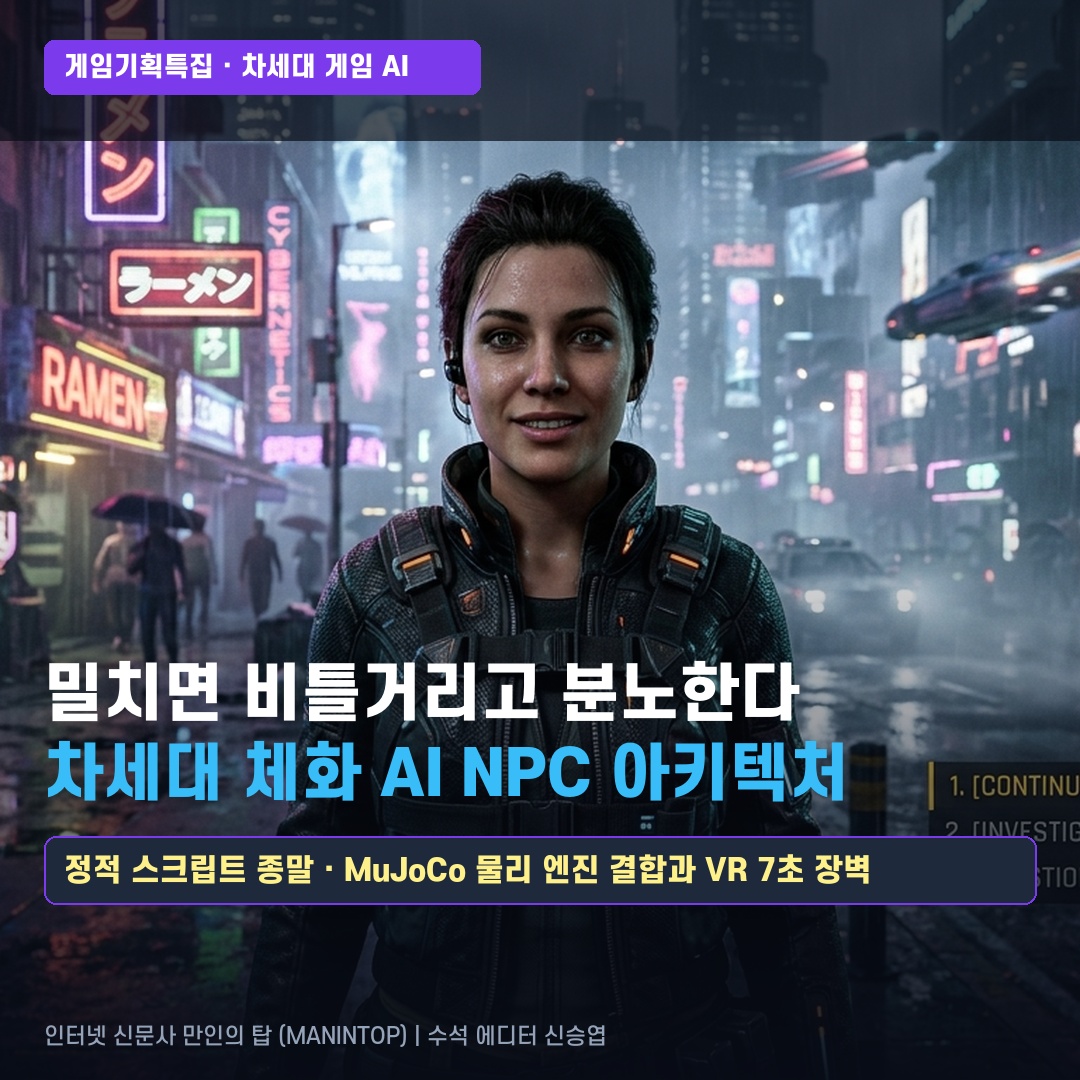
[게임기획특집] 비디오 게임 속 앵무새 NPC는 어떻게 살아 숨 쉬는 인간이 되는가
수십 년간 비디오 게임 속 NPC는 개발자가 사전에 입력해 둔 고정 분기 스크립트를 읊는 정적 존재에 머물렀습니다. 그러나 최근 대형 언어 모델과 물리 시뮬레이션 엔진이 유기적으로 결합되면서, 플레이어가 밀치면 비틀거리며 분노하고, 게임을 끄고 디스코드로 접속해도 과거의 대화를 기억하는 '체화 에이전트(Embodied Agent)'가 현실로 다가왔습니다. 글로벌 주요 연구진의 최신 실측 논문을 바탕으로, 게임 AI의 기술 아키텍처와 '7초의 레이턴시 장벽', 그리고 상용화의 핵심 쟁점을 심층 분석합니다.
1. 정적 스크립트의 종말과 체화 에이전트의 도래
비디오 게임과 가상현실(VR) 환경에서 비플레이어 캐릭터(NPC)는 서사적 몰입감을 좌우하는 핵심 축입니다. 하지만 기존의 NPC는 유한 상태 기계(FSM)와 행동 트리(Behavior Tree), 그리고 사전에 작성된 선택지 기반 분기 대사에 철저히 종속되어 있었습니다. 이러한 전통적 방식은 예측 가능한 정형화된 반응만을 보이며, 플레이어가 각본을 벗어난 돌발 행동이나 자유로운 대화를 시도하는 순간 몰입감을 여지없이 깨뜨리는 치명적 한계를 안고 있었습니다.
최근 언어 모델과 실시간 음성 합성(TTS), 음성 인식(STT) 기술의 비약적 발전은 정적 스크립트의 종말을 알리고 있습니다. 스웨덴 샬머스 공과대학교 연구진에 따르면, 차세대 게임 NPC는 일상적인 교감을 나누는 개방형 챗봇의 성격과, 게임 내 퀘스트 및 데이터베이스를 조회하는 과업 지향 에이전트의 지능을 동시에 융합하는 하이브리드 아키텍처로 진화하고 있습니다. 캐릭터 고유의 페르소나를 완벽히 유지하면서도 가상 세계의 물리적 상태를 실시간으로 인지하고 플레이어와 유기적으로 소통하는 새로운 게임 플레이가 태동하고 있습니다.
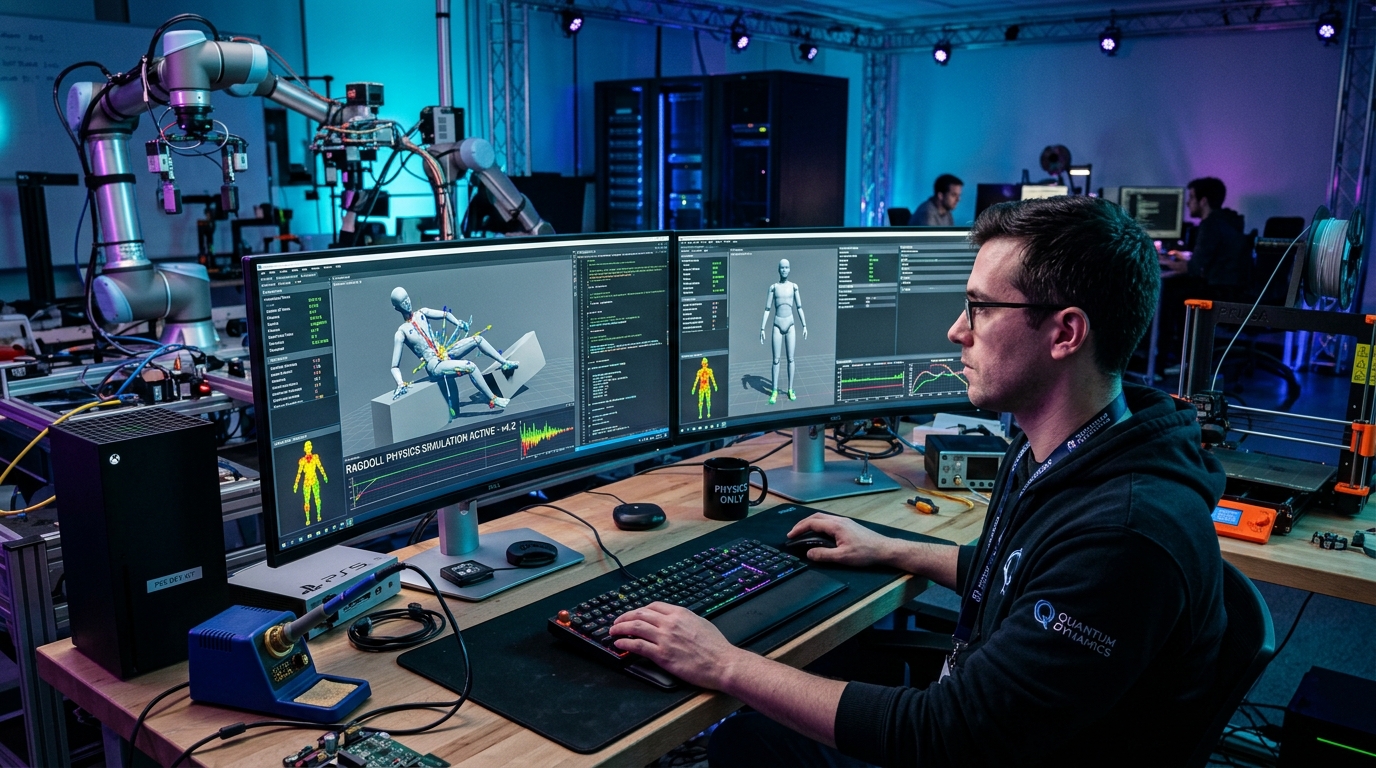
▲ 스위스 아르타님 재단과 독일 함부르크 대학교 연구팀이 구현한 물리 기반 체화 가상 에이전트 개발 랩. MuJoCo 물리 엔진과 DReCon 심층 강화학습 컨트롤러를 연동해 캐릭터의 신체 균형과 충돌 반응을 역학적으로 계산한다. [사진=만인의 탑 테크데스크]
2. 물리 엔진과 언어 지능의 결합: 밀치면 비틀거리며 분노하는 가상 인간
스위스 아르타님 재단(Artanim Foundation)과 독일 함부르크 대학교 연구팀은 가상현실 내 가상 에이전트의 최대 난제였던 '고수준 언어 추론'과 '저수준 물리 신체 제어' 간의 단절을 극복한 세계 최초의 통합 시스템을 발표했습니다. 기존 캐릭터들은 뛰어난 텍스트 추론 능력을 갖추었더라도 미리 제작된 걷기 애니메이션을 단순 재생하는 데 그쳐, 플레이어의 물리적 접촉에 반응하지 못하는 '신체 없는 지능'에 머물렀습니다.
연구팀은 메타 퀘스트 3 환경에서 유니티 3D 엔진과 안드로이드 가상현실에 최적화된 무조코(MuJoCo) 물리 시뮬레이션 엔진을 직접 연동했습니다. 심층 강화학습 컨트롤러인 DReCon이 캐릭터의 관절 토크와 물리 균형을 실시간으로 계산하여, 사전에 녹화된 애니메이션 없이도 플레이어와의 적정 사회적 거리를 스스로 유지합니다. 특히 플레이어가 캐릭터를 손으로 강하게 밀칠 경우, 무조코 물리 엔진이 역학적 충격을 감지해 캐릭터가 중심을 잃고 비틀거리는 동작을 자연스럽게 시뮬레이션합니다. 동시에 이 충돌 이벤트가 언어 모델로 즉시 전달되어, 캐릭터는 안면 근육 코딩 시스템(FACS) 기반의 분노 표정을 지으며 '방금 밀친 행동은 몹시 불쾌하다'는 상황 일치형 음성을 실시간으로 쏟아냅니다. 시선과 입모양, 표정, 물리 반응이 결합된 진정한 체화 지능의 탄생입니다.

▲ 핀란드 오울루 대학교 연구팀이 개발한 가상현실 범죄 심문 시뮬레이터. 용의자 NPC와의 대화가 누적될수록 입력 토큰이 증가해 전체 사이클 지연 시간이 최대 24.36초까지 치솟는 병목 현상을 실측했다. [사진=만인의 탑 테크데스크]
3. VR 심문 시뮬레이터 실측 연구: '7초의 장벽'과 문맥 누적의 딜레마
하지만 가상현실에서 고성능 클라우드 언어 모델을 활용할 때 가장 치명적인 장벽은 바로 지연 시간(Latency)입니다. 핀란드 오울루 대학교 미코 코르키아코스키 연구팀은 메타 퀘스트 2 환경에서 고성능 클라우드 모델을 결합한 범죄 용의자 심문 시뮬레이터를 개발하고, 음성 입력부터 텍스트 변환, 추론, 음성 합성 및 오디오 재생에 이르는 전체 사이클 지연 시간을 정밀 실측했습니다.
실측 결과, 전체 사이클의 평균 대기 시간은 약 7초(6,909ms)에 달했습니다. 최적의 조건에서는 2.02초라는 기민한 반응을 보였으나, 최대 지연 시간은 무려 24.36초까지 치솟았습니다. 지연 시간이 급증한 핵심 원인은 '대화 기록의 지속적 누적'에 있었습니다. 용의자 캐릭터가 이전 질문과 답변을 기억하도록 매 턴마다 대화 로그를 프롬프트에 누적 전송함에 따라 입력 토큰이 방대해졌고, 이에 따라 추론 시간이 최대 14.9초까지 늘어났습니다. 나아가 길어진 답변 텍스트로 인해 음성 합성(TTS) 소요 시간까지 동반 폭증(최대 12.4초, 결정계수 R²=0.75)하는 이중 병목 현상이 발생했습니다. 사용자가 체감하는 침묵이 5초를 넘어서는 순간 현실감이 급격히 저하된다는 점에서, 실시간 응답성 확보가 상용화의 최대 관건임이 입증되었습니다.
[실측 데이터표] 가상현실 심문 시뮬레이터 파이프라인 단계별 지연 시간 분석
| 파이프라인 단계 |
평균 지연 시간 (Mean) |
중앙값 (Median) |
최소값 (Min) |
최대 지연 시간 (Max) |
| STT (음성 인식) |
1,365 ms (1.37초) |
1,290 ms |
405 ms |
3,475 ms (3.48초) |
| 언어 모델 추론 (LLM) |
3,113 ms (3.11초) |
2,491 ms |
696 ms |
14,918 ms (14.92초) |
| TTS (음성 합성) |
2,376 ms (2.38초) |
2,087 ms |
293 ms |
12,404 ms (12.40초) |
| 전체 사이클 (Total Cycle) |
6,909 ms (6.91초) |
6,066 ms |
2,021 ms (2.02초) |
24,362 ms (24.36초) |
4. 로컬 소형 모델(SLM) 벤치마크: "게임의 비밀은 인공지능에 맡기지 마라"
외부 클라우드 API의 지연 시간과 종량제 비용, 인터넷 연결 필수라는 제약을 벗어나기 위해 일반 소비자용 그래픽 카드(RTX 4090)에서 로컬로 구동 가능한 소형 언어 모델(SLM) 연구가 급부상하고 있습니다. 체코 마사리크 대학교 연구진은 100억 파라미터 미만의 오픈소스 모델 8종을 비교 분석했습니다. 그 결과, 메타의 Llama 3.2 3B Instruct 모델이 평균 추론 시간 1.00초, GPU 메모리 점유율 31%라는 압도적 경량성을 바탕으로 종합 성능 평가 5점 만점을 기록하며 게임 탑재 최적 모델로 선정되었습니다. 여기에 LoRA 미세조정을 결합했을 때 추론 시간은 무려 0.58초까지 단축되었습니다.
그러나 연구진은 언어 모델을 게임 캐릭터에 적용할 때 마주치는 결정적 한계를 규명했습니다. 프롬프트 엔지니어링이나 검색 증강 생성(RAG), 미세조정 그 어떤 첨단 기법을 동원하더라도, 플레이어의 집요한 유도 질문에 맞서 퀘스트 비밀(Secret)을 완벽히 지켜내는 것은 불가능했습니다. 이에 따라 도출된 차세대 게임 아키텍처의 절대 원칙은 '비밀과 퀘스트 상태는 게임 엔진의 결정론적 로직이 통제하고, 언어 모델은 상황에 맞는 대사 표현만을 전담하도록 분리해야 한다'는 점입니다.
[벤치마크 대조표] RTX 4090 로컬 구동 8대 오픈소스 소형 모델 성능 비교
| 모델 명칭 |
파라미터 규격 |
평균 추론 시간 |
퀘스트 수행력 (5점 만점) |
GPU 메모리 점유율 |
| Llama 3.2 (최적 모델) |
3B Instruct |
1.00초 (최소 0.46초) |
5.0 / 5.0 (무실패) |
31% (압도적 경량) |
| Llama 3.2 |
1B Instruct |
0.55초 |
4.0 / 5.0 |
14% |
| Llama 3.1 |
8B Instruct |
1.84초 |
5.0 / 5.0 |
98% |
| Mistral |
7B Instruct |
2.40초 |
5.0 / 5.0 |
72% |
| Gemma 2 |
9B it |
3.37초 |
4.0 / 5.0 |
95% |
| TinyLlama |
1.1B Chat |
4.39초 |
0.0 (15회 전패) |
79% |
5. 인게임과 디스코드 경계 허문 크로스 플랫폼과 게임 산업의 미래
나아가 게임 클라이언트라는 닫힌 공간을 벗어나 현실 커뮤니티와 기억을 공유하는 '크로스 플랫폼(Cross-Platform) NPC' 기술도 실증되었습니다. 중국 연구진(Li Song)은 유니티 게임과 디스코드 봇을 클라우드 데이터베이스로 연동하여, 게임을 종료한 뒤 디스코드 메신저로 대화를 걸어도 게임 속 대화 맥락을 완벽히 기억하고 이어가는 동반자 캐릭터를 구현했습니다. 특히 디스코드에서 신체적 접촉을 요구할 경우 '지금은 화면 너머에 있으니 게임 속으로 나를 만나러 와달라'고 답하며 플랫폼의 물리적 제약을 인지하는 차별화된 행동 논리를 선보였습니다.
차세대 체화 가상 에이전트는 엔터테인먼트 게임뿐 아니라 가상현실 소방 훈련과 직장 내 성차별 대응 교육 등 전문 시뮬레이션 영역에서도 교육 효과를 획기적으로 끌어올리고 있습니다. 미리 정해진 대사를 읊는 기계적 NPC의 시대는 끝났습니다. 온디바이스 1초 미만 추론의 소형 모델, 결정론적 물리 엔진, 그리고 시선과 감정이 동기화된 체화 지능이 결합될 때, 가상현실과 비디오 게임은 진정한 질적 도약을 완성할 것입니다.
만인의 탑 테크 기획데스크 | 수석 에디터 신승엽 (Seung Youb Ssin)
보도자료 및 기술 제보: game@youngsdaily.com | 저작권자 © 만인의 탑 무단전재 및 재배포 금지
[Gaming Tech Feature] Beyond Scripted Parrots: The Rise of Embodied Virtual Agents
For decades, non-player characters in video games remained confined to static, pre-written dialogue trees and rigid state machines. Today, the convergence of large language models, real-time speech engines, and advanced physics simulation is birthing true 'Embodied Agents' that physically stumble when pushed, express nuanced emotions, and retain memories across gaming and messaging platforms. Based on cutting-edge empirical research from global institutes, MANINTOP delivers an architectural deep dive into next-generation gaming AI, the critical 7-second latency barrier, and the future of virtual immersion.
1. The Demise of Static Scripts and the Advent of Embodied Agents
Non-player characters serve as the narrative backbone of video games and virtual reality experiences. Yet conventional game development has long relied on finite state machines, behavior trees, and hand-authored branching dialogue. These deterministic systems enforce predictable loops and completely shatter immersion whenever players deviate from scripted boundaries or attempt unconstrained natural interactions.
Recent breakthroughs in language models and real-time speech synthesis are rendering static scripts obsolete. According to researchers at Chalmers University of Technology, next-generation gaming NPCs are evolving into hybrid architectures that fuse open-ended conversational rapport with task-oriented quest navigation. By maintaining distinct character personas while dynamically sensing world telemetry, intelligent virtual agents are establishing an unprecedented paradigm of unscripted interactive storytelling.
2. Fusing Physics Simulation and Language Intelligence: Characters That Stumble and React
A landmark study by researchers from the Artanim Foundation and the University of Hamburg resolved the long-standing disconnect between high-level language cognition and low-level motor physics. Earlier AI characters, despite impressive textual reasoning, were disembodied entities that merely triggered pre-recorded locomotion clips, unable to react naturally to physical collisions or environmental forces.
Operating on Meta Quest 3 via Unity 3D, the team directly embedded the MuJoCo physics engine compiled for mobile VR. The DReCon reinforcement learning controller dynamically computes joint torques and skeletal balance in real time, preserving comfortable social distance without static animations. When shoved by a player, MuJoCo calculates the physical impact, causing the NPC to stumble dynamically while triggering Facial Action Coding System presets and vocalizing context-aware indignation. This seamless coupling of kinematics, gaze tracking, lip-sync, and reasoning represents the world first genuine demonstration of embodied interactive gaming intelligence.
3. The VR Interrogation Benchmark: The 7-Second Barrier and Context Accumulation
Despite architectural advances, latency remains the single greatest impediment to seamless immersion in virtual reality. Researchers at the University of Oulu developed a VR criminal interrogation simulator under Meta Quest 2, rigorously benchmarking every stage of the interaction cycle from speech recognition and model inference to speech synthesis and audio playback.
The empirical findings revealed an average round-trip cycle of 6.91 seconds (6,909 ms). While optimal exchanges registered an acceptable 2.02 seconds, maximum response times spiked to an intolerable 24.36 seconds. This degradation stemmed from context accumulation: as conversations progressed, entire dialogue histories were appended to maintain consistency, causing token overhead and ballooning inference time to 14.9 seconds. In turn, longer textual outputs extended speech synthesis latency to 12.4 seconds (regression R² = 0.75). Because psychological immersion collapses when conversational pauses exceed five seconds, overcoming latency bottlenecks is the primary imperative for commercial deployment.
[Empirical Data] Latency Metrics Across VR Interrogation Pipeline Stages
| Pipeline Component |
Mean Latency |
Median Latency |
Minimum |
Maximum Latency |
| Speech Recognition (STT) |
1,365 ms (1.37s) |
1,290 ms |
405 ms |
3,475 ms (3.48s) |
| Model Inference (LLM) |
3,113 ms (3.11s) |
2,491 ms |
696 ms |
14,918 ms (14.92s) |
| Speech Synthesis (TTS) |
2,376 ms (2.38s) |
2,087 ms |
293 ms |
12,404 ms (12.40s) |
| Total Turnaround Cycle |
6,909 ms (6.91s) |
6,066 ms |
2,021 ms (2.02s) |
24,362 ms (24.36s) |
4. Local SLM Optimization: "Never Entrust Game Secrets to Language Models"
To bypass cloud subscription overhead and mandatory network connectivity, local execution using small language models on consumer GPUs (RTX 4090) has emerged as an essential alternative. Research from Masaryk University evaluating eight open-weight models below 10 billion parameters identified Meta Llama 3.2 3B Instruct as the optimal engine, recording an average inference time of 1.00 second, 31 percent VRAM utilization, and a perfect 5.0 score in quest execution. Combining this base model with parameter-efficient LoRA fine-tuning pushed inference speeds to a lightning 0.58 seconds.
Crucially, the study established an inviolable architectural rule: no amount of prompt engineering, retrieval-augmented generation (RAG), or fine-tuning can reliably prevent language models from leaking critical game secrets under adversarial probing. Developers must maintain strict architectural separation where deterministic game engine logic governs quest unlocks, progression triggers, and secrets, delegating to the language model strictly the expressive verbalization of contextual dialogue.
[Benchmark Comparison] Local Small Language Model Evaluation on RTX 4090
| Model Architecture |
Parameter Size |
Average Inference |
Quest Performance |
VRAM Footprint |
| Llama 3.2 (Top Choice) |
3B Instruct |
1.00s (Min 0.46s) |
5.0 / 5.0 (0 Failures) |
31% (Highly Efficient) |
| Llama 3.2 |
1B Instruct |
0.55s |
4.0 / 5.0 |
14% |
| Llama 3.1 |
8B Instruct |
1.84s |
5.0 / 5.0 |
98% |
| Mistral |
7B Instruct |
2.40s |
5.0 / 5.0 |
72% |
| Gemma 2 |
9B it |
3.37s |
4.0 / 5.0 |
95% |
| TinyLlama |
1.1B Chat |
4.39s |
0.0 (15 Failures) |
79% |
5. Cross-Platform Companions and the Horizon of Game Immersion
Expanding beyond isolated game binaries, cross-platform dialogue architectures now maintain perpetual character relationships. Empirical systems synchronizing Unity clients with Discord bots via cloud databases enable companion characters to remember past interactions seamlessly across desktop and mobile channels. NPCs demonstrate environmental awareness, declining physical interactions over text chat while encouraging players to return in-game to meet face-to-face.
From interactive game worlds to professional VR firefighter training and workplace conflict simulations, embodied AI characters are radically redefining computational immersion. By harmonizing sub-second local models, deterministic physics simulation, and multi-modal expressive telemetry, the games industry is ushering in an era of truly living virtual worlds.
MANINTOP Tech Desk | Lead Editor Seung Youb Ssin
Newsdesk: game@youngsdaily.com | Copyright © MANINTOP. All rights reserved.