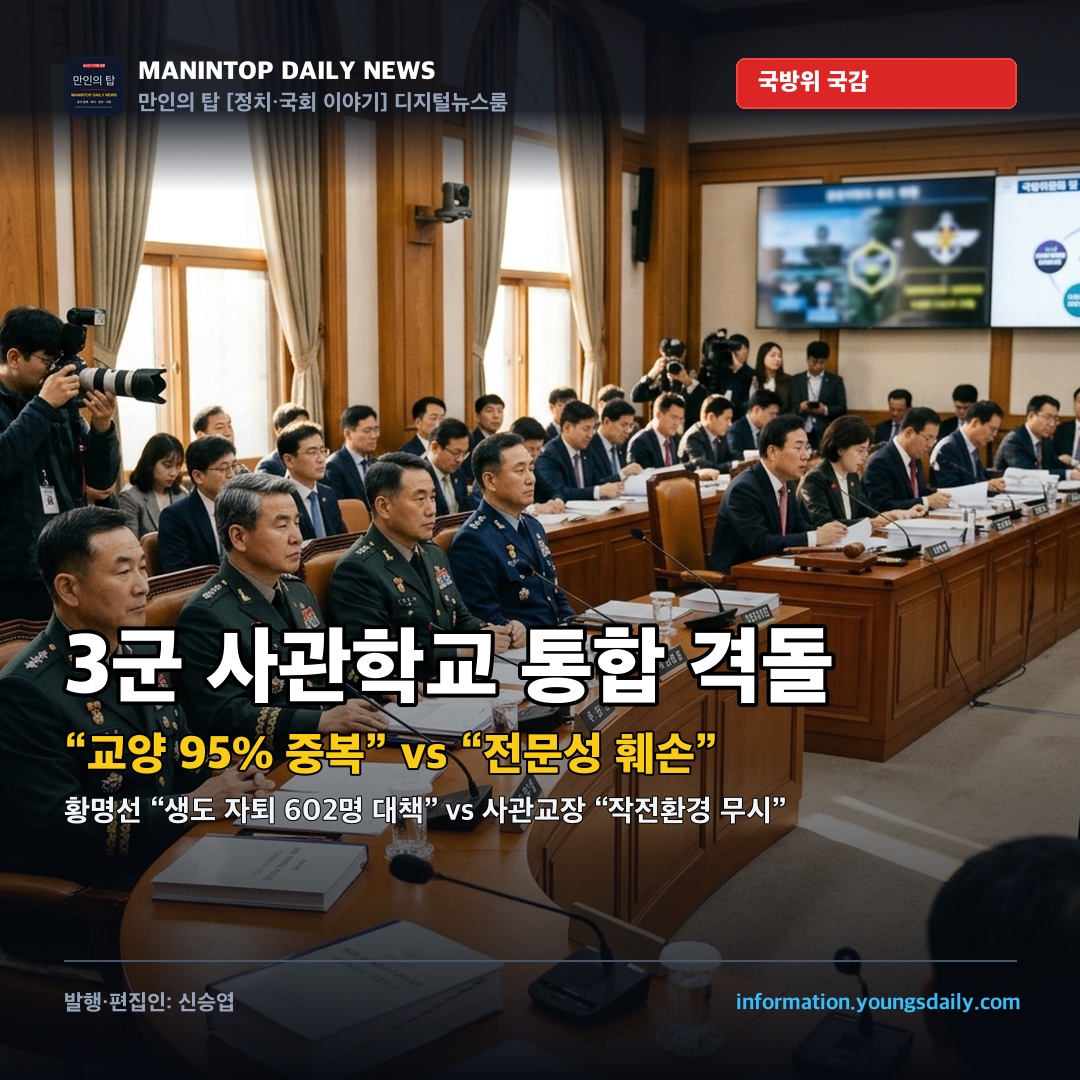
▲ 국회 국방위원회가 서울 노원구 육군사관학교에서 3군 사관학교 국정감사를 진행 중인 가운데, 육·해·공군 사관학교장과 군 수뇌부가 증인석에서 의원 질의에 답변하고 있다. / 그래픽·보도사진=만인의 탑 디지털뉴스룸
📌 만인의 탑 핵심 브리핑 · 이 글에서 다루는 핵심 내용
국회 국방위원회가 서울 노원구 육군사관학교를 직접 찾아 진행한 현장 국정감사에서 육·해·공군 사관학교의 교양 교육과정이 95.4% 중복된다는 실측 분석 결과를 두고 여야 의원들과 3군 사관학교장 간의 격렬한 설전이 벌어졌다. 학령인구 급감과 10년간 생도 602명 자퇴라는 구조적 위기 속에 '통합 국방사관학교' 설립을 촉구하는 개혁론과, 바다와 비행장이 없는 환경에서는 고유 작전 역량을 기를 수 없다는 군별 신중론이 정면으로 맞부딪쳤다.
🔍 3대 핵심 사실관계 요약 (Core Facts)
교양과목 95.4% 유사도 실측: 황명선 의원실 전수조사 결과, 육·해·공군 사관학교의 교양 교과과정이 95.4%, 일반 전공 포함 시 최대 76%가 사실상 동일한 것으로 확인.
생도 양성비 3억 원과 자퇴 602명: 사관생도 1인당 4년간 3억 원 이상의 국비가 투입되나, 최근 10년간 3군 사관생도 602명이 중도 자퇴하며 인구절벽 속 장교 수급 위기 고조.
통합 국방사관학교 vs 작전 특수성 훼손: 1~2학년 통합 캠퍼스 설립을 요구하는 여당 및 국방위 개혁파와, 바다와 비행장이 없는 환경에서 해상·비행 작전 훈련이 불가하다는 3군 사관학교장의 격돌.
1. 육사 현장 찾은 국방위… 생도 시험 기간에 터져 나온 ‘3군 통합론’
국회 국방위원회가 2026년도 국정감사의 일환으로 서울 노원구 공릉동 육군사관학교를 직접 찾아 진행한 현장 감사는 시작부터 팽팽한 긴장감 속에 치러졌다. 통상 사관생도들의 학기 중 시험 기간에는 학업과 군사훈련 집중을 위해 현장 방문을 자제해 왔던 관례를 깨고, 국방위원회가 육사 현장 감사를 단행한 배경에는 군 간부 수급 붕괴와 3군 사관학교 개혁이라는 절박한 국가적 안보 현안이 자리 잡고 있었다.
이날 감사장에는 육군사관학교장을 비롯해 진해 해군사관학교장, 청주 공군사관학교장, 국군간호사관학교장 등 각 군의 미래 지휘관을 양성하는 최고 수뇌부들이 일제히 출석했다. 의원들은 학령인구의 가파른 감소와 초급장교 지원율 급락, 그리고 천문학적인 국비가 투입되는 사관학교 교육의 효율성 문제를 집중 추궁하며, 70년 넘게 유지되어 온 각 군별 분립 양성 체계에 메스를 들이댔다.
2. “교양 95.4%·전공 76% 중복”… 생도 602명 자퇴 속 ‘예산 낭비’ 질타
가장 날카로운 쟁점은 더불어민주당 황명선 의원이 공개한 3군 사관학교 교과과정 전수 실측 데이터였다. 황 의원이 각 군 사관학교로부터 제출받은 교과 편성 자료에 따르면, 육·해·공군 사관학교의 1~2학년 기초 교양과목 유사도는 무려 95.4%에 달했으며, 일반 전공 과목을 합산한 전체 교육과정 중복도 역시 최대 76%에 이르는 것으로 드러났다.
황 의원은 “사관생도 1명을 4년간 길러내는 데 국민 세금이 3억 원 넘게 들어가는데, 같은 내용의 교양 수업을 위해 세 곳의 사관학교가 별도의 캠퍼스와 교수진, 행정 인프라를 막대하게 중복 투자하고 있다”고 질타했다. 특히 “최근 10년간 사관생도 602명이 스스로 군복을 벗고 자퇴하는 등 엘리트 장교들의 이탈이 심각한 수준에 이르렀다”며, 1~2학년 과정을 단일 캠퍼스에서 공동 이수하는 ‘통합 국방사관학교’ 설립의 당위성을 강력히 역설했다.
3. “바다·비행장 없이 장교 육성 불가”… 3군 사관학교장의 강력한 반론
그러나 증인석에 앉은 각 군 사관학교장들의 입장은 단호했다. 사관학교의 핵심은 단순한 대학 교양 지식 습득이 아니라, 입교 첫날부터 각 군 고유의 전장 환경에 동화되는 ‘신체화된 군사 훈련’에 있다는 반론이었다. 해군사관학교장은 “바다가 전혀 없는 내륙 육상 캠퍼스에서 어떻게 해양성(Seamanship)과 함정 당직, 파도와 사투를 벌이는 실전적 해상 적응력을 기를 수 있겠는가”라며 군별 특수성의 훼손을 정면 경고했다.
공군사관학교장 역시 “활주로와 비행장이 없는 환경에서는 조종 장교로서 갖추어야 할 기초 항공 역학과 비행 감각 훈련이 원천적으로 불가능하다”고 토로했다. 국민의힘 성일종 국방위원장을 비롯한 야당 의원들 또한 “사관생도 대상 설문조사에서 91.3%가 통합에 반대하고 있다”면서, “과거 군사정권 쿠데타 방지나 특정 정치적 명분, 혹은 행정적 편의주의를 앞세워 70년 넘게 축적된 군별 전통과 자긍심을 강제로 허물어서는 안 된다”고 맞섰다.
4. 글로벌 합동작전 패러다임 vs 전통 군별 전문성… 국방 개혁의 분수령
이번 국감 공방은 단순한 학교 통폐합 논쟁을 넘어 대한민국 군의 미래 지휘 구조를 둘러싼 패러다임 충돌로 번지고 있다. 현대전은 드론·인공지능·우주·사이버가 결합된 지상·해상·공중의 전면적 합동작전(Joint Operations) 체제로 진화하고 있는 만큼, 육·해·공군 장교들이 생도 시절부터 폭넓은 네트워크와 상호 운용성을 형성해야 한다는 개혁론이 힘을 얻고 있다. 반면, 한반도 작전 환경의 특수성과 군별 정체성이 흔들릴 경우 전장 초기의 독립적 전투 지휘 역량이 급격히 저하될 것이라는 안보 우려도 팽팽하다.
구분
3군 사관학교 통합 개혁안 (찬성론)
현행 체제 유지 및 신중론 (반대론)
핵심 근거
교양 교과목 95.4% 중복, AI·합동작전 필수성
해양·항공 환경 부재 시 군별 고유 작전 훈련 불가
예산 및 자퇴
생도 1인당 3억 예산 중복 절감, 자퇴 602명 대책
통폐합 비용 과다 및 70년 군별 전통 인프라 사수
생도 여론
합동성 교육을 통한 네트워크 형성 기회 제공
생도 대상 설문조사 결과 91.3%가 통합 추진 반대
해법 모델
1~2학년 통합 캠퍼스 + 3~4학년 군별 심화 전공
현 3군 체제 유지 속 연합 훈련 및 교환학습 확대
▲ High-ranking military superintendents testify during the National Assembly Defense Committee audit at the Korea Military Academy. / MANINTOP Global Newsroom Press Photo
MANINTOP GLOBAL NEWSROOM · ENGLISH EDITION
National Assembly Defense Committee Clashes Over Tri-Service Academy Merger Amid Curriculum Redundancy
During an on-site audit at the Korea Military Academy, lawmakers and academy superintendents fiercely clashed over proposed tri-service merger reforms following factual revelations that 95.4% of general education curricula across the Army, Navy, and Air Force academies overlap.
📌 Key Strategic Takeaways
95.4% Curriculum Redundancy: Factual empirical data presented by Lawmaker Hwang Myung-sun proves overwhelming duplication across Army, Navy, and Air Force general education programs.
CADET Dropouts Exceed 602: While state expenditure tops 300 million KRW per cadet over four years, attrition has rapidly escalated amid broader demographic declines.
Tri-Service Merger vs. Operational Autonomy: Parliamentary reformers urge joint foundational training, while naval and air academy leadership warn of catastrophic disruptions to maritime and flight competencies.
1. On-Site Defense Audit at Military Academy Ignites Tri-Service Merger Controversy
The South Korean National Assembly Defense Committee conducted a rare and contentious on-site parliamentary audit at the Korea Military Academy (KMA) in Nowon-gu, Seoul. Breaking traditional protocol that typically avoids auditing cadets during critical examination cycles, lawmakers convened directly on campus to address deep systemic crises surrounding junior officer recruitment shortages and structural inefficiency across military leadership pipelines.
Superintendents from the Korea Military Academy, Naval Academy, Air Force Academy, and Armed Forces Nursing Academy were summoned simultaneously before the committee. Lawmakers confronted military brass over the sustainability of maintaining three entirely isolated service academies in the face of an unprecedented national demographic cliff.
2. Empirical Redundancy Analysis: 95.4% Curriculum Duplication and 602 Dropouts
The focal point of the parliamentary clash was an exhaustive empirical study released by Democratic Party Lawmaker Hwang Myung-sun. According to official academic curriculum submissions, foundational liberal arts and general science coursework across the three service branches exhibits a startling 95.4% similarity, with comprehensive course duplication reaching up to 76% when general major subjects are included.
Hwang emphasized that while taxpayers invest over 300 million KRW (approximately $225,000) to educate a single cadet over four years, three separate institutions redundantly maintain costly faculty, administrative, and physical assets for nearly identical introductory studies. He highlighted that 602 cadets have resigned over the past decade, underscoring an urgent mandate to establish a consolidated national defense academy for initial years.
3. Service Chiefs Push Back: Preserving Maritime and Aerial Operational Realities
In response, service academy superintendents mounted a formidable counterargument, insisting that officer training cannot be measured solely by classroom syllabi. The Naval Academy Superintendent warned that cadets cannot internalize seamanship, shipboard combat vigilance, and maritime tactical instinct within an inland terrestrial campus lacking immediate access to the sea.
Similarly, the Air Force Academy Superintendent testified that absent direct airfield infrastructure and flight simulators, developing foundational aeronautical acumen and spatial situational awareness is fundamentally unachievable. Conservative lawmakers, including Defense Committee Chairman Sung Il-jong, echoed these concerns, pointing out that an internal cadet survey showed 91.3% opposing the merger, and cautioned against dismantling 70 years of distinct service heritage for administrative convenience.
4. Joint Warfare Imperatives vs. Service-Specific Specialization: Future Trajectory
The confrontation reflects a deeper evolutionary struggle in South Korean military doctrine. Proponents argue that modern combat has evolved into multidomain joint operations combining artificial intelligence, unmanned swarms, space assets, and cyber systems, requiring future generals and admirals to cultivate inter-service networks during their formative academy years. Conversely, defense traditionalists maintain that without uncompromised branch-specific operational roots, command competence in localized battlefield crises will severely erode.


0 댓글