▲ 펜실베이니아 주립대 의과대학 연구팀이 입증한 시니어 일상 4분 근력 운동 / 출처: ScienceDaily & PLOS ONE
[시니어 운동의학 심층 리포트]
“65세 이후, 하루 단 4분이면 충분하다”… 펜실베이니아 주립대, 시니어 초단시간 근력 혁신 입증
📌 만인의 탑 핵심 팩트 브리핑
하루 단 4분 초단시간 프로토콜: 실제 운동 시간 단 2분(운동 30초+휴식 30초, 4개 동작)으로 완성되는 기능성 신체 훈련
12주 만에 입증된 정량적 개선: 30초 의자 기립 4.2회 증가, 한 발 서기 균형 3.6초 연장, 기립 속도 2.3초 단축
압도적인 81% 실천율: 장시간 운동의 부담과 통증을 없애 노년층 환자의 81%가 중도 포기 없이 매일 실천 완수
나이가 들수록 근육을 지키기 위해 길고 힘든 운동을 견뎌야 한다는 기존 통념을 뒤엎는 획기적인 의학 연구 결과가 나왔습니다. 미국 펜실베이니아 주립대 의과대학 연구팀이 65세 이상 노년층을 대상으로 하루 단 4분 동안의 기능성 근력 운동을 12주간 시행한 결과, 하지 근력과 신체 균형 감각이 극적으로 개선되어 낙상 위험과 신체 기능 저하를 획기적으로 차단할 수 있음을 규명했습니다.
1. "운동은 오래 해야 효과가 있다"는 통념의 파괴
국제 공인 보건 권고안은 주당 최소 150분의 중강도 유산소 운동과 주 2회 이상의 전신 근력 강화를 제안하지만, 65세 이상 노년층 중 이 기준을 충족하는 비율은 20% 미만에 불과합니다. 관절 통증, 체력 저하, 복잡한 운동 루틴에 대한 심리적 거부감이 주요 장애물로 작용하기 때문입니다.
국제학술지 《PLOS ONE》 최신호에 게재된 이번 임상시험의 책임 저자인 크리스토퍼 시아만나(Christopher Sciamanna) 펜실베이니아 주립대 내과·공중보건학 교수는 "인간의 신체는 규칙적인 자극에 매우 신속하게 적응하고 개선되도록 설계되어 있다"며 "수십 분간 탈진할 때까지 운동하지 않고, 올바른 동작을 단 몇 번 반복하는 것만으로도 일상 자립에 필요한 핵심 신체 기능은 극적으로 반등한다"고 강조했습니다.
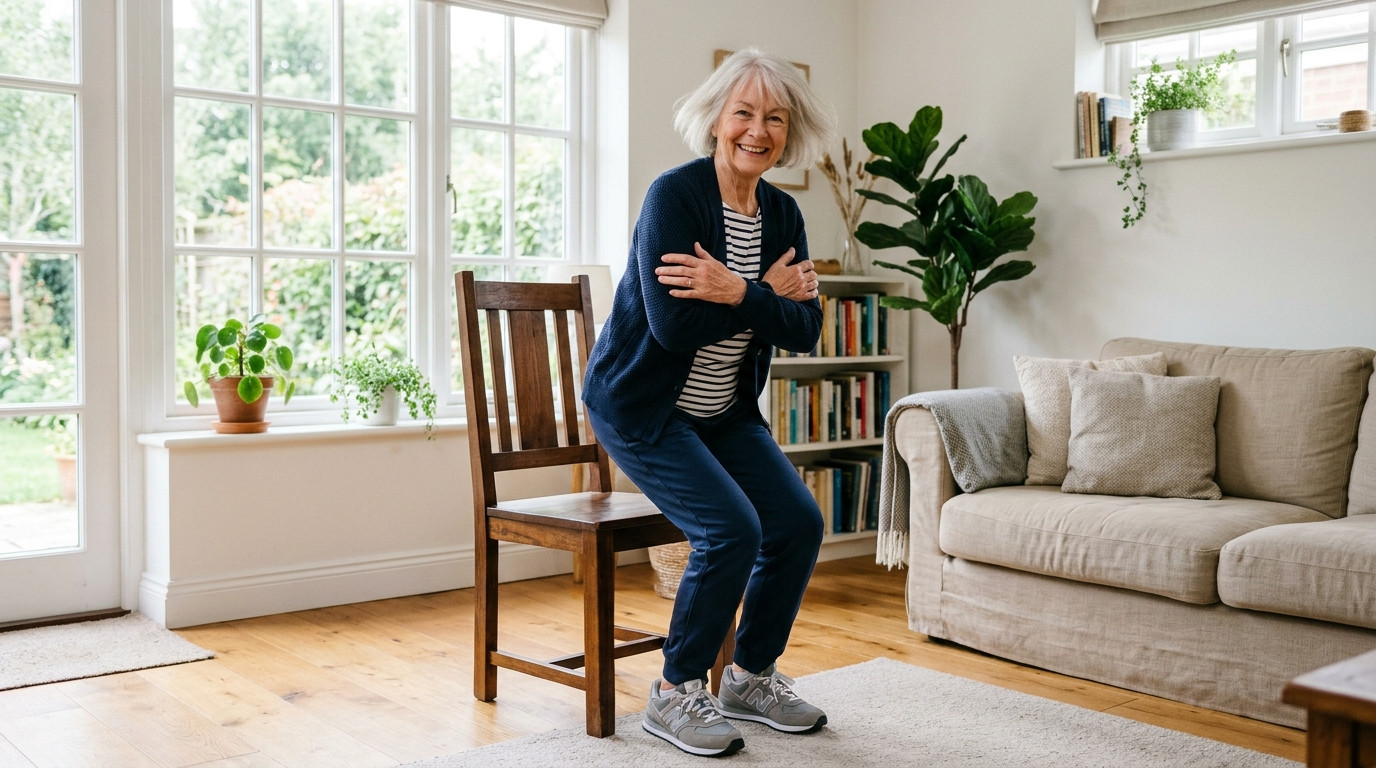
▲ 펜실베이니아 주립대 연구팀이 제안한 체어 스탠드(의자 앉았다 일어서기) 운동을 바른 자세로 시연하는 시니어 / 사진: 만인의 탑 의학 그래픽
2. 'FAST-2' 4분 루틴: 일상 기능을 지키는 4대 핵심 동작
연구팀은 평균 연령 74세의 비활동성 고령층 97명을 두 그룹으로 무작위 배정하고, '기능성 활동 근력 훈련(FAST-2)' 프로그램을 적용했습니다. 참여자들이 사전에 수행하던 주당 운동 시간은 고작 18분에 불과했습니다.
FAST-2 프로그램은 일상생활에서 가장 빈번하게 쓰이는 근육을 타깃으로 4가지 필수 동작으로 구성됩니다:
상체 푸시업 (30초 수행 + 30초 휴식): 벽이나 단단한 탁자를 짚고 수행하는 팔굽혀펴기로 가슴, 어깨, 팔 삼두근 강화
체어 스탠드 (30초 수행 + 30초 휴식): 의자에 앉았다가 두 발로 온전히 일어서는 동작을 반복하여 대퇴사두근과 둔근 강화
투암 로우 (30초 수행 + 30초 휴식): 탄성 밴드를 이용해 팔꿈치를 몸 뒤쪽으로 당기며 등과 상체 자세 유지근 단련
스텝 오르내리기 (30초 수행 + 30초 휴식): 낮은 발판이나 계단을 리드미컬하게 오르내리며 하지 협응력과 동적 균형 강화
3. 12주간의 놀라운 임상 변화와 낙상 위험 차단
12주 후 평가 결과, 4분 운동 그룹은 하지 근력과 이동성에서 통계적으로 유의미한 비약을 보였습니다. 30초 동안 의자에서 일어선 횟수는 평균 4.2회 증가했고, 한 발로 서서 버티는 정적 균형 시간은 3.6초 늘어났으며, 앉았다 일어서는 반응 속도는 2.3초 단축되었습니다.
미국 질병통제예방센터(CDC)에 따르면 낙상 사고는 65세 이상 노년층의 불의의 사망을 초래하는 최대 위험 요인입니다. 의자에서 혼자 힘으로 빠르게 일어서고 한 발로 균형을 유지하는 능력은 낙상 발생률뿐 아니라 요양원 입소 여부를 결정짓는 가장 중요한 임상적 예측 지표입니다. 단 60초의 하지 자극이 이 핵심 지표를 회복시킨 것입니다.
4. "지속 가능성이 최고의 의학": 81% 순응도가 증명한 일상 처방
이번 연구가 거둔 또 다른 결정적 성과는 '지속 가능성'입니다. 실험 참가자들은 전체 연구 기간의 81%에 달하는 날짜 동안 4분 루틴을 스스로 완수했습니다. 이는 만성질환자의 처방약 복약 순응도에 필적하는 경이로운 수치입니다.
시아만나 교수는 "운동의 진정한 목적은 단순한 근육 비대가 아니라 삶의 주도권과 자유를 지키는 것"이라며 "내가 20년 뒤에도 스스로 걷고, 계단을 오르고, 원하는 곳으로 갈 수 있는 자유를 원한다면 지금 당장 거실에서 하루 4분의 투자를 시작해야 한다"고 조언했습니다.
📊 노년층 운동 프로토콜별 임상 비교 분석
평가 항목
기존 표준 권고안 (주 150분)
FAST-2 초단시간 루틴 (일 4분)
12주 임상 변화 및 의학적 의의
총 운동 시간
주당 150분 (하루 30~50분)
하루 4분 (주당 28분, 실운동 14분)
시간 부담 80% 이상 절감
노년층 실천율
20% 미만 (높은 중도 포기율)
81% 완수율 기록
습관화 및 지속 가능성 극대화
의자 기립 능력
점진적 개선 (장기 소요)
30초 기립 횟수 +4.2회 증가
하지 대퇴사두근 기능 급격 반등
신체 균형 및 속도
기준선 유지에 집중
균형 +3.6초 / 속도 2.3초 단축
낙상 사고 및 요양원 입소 위험 차단
[GERIATRIC SPORTS MEDICINE REPORT]
Just 4 Minutes a Day: Penn State Study Proves Ultra-Short Workouts Transform Senior Strength and Balance
📌 MANINTOP Clinical Briefing
Ultra-Brief 4-Minute Daily Protocol: Comprising just two minutes of active exertion (30s active / 30s rest across 4 core movements).
Exceptional 81% Adherence Rate: Overcoming workout fatigue and scheduling barriers, enabling consistent daily habit formation among elderly participants.
Challenging the long-held assumption that seniors must endure demanding workouts to preserve muscle mass, a landmark clinical trial from Penn State College of Medicine demonstrates that just four minutes of daily functional strength training substantially enhances mobility, leg strength, and postural balance in adults aged 65 and older.
1. Overturning the Paradigm: Quality and Frequency Over Exhaustion
While established international health guidelines advocate at least 150 minutes of weekly moderate exercise, fewer than one in five seniors manage to fulfill resistance training recommendations. Common hindrances include joint pain, severe fatigue, time constraints, and the overwhelming complexity of traditional fitness regimens.
"The human body is fundamentally designed to improve very quickly," states Dr. Christopher Sciamanna, professor of medicine and public health at Penn State College of Medicine and lead investigator of the study published in PLOS ONE. "Just a few focused repetitions performed consistently can yield dramatic functional transformations without requiring grueling hour-long gym sessions."
▲ Demonstrating the FAST-2 chair-stand movement to restore lower-body power and balance / Photo: MANINTOP Editorial
2. The FAST-2 Routine: 4 Movements Targeting Essential Daily Biomechanics
The clinical trial evaluated 97 sedentary older adults with a mean age of 74, whose pre-study baseline physical activity averaged merely 18 minutes weekly. Participants were randomized to either a control group or the FAST-2 (Functional Activity Strength Training - 2) routine.
The FAST-2 program alternates 30 seconds of targeted exertion with 30 seconds of rest across four daily movements:
Wall/Incline Push-ups (30s active / 30s rest): Engaging chest, shoulders, and triceps against an elevated stable surface.
Chair Stands (30s active / 30s rest): Transitioning repeatedly from sit to stand to recruit quadriceps, glutes, and core stabilisers.
Two-Arm Resistance Rows (30s active / 30s rest): Retracting elastic resistance bands to strengthen upper postural and scapular muscles.
Stair Stepping (30s active / 30s rest): Step-ups on a stable platform to enhance dynamic balance and lower-extremity coordination.
3. Quantitative Clinical Improvements in Fall Mitigation
At the 12-week endpoint, the intervention cohort demonstrated compelling functional gains: an increase of 4.2 completed chair stands in 30 seconds, 3.6 additional seconds of single-leg balance, and a 2.3-second velocity acceleration in the sit-to-stand transit.
According to the U.S. Centers for Disease Control and Prevention (CDC), falls represent the primary cause of injury-related mortality among adults aged 65 and older. Performance on chair-rise and balance metrics serves as a critical predictive biomarker for nursing home admission and long-term functional autonomy.
4. Unprecedented 81% Adherence: Preserving Autonomy and Freedom
Crucially, participants maintained an 81% adherence rate across the 12-week study, demonstrating that brevity effectively dissolves psychological friction.
"Exercise is fundamentally the key to personal freedom," concluded Dr. Sciamanna. "Freedom means having the physical capability to do what you desire. By dedicating just four minutes each day, older adults can proactively safeguard their independence for decades to come."
📊 Clinical Comparative Analysis of Senior Exercise Regimens
Metric
Standard Guidelines (150 min/wk)
FAST-2 Routine (4 min/day)
12-Week Clinical Outcomes
Time Commitment
150+ minutes weekly
28 minutes weekly (14 min exertion)
>80% reduction in time barrier
Adherence Rate
<20% among older adults
81% completed protocol
Exceptional habit sustainability
Chair-Rise Power
Gradual slow progression
+4.2 additional stands
Substantial quadriceps power revival
Balance & Velocity
Maintenance focus
+3.6s balance / 2.3s faster rise
Mitigates fall and nursing home risk
MANINTOP NEWSLETTER
📬 만인의 탑 뉴스레터 무료 구독
오늘 보신 정책·시사 뉴스가 유익하셨나요? 매일 엄선되는 알짜 복지 혜택과 국회 실시간 속보를 이메일로 가장 먼저 받아보세요. (평생 무료)
Computer Programmer who love programming.
Computer Programmer Who love Riding Bicycle.
Computer Programmer who love trip in abroad.
Computer Programmer who love studying about programming
- even if sometimes it's very boring.
Computer Programmer who love talking with person.
- I love communication with person.
1월이 시작되면 감기는 이미 우리 곁에 와 있습니다. 2월, 3월, 4월까지 이어지는 추위와 건조함은 코와 목을 가장 먼저 공격합니다. 아침에 일어나자마자 막혀 있는 코. 계속 흐르는 콧물. 괜히 칼칼해지는 목. 이 증상은 “시작”일 뿐입니다. 한 번 무너지면 일주일, 길면 한 달까지 끌고 갑니다. 약을 먹으면 잠깐 괜찮아집니다. 하지만 며칠 뒤 또 반복됩니다. 왜일까요? 감기는 ‘치료’의 문제가 아니라 ‘관리’의 문제이기 때문입니다. 대부분은 감기가 오고 나서 약을 찾습니다. 하지만 진짜 중요한 건 감기가 오기 전에 코와 목을 지키는 것입니다. 건조한 실내 공기, 차가운 바깥 공기, 눈에 보이지 않는 세균. 코와 목은 매일 공격받고 있습니다. 지긋지긋하죠! 그런데도 우리는 아무 준비 없이 버티고 있습니다. 이번 겨울도 그렇게 보낼 건가요? 사실 방법은 어렵지 않습니다. 코를 깨끗하게 관리하고, 목을 따뜻하게 보호하고, 점막을 촉촉하게 유지하고, 기관지를 미리 관리하고, 외부 공기를 차단하는 것. 이 다섯 가지만 꾸준히 해도 감기약 없이 겨울을 보내는 것이 충분히 가능합니다. 🔥 이제부터 그 방법을 하나씩 살펴보겠습니다. 🔥 1. 코와 목을 먼저 관리해야 하는 과학적 이유 감기의 대부분은 코 점막에서 시작됩니다. 국제 학술지 Nature Reviews Microbiology 와 Journal of Allergy and Clinical Immunology 에 실린 호흡기 감염 관련 연구들에서는, 감기 바이러스가 비강 상피세포에 먼저 부착해 증식한다는 점을 설명하고 ...
리모델링사업이 진행 중인 아파트를 매매할 때 “계약금 10%를 언제까지 내야 하느냐”는 질문이 특히 많이 나옵니다. 이주공고(이주 안내)가 7~11월쯤이라고 들으면, 그 시점에 맞춰 계약금도 움직일 것 같아서 더 헷갈리기 쉽습니다. 하지만 실제 납부기한은 ‘이주공고가 언제냐’만으로 자동 결정되지 않는 경우가 많습니다. 1) 계약금 10% 납부기한: 결국 ‘문서에 적힌 일정’이 기준 계약금 10%를 언제까지 납부해야 하는지는, 내가 서명하는 매매계약서(특약 포함) 와 사업주체/조합이 제시한 공고·안내문 에 적힌 납부 일정이 기준이 됩니다. 실제 공고문에서는 분양대금 납부의 큰 틀(계약금→중도금→잔금)을 먼저 안내하고, 상세 일정은 별도 표나 유의사항으로 제시하는 방식이 흔합니다. 또, 계약서 문구에 따라 지급 시점이 조건부로 설정될 수도 있습니다. 예를 들어 한 사례 소개 자료에서는 용역계약서에 잔금(10%) 지급시기가 “사업승인 후”로 기재되어 있었다는 점이 언급됩니다. 이런 식으로 ‘사업 단계’와 지급을 연동하는 문구가 들어가면, 질문의 답은 계약서 문구를 확인해야만 확정됩니다. 관련 내용은 링크 에서 문구 사례를 확인할 수 있습니다. 2) 입주자모집공고에서 확인되는 ‘납부 순서’와 잔금 마감 시점 공고문에 적힌 문구를 보면, 납부 순서와 잔금 마감에 대한 기준이 비교적 명확하게 제시되는 경우가 있습니다. 예를 들어 한 입주자모집공고에는 “분양금액(주택가격)은 계약금, 중도금, 잔금의 순서로 납부”하며 “잔금은 입주(열쇠 수령일) 전에 완납”해야 한다고 안내되어 있습니다. (문구 확인: 링크 ) 이 문구가 의미하는 바는 최소 2가지입니다. 분양/공급 형태의 문서에서는 ‘계약금→중도금→잔금’ 흐름이 공식적으로 안내될 수 있습니다. 잔금은 “입주(열쇠 수령)” 이전에 완납해야 한다는 마감 기준이 문서에 적혀 있을 수 있습니다. 다만, 위 공고문 문구는 잔금 마감에 대한 기준을 보여주지만, 계약금 10%의...
윤석열 전 대통령 탄핵 인용 소식을 접하면, 가장 궁금한 지점은 ‘헌재가 정확히 무엇을 위헌·위법으로 봤는가’입니다. 또한 탄핵과 별개로 진행되는 형사재판(내란 우두머리 혐의 등)이 어디까지 왔는지도 함께 정리할 필요가 있습니다. 아래 내용은 제공된 기사/게시물 스니펫과 링크에서 확인되는 범위만 모아, 일반인이 흐름을 이해하기 쉽게 정리한 것입니다. 1) 탄핵 인용 관련: 스니펫에서 확인되는 ‘판단의 골격’ 제공된 근거 중 조국혁신당 사이트에는 헌법재판소가 윤석열 탄핵 심판에서 “피청구인의 위헌·위법행위는 국민 신임 …”이라는 취지로 판단했다는 문장이 인용돼 있습니다( 링크 ). 이 인용문만 놓고 보면, ‘위헌·위법행위’가 있었는지와 그로 인해 ‘국민의 신임’이 어떻게 평가됐는지가 핵심 축으로 소개됩니다. 다만 질문에서 요청하신 세부 항목, 즉 비상계엄 선포 자체를 문제 삼은 구체적 이유, 계엄 이후 조치(포고령, 국회 통제 등)의 어떤 지점이 헌법 위반인지, 국회의 권한행사 방해 및 정치활동 제약을 어떤 논리로 판단했는지 등은, 이번에 제공된 근거의 제목/스니펫만으로는 조항·사실관계·판단 구조가 그대로 제시돼 있지 않습니다. 따라서 이 글에서는 ‘헌재가 무엇을 문제 삼았다’는 세부 리스트를 단정적으로 재구성하기보다, 현재 확인 가능한 문구 수준의 요약(위헌·위법행위 → 국민 신임의 문제로 평가)까지만 적습니다. 만약 헌재 결정문 전문(주문 및 이유)이 추가로 확인되면, 그때는 문장 단위로 ‘어떤 행위’와 ‘어떤 헌법 원리/조항’이 연결되는지(예: 권력분립, 국회의 권한, 정치적 기본권 등) 구조화해 정리하는 것이 가장 정확합니다. 2) 형사 절차(내란 혐의) 관련: 체포영장과 1심 선고 언급 탄핵 심판과 별도로, 12·3 비상계엄 사태로 내란 혐의를 받는 윤석열 대통령에 대해 2024년 12월 31일 체포 영장이 발부됐다는 BBC 보도가 있습니다( 링크 ). 해당 보도는 ‘현직 대통령’에 대한 체포영장 발부라는 점을 함께 언급합니다. 또...




0 댓글