“도움 요청해도 죽어야 끝나는 비극”… 성북구 10대 살해와 친밀관계폭력법 10년 표류
성착취 카르텔·가해자 미격리 참극부터 과태료 300만 원 한계와 이주희 의원안까지
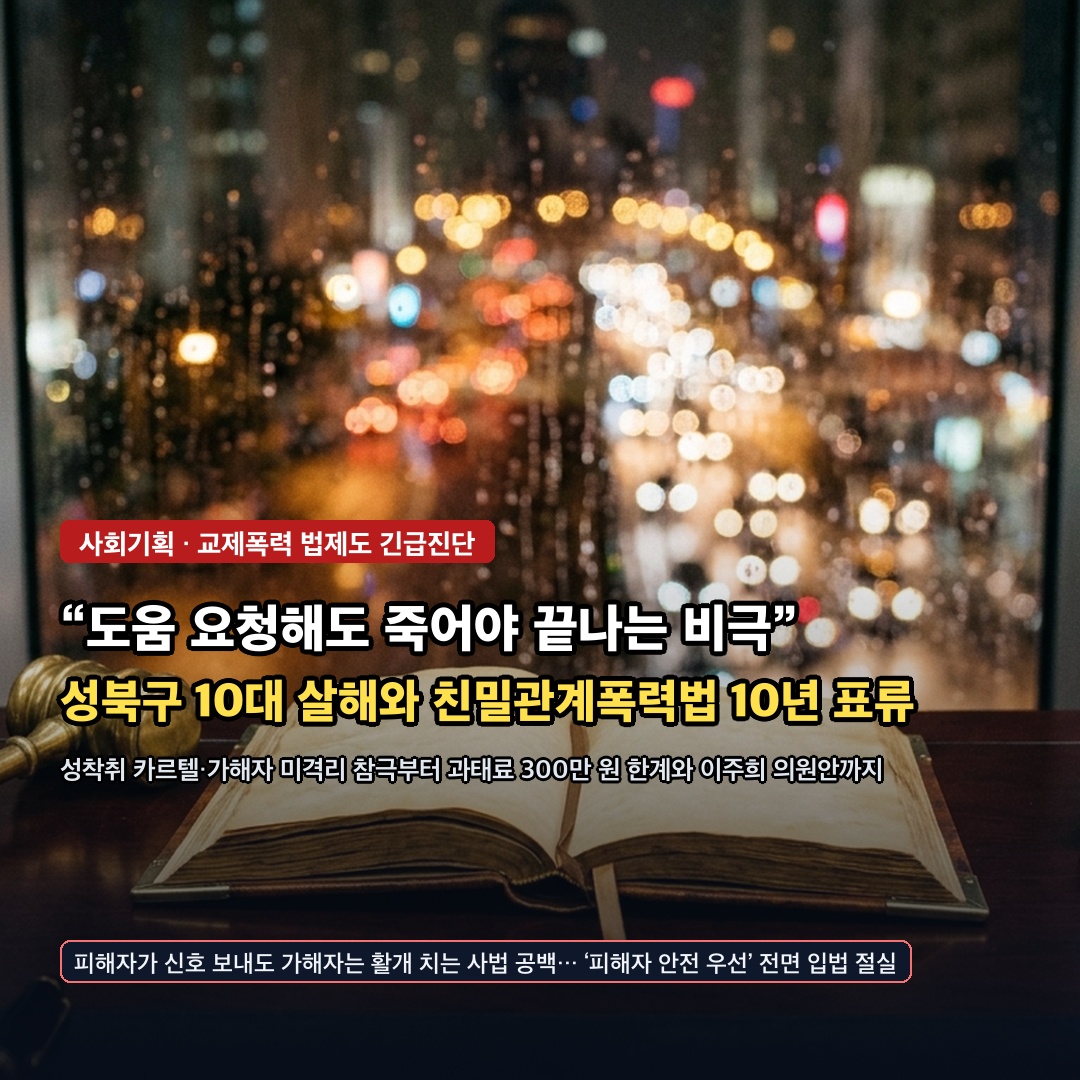
어둠이 내린 집무실 책상 위, 법전과 법봉 곁에서 푸른빛을 내뿜는 전자식 긴급구호 SOS 단말기. 비극을 막지 못한 사법 제도의 구조적 결함과 피해자 중심 보호망 구축의 절박함을 상징한다.
1. 성북구 15세 여성 살해 사건 전말과 입체적 관계망
지난 2026년 11월 10일 밤, 서울 성북구 정릉동의 한 에어비앤비 공유숙박업소에서 15세 청소년 B양이 숨진 채 발견되었습니다. 범인은 피의자 A씨(59세)였습니다.
경찰 조사와 현장 폐쇄회로(CC)TV 분석을 통해 드러난 A씨의 행적은 우발적 범행이 아닌 철저히 계획된 범죄였음을 증명합니다. A씨는 범행 당일 낮 인천의 생활용품점 두 곳을 돌며 범행에 사용할 흉기와 번개탄을 미리 구입했습니다. 사건이 일어난 숙소는 A씨의 전 사실혼 배우자인 20대 여성 C씨가 하루 전 미리 예약해 둔 방이었습니다.
오후 5시 17분경 숙소에 도착한 A씨는 방에서 먼저 기다리고 있던 B양을 만나 객실로 들어갔고, 약 3시간 뒤인 오후 8시 30분경 홀로 방을 빠져나왔습니다. 이후 인근 주택가를 배회하며 범행 흉기와 파손한 B양의 휴대전화를 길가에 버렸습니다. 이튿날 새벽 1시 40분경 제3자의 신고로 출동한 경찰은 번개탄을 피우며 만취 상태로 있던 A씨를 긴급체포했습니다.
현장에서 발견된 A씨의 유서에는 가족에 대한 미안함과 함께 자신의 친아들 D씨의 성범죄를 옹호하는 내용이 담겨 있었습니다. 수사기관은 A씨가 수감 중인 아들의 미성년자의제강간 사건과 관련해 B양에게 합의를 종용하다 거절당하자 앙심을 품고 살해한 것으로 보고, 법정형이 사형·무기 또는 10년 이상 징역에 달하는 특정범죄가중처벌법상 보복살인 혐의를 집중 수사하고 있습니다.
| 인물 | 역할 및 지위 | 얽힌 형사 사건 및 법적 상태 |
|---|---|---|
| A씨 (59세) | 살인 피의자 (D씨의 부친) | 흉기·번개탄 사전 구매 후 B양 살해. 아들 성범죄 합의 거절에 따른 보복살인 혐의 구속영장 신청. 프로파일러 투입. |
| B양 (15세) | 피해자 (사망) | D씨로부터 미성년자의제강간을 당한 고소인. 가정폭력 피해로 일시쉼터를 전전하던 가정 밖 청소년. 성매매·절도 강요 피해. |
| D씨 (20대) | A씨의 친아들 | B양에 대한 미성년자의제강간 혐의로 3월 공소청 불구속 송치. 조건만남 미끼 절도 집행유예 후 별건 절도로 서울남부구치소 구속 중. |
| C씨 (20대) | A씨의 전 사실혼 배우자 | 범행 숙소 예약자. B양에게 성매매와 가출을 강요하고 절도를 교사한 혐의로 고소됨. 영장 기각 후 11월 8일 구속영장 재신청 상태. |
2. 공적 보호 시스템의 붕괴… B양은 왜 끝내 구출되지 못했나
B양은 국가 안전망과 전혀 닿지 않았던 사각지대의 피해자가 아니었습니다. 가정폭력과 아동학대를 피해 경찰에 직접 도움을 요청했고, 지자체와 연계되어 청소년 쉼터의 보호를 받고 있던 상태였습니다. 그럼에도 국가는 B양을 지켜내지 못했습니다.
가장 뼈아픈 실책은 '가해자 집단과의 격리 실패'였습니다. B양은 미성년자의제강간 피해자이자 성착취 카르텔의 강요 피해자였음에도, 수사기관은 가해자 일당을 초기에 단호히 구속 격리하지 않았습니다. 노원경찰서가 지난 7월 C씨에 대해 신청했던 구속영장은 공소청(검찰) 단계에서 청구조차 되지 않고 반려되었습니다. 가해자들이 거리를 활보하는 동안 B양은 보복의 공포 속에서 지속적인 회유와 협박에 노출되었습니다.
여기에 '일시쉼터의 한계'가 겹쳤습니다. 청소년쉼터 체계는 최장 7일 머무는 일시쉼터, 2년의 단기쉼터, 4년의 중장기쉼터로 나뉩니다. 정주할 안정적 주거를 얻지 못한 B양은 여러 지역의 일시쉼터를 옮겨 다녔고, 이 과정에서 지인을 통해 동선이 가해자 측에 실시간으로 노출되었습니다.
전국 17개 성착취 피해 아동·청소년 지원센터의 현실도 처참합니다. 센터당 전담 인력이 평균 3명에 불과해 상담, 의료, 법률 지원, 재판 동행까지 도맡다 보니 고위험 피해자에 대한 24시간 밀착 경호와 즉각적 위험 차단은 구조적으로 불가능했습니다.

거친 석판 위에 놓인 열린 자물쇠와 절단된 쇠사슬. 피해자가 수차례 신호를 보냈음에도 가해자를 제어하지 못하고 끊어져 버린 사법 안전망의 현실을 상징한다.
3. 반복되는 여성살해… 사법 제도의 3대 치명적 구멍
친밀한 관계에서 벌어지는 폭력은 어느 날 갑자기 발생하지 않습니다. 언제나 수차례의 경고 신호와 피해자의 절박한 구조 요청이 선행됩니다.
한국여성의전화 조사에 따르면 지난 15년간 친밀한 남성 파트너에게 살해당한 여성과 주변인은 최소 1,672명에 달하며, 2023년 한 해에만 최소 192명이 목숨을 잃었습니다. 그러나 현행 사법 제도는 이들을 살려내지 못하고 있습니다:
- 접근금지 어겨도 고작 과태료 300만 원: 서울 송파구에서 혼인무효소송 중이던 26세 가해자 김성우는 접근금지 임시조치를 9차례나 보란 듯이 위반했으나 경찰은 알아채지도 못했습니다. 현행법상 임시조치 위반은 형사처벌이 아닌 행정처분(과태료 최대 300만 원)에 불과해 가해자의 살인 질주를 전혀 막지 못했습니다.
- 반의사불벌죄의 덫과 합의 강요: 제주에서 헤어진 연인에게 살해당한 40대 여성은 사망 전 스토킹 2회, 교제폭력 1회 등 총 3차례 경찰에 신고했습니다. 그러나 가해자의 회유와 보복 위협 속에서 "처벌을 원치 않는다"고 진술하자 수사기관은 사건을 종결했고, 결국 여성은 주검으로 발견되었습니다.
- 가해자 감시가 아닌 피해자 일상 파괴: 현행 스마트워치 등 보호장치는 가해자가 아닌 '피해자 중심'으로 작동합니다. 가해자가 반경에 접근할 때마다 울리는 경보와 잦은 경찰 확인으로 피해자의 직장과 동선이 노출되어 피해자가 일상을 포기하고 숨어 살아야 하는 기형적 구조입니다.
4. 10년 묵은 입법 공전 깰 ‘친밀관계폭력처벌법’ 전부개정안
이러한 사법적 잔혹사를 끊어내기 위해 국회에서 근본적인 입법 개혁이 본격 추진되고 있습니다.
더불어민주당 이주희 의원은 한국여성의전화 등 6개 여성단체와 함께 현행 가정폭력처벌법을 전면 폐기하고 피해자 안전을 최우선으로 세우는 '친밀관계폭력범죄의 처벌 등에 관한 특례법' 전부개정안을 대표 발의했습니다.
| 비교 항목 | 현행 법제도 (가정폭력처벌법 등) | 이주희 의원 대표발의 전부개정안 |
|---|---|---|
| 법의 근본 목적 | 가정의 평화와 안정 회복 (가해자 교화 우선) | 피해자의 안전과 인권 보장 (피해자 중심 전환) |
| 적용 범위 | 법률상 배우자 및 사실혼 등 '가정구성원' 한정 | 현재 및 과거의 모든 교제관계(친밀관계) 전면 포함 |
| 폭력의 정의 | 물리적 신체 폭력 중심 | 신체 폭력 외 고립, 감시, 경제적 통제 포함 |
| 임시조치 위반 제재 | 최대 300만 원 이하의 과태료 (행정처분) | 영장 없는 긴급체포 및 3년 이하 징역 / 3천만 원 벌금 |
| 접근금지 거리 | 100미터(m) 이내 | 2킬로미터(km)로 20배 대폭 확장 |
| 가해자 모니터링 | 전자발찌 착용자 외 상시 동향 파악 불가 | 임시조치 1호로 '가해자 모니터링' 신설 (1심 판결 시까지) |
| 처벌 조건 | 반의사불벌죄 적용 (처벌불원 시 공소기각) | 반의사불벌 조항 전면 배제 (보복 합의 강요 원천 차단) |
지난 2016년 이후 10년 동안 교제폭력 법안이 국회 문턱을 넘지 못한 핵심 이유는 법원과 법무부가 주장해 온 '교제관계 정의의 불명확성'과 '죄형법정주의 위배' 논리였습니다.
하지만 최근 국회입법조사처는 획기적인 법리적 해법을 내놓았습니다. 특별법의 핵심인 임시조치는 가해자를 감옥에 보내는 형벌이 아니라 피해자를 살리기 위한 '행정적 긴급구호(보호명령)'이므로, 무죄추정의 원칙에 반하지 않는다는 2025년 헌법재판소 판례를 원용해 구성요건의 명확성 요구를 유연하게 적용할 수 있다는 논리입니다. 법문에 교제 기간과 빈도 등의 판단 기준을 명시하고, 피해자가 직접 법원에 보호명령을 신청하는 민사적 절차를 결합하면 위헌 시비를 원천 차단할 수 있습니다.
5. 10대 대상 온라인 그루밍 실태와 해외 선진국의 엄벌주의
친밀관계를 가장한 범죄의 칼끝은 정보통신기술에 상시 노출된 10대 청소년을 정조준하고 있습니다.
경찰청 디지털성범죄 특별수사본부의 실태조사에 따르면, 전체 디지털성범죄 피해자(1,154명) 중 10대 이하가 60.7%(667명)로 압도적 1위를 기록했습니다. 20대(26.8%)를 합치면 피해자의 87.5%가 1020 청년층이며, 여성 비율은 80.3%에 달했습니다.
가해자들은 모바일 게임(카트라이더, 좀비고 등) 전체 채팅방이나 유튜브, 오픈채팅을 통해 "13세 여자를 구한다"며 친밀감을 쌓은 뒤, 사진을 넘겨받아 협박으로 전환하는 전형적인 온라인 그루밍 수법을 씁니다. 피해 청소년의 91.7%가 심각성을 체감하면서도 "네가 조심하지 않아서 그렇다"는 2차 가해의 두려움 때문에 침묵하다 성착취와 범죄 연루의 덫에 빠집니다.
• 영국: 성범죄법 제15조를 통해 아동 대상 온라인 그루밍을 독립된 성범죄로 명시하고, 신뢰·친밀관계 내 범죄에 대해 최고형 가중 처벌.
• 미국: 연방법상 18세 미만 미성년자에게 성매매 또는 성행위를 하도록 유인·강요하는 행위에 대해 최소 10년 이상의 징역형 선고.
• 호주: 아동성착취방지법을 개정하여 국경 밖 거주 아동 대상 그루밍까지 처벌하며, 일정 기간 내 반복 적발 시 가중 처벌 적용.
6. 더 이상 늦출 수 없는 국가의 책무
15세 청소년이 학대와 성폭력을 피해 도망쳤던 길의 끝이 잔혹한 살해 현장이 되어서는 안 됩니다. 피해자가 수사기관에 세 번, 네 번 구조 신호를 보냈음에도 가해자가 300만 원 과태료를 비웃으며 피해자를 찾아내는 사법 제도는 국가의 명백한 직무유기입니다.
법률상 가족에만 갇혀 있던 낡은 보호망을 허물고, 모든 친밀관계 폭력 피해자에게 국가가 즉각적인 방패가 되어주어야 합니다. 가해자를 격리하고, 피해자의 안전을 최우선으로 보장하는 ‘친밀관계폭력처벌법’의 국회 통과는 더 이상 미룰 수 없는 시대적 명령입니다.
“A Tragedy That Ends Only in Death Despite Cries for Help”… The Seongbuk Teen Murder and the 10-Year Stalling of Intimate Partner Violence Laws
From Exploitation Cartels and Failure to Isolate Perpetrators to 3 Million Won Fines and the Comprehensive Protective Reform Bill
A brass gavel and leather-bound legal code resting beside an electronic emergency SOS beacon emitting a soft blue indicator glow on a dark office desk, symbolizing the critical urgency of structural victim protection in a broken justice system.
1. The Seongbuk 15-Year-Old Murder: Detailed Timeline and Intertwined Criminal Syndicate
On the night of November 10, 2026, 15-year-old B was found murdered inside an Airbnb rental accommodation in Jeongneung-dong, Seongbuk-gu, Seoul. The perpetrator was 59-year-old A.
Police investigations and surveillance footage reveal a premeditated crime. On the afternoon of the murder, A visited two household goods stores in Incheon to purchase weapons and charcoal briquettes. The rental room had been booked a day earlier by C, a woman in her 20s who was A's former common-law partner.
A entered the room at 5:17 PM where B was waiting, and emerged alone around 8:30 PM. He discarded the murder weapon and B's crushed mobile phone in a residential neighborhood before being arrested by police at 1:40 AM while intoxicated beside burning charcoal briquettes.
A suicide note found at the scene contained apologies to his family alongside defenses of his biological son D's past sex crimes. Authorities are investigating A on charges of retaliatory murder under the Act on the Aggravated Punishment of Specific Crimes (punishable by death, life imprisonment, or at least 10 years), believing A murdered B after she refused to settle the statutory rape charges against his son.
| Person | Role & Status | Intertwined Criminal Cases & Legal Proceedings |
|---|---|---|
| Perpetrator A (59) | Murder Suspect (Father of D) | Premeditated purchase of weapons; murdered B. Arrest warrant sought for retaliatory murder following refusal of settlement. |
| Victim B (15) | Victim (Deceased) | Statutory rape victim of D. Runaway youth residing in temporary shelters following domestic abuse; coerced into commercial sex and theft. |
| Son D (20s) | A's Biological Son | Forwarded to prosecutors without detention in March for statutory rape of B. Currently detained in Seoul Southern Detention Center for theft. |
| Accomplice C (20s) | A's Former Common-Law Partner | Booked the murder accommodation. Accused of coercing B into prostitution and theft. Arrest warrant re-submitted by police on Nov 8. |
2. Collapse of Public Safety Nets: Why Was B Left Unprotected?
Victim B was not an unregistered youth outside the state's reach. She had directly sought police assistance after experiencing domestic violence and child abuse and was accommodated in a state-linked youth shelter. Yet the state failed to save her life.
The most egregious breakdown was the failure to isolate the criminal syndicate. Despite B being a primary victim of statutory rape and criminal coercion, prosecutors failed to detain the perpetrators early. An arrest warrant sought for C in July was rejected by prosecutors, leaving B defenseless against ongoing retaliation and intimidation.
Compounding the tragedy was the structural limitation of temporary youth shelters. With stays capped at just seven days, B bounced between facilities across multiple jurisdictions, exposing her location through acquaintances. Furthermore, South Korea's 17 regional child and adolescent sexual exploitation response centers operate with an average of only three staff members per center, making around-the-clock protective security impossible.
An unlatched weathered brass padlock and a severed heavy steel chain link on dark slate stone, symbolizing the fractured institutional barriers that fail to restrain violent abusers.
3. Repeated Femicides: Three Fatal Loopholes in the Current Legal Framework
Fatal violence in intimate relationships does not emerge without warning. It is consistently preceded by multiple distress calls and clear indicators of escalation.
According to Korea Women's Hotline, at least 1,672 women and bystanders were murdered by intimate male partners over the past 15 years, with at least 192 victims in 2023 alone. Yet the justice system fails to intercept these preventable deaths:
- Restraining Order Violations Incur Mere 3 Million Won Fines: In the Songpa mother-in-law murder, 26-year-old Kim Sung-woo violated temporary restraining orders nine times unnoticed by police. Under current law, violations are treated as administrative infractions carrying maximum fines of only 3 million won, completely failing to deter homicidal intent.
- The Trap of Unpunishable-Over-Objection Clauses: In Jeju, a woman in her 40s reported her ex-partner three times for stalking and dating violence before being murdered. Because the case was closed after the terrified victim stated she did not wish to pursue punishment under duress, she was left entirely unprotected.
- Burdening Victims While Abusers Walk Free: Current safety devices such as smartwatches operate on a victim-centric surveillance model. Frequent alarms and police check-ins disrupt the victim's employment and daily routine, forcing victims into hiding while abusers move without restriction.
4. Breaking a 10-Year Impasse: The Comprehensive Intimate Partner Violence Act
To halt this cycle of tragedy, comprehensive legislative reform is finally being advanced in the National Assembly.
Representative Lee Ju-hee of the Democratic Party, alongside six major women's rights organizations, introduced the Special Act on the Punishment of Intimate Partner Violence Crimes, overhauling the outdated domestic violence legal regime.
| Key Dimension | Current Legal Framework (Domestic Violence Act) | Rep. Lee Ju-hee Comprehensive Reform Bill |
|---|---|---|
| Primary Purpose | Restoring family harmony and peace | Guaranteeing victim safety and fundamental human rights |
| Scope of Application | Restricted to legal family and common-law spouses | Includes all current and former dating / intimate partners |
| Definition of Violence | Primarily physical assault | Includes coercive control, surveillance, isolation, financial abuse |
| Sanctions for Order Violations | Administrative fine of up to 3 million won | Warrantless emergency arrest and up to 3 years in prison |
| Restraining Order Radius | Within 100 meters | Expanded twentyfold to 2 kilometers (km) |
| Abuser Monitoring | Unavailable unless electronic ankle monitors are worn | Mandatory perpetrator tracking as Order Measure No. 1 |
| Prosecution Prerequisite | Dismissed if victim expresses non-punishment intent | Complete elimination of non-punishment objection clauses |
The primary roadblock that stalled intimate partner violence bills for a decade was the judiciary's objection regarding the "ambiguity of dating relationships" and the constitutional principle of legality.
However, a groundbreaking legal framework by the National Assembly Research Service resolved this dilemma. Drawing on a September 2025 Constitutional Court ruling, the report established that emergency protective orders are administrative safety measures aimed at saving lives rather than penal sanctions, allowing for more flexible specificity standards. By establishing statutory guidelines regarding relationship duration and frequency and enabling direct civil court protective petitions by victims, constitutional challenges can be completely overcome.
5. Online Grooming Exploitation of Adolescents and Global Legislative Trends
Vulnerable adolescents constantly exposed to digital networks are the primary targets of predatory intimate exploitation.
According to the National Police Agency, out of 1,154 digital sex crime victims, youths aged 10 and under accounted for 60.7% (667 victims), with 80.3% of all victims being female. Predators initiate contact in popular mobile gaming chats (KartRider, Zombie High School) or open chat rooms, building false intimacy before weaponizing private photographs into extortion.
• United Kingdom: Section 15 of the Sexual Offences Act designates online child grooming as an independent felony, with aggravated sentencing for breach of trust in intimate relations.
• United States: Federal law imposes mandatory minimum sentences of 10 years or more for enticing or coercing minors under 18 into commercial sex.
• Australia: Amended child sexual exploitation legislation penalizes cross-border grooming and mandates enhanced sentencing for repeat offenders.
6. An Overdue Obligation of the Democratic State
A 15-year-old child fleeing abuse and exploitation should never find her refuge transformed into a murder scene. A legal system that allows abusers to scoff at 3 million won fines while stalking victims who cried for help four times is guilty of systemic dereliction of duty.
The state must dismantle the archaic barrier that confines protection to traditional households. Passing the Intimate Partner Violence Act to isolate violent abusers and place victim safety above all else is an undeniable imperative of our time.
내가 찾는 상품 키워드, 지금 얼마나 검색될까?
네이버 월간 검색량 + 구글 볼륨 + 아이템스카우트 실시간 상품수와 경쟁강도 배지를 0.5초 만에 무료로 확인하세요.


