사회·교육 심층보도팀 | 국가시험 공정성 및 첨단 보안 기획2026. 11. 13 21:00 KST
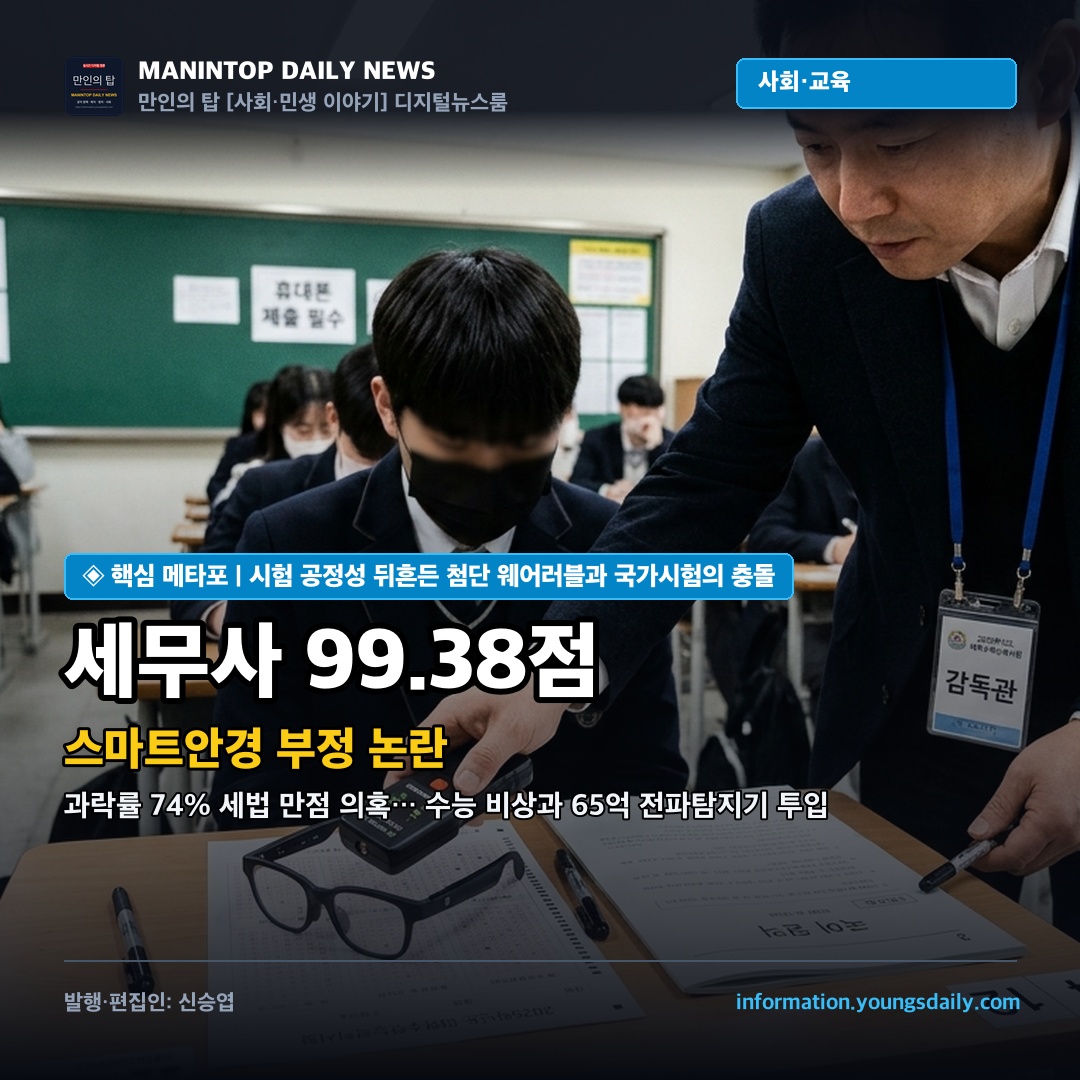
▲ 국가시험장 교실에서 시험 감독관이 무선 통신 신호와 초소형 웨어러블 장비를 적발하기 위해 고성능 전파탐지기로 정밀 보안 검측을 진행하고 있다. / 공식보도자료
국가공인 전문자격시험과 대학수학능력시험 등 국가 주요 시험 전반에서 스마트안경을 활용한 지능형 부정행위 의혹과 실제 적발 사례가 연쇄적으로 터져 나오며 시험 공정성이 거센 소용돌이에 휘말렸습니다. 최근 치러진 제63회 세무사 자격시험에서 수석 합격자가 400점 만점에 397.5점이라는 비현실적인 고득점을 기록하면서 촉발된 이번 사태는 이미 올해 국가기술자격시험장에서 적발된 5건의 웨어러블 장비 부정행위와 맞물려 국민적 공분을 사고 있습니다. 일주일 앞으로 다가온 2027학년도 대입 수능을 비롯해 국가 주요 선발 시험의 신뢰를 통째로 뒤흔드는 초유의 사태에 정부와 교육 당국은 초비상 방어 태세에 돌입했습니다.
'세법학 100점' 수석의 통계적 미스터리… 과락률 74% 시험서 나홀로 만점
사건의 도화선이 된 것은 세무사 1차 시험 수석 합격자 A씨(34세)의 점수 분석표였습니다. 직장인 익명 커뮤니티와 수험가를 중심으로 공개된 성적 통계에 따르면, A씨는 재정학(97.5점) 단 한 문항을 제외하고 세법학개론, 회계학개론, 상법 세 과목에서 모두 100점 만점을 받았습니다. 4과목 평균은 무려 99.38점에 달했습니다. 특히 세법학개론은 전체 응시자 16,856명 중 74.21%가 40점을 넘기지 못해 과락하고 평균 점수가 30.18점에 불과할 정도로 까다롭게 출제된 시험이었음에도, 전국에서 유일하게 100점 만점을 기록해 수험생들의 의구심을 키웠습니다.
통계 전문가들과 현직 세무사들이 더욱 주목한 대목은 3개월 뒤 치러진 2차 주관식 논술 시험과의 현격한 성적 괴리였습니다. A씨는 복잡한 수식과 숫자를 다루는 계산 과목인 회계학 1부(96점)와 회계학 2부(95점)에서는 압도적인 고득점을 올렸으나, 깊이 있는 법리 해석과 문장 구성력이 요구되는 서술형 과목인 세법학 1부에서는 114점(평균 57점)으로 급락했습니다. 1차 객관식에서 전국 유일의 만점을 받을 만큼 완벽했던 세법 지식이 불과 몇 달 만에 평균 수준으로 떨어진 반면, 정밀 계산 과목만 초고득점을 유지한 점은 실시간 연산이나 통신 장비의 도움을 받았다는 의혹에 힘을 실었습니다.
구분 및 시험 회차
응시 과목 및 득점 현황
전체 응시자 평균 지표
통계적 특이점 및 쟁점
세무사 1차 객관식
세법 100, 회계 100, 상법 100, 재정 97.5
세법학개론 평균 30.18점
과락률 74.21% 속 전국 유일 만점
세무사 2차 주관식
회계 1부 96점, 회계 2부 95점
회계학 합격선 50점대 중반
계산 실무 영역 초고득점 유지
세무사 2차 논술형
세법학 1부 114점 (평균 57점)
합격자 평균 54.3점 분포
1차 만점 대비 심층 논술 점수 급락
최종 판정 구조
총점 663점 (평균 82.875점)
최종 합격선 55.25점
주관식 답안지 전문위원 필적·문체 감정 진행
2026년 국가시험 스마트안경 적발 실태… 소방설비부터 가스기능사까지
실제로 국가시험 현장에서는 이미 스마트안경을 악용한 첨단 부정행위가 잇따라 꼬리를 잡혔습니다. 한국산업인력공단이 집계한 2026년 국가기술자격시험 부정행위 적발 현황에 따르면, 전체 40건의 적발 사례 중 전통적인 종이 쪽지(30건)나 스마트폰(4건) 외에 최신 AI 스마트안경을 몰래 착용하고 응시한 사례가 5건에 달했습니다. 지난 5월 광주 소방설비기사 시험장에서는 안경 렌즈 안쪽에서 은은한 빛이 반사되는 것을 감독관이 포착해 장비를 압수했고, 서울 정보처리기사 시험장에서는 안경테 모서리에 숨겨진 초소형 카메라 렌즈와 LED 불빛이 발각되어 응시자가 공소청에 송치되었습니다.
적발 수법은 갈수록 교묘해지고 있었습니다. 전남 목포 전기산업기사 시험에서는 응시자가 안경다리 측면 버튼을 누르며 파란색 초소형 디스플레이를 조작하다 덜미가 잡혔고, 6월 대구 가스기능사 시험장에서는 두 명의 응시자가 소지한 기기에서 미세한 전자음(비프음)이 울리면서 로키드 AR 안경과 메타 레이밴 안경이 동시에 적발되기도 했습니다. 이들 기기는 겉보기에 일반 검은색 뿔테 안경과 거의 구분되지 않아 육안 검사만으로는 식별이 불가능에 가까웠습니다.
CCTV 없는 교실과 사후 제보의 한계… 시험장 보안 관리의 맹점
더 큰 문제는 현행 시험장 관리 체계의 구조적 맹점이었습니다. 대다수 국가시험이 치러지는 일반 초·중·고등학교 교실에는 학생 인권과 개인정보 보호를 이유로 CCTV가 설치되어 있지 않습니다. 이 때문에 시험 도중 이상 행동을 현장에서 즉시 잡아내지 못하면 사후에 영상을 돌려보며 증거를 확보하는 것이 원천적으로 불가능합니다. 세무사 시험 감독위원 4명 역시 조사 과정에서 수험생이 앞줄에 앉아 있었음에도 특이 행동을 전혀 인지하지 못했다고 진술해 현장 육안 감시의 명백한 한계를 드러냈습니다.
▲ 국회 상임위원회 회의장에서 최신 웨어러블 스마트안경의 외형과 렌즈 구조를 실측 검증하며 국가시험 부정행위 방지 대책을 점검하고 있다. / 공식보도자료
시간 경과에 따른 증거 확보의 어려움도 수사의 걸림돌로 꼽힙니다. 세무사 1차 시험은 지난 4월, 2차 시험은 7월에 종료되었으나 본격적인 공론화와 조사는 수개월이 지난 10월 말에야 시작되었습니다. 시험 당시 착용했던 안경을 이미 폐기하거나 통신 기록을 삭제했을 경우 실시간 물증을 확보하기가 극히 어렵습니다. 이에 한국산업인력공단은 A씨의 2차 주관식 논술 답안지 원본을 외부 전문 채점위원들에게 전달해, 기계 번역 특유의 문체나 인공지능 요약 패턴이 존재하는지 정밀 필적·문체 감정에 착수했습니다.
정부 무관용 원칙 천명과 국세청 5년 자격박탈… 세무사회 긴급 대응
사태의 파장이 일파만파 번지자 국무총리실은 11월 13일 긴급 보도설명자료를 내고 국가시험 부정행위에 대한 무관용 원칙을 대내외에 천명했습니다. 총리실은 국가 전문자격시험의 공정성을 훼손하는 행위는 청년들의 땀과 노력을 짓밟는 중대 범죄라며 사법기관과 공조해 진상을 철저히 규명하겠다고 밝혔습니다. 소관 부처인 국세청 역시 사실관계가 확인되는 즉시 당해 합격을 전격 취소하고 향후 5년간 국가시험 응시자격을 박탈하는 등 법이 허용하는 최고 수위의 징계를 내릴 방침입니다.
수험생 단체와 전문가 집단도 발 빠르게 움직이고 있습니다. 한국세무사회는 신속한 수사로 의혹의 실체를 밝혀내야 한다면서도, 억울한 피해자가 발생하지 않도록 객관적 증거에 입각한 진상 규명이 이루어져야 한다는 공식 입장을 내놓았습니다. 아울러 세무사회가 자체 주관하는 전산세무회계 자격시험장에도 웨어러블 전자기기 반입을 차단하는 통합 점검 시스템을 긴급 가동하기 시작했습니다.
수능 전담 판독요원 배치와 65억 전파탐지기 투입… 시험 보안의 대전환
불똥은 11월 19일 전국에서 일제히 치러지는 2027학년도 대학수학능력시험으로 곧장 튀었습니다. 50만 수험생의 인생이 걸린 국가 최대 시험인 만큼, 교육부는 전국 1,300여 개 수능 시험장에 '스마트안경 판독 전담 감시요원'을 특별 배치하기로 결정했습니다. 또한 시험 지구별로 상황실과 직통 핫라인을 열어 조금이라도 의심스러운 안경 착용자가 발견될 경우 즉각 정밀 감식에 돌입하며, 부정행위 적발 시 위계에 의한 공무집행방해 혐의로 즉시 형사 고발하고 최대 3년간 수능 응시자격을 정지시킬 계획입니다.
각종 임용시험과 공무원 채용 시험장에도 전례 없는 고강도 보안 수칙이 내려졌습니다. 당장 이달 말 예정된 중등교원 임용시험에서는 1교시 시작 전 모든 수험생이 착용한 안경을 벗어 감독관에게 정면과 측면 테를 직접 확인받는 '안경 전수 육안검사' 지침이 의무화되었습니다. 안경테 모서리의 카메라 렌즈 홈, 충전 단자, 버튼 유무를 일일이 확인하는 물리적 검문 절차가 국가시험장에 정식 도입된 것입니다.
국회도 근본적인 입법과 예산 지원에 나섰습니다. 국회 환경노동위원회 김위상 의원은 국가자격시험 부정행위 방지를 위한 긴급 방호 예산 65억 7,300만 원의 순증안을 예산결산특별위원회에 공식 제출했습니다. 전국 시험실 7,200곳에 숨겨진 무선 송수신 신호를 실시간 탐지하는 고성능 전파탐지기 도입비 36억 원과, 시험장 현장에 투입될 전문 보안 인력 23,559명의 운영비 29억 7,300만 원이 포함되었습니다. 기술의 발전이 몰고 온 시험장 보안 패러다임의 일대 전환이 이제 시험 제도의 생존 과제로 부상하고 있습니다.
주요 시험 및 기관
도입 보안 장비 및 인력
적발 시 법적 제재 수준
현장 적용 및 시행 일정
2027학년도 수능
시험장별 스마트안경 전담 판독요원
공무집행방해 고발·3년 응시 정지
2026.11.19 본시험 즉시 적용
중등교원 임용시험
1교시 시작 전 안경 전수 육안검사
시험 무효 및 채용 결격 사유 등록
11월 말 전국 시험장 의무화
국가전문자격시험
주관식 답안 필적·문체 감정 TF
합격 취소 및 5년간 응시자격 박탈
국세청·공단 상시 수사 공조
국회 방호 예산 순증
고성능 전파탐지기 7,200대 도입
전문 감시 인력 23,559명 배치
총 65억 7,300만 원 예산 배정
[In-Depth Analysis] AI Smart Glasses Cheating Scandal Rocks National Exams: 99.38 Score Furor, CSAT Alert, and 6.5B Won RF Detector Rollout
Society and Education Investigative Desk | Testing Integrity and High-Tech Surveillance2026. 11. 13 21:00 KST
▲ In a national examination classroom, a proctor operates high-sensitivity radio frequency signal detection equipment to screen for concealed wearable devices and wireless communications. / Press Coverage Photo
Widespread cheating allegations involving covert smart glasses across major state evaluations, from the Certified Public Tax Accountant examination to the upcoming College Scholastic Ability Test, have plunged national exam fairness into severe turbulence. The national crisis erupted after a 34-year-old top candidate achieved an unprecedented score of 397.5 out of 400 on the 63rd Certified Public Tax Accountant preliminary examination. Compounded by five confirmed cases of wearable hardware fraud uncovered in technical qualification centers throughout 2026, the scandal has triggered public fury and forced education authorities into comprehensive crisis management ahead of national university entrance exams.
The 100-Point Mystery: Statistical Anomalies in a 74 Percent Failure Environment
The controversy ignited when candidate A's official score distribution was circulated across professional forums and legal test communities. Candidate A secured perfect scores of 100 in Tax Law Theory, Accounting Principles, and Commercial Law, dropping only a single question in Public Finance with 97.5 points, yielding an extraordinary aggregate average of 99.38. Most notably, on the Tax Law Theory section, where 74.21 percent of the 16,856 test-takers failed to achieve the 40-point cutoff and the national average stalled at 30.18, Candidate A stood alone as the sole examinee nationwide to record a perfect 100.
Statistical researchers and practicing tax attorneys pointed to glaring discrepancies when comparing the first-round multiple-choice scores with the second-round subjective essay examination administered three months later. While Candidate A maintained near-perfect scores on quantitative computational sections—scoring 96 in Financial Accounting Part 1 and 95 in Part 2—scores plummeted to 114 out of 200, an average of 57, in Tax Law Part 1, which demands nuanced legal synthesis and doctrinal exposition. That encyclopedic tax mastery completely dissolved while algorithmic mathematical performance remained pristine strongly indicated external digital calculation and transmission assistance.
Examination Phase
Candidate Scores Recorded
National Cohort Baseline
Statistical Significance
Preliminary Objective Test
Tax 100, Accounting 100, Law 100, Finance 97.5
Tax Theory Average: 30.18
Sole perfect score amid 74.21% fail rate
Secondary Quantitative Test
Accounting I: 96, Accounting II: 95
Passing Cutoff: Mid-50s
Exceptional computational mastery maintained
Secondary Essay Evaluation
Tax Law I: 114 / 200 (Avg 57)
Passing Mean: 54.3 points
Precipitous drop from preliminary mastery
Evaluation Final Status
Aggregate 663 / 800 (82.875 avg)
General Cutoff: 55.25
Subjective manuscripts undergoing forensic review
Smart Glasses Violations Across 2026: From Firefighting to Gas Technicians
Actual testing records confirm that high-tech wearable fraud has breached domestic examination centers. According to the Human Resources Development Service of Korea, 40 total cheating cases were documented during national technical qualification exams in 2026. While traditional methods such as concealed paper notes accounted for 30 violations and smartphones for four, five incidents involved advanced AI smart glasses. In May, proctors at a Firefighting Facility Engineer exam in Gwangju confiscated hardware after observing internal lens reflections, while an Information Processing Engineer examinee in Seoul was referred to prosecutors after inspectors identified concealed corner micro-lenses and emitting diodes.
Concealment techniques have grown increasingly covert and technologically sophisticated. During an Electrical Industrial Engineer evaluation in Mokpo, an applicant was apprehended while manipulating subtle temple buttons to activate a miniature blue display. In late June, two applicants were simultaneously caught at a Gas Technician test in Daegu when internal micro-devices emitted audible electronic chimes, exposing both Rokid augmented reality spectacles and Meta Ray-Ban optical hardware. Visually indistinguishable from conventional horn-rimmed eyeglasses, these wearable terminals evade routine ocular observation.
CCTV Absences and Temporal Delays: Vulnerabilities in Testing Oversight
The underlying vulnerability lies in severe structural blind spots across municipal testing infrastructure. Ordinary public elementary, middle, and high school classrooms utilized for state examinations lack closed-circuit surveillance cameras due to student privacy regulations. Consequently, unless supervisors identify illicit activity in real time, retrospective video forensic reconstruction remains impossible. The four appointed proctors assigned to Candidate A's testing room testified during internal inquiries that despite the examinee occupying desk rows directly facing the podium, they observed no visible behavioral anomalies.
▲ During a parliamentary standing committee session, lawmakers inspect the physical form factor and lens assembly of wearable optical devices to establish testing security protocols. / Press Coverage Photo
Temporal delays between testing dates and whistleblower disclosures present another formidable investigative barrier. The preliminary exam concluded in April and the secondary round in July, yet formal inquiries only mobilized in late October following community disclosures. If physical equipment was discarded and transmission logs purged, recovering real-time physical evidence proves challenging. In response, test administrators forwarded Candidate A's original essay manuscripts to external forensic evaluators to cross-examine handwriting cadence and determine whether textual composition mirrors mechanical translation and algorithmic drafting patterns.
Prime Minister Mandates Zero Tolerance: Five-Year Bans and Professional Responses
As public controversy escalated, the Office of the Prime Minister released an urgent briefing on November 13 declaring strict zero-tolerance enforcement against national examination malpractice. The executive office characterized corrupting public certification processes as a grave crime that destroys honest youth endeavor, ordering law enforcement agencies to pursue uncompromised forensic accountability. The National Tax Service similarly announced that verified infractions will result in immediate disqualification and a mandatory five-year prohibition from all state examinations.
Professional organizations and academic associations have moved swiftly to safeguard testing legitimacy. The Korean Association of Certified Public Tax Accountants issued a statement urging expeditious judicial resolution while emphasizing that factual verification must remain anchored in rigorous evidence rather than speculative witch-hunts. Simultaneously, the professional body initiated emergency operational reviews across its computerized tax and accounting certification venues to implement comprehensive wireless transmission countermeasures.
Dedicated CSAT Screening Officers and 6.5 Billion Won RF Detector Allocations
National anxiety has naturally converged upon the 2027 College Scholastic Ability Test scheduled for November 19 across the nation. With the futures of half a million students hanging in the balance, the Ministry of Education authorized the deployment of dedicated smart glasses detection specialists across 1,300 test centers nationwide. Establishing direct crisis hotlines between testing districts and central command, authorities warned that illicit electronic use will incur immediate criminal prosecution for obstruction of official duties alongside three-year exam suspensions.
Stringent physical inspection protocols have also been enacted across civil service and teacher recruitment examinations. For the upcoming secondary school teacher appointment exam, candidates must remove their eyewear prior to the opening bell, submitting frame rims, hinges, and bridge structures for physical tactile inspection by proctors. Verifying the presence of embedded micro-cameras, battery contact terminals, and wireless transceivers has now become mandatory operational protocol across South Korean test halls.
The National Assembly has mobilized targeted fiscal and statutory reinforcements. Representative Kim Wi-sang submitted a 6.57 billion won emergency budget expansion to the Special Committee on Budget and Accounts to eradicate examination fraud. The appropriation allocates 3.6 billion won to install high-sensitivity radio frequency signal detectors across 7,200 national testing rooms and 2.97 billion won to field 23,559 dedicated security specialists. Adapting examination security to counter wearable digital intrusion has become an urgent prerequisite for preserving meritocratic integrity.
Target Examination & Body
Surveillance Equipment & Staff
Statutory Sanction Level
Implementation Timeline
2027 Academic Year CSAT
Dedicated smart glasses screening officers
Criminal prosecution & 3-year suspension
Immediate enforcement Nov 19, 2026
Teacher Recruitment Exam
Mandatory pre-exam eyewear removal audit
Score nullification & employment disqualification
Mandatory nationwide late November
State Professional Licenses
Forensic handwriting & styling review TF
Certification revoked & 5-year testing ban
NTS & HRDK continuous coordination
National Assembly Budget Increase
7,200 High-sensitivity RF detectors
23,559 Security inspectors deployed
Total 6.57 Billion Won Allocation
PRO SOURCING ENGINE만인의 탑 빅데이터 솔루션
★ 가입 시 600 크레딧(120회) 전원 무료
내가 찾는 상품 키워드, 지금 얼마나 검색될까?
네이버 월간 검색량 + 구글 볼륨 + 아이템스카우트 실시간 상품수와 경쟁강도 배지를 0.5초 만에 무료로 확인하세요.
MANINTOP NEWSLETTER
📬 만인의 탑 뉴스레터 무료 구독
오늘 보신 정책·시사 뉴스가 유익하셨나요? 매일 엄선되는 알짜 복지 혜택과 국회 실시간 속보를 이메일로 가장 먼저 받아보세요. (평생 무료)
1월이 시작되면 감기는 이미 우리 곁에 와 있습니다. 2월, 3월, 4월까지 이어지는 추위와 건조함은 코와 목을 가장 먼저 공격합니다. 아침에 일어나자마자 막혀 있는 코. 계속 흐르는 콧물. 괜히 칼칼해지는 목. 이 증상은 “시작”일 뿐입니다. 한 번 무너지면 일주일, 길면 한 달까지 끌고 갑니다. 약을 먹으면 잠깐 괜찮아집니다. 하지만 며칠 뒤 또 반복됩니다. 왜일까요? 감기는 ‘치료’의 문제가 아니라 ‘관리’의 문제이기 때문입니다. 대부분은 감기가 오고 나서 약을 찾습니다. 하지만 진짜 중요한 건 감기가 오기 전에 코와 목을 지키는 것입니다. 건조한 실내 공기, 차가운 바깥 공기, 눈에 보이지 않는 세균. 코와 목은 매일 공격받고 있습니다. 지긋지긋하죠! 그런데도 우리는 아무 준비 없이 버티고 있습니다. 이번 겨울도 그렇게 보낼 건가요? 사실 방법은 어렵지 않습니다. 코를 깨끗하게 관리하고, 목을 따뜻하게 보호하고, 점막을 촉촉하게 유지하고, 기관지를 미리 관리하고, 외부 공기를 차단하는 것. 이 다섯 가지만 꾸준히 해도 감기약 없이 겨울을 보내는 것이 충분히 가능합니다. 🔥 이제부터 그 방법을 하나씩 살펴보겠습니다. 🔥 1. 코와 목을 먼저 관리해야 하는 과학적 이유 감기의 대부분은 코 점막에서 시작됩니다. 국제 학술지 Nature Reviews Microbiology 와 Journal of Allergy and Clinical Immunology 에 실린 호흡기 감염 관련 연구들에서는, 감기 바이러스가 비강 상피세포에 먼저 부착해 증식한다는 점을 설명하고 ...
리모델링사업이 진행 중인 아파트를 매매할 때 “계약금 10%를 언제까지 내야 하느냐”는 질문이 특히 많이 나옵니다. 이주공고(이주 안내)가 7~11월쯤이라고 들으면, 그 시점에 맞춰 계약금도 움직일 것 같아서 더 헷갈리기 쉽습니다. 하지만 실제 납부기한은 ‘이주공고가 언제냐’만으로 자동 결정되지 않는 경우가 많습니다. 1) 계약금 10% 납부기한: 결국 ‘문서에 적힌 일정’이 기준 계약금 10%를 언제까지 납부해야 하는지는, 내가 서명하는 매매계약서(특약 포함) 와 사업주체/조합이 제시한 공고·안내문 에 적힌 납부 일정이 기준이 됩니다. 실제 공고문에서는 분양대금 납부의 큰 틀(계약금→중도금→잔금)을 먼저 안내하고, 상세 일정은 별도 표나 유의사항으로 제시하는 방식이 흔합니다. 또, 계약서 문구에 따라 지급 시점이 조건부로 설정될 수도 있습니다. 예를 들어 한 사례 소개 자료에서는 용역계약서에 잔금(10%) 지급시기가 “사업승인 후”로 기재되어 있었다는 점이 언급됩니다. 이런 식으로 ‘사업 단계’와 지급을 연동하는 문구가 들어가면, 질문의 답은 계약서 문구를 확인해야만 확정됩니다. 관련 내용은 링크 에서 문구 사례를 확인할 수 있습니다. 2) 입주자모집공고에서 확인되는 ‘납부 순서’와 잔금 마감 시점 공고문에 적힌 문구를 보면, 납부 순서와 잔금 마감에 대한 기준이 비교적 명확하게 제시되는 경우가 있습니다. 예를 들어 한 입주자모집공고에는 “분양금액(주택가격)은 계약금, 중도금, 잔금의 순서로 납부”하며 “잔금은 입주(열쇠 수령일) 전에 완납”해야 한다고 안내되어 있습니다. (문구 확인: 링크 ) 이 문구가 의미하는 바는 최소 2가지입니다. 분양/공급 형태의 문서에서는 ‘계약금→중도금→잔금’ 흐름이 공식적으로 안내될 수 있습니다. 잔금은 “입주(열쇠 수령)” 이전에 완납해야 한다는 마감 기준이 문서에 적혀 있을 수 있습니다. 다만, 위 공고문 문구는 잔금 마감에 대한 기준을 보여주지만, 계약금 10%의...
윤석열 전 대통령 탄핵 인용 소식을 접하면, 가장 궁금한 지점은 ‘헌재가 정확히 무엇을 위헌·위법으로 봤는가’입니다. 또한 탄핵과 별개로 진행되는 형사재판(내란 우두머리 혐의 등)이 어디까지 왔는지도 함께 정리할 필요가 있습니다. 아래 내용은 제공된 기사/게시물 스니펫과 링크에서 확인되는 범위만 모아, 일반인이 흐름을 이해하기 쉽게 정리한 것입니다. 1) 탄핵 인용 관련: 스니펫에서 확인되는 ‘판단의 골격’ 제공된 근거 중 조국혁신당 사이트에는 헌법재판소가 윤석열 탄핵 심판에서 “피청구인의 위헌·위법행위는 국민 신임 …”이라는 취지로 판단했다는 문장이 인용돼 있습니다( 링크 ). 이 인용문만 놓고 보면, ‘위헌·위법행위’가 있었는지와 그로 인해 ‘국민의 신임’이 어떻게 평가됐는지가 핵심 축으로 소개됩니다. 다만 질문에서 요청하신 세부 항목, 즉 비상계엄 선포 자체를 문제 삼은 구체적 이유, 계엄 이후 조치(포고령, 국회 통제 등)의 어떤 지점이 헌법 위반인지, 국회의 권한행사 방해 및 정치활동 제약을 어떤 논리로 판단했는지 등은, 이번에 제공된 근거의 제목/스니펫만으로는 조항·사실관계·판단 구조가 그대로 제시돼 있지 않습니다. 따라서 이 글에서는 ‘헌재가 무엇을 문제 삼았다’는 세부 리스트를 단정적으로 재구성하기보다, 현재 확인 가능한 문구 수준의 요약(위헌·위법행위 → 국민 신임의 문제로 평가)까지만 적습니다. 만약 헌재 결정문 전문(주문 및 이유)이 추가로 확인되면, 그때는 문장 단위로 ‘어떤 행위’와 ‘어떤 헌법 원리/조항’이 연결되는지(예: 권력분립, 국회의 권한, 정치적 기본권 등) 구조화해 정리하는 것이 가장 정확합니다. 2) 형사 절차(내란 혐의) 관련: 체포영장과 1심 선고 언급 탄핵 심판과 별도로, 12·3 비상계엄 사태로 내란 혐의를 받는 윤석열 대통령에 대해 2024년 12월 31일 체포 영장이 발부됐다는 BBC 보도가 있습니다( 링크 ). 해당 보도는 ‘현직 대통령’에 대한 체포영장 발부라는 점을 함께 언급합니다. 또...