[단독] 10년 걸리던 신약 발굴을 몇 달 만에… 엔비디아 '바이오네모' 1.3조 메가 동맹
만인의 탑 편집국11월 13, 2026
월드와이드 심층취재 | 글로벌 테크·바이오 혁신 분석
공식 정론 배포 | 글로벌 뉴스 데스크
[단독] 10년 걸리던 신약 발굴을 몇 달 만에… 엔비디아 '바이오네모' 1.3조 메가 동맹
▲ 첨단 제약 연구실에서 정밀 로봇 핸들러가 미세 플레이트에 후보 시약을 분주하며 실험 자동화를 수행하고 있다. 엔비디아와 일라이 릴리의 메가 동맹은 10년이 걸리던 신약 발굴 주기를 수개월로 단축하는 대전환을 열고 있다. / 글로벌 제약 연구시설 보도 사진 자료
통상 10년이 넘는 긴 세월과 수조 원의 천문학적인 비용을 쏟아붓고도 성공 확률이 100만 분의 1에 불과했던 신약 개발의 패러다임이 인공지능(AI)과 로보틱스를 만나 뿌리부터 뒤흔들리고 있습니다. 엔비디아가 자체 신약 개발 오픈 플랫폼인 '바이오네모(BioNeMo)'의 대규모 확장을 선언하며 글로벌 제약 산업의 '인공지능 운영체제(OS)'로 도약하겠다는 야심 찬 비전을 공개했습니다. 단순히 컴퓨터 화면 속 분자를 시뮬레이션하는 수준을 넘어, 글로벌 제약 거물 일라이 릴리와 손잡고 5년간 최대 10억 달러(약 1조 3,000억 원)를 투입하는 공동 혁신 AI 랩을 구축하기로 했습니다. 여기에 세계 1위 분석 장비 기업 써모 피셔 사이언티픽과 함께 24시간 스스로 실험하고 결과를 학습하는 '자율형 스마트 랩' 동맹까지 출범시켰습니다. 컴퓨터 계산실과 물리적 실험실이 끊김 없이 피드백을 주고받는 '랩-인-더-루프(Lab-in-the-Loop)' 혁신은 신약 개발 주기를 절반으로 줄이고 160조 원에 달하는 새로운 경제적 부가가치를 창출할 것으로 기대됩니다. 삼성바이오로직스의 디지털 트윈 연계 가능성부터 대웅제약, 한미약품, 신테카바이오 등 국내 바이오 생태계에 미칠 파장까지 현장 팩트 데이터를 바탕으로 알기 쉽고 생생하게 긴급 해부합니다.
10년·3조 원의 한계 깨졌다… '우연한 발견'에서 '컴퓨터 설계'로의 대전환
10년이 넘는 긴 세월과 수조 원의 천문학적인 비용을 쏟아붓고도 성공 확률이 100만 분의 1에 불과했던 글로벌 신약 발굴 시장에 엔비디아의 바이오네모 기반 1.3조 원 규모 메가 동맹이 출범하며 제약 연구의 일대 지각변동을 일으키고 있습니다. 과거의 신약 개발은 수만 개의 화학 화합물을 하나하나 시험관에 넣어 반응을 지켜보고 우연히 유효 물질을 건져 올리는 이른바 우연에 의한 발견에 머물러 있었습니다. 평균 10년에서 15년의 세월이 걸리고 건당 2조 원에서 3조 원의 천문학적인 돈을 쏟아붓고도 대부분 전임상이나 임상 단계에서 부작용을 극복하지 못해 고배를 마셨습니다.
그러나 방대한 단백질 구조와 유전체 데이터를 사전에 학습한 생성형 인공지능 플랫폼이 도입되면서 판도가 완전히 뒤바뀌었습니다. 컴퓨터 가상 공간에서 표적 질환 단백질에 정확히 결합하는 최적의 분자를 먼저 정밀하게 디자인하고 독성과 약물성을 사전에 걸러내는 설계에 의한 발견 체계가 안착된 것입니다. 한국보건산업진흥원과 글로벌 테크바이오 업계에 따르면 이러한 플랫폼 도입을 통해 신약 개발 주기는 기존의 절반 수준인 6년에서 9년으로 대폭 단축되고 연구개발 비용 역시 50% 이상 절감될 것으로 분석되었습니다.
시장 성장세도 가히 폭발적입니다. 글로벌 시장조사업체 그랜드뷰리서치는 전 세계 인공지능 신약 개발 시장 규모가 2023년 약 2조 2,000억 원(14억 9,350만 달러)에서 2030년 약 13조 4,000억 원(91억 7,020만 달러)으로 급팽창하며 연평균 29.6%의 초고속 성장을 이어갈 것으로 내다봤습니다. 글로벌 컨설팅 기업 맥킨지 역시 인공지능이 제약 및 헬스케어 영역에서 창출할 연간 경제적 가치가 최대 1,100억 달러, 우리 돈으로 약 161조 7,500억 원에 이를 것으로 추산하며 거대한 패러다임 전환을 예고했습니다.
24시간 쉬지 않는 '랩-인-더-루프'… 바이오네모가 바꾼 실험실 풍경
엔비디아가 선보인 신약 개발 오픈 플랫폼 바이오네모(BioNeMo)의 핵심 경쟁력은 컴퓨터 계산실(Dry Lab)과 물리적 실험실(Wet Lab)을 실시간으로 묶어내는 폐루프, 즉 랩-인-더-루프(Lab-in-the-Loop) 아키텍처에 있습니다. 과거에는 연구원이 컴퓨터로 설계한 물질을 실험실에서 합성해 시험한 뒤 실패하면 그 데이터가 그대로 사장되는 구조적 단절이 있었습니다. 반면 바이오네모 체계에서는 실제 물리 실험실에서 도출된 결과가 그 즉시 인공지능 알고리즘으로 되먹임되어 다음 실험 조건을 스스로 수정하고 개선합니다.
플랫폼에 탑재된 최신 생물학 특화 모델들은 현장 연구의 병목을 단숨에 뚫어내고 있습니다. 메신저 리보핵산(mRNA)과 비코딩 RNA의 3차원 입체 구조를 정밀하게 예측해 유전자 치료제와 백신 설계를 돕는 RNAPro, 인공지능이 머릿속으로 그린 분자가 실제 화학 실험실에서 합성 가능한지를 사전에 검증해 주는 ReaSyn v2가 대표적입니다.
특히 3세대 단백질 설계 추론 모델인 프로테이나 콤플렉사(Proteina Complexa)는 인간의 깊은 숙고 과정과 유사한 테스트 타임 연산 기법을 도입해, 연산 자원을 투입할수록 더 정교한 단백질 바인더를 찾아냅니다. 이전 세대 대비 동일한 연산으로 2배 많은 유효 바인더를 도출해 냈으며, 비바 연구팀과의 실증에서 근육 소모성 난치성 질환 타깃에 결합하는 16개 핵심 바인더를 성공적으로 발굴했습니다. 영국 케임브리지 대학 연구진 역시 사상 처음으로 탄수화물 항원에 결합하는 단백질을 컴퓨터로 설계하는 데 성공하며 그 유효성을 입증했습니다.
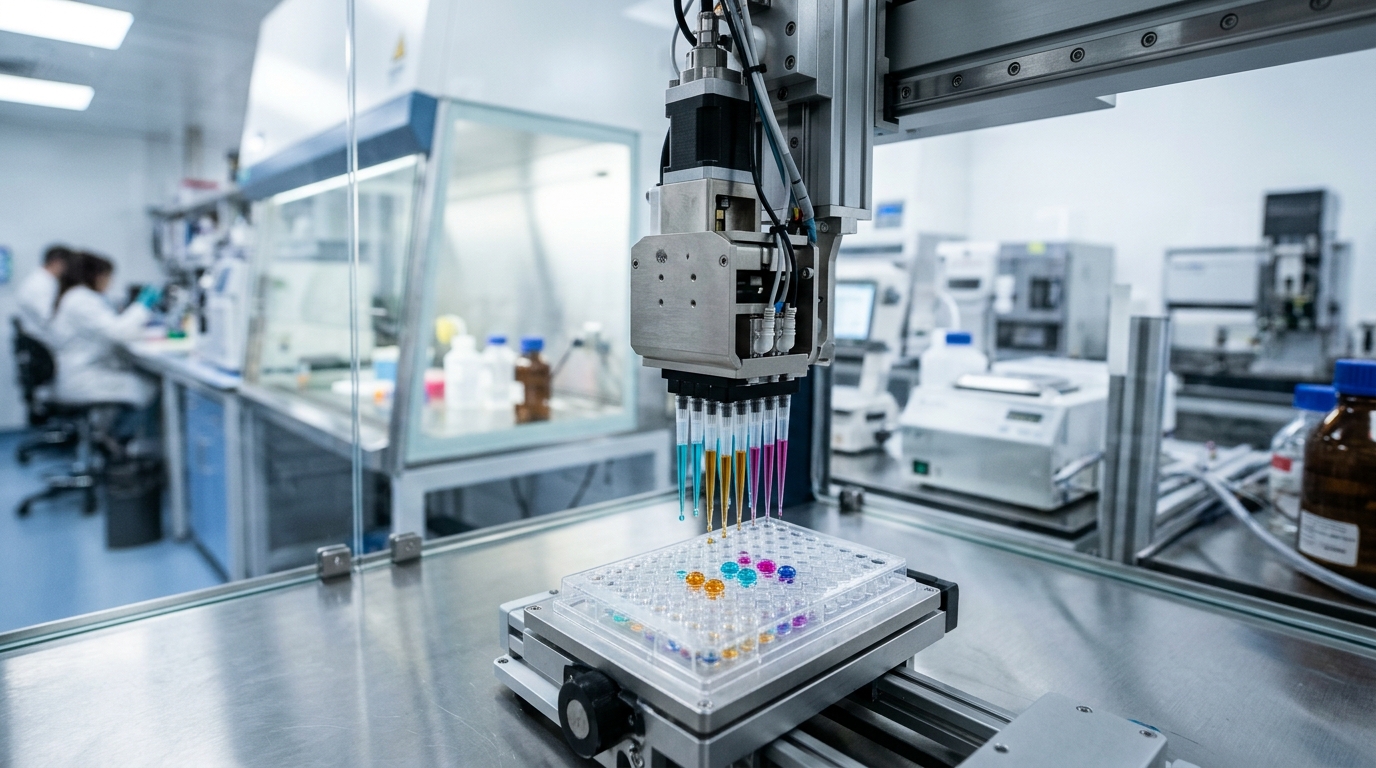
▲ 무균 클린룸 환경에서 시약 분주 작업을 자율적으로 수행하는 다축 제약 로봇 시스템. 컴퓨터 시뮬레이션 결과가 로봇 실험으로 직결되는 랩-인-더-루프 체계가 가동되고 있다. / 스마트 랩 자동화 보도 사진 자료
일라이 릴리와 1.3조 원 '공동 AI 랩'… 써모 피셔의 자율형 실험실까지
엔비디아는 직접 신약을 파는 제약사가 되는 대신, 세계 최대 제약사들과 손잡고 거대한 인프라 동맹을 결성하는 전략을 취했습니다. 그 정점에 선 것이 바로 글로벌 제약 공룡 일라이 릴리(Eli Lilly)와의 메가 파트너십입니다. 양사는 미국 캘리포니아주 사우스 샌프란시스코에 공동 혁신 인공지능 연구소를 신설하고, 향후 5년간 최대 10억 달러(약 1조 3,000억 원)를 인재 유치와 슈퍼컴퓨터 인프라에 공동 투자하기로 확정했습니다.
이번 연합의 핵심은 엔비디아의 바이오네모 플랫폼과 일라이 릴리의 독점 신약 개발 시스템인 튜닝랩(TuneLab)의 결합입니다. 릴리가 수십 년간 쌓아 올린 독점 분자 데이터를 바탕으로 차세대 슈퍼컴퓨팅 아키텍처인 베라 루빈(Vera Rubin) 기반 AI 팩토리를 구동하며, 공장 제조 단계에는 옴니버스 디지털 트윈을 적용해 생산 공정까지 실시간으로 최적화합니다. 데이비드 릭스 일라이 릴리 회장은 "양사의 전문성이 결합하면 신약 개발 방식을 완전히 새롭게 재창조할 수 있다"며 흥분을 감추지 않았습니다.
동시에 세계 1위 분석 장비 기업인 써모 피셔 사이언티픽(Thermo Fisher Scientific)과의 자율형 실험실 동맹도 베일을 벗었습니다. 연구실 테이블 위에 올려놓는 소형 슈퍼컴퓨터 DGX 스파크를 현장에 배치하고, 자율 에이전트 시스템을 구동해 연구자의 손을 거치지 않고도 실험 프로토콜 생성, 로봇 장비 제어, 실시간 품질 관리를 24시간 무인으로 수행하는 미래형 실험실을 현실화했습니다.
개발 방식 및 핵심 지표
전통적 신약 개발 방식
AI 바이오네모 플랫폼 방식
산업적 개선 효과 및 실측 근거
개발 소요 기간
평균 10년 ~ 15년 장기 소요
6년 ~ 9년 수준으로 압축
보건산업진흥원 기준 개발 주기 약 50% 단축
건당 투입 비용
건당 2조 원 ~ 3조 원 천문학적 투입
초기 R&D 예산 50% 이상 절감
불필요한 물리적 합성 시험 단계 대폭 제거
후보물질 성공률
상업화 성공률 100만분의 1 이하
사전 가상 스크리닝으로 실패율 최소화
ReaSyn v2 및 결합력 예측으로 정밀도 극대화
실험실 운영 구조
연구원 수작업 및 단절된 데이터
24시간 폐루프(Lab-in-the-Loop)
써모 피셔 자율 에이전트 및 스마트 랩 연동
글로벌 시장 가치
연간 3000억 달러 R&D 지출 구조
2030년 91.7억 달러 시장 (연 29.6% 성장)
맥킨지 추산 연간 1100억 달러 경제 가치 창출
에디슨·로슈·리커전 총결집… 6개월 연구를 하룻밤에 끝내는 바이오 연합군
바이오네모가 촉발한 변화는 연구 현장의 시간 단위를 완전히 재정의하고 있습니다. 신생 바이오 기업인 에디슨 사이언티픽(Edison Scientific)은 자율 연구 에이전트 코스모스(Kosmos)를 공개해 세계를 놀라게 했습니다. 수백만 건의 논문과 특허, 임상 기록을 순식간에 분석하고 알츠하이머병에서 신경세포 손실을 막아주는 분자를 스스로 설계해 냈는데, 전통적인 연구팀이 꼬박 6개월 동안 매달려야 했던 방대한 작업을 단 하룻밤 만에 완수했습니다.
스위스 다국적 제약사 로슈(Roche)와 자회사 제넨텍 역시 엔비디아의 최신 블랙웰 GPU를 3,500개 이상으로 대거 증설하며 AI 팩토리를 3배 규모로 키웠습니다. 신약 후보물질 발굴부터 항체 치료제 생산 공장까지 옴니버스 기반의 디지털 트윈을 구축해 가동 효율을 극대화하고 있습니다. 엔비디아로부터 5,000만 달러 투자를 받은 리커전(Recursion)을 비롯해 아스트라제네카, 암젠, GSK 등 글로벌 톱 제약사들이 모두 이 생태계에 합류했습니다.
이러한 거대 연합의 배경에는 연산 병목을 해결한 컴퓨터 공학의 진보가 있습니다. 유럽생물정보학연구소(EMBL-EBI), 구글 딥마인드, 그리고 서울대학교 연구진이 공동 참여해 무려 3,000만 개에 달하는 단백질 복합체 구조 데이터셋을 공개했습니다. 단일 단백질 단량체를 넘어 여러 단백질이 얽혀 작용하는 복합체를 시뮬레이션할 수 있게 되었으며, 다중 서열 정렬 과정을 GPU로 고속화해 연산 속도를 100배 끌어올렸습니다.
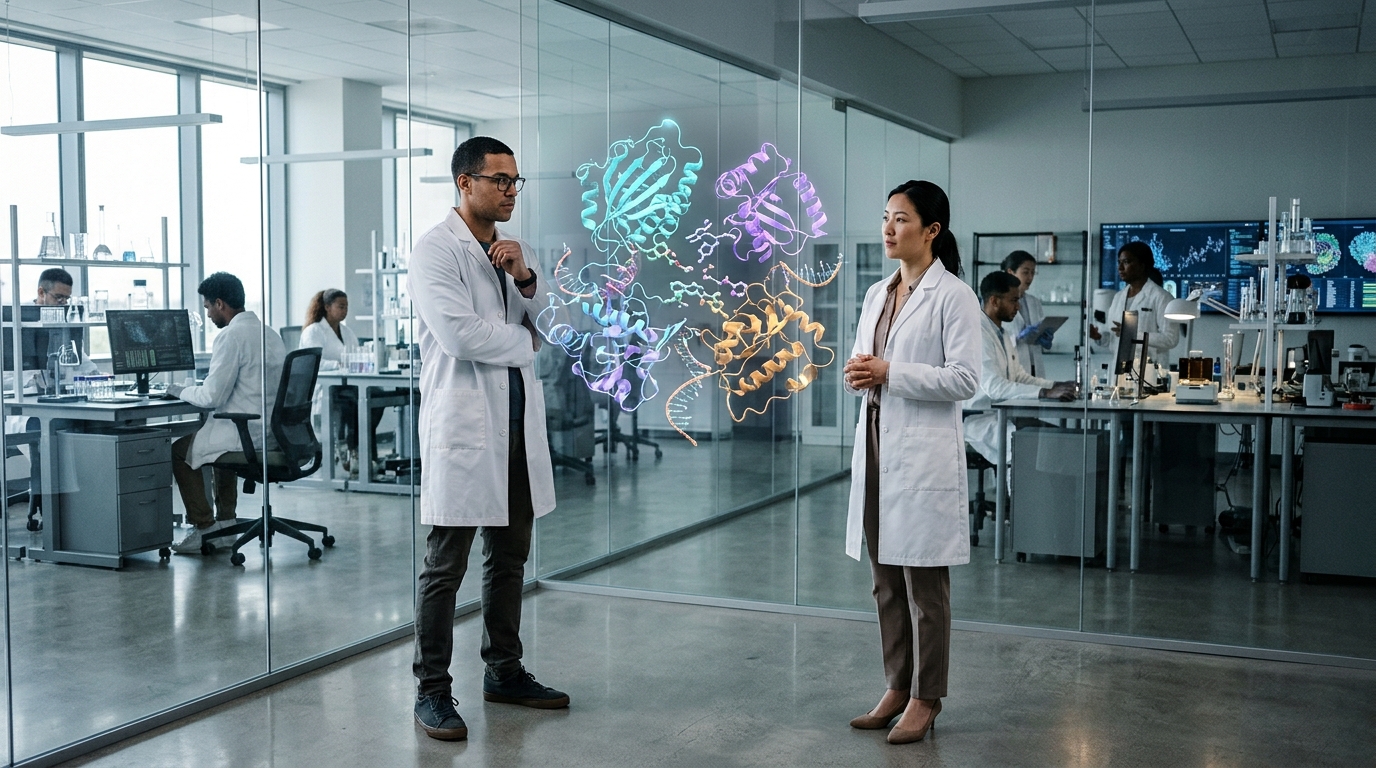
▲ 첨단 생물정보학 연구소에서 과학자들이 3차원 단백질 구조와 분자 결합 시뮬레이션을 관찰하고 있다. 방대한 데이터셋과 고성능 연산이 결합하여 복잡한 생체 분자 설계를 가속화하고 있다. / 바이오 컴퓨터 공학 보도 사진 자료
K-제약·바이오에 미칠 파장… 삼성바이오로직스·대웅·한미의 대응 전략
글로벌 제약바이오 판도를 흔드는 엔비디아의 공세는 한국 산업계에도 중대한 기회와 위기를 동시에 안겨주고 있습니다. 가장 직접적인 수혜 기대감이 번지는 곳은 세계 1위 바이오의약품 위탁개발생산(CDMO) 기업인 삼성바이오로직스입니다. 일라이 릴리의 핵심 위탁생산 파트너인 삼성바이오로직스는 릴리의 공정 혁신 흐름에 맞춰 송도 스마트 팩토리에 엔비디아 옴니버스 기반의 디지털 트윈 공정 관리와 시뮬레이션을 도입할 유력 후보로 거론됩니다. 삼성SDS 자회사인 엠로 역시 글로벌 의약품 공급망 관리(SCM) 최적화와 연계될 수 있습니다.
국내 전통 제약사들도 발 빠르게 자체 플랫폼을 고도화하고 있습니다. 대웅제약은 자체 웹 기반 인공지능 신약 포털 데이지(DAISY)를 가동해 비만·당뇨 활성물질 발굴을 2개월 만에, 항암 선도물질 특허 출원을 6개월 만에 완료하며 통상 1~2년이 걸리던 기간을 획기적으로 줄였습니다. 한미약품 역시 인공지능 플랫폼 HARP를 구축해 비만 신약 후보물질의 세포 신호전달 물질 예측 정확도를 70% 이상으로 끌어올렸으며, JW중외제약과 GC녹십자도 신약 파이프라인 효율화에 속도를 내고 있습니다.
국내 테크바이오 전문 기업들의 글로벌 제휴도 가속화될 전망입니다. 바이오네모와의 실질적 기술 협력을 타진 중인 파로스아이바이오, 자체 슈퍼컴퓨팅 센터로 계산실과 실험실의 선순환을 꾀하는 신테카바이오, 뇌혈관장벽 투과율 높은 표적 치료제에 강한 보로노이가 대표적입니다. 엔비디아 또한 초고속 인터커넥트 기업 포인트투테크놀로지와 언어모델 스타트업 업스테이지, 피지컬 AI 로봇 기업 리얼월드 등에 직접 지분 투자를 단행하며 한국 생태계의 우군을 넓히고 있습니다. 글로벌 빅테크의 바이오 운영체제 선점 경쟁 속에서 K-바이오가 어떤 차별화된 독자 경쟁력을 확보할지 전 세계의 시선이 집중되고 있습니다.
만인의 탑 데일리 뉴스룸 | 바이오·월드와이드 특별취재팀
발행·편집인: 신승엽 | 만인의 탑 데스크 (information.youngsdaily.com)
본 심층 분석 기사는 JP모건 헬스케어 콘퍼런스 공식 발표, 엔비디아 및 일라이 릴리 기업 공시, 한국보건산업진흥원 보고서, 맥킨지 및 그랜드뷰리서치 시장 분석 데이터를 정밀 교차 검증하여 작성되었습니다.
WORLDWIDE IN-DEPTH REPORT | Biotechnology and Life Sciences AI Infrastructure
Official Editorial Dispatch | Global News Desk
[EXCLUSIVE] From Ten Years to Months: Inside Nvidia's $1B BioNeMo Mega-Alliance to Revolutionize Drug Discovery
Photo: Precision multi-axis robotic liquid handling systems dispensing chemical reagents into 96-well microtiter assay plates within a sterile pharmaceutical cleanroom. The mega-alliance between Nvidia and Eli Lilly is accelerating traditional decade-long drug discovery cycles into months. / Pharmaceutical Life Sciences Press Archives
The traditional calculus of pharmaceutical drug discovery—a grueling endeavor historically demanding over a decade, billions of dollars, and contending with a success rate below one in a million—is undergoing a fundamental paradigm shift propelled by generative artificial intelligence and autonomous robotics. Nvidia has announced a transformative expansion of its open drug discovery platform, BioNeMo, declaring its ambition to become the unified artificial intelligence operating system for the global life sciences sector. Transcending virtual molecular simulation, Nvidia has forged an unprecedented mega-alliance with pharmaceutical titan Eli Lilly, committing up to one billion dollars over five years to erect a state-of-the-art Joint Innovation AI Lab in South San Francisco. Simultaneously, a strategic partnership with analytical equipment leader Thermo Fisher Scientific is deploying benchtop supercomputing and multi-agent robotics to establish fully autonomous, continuous-learning smart laboratories. By binding dry computational laboratories and wet physical testing in an unbroken 'Lab-in-the-Loop' feedback architecture, the platform promises to compress discovery timelines by half while unlocking an estimated 110 billion dollars in annual economic value. From digital twin integrations across Samsung Biologics to strategic adaptations at Daewoong, Hanmi, and emerging tech-bio pioneers, this investigative report unpacks the structural revolution transforming medicine.
Shattering the 10-Year, $2 Billion Ceiling: The Paradigm Shift from Chance to Design
For decades, pharmaceutical research operated under a punishing economic reality characterized by trial and error. Traditional drug discovery was fundamentally discovery by chance, requiring scientists to synthesize and physically screen hundreds of thousands of candidate compounds across test tubes and animal models. On average, delivering a single approved therapy consumed ten to fifteen years and between two to three billion dollars in capital, yet commercialization probabilities hovered beneath one in a million due to unforeseen toxicities and poor pharmacokinetic profiles.
The deployment of multimodal biological foundation models has inverted this paradigm into discovery by design. Rather than guessing, researchers now leverage deep generative neural networks to computational target disease proteins in silico, assembling bespoke molecular binders atom by atom while filtering out side effects before any physical pipette is lifted. Life science authorities and health industry research institutes project that this transition compresses total development timeframes by half, bringing timelines down to six to nine years while slashing early stage expenditures by over fifty percent.
Economic projections mirror this scientific acceleration. According to Grand View Research, the global market for artificial intelligence in drug discovery is poised to surge from 1.49 billion dollars in 2023 to 9.17 billion dollars by 2030, compounding at an annual rate of 29.6 percent. Global management consultancy McKinsey estimates that generative intelligence and advanced computing will generate up to 110 billion dollars in annual economic value across the broader biopharmaceutical and healthcare product sectors.
The 24/7 Lab-in-the-Loop Engine: How BioNeMo Automates Biological Intelligence
The structural core of Nvidia's life sciences expansion is BioNeMo, an open development platform anchored by an unbroken Lab-in-the-Loop architecture that fuses dry computational modeling with wet physical laboratories. Historically, data generated in physical assays frequently existed in silos, failing to systematically enrich predictive algorithms when an experiment failed. Under the BioNeMo operating framework, high-throughput robotic assay readouts feed directly back into foundation models in real time, refining subsequent computational hypotheses in an autonomous, continuous-learning loop.
The platform incorporates specialized state-of-the-art biological models addressing critical research bottlenecks. These include RNAPro, which accurately models the three-dimensional structures of messenger RNA and non-coding RNA to accelerate genetic medicines and vaccine designs, and ReaSyn v2, which assesses whether in silico designed molecules can actually be synthesized in a physical chemistry lab, preventing unfeasible designs from leaving the digital drawing board.
At the frontier of macromolecular engineering stands Proteina Complexa, a third-generation protein inference engine. Employing test-time compute methodologies analogous to extended human deliberation, the model allocates deeper compute to optimize binder affinity, doubling effective binder generation relative to previous generations. In benchmark validations with Viva, it successfully yielded 16 viable binders against intractable muscle-wasting disease targets, while researchers at the University of Cambridge accomplished the historic computational de novo design of proteins binding to complex carbohydrate antigens.
Photo: Multi-channel automated robotic liquid dispensers managing assay plates within a pharmaceutical cleanroom. Closed-loop feedback directly bridges computational predictions with physical microplate synthesis. / Smart Laboratory Automation Archives
The $1 Billion Mega-Alliance with Eli Lilly: Inside the Silicon Valley Joint Innovation Lab
Rather than attempting to operate as a standalone pharmaceutical developer, Nvidia has focused on consolidating an expansive enterprise alliance with dominant market incumbents. The marquee manifestation of this strategy is its historic joint venture with Eli Lilly. Announced at the JP Morgan Healthcare Conference, the partners have committed up to one billion dollars over five years to co-found a Joint Innovation AI Lab situated in South San Francisco.
The initiative synthesizes BioNeMo algorithms with Lilly's proprietary TuneLab workflow, combining decades of proprietary biochemical archives with next-generation Vera Rubin DGX SuperPOD computing architecture. Beyond molecule discovery, the collaboration extends to advanced manufacturing facilities, leveraging Nvidia Omniverse to create digital twins of commercial production lines and simulate robotic handling. Lilly Chairman and Chief Executive Officer David Ricks underscored the magnitude of the initiative, noting that the fusion of proprietary data and advanced computing power will fundamentally reinvent therapeutic development.
In parallel, Nvidia has allied with analytical instrument leader Thermo Fisher Scientific to engineer autonomous benchtop environments. Deploying compact DGX Spark supercomputers directly into wet-lab workstations, the multi-agent system formulates experimental protocols, commands laboratory instruments, and conducts real-time quality control without continuous human intervention, establishing a true self-driving scientific facility.
Metric and Research Phase
Traditional Pharmaceutical Method
BioNeMo Platform Framework
Industrial Impact and Empirical Evidence
Development Duration
10 to 15 years average gestation
Compressed to 6 to 9 years
50 percent reduction verified by health agencies
Capital Expenditure
$2.0B to $3.0B per approved drug
Over 50 percent R&D cost reduction
Eliminates unproductive wet-lab screening cycles
Success Probability
Below one in a million from discovery
Pre-screened optimization in silico
ReaSyn v2 filters unviable chemistries early
Laboratory Operations
Manual pipetting with disconnected data
Autonomous 24/7 Lab-in-the-Loop
Thermo Fisher multi-agent robotics integration
Market Value Creation
$300B annual global R&D overhead
$9.17B market by 2030 (29.6% CAGR)
McKinsey projects $110B annual value created
Roche, Edison, and Recursion Unite: Accelerating Six Months of Molecular Biology into 24 Hours
The practical deployment of BioNeMo is radically reordering research chronologies. Venture-backed startup Edison Scientific demonstrated this acceleration with its autonomous agent, Kosmos. By digesting scientific literature, patent repositories, and clinical trials via accelerated parsing, the agent designed functional molecules targeting neurodegeneration in Alzheimer's disease, compressing a workflow that typically consumed six months into a single twenty-four-hour cycle.
Concurrently, Swiss healthcare multinational Roche and its Genentech subsidiary expanded their dedicated computing clusters to over 3,500 Blackwell GPUs, tripling the capacity of their specialized research centers. Their operations deploy Omniverse digital twins across both therapeutic antibody discovery and commercial-scale manufacturing bioreactors. They are joined by global frontrunners including AstraZeneca, Amgen, and GSK, as well as Recursion, which previously received a 50-million-dollar equity investment from Nvidia.
Powering this collective progress is a dramatic reduction in computational bottlenecks. A collaborative consortium featuring the European Bioinformatics Institute (EMBL-EBI), Google DeepMind, and Seoul National University recently published an unprecedented atlas of thirty million protein complex structures. By accelerating multiple sequence alignments directly on GPUs, computational speeds increased a hundredfold, removing memory boundaries that previously prevented the simulation of massive macromolecular assemblies.
Photo: Computational biologists examining three-dimensional macromolecular protein structures and molecular docking simulations. Unprecedented computational scale and vast structural datasets are unravelling complex biological interactions. / Computational Life Sciences Archives
Strategic Implications for K-Bio: How Samsung Biologics, Daewoong, and Hanmi Navigate the Frontier
The consolidation of life sciences infrastructure under global technology platforms introduces profound strategic imperatives for South Korea's biopharmaceutical sector. The most immediate beneficiary is Samsung Biologics, the world's preeminent contract development and manufacturing organization (CDMO). As a primary commercial manufacturing partner for Eli Lilly, Samsung Biologics is uniquely positioned to incorporate Omniverse digital twins across its Songdo biomanufacturing campuses, synchronizing real-time production parameters with global client specifications. Supply chain software provider E-MRO similarly aligns with these digital supply resilience initiatives.
Domestic pharmaceutical houses are simultaneously accelerating internal computational capabilities. Daewoong Pharmaceutical launched its proprietary web-based discovery portal, DAISY, identifying active anti-obesity leads within two months and securing oncology patent filings in six months—slashing early R&D cycles by up to two years. Hanmi Pharmaceutical's HARP platform has achieved over 70 percent accuracy in intracellular cyclic AMP predictive modeling for its obesity candidate HM17321, while JW Pharmaceutical and GC Biopharma advance pipeline efficiency through targeted algorithms.
Specialized tech-bio innovators are forging multilateral alliances. Pharos iBio actively explores platform integration within the BioNeMo framework, Syntekabio scales its proprietary high-performance computing centers to sustain wet-dry laboratory feedback, and Voronoi leverages precision structural design to target central nervous system diseases across the blood-brain barrier. Complementing these initiatives, Nvidia has directed direct strategic investments into domestic startups including Point2 Technology for high-speed interconnects, Upstage for language models, and Realworld for physical AI robotics. As the race to establish the operating foundation of future medicine accelerates, South Korea's life science leaders are moving decisively to secure their place in the emerging global value chain.
This investigative dispatch was compiled in strict accordance with standard news verification protocols utilizing certified corporate disclosures from the JP Morgan Healthcare Conference, institutional findings from the Korea Health Industry Development Institute, and global economic assessments from McKinsey and Grand View Research.
PRO SOURCING ENGINE만인의 탑 빅데이터 솔루션
★ 가입 시 600 크레딧(120회) 전원 무료
내가 찾는 상품 키워드, 지금 얼마나 검색될까?
네이버 월간 검색량 + 구글 볼륨 + 아이템스카우트 실시간 상품수와 경쟁강도 배지를 0.5초 만에 무료로 확인하세요.
MANINTOP NEWSLETTER
📬 만인의 탑 뉴스레터 무료 구독
오늘 보신 정책·시사 뉴스가 유익하셨나요? 매일 엄선되는 알짜 복지 혜택과 국회 실시간 속보를 이메일로 가장 먼저 받아보세요. (평생 무료)
1월이 시작되면 감기는 이미 우리 곁에 와 있습니다. 2월, 3월, 4월까지 이어지는 추위와 건조함은 코와 목을 가장 먼저 공격합니다. 아침에 일어나자마자 막혀 있는 코. 계속 흐르는 콧물. 괜히 칼칼해지는 목. 이 증상은 “시작”일 뿐입니다. 한 번 무너지면 일주일, 길면 한 달까지 끌고 갑니다. 약을 먹으면 잠깐 괜찮아집니다. 하지만 며칠 뒤 또 반복됩니다. 왜일까요? 감기는 ‘치료’의 문제가 아니라 ‘관리’의 문제이기 때문입니다. 대부분은 감기가 오고 나서 약을 찾습니다. 하지만 진짜 중요한 건 감기가 오기 전에 코와 목을 지키는 것입니다. 건조한 실내 공기, 차가운 바깥 공기, 눈에 보이지 않는 세균. 코와 목은 매일 공격받고 있습니다. 지긋지긋하죠! 그런데도 우리는 아무 준비 없이 버티고 있습니다. 이번 겨울도 그렇게 보낼 건가요? 사실 방법은 어렵지 않습니다. 코를 깨끗하게 관리하고, 목을 따뜻하게 보호하고, 점막을 촉촉하게 유지하고, 기관지를 미리 관리하고, 외부 공기를 차단하는 것. 이 다섯 가지만 꾸준히 해도 감기약 없이 겨울을 보내는 것이 충분히 가능합니다. 🔥 이제부터 그 방법을 하나씩 살펴보겠습니다. 🔥 1. 코와 목을 먼저 관리해야 하는 과학적 이유 감기의 대부분은 코 점막에서 시작됩니다. 국제 학술지 Nature Reviews Microbiology 와 Journal of Allergy and Clinical Immunology 에 실린 호흡기 감염 관련 연구들에서는, 감기 바이러스가 비강 상피세포에 먼저 부착해 증식한다는 점을 설명하고 ...
리모델링사업이 진행 중인 아파트를 매매할 때 “계약금 10%를 언제까지 내야 하느냐”는 질문이 특히 많이 나옵니다. 이주공고(이주 안내)가 7~11월쯤이라고 들으면, 그 시점에 맞춰 계약금도 움직일 것 같아서 더 헷갈리기 쉽습니다. 하지만 실제 납부기한은 ‘이주공고가 언제냐’만으로 자동 결정되지 않는 경우가 많습니다. 1) 계약금 10% 납부기한: 결국 ‘문서에 적힌 일정’이 기준 계약금 10%를 언제까지 납부해야 하는지는, 내가 서명하는 매매계약서(특약 포함) 와 사업주체/조합이 제시한 공고·안내문 에 적힌 납부 일정이 기준이 됩니다. 실제 공고문에서는 분양대금 납부의 큰 틀(계약금→중도금→잔금)을 먼저 안내하고, 상세 일정은 별도 표나 유의사항으로 제시하는 방식이 흔합니다. 또, 계약서 문구에 따라 지급 시점이 조건부로 설정될 수도 있습니다. 예를 들어 한 사례 소개 자료에서는 용역계약서에 잔금(10%) 지급시기가 “사업승인 후”로 기재되어 있었다는 점이 언급됩니다. 이런 식으로 ‘사업 단계’와 지급을 연동하는 문구가 들어가면, 질문의 답은 계약서 문구를 확인해야만 확정됩니다. 관련 내용은 링크 에서 문구 사례를 확인할 수 있습니다. 2) 입주자모집공고에서 확인되는 ‘납부 순서’와 잔금 마감 시점 공고문에 적힌 문구를 보면, 납부 순서와 잔금 마감에 대한 기준이 비교적 명확하게 제시되는 경우가 있습니다. 예를 들어 한 입주자모집공고에는 “분양금액(주택가격)은 계약금, 중도금, 잔금의 순서로 납부”하며 “잔금은 입주(열쇠 수령일) 전에 완납”해야 한다고 안내되어 있습니다. (문구 확인: 링크 ) 이 문구가 의미하는 바는 최소 2가지입니다. 분양/공급 형태의 문서에서는 ‘계약금→중도금→잔금’ 흐름이 공식적으로 안내될 수 있습니다. 잔금은 “입주(열쇠 수령)” 이전에 완납해야 한다는 마감 기준이 문서에 적혀 있을 수 있습니다. 다만, 위 공고문 문구는 잔금 마감에 대한 기준을 보여주지만, 계약금 10%의...
윤석열 전 대통령 탄핵 인용 소식을 접하면, 가장 궁금한 지점은 ‘헌재가 정확히 무엇을 위헌·위법으로 봤는가’입니다. 또한 탄핵과 별개로 진행되는 형사재판(내란 우두머리 혐의 등)이 어디까지 왔는지도 함께 정리할 필요가 있습니다. 아래 내용은 제공된 기사/게시물 스니펫과 링크에서 확인되는 범위만 모아, 일반인이 흐름을 이해하기 쉽게 정리한 것입니다. 1) 탄핵 인용 관련: 스니펫에서 확인되는 ‘판단의 골격’ 제공된 근거 중 조국혁신당 사이트에는 헌법재판소가 윤석열 탄핵 심판에서 “피청구인의 위헌·위법행위는 국민 신임 …”이라는 취지로 판단했다는 문장이 인용돼 있습니다( 링크 ). 이 인용문만 놓고 보면, ‘위헌·위법행위’가 있었는지와 그로 인해 ‘국민의 신임’이 어떻게 평가됐는지가 핵심 축으로 소개됩니다. 다만 질문에서 요청하신 세부 항목, 즉 비상계엄 선포 자체를 문제 삼은 구체적 이유, 계엄 이후 조치(포고령, 국회 통제 등)의 어떤 지점이 헌법 위반인지, 국회의 권한행사 방해 및 정치활동 제약을 어떤 논리로 판단했는지 등은, 이번에 제공된 근거의 제목/스니펫만으로는 조항·사실관계·판단 구조가 그대로 제시돼 있지 않습니다. 따라서 이 글에서는 ‘헌재가 무엇을 문제 삼았다’는 세부 리스트를 단정적으로 재구성하기보다, 현재 확인 가능한 문구 수준의 요약(위헌·위법행위 → 국민 신임의 문제로 평가)까지만 적습니다. 만약 헌재 결정문 전문(주문 및 이유)이 추가로 확인되면, 그때는 문장 단위로 ‘어떤 행위’와 ‘어떤 헌법 원리/조항’이 연결되는지(예: 권력분립, 국회의 권한, 정치적 기본권 등) 구조화해 정리하는 것이 가장 정확합니다. 2) 형사 절차(내란 혐의) 관련: 체포영장과 1심 선고 언급 탄핵 심판과 별도로, 12·3 비상계엄 사태로 내란 혐의를 받는 윤석열 대통령에 대해 2024년 12월 31일 체포 영장이 발부됐다는 BBC 보도가 있습니다( 링크 ). 해당 보도는 ‘현직 대통령’에 대한 체포영장 발부라는 점을 함께 언급합니다. 또...