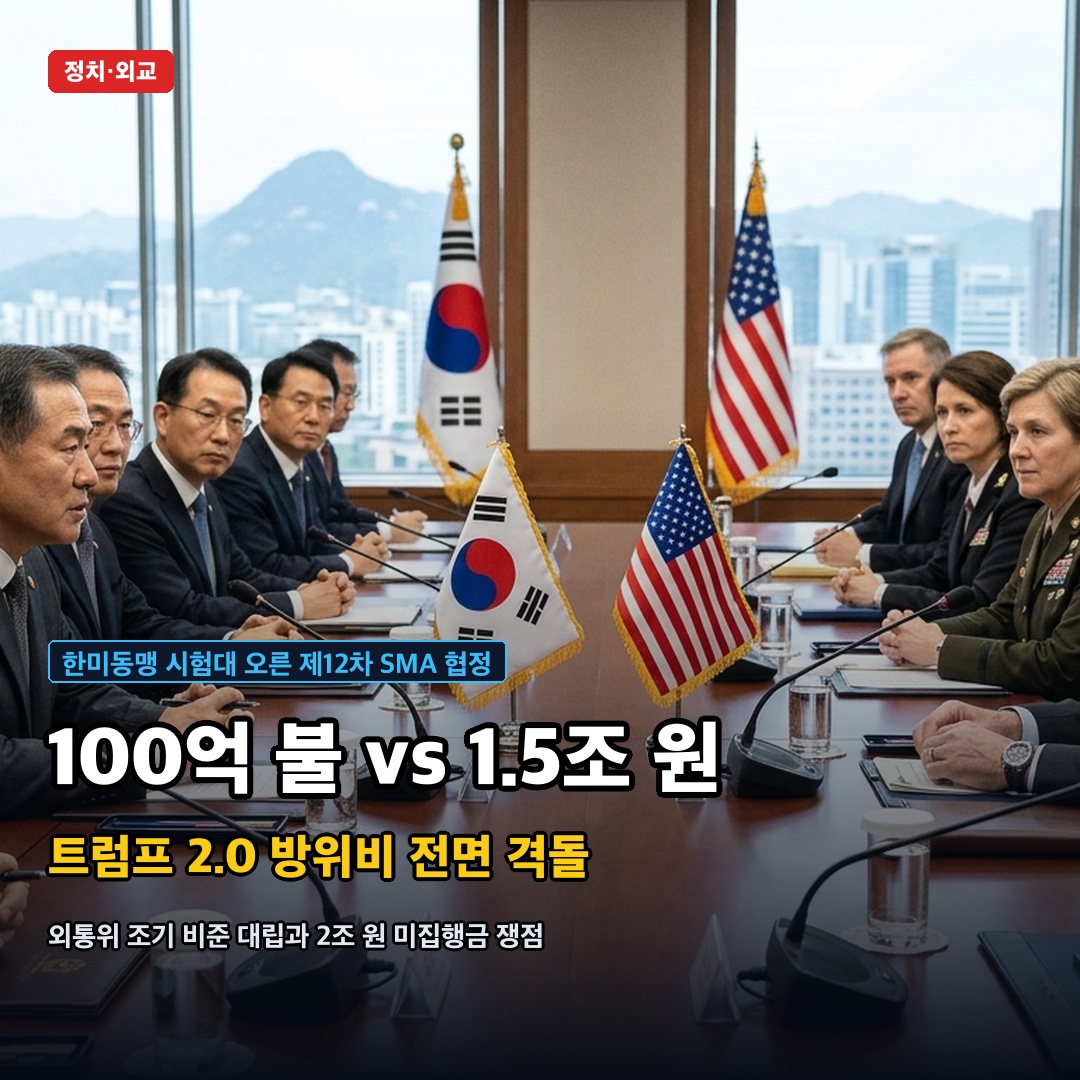
▲ 서울 외교부 청사에서 열린 한미 외교안보 고위급 협의 현장. 제12차 방위비분담특별협정 타결 이후 트럼프 2기 출범에 따른 동맹 재정 분담 문제가 핵심 의제로 논의되고 있다. / 공식보도자료
주한미군 주둔 비용을 둘러싼 한미 방위비분담금 협상이 타결된 지 불과 한 달여 만에, 백악관에 재입성하는 도널드 트럼프 대통령 당선인의 거친 안보 청구서와 정면 충돌하며 한미동맹이 전례 없는 시험대에 올랐습니다. 한국 정부는 2026년부터 적용될 제12차 한미 방위비분담특별협정(SMA)을 서둘러 타결하며 첫해 분담금을 1조 5,192억 원으로 확정했지만, 트럼프 당선인은 한국을 '머니 머신'이라 부르며 연간 100억 달러(약 14조 7,000억 원)라는 천문학적 액수를 노골적으로 요구하고 나섰습니다. 현행 타결액의 10배에 육박하는 거대한 간극 속에서, 안보의 방어벽으로 기대했던 조기 타결안이 오히려 더 큰 재협상 압박을 부르는 뇌관이 될 수 있다는 우려가 커지고 있습니다.
8.3% 첫해 인상과 물가연동제 환원… 5년간 8조 원 육박하는 재정 부담
이번 12차 협정의 핵심은 2026년 첫해 분담금을 전년 대비 8.3%(1,164억 원) 증액한 1조 5,192억 원으로 정하고, 2030년까지 5년간의 인상률을 국방비 증가율 대신 소비자물가지수(CPI) 증가율에 연동하기로 한 점입니다. 연간 인상 상한선은 과거 협정에서 쓰였던 5%로 다시 묶어두었습니다. 정부는 급격한 재정 팽창을 막고 예측 가능성을 확보한 합리적 결과물이라고 자평하고 있습니다. 8.3%라는 첫해 인상률 역시 최근 5년간의 연평균 증가율(6.2%)에 주한미군 한국인 노동자 증원 소요(1.3%)와 군사건설 관리비 요율 현실화(0.8%)를 투명하게 반영한 계산식이라고 설명합니다.
그러나 5년간 국민이 짊어져야 할 실질적인 국고 부담을 꼼꼼히 따져보면 결코 가벼운 수준이 아닙니다. 물가상승률을 2% 안팎으로 보수적으로 잡더라도 연도별 분담금은 2027년 1조 5,496억 원, 2028년 1조 5,806억 원, 2029년 1조 6,122억 원을 거쳐 2030년에는 1조 6,444억 원까지 불어납니다. 5년간 누적 분담금 총액만 최소 7조 9,060억 원에 달합니다. 이는 직전 11차 협정 기간(2020~2025년)의 연평균 분담금(1조 2,514억 원)과 비교했을 때 연평균 26.3%(3,298억 원)나 껑충 뛴 규모입니다.
적용 연도
인상률 산출 기준
예상 분담금 총액
재정적 함의 및 특징
2025년 (기준)
제11차 협정 마지막 해
1조 4,028억 원
국방비 증가율(4.3%) 연동 종료
2026년 (개시)
8.3% 전격 증액 합의
1조 5,192억 원
사상 최초 1조 5,000억 원 돌파
2027~2029년
전전년도 CPI 연동 (약 2%)
연 1조 5,496억 ~ 1조 6,122억
연간 인상 상한선 5% 캡 적용
5년 누적 총액
연평균 1조 5,812억 원
최소 7조 9,060억 원
11차 대비 연평균 26.3% 폭증
트럼프의 '머니 머신' 발언과 원스톱 쇼핑… 관세와 안보의 복합 패키지
진짜 위기는 워싱턴에서 밀려오는 '트럼프 2.0'의 거래적 동맹관입니다. 트럼프 당선인은 동맹을 공통의 가치나 역사적 유대가 아니라 철저한 손익 계산에 따라 거래하는 비즈니스 관계로 바라봅니다. 그가 거론한 연간 100억 달러는 단순한 엄포나 정치적 수사를 넘어, 한국의 경제력과 대미 무역흑자를 겨냥한 실질적 압박 카드로 평가받습니다. 실제로 트럼프 1기 시절에도 그는 50억 달러(약 6조 원)를 요구하며 협상장을 박차고 나가 1년 넘게 협정을 표류시켰던 전력이 있습니다.
특히 우려되는 대목은 트럼프 진영이 예고한 '원스톱 쇼핑' 전략입니다. 경제 통상과 안보 국방을 따로 떼어놓지 않고 한 테이블에 올려 패키지로 흥정하겠다는 계산입니다. 대미 무역흑자국인 한국에 10~20%의 보편관세를 매기겠다고 위협하면서, 관세를 깎아주는 대가로 방위비 분담금 대폭 증액, 미국산 고가 첨단 무기 대량 구매, 현지 대규모 투자 확대를 동시에 밀어붙일 가능성이 매우 높습니다. 자칫하면 우리의 안보 주권과 국익이 무역 협상의 교환 카드로 흔들릴 수 있는 아찔한 구도입니다.
국회 비준과 행정협정의 비대칭성… 2025 국방수권법 감축 빗장 해제
양국의 협정 체결 방식을 둘러싼 법적 비대칭성도 심각한 뇌관입니다. 한국 헌법 제60조 제1항에 따르면 중대한 재정적 부담을 지우는 조약은 국회의 비준동의를 받아야만 법적 효력이 생깁니다. 반면 미국에서 SMA는 상원의 동의가 필요한 정식 조약이 아니라, 대통령의 권한으로 언제든 서명하고 폐기할 수 있는 행정협정에 불과합니다. 즉, 우리 국회가 밤을 새워 비준동의안을 통과시켜 놓더라도, 트럼프 대통령이 백악관에 들어서자마자 행정명령 한 장으로 합의를 백지화하고 재협상을 요구하면 막아설 국제법적 수단이 마땅치 않습니다.
▲ 국회 외교통일위원회 전체회의에서 외교부 장관과 위원들이 제12차 한미 방위비분담특별협정 비준동의안의 파장과 차기 미 행정부 재협상 가능성을 두고 질의응답을 진행하고 있다. / 공식보도자료
미국 의회의 안전장치가 풀려버린 점도 불안을 가중시킵니다. 과거 트럼프 1기 때는 의회가 국방수권법(NDAA)에 '의회의 승인 없이 주한미군을 2만 8,500명 아래로 감축하는 예산을 쓰지 못한다'는 자물쇠를 채워두었습니다. 하지만 2025 회계연도 국방수권법에서는 이 감축 제한 규정이 조용히 사라졌습니다. 게다가 이번 대선과 함께 치러진 선거에서 공화당이 상원과 하원을 모두 장악하면서, 트럼프 대통령이 분담금 인상을 압박하기 위해 주한미군 감축이나 철수 카드를 만지작거리더라도 내부에서 제동을 걸 견제 세력이 사라졌습니다.
외통위 조기 비준 대립과 2조 원 미집행금… 민생 복지 삭감과의 충돌
국회 외교통일위원회에 상정된 비준동의안을 두고 정치권과 시민사회의 시각이 극명하게 갈리는 이유도 여기에 있습니다. 정부와 찬성 측은 트럼프 취임 전에 서둘러 국회 비준을 마쳐야 공식적인 '법적 방어벽'이 형성된다고 역설합니다. 설령 미국이 재협상을 요구해 오더라도 이미 발효된 12차 협정이 버티고 있어야 1조 5,000억 원을 기준선으로 삼아 방어할 수 있다는 논리입니다. 반대로 서두르지 않고 차기 미 행정부와 협상하려다가는 턱없는 요구에 휘둘릴 수 있다는 설명입니다.
하지만 비판론자들의 반론도 만만치 않습니다. 11차 협정 대비 26% 넘게 올려준 이번 안을 서둘러 통과시키는 것은 트럼프에게 한국이 정말로 돈을 쉽게 내주는 나라라는 잘못된 신호를 줄 수 있다는 지적입니다. 오히려 1조 5,000억 원이 재협상의 '바닥선'이 되어, 트럼프 행정부가 여기에 알파를 얹어 추가 청구서를 내미는 덫에 빠질 수 있다고 경고합니다. 조기 비준이 방패가 되기는커녕 미국의 추가 증액 요구를 정당화해 주는 발판이 될 수 있다는 우려입니다.
협정문 속에 숨겨진 2조 원대 미집행금 문제도 뜨거운 감자입니다. 국방부 자료에 따르면 주한미군이 다 쓰지 못해 남아있는 현물 지원분은 군사건설 1조 6,476억 원과 군수지원 2,675억 원 등 1조 9,151억 원에 달하며, 현금 잔액까지 합치면 2조 원을 훌쩍 넘습니다. 12차 협정 제3조는 남은 지원분을 다음 해들로 계속 넘겨서 쓸 수 있도록 길을 열어주었습니다. 그러나 이미 기간이 끝난 과거 협정의 미집행금을 새 협정의 이름으로 뒤늦게 내주는 것은 법적으로 문제가 있다는 비판이 나옵니다. 이 밀린 돈이 순차 집행되면 우리 국민이 실제로 부담해야 할 돈은 8조 원이 아니라 10조 원에 육박하게 됩니다.
국내 재정 현실과의 괴리도 수험생과 시민들의 가슴을 답답하게 만듭니다. 역대급 세수 부족으로 나라 살림이 쪼들리면서, 정부는 고교 무상교육 국고 지원 예산 9,386억 원과 취약계층 아동 보육 예산 3,259억 원을 대폭 삭감했습니다. 그런데 이번 2026년 방위비 분담금 단 한 해 지출액(1조 5,192억 원)은 이 두 민생 복지 예산을 합친 금액보다 큽니다. 극심한 경영난으로 무너져가는 전국 35개 지방의료원의 3년 치 누적 적자(2조 969억 원)의 70% 이상을 단번에 갚아줄 수 있는 천문학적 혈세가 미군 주둔비로 빠져나가는 셈입니다.
참여정부 8.9% 감액의 외교적 교훈… 수세적 방어 넘어설 3대 전략
이처럼 사면초가의 안보 위기 속에서 우리가 되돌아보아야 할 역사적 나침반이 있습니다. 바로 20년 전 노무현 참여정부가 이뤄낸 제6차 SMA 협상입니다. 2004년 당시 미국은 주한미군 재편을 내세우며 막대한 증액을 압박했습니다. 하지만 참여정부 협상단은 주한미군 12,500명 감축 수용, 용산기지 평택 이전 비용 부담, 이라크 자이툰부대 파병 등 한국이 짊어진 거대한 동맹 기여를 하나로 묶어 당당하게 맞섰습니다. 국방부 실무진 대신 외교통상부가 정무적 전략을 총괄하며 판을 흔든 끝에, 1991년 협정 시작 이래 최초로 전년 대비 8.9%를 깎아내는 기적 같은 외교적 승리를 거두었습니다.
다가오는 트럼프 2기의 거센 파고를 넘어서기 위해서는 이제 수세적 방어를 넘어선 당당하고 입체적인 협상 전략이 절실합니다. 우리가 무상으로 제공하는 토지와 세제 혜택 등 연간 3조 4,000억 원이 넘는 간접 기여분을 정밀하게 수치화하여 미국 의회와 조야를 끈질기게 설득해야 합니다. 아울러 미 해군 함정 정비(MRO) 사업을 비롯한 협력도 일방적인 안보 하청이 아니라 국내 조선·방위산업의 실질적 이익으로 연결하는 지혜가 필요합니다. 동맹의 가치는 일방적인 돈 계산이 아니라 상호 존중과 호혜성에서 나온다는 사실을 이제 우리가 명확히 보여주어야 할 때입니다.
주요 쟁점 및 분야
정부 및 찬성 측 논리
야당 및 비판 측 반론
전략적 대안 및 과제
국회 조기 비준
재협상 요구 시 법적 방어벽 확보
재협상 최저 하한선 전락 우려
국회 부대의견 통한 통제권 강화
2조 원 미집행금
협정문 제3조 의거 차기 이월
만료 협정 미집행분 소급 지급 불법
소요형 전환 및 잔액 국고 환수
통상·안보 연계
패키지 딜 통한 파국 회피
보편관세 압박에 안보 주권 종속
연 3.4조 원 간접지원 지수화
역대 협상 모델
외교적 관례 및 실무 협의 유지
미국 소요 제기에 끌려간 총액형
참여정부 8.9% 감액 모델 계승
[In-Depth Analysis] Trump's 10 Billion Dollar Defense Cost Ultimatum vs 1.5 Trillion Won Accord: Korea-US Alliance Faces Watershed SMA Showdown
Political and Defense Investigative Desk | Korea-US Alliance Strategic Analysis2026. 11. 13 21:20 KST
▲ High-level bilateral strategic consultation at the Ministry of Foreign Affairs in Seoul. Following the conclusion of the 12th Special Measures Agreement, defense cost-sharing burdens face renewed scrutiny ahead of the incoming Trump administration. / Press Coverage Photo
Barely a month after concluding bilateral negotiations over American troop upkeep, the defense cost-sharing framework between Seoul and Washington faces unprecedented turbulence as President-elect Donald Trump prepares his transactional return to the White House. While South Korea sought strategic predictability by prematurely concluding the 12th Special Measures Agreement to fix its initial 2026 contribution at 1.5192 trillion won, Trump has reignited tensions by labeling South Korea a money machine and demanding a staggering 10 billion dollars annually. With this rhetorical ultimatum hovering near ten times the negotiated baseline, profound national anxiety mounts over whether Seoul's diplomatic preemptive accord serves as an alliance safeguard or an explosive baseline trap.
Initial 8.3 Percent Hike and Inflation Linkage: Five-Year Outlays Approaching 8 Trillion Won
At the heart of the 12th agreement lies an initial 8.3 percent increase for 2026, lifting national contributions by 116.4 billion won to 1.5192 trillion won, while replacing general defense budget growth rates with the consumer price index as the annual adjustment metric through 2030. Reinstating a five percent annual increase cap, government negotiators defended the outcome as a fiscally prudent compromise that prevents runaway expenditure. Officials explained that the 8.3 percent introductory leap derived mathematically from the five-year average historical increase rate of 6.2 percent, coupled with a 1.3 percent expansion for Korean civilian base personnel and an 0.8 percent adjustment in construction administrative overhead.
Nevertheless, comprehensive fiscal scrutiny reveals that aggregate taxpayer burdens remain formidable over the five-year lifecycle. Even under modest two percent annual inflation projections, yearly outlays steadily compound to 1.5496 trillion won in 2027, 1.5806 trillion won in 2028, 1.6122 trillion won in 2029, and 1.6444 trillion won by 2030. Cumulative commitments across the agreement will consume at least 7.906 trillion won. This represents a steep 26.3 percent annual surge—an additional 329.8 billion won per year—compared to the 1.2514 trillion won annual average maintained during the 11th agreement cycle.
Target Fiscal Year
Adjustment Formula Applied
Projected Contribution
Fiscal Significance & Impact
2025 (Baseline)
Final Year of 11th Agreement
1.4028 Trillion Won
Defense budget indexation expires
2026 (Initial)
8.3 Percent Upfront Increase
1.5192 Trillion Won
First crossing 1.5 trillion won threshold
2027 to 2029
Two-Year Prior CPI Link (~2%)
1.5496T to 1.6122T Won
Reinstatement of 5 percent cap
Five-Year Cumulative
1.5812 Trillion Won Annual Avg
At Least 7.906 Trillion Won
26.3% Annual surge over 11th SMA
Money Machine Rhetoric and One-Stop Shopping: The Cross-Sectoral Tariff-Security Nexus
The genuine structural tempest stems from Washington's impending transactional doctrine under Trump 2.0. The incoming administration approaches traditional alliances not through shared values or mutual security history, but strictly through merchant balance sheets and immediate fiscal extraction. Trump's cited 10 billion dollar price tag—equivalent to roughly 14.7 trillion won under prevailing foreign exchange rates—is widely recognized across diplomatic circles not merely as campaign hyperbole, but as a deliberate coercive leverage designed to monetize allied dependence, recalling his 5 billion dollar demands that paralyzed bilateral talks in 2019.
Diplomatic analysts express acute concern over the incoming administration's declared one-stop shopping negotiating strategy, which deliberately intertwines trade policy with national defense. Confronting South Korea's substantial trade surplus with the United States, Washington appears poised to threaten 10 to 20 percent universal tariffs, conditioning trade exemptions upon massive defense contribution hikes, extensive procurement of high-cost American weapon systems, and expanded onshore corporate investments. Such a sweeping cross-sectoral offensive risks subordinating sovereign defense posture to transactional trade concessions.
Parliamentary Ratification vs Executive Agreements: NDAA Troop Reduction Safeguards Lifted
A profound legal asymmetry between both domestic jurisdictions further compounds vulnerability. Under Article 60, Paragraph 1 of the South Korean Constitution, treaties imposing major financial commitments upon the public require statutory ratification by the National Assembly to attain legal force. Conversely, Washington treats the agreement not as a Senate-ratified treaty, but as a sole executive agreement subject to unilateral presidential decree. Consequently, even if South Korea's parliament ratifies the pact, President Trump possesses full domestic legal authority upon inauguration to abrogate the agreement and demand immediate renegotiation.
▲ Inside the National Assembly Foreign Affairs and Unification Committee, lawmakers and foreign ministry leadership debate ratification strategies and renegotiation risks surrounding the 12th Special Measures Agreement. / Press Coverage Photo
Congressional firewalls on Capitol Hill have also eroded significantly compared to Trump's initial term. During the 2019 to 2021 defense debates, United States lawmakers embedded explicit statutory bars within the National Defense Authorization Act prohibiting federal expenditures to reduce American forces in Korea below 28,500 personnel without legislative consent. In the fiscal year 2025 legislation, however, this mandatory threshold constraint was quietly omitted. With the Republican Party capturing majorities in both chambers, institutional resistance to executive troop withdrawal threats has weakened dramatically.
Committee Ratification Clashes and 2 Trillion Won Unspent Reserves Amid Welfare Cutbacks
These geopolitical fissures have triggered heated debate within the National Assembly Foreign Affairs and Unification Committee. Government proponents argue that securing parliamentary ratification prior to Trump's formal inauguration establishes an essential legal baseline. Under this defensive doctrine, having a finalized international agreement provides a legitimate starting threshold of 1.5 trillion won, preventing unchecked demands and shielding national interests. Leaving the alliance framework legally unmoored, advocates warn, would invite catastrophic exposure to predatory bilateral bargaining.
Conversely, critics and progressive civil coalitions contend that hastening ratification of an agreement containing a 26 percent funding surge validates Trump's cynical depiction of South Korea as an easily pressured financier. Opponents warn that rather than functioning as a protective shield, the 1.5 trillion won accord will merely become the absolute floor from which Washington launches additional fiscal demands. Under this assessment, premature legislative blessing codifies exorbitant contribution baselines while doing nothing to deter future executive extortion.
Controversy also surrounds more than two trillion won in unspent defense funds accumulated across previous agreement cycles. Ministry of National Defense audits document approximately 1.9151 trillion won in unliquidated in-kind allocations, including 1.6476 trillion won for military construction and 267.5 billion won for logistics support, alongside roughly 250 billion won in cash reserves. While Article 3 of the new agreement authorizes perpetual annual rollovers, legal analysts contend that disbursing funds generated under expired pacts constitutes improper retroactive execution, inflating actual national outlays toward 10 trillion won.
The domestic fiscal juxtaposition sharpens public scrutiny amid historic tax revenue shortfalls. Facing budgetary constraints, the administration slashed central funding for high school free tuition by 938.6 billion won and reduced vulnerable childcare support by 325.9 billion won. Yet the single-year 2026 defense contribution of 1.5192 trillion won exceeds both curtailed welfare initiatives combined. That single annual allocation could extinguish more than 70 percent of the three-year cumulative deficit across 35 struggling regional medical centers, sparking intense debate over national expenditure priorities.
Diplomatic Lessons from the 8.9 Percent Roh Era Reduction: Strategic Paradigms for Trump 2.0
Amid these formidable headwinds, South Korean diplomacy possesses a vital historical roadmap in the 6th agreement negotiated under the Roh Moo-hyun administration twenty years ago. In 2004, Washington demanded substantial cost increases during global defense restructurings. The Roh administration counterbalanced American pressures by comprehensively linking defense costs with South Korea's wider strategic contributions: accepting a 12,500 troop reduction, financing the massive relocation to Camp Humphreys, and deploying the Zaytun Division to Iraq. Elevating negotiations under diplomatic leadership, Seoul achieved a historic 8.9 percent cost reduction in 2005.
Navigating the impending turbulence of Trump 2.0 requires transcending passive containment in favor of sophisticated multidimensional diplomacy. South Korea must rigorously quantify its extensive indirect contributions—surpassing 3.4 trillion won annually in rent-free base land, municipal tax exemptions, and extensive arms procurements—to build persuasive coalitions across Capitol Hill and American policy institutes. Furthermore, emerging naval maintenance and overhaul initiatives must be structured to generate reciprocal industrial benefits for domestic shipyards rather than serving as subordinate logistics outposts. True alliance endurance demands equitable reciprocity over crude monetary transaction.
Key Strategic Pillar
Executive Defense Position
Legislative Critical Position
Strategic Blueprint & Action
Early Ratification
Secures legal defense shield
Risks becoming minimum floor
Strengthen parliamentary conditions
2T Won Unspent Funds
Authorized rollover via Article 3
Improper retroactive execution
Transition to requirement audit
Trade-Security Linkage
Comprehensive package deals
Subordinates sovereignty to tariffs
Index 3.4T won indirect support
Negotiation Paradigm
Standard diplomatic continuity
Passive lump-sum allocation
Revive Roh era reduction model
PRO SOURCING ENGINE만인의 탑 빅데이터 솔루션
★ 가입 시 600 크레딧(120회) 전원 무료
내가 찾는 상품 키워드, 지금 얼마나 검색될까?
네이버 월간 검색량 + 구글 볼륨 + 아이템스카우트 실시간 상품수와 경쟁강도 배지를 0.5초 만에 무료로 확인하세요.
MANINTOP NEWSLETTER
📬 만인의 탑 뉴스레터 무료 구독
오늘 보신 정책·시사 뉴스가 유익하셨나요? 매일 엄선되는 알짜 복지 혜택과 국회 실시간 속보를 이메일로 가장 먼저 받아보세요. (평생 무료)
1월이 시작되면 감기는 이미 우리 곁에 와 있습니다. 2월, 3월, 4월까지 이어지는 추위와 건조함은 코와 목을 가장 먼저 공격합니다. 아침에 일어나자마자 막혀 있는 코. 계속 흐르는 콧물. 괜히 칼칼해지는 목. 이 증상은 “시작”일 뿐입니다. 한 번 무너지면 일주일, 길면 한 달까지 끌고 갑니다. 약을 먹으면 잠깐 괜찮아집니다. 하지만 며칠 뒤 또 반복됩니다. 왜일까요? 감기는 ‘치료’의 문제가 아니라 ‘관리’의 문제이기 때문입니다. 대부분은 감기가 오고 나서 약을 찾습니다. 하지만 진짜 중요한 건 감기가 오기 전에 코와 목을 지키는 것입니다. 건조한 실내 공기, 차가운 바깥 공기, 눈에 보이지 않는 세균. 코와 목은 매일 공격받고 있습니다. 지긋지긋하죠! 그런데도 우리는 아무 준비 없이 버티고 있습니다. 이번 겨울도 그렇게 보낼 건가요? 사실 방법은 어렵지 않습니다. 코를 깨끗하게 관리하고, 목을 따뜻하게 보호하고, 점막을 촉촉하게 유지하고, 기관지를 미리 관리하고, 외부 공기를 차단하는 것. 이 다섯 가지만 꾸준히 해도 감기약 없이 겨울을 보내는 것이 충분히 가능합니다. 🔥 이제부터 그 방법을 하나씩 살펴보겠습니다. 🔥 1. 코와 목을 먼저 관리해야 하는 과학적 이유 감기의 대부분은 코 점막에서 시작됩니다. 국제 학술지 Nature Reviews Microbiology 와 Journal of Allergy and Clinical Immunology 에 실린 호흡기 감염 관련 연구들에서는, 감기 바이러스가 비강 상피세포에 먼저 부착해 증식한다는 점을 설명하고 ...
리모델링사업이 진행 중인 아파트를 매매할 때 “계약금 10%를 언제까지 내야 하느냐”는 질문이 특히 많이 나옵니다. 이주공고(이주 안내)가 7~11월쯤이라고 들으면, 그 시점에 맞춰 계약금도 움직일 것 같아서 더 헷갈리기 쉽습니다. 하지만 실제 납부기한은 ‘이주공고가 언제냐’만으로 자동 결정되지 않는 경우가 많습니다. 1) 계약금 10% 납부기한: 결국 ‘문서에 적힌 일정’이 기준 계약금 10%를 언제까지 납부해야 하는지는, 내가 서명하는 매매계약서(특약 포함) 와 사업주체/조합이 제시한 공고·안내문 에 적힌 납부 일정이 기준이 됩니다. 실제 공고문에서는 분양대금 납부의 큰 틀(계약금→중도금→잔금)을 먼저 안내하고, 상세 일정은 별도 표나 유의사항으로 제시하는 방식이 흔합니다. 또, 계약서 문구에 따라 지급 시점이 조건부로 설정될 수도 있습니다. 예를 들어 한 사례 소개 자료에서는 용역계약서에 잔금(10%) 지급시기가 “사업승인 후”로 기재되어 있었다는 점이 언급됩니다. 이런 식으로 ‘사업 단계’와 지급을 연동하는 문구가 들어가면, 질문의 답은 계약서 문구를 확인해야만 확정됩니다. 관련 내용은 링크 에서 문구 사례를 확인할 수 있습니다. 2) 입주자모집공고에서 확인되는 ‘납부 순서’와 잔금 마감 시점 공고문에 적힌 문구를 보면, 납부 순서와 잔금 마감에 대한 기준이 비교적 명확하게 제시되는 경우가 있습니다. 예를 들어 한 입주자모집공고에는 “분양금액(주택가격)은 계약금, 중도금, 잔금의 순서로 납부”하며 “잔금은 입주(열쇠 수령일) 전에 완납”해야 한다고 안내되어 있습니다. (문구 확인: 링크 ) 이 문구가 의미하는 바는 최소 2가지입니다. 분양/공급 형태의 문서에서는 ‘계약금→중도금→잔금’ 흐름이 공식적으로 안내될 수 있습니다. 잔금은 “입주(열쇠 수령)” 이전에 완납해야 한다는 마감 기준이 문서에 적혀 있을 수 있습니다. 다만, 위 공고문 문구는 잔금 마감에 대한 기준을 보여주지만, 계약금 10%의...
윤석열 전 대통령 탄핵 인용 소식을 접하면, 가장 궁금한 지점은 ‘헌재가 정확히 무엇을 위헌·위법으로 봤는가’입니다. 또한 탄핵과 별개로 진행되는 형사재판(내란 우두머리 혐의 등)이 어디까지 왔는지도 함께 정리할 필요가 있습니다. 아래 내용은 제공된 기사/게시물 스니펫과 링크에서 확인되는 범위만 모아, 일반인이 흐름을 이해하기 쉽게 정리한 것입니다. 1) 탄핵 인용 관련: 스니펫에서 확인되는 ‘판단의 골격’ 제공된 근거 중 조국혁신당 사이트에는 헌법재판소가 윤석열 탄핵 심판에서 “피청구인의 위헌·위법행위는 국민 신임 …”이라는 취지로 판단했다는 문장이 인용돼 있습니다( 링크 ). 이 인용문만 놓고 보면, ‘위헌·위법행위’가 있었는지와 그로 인해 ‘국민의 신임’이 어떻게 평가됐는지가 핵심 축으로 소개됩니다. 다만 질문에서 요청하신 세부 항목, 즉 비상계엄 선포 자체를 문제 삼은 구체적 이유, 계엄 이후 조치(포고령, 국회 통제 등)의 어떤 지점이 헌법 위반인지, 국회의 권한행사 방해 및 정치활동 제약을 어떤 논리로 판단했는지 등은, 이번에 제공된 근거의 제목/스니펫만으로는 조항·사실관계·판단 구조가 그대로 제시돼 있지 않습니다. 따라서 이 글에서는 ‘헌재가 무엇을 문제 삼았다’는 세부 리스트를 단정적으로 재구성하기보다, 현재 확인 가능한 문구 수준의 요약(위헌·위법행위 → 국민 신임의 문제로 평가)까지만 적습니다. 만약 헌재 결정문 전문(주문 및 이유)이 추가로 확인되면, 그때는 문장 단위로 ‘어떤 행위’와 ‘어떤 헌법 원리/조항’이 연결되는지(예: 권력분립, 국회의 권한, 정치적 기본권 등) 구조화해 정리하는 것이 가장 정확합니다. 2) 형사 절차(내란 혐의) 관련: 체포영장과 1심 선고 언급 탄핵 심판과 별도로, 12·3 비상계엄 사태로 내란 혐의를 받는 윤석열 대통령에 대해 2024년 12월 31일 체포 영장이 발부됐다는 BBC 보도가 있습니다( 링크 ). 해당 보도는 ‘현직 대통령’에 대한 체포영장 발부라는 점을 함께 언급합니다. 또...