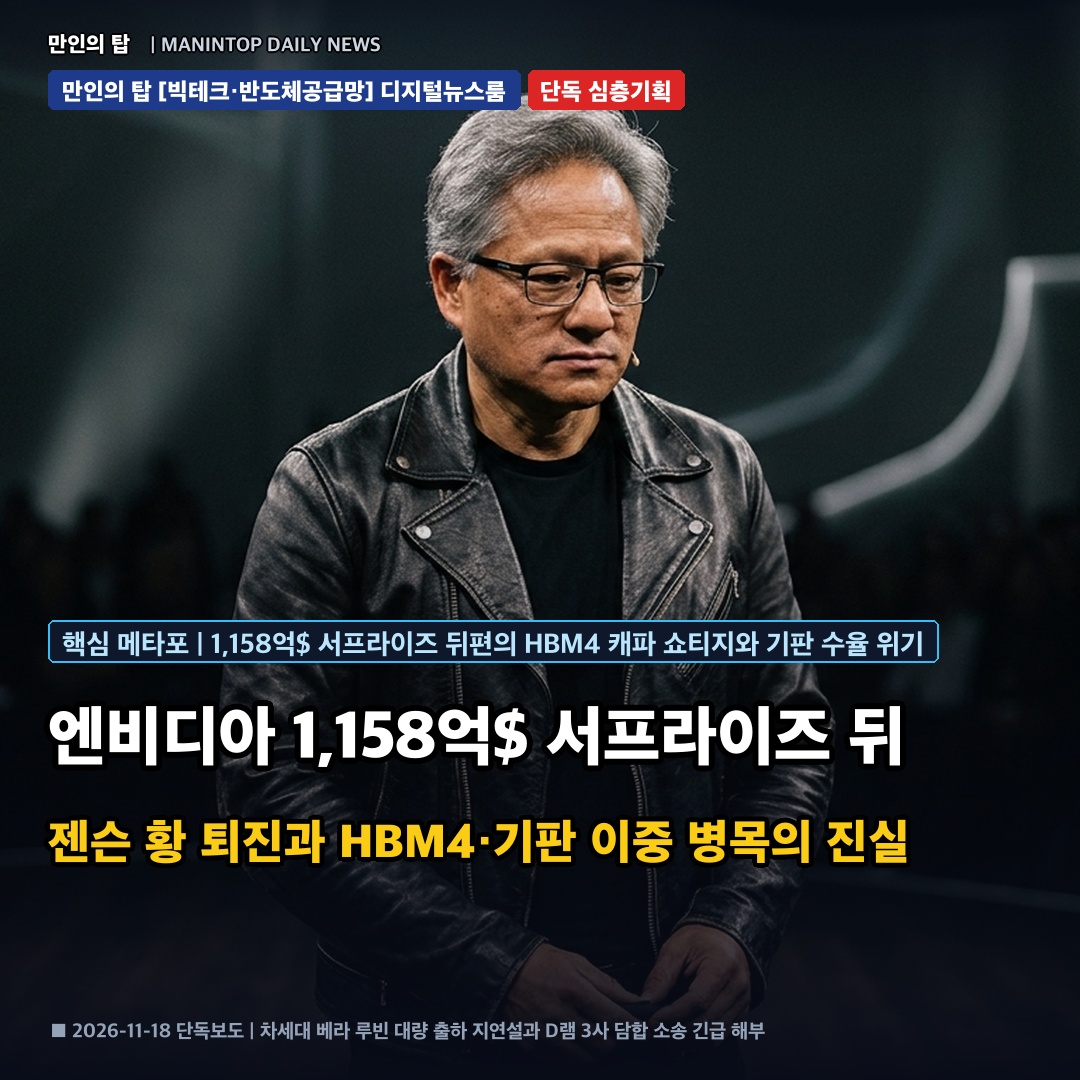
▲ 엔비디아 글로벌 기술 키노트 현장. 분기 1,158억 달러라는 경이적인 실적 달성에도 불구하고, 창업자 젠슨 황의 전격 사임과 차세대 플랫폼 출하 지연설이 겹치며 반도체 생태계 전반에 거대한 지각변동이 일고 있다. / 글로벌 테크 프레스 보도 사진 자료
글로벌 인공지능 인프라 제국을 건설하며 세계 증시의 정점에 섰던 엔비디아가 창사 33년 만에 가장 극적인 명암의 기로에 섰습니다. 30년 넘게 절대적인 지배력을 행사해 온 창업자 젠슨 황의 전격 사임이라는 초유의 지배구조 충격 속에서도, 엔비디아는 분기 매출 1,158억 달러라는 기록적인 어닝 서프라이즈를 발표하며 외형적 건재함을 과시했습니다. 특히 미국의 강력한 대중국 수출 통제로 인해 중국 데이터센터 매출이 완전히 배제된 상태에서 일궈낸 성과라는 점에서 시장은 환호했습니다. 그러나 화려한 실적 축포의 무대 뒤편에서는 차세대 인공지능 플랫폼 ‘베라 루빈’의 대량 출하 지연설, 삼성전자와 SK하이닉스 등 국내 메모리 업계의 HBM4 공급 한계, 32층 초고다층 스위치 기판의 수율 파동, 그리고 미국 연방법원의 D램 3사 담합 소송 기각 결정이라는 복합 뇌관이 동시다발적으로 폭발하고 있습니다. 세계 테크 지형을 뒤흔드는 엔비디아 공급망 지각변동의 심층 내막을 4대 핵심 축을 바탕으로 입체 해부합니다.
1,158억 달러 실적 폭발과 젠슨 황 사임의 명암
외형적 숫자만 보면 엔비디아의 질주는 여전히 적수가 없어 보입니다. 2026년 11월 17일 장 마감 직후 발표된 분기 실적은 금융정보업체 LSEG가 집계한 월가 전망치 1,091억 달러를 가볍게 뛰어넘어 1,158억 4,000만 달러를 기록했습니다. 이는 전년 동기 매출인 570억 달러 대비 무려 103% 폭증한 수치입니다. 조정 주당순이익(EPS) 역시 2.68달러로 전망치를 웃돌았으며, 4분기 매출 가이던스는 1,300억 달러 안팎으로 제시되어 시장의 성장 둔화 우려를 잠재웠습니다.
이번 성적표에서 가장 주목할 대목은 ‘중국 매출 제로’라는 사실입니다. 미국 정부의 전방위적인 반도체 통제로 인해 중국 데이터센터용 칩 판매가 전면 중단된 악조건 속에서도, 글로벌 빅테크 기업들의 인프라 증설 수요만으로 사상 최대 실적을 갈아치웠습니다.
하지만 화려한 잔칫집의 분위기는 얼어붙어 있습니다. 30년간 회사를 이끌며 ‘가죽 재킷의 마법사’로 불리던 젠슨 황 전 최고경영자가 혼외 관계 의혹 및 국가안보 관련 조사라는 초유의 스캔들로 전격 사임했기 때문입니다. 미국 정보당국은 중국 국적 사업가 앨리스 황과 중국 국가안전부(MSS) 간의 연계 여부, 그리고 최첨단 반도체 기술의 유출 가능성을 고강도로 들여다보고 있습니다. 젠슨 황은 오는 12월 1일 미 하원 청문회 출석을 앞두고 있습니다. 사내 일각에서 복귀를 요구하는 목소리가 나오지만, 이사회는 콜레트 크레스 최고재무책임자(CFO)를 임시 사령탑으로 세우고 외부 헤드헌팅을 통한 차기 CEO 인선에 착수하며 복귀 가능성에 선을 그었습니다.
칩 아키텍처 세대전환… GB300의 129% 폭증과 베라 루빈 연기설의 실체
제품 라인업에서는 안도와 불안이 엇갈리고 있습니다. 당초 극심한 발열과 칩 간 통신 오류로 오라클 등 고객사에 수억 달러의 손실을 입혔던 ‘그레이스 블랙웰(GB200 NVL72)’ 랙스케일 아키텍처는 기술적 난제를 완벽히 수습했습니다. 오픈AI가 공개한 최신 코딩 특화 모델 ‘GPT-5.3-코덱스’가 72칩 클러스터에서 안정적으로 사전 학습을 마치며 실전 검증을 끝마쳤습니다.
현재 시장의 실제 볼륨 모델은 2026년 1월부터 본격 출하된 ‘GB300 블랙웰 울트라’입니다. 시장조사업체들에 따르면 GB300 서버 출하량은 전년 대비 129% 급증하며 연간 최대 6만 랙 규모에 달할 전망입니다. 단일 GPU당 288GB의 HBM3e 메모리와 초당 8TB 대역폭을 갖추고, 기존 비앙카(Bianca) 마더보드 설계를 유지해 폭스콘 등 제조 파트너사의 수율 안정을 이끌어낸 보수적 엔지니어링 전략이 주효했습니다.
그러나 차세대 3나노 플랫폼인 ‘베라 루빈(Vera Rubin)’의 상황은 다릅니다. 당초 2026년 가을 양산 출하를 시작해 연말부터 하이퍼스케일러에 대량 공급될 계획이었으나, 모건스탠리와 대만 경제일보는 대량 출하 시점이 2027년 상반기로 연기되었다는 분석을 쏟아내고 있습니다. 취재 결과 이는 엔비디아의 자체 칩 설계 문제가 아니라, 외부 공급망에서 발생한 ‘이중 병목(Dual Bottleneck)’ 때문인 것으로 확인되었습니다.
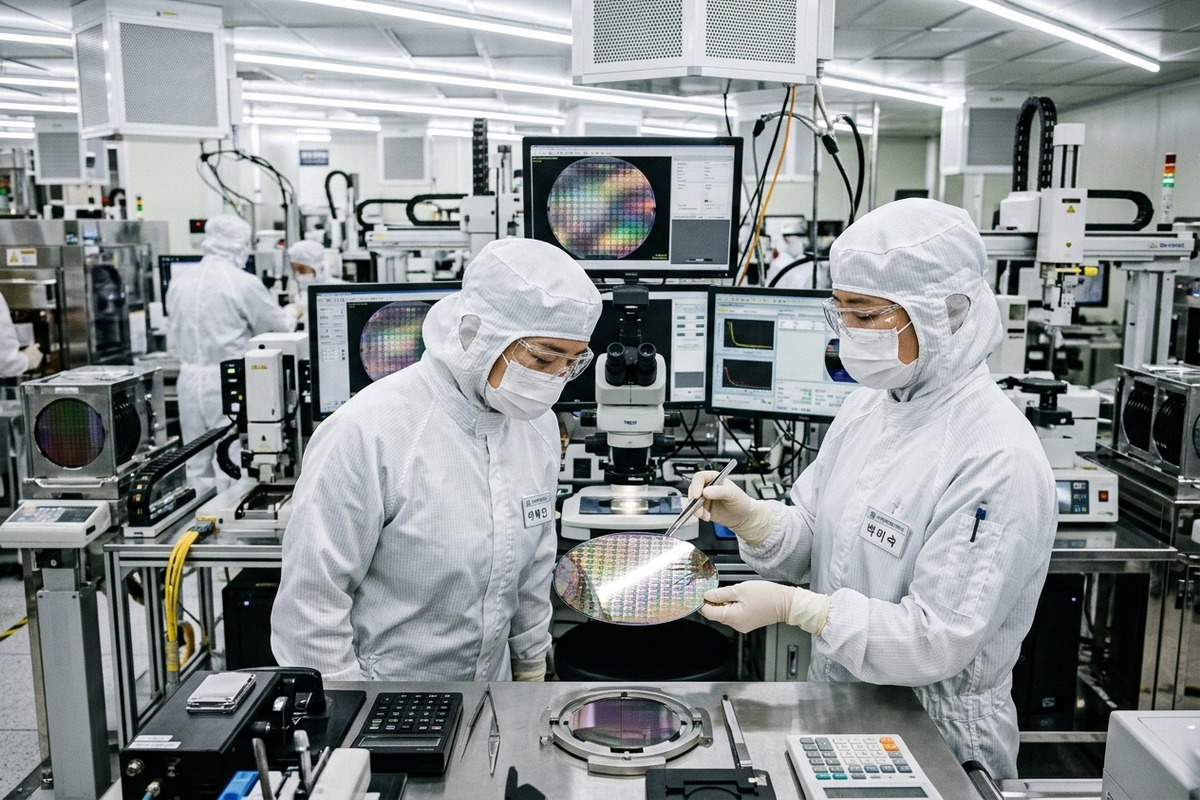
▲ 한국 첨단 반도체 클린룸 생산 라인. 삼성전자와 SK하이닉스의 가동률이 100% 풀가동 상태임에도 쏟아지는 글로벌 HBM4 주문을 감당하지 못하면서 극심한 캐파 포화 현상이 빚어지고 있다. / 반도체 첨단 패키징 제조 현장 보도 사진 자료
공급망 이중 병목 심층 해부… HBM4 캐파 포화와 32층 기판 수율 위기
첫 번째 병목은 메모리에서 터져 나왔습니다. 베라 루빈 GPU는 1개당 6세대 고대역폭메모리인 HBM4를 288GB 탑재합니다. 시장 일각에서는 제조 수율 결함을 의심했으나, 3분기 분기보고서에 따르면 SK하이닉스와 삼성전자의 공장 가동률은 이미 100% 완전 가동 상태입니다. 고객사 요청 물량이 공급 가능량의 2배를 웃도는 등 ‘수율이 아닌 절대적 캐파 포화’가 본질이었습니다.
사태가 급박해지자 엔비디아는 이례적인 규격 하향 조치를 단행했습니다. 루빈 NVL72 랙의 HBM4 메모리 대역폭 요구치를 당초 초당 1,580TB에서 1,400TB로 약 11% 낮췄습니다. 핀당 속도 문턱을 10Gbps에서 9.4~9.5Gbps 수준으로 조정해 납품 가능한 메모리 수량을 극대화하려는 고육지책입니다. 메모리 업계는 이 같은 공급 쇼티지가 최소 2028년에서 2030년까지 지속될 것으로 내다보고 있습니다.
두 번째이자 더욱 치명적인 돌발 변수는 기판 공정이었습니다. 72개의 GPU를 초고속으로 묶어주는 핵심 통신 부품인 NVLink 스위치 기판(코드명 로절린드)이 22층에서 32층 초고다층 구조로 바뀌면서 대량 불량이 발생했습니다. 열 휨 현상과 신호 손실 탓에 특정 동박적층판(CCL) 소재를 쓴 기판의 양산 수율이 10% 미만으로 추락했습니다. 70~80% 정상 수율을 내는 대만 타이광뎬(EMC)의 고급 CCL로 주문이 폭주했고, 국내 유일의 가속기용 CCL 공급사인 두산 전자BG 역시 증평 공장 113.5%, 김천 공장 103.6% 등 한계치를 넘어선 초과 가동에 직면했습니다.
비교 분석 영역
쟁점 및 시장 시각
실측 정밀 데이터
공급망 진실 및 산업적 함의
실적 및 시장 건전성
중국 제재로 인한 성장 둔화 우려
분기 매출 1,158.4억$(103%↑), 중국 매출 0원 반영
글로벌 빅테크 순수 인프라 수요로 사상 최대 경신
차세대 루빈 출시 일정
칩 설계 결함에 따른 양산 연기 의혹
2026년 가을 출하 → 2027년 상반기 대량 인도 지연
HBM4 캐파 포화와 32층 기판 수율 이중 병목
HBM4 메모리 수급
국내 제조사의 기술 수율 결함설 대두
양사 가동률 100%, 엔비디아 대역폭 11% 하향 타협
수율 문제 아닌 수요 폭증에 따른 생산라인 절대 부족
스위치 기판 공정
단순 기판 원판 부족으로 인식
32층 로절린드 특정 수율 10% 미만, 두산 가동률 113%
타이광뎬 긴급 쏠림과 소재사 원가 40% 급등 압박
미 법원 D램 담합 소송
통상적인 소송 기각 가능성 기대
기각 신청 기각, 5대 담합 정황 인정, 12월 7일 답변서
‘되돌리기 어려운 결정’ 법리로 수년치 LTA 관행 타격
자료: 엔비디아 분기보고서, 삼성전자·SK하이닉스 공시, 모건스탠리, 미국 캘리포니아 연방법원 판결문 종합
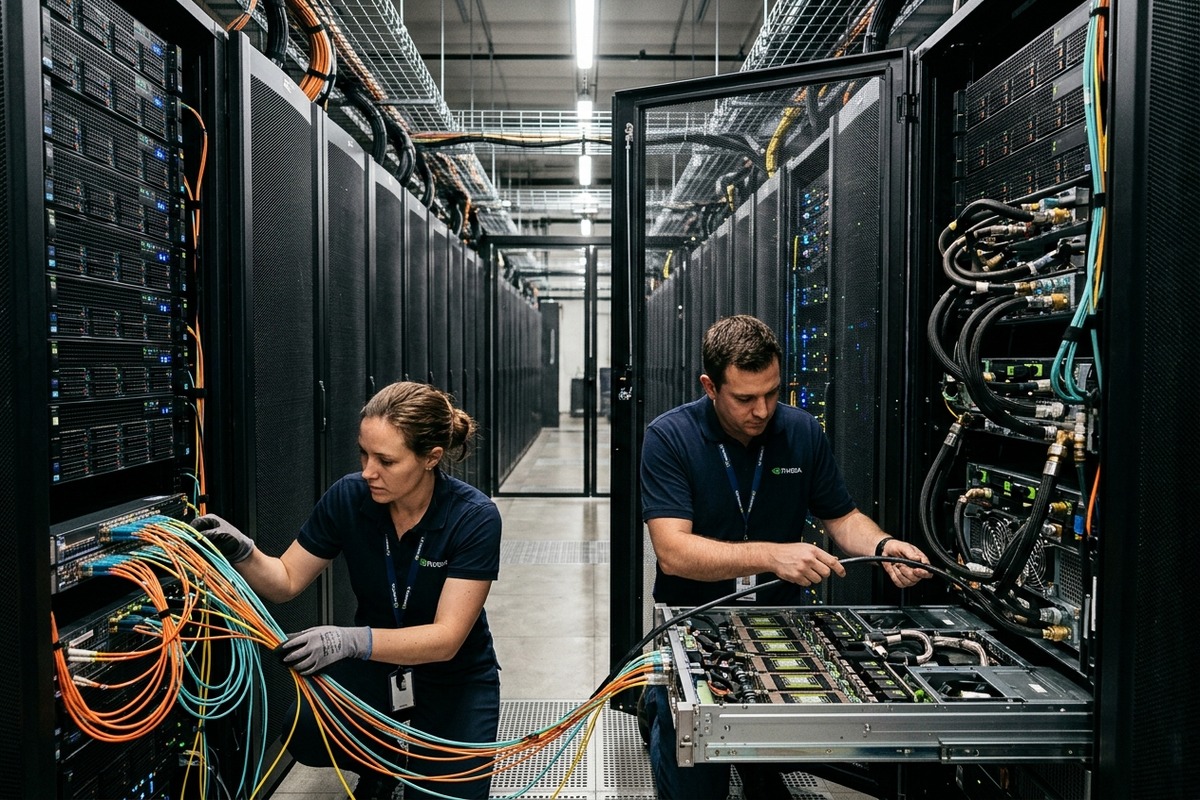
▲ 하이퍼스케일 AI 데이터센터 내부 전경. 엔비디아의 1,190억 달러 제조 약정액 중 빅테크들이 물량을 독점하면서 중소 클라우드 기업들은 1년 이상의 대기열에 갇히는 인프라 양극화가 심화하고 있다. / 하이퍼스케일 데이터센터 보도 사진 자료
HBM4 수주 삼국지와 미 법원 D램 담합 소송… 그리고 3대 잠재 뇌관
메모리 시장에서는 SK하이닉스와 삼성전자의 주도권 쟁탈전이 한층 치열해졌습니다. SK하이닉스는 10나노 5세대(1b) D램과 안정적인 MR-MUF 패키징을 앞세워 2026년 HBM 시장 점유율 54~55%를 차지하고, 루빈용 HBM4 물량의 70%를 선점할 것으로 보입니다. 이에 맞서 삼성전자는 2026년 2월 업계 최초로 HBM4 양산 출하를 공식화하고, 1c D램과 자체 4나노 파운드리 베이스 다이를 결합한 턴키 솔루션을 통해 점유율 30%를 회복하며 AMD 수주까지 확보했습니다.
그러나 국내 반도체 기업들의 앞길에는 거대한 사법 리스크가 가로막아 섰습니다. 미국 캘리포니아 연방법원이 2026년 11월 중순 삼성전자·SK하이닉스·마이크론의 D램 담합 집단소송 기각 신청을 전격 기각한 것입니다. 법원은 범용 D램을 감산하고 HBM으로 전환한 결정이 시장 상황에 따라 쉽게 뒤집을 수 없는 ‘되돌리기 어려운 결정(Irreversible Decisions)’이었다고 판시했습니다. 경쟁사와의 사전 조율 없이는 시장을 잃을 위험이 커 단독으로 결행하기 어렵다는 취지입니다. 12월 7일 답변서 제출을 시작으로 본격적인 증거개시 절차가 진행되면 국내 메모리 업계의 장기공급계약(LTA) 체계 전반에 큰 파장이 일 수 있습니다.
여기에 엔비디아가 투자한 스타트업들이 다시 자사 GPU를 대량 구매하는 ‘순환 금융(Circular Financing)’에 대한 거품론, 싱가포르·말레이시아 등 5개국을 경유하는 우회 수출을 차단한 미국 상무부의 2차 규제, 그리고 오라클 40만 장, 델 513억 달러 등 빅테크의 물량 싹쓸이로 인한 중소기업의 1년 이상 대기열 고착이라는 3대 뇌관이 도사리고 있습니다. 엔비디아는 이비덴, 삼성전기, 앰코 테크놀로지 등과 파트너십을 맺고 글로벌 공급망 2.5배 확장에 나섰지만, 물리적 병목이 해소되기까지는 상당한 인내의 시간이 필요할 전망입니다.
독자가 가장 궁금해하는 핵심 질문 Q&A
Q1. 젠슨 황 전 CEO가 사임했는데 다시 엔비디아로 복귀할 가능성은 없나요?
A. 복귀 가능성은 희박합니다. 사내에서 일부 지지 캠페인이 일고 본인 역시 복귀 의사를 내비쳤지만, 이번 사임은 중국 사업가 및 내부 직원과의 부적절한 관계뿐만 아니라 최첨단 반도체 기술의 중국 유출 의혹에 따른 미국 정보기관의 안보 조사와 직결되어 있습니다. 엔비디아 이사회는 이사회 산하에 국가안보 및 수출통제 감독위원회를 신설하고 전문 헤드헌팅사를 통해 차기 CEO 물색에 공식 착수한 상태입니다.
Q2. 차세대 플랫폼인 베라 루빈의 출하 지연설은 엔비디아 자체 칩의 결함 때문인가요?
A. 칩 자체의 설계 결함이 아닙니다. 외부 공급망에서 발생한 이중 병목이 원인입니다. SK하이닉스와 삼성전자의 공장이 100% 풀가동 중임에도 HBM4 수요가 공급을 2배 이상 초과하고 있으며, 72개 GPU를 연결하는 32층 NVLink 스위치 기판의 열 휨 현상으로 특정 소재 수율이 10% 미만으로 떨어지는 제조 병목이 발생했습니다. 엔비디아가 메모리 대역폭 요구치를 11% 낮추며 타협한 것도 물량을 조금이라도 더 확보하기 위한 조치입니다.
Q3. 미국 법원의 D램 담합 소송 기각 신청 기각이 삼성전자와 SK하이닉스에 왜 위험한가요?
A. 법원이 D램 3사의 범용 제품 감산과 HBM 집중을 개별 기업이 독자적으로 내리기 어려운 '되돌리기 어려운 결정'으로 규정했기 때문입니다. 소송이 본안에 돌입해 증거개시 절차가 진행되면 반도체 기업들의 내부 이메일과 고객사 계약 조건이 공개될 수 있습니다. AI 호황기에 국내 메모리 기업들이 구축해 온 수년 단위의 HBM 장기공급계약(LTA)과 물량 배분 전략에 직접적인 사법적 압박이 가해질 수 있습니다.
발행·편집인: 신승엽 | information.youngsdaily.com
본 기사는 엔비디아 분기 실적 보고서, 삼성전자·SK하이닉스 공시, 모건스탠리 분석, 미국 캘리포니아 연방법원 공인 판결문과 현장 실측 팩트를 바탕으로 작성되었습니다. 무단 전재 및 재배포를 금합니다.
Manintop [Big Tech & Semiconductor Supply Chain] Newsroom | $115.8B Earnings Reality, Jensen Huang Investigation, HBM4 Saturation, and US DRAM Antitrust Suit
Official Editorial Release | Global Technology & Semiconductor Desk
[EXCLUSIVE] Behind Nvidia's $115.8B Surprise: Jensen Huang's Exit and the Reality of Dual Bottlenecks in HBM4 and Substrates
▲ Inside an Nvidia global technical keynote. Despite posting a record quarterly revenue of 115.8 billion dollars, the sudden departure of founder Jensen Huang and rumors of next-generation platform shipping delays are triggering massive shifts across the semiconductor ecosystem. / Global Tech Press Archive
Nvidia, the unrivaled architect of the global artificial intelligence infrastructure revolution, stands at the most dramatic crossroads in its 33-year corporate history. Even as the tech titan navigated the unprecedented governance shock of founder Jensen Huang's sudden resignation after more than three decades of undisputed leadership, it stunned Wall Street by delivering a record-shattering 115.8 billion dollars in quarterly revenue. Remarkably, this milestone was achieved with zero contribution from Chinese data center sales due to stringent United States export curbs, underscoring resilient global hyperscaler appetite. Yet behind the triumphant headline numbers lies a far more precarious reality: whispers of mass delivery delays for the next-generation Vera Rubin computing platform, severe capacity saturation across South Korean memory titans producing sixth-generation HBM4, a crippling 32-layer substrate manufacturing yield crisis, and a consequential antitrust ruling by a US federal court advancing class-action price-fixing claims against the global DRAM triumvirate. This special investigation examines the multi-layered structural shifts reshaping the semiconductor ecosystem across four definitive pillars.
The $115.8B Earnings Explosion and Jensen Huang Exit Shock
Judged strictly by top-line metrics, Nvidia's operational momentum appears insurmountable. Quarterly financial results released immediately after market close on November 17, 2026, easily exceeded Wall Street consensus estimates compiled by LSEG, reaching 115.84 billion dollars against forecasts of 109.1 billion dollars. This represents a staggering 103 percent increase compared to the 57 billion dollars reported in the same period last year. Adjusted diluted earnings per share reached 2.68 dollars, surpassing projections, while fourth-quarter revenue guidance was established around 130 billion dollars.
The most telling aspect of these quarterly disclosures is that Nvidia factored in zero revenue from Chinese data center shipments. Even under strict United States export controls barring high-performance accelerator sales to Chinese entities, pure infrastructure demand from global Western hyperscalers proved sufficient to shatter all previous financial benchmarks.
Yet the mood across Silicon Valley and Wall Street remains deeply apprehensive. Jensen Huang, the iconic executive who steered the company for over three decades, resigned abruptly following allegations of inappropriate personal relationships and an extensive national security investigation. American intelligence agencies are scrutinizing potential connections between Chinese businesswoman Alice Huang and China's Ministry of State Security, investigating whether classified semiconductor technical assets were compromised. Huang is scheduled to testify before the US House of Representatives on December 1. While some internal factions initiated a public reinstatement campaign, the board appointed Chief Financial Officer Colette Kress as interim CEO and retained executive search firms to recruit a permanent successor, closing the door on Huang's return.
Silicon Architecture Evolution: GB300 Surge and Vera Rubin Timeline
Across Nvidia's product portfolio, operational stabilization contrasts sharply with forward-looking anxieties. Initial thermal bottlenecks and inter-chip connectivity flaws that troubled the Grace Blackwell GB200 NVL72 rackscale architecture have been fully resolved. OpenAI completed rigorous pre-training of its cutting-edge coding model, GPT-5.3-Codex, across a unified 72-chip server cluster, providing definitive empirical validation of rackscale stability.
The primary revenue engine for 2026 has shifted to the GB300 Blackwell Ultra, which began mass deployment in January. Industry research indicates that GB300 server shipments will surge 129 percent year-on-year, reaching up to 60,000 racks annually. Delivering 288GB of HBM3e memory per GPU and 8 terabytes per second of memory bandwidth, the platform achieved high manufacturing yields by preserving the proven Bianca motherboard architecture rather than transitioning to riskier layouts.
However, the trajectory for the upcoming 3-nanometer Vera Rubin platform tells an entirely different story. Originally slated for autumn 2026 production and late-year mass deliveries to cloud hyperscalers, analysis from Morgan Stanley and Taiwan's Economic Daily News indicates that large-scale volume shipments have slipped to the first half of 2027. Investigative reporting confirms this postponement stems not from internal silicon logic bugs, but from a severe dual bottleneck across external component supply chains.
▲ High-tech semiconductor fabrication cleanroom in South Korea. Even with memory production lines operating at 100 percent capacity at Samsung Electronics and SK Hynix, unprecedented demand for HBM4 has triggered severe capacity saturation. / Advanced Packaging Fab Coverage Archive
Dual Bottleneck Dissection: HBM4 Saturation and Substrate Warpage
The primary supply restriction emerged within high-density memory manufacturing. Each Vera Rubin GPU incorporates 288GB across multiple sixth-generation HBM4 stacks. While market observers initially suspected packaging yield deficiencies, regulatory filings confirm that cleanroom fab utilization at both SK Hynix and Samsung Electronics stands at 100 percent. Customer order requests exceed deliverable capacity by more than two-fold, demonstrating that the crisis is one of absolute physical fab capacity rather than engineering defect rates.
To mitigate this shortfall, Nvidia instituted an unusual technical concession: reducing the mandatory memory bandwidth specification on Rubin NVL72 racks from 1,580 terabytes per second to 1,400 terabytes per second—an 11 percent reduction. By relaxing per-pin transmission thresholds from 10Gbps to approximately 9.4 to 9.5Gbps, Nvidia sought to maximize acceptable HBM4 yields. Memory executives anticipate that this supply tightness will persist through 2028 and potentially into 2030.
A second and more unexpected disruption materialized in advanced substrate packaging. The NVLink switch substrate, codenamed Rosalind, transitioned from a 22-layer design in Blackwell to a complex 32-layer configuration. Severe thermal warpage and dielectric signal loss caused manufacturing yields using certain copper clad laminate (CCL) materials to plunge below 10 percent. Production immediately pivoted toward Elite CCL grades from Taiwan's Elite Material Company (EMC), creating an acute bottleneck. In South Korea, Doosan Electro-Materials operated its primary domestic CCL plants at 113.5 percent and 103.6 percent of rated design capacity amid 40 percent increases in raw material procurement expenses.
Analysis Domain
Market Perception
Empirical Data Points
Supply Chain Reality
Financial Trajectory
Concerns over revenue slowdown from export curbs
$115.84B revenue (+103% YoY), zero China sales
Pure Western AI demand broke all historical financial records
Vera Rubin Schedule
Suspicions of fatal silicon architectural flaws
Autumn 2026 timeline shifted to 1H 2027 deliveries
Delay driven by external memory capacity and substrate bottlenecks
HBM4 Memory Supply
Claims of low manufacturing yields at foundries
100% fab utilization, bandwidth lowered by 11%
Shortage stems from exponential demand outpacing physical capacity
Substrate Packaging
Viewed as temporary raw board tightness
32-layer yield fell below 10%, Doosan at 113% cap
Emergency reliance on EMC CCL amid soaring raw material costs
US DRAM Antitrust Case
Anticipation of routine judicial dismissal
Motion denied, 5 collusion indicators cited, Dec 7 filing
Sources: Nvidia SEC 10-Q, Samsung Electronics & SK Hynix Filings, Morgan Stanley, US District Court Ruling
▲ Hyperscale AI data center infrastructure. With major hyperscalers monopolizing bulk allocations of Nvidia's 119 billion dollars in purchase commitments, tier-two clouds face extended multi-year delivery lead times. / Hyperscale Infrastructure Press Archive
The HBM4 Battle, US DRAM Antitrust Suit, and Three Latent Risks
In the memory sector, the rivalry between SK Hynix and Samsung Electronics has reached fever pitch. SK Hynix leverages its 10-nanometer 5th-generation (1b) DRAM and refined MR-MUF packaging to defend a 54 to 55 percent market share in 2026, capturing roughly 70 percent of initial Rubin allocations. Concurrently, Samsung Electronics commenced industry-first HBM4 mass production in February 2026, pairing 1c DRAM with proprietary 4-nanometer foundry base dies to secure significant Rubin share while locking in alternative enterprise customers including AMD.
However, memory manufacturers face an ominous legal threat. In mid-November 2026, a federal judge in California denied motions to dismiss a massive class-action antitrust lawsuit filed against Samsung, SK Hynix, and Micron. The court ruled that transitioning fab capacity away from commodity DRAM to HBM constituted an 'irreversible decision' that would be irrational for any single firm to undertake without tacit consensus. As the litigation advances toward evidentiary discovery, confidential supply contracts and internal communications face external scrutiny.
Compounding these tensions are three macroeconomic friction points: persistent skepticism regarding Nvidia's 'circular financing' investments into neo-cloud startups that immediately purchase GPUs; expanded US Bureau of Industry and Security regulations blocking transshipments through Southeast Asian hubs; and acute lead-time bifurcation that leaves secondary enterprises waiting over twelve months for compute allocations. While Nvidia is actively expanding manufacturing alliances with Ibiden, SEMCO, and Amkor to scale global substrate capacity 2.5-fold by 2028, overcoming current physical bottlenecks will require sustained industry endurance.
Frequently Asked Questions & Answers
Q1. Is there any realistic path for Jensen Huang to return as CEO of Nvidia?
A. A return appears highly improbable. While select internal groups expressed loyalty, Huang's departure is directly tied to ongoing national security inquiries by US federal agencies concerning sensitive technology transfer risks. Nvidia's board established a dedicated National Security and Export Control Committee and formally retained global search firms to select a permanent chief executive, confirming an orderly permanent transition under interim CEO Colette Kress.
Q2. Are rumors of Vera Rubin platform shipment delays caused by internal chip defects?
A. No, the delays are caused by severe bottlenecks across external component suppliers. Demand for HBM4 memory exceeds global fab capacity by over 100 percent despite around-the-clock cleanroom operations at SK Hynix and Samsung. Furthermore, 32-layer NVLink switch substrates suffered extreme warpage and low initial yields, compelling Nvidia to reduce its memory bandwidth specification by 11 percent to maximize deliverable volumes.
Q3. Why does the US federal court antitrust ruling pose a serious risk to South Korean memory makers?
A. The court determined that shifting fab capacity away from standard DDR4 DRAM toward dedicated HBM constituted an 'irreversible decision' that plausible economic theory suggests would not occur unilaterally without coordinated behavior. With motions to dismiss rejected, formal discovery proceedings could expose internal email exchanges, pricing frameworks, and multi-year supply contracts, exerting substantial pressure on industry allocation practices.
This article was prepared using official quarterly earnings filings from Nvidia, corporate disclosures from Samsung Electronics and SK Hynix, Morgan Stanley research, and legal filings from the United States District Court. Unauthorized reproduction is strictly prohibited.
PRO SOURCING ENGINE만인의 탑 빅데이터 솔루션
★ 가입 시 600 크레딧(120회) 전원 무료
내가 찾는 상품 키워드, 지금 얼마나 검색될까?
네이버 월간 검색량 + 구글 볼륨 + 아이템스카우트 실시간 상품수와 경쟁강도 배지를 0.5초 만에 무료로 확인하세요.
MANINTOP NEWSLETTER
📬 만인의 탑 뉴스레터 무료 구독
오늘 보신 정책·시사 뉴스가 유익하셨나요? 매일 엄선되는 알짜 복지 혜택과 국회 실시간 속보를 이메일로 가장 먼저 받아보세요. (평생 무료)
1월이 시작되면 감기는 이미 우리 곁에 와 있습니다. 2월, 3월, 4월까지 이어지는 추위와 건조함은 코와 목을 가장 먼저 공격합니다. 아침에 일어나자마자 막혀 있는 코. 계속 흐르는 콧물. 괜히 칼칼해지는 목. 이 증상은 “시작”일 뿐입니다. 한 번 무너지면 일주일, 길면 한 달까지 끌고 갑니다. 약을 먹으면 잠깐 괜찮아집니다. 하지만 며칠 뒤 또 반복됩니다. 왜일까요? 감기는 ‘치료’의 문제가 아니라 ‘관리’의 문제이기 때문입니다. 대부분은 감기가 오고 나서 약을 찾습니다. 하지만 진짜 중요한 건 감기가 오기 전에 코와 목을 지키는 것입니다. 건조한 실내 공기, 차가운 바깥 공기, 눈에 보이지 않는 세균. 코와 목은 매일 공격받고 있습니다. 지긋지긋하죠! 그런데도 우리는 아무 준비 없이 버티고 있습니다. 이번 겨울도 그렇게 보낼 건가요? 사실 방법은 어렵지 않습니다. 코를 깨끗하게 관리하고, 목을 따뜻하게 보호하고, 점막을 촉촉하게 유지하고, 기관지를 미리 관리하고, 외부 공기를 차단하는 것. 이 다섯 가지만 꾸준히 해도 감기약 없이 겨울을 보내는 것이 충분히 가능합니다. 🔥 이제부터 그 방법을 하나씩 살펴보겠습니다. 🔥 1. 코와 목을 먼저 관리해야 하는 과학적 이유 감기의 대부분은 코 점막에서 시작됩니다. 국제 학술지 Nature Reviews Microbiology 와 Journal of Allergy and Clinical Immunology 에 실린 호흡기 감염 관련 연구들에서는, 감기 바이러스가 비강 상피세포에 먼저 부착해 증식한다는 점을 설명하고 ...
리모델링사업이 진행 중인 아파트를 매매할 때 “계약금 10%를 언제까지 내야 하느냐”는 질문이 특히 많이 나옵니다. 이주공고(이주 안내)가 7~11월쯤이라고 들으면, 그 시점에 맞춰 계약금도 움직일 것 같아서 더 헷갈리기 쉽습니다. 하지만 실제 납부기한은 ‘이주공고가 언제냐’만으로 자동 결정되지 않는 경우가 많습니다. 1) 계약금 10% 납부기한: 결국 ‘문서에 적힌 일정’이 기준 계약금 10%를 언제까지 납부해야 하는지는, 내가 서명하는 매매계약서(특약 포함) 와 사업주체/조합이 제시한 공고·안내문 에 적힌 납부 일정이 기준이 됩니다. 실제 공고문에서는 분양대금 납부의 큰 틀(계약금→중도금→잔금)을 먼저 안내하고, 상세 일정은 별도 표나 유의사항으로 제시하는 방식이 흔합니다. 또, 계약서 문구에 따라 지급 시점이 조건부로 설정될 수도 있습니다. 예를 들어 한 사례 소개 자료에서는 용역계약서에 잔금(10%) 지급시기가 “사업승인 후”로 기재되어 있었다는 점이 언급됩니다. 이런 식으로 ‘사업 단계’와 지급을 연동하는 문구가 들어가면, 질문의 답은 계약서 문구를 확인해야만 확정됩니다. 관련 내용은 링크 에서 문구 사례를 확인할 수 있습니다. 2) 입주자모집공고에서 확인되는 ‘납부 순서’와 잔금 마감 시점 공고문에 적힌 문구를 보면, 납부 순서와 잔금 마감에 대한 기준이 비교적 명확하게 제시되는 경우가 있습니다. 예를 들어 한 입주자모집공고에는 “분양금액(주택가격)은 계약금, 중도금, 잔금의 순서로 납부”하며 “잔금은 입주(열쇠 수령일) 전에 완납”해야 한다고 안내되어 있습니다. (문구 확인: 링크 ) 이 문구가 의미하는 바는 최소 2가지입니다. 분양/공급 형태의 문서에서는 ‘계약금→중도금→잔금’ 흐름이 공식적으로 안내될 수 있습니다. 잔금은 “입주(열쇠 수령)” 이전에 완납해야 한다는 마감 기준이 문서에 적혀 있을 수 있습니다. 다만, 위 공고문 문구는 잔금 마감에 대한 기준을 보여주지만, 계약금 10%의...
윤석열 전 대통령 탄핵 인용 소식을 접하면, 가장 궁금한 지점은 ‘헌재가 정확히 무엇을 위헌·위법으로 봤는가’입니다. 또한 탄핵과 별개로 진행되는 형사재판(내란 우두머리 혐의 등)이 어디까지 왔는지도 함께 정리할 필요가 있습니다. 아래 내용은 제공된 기사/게시물 스니펫과 링크에서 확인되는 범위만 모아, 일반인이 흐름을 이해하기 쉽게 정리한 것입니다. 1) 탄핵 인용 관련: 스니펫에서 확인되는 ‘판단의 골격’ 제공된 근거 중 조국혁신당 사이트에는 헌법재판소가 윤석열 탄핵 심판에서 “피청구인의 위헌·위법행위는 국민 신임 …”이라는 취지로 판단했다는 문장이 인용돼 있습니다( 링크 ). 이 인용문만 놓고 보면, ‘위헌·위법행위’가 있었는지와 그로 인해 ‘국민의 신임’이 어떻게 평가됐는지가 핵심 축으로 소개됩니다. 다만 질문에서 요청하신 세부 항목, 즉 비상계엄 선포 자체를 문제 삼은 구체적 이유, 계엄 이후 조치(포고령, 국회 통제 등)의 어떤 지점이 헌법 위반인지, 국회의 권한행사 방해 및 정치활동 제약을 어떤 논리로 판단했는지 등은, 이번에 제공된 근거의 제목/스니펫만으로는 조항·사실관계·판단 구조가 그대로 제시돼 있지 않습니다. 따라서 이 글에서는 ‘헌재가 무엇을 문제 삼았다’는 세부 리스트를 단정적으로 재구성하기보다, 현재 확인 가능한 문구 수준의 요약(위헌·위법행위 → 국민 신임의 문제로 평가)까지만 적습니다. 만약 헌재 결정문 전문(주문 및 이유)이 추가로 확인되면, 그때는 문장 단위로 ‘어떤 행위’와 ‘어떤 헌법 원리/조항’이 연결되는지(예: 권력분립, 국회의 권한, 정치적 기본권 등) 구조화해 정리하는 것이 가장 정확합니다. 2) 형사 절차(내란 혐의) 관련: 체포영장과 1심 선고 언급 탄핵 심판과 별도로, 12·3 비상계엄 사태로 내란 혐의를 받는 윤석열 대통령에 대해 2024년 12월 31일 체포 영장이 발부됐다는 BBC 보도가 있습니다( 링크 ). 해당 보도는 ‘현직 대통령’에 대한 체포영장 발부라는 점을 함께 언급합니다. 또...