[심층기획] '728조 슈퍼예산과 35.5조 R&D 복원의 명암' 5년 만의 법정시한 준수 뒤 밀실 소소위 4.3조와 지역화폐 쏠림 팩트체크
만인의 탑 편집국11월 18, 2026
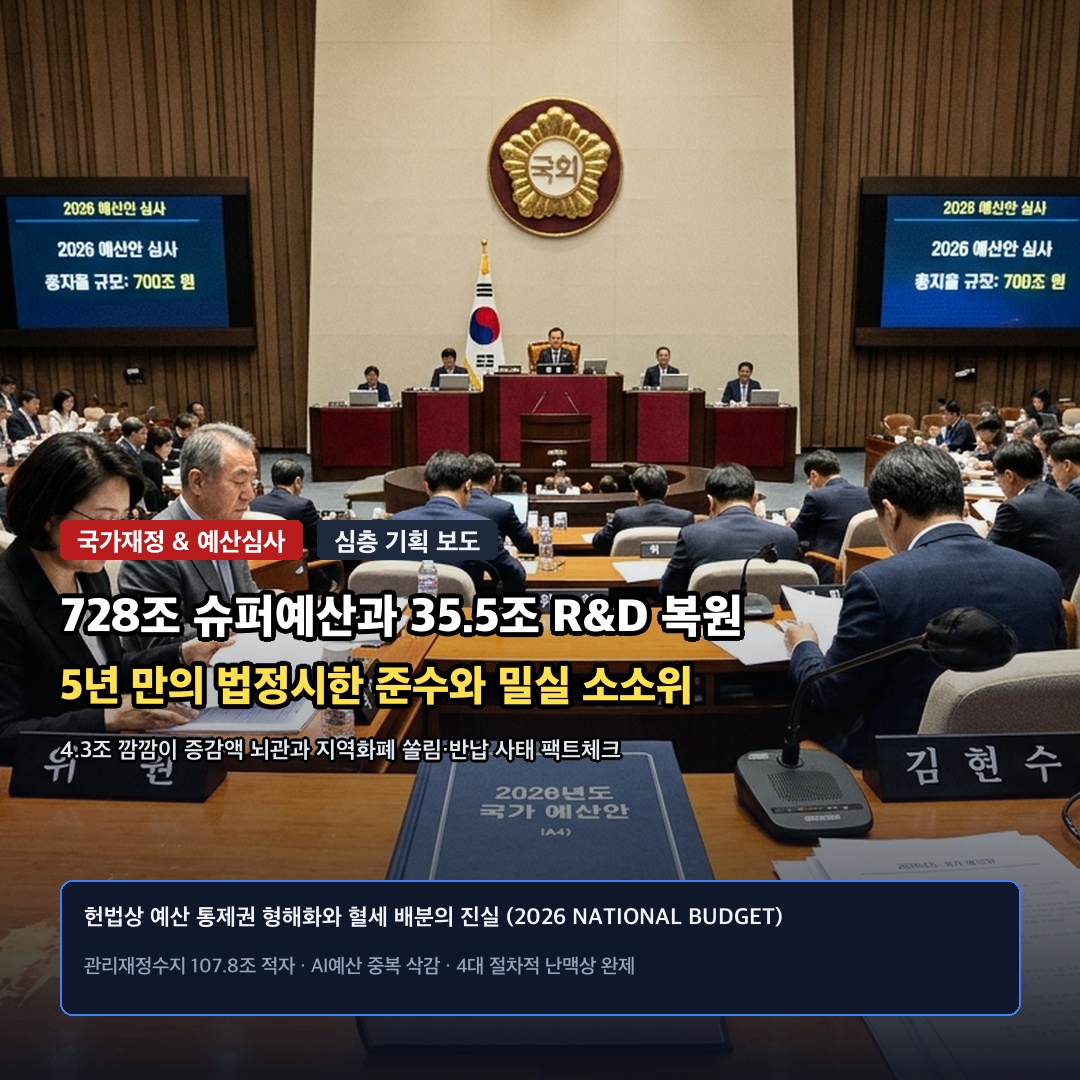
▲ 국회 본회의장에서 여야 의원들과 정부 재정 당국자들이 2026년도 국가 예산안 책자를 검토하며 심의를 진행하고 있다. [사진: 국회 프레스 풀 보도자료]
핵심 쟁점 3줄 요약 (Key Takeaways)
국회가 5년 만에 12월 2일 법정 시한을 지켜 727조 9,000억원 규모의 2026년도 국가 예산안을 의결했으나, 107.8조원에 달하는 관리재정수지 적자와 1,413.8조원의 국가채무를 남겼습니다.
역대 최대인 35조 5,000억원으로 편성된 국가 R&D는 기초연구 복원과 AI 고속도로 투자가 본격화되었지만, 졸속 기획과 중복 편성 사업들이 국회 심의에서 대거 삭감되며 실효성 시비가 이어지고 있습니다.
단 5회에 그친 예결소위와 속기록 없는 밀실 '소소위'에서 4조 3,000억원의 증감액이 결정되었으며, 1.45조원 지역화폐의 2,059억원 반납 및 인기 매장 쏠림 등 혈세 낭비 뇌관이 수면 위로 떠올랐습니다.
대한민국 국회가 2021년도 예산안 처리 이후 5년 만에 헌법상 법정 시한인 12월 2일을 지키며 2026년도 국가 예산안을 최종 가결했습니다. 겉보기에는 여야가 극한의 정쟁 속에서도 파국을 피하고 대승적 타협을 이뤄낸 것처럼 보이지만, 728조원에 육박하는 거대한 재정의 세부 장부를 들여다보면 상황은 사뭇 다릅니다. 2년 연속 100조원을 돌파한 관리재정수지 적자와 1,400조원을 넘어선 국가채무, 사상 최대 규모인 35조 5,000억원으로 복원된 R&D 예산의 졸속 편성 시비, 그리고 헌법이 부여한 의회의 예산 통제권을 밀실 야합으로 무력화한 '소소위'의 깜깜이 증감액까지 곳곳에 암초가 도사리고 있습니다. 5년 만의 법정 시한 준수라는 화려한 외피 뒤에 감춰진 2026년도 국가 예산안의 핵심 쟁점과 실체를 심층 분석했습니다.
5년 만의 법정 시한 준수와 728조 확정… 107.8조 관리재정수지 적자의 그늘
국회 본회의에서 수정 의결된 2026년도 확정 예산의 총지출은 정부 원안(728조원)에서 1,269억원이 순감된 727조 9,000억원으로 매듭지어졌습니다. 전년도 본예산(673조 3,000억원)보다 54조 6,000억원, 전년도 2차 추경(703조 3,000억원)보다 24조 6,000억원 불어난 매머드급 재정입니다. 총수입은 국세 수입 확충 등을 반영해 정부안(674조 2,000억원) 대비 1조원 증액된 675조 2,000억원으로 확정되었습니다.
그러나 나라 살림의 건전성을 보여주는 거시 지표는 여전히 짙은 먹구름에 갇혀 있습니다. 실질적인 재정 수지를 나타내는 관리재정수지는 107조 8,000억원 적자로 집계되었습니다. 이는 국내총생산(GDP) 대비 마이너스 3.9%에 달하는 수치로, 정부 원안(-4.0%)보다 1조 1,000억원 개선되었을 뿐 2년 연속 100조원대 적자의 늪을 벗어나지 못했습니다. 국가채무 역시 1,413조 8,000억원으로 확정되어 GDP의 51.6%를 기록하며 사상 처음으로 1,400조원 선을 돌파했습니다.
12대 분야별 재원 배분에서도 뚜렷한 명암이 갈렸습니다. 저출생·고령화 대응과 사회적 안전망 강화를 위한 보건·복지·고용 분야는 269조 1,000억원으로 전년 추경 대비 17조 4,000억원 늘어나 역대 최대 증가 폭을 기록했습니다. 과학기술 R&D 역시 35조 5,000억원으로 전년 대비 5조 8,000억원 급증했습니다. 반면 긴축의 칼바람을 맞은 산업·중소기업·에너지는 정부안보다 6,000억원 삭감된 31조 8,000억원으로 확정되며 전년 추경 대비 3조 5,000억원 줄어들었고, 일반·지방행정 분야도 5조 8,000억원 감액되었습니다.
사상 최대 35.5조 R&D 복원의 명암… AI 고속도로 5.1조와 중복 사업 삭감의 전말
2026년도 예산안에서 가장 뜨거운 조명을 받은 분야는 단연 과학기술 연구개발(R&D)입니다. 지난 2년간 과학계를 충격에 빠뜨렸던 대대적 예산 삭감의 상처를 딛고, 정부 R&D 총액은 역대 최고액인 35조 5,000억원으로 전격 복원되었습니다. 주무 부처인 과학기술정보통신부 예산도 23조 7,417억원으로 13.1% 늘어났으며, 특히 과기정통부 일반회계 세출은 12조 9,007억원으로 1년 만에 무려 50.3% 폭증했습니다.
세부 재원은 미래 국가 기술 주권을 좌우할 핵심 전략 분야에 집중 배치되었습니다. 차세대 AGI와 국산 AI 반도체, 초고성능 GPU 인프라와 초고속 네트워크를 구축하는 'AI 고속도로 및 디지털 기본사회' 사업에 총 5조 1,000억원이 투입됩니다. 반도체, 첨단바이오, 양자 등 3대 게임체인저 기술에는 5조 9,000억원이 배정되었으며, 연구 현장의 숨통을 틔우기 위해 개인기초연구 과제수를 삭감 이전 수준인 1만 5,311개로 전면 복원하고 단기 실적 압박을 줄이는 장기 다년도 지원 체계를 도입했습니다. 아울러 연구자들을 과제 수주 경쟁으로 내몰았던 프로젝트 기반 인건비 시스템(PBS)을 2030년까지 단계적으로 폐지하기로 했습니다.
그러나 대규모 증액의 화려함 뒤편에서는 졸속 기획과 중복 편성이라는 고질적 병폐가 국회 심의에서 무더기로 적발되었습니다. 10개 부처에 분산 편성되었던 'AX-Sprint 300(AI응용제품 신속상용화)' 사업은 구체적 사업 지침과 성과 지표가 전무하다는 지적 속에 정부안 8,920억원 중 2,785억원이 잘려 나갔습니다. 공공AX 프로젝트에서도 400억원이 감액되었고, 정책펀드 중복 논란을 빚은 과기정통부의 AI혁신펀드(1,000억원)는 전액 삭감되었으며 중소벤처기업부의 모태조합출자 예산 역시 2,800억원이 깎였습니다. 과학기술계 내부에서조차 예산 총량 복원이라는 구호에 취해 밑 빠진 독에 물을 붓는 선 예산 후 계획 사업들을 뼈아프게 자성해야 한다는 자조가 나오는 이유입니다.
재정 거시 지표
2025년 기준치 (본예산·추경)
2026년 국회 확정예산 (GDP 대비)
국회 증감 및 거시 재정 영향
총지출 규모 (Expenditure)
2025 본예산 673.3조원 2025 2차 추경 703.3조원
727조 9,000억원 확정 (정부안 728.0조원 대비)
정부안 대비 1,269억원 순감, 전년 본예산 대비 54.6조원 급증하며 사상 최초 728조원대 돌파
정부안 대비 1.3조원 감소, 전년 본예산 대비 140.5조원 급증하며 사상 첫 1,400조원 돌파
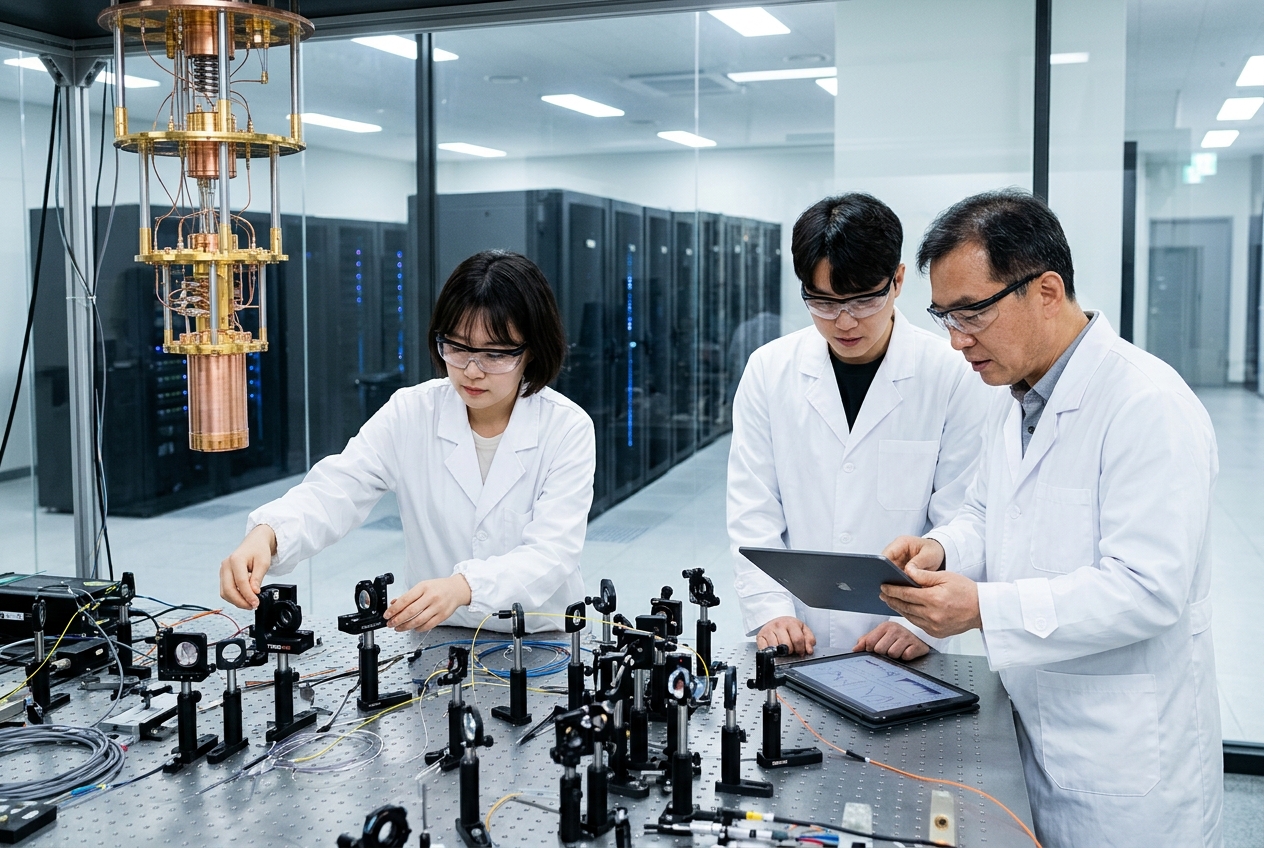
▲ 대덕연구개발특구 내 국책 연구실에서 연구원들이 초고성능 AI 컴퓨팅 장비와 양자 실험 장치를 점검하고 있다. [사진: 과학기술정보통신부 제공 보도자료]
'예결소위 무력화'와 깜깜이 밀실 소소위… 4조 3,000억 원 증감액의 4대 난맥상
예산 심의 절차를 들여다보면 '5년 만의 법정 시한 준수'라는 정치권의 자화자찬이 얼마나 민망한 것인지 드러납니다. 728조원에 달하는 국민 혈세의 옥석을 가려야 할 예산결산특별위원회 예산안조정소위원회(예결소위)는 이번 회기 동안 단 5차례 회의를 여는 데 그쳤습니다. 이는 최근 4년 중 가장 적은 회의 일수로, 예결소위는 소위 결과 미보고, 증액 심사 미실시, 쟁점 1회독 후 중단, 간사 위임 동의 절차 누락이라는 '4무(無)' 파행으로 끝났습니다.
공식 심의 기구가 문을 닫은 뒤, 실질적인 예산 칼자루는 법적 근거가 전혀 없는 양당 간사 간 밀실 협의체인 '소소위'로 넘어갔습니다. 소소위는 회의 속기록도 남기지 않고 언론의 감시도 완전히 차단되는 밀실의 블랙박스입니다. 국회예산정책처와 나라살림연구소 분석에 따르면 국회 심의 과정에서 삭감된 약 4조 3,000억원과 증액된 4조 2,000억원의 대부분이 바로 이 소소위 밀실에서 여야 실세들의 주고받기식 야합으로 결정되었습니다. 국회의원들조차 본회의 표결 직전까지 자신이 찬성표를 던지는 세부 예산표를 보지 못하는 깜깜이 표결 관행이 그대로 반복되었습니다.
여야가 대대적으로 홍보한 '총지출 9조 4,000억원 감액' 역시 거대한 통계적 착시에 불과했습니다. 감액분 9조 4,000억원 중 절반이 넘는 4조 8,000억원은 정부조직 개편에 따른 단순 회계 장부상 이관분이었으며, 이를 제외한 국회의 실질 감액은 4조 6,000억원에 그쳤습니다. 심지어 기재부와 산업부의 대미 통상 예산 1조 2,700억원을 전액 삭감하는 척하면서 기재부에 1조 1,000억원 규모의 '대미투자 지원 프로그램'을 신규 반영해 주는 이름표 바꿔달기 편법이 횡행했습니다. 그 틈을 타 특정 실세 의원의 지역구 경찰서 신축과 리모델링 등 279억원에 달하는 쪽지 예산이 국유재산관리기금으로 우회 반영되었고, 검찰 특수활동비 40억 5,000만원을 깎는 대신 사업추진비 50억원을 올려주는 눈속임 보전이 이뤄졌습니다.
'골목상권 살리기 vs 인기 매장 할인쿠폰'… 지역화폐 1.45조 원 혈세 쟁점 팩트체크
이번 정기국회 예산 심의의 최대 뇌관은 정부와 여당이 밀어붙인 지역사랑상품권(지역화폐) 발행 지원 예산 1조 4,500억원이었습니다. 정부는 전년 대비 3,000억원(26.1%)을 늘리고 할인율을 9%까지 상향하겠다고 공언했으나, 국회 행정안전위원회와 예결위 심사를 통해 공개된 실측 데이터는 골목상권 영세 상인을 살린다는 정책 명분을 무색하게 만들었습니다.
국회사무처 검토보고서에 따르면 지난해 전국 지자체에 교부된 지역사랑상품권 국고보조금 9,996억원 중 무려 20.6%에 달하는 2,059억원이 한 푼도 쓰이지 못하고 국고로 반납되었습니다. 이는 전년도 반납액(218억원)의 9.4배에 달하는 수치로, 전남광주시는 교부액의 53.2%, 부산시는 40.4%를 그대로 반납했습니다. 더 심각한 것은 소비의 극단적 왜곡이었습니다. 전국 16개 시·도의 결제액 상위 100곳을 전수조사한 결과, 최근 4년간 매년 상위 100위 안에 든 228개 인기 가맹점에서만 1,510억원(전체의 10.2%)이 소비되었습니다. 속초의 대형 유명 스시 뷔페, 해남의 대형 주류 매장, 대형 정육점, 그리고 주유소와 연료비 업종에 전체 결제액의 18.7%(2,771억원)가 집중되었습니다. 영세 소상공인의 생존 방파제가 아니라 이미 줄을 서는 인기 매장과 기름값 할인쿠폰으로 전락했다는 비판과 KDI 등 국책 연구기관의 회의적 평가가 쏟아진 배경입니다.
47건 부대의견의 재정 통제와 조세 개편… 2027년 미래대응기금 충돌로 번진 전선
예산안 통과와 함께 채택된 47건의 국회 부대의견과 세법 개정안은 향후 정부의 예산 집행을 옥죄는 강력한 법적 족쇄로 작용할 전망입니다. 국회는 신규 시범사업을 도입할 때 필수적인 경제성 분석과 재정 추계 등 사전검증을 거쳐 국회에 보고하도록 의무화(부대의견 제3호)했으며, 정부가 지출구조조정 실적을 과다하게 부풀려 홍보하지 못하도록 기준을 세우라고 못 박았습니다(제4호). 아울러 밀실에서 급조된 1조 1,000억원 규모의 대미투자 지원 프로그램에 대해서도 국회의 자료 요청과 통제를 받도록 명문화했습니다(제7호).
세법 개정안에서는 배당성향이 높은 기업의 주주를 대상으로 50억원 초과 구간에 최고세율 30%를 적용하는 배당소득 분리과세가 신설되며 자본시장 활성화의 길을 열었습니다. 하지만 예산 국회의 긴장감은 해소되지 않은 채 곧바로 2027년도 차기 예산 국회로 번져가고 있습니다. 정부가 820조 9,000억원에 달하는 차기 예산안과 함께 162조 3,000억원 규모의 '미래대응기금' 신설, 호남 반도체 클러스터 대규모 투자를 추진하면서, 재정 건전성 수호를 외치는 야당과의 전면전이 다시 불붙고 있습니다. 5년 만의 법정 시한 준수라는 안도감도 잠시, 1,400조원 국가채무 시대의 재정 민주주의와 혈세의 올바른 배분을 둘러싼 국가적 시험대는 이제 막 시작되었습니다.
사업 및 정책 분야
정부 원안 편성액
국회 최종 확정액 및 증감
핵심 쟁점 및 사후 통제 과제
연구개발 R&D (과기정통부 소관)
35조 3,000억원 (과기정통부 23조 6,671억)
35조 5,000억원 확정 (+2,000억원 증액)
사상 최대치 복원 속 AX-Sprint 2,785억 및 AI혁신펀드 1,000억 등 중복·부실 사업 대거 삭감
지역사랑상품권 (지역화폐 국비 지원)
1조 4,500억원 (발행 목표 24조원)
1조 4,500억원 원안 확정 (전년비 +3,000억원)
국고보조금 2,059억원(20.6%) 반납 사태 및 상위 228개 인기 매장·주유소 쏠림에 대한 실효성 논란
대미투자 지원 프로그램 (통상 대응 패키지)
통상 대응 프로그램 7,000억 무보 출자 5,700억 (총 1.27조)
1조 1,000억원 신규 확정 (기재부 일반회계 이관)
원안 전액 삭감 후 이름표 바꿔달기 신규 반영, 부대의견 제7호에 따라 투자 조건 국회 통제 의무화
국유재산관리기금 (지역구 쪽지 예산 통로)
정부청사·관사 관리 원안 (경찰 시설 증액 0원)
경찰 시설 40건 279억 증액 (강서 교통센터 110억 신규)
밀실 소소위 심사 틈탄 실세 의원 지역구 민원 챙기기 예산 증액 논란
▲ Lawmakers and government finance officials review bound volumes of the 2026 national budget during a plenary session at the National Assembly in Seoul. [Photo: National Assembly Press Pool]
Key Takeaways
The National Assembly passed the 727.9-trillion-won 2026 national budget within the December 2 constitutional deadline for the first time in five years, yet left behind a 107.8-trillion-won operational fiscal deficit and 1,413.8 trillion won in sovereign debt.
While national R&D reached a record 35.5 trillion won to restore basic research and construct AI highways, widespread legislative cuts against duplicate programs highlighted severe deficiencies in front-end project planning.
Key adjustments amounting to 4.3 trillion won were decided inside closed-door sub-panels after a truncated five-session budget subcommittee, while systemic flaws in the 1.45-trillion-won local voucher program triggered 205.9 billion won in unspent returns alongside heavy usage concentration.
For the first time since the 2021 fiscal deliberations, the South Korean National Assembly met its constitutional deadline on December 2 to formally enact the national budget for fiscal year 2026. While political leaders celebrated this cross-party compromise as a triumph of legislative maturity over bitter partisan gridlock, a rigorous audit of the 728-trillion-won fiscal ledger reveals a starkly different reality. Chronic structural deficits exceeding 100 trillion won for two consecutive years, national debt surpassing 1,400 trillion won, severe planning deficiencies within the record 35.5-trillion-won R&D allocation, and the unconstitutional disenfranchisement of legislative oversight inside closed-door sub-panels continue to raise deep alarms. This investigative report dissects the core controversies and structural vulnerabilities hidden beneath the veneer of punctual statutory passage.
Five-Year Compliance Milestone and 728-Trillion-Won Passage: Shadows of a 107.8T Fiscal Deficit
Under the modified 2026 budget passed by the plenary session, total government expenditure was finalized at 727.9 trillion won, representing a net reduction of 126.9 billion won from the government's initial proposal of 728.0 trillion won. This massive outlay marks a 54.6-trillion-won expansion over the previous year's initial budget of 673.3 trillion won, and an increase of 24.6 trillion won compared to the second supplementary budget of 703.3 trillion won. Total government revenues were adjusted upward by 1.0 trillion won to 675.2 trillion won, reflecting revised tax projections and revenue mobilizations.
Nevertheless, key macroeconomic indicators tracking sovereign fiscal health remain enveloped in thick storm clouds. The operational fiscal balance, which measures the structural state of the budget by excluding social security funds, registered a massive deficit of 107.8 trillion won. Equivalent to minus 3.9 percent of gross domestic product, this represents only a modest 1.1-trillion-won adjustment from the original minus 4.0 percent proposal, trapping public finances in hundred-trillion-won structural deficits for a second straight year. Concurrently, gross sovereign debt reached 1,413.8 trillion won (51.6 percent of GDP), permanently breaking through the 1,400-trillion-won barrier.
Resource allocation across the twelve functional sectors illustrated sharp institutional divides. Health, welfare, and employment appropriations expanded by 17.4 trillion won over the previous supplementary budget to reach 269.1 trillion won, marking the largest increase across all categories to bolster demographic and social safety nets. Scientific R&D also surged by 5.8 trillion won to 35.5 trillion won. In contrast, fiscal austerity hit industry, small business, and energy budgets, which were cut by 600 billion won below the executive submission to 31.8 trillion won (down 3.5 trillion won from the supplementary budget), while general and regional administration spending decreased by 5.8 trillion won.
Highs and Lows of the Record 35.5T R&D Restoration: 5.1T AI Highways and Duplicate Project Cuts
Scientific research and development received the most intense public attention in the 2026 budget. Overcoming the severe disruptions triggered by aggressive across-the-board budget reductions during the prior two years, aggregate state R&D funding was fully restored to an all-time peak of 35.5 trillion won. Appropriations for the Ministry of Science and ICT rose by 13.1 percent to 23.74 trillion won, with its general account outlays skyrocketing by 50.3 percent year-on-year to 12.90 trillion won.
Strategic capital was concentrated into transformative technology domains critical to long-term digital sovereignty. A comprehensive 5.1-trillion-won package was authorized for the 'AI Highway and Digital Basic Society' initiative, covering full-stack artificial general intelligence (AGI), indigenous AI semiconductor architectures, supercomputing GPU clusters, and high-speed data networks. The three strategic game-changers—semiconductors, advanced biotechnology, and quantum technologies—secured 5.9 trillion won. To rebuild morale, individual basic research grants were fully restored to 15,311 projects alongside multi-year funding frameworks, while the project-based system (PBS) that forced public researchers into grant-seeking competition will be phased out through 2030.
Yet beneath this grand fiscal expansion lay systemic vulnerabilities of hasty planning and duplicate appropriations that faced aggressive parliamentary scrutiny. The 'AX-Sprint 300' commercialization initiative, fragmented across ten separate ministries without clear operational metrics, saw 278.5 billion won slashed from its 892.0-billion-won budget. Public sector AI demonstration projects were cut by 40.0 billion won, while overlapping policy fund commitments were pruned, including the complete defunding of the 100.0-billion-won AI Innovation Fund and a 280.0-billion-won cut to SME venture fund injections. Even among scientific communities, self-critical voices warned that restoring fiscal volume without rigorous milestones risks fueling ineffective, unvetted vanity projects.
Reduced by 1.3T from proposal; swells by 140.5T over 2025 baseline to breach the 1,400T threshold
▲ Scientists and engineers inspect supercomputing AI clusters and quantum experimental apparatus inside a national research institute in Daedeok Innopolis. [Photo: Ministry of Science and ICT Press Release]
Crippled Subcommittees and Closed-Door Sub-Panels: Four Procedural Distortions Behind 4.3T Transfers
A close examination of parliamentary deliberation exposes the hollowness of political self-praise over statutory timeliness. The Special Committee on Budget and Accounts' Adjustment Subcommittee, the statutory organ responsible for item-by-item scrutiny of the 728-trillion-won budget, convened merely five times throughout the entire legislative session. This represents the lowest session frequency in four years, turning the subcommittee into a rubber-stamp body marked by four procedural voids: zero final outcome reports, zero formal hearings on expenditure increases, zero second-reading deliberations, and zero formal authorization votes before delegating decisions to informal whips.
Once formal committee rooms shut their doors, real fiscal power shifted into the unconstitutional, unminuted backroom body known as the 'informal sub-panel' (so-so-wi). Devoid of stenographic records and shielded from journalistic scrutiny, this black box determined the fate of 4.3 trillion won in reductions and 4.2 trillion won in additions through private horse-trading between party leaders. Ordinary lawmakers were reduced to casting blind votes on omnibus budget bills whose finalized line items they were never permitted to examine prior to the plenary bell.
Furthermore, the widely touted 9.4-trillion-won expenditure reduction was largely an optical illusion. Over 4.8 trillion won of this amount stemmed from technical bookkeeping reallocations following the October government restructuring, leaving genuine legislative cuts at only 4.6 trillion won. Tactical relabeling was rampant: lawmakers defunded 1.27 trillion won in bilateral trade programs at the Finance and Industry Ministries only to create an identical 1.10-trillion-won 'US Investment Support Program' under the Finance Ministry. Meanwhile, entrenched regional pork-barrel requests resurfaced through the State Property Management Fund, which absorbed 27.9 billion won for police station renovations—including 11.0 billion won for a traffic center in a powerful lawmaker's district—while prosecutorial special activity cuts were quietly offset by a 5.0-billion-won boost in project operations.
'Revitalizing Alley Markets vs Subsidized Discounts': Fact-Checking the 1.45T Local Currency Debate
The primary fiscal flashpoint of the session was the 1.45-trillion-won national subsidy allocated to local gift vouchers (local currency). Although the administration committed to a 26.1-percent funding increase to underwrite 24 trillion won in voucher issuances with discount subsidies raised to 9 percent, granular data tabled before the Public Administration and Security Committee dismantled the narrative of aiding vulnerable mom-and-pop storefronts.
Audit records from the National Assembly Secretariat revealed that of the 999.6 billion won disbursed to provincial governments last year, a staggering 20.6 percent—amounting to 205.9 billion won—went unspent and was returned to the treasury. This marked a 9.4-fold spike over previous unspent balances, with South Jeolla and Gwangju returning 53.2 percent and Busan returning 40.4 percent of their allocations. Consumption data across 16 provinces showed intense commercial distortion: 228 prominent merchants accounted for 151.0 billion won (10.2 percent) of all voucher expenditures over four years, directing public subsidies toward luxury sushi buffets in Sokcho, wholesale liquor warehouses in Haenam, and regional meat markets. Crucially, gas stations and fuel merchants captured 18.7 percent (277.1 billion won) of total spending, validating warnings from state think tanks like KDI that vouchers subsidize existing demand rather than generating net macroeconomic consumption.
Legislative Conditions, Tax Code Overhauls, and the Emerging 2027 Future Response Fund Battle
The 47 legislative conditions and companion tax bills adopted alongside the budget establish strict statutory guardrails over executive spending. Lawmakers mandated rigorous advance economic evaluations and long-term fiscal projections before the rollout of any new demonstration pilots (Condition No. 3) and instituted strict rules to prevent inflated claims of administrative restructuring savings (No. 4). The newly created 1.10-trillion-won US investment facility was also subjected to mandatory parliamentary oversight and document disclosures (No. 7).
In accompanying tax legislation, the National Assembly established a new 30-percent top bracket for separate dividend taxation on dividend incomes exceeding 5.0 billion won from high-payout corporations, seeking to invigorate domestic equity markets. However, the legislative truce will be short-lived. As the administration prepares an 820.9-trillion-won budget framework for 2027 featuring a massive 162.3-trillion-won Future Response Fund and major semiconductor cluster commitments, confrontations over sovereign fiscal rules and deficit thresholds are set to reignite. In an era of 1,400-trillion-won public debt, the true test of fiscal accountability and democratic budget governance has only just begun.
Program & Policy Domain
Executive Budget Proposal
Final Approved Allocation & Delta
Core Controversies & Post-Hoc Audit Focus
National R&D Portfolio (Science & ICT Ministry)
35.3 Trillion KRW (MSIT: 23.67T KRW)
35.5 Trillion KRW Final (+200 Billion KRW)
Record budget recovery clouded by deep cuts against unvetted programs (AX-Sprint cut by 278.5B; AI Fund defunded)
Local Gift Vouchers (Regional Currency Subsidy)
1.45 Trillion KRW (Issuance target: 24T)
1.45 Trillion KRW Approved (+300 Billion YoY)
Severe policy distortion marked by 205.9B in unspent returns (20.6%) and heavy usage concentration in top merchants
US Investment Support Facility (Bilateral Trade Package)
1월이 시작되면 감기는 이미 우리 곁에 와 있습니다. 2월, 3월, 4월까지 이어지는 추위와 건조함은 코와 목을 가장 먼저 공격합니다. 아침에 일어나자마자 막혀 있는 코. 계속 흐르는 콧물. 괜히 칼칼해지는 목. 이 증상은 “시작”일 뿐입니다. 한 번 무너지면 일주일, 길면 한 달까지 끌고 갑니다. 약을 먹으면 잠깐 괜찮아집니다. 하지만 며칠 뒤 또 반복됩니다. 왜일까요? 감기는 ‘치료’의 문제가 아니라 ‘관리’의 문제이기 때문입니다. 대부분은 감기가 오고 나서 약을 찾습니다. 하지만 진짜 중요한 건 감기가 오기 전에 코와 목을 지키는 것입니다. 건조한 실내 공기, 차가운 바깥 공기, 눈에 보이지 않는 세균. 코와 목은 매일 공격받고 있습니다. 지긋지긋하죠! 그런데도 우리는 아무 준비 없이 버티고 있습니다. 이번 겨울도 그렇게 보낼 건가요? 사실 방법은 어렵지 않습니다. 코를 깨끗하게 관리하고, 목을 따뜻하게 보호하고, 점막을 촉촉하게 유지하고, 기관지를 미리 관리하고, 외부 공기를 차단하는 것. 이 다섯 가지만 꾸준히 해도 감기약 없이 겨울을 보내는 것이 충분히 가능합니다. 🔥 이제부터 그 방법을 하나씩 살펴보겠습니다. 🔥 1. 코와 목을 먼저 관리해야 하는 과학적 이유 감기의 대부분은 코 점막에서 시작됩니다. 국제 학술지 Nature Reviews Microbiology 와 Journal of Allergy and Clinical Immunology 에 실린 호흡기 감염 관련 연구들에서는, 감기 바이러스가 비강 상피세포에 먼저 부착해 증식한다는 점을 설명하고 ...
리모델링사업이 진행 중인 아파트를 매매할 때 “계약금 10%를 언제까지 내야 하느냐”는 질문이 특히 많이 나옵니다. 이주공고(이주 안내)가 7~11월쯤이라고 들으면, 그 시점에 맞춰 계약금도 움직일 것 같아서 더 헷갈리기 쉽습니다. 하지만 실제 납부기한은 ‘이주공고가 언제냐’만으로 자동 결정되지 않는 경우가 많습니다. 1) 계약금 10% 납부기한: 결국 ‘문서에 적힌 일정’이 기준 계약금 10%를 언제까지 납부해야 하는지는, 내가 서명하는 매매계약서(특약 포함) 와 사업주체/조합이 제시한 공고·안내문 에 적힌 납부 일정이 기준이 됩니다. 실제 공고문에서는 분양대금 납부의 큰 틀(계약금→중도금→잔금)을 먼저 안내하고, 상세 일정은 별도 표나 유의사항으로 제시하는 방식이 흔합니다. 또, 계약서 문구에 따라 지급 시점이 조건부로 설정될 수도 있습니다. 예를 들어 한 사례 소개 자료에서는 용역계약서에 잔금(10%) 지급시기가 “사업승인 후”로 기재되어 있었다는 점이 언급됩니다. 이런 식으로 ‘사업 단계’와 지급을 연동하는 문구가 들어가면, 질문의 답은 계약서 문구를 확인해야만 확정됩니다. 관련 내용은 링크 에서 문구 사례를 확인할 수 있습니다. 2) 입주자모집공고에서 확인되는 ‘납부 순서’와 잔금 마감 시점 공고문에 적힌 문구를 보면, 납부 순서와 잔금 마감에 대한 기준이 비교적 명확하게 제시되는 경우가 있습니다. 예를 들어 한 입주자모집공고에는 “분양금액(주택가격)은 계약금, 중도금, 잔금의 순서로 납부”하며 “잔금은 입주(열쇠 수령일) 전에 완납”해야 한다고 안내되어 있습니다. (문구 확인: 링크 ) 이 문구가 의미하는 바는 최소 2가지입니다. 분양/공급 형태의 문서에서는 ‘계약금→중도금→잔금’ 흐름이 공식적으로 안내될 수 있습니다. 잔금은 “입주(열쇠 수령)” 이전에 완납해야 한다는 마감 기준이 문서에 적혀 있을 수 있습니다. 다만, 위 공고문 문구는 잔금 마감에 대한 기준을 보여주지만, 계약금 10%의...
윤석열 전 대통령 탄핵 인용 소식을 접하면, 가장 궁금한 지점은 ‘헌재가 정확히 무엇을 위헌·위법으로 봤는가’입니다. 또한 탄핵과 별개로 진행되는 형사재판(내란 우두머리 혐의 등)이 어디까지 왔는지도 함께 정리할 필요가 있습니다. 아래 내용은 제공된 기사/게시물 스니펫과 링크에서 확인되는 범위만 모아, 일반인이 흐름을 이해하기 쉽게 정리한 것입니다. 1) 탄핵 인용 관련: 스니펫에서 확인되는 ‘판단의 골격’ 제공된 근거 중 조국혁신당 사이트에는 헌법재판소가 윤석열 탄핵 심판에서 “피청구인의 위헌·위법행위는 국민 신임 …”이라는 취지로 판단했다는 문장이 인용돼 있습니다( 링크 ). 이 인용문만 놓고 보면, ‘위헌·위법행위’가 있었는지와 그로 인해 ‘국민의 신임’이 어떻게 평가됐는지가 핵심 축으로 소개됩니다. 다만 질문에서 요청하신 세부 항목, 즉 비상계엄 선포 자체를 문제 삼은 구체적 이유, 계엄 이후 조치(포고령, 국회 통제 등)의 어떤 지점이 헌법 위반인지, 국회의 권한행사 방해 및 정치활동 제약을 어떤 논리로 판단했는지 등은, 이번에 제공된 근거의 제목/스니펫만으로는 조항·사실관계·판단 구조가 그대로 제시돼 있지 않습니다. 따라서 이 글에서는 ‘헌재가 무엇을 문제 삼았다’는 세부 리스트를 단정적으로 재구성하기보다, 현재 확인 가능한 문구 수준의 요약(위헌·위법행위 → 국민 신임의 문제로 평가)까지만 적습니다. 만약 헌재 결정문 전문(주문 및 이유)이 추가로 확인되면, 그때는 문장 단위로 ‘어떤 행위’와 ‘어떤 헌법 원리/조항’이 연결되는지(예: 권력분립, 국회의 권한, 정치적 기본권 등) 구조화해 정리하는 것이 가장 정확합니다. 2) 형사 절차(내란 혐의) 관련: 체포영장과 1심 선고 언급 탄핵 심판과 별도로, 12·3 비상계엄 사태로 내란 혐의를 받는 윤석열 대통령에 대해 2024년 12월 31일 체포 영장이 발부됐다는 BBC 보도가 있습니다( 링크 ). 해당 보도는 ‘현직 대통령’에 대한 체포영장 발부라는 점을 함께 언급합니다. 또...