만인의 탑 정치·경제 정책탐사보도팀 | 부동산세제·국제조세 심층기획2026년 11월 12일
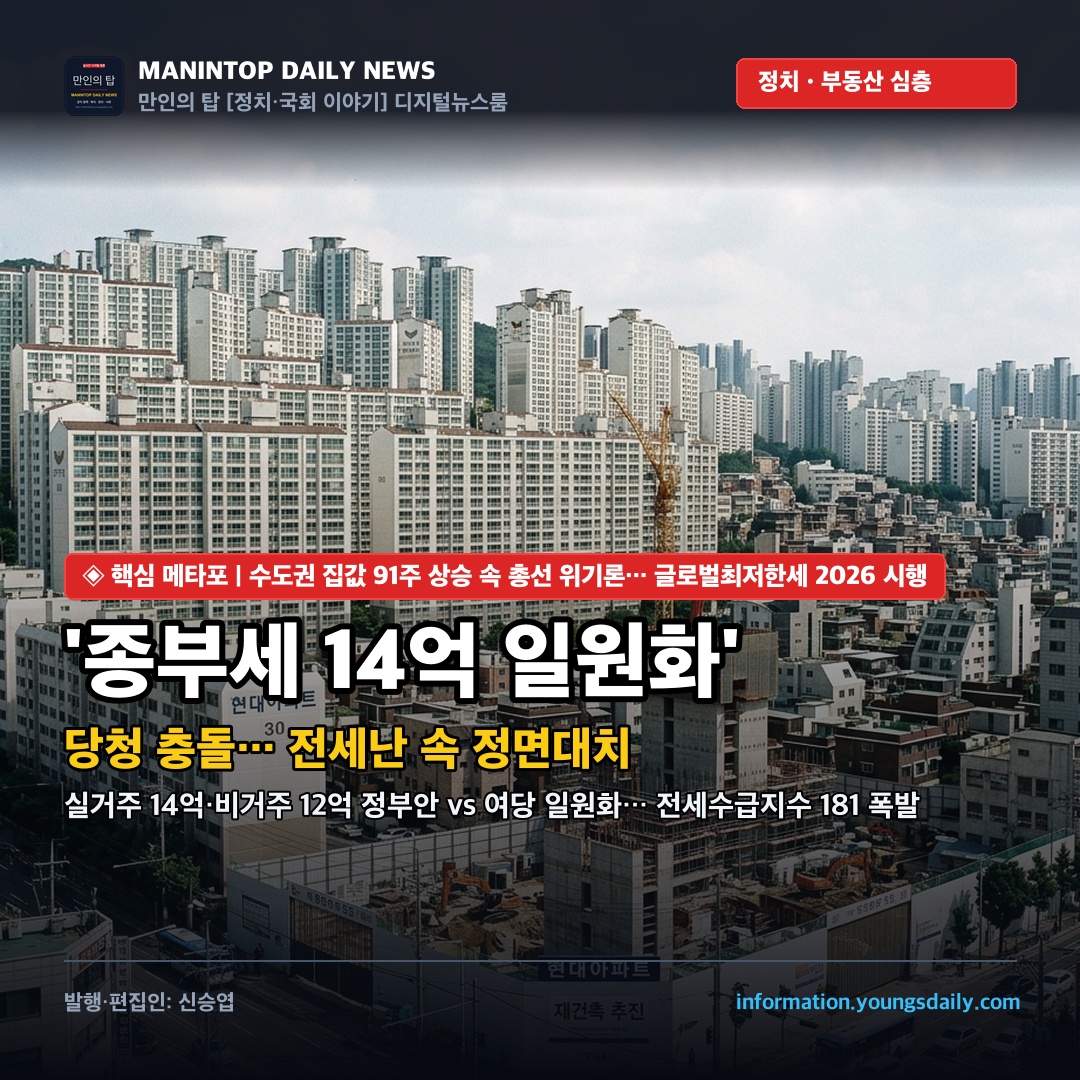
▲ 서울 한강변 일대에 밀집한 대규모 고층 아파트 단지 전경. 2026년도 종합부동산세 개편과 실거주 차등 적용을 둘러싼 당청 갈등이 정국의 최대 쟁점으로 부상했다. / 공식보도자료
주택 보유세의 상징적 지표인 종합부동산세(종부세) 기본공제액을 둘러싸고 청와대와 여당이 정면으로 충돌하면서, 2026년도 부동산 세제 개편안이 정권의 명운을 가르는 최대 정치적 화약고로 급부상했다. 실거주 1주택자에게만 14억 원을 적용하고 비거주자는 12억 원으로 묶어두려는 정부의 원칙론에 맞서, 여당 지도부와 수도권 의원들은 거주 여부와 무관하게 14억 원으로 통일할 것을 요구하며 팽팽히 맞서고 있다. 서울 아파트값 91주 연속 상승과 전세수급지수 181.4라는 기록적 품귀 대란 속에 여야의 입법 대치와 2026년 1월 1일 전면 도입되는 OECD 글로벌최저한세의 경제적 충격까지 겹쳐 거대한 정책적 격랑이 일고 있다.
실거주 14억·비거주 12억 정부 수정안과 여당의 14억 일원화 요구
갈등의 발단은 정부가 국회에 제출한 세제개편안의 차등 공제 설계에서 비롯되었다. 정부는 당초 1세대 1주택자의 종부세 기본공제액을 실거주 주택은 12억 원에서 14억 원으로 높이되, 비거주 주택은 12억 원에서 9억 원으로 대폭 깎아 비거주 1주택자를 투기 세력으로 간주하는 징벌적 차등안을 마련했다. 그러나 지난 8월 더불어민주당 지도부의 강력한 반발에 부딪히자 정부는 비거주 공제액을 현행 12억 원으로 유지하는 수정안을 국회에 제출했다. 하지만 민주당 서울시당과 수도권 의원들은 이에 만족하지 않고 거주·비거주 구분 자체를 완전히 철폐해 14억 원으로 일원화할 것을 추가 요구하면서 당청 충돌이 격화되었다.
청와대와 기획재정부는 추가 양보는 정책의 근간을 허무는 일이라며 결사항전의 태세를 보이고 있다. 청와대 고위 관계자는 비거주 주택 공제액을 9억 원에서 12억 원으로 유지해 준 것 자체가 엄청난 후퇴였는데, 이것마저 14억 원으로 올려 차등을 없앤다면 이번 부동산 개편안 자체가 무력화된다고 선을 그었다. 기재부 당국자 역시 국회 예결위 등을 통해 더 물러설 공간이 없으며, 이는 단순한 기싸움이 아니라 국정 철학과 정책 주도권을 지키는 마지노선이라고 강조했다. 이재명 대통령 또한 정권의 운명보다 망국적 부동산 투기 탈출이 우선이라며 실거주자 우대 원칙을 천명했다.
구분 항목
현행 제도
정부 국회제출안
여당(민주당) 요구안
1세대 1주택 (실거주)
12억 원
14억 원으로 상향
14억 원 유지 확정
1세대 1주택 (비거주)
12억 원
12억 원 (당초 9억서 철회)
14억 원 일원화 (차등 철폐)
부부 공동명의 과세
부부 각 9억 (합산 18억)
실거주 각 9억, 비거주 각 6억
비거주 공동명의 추가 완화 요구
종부세 세부담 상한률
직전연도 총보유세의 150%
150% 유지 (당초 200% 철회)
현행 150% 유지 합의
청와대의 '배수진'과 여당 내 노선 갈등… 2028 총선 공포
여당 내부에서도 계파 간 노선 갈등이 격렬하게 분출하고 있다. 더불어민주당 수도권 의원 20명이 결성한 '전월세 주거 안정화를 위한 부동산 실용주의 의원 연구모임(전실모)'은 정부의 획일적 실거주 규제가 임대 공급을 틀어막아 서민들을 전·월세 지옥으로 몰아넣고 있다고 비판했다. 이언주 의원은 은퇴 고령자가 수도권 주택을 전세로 놓고 지방으로 이주할 경우 주택연금을 유지할 수 있도록 비거주 예외를 인정해야 한다고 제안했고, 황희 의원은 100여 곳의 재건축 이주 수요를 공공 물량만으로 감당할 수 없다며 규제 완화를 촉구했다.
반면 친명계 주류와 야권 진보 진영은 세제 완화를 갭투기 용인이자 부자 감세라고 맹비난했다. 정청래 전 대표는 비거주 공제액을 14억 원으로 올리는 것은 국가가 갭투기를 합법화하는 잘못된 신호를 준다며 정부안 사수를 주장했고, 최민희 최고위원은 당이 개혁 정책을 흔들어서는 안 된다고 비판했다. 조국 조국혁신당 원장 역시 거주 여부와 무관하게 14억 원을 일괄 공제하면 시가 20억 원대 고가 주택까지 종부세가 면제된다며, 전세금 폭등에 고통받는 청년과 서민들이 이를 보면 등을 돌릴 것이라고 직격했다.
수도권 의원들이 지도부의 압박에도 불구하고 반발을 멈추지 못하는 근본적 배경에는 2028년 총선에 대한 짙은 공포가 깔려 있다. 한국부동산원 조사에 따르면 서울 아파트 매매가격은 성동구 24.75%, 성북구 20.40%, 광진구 20.05% 등 전실모 소속 의원 지역구 대다수가 서울 평균 상승률(15.94%)을 크게 웃돌았다. 집주인은 보유세 폭탄에 분노하고 세입자는 전셋값 폭등에 절망하는 이중고 속에서, 내년 7월과 9월 재산세에 이어 12월 종부세 고지서가 발송되면 수도권 민심이 폭발할 것이라는 위기감이 극에 달한 상태다.
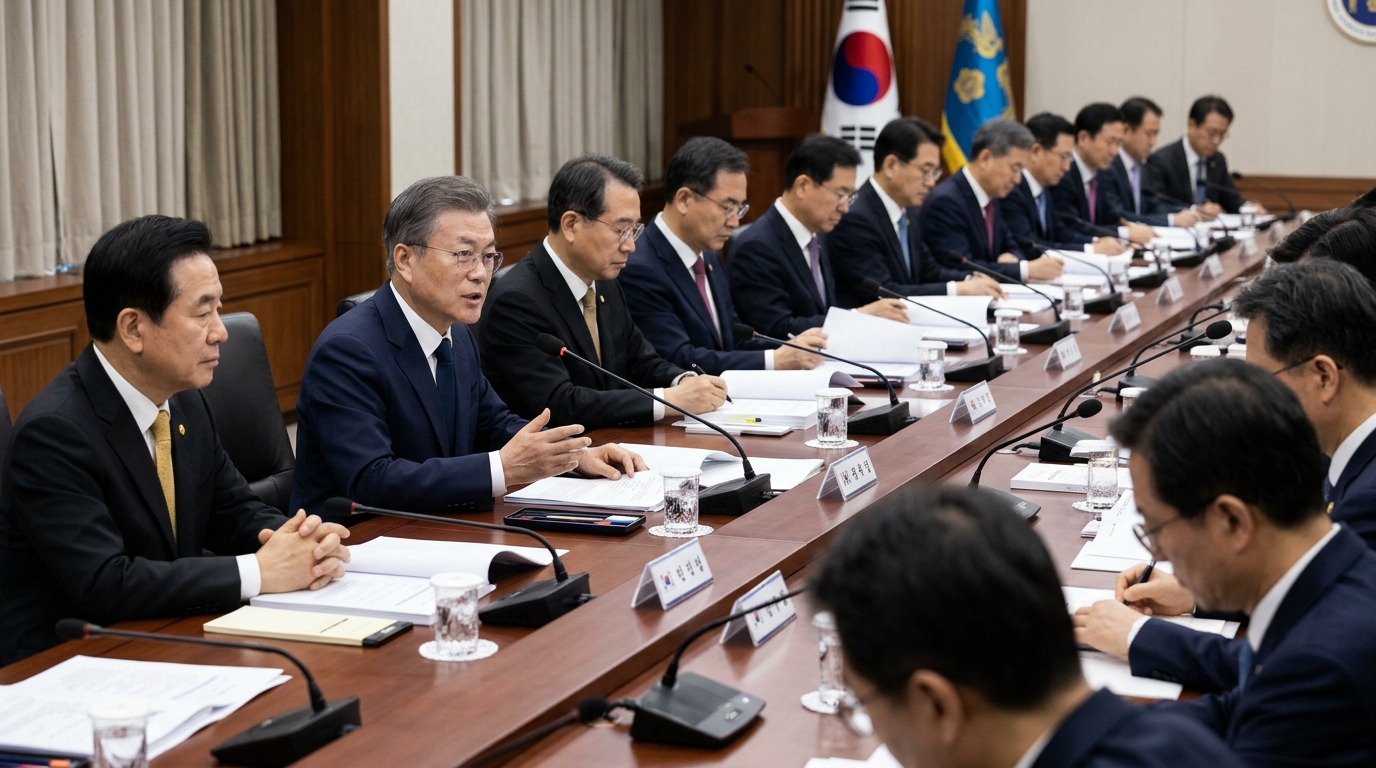
▲ 정부서울청사 대회의실에서 국무위원들과 여당 원내지도부가 참석한 가운데 부동산 세제 개편안과 글로벌최저한세 도입 방안을 조율하고 있다. / 국회공식보도사진
서울 아파트값 91주 상승과 전세수급지수 181.4… 야당의 총공세
부동산 지표의 경고음은 위험 수위를 넘어섰다. KB국민은행 집계에 따르면 서울 아파트 평균 매매가격은 16억 3,546만 원을 돌파했고, 서울 아파트 전세수급지수는 181.4를 기록하며 문재인 정부 이후 최고치를 갈아치웠다. 지수가 100을 넘어 180대에 진입했다는 것은 시장에 전세 매물이 완전히 메말라 극심한 품귀 상태에 빠졌음을 뜻한다. 주간 전셋값 상승률(0.17%)이 매매가 상승률(0.07%)의 두 배를 웃돌고 강북구의 1년간 전셋값 상승률이 18.9%에 달하면서, 한국갤럽 조사에서 51%에 달했던 정부 부동산 정책 긍정 평가는 입소스 조사에서 46%까지 급락했다.
야당인 국민의힘은 이를 정권의 총체적 무능과 독선으로 규정하고 전면 공세에 나섰다. 정점식 원내대표는 대통령의 잘못된 규제로 서울 아파트값이 91주 연속 오르고 있다며 징벌적 세제개편안과 대출 규제를 전면 철회하라고 요구했다. 보수 야권의 '수도권주거혁신포럼' 세미나에 참석한 최경환 전 경제부총리는 현 정부의 정책을 '경제를 아는 사람이라면 도저히 할 수 없는 미친 대출 규제'라고 비판하며 주택담보대출 LTV 80% 완화와 토지거래허가구역 해제를 촉구했다. 여기에 오세훈 서울시장과 정원오 후보 간의 서울시장 전초전까지 가열되며 부동산 정국은 걷잡을 수 없이 소용돌이치고 있다.
2026 OECD 글로벌최저한세 전면 시행과 내국추가세(DMTT)의 역설
정부와 여당은 성난 민심을 달래기 위해 조기 대량 공급과 입법 배수진을 치고 있다. 이재명 대통령은 SNS를 통해 500세대 이하 소규모 주택의 인허가권을 구청장에게 과감히 이양해 조기 착공을 유도하고, 향후 고금리와 공급 과잉으로 주택 가격이 급락할 경우 국가가 공공주택용으로 대량 매입하는 시장 안전장치를 마련하겠다고 발표했다. 국회 정기국회에서는 도시정비법, 부동산감독원 설치법, 반도체 세수 기반 100조 원 미래대응기금, 800조 원대 슈퍼예산안 처리를 밀어붙이고 있으나, 야당은 재건축초과이익환수제(재초환) 폐지를 요구하며 필리버스터 총력 저지를 예고했다.
부동산 세제와 더불어 2026년 대한민국 경제계를 뒤흔들 최대 복병은 2026년 1월 1일 전면 시행되는 OECD 글로벌최저한세(Pillar Two)와 내국추가세(DMTT)다. 직전 4개년 중 2개년 이상 연결매출 7억 5,000만 유로(약 1조 원) 이상인 다국적기업 그룹에 대해 관할국별 실효세율이 15%에 미달할 경우 차액만큼 추가세를 부과하는 제도로, 한국은 외국 과세당국에 앞서 국내 저율과세 소득에 대한 세금을 우선 징수하는 내국추가세를 공식 도입했다.
세목 및 제도
개편 핵심 내용
적용 대상 및 기준
시장 및 기업 파급 효과
글로벌최저한세(DMTT)
실효세율 15% 미달 시 내국추가세 우선 징수
연결매출 7.5억 유로(약 1조 원) 다국적기업
국내 R&D·투자 감면 혜택 무력화 역설 발생
ISA(자산관리계좌) 개편
일반 ISA 일몰 무제한, '생산적금융 ISA' 신설
연 2천만 원, 총 2억 원 납입 한도
자본시장 자금 유입 및 청년 미래자산 지원
일시적 2주택 처분기한
조정대상지역 내 종전 주택 처분 유예 단축
현행 3년에서 2년으로 1년 단축
다주택 취득세 중과 회피 갭투자 차단
다주택 지방소득세 유예
2년 이상 보유 주택 양도 시 중과세 유예
2027년부터 2028년까지 2년간 한시 적용
매물 잠김 완화 유도 및 거래 퇴로 마련
ISA 확대와 다주택 중과 유예… 2026 국세·지방세제 개편 총괄
문제는 글로벌최저한세 체계에서 한국 정부가 대기업에 제공해 온 세제 지원책이 도리어 부메랑이 된다는 점이다. 과거에는 R&D 세액공제, 설비투자 세액공제, 고용지원 세제가 기업의 핵심 절세 수단이었으나, 공제를 받아 국내 법인세 실효세율이 15% 밑으로 떨어지면 경감받은 세액만큼 내국추가세로 토해내야 하는 역설이 발생한다. 대규모 설비투자에 따른 가속상각 제도 역시 회계상 이익 대비 납부 세액을 줄여 실효세율을 급격히 떨어뜨리므로, 국내 굴지의 대기업과 외국계 투자기업들은 기존 세무 전략을 전면 재수정해야 하는 혼란에 직면했다.
한편 정부는 2026년 세법 및 지방세제 개편을 통해 서민 자산 형성과 시장 연착륙을 위한 정비도 병행하고 있다. 일반 ISA의 의무 가입기간과 일몰을 폐지하고 납입한도를 연 2,000만 원, 총 2억 원으로 확대한 생산적금융 ISA를 신설했으며, 조정대상지역 내 일시적 2주택자의 종전 주택 처분 유예기간을 3년에서 2년으로 단축했다. 아울러 다주택자의 2년 이상 보유 주택 양도 시 개인지방소득세 중과를 2027년부터 2028년까지 2년간 한시 유예하고, 1주택자 재산세 특례를 2029년까지 3년 연장했다. 부동산 보유세 갈등과 글로벌 조세 혁명이 동시에 교차하는 2026년, 정권의 리더십과 정책적 정밀성이 시험대에 올랐다.
[In-Depth Analysis] Ruling Party Clashes with Blue House over 1.4B Won Property Tax: Seoul Rental Crisis and 2026 Tax Overhauls
MANINTOP Political and Economic Investigation Desk | Real Estate and International Taxation AnalysisNovember 12, 2026
▲ High-density residential apartment complexes along the Han River in Seoul. Clashes between the ruling party and the Blue House over holding tax exemptions and residency rules have emerged as the central political battleground. / Press Coverage Photo
A fierce confrontation between the Blue House and the ruling Democratic Party over basic deduction thresholds under the Comprehensive Real Estate Holding Tax has transformed the 2026 Real Estate Tax overhaul into a critical political flashpoint. While the executive branch insists on maintaining a dual-tier framework granting a 1.4 billion won deduction exclusively to owner-occupiers while capping non-residing single homeowners at 1.2 billion won, ruling party lawmakers demand a unified 1.4 billion won threshold regardless of residency. This high-stakes standoff unfolds amidst a 91-week surge in Seoul home prices, a historic rental shortage index reaching 181.4, intense parliamentary clashes, and the full domestic enforcement of the OECD Global Minimum Tax.
Government Revision on Residency Deductions and Ruling Party's Single 1.4B Won Demand
The legislative dispute originated from the administration's initial proposal to establish sharp tax disparities based on residency. The government originally planned to raise the deduction for owner-occupiers from 1.2 billion to 1.4 billion won while slashing it to 900 million won for non-residing owners, effectively penalizing absentee landlords as speculative investors. Following stiff resistance from ruling party leadership in August, the Ministry of Economy and Finance submitted a revised compromise maintaining the non-residency deduction at the status quo of 1.2 billion won. However, Seoul and metropolitan area lawmakers quickly rejected the compromise, demanding the complete eradication of residency distinctions and a single 1.4 billion won exemption across all single homeowners.
The Blue House and fiscal authorities maintain that further concessions would obliterate foundational tax principles. A senior presidential official emphasized that lifting the non-residency threshold from 900 million back to 1.2 billion won already constituted a massive policy compromise, warning that equalizing both categories at 1.4 billion won would completely neutralize the housing tax overhaul. Finance ministry officials similarly declared before parliamentary committees that there remains zero room for retreat, framing the dispute as a non-negotiable battle over administrative authority. President Lee Jae-myung reaffirmed his stance across Cabinet addresses, insisting that ending speculative real estate distortions supersedes short-term political fortunes.
Category
Current System
Government Revision
Ruling Party Demand
Single Owner (Residing)
1.2 Billion Won
Raised to 1.4 Billion Won
Maintained at 1.4B Won
Single Owner (Non-Residing)
1.2 Billion Won
Maintained at 1.2B Won
Unified at 1.4B Won (No Disparity)
Joint Spousal Ownership
900M each (Total 1.8B)
Residing 900M / Non-Residing 600M
Demands additional relaxation
Tax Burden Cap
150% of prior year total tax
150% maintained (200% proposal dropped)
Agreed to maintain at 150%
Blue House Unyielding Line and Factional Clashes: 2028 Election Apprehensions
Fierce ideological fault lines have erupted within the ruling party ranks. A coalition of twenty lawmakers representing Seoul and Gyeonggi constituencies—the Parliamentary Forum for Pragmatic Rental Housing Stabilization—publicly attacked government residency mandates for constricting rental supply and trapping working-class tenants in rental distress. Representative Lee Eon-joo proposed permitting elderly retirees who relocate to rural provinces to retain reverse mortgages on leased metropolitan properties, urging statutory exemptions from non-residency penalties. Representative Hwang Hee underscored that over one hundred urban redevelopment projects face acute tenant displacement that cannot be absorbed by public housing alone.
In sharp contrast, pro-administration loyalists and progressive leaders condemned the proposed tax rollback as a capitulation to real estate speculation. Former party chairman Jung Chung-rae stated that expanding non-residency deductions to 1.4 billion won would send a toxic signal endorsing leveraged gap speculation, demanding strict defense of the executive bill. Supreme Council member Choi Min-hee criticized parliamentary efforts to weaken reform momentum, while Fatherland Innovation Party policy chief Cho Kuk warned that a blanket 1.4 billion won deduction would exempt luxury homes valued up to 2.0 billion won, alienating youth and low-income families suffering under runaway rental inflation.
The relentless resistance of metropolitan lawmakers stems from acute electoral anxiety regarding the April 2028 parliamentary and municipal elections. Korea Real Estate Board records demonstrate that cumulative apartment price gains under the Lee administration averaged 15.94 percent across Seoul, with key metropolitan districts experiencing far steeper escalations, including Seongdong at 24.75 percent, Seongbuk at 20.40 percent, and Gwangjin at 20.05 percent. Caught between property owners infuriated by mounting holding taxes and tenants crushed by soaring deposits, ruling party strategists fear a devastating electoral backlash once municipal property taxes and holding tax bills arrive next summer and winter.
▲ Cabinet ministers and ruling party leaders deliberate property tax reforms and Global Minimum Tax rules during a policy coordination conference in Seoul. / Press Photo Coverage
Seoul Apartment Prices Up 91 Weeks and Rental Shortage Index at 181.4: Opposition Offensive
Underlying market indicators reflect alarming systemic imbalances. Real estate data compiled by KB Kookmin Bank indicates that the average Seoul apartment price surpassed 1.635 billion won, while the Seoul apartment rental supply-and-demand index peaked at 181.4, marking the highest supply deficit since the Moon Jae-in presidency. An index reading above 180 denotes an acute rental drought where available leases have nearly vanished. With weekly rental price gains doubling transaction sales growth and northern Seoul rents surging 18.9 percent year-on-year, public approval for government housing policies plunged from 51 percent in March down to 46 percent in May.
The conservative People Power Party launched an aggressive parliamentary offensive, framing the policy rift as proof of executive incompetence. Floor leader Jung Jeom-sik attacked the administration over 91 consecutive weeks of rising home prices, demanding the total withdrawal of punitive holding taxes and loan ceilings. Speaking at a conservative housing forum, former Deputy Prime Minister Choi Kyoung-hwan denounced state credit restrictions as irrational financial policies, advocating for 80 percent loan-to-value limits and the abolition of transaction permit zones. Meanwhile, the emerging Seoul mayoral contest between Mayor Oh Se-hoon and progressive candidate Jung Won-oh has further inflamed regional housing debates.
Full Enforcement of 2026 OECD Global Minimum Tax and the Domestic Top-Up Tax Paradox
To counter public outrage, the administration and parliamentary leaders are attempting to balance aggressive housing construction with regulatory defenses. President Lee announced plans to delegate municipal construction permitting for developments under 500 units directly to autonomous district mayors to accelerate groundbreaking schedules, alongside establishing a public reserve purchasing mechanism to absorb private housing assets if high interest rates induce market crashes. Concurrently, the regular parliamentary session features intense partisan gridlock over an 800 trillion won national budget, a 100 trillion won Future Response Fund backed by semiconductor tax windfalls, and conservative demands to repeal redevelopment excess profit recaptures.
Beyond domestic housing turmoil, the corporate sector confronts another monumental tax shock with the full implementation of the OECD Pillar Two Global Minimum Tax and the Domestic Minimum Top-up Tax (DMTT) on January 1, 2026. Applying to multinational enterprise groups with consolidated annual revenues exceeding 750 million euros (roughly 1.0 trillion won), the regime imposes top-up levies whenever effective jurisdictional tax rates fall below 15 percent. South Korea's enactment of the DMTT ensures that domestic tax authorities retain primary taxing rights over low-taxed domestic profits prior to the application of foreign income inclusion rules.
Tax and System
Key Legislative Contents
Coverage Threshold
Market and Corporate Impact
Global Minimum Tax (DMTT)
Domestic top-up tax prioritized when rate is under 15%
MNEs with consolidated revenue over 750M euros
Domestic R&D and capital investment tax breaks neutralized
Wealth Account (ISA) Reform
Unlimited sunset on general ISA, Productive ISA created
Annual 20M won, total 200M won contribution limit
Channeling retail capital to equities and youth wealth
Temporary 2-Home Disposal
Shortened disposal grace period in regulated zones
Reduced from 3 years to 2 years
Curbs speculative gap investments avoiding acquisition taxes
Local Income Tax Surcharge
Temporary capital gains surcharge holiday on multi-homes
Properties held 2+ years, effective 2027 to 2028
Eases lock-in effects and unlocks metropolitan inventory
Expansion of Wealth Accounts and Temporary Relief: Overview of 2026 Tax Code Amendments
This global tax architecture triggers a paradoxical neutralization of established domestic corporate incentives. Traditionally, corporate tax deductions for research and development, capital equipment investments, and job creation served as foundational drivers of industrial competitiveness. Under Pillar Two, however, whenever statutory credits reduce a corporation's domestic effective tax rate below 15 percent, the resulting tax savings are immediately recouped through the domestic minimum top-up tax. Accelerated depreciation schedules similarly suppress accounting tax payments relative to book earnings, forcing major industrial conglomerates and foreign multinationals to overhaul their global tax planning.
Concurrently, legislative packages refine broader national and local tax codes to cushion working-class balance sheets and support real estate market liquidity. The government eliminated mandatory expiration windows on standard individual wealth management accounts (ISA) while inaugurating a dedicated Productive Finance ISA featuring expanded 200 million won contribution ceilings. Local tax amendments shortened the disposal grace period for temporary two-home owners from three years to two years, instituted a temporary two-year capital gains surcharge holiday on multi-home owners holding properties for over two years, and extended property tax rate reductions for single homeowners through 2029. Navigating real estate tax conflicts alongside global corporate tax reform represents the ultimate test of state governance.
PRO SOURCING ENGINE만인의 탑 빅데이터 솔루션
★ 가입 시 600 크레딧(120회) 전원 무료
내가 찾는 상품 키워드, 지금 얼마나 검색될까?
네이버 월간 검색량 + 구글 볼륨 + 아이템스카우트 실시간 상품수와 경쟁강도 배지를 0.5초 만에 무료로 확인하세요.
MANINTOP NEWSLETTER
📬 만인의 탑 뉴스레터 무료 구독
오늘 보신 정책·시사 뉴스가 유익하셨나요? 매일 엄선되는 알짜 복지 혜택과 국회 실시간 속보를 이메일로 가장 먼저 받아보세요. (평생 무료)
1월이 시작되면 감기는 이미 우리 곁에 와 있습니다. 2월, 3월, 4월까지 이어지는 추위와 건조함은 코와 목을 가장 먼저 공격합니다. 아침에 일어나자마자 막혀 있는 코. 계속 흐르는 콧물. 괜히 칼칼해지는 목. 이 증상은 “시작”일 뿐입니다. 한 번 무너지면 일주일, 길면 한 달까지 끌고 갑니다. 약을 먹으면 잠깐 괜찮아집니다. 하지만 며칠 뒤 또 반복됩니다. 왜일까요? 감기는 ‘치료’의 문제가 아니라 ‘관리’의 문제이기 때문입니다. 대부분은 감기가 오고 나서 약을 찾습니다. 하지만 진짜 중요한 건 감기가 오기 전에 코와 목을 지키는 것입니다. 건조한 실내 공기, 차가운 바깥 공기, 눈에 보이지 않는 세균. 코와 목은 매일 공격받고 있습니다. 지긋지긋하죠! 그런데도 우리는 아무 준비 없이 버티고 있습니다. 이번 겨울도 그렇게 보낼 건가요? 사실 방법은 어렵지 않습니다. 코를 깨끗하게 관리하고, 목을 따뜻하게 보호하고, 점막을 촉촉하게 유지하고, 기관지를 미리 관리하고, 외부 공기를 차단하는 것. 이 다섯 가지만 꾸준히 해도 감기약 없이 겨울을 보내는 것이 충분히 가능합니다. 🔥 이제부터 그 방법을 하나씩 살펴보겠습니다. 🔥 1. 코와 목을 먼저 관리해야 하는 과학적 이유 감기의 대부분은 코 점막에서 시작됩니다. 국제 학술지 Nature Reviews Microbiology 와 Journal of Allergy and Clinical Immunology 에 실린 호흡기 감염 관련 연구들에서는, 감기 바이러스가 비강 상피세포에 먼저 부착해 증식한다는 점을 설명하고 ...
리모델링사업이 진행 중인 아파트를 매매할 때 “계약금 10%를 언제까지 내야 하느냐”는 질문이 특히 많이 나옵니다. 이주공고(이주 안내)가 7~11월쯤이라고 들으면, 그 시점에 맞춰 계약금도 움직일 것 같아서 더 헷갈리기 쉽습니다. 하지만 실제 납부기한은 ‘이주공고가 언제냐’만으로 자동 결정되지 않는 경우가 많습니다. 1) 계약금 10% 납부기한: 결국 ‘문서에 적힌 일정’이 기준 계약금 10%를 언제까지 납부해야 하는지는, 내가 서명하는 매매계약서(특약 포함) 와 사업주체/조합이 제시한 공고·안내문 에 적힌 납부 일정이 기준이 됩니다. 실제 공고문에서는 분양대금 납부의 큰 틀(계약금→중도금→잔금)을 먼저 안내하고, 상세 일정은 별도 표나 유의사항으로 제시하는 방식이 흔합니다. 또, 계약서 문구에 따라 지급 시점이 조건부로 설정될 수도 있습니다. 예를 들어 한 사례 소개 자료에서는 용역계약서에 잔금(10%) 지급시기가 “사업승인 후”로 기재되어 있었다는 점이 언급됩니다. 이런 식으로 ‘사업 단계’와 지급을 연동하는 문구가 들어가면, 질문의 답은 계약서 문구를 확인해야만 확정됩니다. 관련 내용은 링크 에서 문구 사례를 확인할 수 있습니다. 2) 입주자모집공고에서 확인되는 ‘납부 순서’와 잔금 마감 시점 공고문에 적힌 문구를 보면, 납부 순서와 잔금 마감에 대한 기준이 비교적 명확하게 제시되는 경우가 있습니다. 예를 들어 한 입주자모집공고에는 “분양금액(주택가격)은 계약금, 중도금, 잔금의 순서로 납부”하며 “잔금은 입주(열쇠 수령일) 전에 완납”해야 한다고 안내되어 있습니다. (문구 확인: 링크 ) 이 문구가 의미하는 바는 최소 2가지입니다. 분양/공급 형태의 문서에서는 ‘계약금→중도금→잔금’ 흐름이 공식적으로 안내될 수 있습니다. 잔금은 “입주(열쇠 수령)” 이전에 완납해야 한다는 마감 기준이 문서에 적혀 있을 수 있습니다. 다만, 위 공고문 문구는 잔금 마감에 대한 기준을 보여주지만, 계약금 10%의...
윤석열 전 대통령 탄핵 인용 소식을 접하면, 가장 궁금한 지점은 ‘헌재가 정확히 무엇을 위헌·위법으로 봤는가’입니다. 또한 탄핵과 별개로 진행되는 형사재판(내란 우두머리 혐의 등)이 어디까지 왔는지도 함께 정리할 필요가 있습니다. 아래 내용은 제공된 기사/게시물 스니펫과 링크에서 확인되는 범위만 모아, 일반인이 흐름을 이해하기 쉽게 정리한 것입니다. 1) 탄핵 인용 관련: 스니펫에서 확인되는 ‘판단의 골격’ 제공된 근거 중 조국혁신당 사이트에는 헌법재판소가 윤석열 탄핵 심판에서 “피청구인의 위헌·위법행위는 국민 신임 …”이라는 취지로 판단했다는 문장이 인용돼 있습니다( 링크 ). 이 인용문만 놓고 보면, ‘위헌·위법행위’가 있었는지와 그로 인해 ‘국민의 신임’이 어떻게 평가됐는지가 핵심 축으로 소개됩니다. 다만 질문에서 요청하신 세부 항목, 즉 비상계엄 선포 자체를 문제 삼은 구체적 이유, 계엄 이후 조치(포고령, 국회 통제 등)의 어떤 지점이 헌법 위반인지, 국회의 권한행사 방해 및 정치활동 제약을 어떤 논리로 판단했는지 등은, 이번에 제공된 근거의 제목/스니펫만으로는 조항·사실관계·판단 구조가 그대로 제시돼 있지 않습니다. 따라서 이 글에서는 ‘헌재가 무엇을 문제 삼았다’는 세부 리스트를 단정적으로 재구성하기보다, 현재 확인 가능한 문구 수준의 요약(위헌·위법행위 → 국민 신임의 문제로 평가)까지만 적습니다. 만약 헌재 결정문 전문(주문 및 이유)이 추가로 확인되면, 그때는 문장 단위로 ‘어떤 행위’와 ‘어떤 헌법 원리/조항’이 연결되는지(예: 권력분립, 국회의 권한, 정치적 기본권 등) 구조화해 정리하는 것이 가장 정확합니다. 2) 형사 절차(내란 혐의) 관련: 체포영장과 1심 선고 언급 탄핵 심판과 별도로, 12·3 비상계엄 사태로 내란 혐의를 받는 윤석열 대통령에 대해 2024년 12월 31일 체포 영장이 발부됐다는 BBC 보도가 있습니다( 링크 ). 해당 보도는 ‘현직 대통령’에 대한 체포영장 발부라는 점을 함께 언급합니다. 또...