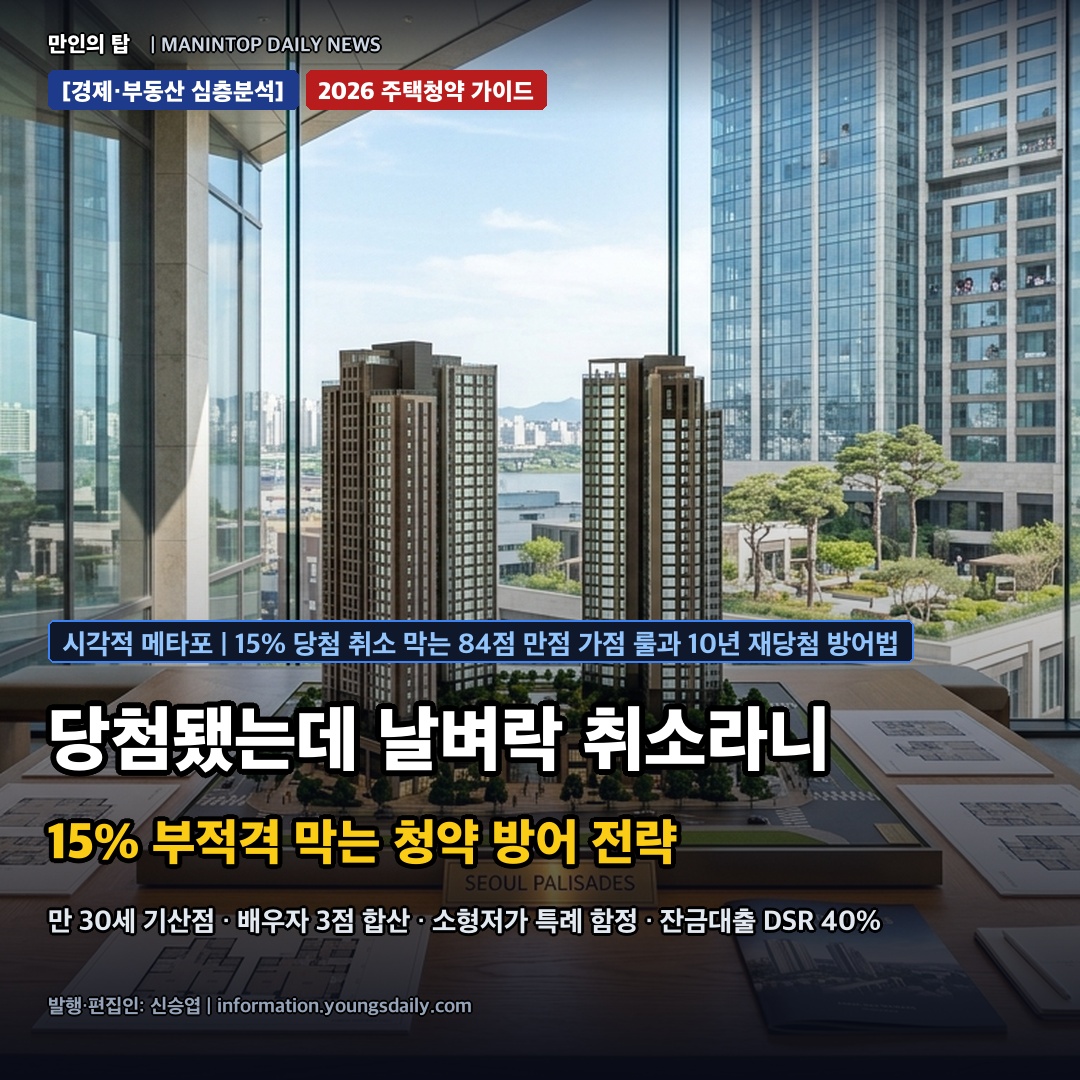
[심층분석] "당첨됐는데 날벼락 취소"… 15% 부적격 막는 청약 가점 룰과 10년 재당첨 방어법
만인의 탑 편집국11월 16, 2026
▲ 수도권 신축 아파트 분양 홍보관에서 예비 청약자들이 단지 조감도와 세부 평면도를 검토하며 청약 자격을 확인하고 있다. [사진=한국부동산원 제공]
[핵심 보도 요약 : 3대 쟁점]
청약 당첨자의 10~15%가 서류 검증에서 탈락하는 부적격 실태와 최장 10년 재당첨 제한 및 통장 효력 박탈 분석
배우자 청약통장 최대 3점 합산과 부부 동일 단지 중복 청약 허용 등 2026년 84점 만점 가점제 핵심 개편 룰 총정리
소형·저가주택 특례의 특별공급 탈락 함정과 만 60세 이상 유주택 부모 부양가족 점수 오류 원천 차단법
당첨됐는데 날벼락 취소 속출: 15% 부적격 탈락과 10년 재당첨 제한 여파
수백 대 일의 치열한 경쟁을 뚫고 주택청약에 당첨됐는데 사흘 만에 날벼락처럼 당첨 취소 통보를 받는 사례가 전체 당첨자의 15%에 달하며 청약 시장에 비상이 걸렸습니다. 단순한 가점 계산 실수나 자격 요건 착오로 부적격 처분을 받으면 당첨이 취소되는 것은 물론 최장 10년간 재당첨이 전면 제한되고 수십 년간 부어온 청약통장의 효력까지 하루아침에 소멸하기 때문입니다.
국토교통부와 한국부동산원의 공시 통계에 따르면 주요 분양 단지에서 서류 검증을 통과하지 못해 탈락하는 비율은 매년 10%에서 15%를 꾸준히 기록하고 있습니다. 특히 수도권 분양가 상한제 단지의 경우 계약을 포기하거나 부적격 처리되면 본인과 동일 세대원 전원이 10년간 다른 청약에 지원할 수 없어 가족 전체의 주거 계획이 마비되는 치명적인 불이익을 겪게 됩니다.
부적격 통보를 받은 청약자에게는 7일에서 10일간의 소명 기간이 주어지지만, 행정청의 명백한 전산 오류가 아닌 단순한 법률 부지나 실수에 의한 오기재는 구제 대상에서 원천 배제됩니다. 따라서 청약 신청 버튼을 클릭하기 전에 가점 항목과 무주택 자격을 1원 단위, 하루 단위까지 교차 검증하는 철저한 방어적 청약 자세가 필수적입니다.
민영주택 일반공급의 당첨자를 가리는 청약 가점제는 무주택 기간 32점, 부양가족 수 35점, 청약통장 가입 기간 17점을 합쳐 총 84점 만점으로 구성됩니다. 이 중 부부 합산 혜택이 대폭 강화되면서 당첨선 근처의 판도가 요동치고 있습니다.
기존에는 본인의 통장 가입 기간만 인정받았으나, 제도 개편을 통해 배우자 청약통장 가입 기간의 50%를 인정받아 최대 3점까지 추가 가점을 본인 점수에 합산할 수 있게 되었습니다. 1~2점 차이로 당락이 갈리는 서울과 수도권 핵심 입지에서 이 3점은 결정적인 승패를 가르는 무기가 됩니다. 다만 합산 후에도 통장 점수 상한인 17점을 초과할 수는 없으며 당첨 직후 배우자 통장을 해지해서는 안 됩니다.
아울러 과거 부부가 같은 아파트 단지에 동시 청약하면 둘 다 무효 처리되던 독소 조항이 전면 폐지되어 동일 단지 부부 중복 청약이 허용되었습니다. 둘 다 당첨될 경우 전산 접수 시간상 먼저 신청한 건이 유효 당첨으로 확정되므로 신혼부부는 청약 당첨 확률을 실질적으로 두 배로 끌어올릴 수 있습니다.
청약 핵심 검증 항목
민영주택 일반공급
특별공급 (신혼·생초 등)
부적격 판정 및 오류 원인
소형·저가주택 (전용 60㎡ 이하)
무주택자 인정 (가점 합산)
유주택자 처리 (자격 박탈)
특공에 소형빌라 보유 청약 시 취소
만 60세 이상 부모 유주택
신청자 무주택 1순위 가능
유주택 처리 (노부모특공 배제)
부모님 부양가족(5점) 합산 시 탈락
무주택 기간 기산점
만 30세 또는 혼인신고일
공고일 현재 무주택 여부
만 30세 미만 미혼 기간 오기재
직계비속 부양가족 요건
만 30세 이상 3년 등재 필수
미성년 자녀 수 우선 배정
과거 기준(1년) 착각해 5점 과다산정
▲ 아파트 완공 후 잔금대출 전환 시 DSR 40% 한도와 월 상환액을 사전 시뮬레이션하고 있는 예비 입주자. [사진=국토교통부 제공]
소형·저가주택의 특공 탈락 함정과 만 60세 유주택 부모의 이중 잣대
현장에서 가장 많은 눈물을 쏟아내게 만드는 대표적인 부적격 원인은 소형·저가주택 특례와 만 60세 이상 유주택 부모님의 이중 규정입니다.
전용 60㎡ 이하이자 공시가격 수도권 1억 6천만 원 이하(지방 1억 원 이하)인 주택 1호를 가진 경우 민영주택 일반공급에서는 무주택자로 인정받습니다. 그러나 신혼부부, 생애최초, 다자녀 등 특별공급이나 공공분양에서는 예외 없이 유주택자로 처리됩니다. 소형 빌라 1채를 소유한 채 생애최초 특공에 지원해 당첨된 청약자들이 100% 당첨 취소되는 비극이 반복되는 이유입니다.
또한 만 60세 이상의 부모님이 집을 가지고 있어도 자녀는 무주택 세대원으로 1순위 청약을 넣을 수 있지만, 부모님을 부양가족 1명당 5점의 가점으로 합산해서는 절대 안 됩니다. 현행 법령은 피부양자가 주택을 소유한 경우 부양가족 점수를 0점으로 규정하고 있기 때문입니다. 부모님 점수를 잘못 넣어 당첨된 후 서류 검토에서 점수가 깎여 취소되는 사례가 빈발하고 있습니다.
중도금 60% 안심 뒤 덮치는 잔금대출 DSR 40% 한도 절벽 방어법
가점 검증을 완벽히 마쳤더라도 자금 조달 계획을 소홀히 하면 입주 직전 계약을 포기해야 하는 위기에 직면합니다. 분양가의 60%를 차지하는 중도금 집단대출은 DSR 규제가 적용되지 않아 수월하게 실행되지만, 입주 시점의 잔금대출 전환 단계에서는 상황이 180도 달라집니다.
아파트가 완공되어 입주할 때 중도금대출을 갚고 주택담보대출로 전환하는 순간 차주의 소득을 기준으로 총부채원리금상환비율인 DSR 40%가 전면 적용됩니다. 기존 신용대출이나 자동차 할부금이 있거나 소득 증빙이 부족할 경우 잔금대출 한도가 중도금 대출액보다 수천만 원 이상 적게 나오는 한도 절벽 사태가 벌어집니다.
자금 부족으로 계약을 포기하면 부적격과 동일하게 최장 10년간 재당첨이 제한됩니다. 따라서 분양가 10~20%의 계약금을 현금으로 확보하는 것은 물론, 한국부동산원 청약홈의 가상 체험과 금융 시뮬레이션을 통해 입주 시점의 DSR 한도를 사전에 반드시 산출해 보아야 합니다.
발행·편집인: 신승엽 | information.youngsdaily.com.
[In-Depth Analysis] From Jackpot to Disqualification: Navigating 2026 Housing Subscription Pitfalls and 10-Year Penalty Defense
▲ Homebuyers reviewing residential complex scale models and floor layouts at a metropolitan apartment showroom. [Photo: Korea Real Estate Board]
[Key Editorial Takeaways]
Statistical analysis reveals 10 to 15 percent of housing lottery winners face immediate cancellation and up to 10-year bans
Critical updates to the 84-point scoring grid allowing spousal subscription tenure merging and concurrent dual-spousal filings
Decisive legal boundaries governing small low-cost property exceptions and homeowning senior parents within dependent calculations
Statistical Analysis of 15% Disqualification Rate and Severe 10-Year Restrictions
Securing an apartment allocation through fierce competition frequently descends into crisis when winners receive sudden cancellation notifications due to administrative errors. In designated price-capped zones across the Seoul metropolitan region, disqualification triggers an unyielding ten-year nationwide re-application embargo while permanently extinguishing decades of accumulated subscription account tenure.
Data published by regulatory authorities indicates that 10 to 15 percent of preliminary winners are disqualified during formal document scrutiny. Under statutory frameworks governing speculative overheating districts, forfeiture or disqualification paralyzes the housing mobility of the applicant and all registered household dependents for an entire decade.
While disqualified applicants receive a formal seven to ten-day clarification window, relief remains strictly confined to provable bureaucratic clerical mistakes. Subjective oversights or misinterpretations of complex housing rules are unequivocally rejected, mandating exhaustive pre-submission qualification audits.
▲ Official subscription guideline manuals and point evaluation tablets placed on an advisory counter. [Photo: Housing and Urban Guarantee Corporation]
Mastering 84-Point Merit System and Crucial 3-Point Spousal Account Synergy
The 84-point merit framework governing private housing allocations comprises homeless duration at 32 points, family dependents at 35 points, and account tenure at 17 points. Significant structural revisions expanding spousal participation have dramatically altered metropolitan cut-off dynamics.
Applicants can now incorporate 50 percent of their spouse’s account enrollment period, adding up to three bonus points to their primary score within the 17-point account ceiling. In high-demand metropolitan hubs where outcomes are decided by single-point margins, this three-point supplement delivers decisive competitive leverage.
Furthermore, statutory prohibitions barring couples from submitting dual applications within identical residential developments have been eliminated. In the event of dual selection, the timestamped earlier submission remains valid while the subsequent entry is cleanly vacated, doubling overall acquisition probabilities for newlyweds.
Statutory Audit Parameter
General Private Supply
Special Supply Categories
Disqualification Vulnerability
Small Low-Cost Asset (Sub-60sqm)
Recognized as homeless
Treated as property owner
Automatic cancellation in special tracts
Senior Parents Owning Realty
Applicant eligible for 1st rank
Owner status (Elderly supply barred)
Claiming 5-pt dependent points revoked
Homeless Baseline Inception
Age 30 or formal marriage date
Current announcement date status
Claiming years under 30 without marriage
Adult Descendant Criteria
3-year continuous registry mandatory
Prioritized by minor child count
Using outdated 1-year rule causes failure
▲ Prospective homeowners reviewing Debt Service Ratio limitations and financing schedules prior to closing. [Photo: Ministry of Land, Infrastructure and Transport]
Special Supply Hazards of Small Assets and Dual Senior Parent Regulations
The primary source of administrative disqualification centers on structural contradictions within small property exceptions and senior parental dependency guidelines.
Owning a single residential unit under 60 square meters with an official assessed price below 160 million won in the capital area confers homeless classification strictly for general private allocations. However, in special supplies for newlyweds, first-time buyers, or public housing developments, the identical holding classifies the applicant as a property owner, triggering immediate disqualification upon verification.
A corresponding hazard involves parents aged sixty and above who own residential real estate. While applicants cohabiting with property-owning senior parents retain homeless eligibility to apply for first-tier general slots, statutory guidelines explicitly prohibit claiming five dependent points per parent. Claiming unearned dependent points consistently results in post-selection score adjustments and summary rejection.
Managing the Transition from Interim Loans to 40% DSR Mortgage Limits
Flawless scoring execution remains inconsequential if capital planning fails prior to title conveyance. While 60 percent interim collective construction financing operates entirely exempt from Debt Service Ratio limits, conversion to permanent mortgages upon completion imposes comprehensive restrictions.
At occupancy, transition into primary residential mortgages mandates strict compliance with a 40 percent ceiling on debt service relative to verified annual income. Applicants encumbered with existing personal lines of credit, vehicle financing, or unsubstantiated income frequently face sudden financing shortfalls when final mortgage limits fall below outstanding interim debt balances.
Defaulting on purchase contracts due to capital insufficiency carries identical penalties to administrative disqualification, including up to ten years of barred lottery participation. Securing 10 to 20 percent liquid down payments and conducting rigorous DSR simulations through official portal utilities are non-negotiable prerequisites.
1월이 시작되면 감기는 이미 우리 곁에 와 있습니다. 2월, 3월, 4월까지 이어지는 추위와 건조함은 코와 목을 가장 먼저 공격합니다. 아침에 일어나자마자 막혀 있는 코. 계속 흐르는 콧물. 괜히 칼칼해지는 목. 이 증상은 “시작”일 뿐입니다. 한 번 무너지면 일주일, 길면 한 달까지 끌고 갑니다. 약을 먹으면 잠깐 괜찮아집니다. 하지만 며칠 뒤 또 반복됩니다. 왜일까요? 감기는 ‘치료’의 문제가 아니라 ‘관리’의 문제이기 때문입니다. 대부분은 감기가 오고 나서 약을 찾습니다. 하지만 진짜 중요한 건 감기가 오기 전에 코와 목을 지키는 것입니다. 건조한 실내 공기, 차가운 바깥 공기, 눈에 보이지 않는 세균. 코와 목은 매일 공격받고 있습니다. 지긋지긋하죠! 그런데도 우리는 아무 준비 없이 버티고 있습니다. 이번 겨울도 그렇게 보낼 건가요? 사실 방법은 어렵지 않습니다. 코를 깨끗하게 관리하고, 목을 따뜻하게 보호하고, 점막을 촉촉하게 유지하고, 기관지를 미리 관리하고, 외부 공기를 차단하는 것. 이 다섯 가지만 꾸준히 해도 감기약 없이 겨울을 보내는 것이 충분히 가능합니다. 🔥 이제부터 그 방법을 하나씩 살펴보겠습니다. 🔥 1. 코와 목을 먼저 관리해야 하는 과학적 이유 감기의 대부분은 코 점막에서 시작됩니다. 국제 학술지 Nature Reviews Microbiology 와 Journal of Allergy and Clinical Immunology 에 실린 호흡기 감염 관련 연구들에서는, 감기 바이러스가 비강 상피세포에 먼저 부착해 증식한다는 점을 설명하고 ...
리모델링사업이 진행 중인 아파트를 매매할 때 “계약금 10%를 언제까지 내야 하느냐”는 질문이 특히 많이 나옵니다. 이주공고(이주 안내)가 7~11월쯤이라고 들으면, 그 시점에 맞춰 계약금도 움직일 것 같아서 더 헷갈리기 쉽습니다. 하지만 실제 납부기한은 ‘이주공고가 언제냐’만으로 자동 결정되지 않는 경우가 많습니다. 1) 계약금 10% 납부기한: 결국 ‘문서에 적힌 일정’이 기준 계약금 10%를 언제까지 납부해야 하는지는, 내가 서명하는 매매계약서(특약 포함) 와 사업주체/조합이 제시한 공고·안내문 에 적힌 납부 일정이 기준이 됩니다. 실제 공고문에서는 분양대금 납부의 큰 틀(계약금→중도금→잔금)을 먼저 안내하고, 상세 일정은 별도 표나 유의사항으로 제시하는 방식이 흔합니다. 또, 계약서 문구에 따라 지급 시점이 조건부로 설정될 수도 있습니다. 예를 들어 한 사례 소개 자료에서는 용역계약서에 잔금(10%) 지급시기가 “사업승인 후”로 기재되어 있었다는 점이 언급됩니다. 이런 식으로 ‘사업 단계’와 지급을 연동하는 문구가 들어가면, 질문의 답은 계약서 문구를 확인해야만 확정됩니다. 관련 내용은 링크 에서 문구 사례를 확인할 수 있습니다. 2) 입주자모집공고에서 확인되는 ‘납부 순서’와 잔금 마감 시점 공고문에 적힌 문구를 보면, 납부 순서와 잔금 마감에 대한 기준이 비교적 명확하게 제시되는 경우가 있습니다. 예를 들어 한 입주자모집공고에는 “분양금액(주택가격)은 계약금, 중도금, 잔금의 순서로 납부”하며 “잔금은 입주(열쇠 수령일) 전에 완납”해야 한다고 안내되어 있습니다. (문구 확인: 링크 ) 이 문구가 의미하는 바는 최소 2가지입니다. 분양/공급 형태의 문서에서는 ‘계약금→중도금→잔금’ 흐름이 공식적으로 안내될 수 있습니다. 잔금은 “입주(열쇠 수령)” 이전에 완납해야 한다는 마감 기준이 문서에 적혀 있을 수 있습니다. 다만, 위 공고문 문구는 잔금 마감에 대한 기준을 보여주지만, 계약금 10%의...
윤석열 전 대통령 탄핵 인용 소식을 접하면, 가장 궁금한 지점은 ‘헌재가 정확히 무엇을 위헌·위법으로 봤는가’입니다. 또한 탄핵과 별개로 진행되는 형사재판(내란 우두머리 혐의 등)이 어디까지 왔는지도 함께 정리할 필요가 있습니다. 아래 내용은 제공된 기사/게시물 스니펫과 링크에서 확인되는 범위만 모아, 일반인이 흐름을 이해하기 쉽게 정리한 것입니다. 1) 탄핵 인용 관련: 스니펫에서 확인되는 ‘판단의 골격’ 제공된 근거 중 조국혁신당 사이트에는 헌법재판소가 윤석열 탄핵 심판에서 “피청구인의 위헌·위법행위는 국민 신임 …”이라는 취지로 판단했다는 문장이 인용돼 있습니다( 링크 ). 이 인용문만 놓고 보면, ‘위헌·위법행위’가 있었는지와 그로 인해 ‘국민의 신임’이 어떻게 평가됐는지가 핵심 축으로 소개됩니다. 다만 질문에서 요청하신 세부 항목, 즉 비상계엄 선포 자체를 문제 삼은 구체적 이유, 계엄 이후 조치(포고령, 국회 통제 등)의 어떤 지점이 헌법 위반인지, 국회의 권한행사 방해 및 정치활동 제약을 어떤 논리로 판단했는지 등은, 이번에 제공된 근거의 제목/스니펫만으로는 조항·사실관계·판단 구조가 그대로 제시돼 있지 않습니다. 따라서 이 글에서는 ‘헌재가 무엇을 문제 삼았다’는 세부 리스트를 단정적으로 재구성하기보다, 현재 확인 가능한 문구 수준의 요약(위헌·위법행위 → 국민 신임의 문제로 평가)까지만 적습니다. 만약 헌재 결정문 전문(주문 및 이유)이 추가로 확인되면, 그때는 문장 단위로 ‘어떤 행위’와 ‘어떤 헌법 원리/조항’이 연결되는지(예: 권력분립, 국회의 권한, 정치적 기본권 등) 구조화해 정리하는 것이 가장 정확합니다. 2) 형사 절차(내란 혐의) 관련: 체포영장과 1심 선고 언급 탄핵 심판과 별도로, 12·3 비상계엄 사태로 내란 혐의를 받는 윤석열 대통령에 대해 2024년 12월 31일 체포 영장이 발부됐다는 BBC 보도가 있습니다( 링크 ). 해당 보도는 ‘현직 대통령’에 대한 체포영장 발부라는 점을 함께 언급합니다. 또...