“사지 마” 호통치자 15만 명 몰렸다… 600년 남대문시장 ‘스카프리오’와 레트로 부활
2030 디깅 소비·옥반지 열풍부터 41만 완판 스마트스토어와 골목의 명암까지
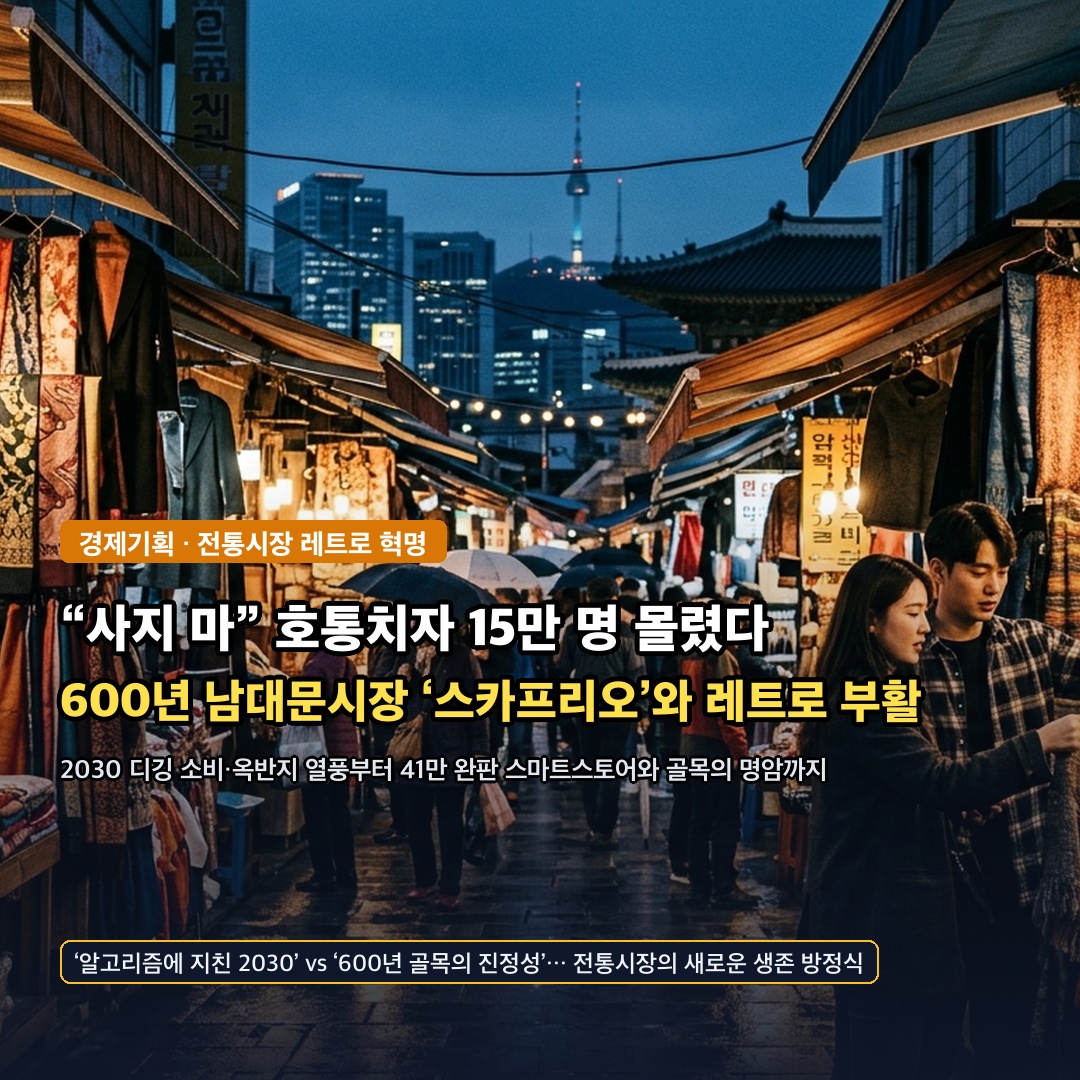
따스한 백열등이 불을 밝히기 시작한 남대문시장 골목길, 다채로운 스카프와 직물이 걸린 상점 사이로 청년들과 외국인 관광객들이 오가고 있다. 600년의 시간을 품은 오래된 시장 골목이 알고리즘에 지친 2030세대의 감성 놀이터이자 글로벌 문화 성지로 다시 피어나는 현장을 상징한다.
1. “사지 마라” 면박에 지갑 열렸다: ‘스카프리오’ 신드롬의 실체
최근 남대문시장을 전국적인 화제의 중심에 올려놓은 주인공은 중앙상가에서 잡화점 ‘한양사’를 운영하는 마흔네 살의 상인입니다. 두 딸을 키우며 시장 바닥에서 10년 넘게 잔뼈가 굵은 그는 좌판부터 시작해 의류, 모자, 잠옷 등 손에 잡히는 대로 팔며 치열하게 생존해 온 베테랑 상인입니다.
대중이 열광한 결정적 이유는 물건을 권유하는 상투적인 방식을 180도 뒤집은 ‘반어법적 면박 화법’이었습니다. 1장 1,600원짜리 스카프를 고르는 손님에게 “너희 지금 과소비한다”, “집에 가면 안 쓸 게 뻔하니 사지 마라”며 오히려 구매를 만류하는 유쾌한 입담이 SNS를 타고 폭발적인 반응을 이끌어냈습니다. 이는 계산된 마케팅이 아니라, 지난 10여 년간 골목에서 손님들과 격의 없이 웃고 떠들며 체득한 서민적 진정성이었기에 독자들에게 통쾌한 카타르시스를 주었습니다.
그의 거침없는 판매 영상은 틱톡과 릴스, 유튜브 쇼츠에서 수백만 조회 수를 기록했고, 누리꾼들은 배우 리어나도 디캐프리오의 이름을 따 ‘스카프리오’라는 애칭을 붙였습니다. 카메라를 보며 묵묵히 걷기만 하는 평범한 출근길 영상조차 195만 뷰를 넘어서며 알고리즘을 장악했습니다. 소비자들은 단순히 물건을 사는 것을 넘어 ‘스카프리오라는 인물을 직접 대면하고 경험하기 위해’ 남대문시장으로 몰려들었습니다. 심지어 매장에서 스카프를 산 손님들이 영업 마감으로 허탈해하는 뒤쪽 대기자들에게 자신이 산 스카프를 무상으로 나누어주는 따뜻한 연대의 풍경까지 연출되었습니다.

고풍스러운 원목 작업대 위에 정갈하게 놓인 비단 스카프 직조물과 은은한 비취빛 옥반지. 획일화된 공산품에서 벗어나 켜켜이 쌓인 시간의 결을 만끽하려는 젊은 세대의 취향과 디깅 소비의 매력을 시각적으로 표현한다.
2. 2030의 ‘디깅 소비’와 남대문 던전 탐험
과거 어르신들의 전유물로 여겨지던 남대문시장이 젊은 세대의 ‘핫플레이스’로 부상한 배경에는 취향과 희소성을 발굴하는 ‘디깅(Digging) 소비’ 문화가 있습니다. 정형화된 백화점이나 며칠 만에 사라지는 팝업스토어와 달리, 미로처럼 얽힌 남대문시장 특유의 구조는 청년들에게 일종의 ‘오프라인 게임 던전’을 탐험하듯 보물을 찾는 재미를 선사하고 있습니다.
실제로 현장에서는 독특한 품목들이 젊은 층의 폭발적인 지지를 얻고 있습니다:
1. 옥반지 열풍 (D동 1층 액세서리 상가): 방탄소년단(BTS) 뷔와 배우 고윤정 등이 착용한 모습이 SNS에 알려지며 1만~2만 원대 옥반지를 레이어드해 착용하려는 젊은 여성들의 오픈런이 이어지고 있습니다.
2. ‘사우나코어’ 목욕용품 (D동): 웰니스 트렌드와 맞물려 피부 마사지용 괄사(5,000원), 레트로 때밀이 타월과 핸드타월 묶음(1만 원)이 다이소 이상의 가성비로 큰 인기를 끌고 있습니다.
3. 감성 빈티지 식기 (C·D동 3층 그릇상가): 달걀 모양 컵, 깨갈이, 잉어 장식 접시 등 개성 넘치는 독특한 식기가 4,000~5,000원대에 판매되며 2030 1인 가구 자취생과 홈카페족의 성지가 되었습니다.
4. 글로벌 K-아동복 거리 (F·G동): 저렴한 가격에 독창적인 디자인을 갖춰 대만, 몽골, 호주 등 전 세계 바이어와 관광객들이 양손 가득 쓸어 담는 필수 코스입니다.
5. 남던 먹거리 투어: 회현역 5번 출구 모자 쇼핑으로 시작해 갈치조림 골목, 칼국수 골목, 줄 서서 먹는 야채호떡으로 이어지는 1만 원대 갓성비 나들이 코스가 청년들의 재방문을 이끌고 있습니다.
3. 빅데이터로 입증된 상권 부활의 정량 지표
남대문시장의 활기는 단순한 입소문이 아닙니다. 금융 빅데이터와 공공 통계 분석 결과, 소비 주체의 세대교체와 글로벌 수요 유입이 뚜렷하게 확인되었습니다.
| 지표 항목 | 세부 수치 및 변동 추이 | 조사 기관 및 기준 기간 |
|---|---|---|
| 연령별 주말 카드 결제 | 20대 이하 44% 증가, 30대 53% 증가 | 신한카드 빅데이터연구소 (2024 대비 2026) |
| 생활용품 2030 소비 | 결제 건수 15배 급증, 결제 금액 5배 증가 | 삼성카드 (2025년 1월 대비 2026년 9월) |
| 외국인 카드 매출액 | 157억 5,800만 원 (전년 동기 95.1억 대비 65.6% 급증) | 서울시·신한카드 (자유상가 일대, 1~9월) |
| 외국인 매출 비중 | 전체 카드 매출 중 9%에서 14%로 5%p 상승 | 서울시·신한카드 (자유상가 일대) |
| 내국인 카드 매출 증가율 | 전년 동기 대비 1.5% 증가에 그침 (외국인 대비 정체) | 서울시·신한카드 (자유상가 일대) |
| 외국인 일평균 유동인구 | 3만 132명 (전체 유동인구의 28.0% 점유) | 서울AI재단 분석 보고서 |
| 구글 트렌드 검색 관심도 | 1년 전 대비 약 300% 폭증 | 구글 트렌드 (최근 3개월 분석) |
이 데이터는 매우 중요한 시사점을 던집니다. 2030세대의 결제 건수가 50%가량 급증하고 생활용품 이용 건수가 15배로 치솟은 것은 시장의 소비 축이 젊은 세대로 확실히 옮겨갔음을 증명합니다. 반면 외국인 매출이 65.6% 폭증하는 동안 내국인 매출 증가는 1.5%에 머물렀다는 점은, 현재의 회복세가 외국인 관광객에 크게 의존하고 있어 내국인 소비의 저변 확대가 시급함을 보여줍니다.
4. 화려한 부활 이면의 그늘: ‘인기 비용’과 골목의 갈등
그러나 한 상인의 폭발적인 인기가 시장 전체의 축제로만 이어진 것은 아닙니다. 6장 1만 원짜리 초저가 잡화는 빠른 회전율이 생명이지만, 현장에는 구매보다 사진과 영상 촬영을 위해 몰려든 구경꾼들이 매장 앞을 가득 메우면서 실제 구매 고객의 진입이 차단되는 역설이 발생했습니다.
사설 경호 인력 고용비와 영업 단축에 따른 기회비용, 온라인 배송 인건비 등 이른바 ‘인기 비용’이 눈덩이처럼 불어났습니다. 더욱이 좁은 시장 골목에 끝없는 대기 줄이 늘어서면서 인근 점포 앞 통로가 막히고 기존 단골들의 발길이 끊기자 주변 상인들이 피해를 호소하는 갈등도 불거졌습니다. 중앙상가 안쪽 골목에서 의류와 잡화를 파는 70대 어르신 상인들은 “젊은이들과 외국인은 바깥 큰길에만 몰리고 상가 안쪽 깊숙한 곳까지는 들어오지 않는다”며 극심한 체감 격차를 토로했습니다.
여기에 일부 점포의 현금 유도 관행과 정찰 가격표 미부착은 여전히 개선해야 할 과제입니다. 외국인 관광객 리야나 씨와 앨리슨 씨는 “카드가 안 되고 현금이나 계좌이체만 요구해 당황스러웠다”고 털어놓았습니다. 흥정에 익숙지 않은 2030세대에게도 가격표가 없는 환경은 심리적 장벽으로 작용하고 있습니다.
— 학계 유통소비 전문가들의 공통 제언
5. 600년 역사의 미래: 디지털 전환과 상생의 해법
1414년 조선 태종 시전 설치로 시작해 1608년 선혜청과 칠패시장, 한국전쟁 직후 도깨비시장을 거쳐온 남대문시장은 이제 또 한 번의 거대한 문명사적 전환을 준비하고 있습니다. 연간 1억 명의 유동 인구를 디지털 데이터와 지속 가능한 매출로 연결하기 위한 인프라 구축이 본격화되었습니다.
남대문시장 상인회(회장 문남엽)는 문화·기술 콘텐츠 전문기업 나라아트(회장 양승국)와 업무협약을 맺고 디지털 전환에 착수했습니다. 시장 전역에 방문객 맞춤형 점포 안내 시스템, 38개국 언어를 지원하는 다국어 거점 키오스크, 고령 상인을 위한 실시간 번역 솔루션, K-패션과 라이프스타일 상품을 글로벌로 송출하는 라이브 방송 스튜디오를 단계적으로 조성하고 있습니다. 행정안전부 역시 남대문시장을 다중운집인파 관리시스템 모니터링 구역으로 편입해 인파 밀집 위험을 사전에 통제할 방침입니다.
결국 남대문시장의 부활이 던지는 메시지는 명확합니다. 완벽하게 짜인 디지털 알고리즘의 시대일수록, 사람 냄새 나는 진솔한 교감과 보물찾기 같은 오프라인 경험의 가치는 더욱 빛을 발한다는 사실입니다. 거점 인기 매장의 온기가 시장 전체로 퍼져나가는 상생의 선순환 구조를 완성할 때, 600년 남대문시장은 세대와 국경을 뛰어넘는 살아있는 문화 플랫폼으로 영원히 호흡할 것입니다.
“Don't Buy!” He Shouted, Yet 150,000 Flocked In: The 600-Year-Old Namdaemun Market's 'Scarforio' Syndrome and Retro Rebirth
From Gen MZ's 'Digging Consumption' and Jade Ring Craze to a 410,000-Visitor Sold-Out SmartStore and Alleyway Paradoxes
Namdaemun Market's bustling historic alley illuminated by warm tungsten lanterns at twilight, filled with young Koreans and international travelers browsing colourful textile stalls. An emblem of a 600-year-old living marketplace transforming into a cultural playground for a digital generation weary of corporate algorithms.
1. Wallets Opened by Scolding: The Reality of the 'Scarforio' Syndrome
The catalyst behind Namdaemun's explosive revival is a 44-year-old merchant operating 'Hanyangsa' in the Central Arcade. Raising two daughters, he has endured over a decade of gritty market survival, selling everything from street apparel and hats to sleepwear on humble stalls.
What captured the public imagination was his counter-intuitive sales banter. Scolding prospective buyers browsing 1,600-won scarves with remarks like “You're overspending” and “You'll never wear it once you get home,” his humorous, self-deprecating wit went viral across social media. Far from a calculated marketing scheme, his candid approach reflected a decade of unvarnished banter honed through everyday survival, offering modern consumers an intoxicating sense of human authenticity.
Short-form video clips of his exchanges amassed millions of views across TikTok, Instagram Reels, and YouTube Shorts. Netizens affectionately dubbed him 'Scarforio,' combining 'scarf' with Leonardo DiCaprio. Even an unedited 15-second clip of his daily commute garnered 1.95 million views. Consumers began visiting Namdaemun not merely for utilitarian shopping, but to directly engage with the 'Scarforio' persona. In heartwarming scenes, early shoppers who secured scarves freely gifted their purchases to late-arriving strangers left waiting in line after closing time, fostering an organic communal bond.
Finely woven silk textiles and a polished vintage jade ring resting upon an aged wooden counter. Visually articulating the appeal of tangible heritage craftsmanship and 'digging consumption' among youth seeking alternatives to mass-produced uniformity.
2. The 2030 Generation's 'Digging Consumption' in the 'Namdaemun Dungeon'
Namdaemun's transformation from an elderly enclave into a Gen MZ hotspot is powered by 'digging consumption'—a cultural trend prioritizing personal taste discovery and tactile exploration. In contrast to sanitized department stores or fleeting pop-up shops, the chaotic, labyrinthine alleys of Namdaemun present young urbanites with an exhilarating 'offline game dungeon' where discovery itself completes the product's value.
Specialty categories are witnessing unprecedented youthful patronage:
1. Jade Ring Craze (Building D, 1st Floor): After BTS member V and actress Go Youn-jung were seen wearing jade rings on social media, young women rushed to buy multiple rings priced affordably at 10,000 to 20,000 KRW for stylish layering.
2. 'Saunacore' Bath Goods (Building D): Aligning with the wellness movement, traditional massage gua sha tools (5,000 KRW) and retro scrub towels (10,000 KRW bundles) offer unbeatable value surpassing modern discount chains.
3. Sensory Vintage Tableware (Buildings C & D, 3rd Floor): Egg-shaped ceramic cups, sesame grinders, and whimsical chopstick rests selling for 4,000 to 5,000 KRW have become must-haves for single-person home cafe enthusiasts.
4. Global K-Children's Wear (Buildings F & G): Offering high quality at modest prices, Namdaemun's kids' apparel district remains a bustling hub for international buyers and traveling families from across Asia and the West.
5. The 10,000-Won Food Tour: Browsing trendy hats outside Hoehyeon Station Exit 5, navigating accessory alleys, and finishing with 1980s braised hairtail, knife-cut noodles, and vegetable hotteok offers an unmatched half-day outing on a modest budget.
3. Big Data Metrics Validating Commercial Rejuvenation
Namdaemun's revitalization is quantitatively verified by extensive payment and municipal big data:
| Indicator | Data & Growth Margin | Source & Reference Period |
|---|---|---|
| Weekend Card Transactions by Age | Under-20s surged 44%, 30s jumped 53% | Shinhan Card Big Data Lab (2024 vs 2026) |
| Household Goods Gen MZ Spending | Transaction count up 15-fold; volume up 5-fold | Samsung Card (Jan 2025 vs Sep 2026) |
| Foreign Card Revenue | 15.758 billion KRW (up 65.6% from 9.514 billion KRW) | Seoul City & Shinhan Card (Jan-Sep cumulative) |
| Foreign Share of Total Revenue | Rose from 9% to 14% (5%p expansion) | Seoul City & Shinhan Card (Jan-Sep cumulative) |
| Domestic Card Revenue Growth | Stagnant at 1.5% year-on-year growth | Seoul City & Shinhan Card (Jan-Sep cumulative) |
| Daily Foreign Floating Footfall | 30,132 people (28.0% of total market foot traffic) | Seoul AI Foundation Big Data Report |
| Google Trends Search Volume | Surged roughly 300% year-on-year | Google Trends (3-month window analysis) |
These findings provide critical analytical insights. The 50% jump in 2030 transactions and 15-fold explosion in household goods purchases confirm that generational renewal is taking root. However, while foreign tourist revenues leaped by 65.6%, domestic spending grew by a meager 1.5%, underscoring an urgent imperative to broaden sustainable local consumer engagement.
4. The Shadow of Viral Stardom: 'The Cost of Popularity'
A single vendor's viral triumph has not been an unmixed blessing. For shops offering low-margin goods, rapid turnover is essential. Yet crowds of onlookers brandishing smartphones have frequently obstructed shopfronts, preventing paying customers from entering.
The merchant has borne escalating 'costs of popularity,' including private security retainers, opportunity losses from shortened operating hours, and packaging labor for online dispatches. Furthermore, sprawling queues blocked adjacent storefronts and delivery pathways, prompting neighboring shopkeepers to voice frustration over disrupted business. Senior merchants deep within Central Arcade noted that youthful visitors concentrate heavily along peripheral thoroughfares, leaving interior aisles comparatively quiet.
Moreover, persistent cash-only requests and the absence of fixed price tags in certain shops continue to create friction for international visitors and younger shoppers unaccustomed to haggling.
— Consensus from Retail and Consumer Studies Scholars
5. The Future of 600 Years: Digital Transformation and Symbiosis
From its inception under King Taejong in 1414 through wartime black markets, Namdaemun has continuously adapted. Today, it embarks on an ambitious digital transformation (AX) to convert 100 million annual visitors into structured data and sustainable commerce.
The Namdaemun Merchants Association (Chairman Moon Nam-yeop) partnered with cultural technology firm Nara Art (Chairman Yang Seung-kook) to roll out personalized visitor routing, 38-language AI kiosks, real-time merchant translation tools, and a dedicated live broadcast studio to stream K-fashion and lifestyle products directly to global audiences. The Ministry of the Interior and Safety will also integrate the district into its crowd monitoring system to preemptively manage density risks.
The overarching lesson of Namdaemun's renaissance is clear: in an age saturated by synthetic algorithms, raw human warmth, tangible heritage, and the thrill of real-world discovery hold timeless appeal. By fostering inclusive coexistence between viral hotspots and quiet traditional stalls, Namdaemun Market ensures its place as a thriving cultural bridge connecting past, present, and future.
내가 찾는 상품 키워드, 지금 얼마나 검색될까?
네이버 월간 검색량 + 구글 볼륨 + 아이템스카우트 실시간 상품수와 경쟁강도 배지를 0.5초 만에 무료로 확인하세요.


