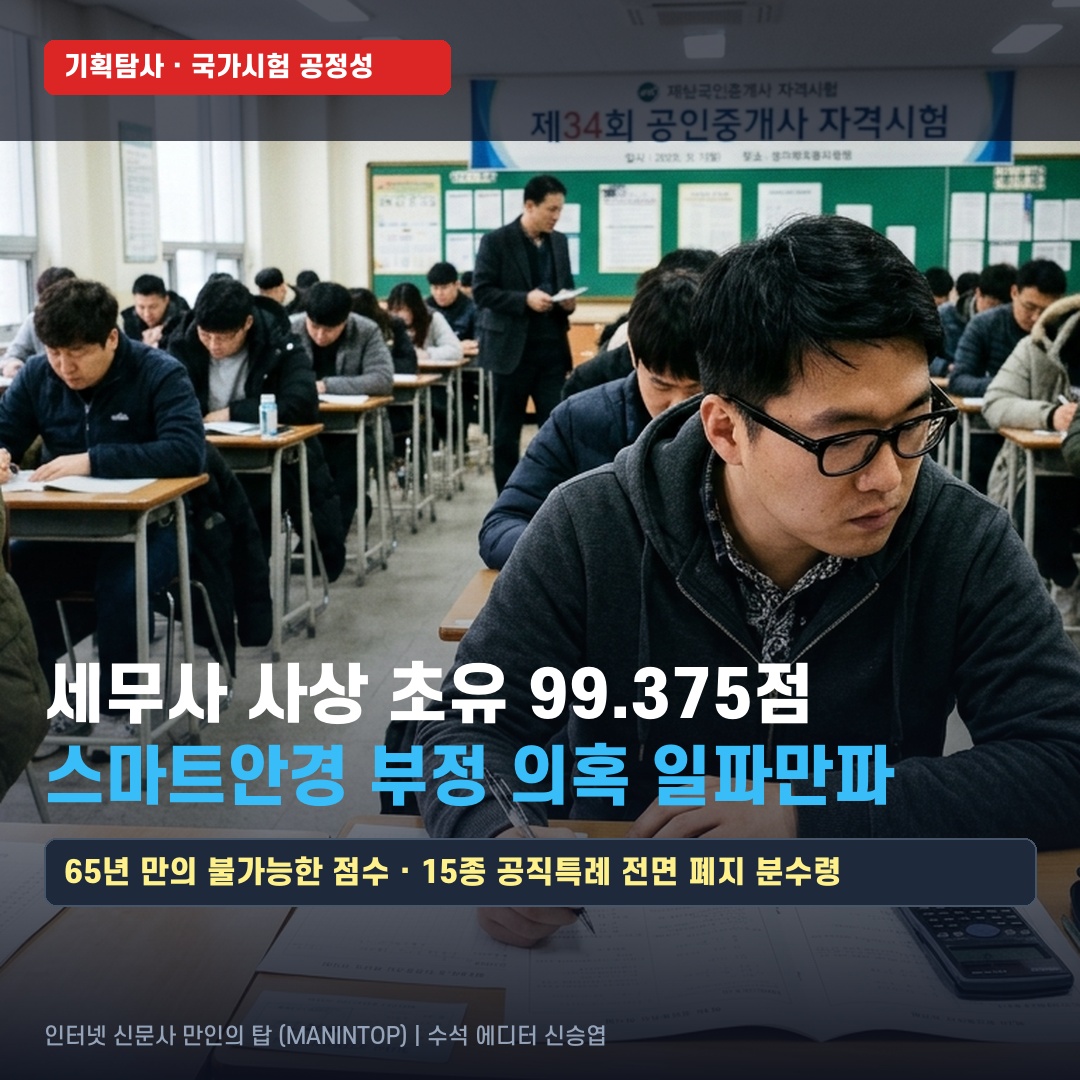
[기획탐사 취재수첩] 청년의 미래를 짓밟는 국가시험의 두 가지 불공정
국가전문자격시험은 매년 수십만 명의 청년 수험생들이 공정한 경쟁을 신뢰하며 청춘을 바쳐 도전하는 사회적 사다리입니다. 그러나 2026년 11월, 사상 초유의 99.375점을 획득한 세무사 수석 합격자의 '인공지능 스마트안경 부정행위 의혹'과 수십 년간 지속된 기득권 세무관료 대상 '공직경력 특례' 문제가 동시에 폭발하며 사회적 신뢰가 송두리째 흔들리고 있습니다. 만인의 탑은 사태의 전말과 구조적 모순, 공정 사회를 향한 개혁 분수령을 심층 추적 보도합니다.
1. 160문항 중 단 1문제 오답… 65년 만의 불가능한 수치와 'AI 안경' 의혹
2026년 11월 한국산업인력공단이 발표한 제63회 세무사 자격시험 최종 합격자 명단이 공개된 직후, 수험가는 유례없는 충격과 분노에 휩싸였습니다. 온라인 수험 커뮤니티에서 활동하던 수석 합격자 한원석 씨가 인증한 성적표는 400점 만점에 397.5점, 평균 99.375점이라는 경악스러운 수치였습니다. 총 160문항 중 재정학 단 1문항을 제외한 나머지 전 과목(세법학개론 100점, 회계학개론 100점, 선택과목 상법 100점)에서 만점을 기록한 것입니다.
세무사 1차 시험은 과목당 40점 이상, 전 과목 평균 60점을 넘기면 통과하는 절대평가 구조로 운영됩니다. 따라서 대다수 수험생과 일타강사들은 지엽적이고 난해한 문제를 과감히 버리고 시간 내 과락을 면하는 실용적 전략을 택합니다. 1961년 세무사 시험이 도입된 이래 65년 동안 역대 최고 수석 점수는 94점대였으며, 통상 수석 성적도 90점대 초반에 형성되어 왔습니다. 특히 이번 시험에서 세법학개론은 응시자 전체 평균이 30.18점에 불과하고 무려 74.21%가 과락으로 탈락한 '역대 최악의 불시험'이었습니다. 당해 차석 합격자조차 80점대에 머문 극악의 시험에서 100점 만점이 나왔다는 사실은 인간의 인지적 한계를 벗어난 수치라는 것이 전문가들의 공통된 지적입니다.
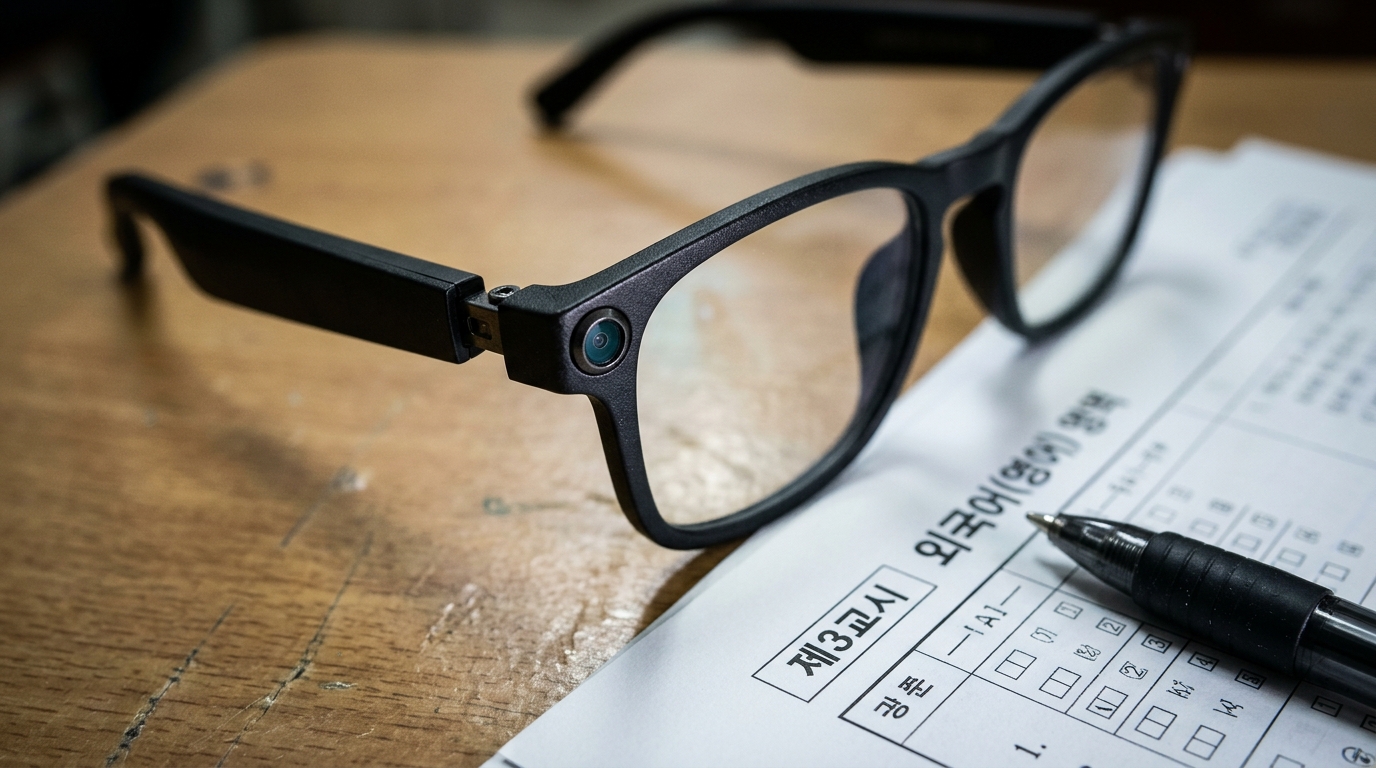
▲ 시중에서 손쉽게 구매 가능한 상용 스마트안경. 안경테 내부에 초소형 렌즈와 디스플레이가 탑재되어 시험지를 촬영하고 외부 인공지능 솔루션으로부터 실시간 정답을 수신하는 신종 부정행위 도구로 악용되고 있다. [사진=만인의 탑 탐사보도팀]
2. 1문항당 50초의 한계와 수석 합격자 이력의 치명적 모순
시간 배분 측면에서도 심각한 물리적 모순이 확인됩니다. 세무사 1차 시험은 교시당 2과목 80문항을 80분 동안 풀어야 합니다. OMR 답안지 마킹 시간 5분을 제외하면 1문항당 주어지는 실질 풀이 시간은 약 50초에 불과합니다. 세법학의 복잡한 법령 조문 해석과 회계학의 다단계 계산 문제를 지문 독해부터 쌀집 계산기 조작, 정답 도출까지 50초 안에 완벽히 끝마쳐 159문항을 맞히는 것은 인간의 뇌 연산 속도로 물리적으로 불가능하다는 것이 현직 회계사·세무사들의 분석입니다.
2018년 제53회 공인회계사(CPA) 수석인 김용재 회계사는 공개 영상에서 "물리적으로 절대 받을 수 없는 점수이며, 초인적인 천재가 아니라면 광학 스마트안경을 활용했을 가능성이 농후하다"고 꼬집었습니다. 여기에 수석 합격자 한 씨가 직접 밝힌 수험 이력도 의혹을 부채질했습니다. 토익 700점 수준인 기초 영어(G-TELP) 시험을 무려 20번이나 치른 끝에 턱걸이로 통과했다고 밝혔음에도, 방대한 법률과 회계 지식이 집약된 본시험을 불과 2년 만에 만점급으로 통과했다는 점, 합격 인증 사진에 공개된 교재가 손때 하나 묻지 않은 새 책 상태였다는 점, 그리고 세무 용어의 기본인 '원천징수'를 '원청징수'로 적는 등 기초적인 맞춤법 오류를 노출한 점이 수험생들의 공분을 샀습니다.
[데이터 대조표] 2026년 제63회 세무사 1차 시험 과목별 성적 분포 및 체감 난이도
| 시험 과목 |
수석 합격자 점수 |
일반 응시자 평균 / 과락률 |
수험가 체감 난이도 및 팩트 평가 |
| 재정학 |
97.5점 (1문항 오답) |
55.4점 / 과락률 24.1% |
40문항 중 39문항 정답, 고난도 미시경제 계산 포함 |
| 세법학개론 |
100점 (만점) |
30.18점 / 과락률 74.21% |
역대 최악의 불시험, 일타강사도 반타작 어려웠던 지엽적 조문 |
| 회계학개론 |
100점 (만점) |
38.62점 / 과락률 52.18% |
다단계 원가회계 등 50초 내 계산 불가능한 복합 연산 다수 |
| 선택과목 (상법) |
100점 (만점) |
61.30점 / 과락률 19.5% |
최신 대법원 판례 장문 지문 해석 완벽 적중 |
| 1차 종합 결과 |
총점 397.5점 (평균 99.375점) |
차석 80점대 / 합격선 60점 |
1961년 시행 이래 65년 만에 사상 초유의 비정상적 점수 |
3. 고사장 CCTV 전무·졸음 감독… 첨단 장비 앞에 무너진 시험 보안망
이번 사태는 기술의 급격한 진화를 전혀 따라가지 못하는 한국산업인력공단의 후진적 시험 관리 실태를 적나라하게 드러냈습니다. 실제로 국회 기후에너지환경노동위원회 김위상 의원(국민의힘)이 제출받은 자료에 따르면, 2026년 공단 주관 국가자격시험에서 발생한 40건의 부정행위 중 스마트안경을 악용한 부정행위가 이미 5건(10월 말 기준 6건)이나 공식 적발된 바 있습니다. 시중의 로키드(Rokid)나 메타(Meta) 스마트안경을 착용하고 시험 도중 렌즈 디스플레이에 푸른빛이 투사되거나 카메라 렌즈가 육안으로 식별되어 덜미를 잡힌 사례들이었습니다.
그러나 세무사 시험 고사장 교실에는 CCTV가 단 한 대도 설치되어 있지 않아 사후 비디오 교차 검증이 원천 차단되었으며, 금속탐지기 전수 검사 지침은 현장에서 전혀 이행되지 않았습니다. 심지어 올해 초 국민신문고를 통해 "스마트안경을 이용한 부정행위 위험이 크니 고사장 반입 통제를 강화해 달라"는 사전 민원이 접수되었음에도, 공단 측은 "아직 상용화되지 않은 기술"이라며 안일하게 일축했던 사실이 밝혀져 행정 방만이라는 거센 비판을 받고 있습니다.
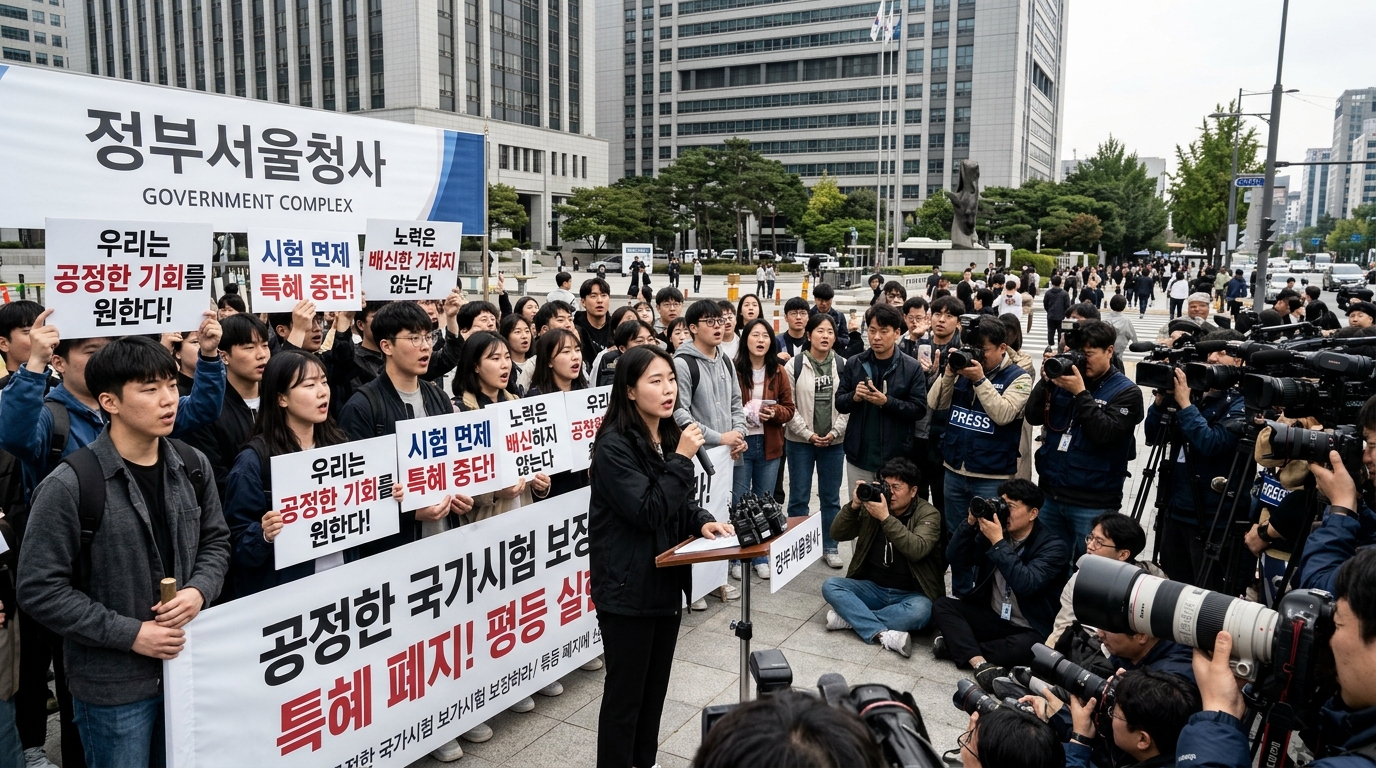
▲ 정부서울청사 앞에서 국가전문자격시험 공직경력 특례 전면 폐지와 공정 경쟁 보장을 촉구하는 청년 수험생과 청년 단체들의 기자회견 현장. [사진=만인의 탑 탐사보도팀]
4. 청년 울린 '공직경력 특례' 65년 잔혹사와 2021년 제58회 대참사
AI 안경 논란이 시험 집행 상의 '기술적 보안 공백'이라면, 수험생들의 가슴속에 내재된 더 거대하고 본질적인 분노는 바로 60년 넘게 이어진 '공직 경력자에 대한 제도적 시험 면제 특혜'입니다. 1961년 도입된 이 제도는 국세청 등에서 일정 기간 근무한 공무원에게 1차 시험 전 과목 면제와 2차 시험 일부 과목(세법학 1·2부) 면제 혜택을 부여해 왔습니다.
이 불공정 제도의 폐해가 극단적으로 폭발한 사건이 바로 2021년 9월 시행된 제58회 세무사 2차 시험 사태였습니다. 당시 출제진은 일반 수험생만 치르는 세법학 1부를 비정상적으로 어렵게 출제하여 일반 응시자 3,962명 중 무려 82.13%(3,254명)를 과락으로 집단 탈락시켰습니다. 반면 세법학을 면제받고 회계학만 응시한 국세청 출신 공무원 합격자는 237명으로 급증하여 전체 합격자의 33.57%를 독식했습니다. 수년간 피땀 흘려 전 과목을 공부해 온 청년 수험생들의 합격권이 제도적 기득권에 의해 통째로 강탈당한 것입니다.
[역대 통계] 세무사 2차 시험 세무공무원 합격 비율 및 일반 수험생 과락률 추이
| 회차 / 연도 |
전체 2차 응시자 |
공무원 합격자 수 (비율) |
일반 수험생 세법학1부 과락률 |
사태 결과 및 주요 쟁점 |
| 54회 (2017년) |
5,305명 |
38명 (6.03%) |
26.5% |
통상적 수준 유지 |
| 55회 (2018년) |
5,331명 |
26명 (4.04%) |
42.2% |
평이한 난이도 |
| 56회 (2019년) |
5,245명 |
72명 (9.93%) |
50.5% |
과락률 상승 조짐 |
| 57회 (2020년) |
5,378명 |
47명 (6.61%) |
30.6% |
안정세 유지 |
| 58회 (2021년) |
4,597명 |
237명 (33.57%) |
82.13% (3,254명 전멸) |
공무원 면제과목 폭탄 출제로 일반 청년 떼탈락, 감사원 감사·헌법소원 |
5. 국민권익위 15종 전면 폐지 의결과 공정 사회를 향한 개혁 분수령
청년들의 피 끓는 호소와 헌법소원에 직면한 국민권익위원회는 2024년 6월 10일 전원위원회 의결을 통해 세무사, 법무사, 관세사, 행정사, 변리사, 공인노무사, 공인회계사 등 15종 국가전문자격시험의 공직경력 특례를 전면 폐지하라고 정부 부처에 공식 권고했습니다. 징계받은 비위 공무원에 대한 특혜 배제와 퇴직 전관 세무사의 1년간 수임 제한도 포함되었습니다. 국민생각함 설문조사 결과 일반 국민의 77%가 특례 폐지에 압도적으로 찬성표를 던졌습니다.
그러나 각 부처 관료들이 퇴임 후 자격 취득이라는 잠정적 기득권을 지키기 위해 법안 제출을 1년 넘게 미루며 조직적 태업을 벌이자, 2026년 8월 대통령이 직접 나서 "청년들이 민감하게 받아들이는 공정의 가치를 바로세워야 한다"며 특례 폐지 권고를 신속히 이행할 것을 재차 지시했습니다. 국무총리실 또한 11월 13일 "AI 안경 부정행위는 공정한 기회를 침해하는 중대한 범죄"로 규정하고 경찰 수사 의뢰와 함께 시험 무효화 및 형사 책임을 묻겠다고 공표했습니다.
첨단 IT 기기를 동원한 지능형 부정행위를 원천 봉쇄할 고사장 감시 시스템 구축과, 수십 년간 청년들의 사다리를 걷어차 온 공직 특례 카르텔의 완전한 해체 없이는 대한민국의 시험 공정성은 회복될 수 없습니다. 공정한 경쟁의 룰을 바로 세우는 일, 그것이 바로 벼랑 끝에 선 청년 수험생들에게 국가가 답해야 할 최소한의 책무입니다.
만인의 탑 탐사보도팀 | 수석 에디터 신승엽 (Seung Youb Ssin)
제보 및 문의: information@youngsdaily.com | 저작권자 © 만인의 탑 무단전재 및 재배포 금지
[Special Investigation Desk] Two Structural Flaws Shattering Korea's Testing Fairness
South Korea's national professional qualification examinations have long served as a vital social ladder for hundreds of thousands of young aspirants who dedicate years of intense study under the promise of fair competition. However, in November 2026, two explosive crises erupted simultaneously: an unprecedented near-perfect score of 99.375 points in the 63rd Certified Public Tax Accountant (CPTA) examination triggering allegations of optical smart glasses cheating, and the intensifying push to completely abolish decades-old special exam exemptions granted to tax bureaucrats. MANINTOP delivers an in-depth investigation into this critical watershed for societal trust and institutional meritocracy.
1. The 99.375-Point Anomaly: A Statistically Impossible Record Sparks Smart Glasses Scandal
Following the official announcement of the 63rd Certified Public Tax Accountant examination results by the Human Resources Development Service of Korea, the testing community was plunged into disbelief. The verified score card shared by top scorer Han Won-seok revealed a staggering total of 397.5 points out of 400, representing an average of 99.375 points. Out of 160 questions, he answered 159 correctly, dropping only a single question in Public Finance while scoring a perfect 100 points in Tax Law Theory, Accounting Principles, and Commercial Law.
The first-stage CPTA examination operates under an absolute grading benchmark where candidates pass by scoring 40 points or higher in each subject and an overall average exceeding 60 points. Because the test involves severe time constraints, candidates and veteran instructors routinely skip excessively obscure questions to avoid failing thresholds. Throughout the 65-year history of the exam established in 1961, top scores typically hovered in the low 90s, with the historical record previously capped at 94 points. Crucially, the 2026 Tax Law Theory section was notoriously brutal, resulting in an examinee average of just 30.18 points and a catastrophic failing rate of 74.21 percent. In a test where the second-place candidate scored in the 80s, achieving a flawless 100 points has been universally described by testing experts as physically and cognitively impossible for a human test-taker.
2. The 50-Second Physical Barrier and Unresolved Background Contradictions
An analysis of physical pacing reveals an insurmountable cognitive barrier. The first stage consists of two 80-minute periods, each covering two subjects and 80 multiple-choice questions. Factoring in five minutes to mark the optical answer sheet, test-takers have approximately 50 seconds per question. Reading dense statutory provisions, executing complex multi-step cost accounting formulas on a manual calculator, and marking the correct answer within 50 seconds for 160 consecutive items exceeds the processing bandwidth of the human brain.
Kim Yong-jae, a former top scorer in the 53rd Certified Public Accountant exam, stated in a public analysis that obtaining such a score without technological assistance is virtually impossible, pointing toward covert optical smart glasses as the most viable explanation. Furthermore, the candidate's personal background added substantial weight to these suspicions: despite requiring 20 attempts to barely pass an elementary English proficiency requirement (G-TELP 65), he claimed to have mastered the vastly more demanding tax curriculum in only two years. Moreover, photographs of his textbooks shared online revealed pristine, untouched pages without notes, accompanied by elementary spelling mistakes in fundamental tax terminology.
[Data Analysis] Score Distribution and Difficulty of the 63rd CPTA Preliminary Examination
| Exam Subject |
Top Scorer Result |
Cohort Average / Failing Rate |
Expert Difficulty Assessment |
| Public Finance |
97.5 (1 incorrect) |
55.4 pts / 24.1% fail rate |
39 out of 40 correct, complex microeconomic formulas included |
| Tax Law Theory |
100 (Perfect) |
30.18 pts / 74.21% fail rate |
Historically brutal test; three-quarters of all candidates eliminated |
| Accounting Principles |
100 (Perfect) |
38.62 pts / 52.18% fail rate |
Multi-step cost calculation items impossible within 50-second window |
| Commercial Law |
100 (Perfect) |
61.30 pts / 19.5% fail rate |
Flawless interpretation of recent extensive Supreme Court precedents |
| Overall Result |
397.5 pts (Avg 99.375) |
Runner-up in 80s / Passing: 60 |
Unprecedented statistical anomaly in 65 years of testing history |
3. Structural Security Lapses: Absence of CCTVs and Negligent Proctoring
The controversy laid bare severe vulnerabilities in national test administration overseen by the Human Resources Development Service of Korea. Official parliamentary records submitted to Representative Kim Wi-sang revealed that out of 40 cheating incidents caught in national technical qualification exams during 2026, five cases (six by late October) involved optical smart glasses, including commercial Rokid and Meta devices equipped with concealed miniature lenses and head-up displays.
Despite these recurring violations, primary testing halls situated in standard secondary schools lacked CCTV monitoring, making retrospective video audits impossible. Metal detector scans were omitted in practice, and proctors reportedly failed to inspect eyeglasses. Earlier in the year, formal public petitions warning of illicit smart glasses usage were dismissed by testing authorities on the complacent premise that such consumer technology was not yet widely commercialized, reflecting administrative negligence in safeguarding testing integrity.
4. Six Decades of Privilege: The 2021 Disaster and Civil Service Exemptions
While covert smart glasses expose technological vulnerabilities, an even deeper sense of public outrage stems from statutory exemptions granted to career bureaucrats. Established under the 1961 Certified Public Tax Accountant Act, civil servants from the National Tax Service with specific career tenures were systematically excused from preliminary testing and key second-stage essay modules.
This structural inequality culminated in the infamous disaster of the 58th CPTA examination in September 2021. Test examiners formulated the Tax Law Theory Module 1—taken exclusively by general candidates—at an impossibly punitive level of difficulty, eliminating 82.13 percent (3,254 students) on automatic failing thresholds. Meanwhile, tax bureaucrats excused from that specific paper surged to claim 33.57 percent (237 seats) of total qualifying certifications, effectively dislodging hundreds of dedicated student candidates who had prepared the full four-paper curriculum.
[Historical Data] Tax Official Pass Ratios and Candidate Elimination Rates (54th to 58th)
| Session / Year |
Total Examinees |
Exempt Bureaucrat Passes (Share) |
General Candidate Fail Rate (Tax Law 1) |
Institutional Outcome |
| 54th (2017) |
5,305 |
38 (6.03%) |
26.5% |
Normalized statistical distribution |
| 55th (2018) |
5,331 |
26 (4.04%) |
42.2% |
Standard variance |
| 56th (2019) |
5,245 |
72 (9.93%) |
50.5% |
Gradual increase in exempt pass rates |
| 57th (2020) |
5,378 |
47 (6.61%) |
30.6% |
Maintained equilibrium |
| 58th (2021) |
4,597 |
237 (33.57%) |
82.13% (3,254 disqualified) |
Severe anomaly triggered Board of Audit inspection and constitutional lawsuits |
5. Abolishing the Exemption Cartel: A Crucial Watershed for Fair Opportunity
In response to nationwide outcry and legal challenges, the Anti-Corruption and Civil Rights Commission adopted a resolution on June 10, 2024, formally recommending the comprehensive abolition of civil service exam exemptions across 15 national professional licenses, including tax accountants, patent attorneys, labor attorneys, judicial scriveners, and public accountants. Public opinion polls conducted on the government civic platform showed overwhelming backing, with 77 percent of citizens demanding total elimination of bureaucratic privileges.
Despite foot-dragging by bureaucratic ministries reluctant to surrender lucrative post-retirement privileges, the President directly intervened in August 2026, ordering relevant ministries to expedite the abolition bills to restore institutional equity. On November 13, the Prime Minister's Office affirmed that illicit technological cheating constitutes a grave crime that sabotages fair opportunity, mandating immediate criminal investigations and the revocation of tainted credentials.
Rebuilding public trust in South Korea's testing infrastructure demands a decisive two-pronged overhaul: deploying advanced RF wave detection to neutralize covert digital surveillance devices, and dismantling the entrenched bureaucratic cartel of special career exemptions. Restoring an uncompromised level playing field is the irreducible duty owed to the nation's young generation.
MANINTOP Investigative Team | Lead Editor Seung Youb Ssin
Newsdesk: information@youngsdaily.com | Copyright © MANINTOP. All rights reserved.