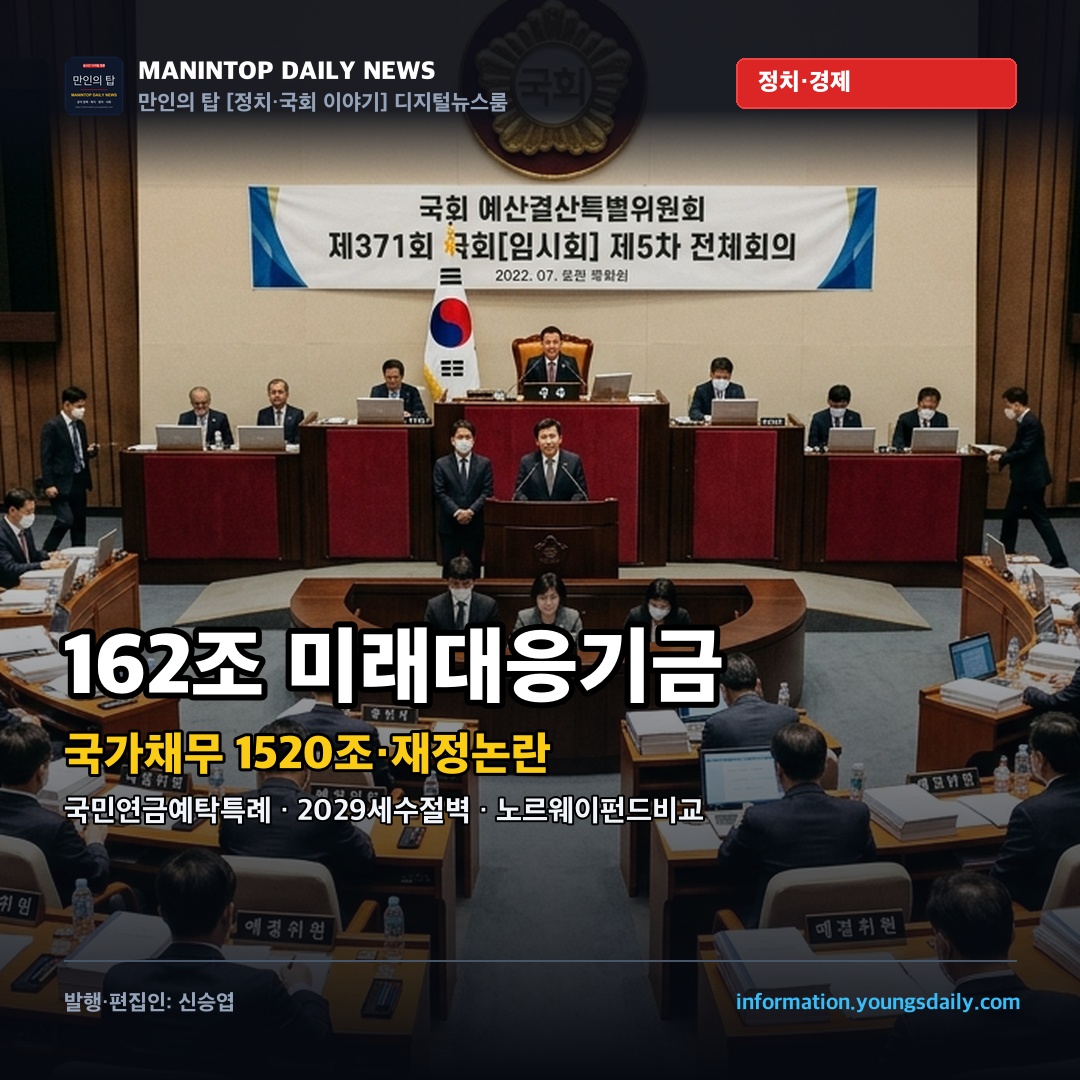
국회 예결위 미래대응기금 162조 원 신설 논란과 재정건전성 총점검: 국가채무 1520조 속 적립의 역설과 국민연금 예탁 쟁점
▲ 국회 예결위 미래대응기금 162조 원 신설 논란과 재정건전성 총점검: 국가채무 1520조 속 적립의 역설과 국민연금 예탁 쟁점 (공식 보도 자료)
📌 핵심 브리핑 · 주요 쟁점 및 핵심 요약

2027년도 정부 예산안의 최대 쟁점으로 떠오른 162조 3,000억 원 규모 미래대응기금은 반도체 호황에 따른 세수 잉여분을 비축하고 미래 성장동력을 키우겠다는 취지로 추진되고 있습니다. 그러나 국가채무가 1,520조 원에 육박하는 상황에서 104조 원을 별도 적립하는 '부채의 역설', 국민연금 여유자금을 끌어다 쓸 수 있도록 길을 터준 예탁 특례, 그리고 국회의 사전 심의권을 무력화할 수 있는 13조 원대 행정 재량권 조항이 드러나면서 정치권과 학계의 공방이 거세지고 있습니다. 나랏빚 상환 우선 원칙과 2029년 세수 절벽 이후의 재정 건전성 대책까지 공인 팩트를 알기 쉽게 총정리합니다.

SPONSORED · ADVERTISEMENT
추진 및 찬성 측 핵심 논리
공정과 상식의 원칙에 따라 실체적 진실을 명명백백하게 규명하고 국민적 의혹을 해소해야 한다는 단호한 입장.
반대 및 비판 측 핵심 논리
정치적 표적 공세이자 국정 흔들기에 불과하며, 법리적 요건을 결여한 정쟁용 정치 쇼에 불과하다는 정면 반박.

1. 162조 미래대응기금 신설 배경과 4대 계정별 재원 배분의 실태

정부가 국회에 제출한 2027년도 예산안은 총 820조 9,000억 원 규모로 전년 대비 12.8% 급증하며 역대 최대 지출 증가율을 기록했습니다. 이 같은 확장재정을 가능하게 한 배경에는 반도체 슈퍼 사이클에 따른 세수 폭증이 자리 잡고 있습니다. 정부는 2027년 국세수입이 584조 4,000억 원으로 전년 본예산 대비 194조 2,000억 원 늘어날 것으로 추산하고, 최근 10년간 내국세 증가 추세선을 웃도는 162조 3,000억 원을 전액 신설 미래대응기금의 재원으로 배정했습니다.

반도체처럼 경기 변동성이 극심한 업종에서 일시적으로 거둬들인 초과 세수를 한 해 예산에 몽땅 써버리면, 나중에 반도체 가격이 급락했을 때 심각한 세수 절벽을 맞이하게 됩니다. 이에 따라 정부는 일시적인 세수 잉여분을 일반회계와 분리해 저수지처럼 비축하고 미래 첨단 성장동력에 집중 투자하겠다는 논리를 펴고 있습니다.

그러나 국회예산정책처의 정밀 분석 결과, 사업비 45조 4,000억 원의 세부 내용에는 상당한 구조적 결함과 중복이 존재하는 것으로 확인되었습니다. 기금의 130개 사업 중 순수 신규 사업은 18조 9,000억 원(41.6%)에 그쳤으며, 나머지 58.4%(26조 5,000억 원)는 기존 일반회계나 다른 기금에서 수행하던 사업을 단순히 옮겨 담거나 쪼갠 것에 불과합니다. 특히 성장동력계정(14.2조), 청년계정(13.3조), 지방계정(10.3조), 교육·인재계정(7.6조) 등 4대 계정은 기존 고용보험기금, 주택도시기금, 지역균형발전특별회계와 광범위하게 겹치면서 불필요한 행정 칸막이만 키웠다는 지적이 나옵니다. 여기에 적립금 104조 4,000억 원 중 무려 94조 원이 구체적 집행 계획 없이 금융기관 예치금이라는 단 한 줄 설명으로 국회에 제출되어 깜깜이 운용 논란을 낳고 있습니다.

현장 보도 및 관련 자료 사진
▲ 국회 상임위 및 정당 지도부 공식 브리핑 현장 자료
🔍 주요 쟁점 팩트체크 및 구조 진단
양측의 주장이 평행선을 달리는 가운데, 핵심 법률 조항과 관련 규정상 수사 및 특검 추진 요건이 충족되는지 여부가 향후 사법·정치적 분수령이 될 전망입니다.

2. 1520조 나랏빚 속 적립의 역설과 통계적 착시 논란

재정학계와 야권이 지적하는 가장 근본적인 문제는 빚을 대규모로 내면서 동시에 저축을 한다는 부채의 역설입니다. 정부의 2027년도 재정계획에 따르면 국가채무는 전년(1,413조 8,000억 원) 대비 약 106조 원 이상 급증하여 1,519조 8,000억 원에 도달할 전망입니다. 정부는 적자국채 순증 규모가 전년 108조 원에서 96조 원으로 축소된다고 설명하지만, 여전히 매년 100조 원에 가까운 빚을 새로 찍어내는 구조입니다.

정부는 국내총생산(GDP) 대비 국가채무비율이 2026년 51.6%에서 2027년 48.3%로 3.3%포인트 낮아진다는 점을 건전재정의 성과로 강조하고 있습니다. 그러나 한국재정정책학회는 이를 두고 국가채무 절대액이 줄어든 것이 아니라, 반도체 가격 급등으로 명목 GDP라는 분모가 일시적으로 부풀어 올라 수치가 개선된 것처럼 보이는 전형적인 통계적 착시라고 진단했습니다. 실제로 국민 세금으로 갚아야 하는 순수 적자성 채무의 비중은 2030년 75.7%까지 치솟으며, 국고채 이자 지출 역시 2026년 30조 원 안팎에서 2030년 최대 53조 3,000억 원으로 폭증하게 됩니다.

박명호 한국재정정책학회장은 미래대응기금에 104조 4,000억 원의 여유자금을 쌓아두지 않고 국채 상환에 우선 투입했다면 국가채무를 16조 원에서 최대 83조 원까지 추가로 줄일 수 있었다고 분석했습니다. 비싼 이자를 물면서 국채를 대규모 발행하는 동시에 다른 한편으로는 저금리 금융기관에 94조 원을 예치하는 것은 국가 재정 운용의 기본 원칙을 저버린 행위라는 비판입니다. 또한 국회예산정책처와 IMF가 추산한 2027년 한국의 산출갭은 각각 1.9%, 1.2%로 잠재 GDP를 웃도는 경기 과열 국면입니다. 경제가 이미 확장적인 상황에서 정부가 12.8%의 초확장재정을 집행하면 물가 상승 압력이 극대화되어 한국은행의 긴축적 통화정책과 정면 충돌할 위험이 높습니다.

구분 및 핵심 영역 한국 미래대응기금 (정부안) 노르웨이 국부펀드 (GPFG) 학계 및 국회 주요 지적 쟁점
적립 전제 및 재정 여건 연 100조 적자국채 발행·국가채무 1,520조 원 육박 상태서 기금 적립 국가채무가 없는 상태에서 발생하는 순수 잉여 재원만 전액 해외 적립 빚내서 저축하는 부채의 역설 발생, 국가재정법상 채무상환 우선 원칙 실종
원금 지출 및 운용 방식 162.3조 원 중 45.4조 원을 첫해부터 직접 사업비로 즉각 소진 원금 절대 불침 원칙, 기대 실질수익률(3%) 이내에서만 정부 예산 이전 2029년 세수 고갈 후 영구 복지 유지를 위한 대규모 적자국채 발행 위험
의회 통제 및 변경 권한 국회 승인 없는 30%(13.6조 원) 자체변경 및 세수결손 무제한 전출 기금 독자 사업 일절 금지, 의회 의결 본예산 단일 통로로만 전액 집행 헌법상 국회 예산 심의권 침해, 예산총계주의 위배 행정 재량권 남용
공적 연기금 예탁 특례 개별 법률에도 불구하고 국민연금 여유자금 강제 예탁 특례 조항 신설 연기금 자금 강제 동원 전면 금지, 독립적 자산운용 원칙 완벽 준수 국민연금 독립성 침해, 최소 확정수익률 미보장 및 노후자금 쌈짓돈 전락
SPONSORED · ADVERTISEMENT
현장 보도 및 관련 자료 사진
▲ 헌법기관 및 사법부 주요 공판·판결 공보 현장 자료

3. 2029년 세수 절벽 예고와 영구적 현금 복지의 덫

미래대응기금이 안고 있는 가장 치명적인 위험 요인은 재원의 일시성과 지출의 영구성·경직성이 정면 충돌한다는 점입니다. 국회예산정책처와 한국조세재정연구원의 중기 세수 추계에 따르면, 반도체 호황에 따른 추가 세수는 2027년 162조 3,000억 원에서 2028년 57조~61조 원대로 급감한 뒤, 2029년부터는 0원으로 완전히 소멸합니다. 정부의 공식 국가재정운용계획에서도 2029년부터 총지출이 총수입을 넘어서는 재정 역전이 시작됩니다.

세수가 3년 뒤 단절될 것이 명백함에도, 기금에는 소득 수준과 무관하게 영구적으로 지급되는 현금성 복지 사업이 대거 편성되었습니다. 총 130개 사업 중 아동수당과 출산장려금에만 3조 6,253억 원이 배정되었습니다. 아동기본수당은 월 10만 원에서 20만 원으로 2배 인상(2조 9,272억 원)되었고, 출산지원금(6,981억 원)은 첫째 1,000만 원, 둘째 1,200만 원, 셋째 1,500만 원으로 상향되었습니다. 여기에 농어촌 기본소득(1조 1,658억 원), 청년문화예술패스(7,925억 원), 청년월세(2,319억 원) 등이 포함되었습니다.

이러한 현금성 지출은 한 번 지급하기 시작하면 수혜자의 반발로 인해 축소하거나 폐지하기가 사실상 불가능합니다. 결국 2029년 추가 세수가 고갈되면 이들 사업을 유지하기 위해 고스란히 일반회계에서 적자국채를 발행해 메워야 하는 구조적 적자의 덫에 빠지게 됩니다. 여기에 대한민국교육감협의회가 5년간 38조 9,257억 원을 미래대응기금에서 보전해 줄 것을 요구하고 소방 재정 지원 2조 원 전용이 추진되는 등, 기금이 정치권과 각 부처의 선심성 쌈짓돈으로 변질되고 있다는 우려가 커지고 있습니다.

4. 국민연금 예탁 특례 논란과 13조 원대 국회 패싱 재량권

금융시장과 국민들에게 가장 큰 파장을 일으킨 대목은 국민연금 등 공적 연기금의 여유자금을 미래대응기금으로 끌어다 쓸 수 있도록 길을 터준 조항입니다. 정부가 제출한 법안 제10조는 특별회계와 기금의 관리주체가 개별 설치 법률의 규정에도 불구하고 여유자금을 미래대응기금 총괄계정에 예탁할 수 있도록 명시했습니다.

현행 국가재정법 제13조는 회계·기금 간 여유재원의 통합 활용을 허용하면서도, 국민연금기금 등 9개 연금·보험성 기금은 가입자의 수급권과 자산 보호를 위해 강제 예탁 대상에서 엄격히 제외하고 있습니다. 그러나 미래대응기금법안은 특례 문구를 삽입함으로써 국민연금기금운용위원회의 독립적 의결이나 보건복지부 장관 승인 등 필수 보호 절차를 무력화하고 정부가 임의로 연금을 차출할 수 있는 법적 근거를 만들었습니다. 더욱이 최소 확정수익률 보장 조항이 전무하고, 예탁받은 자금을 상환 의무가 없는 사업계정으로 넘겨 직접 지출할 수 있어 세수 결손 시 국민 노후 자금의 원리금 회수 위험마저 제기됩니다.

아울러 정부안은 헌법이 규정한 국회의 예산 심의·확정권을 우회할 수 있는 전례 없는 행정 재량권을 담고 있습니다. 현행 국가재정법상 기금의 지출 자체변경 한도는 20%인데, 미래대응기금은 이를 30%로 확대했습니다. 2027년 사업비 45조 4,000억 원을 기준으로 환산하면 무려 13조 6,200억 원에 달하는 예산을 정부가 국회 동의 없이 임의로 전용할 수 있게 됩니다. 나아가 일반회계 세수 결손을 메우는 전출에 대해서는 30% 한도조차 적용하지 않도록 배제했습니다. 국회입법조사처는 초과 세수의 활용이나 세수 결손 보전은 국회의 사전 심의를 거치지 못할 만큼 긴급한 사안이 아니라고 지적하며, 재정민주주의 원칙을 지키기 위해 사전 심의·의결권을 반드시 복원해야 한다고 권고했습니다.


RECOMMENDED STORIES · SPONSORED
발행·편집인: 신승엽
Controversy Surrounding the Establishment of a 162 Trillion Won Future Response Fund in the National Assembly's Budget and Settlement Committee: A Comprehensive Review of Fiscal Soundness Amidst a National Debt of 1,520 Trillion Won and Issues Surrounding National Pension Deposits.
▲ Official Press Coverage & Contextual Archive
GLOBAL EDITION · FACT BRIEFING

Controversy Surrounding the Establishment of a 162 Trillion Won Future Response Fund in the National Assembly's Budget and Settlement Committee: A Comprehensive Review of Fiscal Soundness Amidst a National Debt of 1,520 Trillion Won and Issues Surrounding National Pension Deposits.

The 162.3 trillion won Future Response Fund has emerged as the major issue in the government's budget proposal for 2027. This fund aims to reserve surplus tax revenue generated from the semiconductor boom to foster future growth drivers. However, in a context where national debt is nearing 1,520 trillion won, the paradox of accumulating an additional 104 trillion won in debt, the special provisions allowing the use of surplus funds from the National Pension, and the administrative discretion clause worth approximately 13 trillion won that could undermine the National Assembly's prior review authority have intensified the political and academic debate. This article will clearly summarize the established facts regarding the principle of prioritizing national debt repayment and the measures for fiscal soundness following the anticipated revenue cliff in 2029.

📌 Key Takeaways
  • The National Assembly's Budget and Settlement Committee officially confirms the establishment of a 162 trillion won Future Response Fund.
  • Detailed criteria and support requirements will be fully realized.
  • Official procedures must be confirmed, and submissions must be made within the deadline.

1. Background of the Establishment of the 162 Trillion Won Future Response Fund and the Actual Allocation of Resources by Four Major Accounts

The government's budget proposal for 2027, submitted to the National Assembly, amounts to a total of 820.9 trillion won, marking a 12.8% increase from the previous year and the highest expenditure growth rate on record. This expansionary fiscal policy is primarily driven by a surge in tax revenue due to the semiconductor super cycle. The government estimates that national tax revenue will reach 584.4 trillion won in 2027, an increase of 194.2 trillion won compared to the previous year's budget, and has allocated a total of 162.3 trillion won from this surplus entirely to the newly established Future Response Fund.

If the excess tax revenue collected temporarily from highly volatile sectors like semiconductors is fully spent in a single year's budget, it will lead to a severe revenue cliff when semiconductor prices plummet later. Consequently, the government argues that it will separate temporary tax surpluses from the general account and stockpile them like a reservoir, focusing on investing in future advanced growth drivers.

However, a detailed analysis by the National Assembly Budget Office revealed significant structural flaws and redundancies in the 45.4 trillion won project details. Out of the 130 projects under the fund, only 18.9 trillion won (41.6%) are entirely new initiatives, while the remaining 58.4% (26.5 trillion won) merely involve transferring or splitting existing projects from the general account or other funds. In particular, the four major accounts—Growth Driver Account (14.2 trillion won), Youth Account (13.3 trillion won), Local Account (10.3 trillion won), and Education and Talent Account (7.6 trillion won)—overlap extensively with existing funds such as the Employment Insurance Fund and the Housing and Urban Fund, leading to unnecessary administrative barriers. Additionally, of the 104.4 trillion won in reserves, a staggering 94 trillion won was submitted to the National Assembly with only a vague description as deposits in financial institutions, raising concerns over opaque management practices.

Controversy Surrounding the Establishment of a 162 Trillion Won Future Response Fund in the National Assembly's Budget and Settlement Committee: A Comprehensive Review of Fiscal Soundness Amidst a National Debt of 1,520 Trillion Won and Issues Surrounding National Pension Deposits. press coverage photo
▲ Official Press Archive & Contextual Documentation

2. The Paradox of Accumulation Amidst 1,520 Trillion Won National Debt and Controversy Over Statistical Illusions

The most fundamental issue pointed out by fiscal experts and opposition parties is the paradox of accumulating savings while incurring massive debt. According to the government's fiscal plan for 2027, national debt is expected to surge by over 106 trillion won from the previous year (1,413.8 trillion won) to reach 1,519.8 trillion won. While the government explains that the net increase in deficit bonds will decrease from 108 trillion won to 96 trillion won compared to the previous year, the structure still involves creating nearly 100 trillion won in new debt annually.

The government emphasizes that the national debt-to-GDP ratio will decrease from 51.6% in 2026 to 48.3% in 2027, highlighting this as a sign of sound fiscal management. However, the Korean Fiscal Policy Association has diagnosed this as a typical statistical illusion, noting that the absolute amount of national debt has not decreased; rather, it appears improved due to a temporary inflation of nominal GDP caused by soaring semiconductor prices. In reality, the proportion of pure deficit debt that must be repaid with taxpayer money is projected to soar to 75.7% by 2030, while interest payments on government bonds are expected to explode from around 30 trillion won in 2026 to a maximum of 53.3 trillion won by 2030.

Park Myung-ho, president of the Korean Fiscal Policy Association, analyzed that if the 104.4 trillion won in surplus funds had been prioritized for debt repayment instead of being stockpiled in the Future Response Fund, national debt could have been reduced by an additional 16 trillion to 83 trillion won. Critics argue that issuing government bonds at high interest rates while simultaneously depositing 94 trillion won in low-interest financial institutions violates the fundamental principles of national financial management. Furthermore, the National Assembly Budget Office and the IMF estimate that Korea's output gap in 2027 will be 1.9% and 1.2%, respectively, indicating an overheating economy that exceeds potential GDP. Implementing a highly expansionary budget of 12.8% in an already expansive economic environment could exacerbate inflationary pressures and significantly conflict with the Bank of Korea's tightening monetary policy.

Key Issue Government / Ruling Position Opposition & Critical View Legislative Outlook
Accumulation Premises and Financial Conditions With the issuance of 100 trillion won in deficit bonds and national debt nearing 1,520 trillion won, the fund is being accumulated. Only the pure surplus resources generated in a state without national debt are fully accumulated overseas. The paradox of borrowing to save arises, leading to the disappearance of the principle of prioritizing debt repayment under the National Finance Act.
Principal Expenditure and Management Methods Out of 162.3 trillion won, 45.4 trillion won will be immediately spent on direct project costs from the first year. The absolute principle of not touching the principal, with government budget transfers only within the expected real yield rate (3%). There is a risk of issuing large-scale deficit bonds to maintain permanent welfare after the depletion of tax revenue in 2029.
Parliamentary Control and Amendment Authority 30% (13.6 trillion won) can be changed unilaterally without National Assembly approval, with unlimited transfers for tax revenue shortfalls. Independent projects of the fund are completely prohibited, with all expenditures executed solely through parliamentary approval of the main budget. This infringes upon the National Assembly's constitutional authority to review budgets and constitutes an abuse of administrative discretion, violating the principle of total budget accountability.
Special Provisions for Public Pension Fund Deposits Despite individual laws, a special provision has been established to mandate the deposit of surplus funds from the National Pension. The complete prohibition of forced mobilization of pension fund resources ensures perfect adherence to the principle of independent asset management. There is an infringement on the independence of the National Pension, with no guarantee of a minimum fixed return, reducing retirement funds to mere petty cash.

3. Forecast of a Revenue Cliff in 2029 and the Trap of Permanent Cash Welfare

The most critical risk factor facing the Future Response Fund is the direct conflict between the temporary nature of its resources and the permanence and rigidity of its expenditures. According to medium-term revenue projections by the National Assembly Budget Office and the Korea Institute of Public Finance, additional tax revenue from the semiconductor boom is expected to plummet from 162.3 trillion won in 2027 to between 57 trillion and 61 trillion won in 2028, before completely disappearing to zero starting in 2029. The government's official national financial operation plan also indicates that a fiscal reversal will begin in 2029, where total expenditures will exceed total revenues.

Despite the clear indication that tax revenue will be cut off in three years, the fund has allocated a significant number of cash welfare projects that will be paid permanently regardless of income levels. Among the 130 projects, 3.6253 trillion won has been earmarked for child allowances and childbirth incentives. The basic child allowance has been doubled from 100,000 won to 200,000 won (2.9272 trillion won), and the childbirth support payment (698.1 billion won) has been increased to 10 million won for the first child, 12 million won for the second, and 15 million won for the third. This also includes basic income for rural areas (1.1658 trillion won), youth cultural and arts passes (792.5 billion won), and youth monthly rent support (231.9 billion won).

Once these cash expenditures begin, it becomes virtually impossible to reduce or eliminate them due to backlash from beneficiaries. Ultimately, when the additional tax revenue is depleted in 2029, maintaining these projects will necessitate issuing deficit bonds from the general account, trapping the government in a structural deficit. Additionally, the Korea Association of Superintendents has demanded that 38.9257 trillion won be compensated from the Future Response Fund over five years, and there are moves to divert 2 trillion won for fire service financial support, raising concerns that the fund is being transformed into a political slush fund for various departments.

Controversy Surrounding the Establishment of a 162 Trillion Won Future Response Fund in the National Assembly's Budget and Settlement Committee: A Comprehensive Review of Fiscal Soundness Amidst a National Debt of 1,520 Trillion Won and Issues Surrounding National Pension Deposits. press coverage photo
▲ Institutional Field Data & Media Archive

4. Controversy Over Special Provisions for National Pension Deposits and Discretionary Authority Exceeding 13 Trillion Won Without National Assembly Approval

The most significant impact on financial markets and the public has stemmed from a provision allowing surplus funds from public pension funds, such as the National Pension Service, to be used for the Future Response Fund. Article 10 of the bill submitted by the government specifies that, despite the regulations of individual establishment laws, the managing entities of special accounts and funds can deposit surplus funds into the general account of the Future Response Fund.

Current Article 13 of the National Finance Act permits the integrated use of surplus resources between accounts and funds but strictly excludes nine pension and insurance funds, including the National Pension Fund, from mandatory deposit targets to protect the rights of beneficiaries and their assets. However, the Future Response Fund bill has inserted special provisions that undermine essential protective procedures, such as independent decision-making by the National Pension Fund Management Committee or approval by the Minister of Health and Welfare, thereby creating a legal basis for the government to arbitrarily draw from pension funds. Furthermore, there are no guarantees for minimum fixed returns, and the deposited funds can be transferred to project accounts without repayment obligations, raising concerns about the risk of recovering principal and interest from citizens' retirement funds in the event of revenue shortfalls.

Additionally, the government's proposal contains unprecedented administrative discretion that could bypass the National Assembly's constitutional authority to review and finalize budgets. Under current law, the limit for changing fund expenditures is 20%, but the Future Response Fund has expanded this to 30%. Based on the 2027 project budget of 45.4 trillion won, this allows the government to arbitrarily reallocate as much as 13.62 trillion won without National Assembly consent. Moreover, transfers to cover general account revenue shortfalls are exempt from even the 30% limit. The National Assembly Legislative Research Service has pointed out that the use of excess tax revenue or compensation for revenue shortfalls is not an urgent matter that requires bypassing prior review by the National Assembly, recommending that the right to prior review and approval be restored to uphold the principles of fiscal democracy.

Publisher & Editor-in-Chief: Seung Youb Ssin, Ph.D.
PRO SOURCING ENGINE 만인의 탑 빅데이터 솔루션
★ 가입 시 600 크레딧(120회) 전원 무료

내가 찾는 상품 키워드, 지금 얼마나 검색될까?

네이버 월간 검색량 + 구글 볼륨 + 아이템스카우트 실시간 상품수와 경쟁강도 배지를 0.5초 만에 무료로 확인하세요.